The Capitol Building and Dome

August 26, 2014

From 1793 until today, the Capitol building in Washington, D.C. has been a topic of interest—and has been the subject of several Government publications! The Capitol dome is soon to be covered with scaffolding for two years for a restoration project, so let’s try to uncover some Capitol treasures before that happens.

Proposed scaffolding for Capitol dome restoration Architect of the Capitol

Proposed scaffolding for Capitol dome restoration
Architect of the Capitol

History of the Capitol

Representative Rufus Choate in 1833 came up with this idea: “We have built no national temples but the Capitol; we consult no common oracle but the Constitution.” Do you agree? You’ll find that quote as well as plenty more information about the building in the book History of the United States Capitol: A Chronicle of Design, Construction, and Politics, also known as S. Doc. 106-29 and part of the Congressional Committee Materials collection on GPO’s Federal Digital System (FDsys). If you’re a more down to earth person and want details on the cost of building the Capitol, check out Chapter 10 of H. Doc. 108-240, Glenn Brown’s History of the United States Capitol , also available on FDsys.

Capitol dome/Dome restoration

The Capitol dome is part of what makes it one of the most recognizable buildings in the country—but did you know it is not the first dome that was on the building? The current dome was designed by Thomas U. Walter and built over 150 years ago, from 1855-1866. The first dome was designed by Charles Bulfinch and finished in 1824. The last time the dome was restored was 1959-1960, and the cast iron now has more than 1,000 cracks, so it’s about to get restored in a two-year project.

Capitol in 1834 with Bulfinch dome Library of Congress (http://www.loc.gov/pictures)/item/2002711965/>

Capitol in 1834 with Bulfinch dome
Library of Congress

Capitol artwork

What about inside the building? The National Statuary Hall Collection has two statues from every U.S. state, and H.R. 5711 was introduced in the 111th Congress (2010) to allow U.S. territories to furnish statues for the hall too. Illinois was the first state to send a statue of a woman —educator and reformer Frances E. Willard’s statue was installed in 1905.

Restoring the Dome Architect of the Capitol

Restoring the Dome
Architect of the Capitol

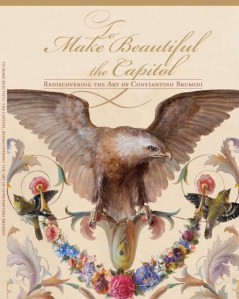
To Make Beautiful the Capitol: Rediscovering the Art of Constantino Brumidi

brumidi-to-make-beautiful-the-capitolThe Capitol also contains striking artwork by Constantino Brumidi. This Italian artist came to the United States when he was almost fifty years old. Brumidi embraced American history and the United States, signing himself “C. Brumidi Artist Citizen of the U.S.” on one of his Capitol frescoes. Read more about Brumidi and his work in To Make Beautiful the Capitol: Rediscovering the Art of Constantino Brumidi, Constantino Brumidi: Artist of the Capitol, or at the Architect of the Capitol’s Web site.

North Brumidi Corridor Architect of the Capitol

North Brumidi Corridor
Architect of the Capitol

Fun facts and more

S.R. 7, 40th Congress, 1867 Library of Congress

S.R. 7, 40th Congress, 1867
Library of Congress

For those who like historical tidbits (and cider), check out joint resolution S.R. 7 from 1867 prohibiting alcoholic beverages in the Capitol . . . or the 2011 hearing on “Nuclear Energy Risk Management” before a House committee which says the granite of the Capitol building means it has “some of the highest radiation levels in all of the United States, about 85 millirem per year.” (But don’t worry, cross-examination reveals that that level is just “normal radiation exposures from natural background.”) And finally, for even more detail, historical facts, and great images, don’t forget to check out the fabulous Web site of the Architect of the Capitol – they are experts on this fascinating building!

HOW DO I OBTAIN THESE PUBLICATIONS?

In addition to clicking on the links in the article above to find the publications, you may find these publications from the following:

Visit a Federal Depository Library: Search for U.S. Government publications in a nearby Federal depository library. You can find the records for most titles in the Catalog of U.S. Government Publications (CGP)

Shop Online Anytime: You can buy these print publications (with FREE Standard Shipping worldwide) from the U.S. Government Online Bookstore website at http://bookstore.gpo.gov:

Order by Phone: You may also order print editions by calling GPO’s  Customer Contact Center Monday through Friday, 8 am to 5:30 pm Eastern (except US Federal holidays). From US and Canada, call toll-free 1.866.512.1800. DC or International customers call +1.202.512.1800.

Shop our Retail Store: Buy a copy of any print editions at GPO’s retail bookstore at 710 North Capitol Street NW, Washington, DC 20401, open Monday–Friday, 9 a.m. to 4 p.m., except Federal holidays, Call (202) 512-0132 for information or to arrange in-store pick-up.

About the author: Lara Otis is an Outreach Librarian for the U.S. Government Printing Office’s Library Services & Content Management (LSCM) Division.


Education Statistical Resources from the Federal Government

August 19, 2014

With the start of a new school year just around the corner, Government Book Talk takes a look at two recently released publications from the Department of Education that examine the latest trends and developments in American education.

The Condition of Education 2013 and the Digest of Education Statistics 2012,which are currently available from the GPO Bookstore, provide important statistical data on the progress of education in the United States.

065-000-01438-6_2The Condition of Education 2013 focuses on 42 indicators in the subject areas of population characteristics, participation in education, elementary and secondary education, and postsecondary education. Each indicator covers important developments and key indicators such as economic outcomes, preprimary education, school characteristics and climate, and finance and resources.

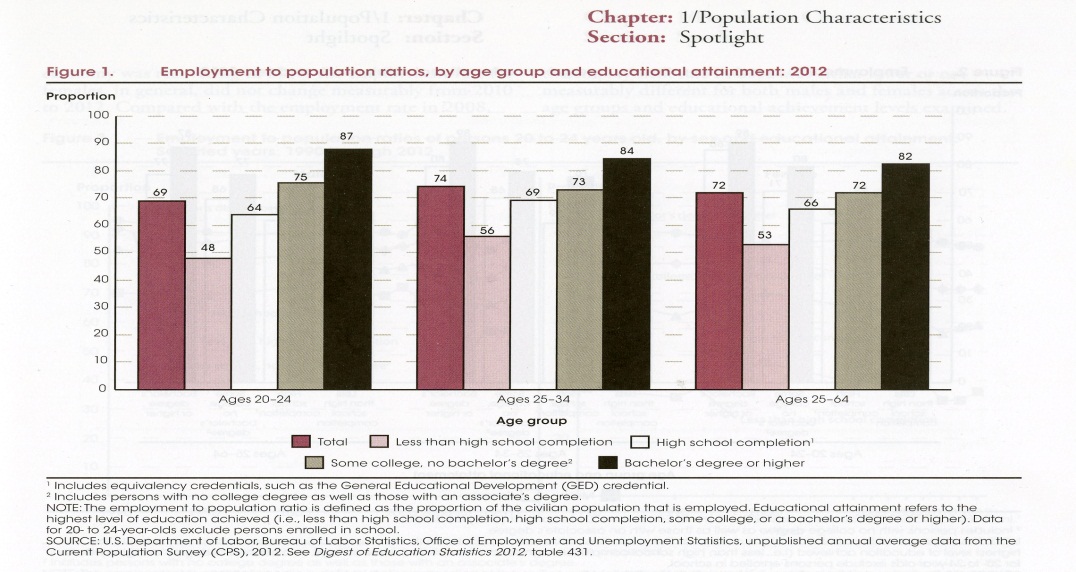
The report also features easy-to-read charts and graphs to illustrate the current trends within each indicator. For example, the chart below from the book illustrates trends in employment rates by age group and education attainment for 2012. According to the chart, in 2012, the employment rate for young adults was 87 percent for those with at least a bachelor’s degree, compared with 75 percent for those whose educational attainment was some college, 64 percent for high school graduates, and 48 percent for those who did not complete high school. Further analysis of the chart points out that older students that did not complete school—those aged 25-34 and 25-64 did slightly better in comparison to their younger counterparts, however, were still employed at a significantly lower rate than those with additional education. (CLICK ON IMAGE TO ENLARGE)

conditions employment chart 2012In addition to trends in employment rates by educational attainment, this year’s report focuses on kindergarten entry status, the status of rural education, and financing postsecondary education in the United States.

065-000-01439-4The Digest of Education Statistics 2012 provides a compilation of statistical information covering the broad field of American education from pre-kindergarten through graduate school. Like the Condition of Education, the data in this annual report was drawn from government and private sources, but especially from surveys and other activities led by NCES (National Center for Education Statistics) part of the Institute for Education Sciences (IES). The digest contains information on the number of schools, students, and teachers, as well as statistics on educational attainment, finances, libraries, technology, and international comparisons. Details on population trends, education attitudes, labor force characteristics, and federal aid supplies helpful background for evaluating the education data.

In addition to updating many of the statistics that have appeared in previous years, this edition contains new material, including:

  • Percentage distribution of 6- to 18-year olds, by parent’s highest level of educational attainment, household type (either two-parent or single-parent), and child’s race/ethnicity (table 12)
  • Enrollment and percentage distribution of enrollment in public elementary and secondary schools, by race/ethnicity and region (table 44)
  • Number and percentage of public school students participating in programs for English language learners, by state (table 47)
  • Children 3 to 21 years old served under Individuals with Disabilities Education Act, Part B, by age group and race/ethnicity (table 49)
  • Percentage of 3-, 4-, and 5-year-old children enrolled in preprimary programs, by attendance status, level of program, and selected child and family characteristics (table 57)
  • Number and enrollment of public elementary and secondary schools that have closed, by school level and type (table 109)
  • Number and percentage distribution of public school students eligible for free or reduced-price lunch, by school level, locale, and student race/ethnicity (table 112)

This statistical reference could be helpful to parents choosing schools for their children as well as for teachers, librarians, and public administrators as it tracks enrollment, population trends and key areas of studies with student progress.

How can I get these publications on education statistics?

Shop Online Anytime: You can buy these and other publications (with FREE Standard Shipping worldwide) from the U.S. Government Online Bookstore website at http://bookstore.gpo.gov:

Shop our Retail Store: Buy a copy of any print editions from this collection at GPO’s retail bookstore at 710 North Capitol Street NW, Washington, DC 20401, open Monday–Friday, 9 a.m. to 4 p.m., except Federal holidays, Call (202) 512-0132 for information or to arrange in-store pick-up.

Order by Phone: Call our Customer Contact Center Monday through Friday, 8 am to 5:30 pm Eastern (except US Federal holidays). From US and Canada, call toll-free 1.866.512.1800. DC or International customers call +1.202.512.1800.

Visit a Federal Depository Library: Search for these in a nearby Federal depository library. You can find the records for most titles in the Catalog of U.S. Government Publications or CGP.

About the author: Trudy Hawkins is a writer and marketing specialist in GPO’s Publication & Information Sales Division supporting the U.S. Government Online Bookstore (http://bookstore.gpo.gov).


Happy Birthday, Medicare!

July 24, 2014

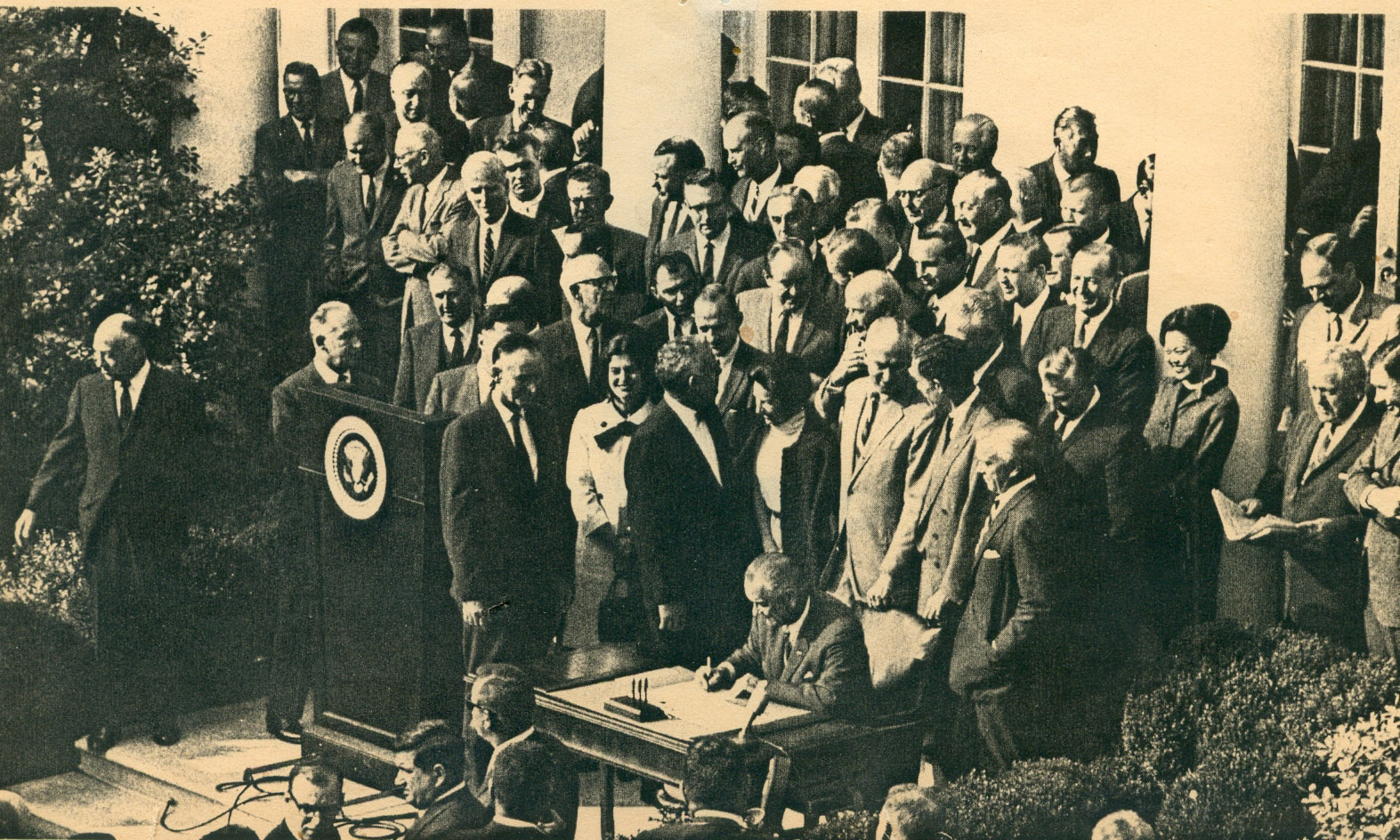
July 30th marks the 49th anniversary of the establishment of the Social Security Act Amendments. In 1965, on this date, President Lyndon B. Johnson signed into law what is better known as the Medicare law. This established both Medicare, the health insurance program for Americans over 65, and Medicaid, the health insurance program for low income Americans. You can read this Public Law in the United States Statutes at Large on GPO’s Federal Digital System (FDsys).

President Lyndon Johnson signs the Medicare Bill. President Harry S. Truman is seated next to him. Others looking on include Lady Bird Johnson, Vice President Hubert Humphrey, and Bess Truman. July 30, 1965. Photo courtesy of Lyndon B. Johnson Presidential Library, U.S. National Archives

President Lyndon Johnson signs the Medicare Bill. President Harry S. Truman is seated next to him. Others looking on include Lady Bird Johnson, Vice President Hubert Humphrey, and Bess Truman. July 30, 1965. Photo courtesy of Lyndon B. Johnson Presidential Library, U.S. National Archives

Former President Harry S. Truman participated in the signing ceremony with President Johnson at the Truman Presidential Library in Independence, Missouri. President Truman’s participation served to recognize his effort during his administration to establish a national health insurance program. President Truman and former first lady, Bess Truman, received Medicare registration cards numbers one and two.

on the occasion of the signing of the Social Security Amendments of 1965 in Independence, Missouri. Photo courtesy of Lyndon B. Johnson Presidential Library, U.S. National Archives

This is the Medicare card believed to have been given to Harry Truman by President Lyndon on the occasion of the signing of the Social Security Amendments of 1965 in Independence, Missouri. Photo courtesy of Lyndon B. Johnson Presidential Library, U.S. National Archives

The 1950 Census showed that the aged population in the U.S. had grown from 3 million in 1900 to 12 million in 1950. The jump was even greater between 1950 and 1963, growing from 12 million to 17.5 million, a large number of whom had no health insurance. It’s no surprise that in the program’s first three years, nearly 20 million beneficiaries enrolled in Medicare.

Fast forward to today, and Medicare provides health insurance to about 50 million Americans. The Centers for Medicare and Medicaid Services (CMS), a division of the U.S. Department of Health and Human Services (HHS), administers the program.

Finding Medicare information and services has never been easier than with www.medicare.gov.

Using the site, users can access a wide array of services. Some examples include:

  • Signing up for Medicare;
  • Modifying Medicare plans;
  • Finding health and drug plans;
  • Learning about different levels of coverage and how to sign up for each, various costs, and supplements and other insurance;
  • Determining if specific tests or services are covered;
  • Filing a complaint, claim, or appeal;
  • Checking the status of any application, claim, or pending action;
  • Finding doctors, providers, hospitals, and suppliers;
  • Accessing forms, resources, and personal assistance;
  • Changing one’s address; and
  • Reporting lost or stolen Medicare cards.

In addition to that, the site offers access to podcasts, videos, and blogs that are not only interesting, but very informative. You can also connect with Medicare via Twitter and YouTube.

The U.S. Government Printing Office (GPO) also provides access to a wide variety of Medicare resources. The U.S. Government Bookstore sells the CMS-1500, the standard health insurance claim form developed by the National Uniform Claim Committee and used by all non-institutional medical providers or suppliers to bill Medicare carriers. It is also used to bill some Medicaid State Agencies.

GPO also provides access to an array of Medicare resources through its Catalog of U.S. Government Publications (CGP), including a collection of free eBooks. Through the CGP, users can access the descriptive catalog record for each publication, as well as a direct link to any publication that available online. Some of the free eBooks available on Medicare topics are:

The CGP and FDsys provide access to a wide variety of other Government documents related to Medicare. Here is just a small sampling:

You can also access countless Federal Government documents related to Medicare at Federal depository libraries nationwide. Find the Federal depository nearest you by visiting the Federal Depository Library Directory.

Happy Birthday, Medicare, and here’s to many more years of helping the American public!

How can I find these Medicare publications?

In addition to clicking on the links in the article above to find the publications, you may find these publications from the following:

And to find popular current Federal publications, you may:

  • Shop Online Anytime: You can buy eBooks as well as print publications (with FREE Standard Shipping worldwide) from the U.S. Government Online Bookstore website at http://bookstore.gpo.gov
  • Order by Phone: You may also Order print editions by calling GPO’s  Customer Contact Center Monday through Friday, 8 am to 5:30 pm Eastern (except US Federal holidays). From US and Canada, call toll-free 1.866.512.1800. DC or International customers call +1.202.512.1800.
  • Shop our Retail Store: Buy a copy of any print editions at GPO’s retail bookstore at 710 North Capitol Street NW, Washington, DC 20401, open Monday–Friday, 9 a.m. to 4 p.m., except Federal holidays, Call (202) 512-0132 for information or to arrange in-store pick-up.

About the author: Our guest blogger is Kelly Seifert, Lead Planning Specialist for GPO’s Library Services & Content Management Division that supports the Federal Depository Library Program.


I’ve got the Whole World in my Hands…

July 15, 2014

World Factbook 2013-14You know you just sang the title of this blog. Now that I have your attention, let me tell you how you can have the whole world in your hands. Pick up the latest edition of The World Factbook 2013-14, currently available from the GPO Bookstore. Jam-packed with a plethora of information, it’s a one-stop reference for everyone from the youngster who has a geography project to a college student researching the economic climate in other countries.


cia logo

The World Factbook is prepared by the Central Intelligence Agency (CIA)

For those of you who are new to the World Factbook, here are a few key facts:

  • It is prepared by the Central Intelligence Agency.
  • The first unclassified version of the Factbook was published in 1971.
  • The 1975 Factbook was the first to be made available to the public with sales through the US Government Printing Office (GPO)
  • In 1981, it officially became The World Factbook.

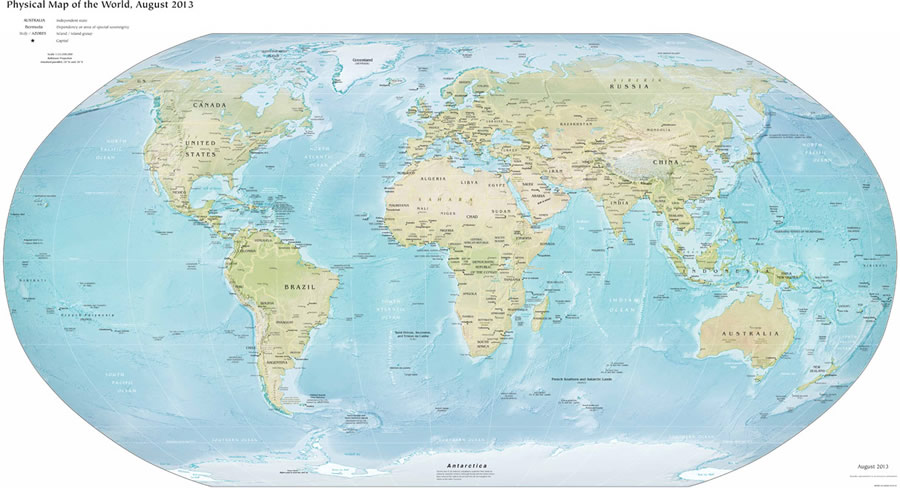
The World Factbook 2013-14 provides the latest statistical facts for 267 countries and regions around world. Each entry begins with a small black and white map of the country or territory. It goes on to give a brief background introduction, the geography, people and society, government, economy, energy, communications, transportation, military, and transnational issues. The publication also contains maps that present the physical features and political boundaries of each nation, as well as, the standard times zones of the world and the official flag of each country.

This image of the Physical Map of the World is one of several maps included the World Factbook

This image of the Physical Map of the World is one of several maps included in the World Factbook.

The World Factbook is filled many interesting facts. For instance, did you know that Russia and Japan have not formally ended World War II? According to the World Factbook, “the sovereignty dispute over the islands of, Etorofu, Kunashiri and Shikotan and the Habomai group, known in Japan as the ‘Northern Territories’ and in Russia as the ‘Southern Kuril islands,’ occupied by the Soviet Union in 1945, now administered by Russia and claimed by Japan, remains the primary sticking point to signing a peace treaty formally ending World War II hostilities.”

Other interesting facts, as well as recent updates to various categories and maps can all be found in the World Factbook 2013-14.

Take a journey into the Factbook to learn what you didn’t know about the world we live in.

HOW DO I OBTAIN THE WORLD FACTBOOK 2013-14?

Shop Online Anytime: You can buy these publications (with FREE Standard Shipping worldwide) from the U.S. Government Online Bookstore website at http://bookstore.gpo.gov:

Order by Phone: You may also Order print editions by calling our Customer Contact Center Monday through Friday, 8 am to 5:30 pm Eastern (except US Federal holidays). From US and Canada, call toll-free 1.866.512.1800. DC or International customers call +1.202.512.1800.

Shop our Retail Store:Buy a copy of any print editions from this collection at GPO’s retail bookstore at 710 North Capitol Street NW, Washington, DC 20401, open Monday–Friday, 9 a.m. to 4 p.m., except Federal holidays, Call (202) 512-0132 for information or to arrange in-store pick-up.

Visit a Federal Depository Library:Search for U.S. Government publications in a nearby Federal depository library. You can find the records for most titles in the Catalog of U.S. Government Publications or CGP.

About the author: Faith Johnson is an Outreach and Support Librarian for the U.S. Government Printing Office’s Library Services & Content Management division.

Additional content, images and editing provided by Trudy Hawkins, a writer and marketing specialist in GPO’s Publication & Information Sales Division supporting the U.S. Government Online Bookstore (http://bookstore.gpo.gov).


Notable Government Documents 2013 – Winners

June 27, 2014

ALA Notable Government Documents 2013Each year, the American Library Association’s (ALA) GODORT Notable Documents Panel selects what it considers to be the most “Notable Government Documents” published during the previous year by Federal, state, and local governments and includes the list of winners in its prestigious Library Journal (LJ). Typically, many of the Federal publications it picks are available through the Government Printing Office’s U.S. Government Online Bookstore.

Library Journal LogoKnown as “the most trusted and respected publication for the library community,” LJ provides groundbreaking features and analytical news reports covering technology, management, policy and other professional concerns to public, academic and institutional libraries. Its hefty reviews sections evaluate 8000+ reviews annually of books, ebooks, audiobooks, videos/DVDs, databases, systems and websites.

According to LJ, “This year’s list of notable documents includes titles on cultural heritage, globalism, diversity and gender equality, lifelong learning, and the environment.” Here are Federal Government documents available through GPO that were selected as Most Notable for 2013.

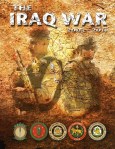
The Iraq War 2003-2011The Iraq War 2003-2011 “Focusing entirely on the self-sacrifice of military personnel and not on the politics, this chronology tells its story primarily through color photographs and minimal text. Emphasizing the successes of the coalition forces, it centers on medal of honor winners, the wounded, and the dead.” – LJ

A Sense of Place Design Guidelines for Yosemite National ParkA Sense of Place: Design Guidelines for Yosemite National Park “Revised and expanded from the 2004 edition, this history of development in ¬Yosemite covers up to the present. With maps and historical images, the authors attempt to influence the design ethic of future park developers and establish guidelines so that successive plans are compatible with the rhythms and spirit of Yosemite’s landscape and scenery.” – LJ

You Cannot Surge TrustYou Cannot Surge Trust: Combined Naval Operations of the Royal Australian Navy, Canadian Navy, Royal Navy, and United States Navy, 1991-2003 “The premise of this investigation is that the U.S. military can no longer act alone as the world’s only superpower. Within the context of a general history of the role of naval power in defense policy development and using examples dating back to the Revolutionary War, Weir outlines the increasing dependence nations have on one another and argues that conflicts between partners caused by varying rules of engagement can be overcome.” – LJ

The Warren Commission ReportThe Warren Commission Report: The Official Report on the Assassination of President John F. Kennedy “Rereleased on the 50th anniversary of the Kennedy assassination, this is the online pdf version of the Warren Commission Report Summary, which condenses the contents of the 26 hearings and evidence volumes. Reproductions of forensic photos, police reports, physicians’ notes, coroners’ reports, and verbatim extracts of graphic witness testimony supplement the story of that tragic day in Dallas in 1963.” – LJ

Congratulations to the publishers of these deserving award winning publications!

How can you get these publications from this year’s Federal Notable Government Documents collection?

Shop Online Anytime: You can buy these and other publications (with FREE Standard Shipping worldwide) from the U.S. Government Online Bookstore website at http://bookstore.gpo.gov:

Shop our retail bookstore at 710 North Capitol Street NW, Washington, DC 20401, open Monday-Friday, 9am to 4pm, except Federal holidays, (202) 512-0132.

Order by Phone: Call our Customer Contact Center Monday through Friday, 8 am to 5:30 pm Eastern (except US Federal holidays). From US and Canada, call toll-free 1.866.512.1800. DC or International customers call +1.202.512.1800.

Visit a Federal Depository Library: Search for U.S. Government publications in a nearby Federal depository library. You can find the records for most titles in the Catalog of U.S. Government Publications or CGP.

About the author: Trudy Hawkins is a writer and marketing specialist in GPO’s Publication & Information Sales Division supporting the U.S. Government Online Bookstore (http://bookstore.gpo.gov).


Federal Resources for Food and Nutrition Planning

June 11, 2014

News concerning the debate over changes to the School Lunch Program has brought the topic of child nutrition and health to the forefront, in recent weeks. As government and school officials debate this important topic, Government Book Talk takes a look at the Food and Nutrition Information Center Resources CD-ROM currently available from the GPO Online Bookstore.

Resource Lists CD-ROMThe Food and Nutrition Information Center Resources CD-ROM from the U.S. Department of Agriculture (USDA), Food and Nutrition Information Center (FNIC) contains a plethora of useful information related to various food and nutrition programs, such as the National School Lunch Program. It particularly offers guidance to help nutrition professionals and consumers locate information and materials on specific food and nutrition topics, such as Child Nutrition and Health, Food and Nutrition Education, School Food Service, and much more. Compiled by Nutrition Information Specialists, these Resource Lists provide resources in a variety of formats including articles, pamphlets, books, audio-visuals, and Web links.

This resource list excerpt from 2008 for educators provides resource information on cultural and ethnic food nutrition.

This resource list excerpt from 2008 for educators provides resource information on cultural and ethnic food nutrition.

The vast information contained on this CD-ROM from the National Agriculture Library collection will prove to be a great resource for parents, educators, school food service professionals and child care providers. Child Nutrition Programs including before/after school and children’s summer municipal camp programs will also benefit from these resource lists for nutritional guidance and food planning for their summer and new school year child nutrition initiatives.

The FNIC website contains over 2500 links to current and reliable nutrition information.

The FNIC website contains over 2500 links to current and reliable nutrition information.

About the FNIC

According to its website, the FNIC is a leader in food and human nutrition information. Located at the National Agricultural Library (NAL) of USDA, the FNIC provides credible, accurate, and practical resources for nutrition and health professionals, educators, government personnel and consumers. To learn more about the FNIC and its various resource lists topics visit the FNIC website.

In addition to the Food and Nutrition Information Center Resources CD-ROM, the USDA has published the following print publication focusing on nutrition and diet, which is also available from the U.S. Government Bookstore.Dietary Guidelines for Americans

The Dietary Guidelines for Americans, 2010 offers advice regarding nutrition to promote health and to reduce risk for major chronic diseases through diet and physical activity. The publication is oriented toward policymakers, nutrition educators, nutritionists, and healthcare providers. It summarizes and synthesizes knowledge regarding individual nutrients and food components into recommendations for a pattern of eating that can be adopted by the public. Key Recommendations listed by chapter include: Balancing Calories to Manage Weight; Foods and Food Components to Reduce; Foods and Nutrients to Increase; Building Healthy Eating Patterns; and Helping Americans Make Healthy Choices. It also explains the new food plate which replaced the food pyramid.

How can I get these federal resources on Food and Nutrition Planning?

Shop Online Anytime: You can buy these and other publications (with FREE Standard Shipping worldwide) from the U.S. Government Online Bookstore website at http://bookstore.gpo.gov:

Shop our retail bookstore at 710 North Capitol Street NW, Washington, DC 20401, open Monday-Friday, 9am to 4pm, except Federal holidays, (202) 512-0132.

Order by Phone: Call our Customer Contact Center Monday through Friday, 8 am to 5:30 pm Eastern (except US Federal holidays). From US and Canada, call toll-free 1.866.512.1800. DC or International customers call +1.202.512.1800.

Visit a Federal Depository Library: Search for U.S. Government publications in a nearby Federal depository library. You can find the records for most titles in the Catalog of U.S. Government Publications or CGP.

About the author: Trudy Hawkins is a writer and marketing specialist in GPO’s Publication & Information Sales Division supporting the U.S. Government Online Bookstore (http://bookstore.gpo.gov).


Designing a Nation: Civic Art in the Nation’s Capital

April 17, 2014

The U.S. Capitol and National Mall are a beautiful representation of the dignity and public spirit of the United States of America. This area is steeped in history, and you can learn more about the past and continued efforts to design, build, and preserve the U.S. Capitol and National Mall through many government publications.

Brumidi-To-Make-Beautiful-the-CapitolWith its famous dome celebrating its 150th anniversary in December 2013, the United States Capitol is a treasure-trove of civic art. Just released, To Make Beautiful the Capitol: Rediscovering the Art of Constantino Brumidi gives a detailed history of renowned Italian-born artist Constantino Brumidi’s masterful work in “making beautiful” the walls and ceilings of the United States Capitol in a span of 25 years starting in 1854. Every page delights with gorgeous, full-color photographs and images of Brumidi’s art, from photographs of the frescoes and decoration, to sketches, paintings and images of the artist, particularly the Brumidi Corridors and his “monumental fresco” in the Capitol Rotunda, called The Apotheosis of Washington. Fascinating anecdotes are included throughout of the artist and the inspirations he received for various elements, his relationship with engineer Montgomery C. Meigs, and the conservation efforts to preserve his work accurately for posterity. Read more about this publication and others about art in the Capitol in our prior blog post, National Treasure: The art and architecture of the US Capitol.

The primary oversight board for projects in the National Mall area is the U.S. Commission of Fine Arts, which was established by an act of Congress on May 17, 1910 in Public Law 61-181. This commission was created as an independent review agency for the work of designing the national capitol and to guide the architectural development of Washington. The commission’s role was expanded with later passage of the Shipstead-Luce Act of 1930 (Public Law 71-231 and Public Law 76-248), and the Old Georgetown Act of 1950 (Public Law 81-808). The U.S. Commission of Fine Arts has a long history of guiding the development of the nation’s capital. Several resources are available in print and online to learn more about the commission’s history.

The National Park Service maintains a detailed guide linking to documents and reports that detail the area history. The Mall Cultural Landscape Inventory, part 2 contains several pages describing the history of the Senate Park Commission and its formation into the U.S. Commission of Fine Arts.

Designing-the-nations-capitalThe U.S. Commission of Fine Arts published a monograph in 2006; Designing the nation’s capital: the 1901 plan for Washington D.C. This 359 page monograph contains illustrations in color and black and white, as well as maps. The National Park Service provides full text access to this title online.

In addition to this title, several editions of this history of the U.S. Commission of Fine Arts from 1910 to date were published in 1964, 1977, 1981, 1985, 1991, and 1996.

Civic Art : a centennial history of the U.S. Commission of Fine ArtsThe most recent addition to the volumes available about the history of the commission is celebrates 100 years of the work of the commission. Civic Art : a centennial history of the U.S. Commission of Fine Arts is a beautiful, 626 page monograph with illustrations, maps and plans. It is a comprehensive history of the agency and includes original essays by prominent architects and landscape architects including Arleyn Levee, Carroll William Westfall, and Richard Guy Wilson.

A Botanic Garden for the Nation: The United States Botanic GardenAnother beautiful book that features some of the history of the national mall area is A Botanic Garden for the Nation: The United States Botanic Garden. You can read more about this publication in a previous post on Government Book Talk.

For more information about the U.S. Capital building, you can also check out the publications highlighted in the previous Government Book Talk post on the 150th anniversary of the completion of the Capital Dome.

America’s Castle: the evolution of the Smithsonian Building and its institution, 1840-1878To read more about the history of the Smithsonian, you could visit a depository library and check out the publication, America’s Castle: the evolution of the Smithsonian Building and its institution, 1840-1878.

If you are interested in the official records of the commission, you can locate them at the National Archives. The record collection includes administrative history, annual reports, and a selection of still photographs. The records are divided between College Park, MD and Washington DC. Many of the records pertaining to the building and continued development of the National Mall are available at the National Archives, such as the National Park Service Records for the National Capital Region, and the Records of the Office of Public Buildings and Public Parks of the National Capital.

How Can I get this book and other publications about history of the U.S. Commission of Fine Arts?

About the author: Our guest blogger is Cathy Wagner, a GPO Outreach Librarian for the U.S. Government Printing Office’s Library Services & Content Management (LSCM) Division. Additional content, images and editing provided by Trudy Hawkins, a writer and marketing specialist in GPO’s Publication & Information Sales Division supporting the U.S. Government Online Bookstore (http://bookstore.gpo.gov).


Stop Me If You’ve Heard This One… a Top Ten List of Funny Federal Titles

April 1, 2014

A few weeks ago, Jennifer Davis’ supervisor delivered a challenge to her via email: write a story about humorous government document titles for April Fool’s Day. (Read various stories about the origins of April Fool’s Day here, here and here.) April Fool’s humor has had a long history with American Government, dating back to Founding Father Benjamin Franklin (read caption below).
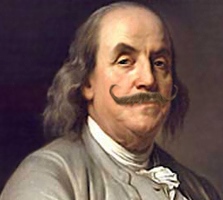
Benjamin Franklin wearing an ostentatious fake moustache for April Fool's Day

According to news humor site “Weekly World News”, the American founding father of April Fool’s Day was Benjamin Franklin. Since Franklin, April 1st has been synonymous in America for a day of practical jokes and general mischief. Tales of his exploits were published in the Philadelphia Gazette on the 1st of April every year. For example, says the site, he was known to give entire public speeches on April 1 wearing an ostentatious fake moustache. 😉 Can you believe it? (Image courtesy of Weekly World News.)- M. Bartram

Says Jennifer: “I love reading government documents for their data and their fascinating stories, but I usually wouldn’t consider them to be laugh-out-loud funny. Or as a colleague said, “They’re not Abbott and Costello funny”. But everyone’s got to laugh some time, right? And when I searched GPO’s Catalog of U.S. Government Publications (CGP), and picked my colleagues’ brains, I found that Uncle Sam sometimes gets his chuckles, too. I found more titles than these ten—but I want to save some for another occasion. There have been a few other lists of humorous government documents, not all of them Federal titles, circulating around the Internet, and so I’ve tried to keep this list as unique as possible.”

(If you like the topic of this column, you should visit the Washington State University’s exhibit, The Lighter Side of…. The Government Printing Office, which runs through June 28, 2014.)

[Michele Bartram Editor’s Note: Over the years, Government Book Talk has also highlighted some funny Federal publication titles within previous blog posts including: Society through a Comic Lens, The Nuttall Tick CatalogueDr. Seuss, U.S. Army, Sprocket Man!War Games, and Ponzimonium. You’ll chuckle over the odd, quirky, ironic or inadvertently funny titles of the books mentioned!]

All of these titles in this blog post have records in GPO’s Catalog of U.S. Government Publications, and you might be able to find a copy in your local Federal depository library, or find one at your regional library. Click here for a list of Federal Depository Libraries (the Federal Depository Library Directory or FDLD). Since many of these Government documents —books, posters, pamphlets and PDFs— are older than five years, you might have to search a bit to find a copy. When available, we have provided links for the electronic version of these titles.

Below is the list of Top 10 funniest titles that Jennifer provided, along with additional details about each.

TOP 10 FUNNIEST TITLES

Gobbledygook_has-gotta-go_green-cover1) Gobbledygook has Gotta Go. This Bureau of Land Management title about the problems with Government writing is a classic, and a precursor to the “Plain Language” initiative today to simplify the wording in communications. It has been cited in several collected lists of funny titles, and it’s the only time I cheated and included it in my list anyway.  Gobbledygook is just such a great word to say, and the alliteration makes the title even funnier. You can read a scanned copy of this book here.

2) Preparedness 101: Zombie Pandemic. All of our GPO office mates agree: this comic has got to be the most fun Federal government document to date.  The CDC was smart and exploited the current interest in zombies, and made an emergency preparedness checklist into a comic on preparing for the “zombie pandemic”. In this comic, the scientists of the CDC are the superheroes, isolating the virus “Z5N1” and developing a vaccine in record time, while the locals develop a checklist of emergency supplies so they can stay inside their home. Just the title alone is enough to make you smile—and it gets its point across. You can read the entire publication online here.

cdc-preparedness-101-zombie-pandemic

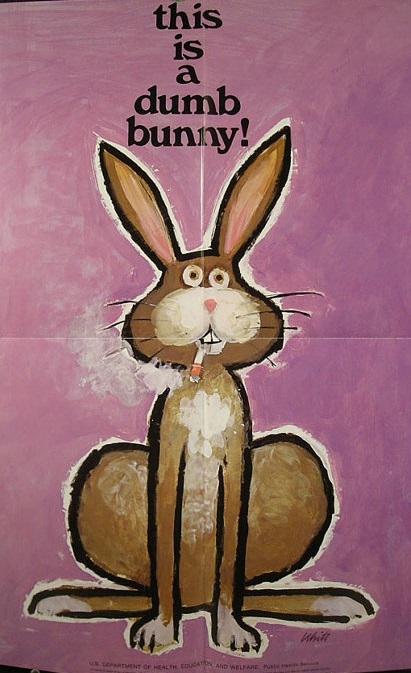
3) This is a Dumb Bunny. I love the idea of the Federal government calling someone a “dumb bunny”. Even if the document it is quite literally the image of a rabbit, which spoils some of the fun, I am still tickled by the idea of a snarky Uncle Sam. The poster’s actually about smoking cessation.

"This is a dumb bunny!" anti-smoking 1970s poster from the U.S. Department of Health, Education and Welfare

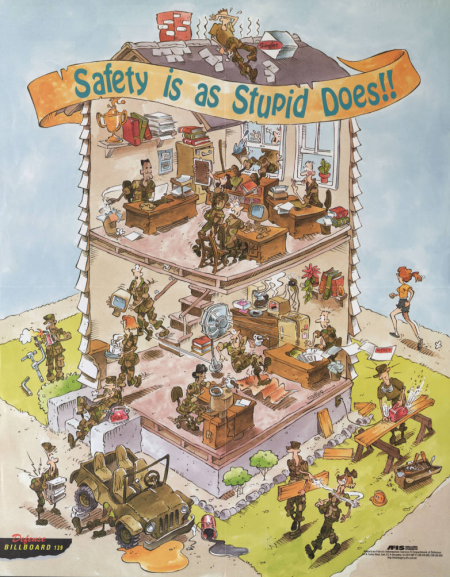
4) Safety is as Stupid Does!!  I know what the goal was with this title. The poster (seen on the University of Iowa Digital Library) makes it clear to the intended audience of military personnel that not thinking hurts safety on the job. However, I think the title missed the mark. It’s funny in its own right.
Safety-is-as-stupid-does_DOD-poster

5) Do Mandrakes Really Scream?  A colleague of mine is a huge Harry Potter fan. She said cataloging this title was the pinnacle of her career. It’s the online exhibition catalog of an National Library of Medicine (NLM) History of Medicine exhibit relating NLM’s historical holdings and the magic and medicine of Harry Potter.

If you read the Harry Potter series, you’ll know what the title is referring to. If you haven’t read the series, check out this free exhibit first; you might find yourself diving into the book series afterwards.

National Library of Medicine NLM "Do Mandrakes Really Scream? Magic and Medicine in Harry Potter" website

6) USDA Saves French Donkey.  The title of this mid-1980s US Department of Agriculture publication just speaks for itself.

[Editor’s note: Probably the publication refers to this 1985 story reported in the Los Angeles Times about a rare 7-month-old curly haired French Poitou donkey named Sonette at the San Diego Zoo: Rare Donkey Passes Test, Can Stay Here”]

French Poitou donkey has dreadlocks that need a haircut

The rare French Baudet du Poitou donkey breed is born with curly hair that naturally grows into long dreadlocks as an adult. This one hasn’t had a haircut in 17 years! (Source: The Telegraph – UK)

7) Self-Motion Perception and Motion Sickness: Final Report for the Project  NASA’s report on a motion sickness project makes me want to just… stop… moving! Read about it on NASA’s website.

NASA-astronauts-with-motion-sicknessAbove: NASA astronauts in zero gravity try to fend off the effects of motion sickness.  To learn more about motion sickness, watch this 3-minute TED Talk animated video about “The Mystery of Motion Sickness.”
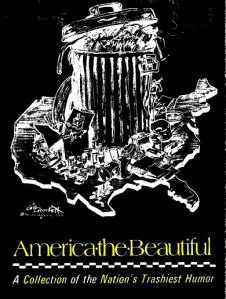
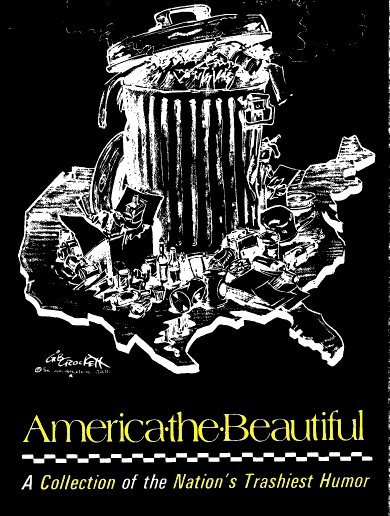
America the Beautiful: A Collection of the Nation's Trashiest Humor with comic strips about solid waste or trash8) America the Beautiful: Collection of the Nation’s Trashiest Humor. Not only is the title funny, but the book’s content promises humor as well. This is publication number 2048 of The U.S. Department of Health, Education, and Welfare, originally published in 1970. The book consists of thirty comics, from the funny pages like B.C., and some from the editorial pages of publications from the New Yorker to the Cleveland Plain Dealer, all focusing on the problem of waste disposal. You can read the publication in its entirety online at the EPA’s website.

9) French Meadows: Hell Hole Recreation Areas. Although the area is really quite lovely, there’s a problem with image marketing in this U.S. Forest Service tourism brochure.

French-Meadows-Hell-Hole-Reservoir

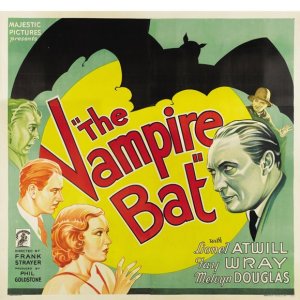
Poster for The Vampire Bat movie starring Fay Wray10) Controlling Vampire Bats.  This serious US Agency for International Development publication about controlling the spread of rabies through these creatures nevertheless evokes shades of Tippi Hedren… Don’t you get a mental picture of people running down the street away from the bats, waving their arms over their heads and screaming, à la The Birds? Or Fay Wray being controlled by an evil vampire in bat form in the movie “The Vampire Bat” (movie poster image at the right)? Maybe I’ve read too many zombie comics.

How can I find these funny-titled Federal publications?

In addition to clicking on the links in the article above to find the publications, you may find these publications from the following:

  • Visit a Federal Depository Library: Search for U.S. Government publications in a nearby Federal depository library.
  • Visit a Public Library: Ask your local public librarian about Federal Government books available to check out as well as Federal eBooks that may be available for library patrons to digitally download through the library’s Overdrive subscription.

And to find popular current Federal publications, you may:

  • Shop Online Anytime: You can buy eBooks as well as print publications (with FREE Standard Shipping worldwide) from the U.S. Government Online Bookstore website at http://bookstore.gpo.gov
  • Order by Phone: You may also Order print editions by calling GPO’s  Customer Contact Center Monday through Friday, 8 am to 5:30 pm Eastern (except US Federal holidays). From US and Canada, call toll-free 1.866.512.1800. DC or International customers call +1.202.512.1800.
  • Shop our Retail Store: Buy a copy of any print editions at GPO’s retail bookstore at 710 North Capitol Street NW, Washington, DC 20401, open Monday–Friday, 9 a.m. to 4 p.m., except Federal holidays, Call (202) 512-0132 for information or to arrange in-store pick-up.

About the author: Adapted and expanded by Michele Bartram, Government Book Talk Editor and Promotions Manager for GPO’s Publication and Information Sales Division in Washington, DC, from an original post by Jennifer K. Davis, formerly from GPO’s Library Services & Content Management Division that supports the Federal Depository Libraries Program (FDLP).

Have a fun and funny April Fool’s Day!


Get to the Olympics with Help from these Free U.S. Government Resources

February 21, 2014

Guest blogger and GPO Supervisory Librarian Valerie Furino writes about U.S. Government publications that can help you achieve your Olympic ambitions.

The 2014 Sochi Winter Olympics are wrapping up, and they have been entertaining and full of surprises.  Many people watch the Olympics and dream of the magical moment of being awarded a medal (preferably gold).   However, that dreamy medal was earned through years of training and preparation.  If you want to give living the life of an Olympian a try, you’ll need to work hard.  You need to eat like an athlete – you need to train like an athlete – and you’ll actually need to GET to the Olympics – grab that suitcase!  Think you’ve got what it takes?  Let’s find out.

us-olympic-training-center-signImage: Tourists enjoying the Olympic Rings sign at the Headquarters for the U.S. Olympic Committee administration and the Olympic Training Center programs in Colorado Springs, Colorado.

Get into Competition Shape

First, let’s examine eating habits.  This should be easy – athletes are known for devouring lots of calories.  This handy chart illustrates typical calories burned, depending on a person’s weight – note that the Olympic sports ice hockey, ice skating, and skiing are all included.  (If all the activities on this chart were Olympic sports, I’d be a gold medalist shoo-in for “Operate Snow Blower” after this winter!)  However, you need to eat the right kind of calories.  You’ll need fuel to power you through those salchows and Axel jumps. Nutrition.gov provides a great starting place on various nutrition topics, including meal planning, label reading, and dietary supplements.

ChooseMyPlate_gov_Winter-Health-ChallengeImage: Winter Health Challenge from ChooseMyPlate.gov (February 2014).

Que hay en su plato- Spanish version of What's on My Plate from ChooseMyPlateFrom there, you can navigate to ChooseMyPlate.gov (or buy the What’s on Your Plate?: Choose My Plate -English Language Version or the Spanish language version, Que Hay en Su Plato?: Mi Plato) which contains helpful advice on what to eat.  No matter your circumstance – college student, vegetarian, pregnant – you’ll find great tips on nutrition and some helpful recipes.

OK, nutritional standards have been established.  Now let’s move on to physical training.  Depending on your sport preference, you’ll need to exercise specific muscles – for example, cross-country skiing requires a well-developed abdomen, arms, and lower back, while snowboarding needs a strong core and shoulders.  Health.gov is a good place to start, as it provides general information on both nutrition and activity.  It provides a helpful link to Let’s Move!, a well-known initiative supported by First Lady Michelle Obama that encourages physical activity.  The President’s Council on Fitness, Sports, and Nutrition has a fantastic site loaded with activity and nutrition tips.  If you’d like all your information in one publication, try the Physical Activity Guidelines for Americans; if you’re more a visual person, check out some videos .  All these resources are useful tools to get you in shape – or at least keep you towing the line on your fitness New Year’s resolutions.

First-Lady-Michelle-Obama-White-House-lawn-Lets-move-kidsImage: First Lady Michelle Obama exercising with kids on the White House lawn for the Let’s Move! initiative. Source: White House

Getting to the Games

Apply-for-US-passport-State-DepartmentYou’ve trained and you’ve been keeping excellent eating habits – you’re now ready to get to the games, whether as an athlete or a spectator!  (Hey, it takes a lot of climbing to get to your seat in an Olympic stadium.)   Besides the United States, the Olympics have been held in some beautiful and exotic places – London, Beijing, Athens,  Vancouver, and Torino.  If traveling out of your home country, be sure to check if any vaccinations are required.  Also check for any travel alerts.  Do you have a current passport?  Need a visa to travel to the host country? These convenient U.S. State Department sites will guide you.

world_factbook_12-13After taking care of logistics, spend some time reading up on the host nation.  The World FactBook updated annually by the CIA (you can also buy the World Factbook print edition complete with wall maps) and the Library of Congress Country Studies series (many also available in print from our Foreign Country Studies collection) are two excellent resources to help guide you through your host country.  And this handy worldwide wireless guide from the Federal Communications Commission will help you figure out how to use your phone while traveling abroad!

How can I get these publications?

  • Click on the Links: For the free resources, click on the links above in the blog post.
  • Visit a Federal Depository Library: Search for one of these publications in a nearby Federal depository library. (Librarians: You can find the records for most of these titles in the Catalog of U.S. Government Publications or CGP.)
  • Shop Online Anytime: You can buy any of the eBooks or print publications mentioned above—with FREE Standard Shipping worldwide— from the U.S. Government Online Bookstore at http://bookstore.gpo.gov.
  • Order by Phone: You may also order print editions mentioned in this blog post by calling our Customer Contact Center Monday through Friday, 8 am to 5:30 pm Eastern (except US Federal holidays). From US and Canada, call toll-free 1.866.512.1800. DC or International customers call +1.202.512.1800.
  • Shop our Retail Store: Buy a copy of any print editions mentioned in this blog post by visiting GPO’s retail bookstore at 710 North Capitol Street NW, Washington, DC 20401, open Monday–Friday, 9 a.m. to 4 p.m., except Federal holidays, Call (202) 512-0132 for information or to arrange in-store pick-up.

About the Author: Valerie Furino is a Supervisory Librarian for the Government Printing Office’s Library Services & Content Management (LSCM) Division.


Federal Favorites: Our Best Selling Books of 2013

January 16, 2014

Ahhh…. It’s that time of the year again: Awards season! From the Golden Globes to the Academy Awards, red carpets abound with interviews of movie stars and other celebrities boasting about their best work during the past year.

We at the US Government Bookstore want to make sure our star publications and Federal agency publishers get their moment in the limelight, too. So, we are pleased to announce the winning publications that you, our readers, chose through your purchases over the past year: The US Government Bookstore Best Sellers of 2013!

Top-Government Books and Best-Sellers-of-2013 from the GPO US Government Online BookstoreHere are some of the more notable books, eBooks, posters and more that were winners in your eyes over the past year:

ART & TRAVEL

National Park System (Wall Map Poster)Americans love our national parks, so it’s no surprise the National Park System Wall Map Poster was a big hit.

Humanities-Magazine-2014-01Humanities is a bimonthly magazine published by the National Endowment for the Humanities (NEH) which covers NEH sponsored research in the humanities and NEH programs and projects, as well as information on recent and upcoming NEH grants.

HISTORY

With the 150th anniversary and reenactment of the Battle of Gettysburg last summer, The Gettysburg Campaign, June-July 1863 was a smash success (Read our post “Gettysburg, America’s Bloodiest Battle” for more information).

Perennial favorite Underground Railroad: Official Map and Guide (Read our post “The Underground Railroad Leaves its Tracks in History”) was joined by two publications commemorating 50th anniversaries:

Book Cover Image for Statistical Abstract of the United States 2012 (Paperback)Finally, the Statistical Abstract of the United States, the last official edition published in 2012 by the U.S. Census Bureau, contains a standardized summary of all official key statistics on the social, political, and economic organization of the United States (Read our post: “Statistical Abstract and Print Mashups in a Digital Age”).

TREES & FORESTS

Book Cover Image for The Little AcornI won’t be going out on a limb to say that our customers definitely wanted to hug trees this year, as books about Trees & Forests topped the lists. Why Would Anyone Cut a Tree Down? and The Little Acorn are extremely popular books for children explaining about the uses and life cycle of trees.

Image for Timber Management Field BookHow to Prune Trees and How To Recognize Hazardous Defects in Trees for amateur and professional gardeners, landscapers and foresters alike, and the Timber Management Field Book serves as the most popular reference handbook for forestry professionals.

(Read our posts “Oh, say, can you tree? American Christmas tree traditions,” “Pruning Trees” and “Dr. Seuss’ The Lorax Inspires Kids to Hug a Tree” for more information on these titles.)

BUSINESS AND LAW

A Basic Guide to Exporting for Small & Medium-Sized Businesses (10th Revised)International business entrepreneurs and would-be exporters have made A Basic Guide to Exporting: The Official Government Resource for Small and Medium-Sized Businesses a best-seller every year (Read our posts: “Exporting Made Simple and “Government eBooks Made Easy– and Sometimes Free” for more information).

Copyright Law of the United States in U.S. Code as of 12/2011Protecting intellectual property and privacy were extremely hot topics in 2013, making the Copyright Law of the United States and Related Laws and the Overview of the Privacy Act of 1974, 2012 Edition (extremely popular last year (Read our post: “The Privacy Act: What the Government Can Collect and Disclose about Youfor more information).

TRANSPORTATION AND NAVIGATION

TAstronomical Almanac for the Year 2014 and Its Companion the Astronomical Almanahe latest versions of the annual best-selling Astronomical Almanac for the Year 2014 (Combined Print plus Online Edition) and The Nautical Almanac for the Year 2014 are critical tools to aid commercial and private navigation by both air or water (Read our post: “Navigating by the Moon, Planets, and Starsfor more information).

Specifically for maritime navigation, Navigation Rules, International-Inland contains the latest international regulations for preventing Book Cover Image for FAA Safety Briefingcollisions at sea as well as the U.S. Inland Navigation Rules which have been in effect for all inland waters, including the Great Lakes.

The FAA Safety Briefing magazine provides updates on major Federal Aviation Administration rule changes and proposed changes, as well as refresher information on flight rules, maintenance air worthiness, avionics, accident analysis, and other aviation topics.

CITIZENSHIP AND CIVICS

Preparing to become a United States citizen and reaffirming knowledge of the American system of Government is extremely popular with our customers, and this year was no exception. Top civics and citizenship publications for 2013 included the Constitution of the United States and the Declaration of Independence (Pocket Edition) and materials for preparing for the U.S. Naturalization Test to become a United States citizen—

(Read our posts: “Quiz and History for Bill of Rights Day December 15”, “Quiz: Are you smarter than an 8th grade Civics student?”, and “Notable Documents 2009: Civics Flash Cardsfor more information on these products.)

Another patriotic publication that proved popular (Do you like the alliteration?:-) was Our Flag, which briefly describes the history of the American flag and sets forth the practices and observances appropriate to the display of Old Glory, was a top-seller.Book Cover Image for How Our Laws Are Made

The Congressional book, How Our Laws Are Made, provides citizens with a basic outline of the numerous steps of our Federal law-making process from the source of an idea for a legislative proposal through to its publication as a statute and becoming the “law of the land”.

HEALTH

Watching our weight and eating better were definitely on the minds of Americans this year as Diet & Nutrition books and posters were best sellers, including:

Book Cover Image for Special Operations Forces Medical HandbookHealthcare professionals turned often to the U.S. Government Bookstore for Physician References & Medical Handbooks, Medical & Health Research, and Military & Emergency Medicine publications in 2013. Top on the list were copies of the new Healthcare Law, as well as the Special Operations Forces Medical Handbook.

But also important were publications used to improve the quality of healthcare research and patient care and safety. These included the ORI: Introduction to the Responsible Conduct of Research  (also available in Packages of 50) which provides guidelines for Public Health Service-funded researchers, as well as the TeamSTEPPS patient care and safety training materials for healthcare personnel, such as the TeamSTEPPS Instructor Guide (Binder Kit) and TeamSTEPPS Pocket Guide that should be handed out to all healthcare personnel who attend TeamSTEPPS training.

SECURITY AND EMERGENCY MANAGEMENT

Emergency management personnel and first responders responded strongly to the many great safety and emergency response publications on the U.S. Government Bookstore.  These books and pocket guides topped their “must have” list in 2013:

Specifically for dealing with Hazardous Materials (HAZMAT) and Chemical-Biological-Radiological-Nuclear-Explosive (CBRNE) incidents, clean-up and response were these best-selling guides:

The importance of radio communications was underscored by the popularity of the United States Frequency Allocations: The Radio Spectrum Chart (Poster) of all assigned frequencies and the National Interoperability Field Operations Guide which contains radio guidelines for establishing or repairing emergency communications in a disaster area.

GOVERNMENT

Every year, the publications containing the President’s proposed Federal Budget for the upcoming fiscal year are on our best sellers list, and the Fiscal Year 2014 Budget publications followed this tradition. (Note: Stay tuned! The new Fiscal Year 2015 Budget publications will be coming out soon from the White House).

United States Government Manual 2013 lists all federal agenciesThe U.S. Government Manual, the ultimate handbook of all Federal agencies, was a hit as it is every year. Now you can get the new edition: United States Government Manual 2013 (Read about it on our Blog post:  “Understand How the U.S. Government is Organized”).

Other “Best of the Best” Government titles include:

How can I get these “Best-selling Books of 2013”?

  • Shop Online: You can purchase these publications from the U.S. Government Online Bookstore at http://bookstore.gpo.gov by clicking on the individual links above in this blog post. You may also click here to shop our entire “Best Sellers of 2013” collection.
  • Order by Phone: Call our Customer Contact Center Monday through Friday, 8 am to 5:30 pm Eastern (except US Federal holidays). From US and Canada, call toll-free 1.866.512.1800. DC or International customers call +1.202.512.1800.
  • Shop our Retail Store: Buy a copy of any print editions from this collection at GPO’s retail bookstore at 710 North Capitol Street NW, Washington, DC 20401, open Monday–Friday, 9 a.m. to 4 p.m., except Federal holidays, Call (202) 512-0132 for information or to arrange in-store pick-up.
  • Visit a Federal Depository Library: Search for one of these publications in a nearby Federal depository library.

About the Author: Government Book Talk Editor Michele Bartram is also Promotions and Ecommerce Manager for GPO’s Publication and Information Sales Division in Washington, DC, and is responsible for online and offline marketing of the US Government Online Bookstore (http://bookstore.gpo.gov) and promoting Federal government content to the public. Assistance provided by Stephanie Jaeger, Sales & Marketing Coordinator for GPO’s Sales & Marketing Division that markets GPO’s publishing services to the Federal sector.


Government eBooks Made Easy– and Sometimes Free

December 19, 2013

Riding on Washington, DC’s Metrorail subway system these days, one sees more electronic devices in hand than print books (the same is true when I was in New York, Chicago, San Francisco and across the country). This reflects the revolution going on in the publishing industry nationwide with the astonishing growth of ebooks.

Reading-books-ebooks-ipad-on-subwayImage: Digital and print readers on the New York City subway. Courtesy: “corners311” on Reddit.

According to Publisher’s Weekly, Bowker Market Research found that for the first half of 2013, e-book sales in the United States accounted for 14% of consumer dollars spent and 30% of all the units sold of any format of books.

The Rumors of [Print’s] Death are Greatly Exaggerated

However, print is far from dead. In fact, hardcover book sales in the U.S. were up over 10% through the first eight months of 2013, according to the latest numbers from the Association of American Publishers. And many users still prefer print for reference and textbooks.

Battle-of-ebooks-vs-print-booksImage: Infographic of the benefits of both ebooks and print books. Courtesy: Coupon Audit and Self Publishing Review.

When media research firm Voxburner questioned sixteen to 24-year-olds about their preferences for physical products versus digital content, printed books jump out as the media most desired in material form, ahead of movies (48%), newspapers and magazines (47%), CDs (32%), and video games (31%).

The two big reasons for preferring print are value for money and an emotional connection to physical books. On questions of ebook pricing, 28% think that ebooks should be half their current price, while just 8% say that ebook pricing is right. The top-rated reasons for preferring physical to digital products were: “I like to hold the product” (51%), “I am not restricted to a particular device” (20%), and “I can easily share it” (10%).

U.S. Government Bookstore Makes eBooks Easy

US-Government-bookstore-DRM-Free-eBooks at http://bookstore.gpo.gov/ebooksImage: U.S. Government Online Bookstore’s eBooks section.

Fortunately, the U.S. Federal Government addresses these issues with our new downloadable eBooks, as we launched our new eBooks section.

  • Not Restricted: All eBooks on the U.S. Government Bookstore website are non-proprietary. They are not restricted to a particular device or manufacturer, assuming the correct format is chosen. (See below for an explanation of ePub, Mobi, and PDF formats).
  • Easily shared: The eBooks on the U.S. Government Bookstore are DRM-free (Digital Rights Management) eBooks, meaning once you own a title, you can share it.
  • Economical Pricing:  Many eBooks on our website are free, and others are very reasonably priced, with the unlimited downloads and sharing.
  • Multiple Formats: For those who still “want to hold a product,” many of our titles are offered in print or eBook format, with users often buying both.
  • Third Party Channels: To expand the availability, GPO has set up partnerships to make these eBooks available on many of the top online retail and library channels such as BarnesandNoble.com,  Apple iBookstore, Google Play, Overdrive (for libraries).

To EPUB or MOBI, that is the question

Readers need to select the correct eBook format for their devices. PDFs work best on computers or if you want to print, since they are really like photocopies of a page. Text is not reflowable, meaning it is fixed on the page and does not automatically readjust if you want to change the font size or turn your device sideways.

For most users, EPUB format is the best, since it is the industry standard of most publishers and libraries. EPUB format eBooks can be used on most eReader devices like the Barnes & Noble Nook or Apple iPad, as well as on computers with free eReader software like Adobe Digital Editions.

If you want to read the eBook on an Amazon Kindle, you need to choose MOBI format eBooks.

On all of these eBooks on the U.S. Government Bookstore, you will need to side-load them onto your device, by downloading them and copying them to the particular device.

For more information about this, read our page on eBook Readers and Digital File Formats on the U.S. Government Online Bookstore website.

New and Newsworthy eBooks from the U.S. Government

Here are a few of the new and newsworthy DRM-free eBooks currently on the U.S. Government Bookstore to build your own online library of free and inexpensive ebooks:

FREE EBOOKS

Ponzimonium: How Scam Artists Are Ripping Off America (ePub eBook)Ponzimonium: How Scam Artists Are Ripping Off America (ePub eBook) Terrific book about Ponzi schemes and other investment fraud, the con artists who got caught, and how consumers can avoid these scams.

FAA_NextGen_Implementation_Plan_2013_ 9780160920714FAA NextGen Implementation Plan (ePub eBook) Provides a roadmap of the Federal Aviation Administration’s (FAA’s) transition to the next generation of smarter, satellite-based and digital technologies and new procedures to make air travel more convenient, predictable and environmentally friendly.

NEWSWORTHY EBOOKS

A Basic Guide to Exporting: The Official Government Resource for Small and MediuA Basic Guide to Exporting: The Official Government Resource for Small and Medium-Sized Businesses 10th Revised edition (ePub eBook)

For more than 70 years, A Basic Guide to Exporting has been the resource that businesses have turned to for answers to their questions
about how to establish and grow overseas markets for their products and services. Whether your firm is new to exporting or in need of a refresher on the latest ideas and techniques, this comprehensive guide, now
completely revised and updated, provides the nuts-and-bolts information you will need to meet the challenges of the world economy.

The U.S. is the world’s largest exporter of products and services, but a comparatively small percentage of businesses actually do it. The business owners that export find it lucrative, educational and endlessly fascinating as their work brings them into close contact with people and cultures worldwide. This book profiles 25 Americans who battled competitors, fear of the unknown, and personal adversity to build successful small businesses in the global marketplace.

The Children's Bureau Legacy: Ensuring the Right to Childhood (ePub eBook)The Children’s Bureau Legacy: Ensuring the Right to Childhood (ePub eBook) Comprehensive history of the Children’s Bureau from 1912-2012 in eBook format that shares the Bureau’s legacy of leadership and commitment to improving the safety, permanency and well-being of children, youth and families.

9/11 Commission Report (ePub eBook)9/11 Commission Report (ePub eBook) Contains the final report of the National Commission on Terrorist Attacks Upon the United States (also known as the 9-11 Commission), an independent, bipartisan commission created by congressional legislation and the signature of President George W. Bush in late 2002. This edition has been designated as the only official U.S. Government edition of the 9-11 Commission’s Final Report. It provides a full and complete account of the circumstances surrounding the September 11, 2001 terrorist attacks, including preparedness for and the immediate response to the attacks. It also includes recommendations designed to guard against future attacks.

Wings in Orbit is an authoritative documentation of the many accomplishments of the NASA Space Shuttle Program. Starting with a foreword written by astronauts John Young and Robert Crippen, this compelling book provides accurate, authentic and easily understood accounts from NASA’s best subject matter experts and external resources. The book captures the passion of those who devoted their energies to the Program’s success for more than three decades. It focuses on their science and engineering accomplishments, the rich history of the program and the shuttle as an icon in U.S. history.

How can I obtain these eBooks?

  • Shop Online: You can purchase these publications from the U.S. Government Online Bookstore at http://bookstore.gpo.gov by clicking on the links above in this blog post or  clicking here to shop our eBooks collection.
  • Order by Phone: Call our Customer Contact Center Monday through Friday, 8 am to 5:30 pm Eastern (except US Federal holidays). From US and Canada, call toll-free 1.866.512.1800. DC or International customers call +1.202.512.1800.
  • Shop our Retail Store: Buy a copy of any print editions from this collection at GPO’s retail bookstore at 710 North Capitol Street NW, Washington, DC 20401, open Monday–Friday, 9 a.m. to 4 p.m., except Federal holidays, Call (202) 512-0132 for information or to arrange in-store pick-up.
  • Visit a Federal Depository Library: Search for one of these publications in a nearby Federal depository library.

Federal Agencies: Interested in seeing your eBooks here?

If you are with a U.S. Federal Government agency and wish to see your print or digital publications made available on the U.S. Government Bookstore or need dissemination of your publications, contact us.

Click here to read about all Government Printing Office services for Federal agencies.

About the Authors: Government Book Talk Editor Michele Bartram is Promotions Manager for GPO’s Publication and Information Sales Division in Washington, DC, and is responsible for online and offline marketing of the US Government Online Bookstore (http://bookstore.gpo.gov) and promoting Federal government content to the publicStephanie Jaeger is Sales & Marketing Coordinator for GPO’s Sales & Marketing Division and is responsible for marketing GPO’s publishing services to the Federal sector.


Oh, say, can you tree? American Christmas tree traditions

December 17, 2013

Victorian German style Christmas Xmas tree1899To anyone who enjoys Christmas trees, we say “Wie treu sind deine Blätter!” This means “how faithful are your branches”, a line from “O Tannenbaum,” the German Christmas carol. “O Tannenbaum” (Oh Christmas Tree)* was originally a folk song from Germany that’s been translated to English and sung here in the United States for years. In fact, Nat King Cole sang a classic version in German if you’re ever interested in hearing the original version. A bit of trivia: *The tune for “O Tannenbaum” is also used for the state song of Maryland—if you’re from there, or went to university there, you might have heard the state song if you haven’t heard the holiday version! Just like they got us hooked on the song about evergreens, Germany was instrumental in getting us hooked on the decorated Christmas tree tradition as well.

German immigrants really started the modern craze for Christmas trees that came to the United States in the early 1800s. Queen Victoria, who helped set fashions for the Western world in the mid to late 1800s, helped the trend along with her family Christmas tree (which she may have learned about from her German husband, Albert). (Image above depicts a Victorian era Christmas celebration.)

The evergreen tree is likely a Yule custom carried over and remade from Celtic and/or Scandinavian pagans. Regardless of the origins of the custom of bringing an evergreen into your dwelling place during the year’s darkest days, this much is for sure: having a Christmas tree is now a tried and true American holiday tradition.

Since Christmas trees have become more secular and are so popular, the Christmas tree industry is a huge business in the United States. In 2007, Americans spent over $460 million on cut trees. The Federal government wants to support this industry, and people’s holiday happiness.

TREE AND FIRE SAFETY

To help people keep their holidays safe, the Federal government publishes a number of Christmas tree fire safety publications, such as the U.S. Fire Safety Administration’s (USFA) Christmas/Christmas Tree Fires and December and Holiday Fires.

FEMA-USFA-holiday-fire-safety-infographicImage: US Fire Safety Administration’s Winter Holiday Fire Safety infographic.

According to the USFA, fire deaths increase by 50% between December 24 and 26, and injuries during that period increase by 61%.  As the USFA pointed out, “In residential structure fires where the ignition point is a Christmas tree or other holiday decoration, the fire is typically more severe in every measurable way (p.2)”. For tips on avoiding Christmas tree fires, and to view a video on proper Christmas tree safety, take a look at USFA’s Holiday & Christmas Tree Fire Safety Outreach Materials. You’ll be able to increase your awareness and look out for your family’s welfare while continuing to enjoy your household decorations.

CUTTING YOUR OWN TREE FROM A NATIONAL FOREST

If you and/or your family enjoy going out to pick a tree and cut it, you might be able to pick one up from a national forest. For example, the Federal government has harvested all of the Capitol Christmas trees from national forests. In fact, the 2009 tree was a blue spruce that came from the Apache-Sitgreaves National Forest.

Certain forests have designated areas where it is possible to cut Christmas trees, once you have paid for your cutting permit. Contact your local national forest for its policies; you’re especially likely to find Christmas tree cutting areas in the West. Some national forests post their Christmas tree maps online. You can download Kenai National Wildlife Refuge, Soldotna, Alaska: Christmas Tree Cutting Areas and Maps of 2013 Cutting Areas in the Apache and Sitgreaves National Forests. You’ll be pulling your tree from a prestigious tree-growing area, if you do decide to get a permit from a national forest.

The trees are for personal use only, and Forest Service allows only one tree per household. Permits for the trees are quite cheap, compared to what I paid at my local Washington, DC, area hardware store. You do have to factor into the cost a bit more money for the gas it takes to haul a tree out of the forest and get it home. However, some experiences, such as holiday traditions spent together with family and friends, are priceless.

PLANTING AND CARING FOR YOUR LIVE TREE

Why-would-anyone-cut-a-tree-down? by US Forest Service ISBN: 9780160916267Some families buy live Christmas trees then plant them when the holidays are over, while others use a cut tree for the holidays then plant a new tree in the spring as a symbol of renewal.

To explain to children the need for cutting trees as well as the value of this renewable resource, the Forest Service has published the best-selling publication “Why Would Anyone Cut a Tree Down?” It is full of explanations of need to remove trees for fire management and helping prevent overcrowding, and gives instructions on how to plant a tree as well.

How-to-Prune-Trees How-to-Recognize-Defects-in-TreesTo care for your live tree once it’s planted, be sure to check out How to Prune Trees to keep your tree looking and growing its best.

And the useful How To Recognize Hazardous Defects in Trees will help you identify problems in a tree that could be detrimental to its health.

FAMOUS WASHINGTON, DC AREA CHRISTMAS TREES

Here in the Nation’s capital, there are a number of famous Christmas trees.

National Christmas Tree and the Pathway of Peace

Since 1923, the United States has held a tradition of having a National Christmas Tree lighting in Washington, DC, starting with President Coolidge lighting the “First National Christmas Tree.” Starting in 1954, a “Pathway of Peace,” 56 smaller, decorated trees representing all 50 states, five territories, and the District of Columbia were planted surrounding the National Christmas Tree. They stay decorated through New Year’s Day.

2012-National-Tree_Pathway-of-PeaceImage: 2012 National Christmas Tree and Pathway of Peace on Ellipse behind the White House. Credit: National Park Service

Today, the annual lighting ceremony on the Ellipse—the grassy area south of the White House— is usually televised with tickets given by lottery in advance, with celebrities and the President and First Family doing the honors of lighting the National Christmas Tree and kicking off the season.

The Capitol Christmas Tree

The annual Capitol Christmas Tree lighting held on the West Lawn of the U.S. Capitol has been an American tradition since 1964 and is a great holiday event that you don’t want to miss. However, the official practice of lighting the “Capitol Christmas Tree” did not start until 1968 according to the Architect of the Capitol.

2013-Capitol-Xmas-TreeImage: 2013 Capitol Christmas Tree. Image source: Architect of the Capitol.

The Capitol Christmas Tree should not to be confused with the National Christmas Tree, which is planted near the White House and lighted every year by the President and First Lady. The Speaker of the House officially lights the Capitol Christmas Tree.

“Yule” Scream for the Norwegian Embassy Tree

A lesser known but charming Capital City tradition comes from Norway. Since 1996, the Royal Norwegian Embassy in Washington, D.C. has given a Christmas tree to the American people as a symbol of friendship between the United States and Norway. The lighted tree is usually decorated with both U.S. and Norwegian flags, and can be found in DC’s Union Station train station. As explained by the Norwegian ambassador in the annual lighting ceremony attended by high-level U.S. military  and Government officials as guests, the gift of the Norway-US friendship tree also express Norway’s gratitude for the assistance received from the United States during and after World War II.

Tusen-takk-Amerika or Thank you, America banner from the Norwegian Embassy's 2013 Friendship Christmas Tree at Union Station in Washington, DC. Photo copyright: Michele BartramImage: Norwegian Embassy’s “Thank you, America” (Tusen Takk, Amerika!) banner at base of the Norwegian-US Friendship Xmas tree at Washington, DC’s Union Station in 2013. Image credit: Michele Bartram

From a distance, all you see are the 20,000 lights and the American and Norwegian flags cascading up the 32-foot tree. Upon closer inspection, this year’s visitors found 700 little reflective screaming faces on ornaments Norwegian-Embassy-Tree-Edvard-Munch-Scream-ornament-2013 from the Norwegian Embassy's 2013 Friendship Christmas Tree at Union Station in Washington, DC. Photo copyright: Michele Bartramdepicting Norwegian artist Edward Munch’s infamous “Scream” painting—placed on the tree by the humorous Norwegians in honor of 2013’s 150th anniversary of Munch’s birth.

In a way, [the “Scream”] symbolizes all the angst in preparing for an excellent Christmas,” said Norwegian Ambassador Kare Aas to the Washington Post with tongue planted firmly in cheek.

Image: Edvard Munch “Scream” 2013 ornament and flag of Norway on the Norwegian Embassy Friendship Christmas Tree. Image credit: Michele Bartram

Just taking a drive around the National Mall on a December night, seeing the National Christmas Tree and the Pathway of Peace, the national menorah, the Capitol Christmas Tree, and the Norway-US Friendship Tree can put you in more of a holiday mood.

GIFTS FOR UNDER YOUR TREE

Incidentally, if you’re still looking for holiday gifts to go under your tree, GPO’s U.S. Government Bookstore has loads of gift suggestions on their Gift Guides & Calendars page. Or give an eBook for a great last-minute gift to anyone around the world.

Hanukkah is past this year and there are only a few days left before Christmas day, but then again, there are always gift opportunities on Hogmanay, New Year’s Day, and Three King’s Day (Los Reyes Magos)/ Epiphany, too!

HOW CAN YOU GET THE PUBLICATIONS LISTED HERE?

And remember, worldwide standard SHIPPING IS FREE on the U.S. Government Bookstore website, so shop away!

  • Shop Online: Download the free publications listed by clicking on the links in the article above.
    You can purchase the print and ebook publications mentioned from the U.S. Government Online Bookstore at http://bookstore.gpo.gov by clicking on the individual links above in this blog post or the links below:

  • Order by Phone: Call our Customer Contact Center Monday through Friday, 8 am to 5:30 pm Eastern (except US Federal holidays). From US and Canada, call toll-free 1.866.512.1800. DC or International customers call +1.202.512.1800.
  • Shop our Retail Store: Buy a copy of any print editions from this collection at GPO’s retail bookstore at 710 North Capitol Street NW, Washington, DC 20401, open Monday–Friday, 9 a.m. to 4 p.m., except Federal holidays, Call (202) 512-0132 for information or to arrange in-store pick-up.
  • Visit a Federal Depository Library: Search for one of these publications in a nearby Federal depository library.

About the author(s): Adapted and expanded by Government Book Talk Editor-in-Chief and the US Government Printing Office (GPO) Promotions & Ecommerce Manager, Michele Bartram, from an original blog post by Jennifer K. Davis from GPO’s Library Services & Content Management Division that supports the Federal Depository Libraries Program (FDLP). Happy holidays from us both!