October 9, 2014
 October 13 marks the 239th anniversary of the establishment of the United States Navy. Dating back to the early days of the revolution, the Navy was initially formed when the Continental Congress voted to “fit out” two sailing vessels. The sailing vessels armed with carriage and swivel guns and manned by small crews were sent out in an effort to stop transports that helped supply British forces during the American Revolution. This effort mandated by the Continental Congress on October 13, 1775 established the Continental Navy, and thus is now recognized as the official birthday of the U.S. Navy. Celebrate the remarkable history of the U.S. Navy with these publications currently available from the U.S. Government Bookstore:
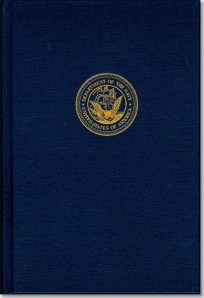 Naval Documents of the American Revolution, V. 12, American Theater, April 1, 1778-May 31, 1778; European Theater, April 1, 1778-May 31, 1778: This twelfth volume in the Naval History and Heritage Command’s Naval Documents of the American Revolution series tells the story of the Revolutionary War on the water during the period of April to June 1778. In the tradition of the preceding volumes—the first of which was published in 1964—this work synthesizes edited documents, including correspondence, ship logs, muster rolls, orders, and newspaper accounts, that provide a comprehensive understanding of the war at sea in the spring of 1778. The editors organize this wide array of texts chronologically by theater and incorporate French, Italian, and Spanish transcriptions with English translations throughout. Volume 12 presents the essential primary sources on a crucial time in the young republic’s naval history—as the British consolidate their strength in the Mid-Atlantic, and the Americans threaten British shipping in European waters and gain a powerful ally as France prepares to enter the war.
 Sea Raiders of the American Revolution: The Continental Navy in European Waters: This book discusses three American Revolutionary War captains: Lambert Wickes, Gustavus Conyngham, and John Paul Jones. Each of them lead raids on British waters during the American Revolution.
 Commerce Raiding: Historical Case Studies, 1755-2009: The book of sixteen case studies examining commerce raiding or guerre de course shows that this strategy has time after time proven itself a most efficient way for sea powers to exert pressure on an opponent, especially a lesser sea power or land power, but that land powers have had little success using this strategy against sea powers. Topics include international piracy, international trade and historical background for the American War of Independence, the Civil War, and both World Wars.
 Talking About Naval History: A Collection of Essays: This collection of naval history essays provides a wide historical perspective that ranges across nearly four centuries of maritime history. A number of these pieces have been published previously but have appeared in other languages and in other countries, where they may not have come to the attention of an American naval reading audience. This collection is divided into parts that deal with four major themes: the broad field of maritime history; general naval history, with specific focus on the classical age of sail, from the mid-seventeenth century to the end of the Napoleonic Wars in 1815; the wide scope of American naval history from 1775 to the end of the twentieth century; and finally, the realm of naval theory and its relationship to naval historical studies.
 New Interpretations in Naval History: Selected Papers From the Sixteenth Naval History Symposium: A selection of the best 12 papers presented at the 2009 Naval History Symposium, the 16th in the series. The contributors are all maritime and naval historians, and their contributions range from the U.S. colonial era through the 1960s. They are not tied to a central theme but represent the vitality of studies in naval and maritime history.
HOW DO I OBTAIN THESE PUBLICATIONS?
Shop Online Anytime: You can buy these and other publications (with FREE Standard Shipping worldwide) from the U.S. Government Online Bookstore website at http://bookstore.gpo.gov:
Shop our Retail Store: Buy a copy of any print editions from this collection at GPO’s retail bookstore at 710 North Capitol Street NW, Washington, DC 20401, open Monday–Friday, 9 a.m. to 4 p.m., except Federal holidays, Call (202) 512-0132 for information or to arrange in-store pick-up.
Order by Phone: Call our Customer Contact Center Monday through Friday, 8 am to 5:30 pm Eastern (except US Federal holidays). From US and Canada, call toll-free 1.866.512.1800. DC or International customers call +1.202.512.1800.
Visit a Federal Depository Library: Search for these in a nearby Federal depository library.
About the author: Trudy Hawkins is Senior Marketing and Promotions Specialist in GPO’s Publication & Information Sales Division supporting the U.S. Government Online Bookstore (http://bookstore.gpo.gov).
 Leave a Comment » |
  Center of Military History, Department of Defense, Military History, National Defense University, Naval War College, U.S. Navy, World History | Tagged: American Revolution, Continental Navy, naval history, Navy Anniversary, navy history, revolutionary war, U.S. Department of Navy, U.S. Navy, U.S. Navy History, United States Department of Navy, US Navy |
  Permalink
 Posted by Trudy Hawkins
September 11, 2014
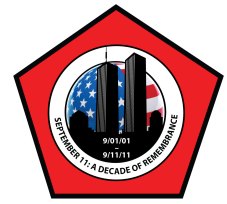 In remembrance of the terrorist attacks of September 11, 2001, Government Book Talk revisits blogger Michele Bartram’s post from September 11, 2013.
There are certain moments and events that are etched in our national consciousness. Ask any American who was alive in the 60’s where he or she was when John F. Kennedy or Martin Luther King was assassinated and you will hear a stirring personal story. For our generation, it was September 11, 2001.
Image: September 11 Decade of Remembrance logo with World Trade Center Twin Towers surrounded by a figure representing the Pentagon. Created by David McKenzie with the Government Printing Office for the U.S. Government Bookstore.
I was right across from the Twin Towers twelve years ago today, getting ready to board a ferry for my daily commute from New Jersey across the Hudson River into Manhattan, when I saw the second plane hit the World Trade Center right across from me. So, too, I cried with a group of strangers as we stood on the ferry platform and watched in horror as the first tower fall, saw the dust cloud rise and felt the earth—and the world—tremble.
America and Americans have changed since that day… twelve years ago today. We have since heard stirring stories of heroes and sacrifice, and learned many grim lessons that are still affecting both policy and people today.
Many of these stories of heroism, missed opportunities, and resulting actions have been painstakingly and faithfully chronicled by a wide array of Federal agencies, ensuring the sacrifices and lessons are not forgotten.
Responding to the Tragedies
Both in New York and the Pentagon in Washington, DC, we saw how first responders and medical personnel rushed to save lives. These excellent publications tell the stories of the heroes from that day:
 Pentagon 9/11 (10th Anniversary Edition) (Paperback) includes a foreword by Secretary of Defense Leon Panetta and provides the most comprehensive account available of the 9/11 attack on the Pentagon and aftermath, including unprecedented details on the impact on the Pentagon building and personnel and the scope of the rescue, recovery, and care-giving effort.
 Attack on the Pentagon: The Medical Response to 9/11 not only tells the personal stories from medical personnel responding to the attack on the Pentagon, but also provides insight from MEDCOM officers detailed to New York to support National Guard troops guarding ground zero’s perimeter. It also includes the Army’s involvement in the recovery of deceased attack victims at the Pentagon and the work of the Armed Forces Institute of Pathology in identifying human remains at Dover Air Force Base. In addition, the roles of military and civilian hospital staffs and of military environmental health and mental health specialists in taking care of attack victims and their families are also examined.
Tough Lessons
The single must-read for every American about September 11 is the official version of The 9/11 Commission Report: Final Report of the National Commission on Terrorist Attacks Upon the United States. This publication lists the findings of the National 9/11 Commission, listing all the painful errors made leading up to the terrorist attacks and outlining specific recommendations for international, national, state and local changes in policy and procedures that the panel of experts felt needed to be implemented to ensure a similar attack never happened again. This seminal publication has served to inform all subsequent policies and legislation since 9/11. It is available in print or as an eBook.

Image: Launch of the 9/11 Commission Report. Courtesy: CSMonitor.com
The Senate, Select Committee on Intelligence, and House, Permanent Select Committee on Intelligence examined the intelligence failures leading up to 9/11 and jointly published the results in United States Congressional Serial Set, Serial No. 14750: Joint Inquiry Into Intelligence Community Activity Before and After Terrorists Attacks of September 11, 2001 With Errata.
 Additional insights into the causes of and responses to terrorism can be gleaned from Terrorism Research and Analysis Project (TRAP): A Collection of Research Ideas, Thoughts, and Perspectives, V. 1. This publication provides the findings from the post-9/11 FBI Terrorism Research and Analysis Project (TRAP) Symposium. TRAP is a leading research consortium made up of international/domestic academics and law enforcement officers, and is a working group sponsored by the FBI’s Behavioral Science Unit. In it, these counter-terrorism experts provide a better understanding of the causes of terrorist activity and possible government response tactics to mitigate terrorist actions.
 As we watch the new World Trade Center going up in New York, we can be assured that builders are incorporating architectural and construction lessons learned from the World Trade Center Building Performance Study: Data Collection, Preliminary Observations, and Recommendations.
Policy and Legislative Response
United States Congressional Serial Set, Serial No. 14924, House Report No. 724, 9/11 Recommendations Implementation Act, Pts. 1-6 outlines the specific legislative changes enacted by Congress, providing both background and justifications for them along with attribution.
A print copy of the law itself can be purchased here: Implementing Recommendations of the 9/11 Commission Act of 2007, Public Law 110-53 along with the details of the various committee conferences contributing to it in Implementing Recommendations of the 9/11 Commission Act of 2007, Conference Report to Accompany H.R. 1, July 25, 2007.
Defending the Homeland since 9/11
 National Strategy for Homeland Security (October 2007) provides the common framework outlined by the George W. Bush Administration to guides, organize and unify the United States’ homeland security efforts.
 A new publication from the Air Force Reserve called Turning Point 9.11: Air Force Reserve in the 21st Century, 2001-2011 tells the story of how the Air Force Reserve responded to 9/11 and have contributed to the security of the United States in a post-September 11 world.
 In a similar vein, Rogue Wave: The U.S. Coast Guard on and After 9/11 chronicles the involvement of the U.S. Coast Guard on that fateful day and the evolving role in national and world security since. Part of the Coast Guard 9/11 response is told in this touching video about the boatlift to evacuate people from lower Manhattan is told in a video narrated by Tom Hanks entitled: “BOATLIFT, An Untold Tale of 9/11 Resilience.”
 Click on the image above or this link to view the “Boatlift” video.
The upcoming U.S. Army War College Guide to National Security Issues, Volume 2: National Security Policy and Strategy provides a summarized look at the national security curriculum now taught to our nation’s top military and civilian leaders by the U.S. Army War College. Revised with the lessons learned from the years since 9/11, this publication includes a chapter on ”Securing America From Attack: The Defense Department’s Evolving Role After 9/11.”
How can I obtain these Federal 9/11 publications?
- Shop Online: Print Editions of these 9/11-related publications may be ordered from the U.S. Government Online Bookstore at http://bookstore.gpo.gov, by clicking on the links above in this blog post or shopping our Terrorism & 9/11 History collection under our US & Military History category.
- Order by Phone: Call our Customer Contact Center Monday through Friday, 8 am to 5:30 pm Eastern (except US Federal holidays). From US and Canada, call toll-free 1.866.512.1800. DC or International customers call +1.202.512.1800.
- Visit our Retail Store: Buy copies of these publications at GPO’s retail bookstore at 710 North Capitol Street NW, Washington, DC 20401, open Monday–Friday, 9 a.m. to 4 p.m., except Federal holidays, Call (202) 512-0132 for information or to arrange in-store pick-up.
- Find them in a Library: Find these publications in a federal depository library.
About the author: Adapted by Trudy Hawkins, Writer and Marketing Specialist in GPO’s Publication & Information Sales Division in Washington, DC, from an original post by Michele Bartram, former Government Book Talk Editor in support of the U.S. Government Online Bookstore (http://bookstore.gpo.gov).
Leave a Comment » | Award Winning Books, Center of Military History, Commission report, Congress, Consumers, Department of Defense, Department of Health & Human Services, Department of Homeland Security, Disasters, Emergency Response, Executive Branch, Federal Bureau of Investigation, Federal Government Role, FEMA Federal Emergency Management Agency, International, Legislative Branch, Military History, National Guard, Notable Government Documents, Presidents, Senate, Terrorism, The White House, U.S. Air Force, U.S. Army, U.S. Army Corps of Engineers, U.S. Army Medical Department, U.S. Coast Guard, U.S. History, U.S. Marines, U.S. National Guard, U.S. Navy, U.S. Senate | Tagged: 09-01-11, 9-1-11, 9-11, al Qaeda, attack on the Pentagon, bin laden, lessons learned, national security, Osama bin Laden, Pentagon, sept 11, September 11, september 11th, terrorism, terrorist attack, the Pentagon, twin towers, United States, world trade center, wtc | Permalink
Posted by Trudy Hawkins
July 10, 2014
Gettysburg, Manassas, and Antietam are famous Civil War battles remembered for President Lincoln’s address, the turning point of the war, and the bloodiest battle of the war. They are also battles that took place in states surrounding Washington, DC – within 100 miles of the nation’s capital. This week marks the 150th anniversary of the only and relatively unknown battle that took place in Washington, DC, the Battle of Fort Stevens.
![024-005-01232-0[1]](https://govbooktalk.gpo.gov/wp-content/uploads/2014/07/024-005-01232-01.jpg?w=450) A Historic Resources Study: The Civil War Defenses of Washington by the Department of Interior’s National Park Service follows the history of efforts to defend Washington, DC from the city’s conception in the 1790s to the Civil War and the Battle of Fort Stevens. This publication is very descriptive painting a clear picture of what Washington, DC was like during the Civil War. The Union constructed a fortification system to protect Washington, DC that by the end of the war consisted of 68 enclosed forts and batteries, emplacements for 1,120 guns, and 20 miles of rifle-trenches. Because the city was the capital and the location of war departments and bureaus it had the largest collection of supplies, equipment, and materials. In the Foggy Bottom area where the Kennedy Center, George Washington University, and the Department of State currently sit, there was a depot of 30,000 horses and mules and the Washington Monument grounds housed an Army cattle-slaughtering yard.
A Historic Resources Study: The Civil War Defenses of Washington by the Department of Interior’s National Park Service follows the history of efforts to defend Washington, DC from the city’s conception in the 1790s to the Civil War and the Battle of Fort Stevens. This publication is very descriptive painting a clear picture of what Washington, DC was like during the Civil War. The Union constructed a fortification system to protect Washington, DC that by the end of the war consisted of 68 enclosed forts and batteries, emplacements for 1,120 guns, and 20 miles of rifle-trenches. Because the city was the capital and the location of war departments and bureaus it had the largest collection of supplies, equipment, and materials. In the Foggy Bottom area where the Kennedy Center, George Washington University, and the Department of State currently sit, there was a depot of 30,000 horses and mules and the Washington Monument grounds housed an Army cattle-slaughtering yard.
![Battle-of-Fort-Stevens[1]](https://govbooktalk.gpo.gov/wp-content/uploads/2014/07/battle-of-fort-stevens1.jpg?w=300&h=242)
Company F, 3d Regiment Massachusetts Heavy Artillery assembled at Fort Stevens. Photo by William Morris Smith, courtesy Library of Congress.
The Battle of Fort Stevens is the grand finale of the publication. After establishing the condition and role of the Washington, DC during the war, the book goes into step-by-step detail of the battle. Here is my perceived synopsis of the Battle of Fort Stevens: General Robert E. Lee of the Confederate army gave orders to Lieutenant General Jubal Early to threaten Washington, DC, which had remained largely untouched during the war. Early led his troops through Virginia and Maryland, taking part in different skirmishes along the way. On July 9 at the Battle of Monocacy near present-day Frederick, Maryland, Early defeated the Union army, thereby opening up the route to Washington, DC. The Battle of Monocacy temporarily stalled Early, giving General Ulysses Grant more time to send reinforcement troops to defend the capital – ultimately derailing Early’s efforts. The Battle of Fort Stevens started on July 11 and ended with Early withdrawing his troops by July 13. The Confederate troops moved towards the Capitol along Georgetown Pike and Rockville Pike culminating in the Battle of Fort Stevens, which took place with the Capitol dome in sight – six miles away – on what was mostly open farm area around present-day Georgia Avenue near Rock Creek Park. The reinforcements sent by Grant and reports suggesting more Union troops were coming caused Early to retreat and end his pursuit of the city.
![battle-of-fort-stevens-925[1]](https://govbooktalk.gpo.gov/wp-content/uploads/2014/07/battle-of-fort-stevens-9251.jpg?w=300&h=222)
Battle of Fort Stevens Map courtesy Civil War Preservation Trust
GPO’s early history is intertwined with the Civil War. One of GPO’s most significant print jobs was the preliminary version of the
Emancipation Proclamation produced in September 1862. Aside from production work done by the agency as part of the war effort, some GPO employees were part of the Interior Department Regiment organized to protect the city. With the threat of General Early closing in on Washington, employees were called on to defend the city but not needed when the reinforcement troops sent by General Grant arrived.
During the 150th anniversary of the Civil War, think beyond the famous battles of the war and remember the skirmishes and other important battles like the Battle of Fort Stevens that may be unknown but are just as important.
HOW DO I OBTAIN THIS PUBLICATION?
Shop Online Anytime: You can buy these and other publications (with FREE Standard Shipping worldwide) from the U.S. Government Online Bookstore website at http://bookstore.gpo.gov:
Shop our Retail Store: Buy a copy of any print editions from this collection at GPO’s retail bookstore at 710 North Capitol Street NW, Washington, DC 20401, open Monday–Friday, 9 a.m. to 4 p.m., except Federal holidays, Call (202) 512-0132 for information or to arrange in-store pick-up.
Order by Phone: Call our Customer Contact Center Monday through Friday, 8 am to 5:30 pm Eastern (except US Federal holidays). From US and Canada, call toll-free 1.866.512.1800. DC or International customers call +1.202.512.1800.
Visit a Federal Depository Library: Search for these in a nearby Federal depository library.
About the author: Our guest blogger is Emma Wojtowicz, Public Relations Specialist in GPO’s Office of Public Affairs.
Leave a Comment » | Center of Military History, Civil War, Government Printing Office (GPO), Military History, National Park Service | Tagged: 150th Anniversary Fort Stevens Battle, American Civil War History, Battle of Fort Stevens, Civil War, Civil war 150th, Civil War Battles, Civil War Defenses of Washington, civil war history, DC, Fort Stevens, George Washington, The Civil War, Washington | Permalink
Posted by Trudy Hawkins
June 4, 2014
Friday June 6 is the 70th anniversary of D-Day when 160,000 Allied troops landed on the beaches of Normandy, France and successfully began to turn the tide of World War II against Nazi Germany. The World War II generation is aging and passing on and with them goes a first-hand account of history. Soon, we will have to rely on books, documentaries, and other secondary sources as the official account of history. Luckily, the federal government is a repository of information with publications relating to World War II. Commemorate the 70th anniversary of D-Day with these federal titles:
 D-Day: The 6th of June: A commemorative two-sided, full color historical map/poster with accompanying graphics and chronology of the World War II Normandy Invasion on the coast of France on June 6, 1944 from the National Geospatial-Intelligence Agency.
 Normandy Air Campaign: Historical Map: A colored map of fighter patrol areas on D-Day featuring the assault area and the main shipping route in Normandy, France from the National Geospatial-Intelligence Agency.
 Omaha Beachhead (June 6-13, 1944): A historical narrative focusing on American military operations in France during the month of June 1944 including D-Day in Normandy from the Department of Defense Center of Military History Armed Forces in Action Series.
 Normandy: The U. S. Army Campaigns of World War II: Part of a series of 40 illustrated brochures that describe campaigns the U.S. Army troops participated in during the war with a focus on strategic setting, tracing the operations of the major American units involved, and analyzing the impact of the campaign on future operations from the Department of Defense Center of Military History Armed Forces.
 United States Army in World War II: European Theater of Operations, Cross-Channel Attack: The first volume of the European Theater of Operations set covering the prelude to the June 6, 1944 assault and combat operations of the First U.S. Army in Normandy until July 1, 1944 from the Department of Defense Center of Military History Armed Forces.
 Command Decisions: A book analyzing decisions reached by chiefs of state and their military subordinates during World War II with a focus on important political, strategic, tactical, and logistical questions, including the invasion Normandy as well as the use of the atomic bomb, the capture of Rome, the campaigns in the western Pacific, and the internment of Japanese-Americans from the Department of Defense Center of Military History Armed Forces.
HOW DO I OBTAIN THESE PUBLICATIONS?
Shop Online Anytime: You can buy these and other publications (with FREE Standard Shipping worldwide) from the U.S. Government Online Bookstore website at http://bookstore.gpo.gov:
Shop our Retail Store: Buy a copy of any print editions from this collection at GPO’s retail bookstore at 710 North Capitol Street NW, Washington, DC 20401, open Monday–Friday, 9 a.m. to 4 p.m., except Federal holidays, Call (202) 512-0132 for information or to arrange in-store pick-up.
Order by Phone: Call our Customer Contact Center Monday through Friday, 8 am to 5:30 pm Eastern (except US Federal holidays). From US and Canada, call toll-free 1.866.512.1800. DC or International customers call +1.202.512.1800.
Visit a Federal Depository Library: Search for these in a nearby Federal depository library.
About the author: Our guest blogger is Emma Wojtowicz, Public Relations Specialist in GPO’s Office of Public Affairs.
Leave a Comment » | Center of Military History, Department of Defense, Military History, U.S. Army, U.S. History, World History, World War II | Tagged: D-day, D-Day June 6, D-Day Normandy, France, Normandy, Normandy Air Campaign, Omaha Beachhead, United States Army, World War II, World War II D-day, WW II Normandy, ww2, ww2 history, wwii | Permalink
Posted by Trudy Hawkins
May 20, 2014
 This year marks the 150th anniversary of the designation of Arlington National Cemetery. On May 13, 1864, the body of Private William Henry Christman of Pennsylvania was laid to rest on the grounds of Arlington House, the former home of Gen. Robert E. Lee until the Civil War. Private Christman was the first soldier laid to rest at Arlington National Cemetery, one month prior to its official establishment as a military cemetery. The first of many events to be held this summer commemorating this important anniversary, began on May 13, 2014 with the laying of a wreath at Private Christman’s grave. Special Guided Tours are also planned, through the months of May and June. The events conclude with a laying of a wreath at the Tomb of the Unknown Soldier on June 16th.

A wreath is placed at the grave of Army Private William Christman, the first person laid to rest at Arlington National Cemetery. Image source: http://www.dcmilitary.com
There are many Government documents available to learn more about the Civil War, Arlington House, and the designation and history of Arlington National Cemetery. For a brief history, check out the U.S. Department of Veterans Affairs publication, Arlington National Cemetery. You can also check out this fact sheet about the history and development of all VA National Cemeteries.
Arlington House and the development of Arlington National Cemetery
The National Park Service (NPS) has published several publications regarding the remarkable history of Arlington House, including the following publications, which are currently available from the U.S. Government Bookstore:
 Arlington House: A Guide to Arlington House, The Robert E. Lee Memorial, Virginia. Although small in size like most NPS handbooks, this publication provides a wealth of information on the history of Arlington House. The publication opens with an introduction of General Lee and Arlington House. It also presents a brief historical account of the house and its occupants, the Custises and the Lees, as well as providing concise information on the house and its grounds.
 The National Park Service also published a Cultural Landscape Report about Arlington House in 2001. As stated in the report, “It’s hard to imagine today what the grounds of Arlington House originally looked like because of the graves of Arlington National Cemetery that surround the house. Arlington National Cemetery almost overwhelms Arlington House.” This Cultural Landscape Report and Site History about Arlington House, tells the story of the creation and use of Arlington House and its link to the formation and design of our national cemetery. It compiles in one place the site’s heritage, documents the changes over time, and establishes what is important to preserve. To learn more about Cultural Landscape Reports read A Guide to Cultural Landscape Reports: Contents, Process, and Techniques available from the GPO Bookstore. You can also read “Custis-Lee Mansion: The Robert E. Lee Memorial” online from the National Park Service, or check out a print copy at a local Federal depository library.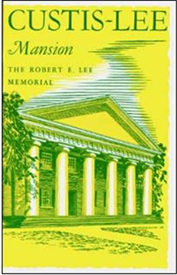
National Cemetery Burial Eligibility
Arlington National Cemetery holds about 27 funerals each week. There are several House Committee Reports regarding veterans’ eligibility for burial in Arlington. H.R. 3211 of the 105th Congress, as well as H.R. 3423 from the 107th Congress amended Title 38 of the U.S. Code to modify eligibility of burial in Arlington National Cemetery. You can access hearings, as well as the legislative history for H.R. 3423 and other bills online. You can also visit a Federal depository library for older reports concerning burials, such as a 1921 report before a subcommittee on the Expenses of burial in Arlington Cemetery of an unknown member of the Expeditionary Forces. You can also browse the volumes of “The war of the rebellion: a compilation of the official records of the Union and Confederate armies” for any records of the history of Arlington House and the appropriation of the land by the Federal government after the war. The volumes are available at many Federal depository libraries.
Arlington National Cemetery Memorials
There are many memorials at Arlington National Cemetery commemorating wars, notable military figures, presidents, and service men and women. If you visit a Federal depository library you could check out a copy of “In Remembrance of a Sailor: a shrine to America’s heroes”, a 1990 publication from the U.S. Navy Department. Information about other memorials in the cemetery can be found on the Arlington Cemetery website.
The Tomb of the Unknown Soldier

President Dwight D. Eisenhower places a wreath at the Tomb of the Unknown Soldier of World War I during interment ceremonies for the Unknown Servicemen of World War II and the Korean Conflict, at Arlington National Cemetery. Image source: Old Guard
The Tomb of the Unknown Soldier was approved by Congress on March 4, 1921. Details of the act can be found in the Congressional Record from that period. You can visit a Federal depository library to access historic copies of the Congressional Record and view the enabling legislation for the Tomb of the Unknowns. The remains of soldiers from World War I, World War II, and the Korean War lay in state and are honored by The Old Guard. In 1984, the remains of an unknown Vietnam War soldier were interred in the Tomb of the Unknown. A document about this soldier, “The Unknown Serviceman of the Vietnam War Era” was created by the U.S. Army Center of Military History. You can read more about it at a Federal depository library, or online from the HathiTrust. Pictures of the Tomb of the Unknowns can be found on the Old Guard Pinterest Board.
If you’re not in the Washington, DC area to participate in any of the events mentioned in this blog, curl up with these documents and immerse yourself in the history and stories of the men and women who fought for our country and were laid to rest on the grounds of the National Cemetery.
How can I get these publications about the history of Arlington House and Arlington National Cemetery?
Shop Online Anytime: You can buy these and other publications (with FREE Standard Shipping worldwide) from the U.S. Government Online Bookstore website at http://bookstore.gpo.gov:
Order by Phone: You may also Order print editions by calling our Customer Contact Center Monday through Friday, 8 am to 5:30 pm Eastern (except US Federal holidays). From US and Canada, call toll-free 1.866.512.1800. DC or International customers call +1.202.512.1800.
Shop our Retail Store: Buy a copy of any print editions from this collection at GPO’s retail bookstore at 710 North Capitol Street NW, Washington, DC 20401, open Monday–Friday, 9 a.m. to 4 p.m., except Federal holidays, Call (202) 512-0132 for information or to arrange in-store pick-up.
Visit a Federal Depository Library: Search for U.S. Government publications in a nearby Federal depository library. You can find the records for most titles in the Catalog of U.S. Government Publications or CGP.
About the author: Cathy Wagner is an outreach librarian with the Education & Outreach team in the Library Services & Content Management (LSCM) division at the Government Printing Office.
Additional content, images and editing provided by Trudy Hawkins, a writer and marketing specialist in GPO’s Publication & Information Sales Division supporting the U.S. Government Online Bookstore (http://bookstore.gpo.gov).
Leave a Comment » | Center of Military History, Civil War, Department of Veterans Affairs, Military History, National Park Service, U.S. Air Force, U.S. Army, U.S. Army Corps of Engineers, U.S. Army Medical Department, U.S. Coast Guard, U.S. History, U.S. Marines, U.S. National Guard, U.S. Navy, Vietnam, War of 1812, World War I, World War II | Tagged: arlington cemetery, Arlington Cemetery Anniversary, arlington national cemetary, Arlington National Cemetery, history of the military, History of the National Cemetary, national cemetary, national cemetary history, National Cemetery, VA National Cemeteries | Permalink
Posted by Trudy Hawkins
May 12, 2014
 May is National Military Appreciation Month (NMAM), a time to recognize and celebrate the contributions of the courageous men and women who have served or are currently serving in the United States Armed Forces.
Designated by Congress, NMAM encourages Americans to publicly show their appreciation for the sacrifices—and accomplishments—made by our military personnel. During this important month, Americans have the opportunity to come together to thank our military for their patriotic service in support of our country, at several national events planned throughout the month.
 Loyalty Day, which is celebrated May 1 of each year, kicks off our Nation’s month-long celebration of military appreciation. In his proclamation of Loyalty Day, 2014, President Barack Obama reminded Americans of the significance of this important day: “On this day, let us reaffirm our allegiance to the United States of America and pay tribute to the heritage of American freedom.”
Other important events honoring our military’s achievements include Victory in Europe (VE) Day celebrated on May 8, Military Spouse Appreciation Day celebrated on May 9, Armed Forces Day celebrated on May 17, and Memorial Day celebrated on May 26. Armed Forces Day and Memorial Day are the best known of the May military-themed holidays. Armed Forces Day, which was created to honor all branches of the U.S. Military, replaced separate Army, Navy and Air Force Days. And Memorial Day commemorates the men and women who died while serving in military service.

A man looks at the Vietnam Veterans Memorial on Memorial Day 2013: Image source nps.gov
In observance of NMAM and the other important events around the country honoring our military this month, Government Book Talk is highlighting several of our bestselling military journals and magazines.
 Army History is published by the U.S. Army Center of Military History (CMH). It is a professional military magazine devoted to informing the military history community about new work on the Army’s history. Issues include illustrated articles, commentaries, book reviews, and news about Army history and the U.S. Army Center of Military History.
 Naval Aviation News is the flagship publication of naval aviation. It covers all aspects of naval air operations. Featured articles review the latest technological advances in aircraft and weapon systems and the influence of U.S. naval air power in global events. Issues include historical profiles of aircraft, aviation ships, important aviators, and organizations that affected the Navy’s control of the air.
 As one of the premier military magazines/military journals, Military Review provides a forum for original thought and debate on the art and science of land warfare and other issues of current interest to the U.S. Army and the Department of Defense.
Joint Force Quarterly is designed for national security professionals in and out of the U.S. Government to promote understanding of the integrated employment of land, sea, air, space, and special operations forces. This journal focuses on joint doctrine, integrated operations, coalition warfare, contingency planning, military operations conducted across the spectrum of conflict, and joint force development.
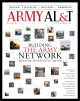 Army AL&T Magazine is a quarterly professional journal published
by the U.S. Army Acquisition Support Center within the Office of the Assistant Secretary of the Army for Acquisition, Logistics, and Technology or AL&T. This official military magazine reports on Army research, development and acquisition and includes articles relative to state-of-the-art technology, capabilities, processes, procedures, techniques, and management philosophy, focusing heavily on lessons learned and best business practices.
How can I get these military magazine/journal publications?
Shop Online Anytime: You can buy these publications (with FREE Standard Shipping worldwide) from the U.S. Government Online Bookstore website at http://bookstore.gpo.gov:
• Click here to purchase Army History
• Click here to purchase Naval Aviation News
• Click here to purchase Military Review
• Click here to purchase Joint Force Quarterly
• Click here to purchase Army AL&T
• Shop our entire Military Journals and Magazines collection
Order by Phone: You may also Order print editions by calling our Customer Contact Center Monday through Friday, 8 am to 5:30 pm Eastern (except US Federal holidays). From US and Canada, call toll-free 1.866.512.1800. DC or International customers call +1.202.512.1800.
Shop our Retail Store: Buy a copy of any print editions from this collection at GPO’s retail bookstore at 710 North Capitol Street NW, Washington, DC 20401, open Monday–Friday, 9 a.m. to 4 p.m., except Federal holidays, Call (202) 512-0132 for information or to arrange in-store pick-up.
Visit a Federal Depository Library: Search for U.S. Government publications in a nearby Federal depository library. You can find the records for most titles in the Catalog of U.S. Government Publications or CGP.
About the author: Trudy Hawkins is a writer and marketing specialist in GPO’s Publication & Information Sales Division supporting the U.S. Government Online Bookstore (http://bookstore.gpo.gov).
Leave a Comment » | Afghanistan, Center of Military History, Civil War, Cold War, Department of Defense, Department of Homeland Security, Iraq, Middle East, Military History, National Defense University, National Guard, Naval War College, U.S. Air Force, U.S. Army, U.S. Army Corps of Engineers, U.S. Army Medical Department, U.S. Coast Guard, U.S. History, U.S. Marines, U.S. National Guard, U.S. Navy, Vietnam, Walter Reed Army Medical Center, War of 1812, World History, World War I, World War II | Tagged: Appreciation Day, armed forces, Armed Forces Day, Center of Military History, meaning of memorial day, Memorial Day, military, military appreciation, National Military Appreciation Month, troops, U.S. Army, United States Armed Forces, us military, vietman veterans, Vietnam, Vietnam War | Permalink
Posted by Trudy Hawkins
April 9, 2014

TV Week final episode cover depicting M*A*S*H television show cast. Did you know that the character of MASH 4077th’s head nurse “Hot Lips” Margaret Houlihan was inspired by two real-life Korean War Army MASH head nurses “Hotlips” Hammerly and Janie Hall?
The music starts. The lyrics to the haunting song “Suicide is Painless” play in your head. The sound and sight of helicopters enter and then you are looking down from the helicopters view on a village of tents and red crosses. The television series M*A*S*H, based on the 1970 movie that was set during the Korean War at the fictitious 4077th Mobile Army Surgical Hospital or M*A*S*H, established itself as one of the greatest shows in history. The show was on air from 1972-1983, and it still lives on today in syndication.
The series finale was broadcasted on February 28, 1983 to 105.9 million viewers, becoming the most watched television broadcast of all time. The record held for nearly three decades until the 2010 Superbowl surpassed M*A*S*H’s record with 106.5 million viewers. The show had the ability to make you cry from both a comedic and emotional standpoint striking a unique balance unlike many shows.
But sometimes real life can be as fascinating as fiction. Learn about the real-life exploits of a genuine Army MASH unit and of brave medical researchers fighting tropical diseases in southeast Asia with two recent Armed Forces medical history publications from the U.S. Army Medical Center and School’s Borden Institute.
 Skilled and Resolute: A History of the 12th Evacuation Hospital and the 212th MASH, 1917-2006 follows the 90-year history of a medical unit, the 12th Evacuation Hospital and its successor the 212th Mobile Army Surgical Hospital, which served in military engagements from World War I to Operation Iraqi Freedom as well as many peacekeeping and humanitarian missions. The unit’s goal is to be trained, equipped, and deployable at a moment’s notice.
There are some gruesome pictures in the Vietnam War section, but overall the book is a fascinating read about how medical techniques evolved with warfare practices in makeshift hospitals close to front lines. In 2006, the unit transformed once again to the 212th Combat Support Hospital and was deployed to Afghanistan.

Lt. General George S. Patton visits the US Army 12th Evacuation Hospital (MASH) to award decorations to the wounded. Patton would later infamously get in trouble for slapping a soldier at another World War 2 hospital who was suffering from post-traumatic stress disorder (PTSD) or combat stress reaction (CSR), which was called shell shock starting in WW 1. (Photo courtesy U.S. Army Medical Department, Office of Medical History)
The photos in the book look like scenes out of the M*A*S*H television series; you can picture Radar turning is head to the side, pausing to listen and exclaiming “Choppers!” to be followed by the sound of helicopters.

Army helicopters were critical for evacuating the sick and wounded from the front to a MASH unit ambulance during the Korean War. (Image courtesy http://www.koreanwar60.com/army)
 The Armed Forces Research Institute of Medical Sciences (AFRIMS), 1960-2010: a 50th Anniversary Photographic History is a lean coffee table book organized by decade. The black and white and color photographs tell the story of AFRIMS – a medical military partnership between the United Sates and Thailand that was founded in response to a cholera epidemic in Thailand in 1959. Within 10 years, a laboratory was built and AFRIMS established the reputation of being a major force in tropical medical research. In the 1970s, the lab played a crucial role in researching and developing treatment for tropical diseases inflicting the military serving in the Vietnam War.
Technology advancements in the 1980s were adapted by AFRIMS and helped with storing and organizing research. In the 1990s and the first decade of the new century, AFRIMS conducted trials impacting the research on vaccines for hepatitis A, malaria, and HIV. The photographs are very compelling and effectively share history while showing the way they conducted research and interacted with the Thai community.

AFRIMS Captain Michael “Mike” Benenson (future USAMC director) returns a child’s “wai” greeting while the study team prepares medications in the 1973 malaria drug prophylaxis study. (Book photograph courtesy of Dr. Michael Benenson)
HOW DO I GET A COPY OF THESE BOOKS?
- Shop Online Anytime: You can buy these publications (with FREE Standard Shipping worldwide) from the U.S. Government Online Bookstore website at http://bookstore.gpo.gov:
- Order by Phone: You may also Order print editions by calling our Customer Contact Center Monday through Friday, 8 am to 5:30 pm Eastern (except US Federal holidays). From US and Canada, call toll-free 1.866.512.1800. DC or International customers call +1.202.512.1800.
- Shop our Retail Store: Buy a copy of any print editions from this collection at GPO’s retail bookstore at 710 North Capitol Street NW, Washington, DC 20401, open Monday–Friday, 9 a.m. to 4 p.m., except Federal holidays, Call (202) 512-0132 for information or to arrange in-store pick-up.
- Visit a Federal Depository Library: Search for U.S. Government publications in a nearby Federal depository library. (Librarians: You can find the records for most titles in the Catalog of U.S. Government Publications or CGP.)
About the author: Our guest blogger is Emma Wojtowicz, Public Relations Specialist in GPO’s Office of Public Affairs.
Additional images and content provided by Government Book Talk Editor Michele Bartram is Promotions and Ecommerce Manager for GPO’s Publication and Information Sales Division in Washington, DC, and is responsible for online and offline marketing of the US Government Online Bookstore (http://bookstore.gpo.gov) and promoting Federal government content to the public.
Leave a Comment » | Afghanistan, Department of Defense, Emergency Response, Gifts, Health care, International, Military History, U.S. Army, U.S. Army Medical Department, Vietnam, World History, World War I, World War II | Tagged: army doctors, army medical, army medicine, army nurses, army research, cholera treatment, evac hospital, Gen patton, korean conflict, Korean War, m*a*s*h, malaria, malaria treatment, mash history, mash series, mash tv, medical research, military aid, military medicine, tropical diseases, vietman conflict, Vietnam War, ww ii, ww2, ww2 history, wwii | Permalink
Posted by Michele Bartram, U.S. Government Online Bookstore
February 20, 2014
With worldwide sports audiences focused on television and Internet stories from the 2014 winter games in Sochi, Russia, we are all learning more about this fascinating country. America has had a long and complex history of relations with Russia, from both the Soviet Union era and now as the Russian Federation. From allies to adversaries—and sometimes both at the same time— the U.S. and Russia have covered the gamut of different roles over the centuries.
In a month replete with themes of love for Valentine’s Day and stories about Russian history, the U.S. Government Bookstore adds to the dialogue with dozens of publications about Russia and the Soviet Union that show, if not always love, then the perpetual mutual respect between our two nations.

World War II
 Russia’s role as both an adversary and an ally during the Second World War lays the foundation for its complicated but critical relationship with the rest of the world today. But its historic triumph over its former ally, Nazi Germany, is a feat still studied and admired today. In Moscow to Stalingrad: Decision in the East (Paperback), the planning and execution of the German offensive against Russia in 1941-1942 are reviewed.
 Stalingrad to Berlin: The German Defeat in the East (in Paperback and ePub eBook) describes the German defeat by the Russians in World War II and the events that resulted in the Soviet Union becoming a dominant military power in Europe.
The Soviet Union, the Warsaw Pact and the Cold War
In response to West Germany’s inclusion in NATO and reflecting Soviet leadership’s desire to maintain control over military forces in Central and Eastern Europe, the Warsaw Pact was signed in May 1955 in Warsaw, Poland, as a mutual defense treaty between eight Cold War communist states of Central and Eastern Europe. Warsaw Pact members included the U.S.S.R. plus Albania, Bulgaria, Czechoslovak Republic, German Democratic Republic (East Germany), Hungary, Poland, and Romania.
 Soviet military planning for conflict in Europe after World War II from the outset harnessed East European military capabilities to Soviet military purposes. This “operational subordination” of the member states’ military is thoroughly analyzed in The Warsaw Pact Wartime Statutes: Instruments of Soviet Control (Book and DVD) whose book and accompanying DVD include a wealth of newly declassified Central Intelligence Agency documents covering the Warsaw Pact period.
 Another book and DVD set from the same series, The Warsaw Pact, Treaty of Friendship, Cooperation, and Mutual Assistance: Soviet-East European Military Relations in Historical Perspective; Sources and Reassessments (Book and DVD), is a collection of hundreds of recently declassified documents designed to take stock of where we are twenty years after the collapse of East European Communism. It includes sensitive Soviet and Warsaw Pact military journals from 1961 to 1984, recently uncovered in newly opened archives across former Warsaw Pact nations, providing a view into Warsaw Pact military strategy.
At the conclusion of World War 2, the Soviet Union was a major player in the world and again an adversary. The period roughly from 1947 to 1991 was known as the Cold War, in which the powers in the Eastern Bloc (the Soviet Union and its allies in Warsaw Pact) were lined up against the Western Bloc (the U.S. and NATO allies).  It was referred to as a “cold” war because there were no major world wars or direct conflicts between the two sides, although there were significant regional wars in Korea and Vietnam. Watching the Bear: Essays on CIA’s Analysis of the Soviet Union focuses on the organizational evolution of the CIA’s analysis of the Soviet economic, political, military, and scientific and technological developments during the Cold War. Interestingly, it also assesses the extent to which Western analyses of the Soviet Union may have influenced the USSR’s policy making process.
In addition to watching the West, Soviet leadership had a constant struggle to keep its own member states in line, particularly as some began to chafe under the communist system.
For example, many remember the Czechoslovak crisis from January 1968, when Alexander Dubcek was elevated to the post of First Secretary of the Communist Party of Czechoslovakia. Under Dubcek, the Czech communist leadership had embarked on a radical program of dramatic liberalization of the Czechoslovak political, economic, and social order that was not approved by Moscow.  In Strategic Warning & the Role of Intelligence: The CIA and Strategic Warning; The 1968 Soviet-Led Invasion of Czechoslovakia (Book and DVD), the Central Intelligence Agency’s Information Management Services reviewed, redacted, and released hundreds of documents related to the 1968 Czechoslovak-Soviet crisis, creating this fascinating book. The accompanying DVD has over 500 documents and 2,000 pages of recently declassified material about the crisis.
Détente Era
During the period of 1967 to 1979, there was an easing of Cold War tensions between the U.S. and the Soviet Union. Referred to as détente, the era was a time of increased trade and cooperation with the Soviet Union and the signing of the SALT treaties, but relations cooled again with the Soviet invasion of Afghanistan until the fall of the Soviet Union and the founding of the Russian Federation.
 The best overview of this important period can be found in Soviet-American Relations: The Détente Years, 1969-1972. With a foreword by Henry A. Kissinger, this unprecedented joint documentary publication presents the formerly top-secret record of how the United States and Soviet Union moved from Cold War to détente during 1969 to 1972. Published side-by side are both the U.S. and Soviet accounts of meetings between Henry Kissinger and Soviet Ambassador Anatoliy Dobrynin, the so-called Kissinger-Dobrynin confidential back channel, related documents, and the full Soviet and U.S. record of the first Moscow Summit between President Richard Nixon and Soviet Secretary General Leonid Brezhnev. The Soviet documents are being released in the volume for the first time anywhere.
The Foreign Relations of the United States series fondly known as FRUS has a number of terrific titles about the U.S. relations with the Soviet Union.  One volume in particular, Foreign Relations of the United States, 1969-1976, Volume XXXIV, National Security Policy, documents U.S. national security policy in the context of the Vietnam War and the changing Cold War strategic balance between the United States and the Soviet Union. Another volume in the series,
  Foreign Relations of the United States, 1969-1976, V. XV, Soviet Union, June 1972-August 1974, includes numerous direct personal communications between President Nixon and Soviet Leader Brezhnev covering a host of issues, including clarifying the practical application of the SALT I and AMB agreements, arms control, the October 1973 Arab-Israeli war, commercial relations and most-favored-nation status, the emigration of Soviet Jews, and the Jackson-Vanik amendment to Title IV of the 1974 Trade Act which denied most favored nation status to certain countries with non-market economies that restricted free emigration, such as the Soviet Union.
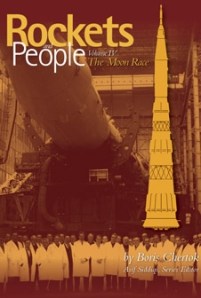 One of the crowning achievements of Russia and the Soviet Union has been its space program. From the launching of Sputnik that triggered the space race to participation in the International Space Station, Russians are justifiably proud of their “stellar” accomplishments. This pride is borne out in the fascinating book Rockets and People: Volume IV: The Moon Race. In this book translated from its original Russian version to English, the famous Russian spacecraft designer Boris Chertok— who worked under the legendary Sergey Korolev— continues his fascinating memoirs about the history of the Soviet space program, this time covering 1968 to 1974, the peak years of the Soviet human lunar program.
The Russian Federation
Today, Russia or the Russian Federation continues to be a major power, politically, militarily and economically. But since the breakup of the Soviet Union, the Russian Federation has continued to have issues with insurgencies and disagreements among its population.  Breaking the Mold: Tanks in the Cities (in Paperback and as an eBook) provides an up-to-date analysis of the utility of tanks and heavy armored forces in urban combat from across the world, and includes an analysis of the Russian use of tanks in quelling the insurgency in the Chechen Republic (Chechnya) in 1995.
No longer a communist nation, Russia today still has a number of social welfare programs that differ from the rest of Europe. The Social Security Programs Throughout the World series highlights the principal features of social security programs in more than 170 countries.  Now included in the most recent European edition, Social Security Programs Throughout the World: Europe 2012, Russian social security programs are analyzed and compared to other nations in Europe.
 And finally, The Russian Military Today and Tomorrow: Essays in Memory of Mary FitzGerald includes essays by top U.S. and Russian analysts to assess current Russian military thinking on warfare, giving insight into the Russia of today.
They say one must study history to understand where we are today and where we are heading. This listing is just a smattering of the many thoughtful publications about Russia and the Soviet Union that can add to your understanding of where this major power has been, where it is today and perhaps, where it might go in the future.
How can I get these publications about Russia and the Soviet Union?
- Shop Online Anytime: You can buy any of these eBooks or print publications—with FREE Standard Shipping worldwide— from the U.S. Government Online Bookstore website at http://bookstore.gpo.gov:
- Order by Phone: You may also Order print editions by calling our Customer Contact Center Monday through Friday, 8 am to 5:30 pm Eastern (except US Federal holidays). From US and Canada, call toll-free 1.866.512.1800. DC or International customers call +1.202.512.1800.
- Shop our Retail Store: Buy a copy of any print editions from this collection at GPO’s retail bookstore at 710 North Capitol Street NW, Washington, DC 20401, open Monday–Friday, 9 a.m. to 4 p.m., except Federal holidays, Call (202) 512-0132 for information or to arrange in-store pick-up.
- Visit a Federal Depository Library: Search for one of these publications in a nearby Federal depository library. (Librarians: You can find the records for most of these titles in the Catalog of U.S. Government Publications or CGP.)
About the author: Government Book Talk Editor Michele Bartram is Promotions Manager for GPO’s Publication and Information Sales Division in Washington, DC, and is responsible for online and offline marketing of the US Government Online Bookstore (http://bookstore.gpo.gov) and promoting Federal government content to the public.
1 Comment | Center of Military History, Central Intelligence Agency (CIA), Cold War, Department of Defense, Department of Homeland Security, Department of State, Foreign Relations, International, Military History, Naval War College, Presidents, Soviet Union / Russia, U.S. Army, U.S. Army Corps of Engineers, World History, World War II | Tagged: arms race, chechen rebellion, Cold War, czech uprising, detente, Kissinger, relations with russia, russian federation, russian intelligence, SALT treaty, soviet american relations, soviet era, soviet intelligence, Soviet Union, Space Race, Union of Soviet Socialist Republics, USSR | Permalink
Posted by Michele Bartram, U.S. Government Online Bookstore
February 5, 2014
February is National African American History Month, also known as Black History Month in the United States. One significant event in African American history happened 151 years ago. On January 1, 1863, President Abraham Lincoln issued the Emancipation Proclamation, announcing “that all persons held as slaves” in rebellious areas “shall be then, thenceforward, and forever free.” While this Executive Order only freed slaves living in Confederate states during the Civil War, it nevertheless ultimately paved the way for the eventual abolition of slavery in America and became an important aspect of President Lincoln’s legacy.
 In his proclamation of the 150th anniversary of the Emancipation Proclamation on January 1, 2013, President Barack Obama encouraged all Americans to acknowledge and celebrate the Emancipation Proclamation and “reaffirm the timeless principles it upheld.”
Image: Illustration of President Abraham Lincoln signing the Emancipation Proclamation on January 1, 1863, in Washington. Source: AP
As we honor African American heritage this month, I’m reminded of the Emancipation Proclamation and the “timeless principles” President Obama was speaking of.
A symbol of equality and justice
The significance of Abraham Lincoln’s signing of the Proclamation during the Civil War was two-fold for African Americans. As mentioned earlier, not only did it lay the foundation for the eventual freedom of all slaves, it also allowed black men to enlist in the Union Army and Navy. This strategic Presidential “war measure” provided African Americans the opportunity to join in the fight for their freedom, in effect enabling the liberated to become liberators. By the end of the war, almost 200,000 black soldiers and sailors had fought for the Union and freedom.
As history teaches, the Civil War was initially about preserving the Union; however, the Emancipation Proclamation also made it about freeing the slaves– “an act of justice” that would grant African Americans, and generations to come, equal citizenship in the U.S.
For this reason, the Emancipation Proclamation remains a widely recognized symbol of freedom in American History that will forever be revered in Black History.
 Image: Engraving by W. Roberts with the text of the Emancipation Proclamation. Source: Library of Congress’s Prints and Photographs division under the digital ID pga.04067.
GPO’s role in the Emancipation Proclamation
But the Emancipation Proclamation also played a significant role in GPO’s own history. Did you know… the then newly established Government Printing Office printed the preliminary version of the Emancipation Proclamation for President Lincoln as one of its first major tasks? The original printer’s proof version was displayed for six months at GPO’s 150th History Anniversary exhibit that opened in June of 2011. I (along with many other GPO employees and visitors) was given an extraordinary opportunity to personally view the original historic document, which contained the printer’s actual proofing marks with requested changes!
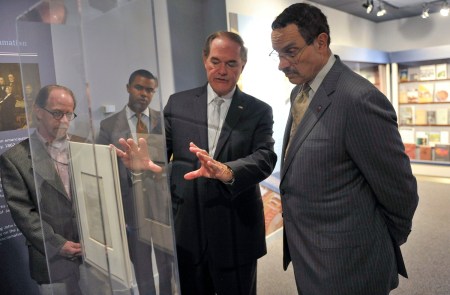 Image: Former Public Printer William Boarman views original GPO printer’s proof copy of the preliminary version of the Emancipation Proclamation with Washington DC Mayor Vincent Gray at the GPO history exhibit. In 1862, GPO printed the preliminary version of the Emancipation Proclamation in general orders format, issued as an Executive Order from President Lincoln in his role as Commander-in-Chief of the armed forces. GPO printed 15,000 copies for the War Department, which were distributed to military commanders and their troops and diplomats in foreign countries. The copy displayed at GPO contained proofing marks; those corrections were made in the final version of the Emancipation Proclamation in 1863. Source: GPO
The GPO history exhibit is currently open to the public with free admission, Monday through Friday from 8am to 4:30pm at GPO’s Washington, DC, headquarters at 732 North Capitol Street NW. Unfortunately, the landmark document, which was on loan for six months from the Library of Congress, is no longer available for viewing, but many more historic exhibits are on view for free.
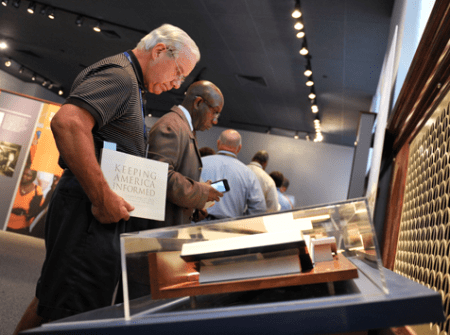 Image: Visitor who has just purchased the GPO history book “Keeping America Informed” views the GPO 150th Anniversary History Exhibit. Source: GPO
To learn more about GPO’s role in the printing of this historic document and other important Federal publications, read GPO’s 150th anniversary history book, Keeping America Informed: The United States Government Printing Office 150 Years of Service to the Nation.
However, you can view and/or read the entire Emancipation Proclamation online at the National Archives website or visit the National Archives in Washington, DC, to see the original signed document.
Teaching the Next Generation about the Emancipation Proclamation
To help parents and educators teach children about the importance of the Emancipation Proclamation and its role in Black History, the National Archives and Record Administration (NARA) published the 150th Anniversary of the Emancipation Proclamation: Commemorative Coloring Book: Forever Free.
 Image: Buy the family friendly 150th Anniversary of the Emancipation Proclamation: Commemorative Coloring Book: Forever Free.
This 150th anniversary commemorative publication about the Emancipation Proclamation is not a typical children’s coloring book. The wealth of information contained within this great little read makes it useful as a history book for the entire family, not just for kids. For example, I learned about the origins of “Watch Night”:
On December 31, 1862, many enslaved African Americans gathered in churches and prayed. Throughout the night, they waited for the moment when the Emancipation Proclamation would take effect. This special night became known as “Watch Night,” and continues to be celebrated today in many African American churches on New Year’s Eve.
The publication opens with a brief history about President Lincoln’s signing of the Emancipation Proclamation on January 1, 1863. It also provides portraits and short biographies describing historical events involving African Americans, such as Harriet Tubman, a former slave and Union spy who also helped recruit black troops, and Frederick Douglass, an abolitionist who helped Abraham Lincoln recruit black troops during the Civil War. It even includes a reference to this famous image:
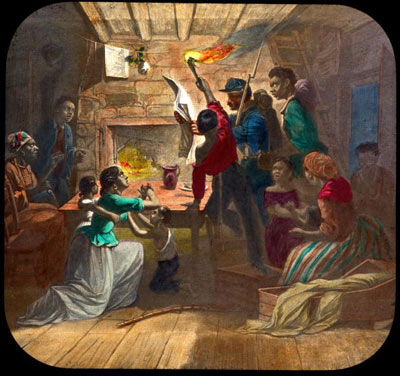 Image: By torchlight, a Union soldier reads the ‘Emancipation Proclamation’ to a room of slaves and their children, 1860s. The image was published as part of the ‘Life of Lincoln: Additional View’ series by the C.W. Briggs Company. Photo credit: George Eastman House/Getty Images
Other short biographies of important figures in black history covered in this book include Rosa Parks, Martin Luther King, and President Barack Obama.
 The National Park Service also has produced another children’s publication focusing on black history and mentioning the Emancipation Proclamation: Discovering the Underground Railroad: Junior Ranger Activity Book. Young children ranging from ages 5 to 10 and older are taught about the history of the Underground Railroad and the struggles African Americans endured in their quest for freedom. Activities include a wordsearch of terms related to the Civil War; a maze routing the journey to freedom; and a timeline highlighting significant events in Black History, such as the Emancipation Proclamation and much more. Upon completion of the activities, children are encouraged to send in their completed booklet for an official Jr. Ranger Badge. [Read about this and other Underground Railroad publications in our blog post: “The Underground Railroad Leaves its Tracks in History“.]
How can you get these publications?
- Shop Online Anytime: You can buy these and other publications with FREE Standard Shipping worldwide from the U.S. Government Online Bookstore website at http://bookstore.gpo.gov:
- Shop our Retail Store: Buy a copy of any print editions from this collection at GPO’s retail bookstore at 710 North Capitol Street NW, Washington, DC 20401, open Monday–Friday, 9 a.m. to 4 p.m., except Federal holidays, Call (202) 512-0132 for information or to arrange in-store pick-up.
- Order by Phone: Call our Customer Contact Center Monday through Friday, 8 am to 5:30 pm Eastern (except US Federal holidays). From US and Canada, call toll-free 1.866.512.1800. DC or International customers call +1.202.512.1800.
- Visit a Federal Depository Library: Search for these in a nearby Federal depository library.
About the author: Guest blogger Trudy Hawkins is a writer and marketing specialist in GPO’s Publication & Information Sales Division supporting the U.S. Government Online Bookstore (http://bookstore.gpo.gov).
Images and additional content provided by Government Book Talk Editor Michele Bartram. Bartram is Promotions and Ecommerce Manager for GPO’s Publication and Information Sales Division in Washington, DC, and is responsible for online and offline marketing of the US Government Online Bookstore and promoting Federal government content to the public.
2 Comments | African Americans, Children, Civics and Citizenship, Civil War, Executive Branch, Family, Government Printing Office (GPO), Human Rights, Legislative Branch, Library of Congress (LOC), Military History, National Archives and Records Administration (NARA), National Park Service, Notable Government Documents, Presidents, Teachers and teaching, The White House, U.S. Army, U.S. Navy, Women | Tagged: Abraham Lincoln, african american history, battle of gettysburg, black history, black history month, president lincoln | Permalink
Posted by Michele Bartram, U.S. Government Online Bookstore
January 16, 2014
Ahhh…. It’s that time of the year again: Awards season! From the Golden Globes to the Academy Awards, red carpets abound with interviews of movie stars and other celebrities boasting about their best work during the past year.
We at the US Government Bookstore want to make sure our star publications and Federal agency publishers get their moment in the limelight, too. So, we are pleased to announce the winning publications that you, our readers, chose through your purchases over the past year: The US Government Bookstore Best Sellers of 2013!
 Here are some of the more notable books, eBooks, posters and more that were winners in your eyes over the past year:
ART & TRAVEL
 Americans love our national parks, so it’s no surprise the National Park System Wall Map Poster was a big hit.
 Humanities is a bimonthly magazine published by the National Endowment for the Humanities (NEH) which covers NEH sponsored research in the humanities and NEH programs and projects, as well as information on recent and upcoming NEH grants.
HISTORY
With the 150th anniversary and reenactment of the Battle of Gettysburg last summer, The Gettysburg Campaign, June-July 1863 was a smash success (Read our post “Gettysburg, America’s Bloodiest Battle” for more information).
Perennial favorite Underground Railroad: Official Map and Guide (Read our post “The Underground Railroad Leaves its Tracks in History”) was joined by two publications commemorating 50th anniversaries:
 Finally, the Statistical Abstract of the United States, the last official edition published in 2012 by the U.S. Census Bureau, contains a standardized summary of all official key statistics on the social, political, and economic organization of the United States (Read our post: “Statistical Abstract and Print Mashups in a Digital Age”).
TREES & FORESTS
 I won’t be going out on a limb to say that our customers definitely wanted to hug trees this year, as books about Trees & Forests topped the lists. Why Would Anyone Cut a Tree Down? and The Little Acorn are extremely popular books for children explaining about the uses and life cycle of trees.
 How to Prune Trees and How To Recognize Hazardous Defects in Trees for amateur and professional gardeners, landscapers and foresters alike, and the Timber Management Field Book serves as the most popular reference handbook for forestry professionals.
(Read our posts “Oh, say, can you tree? American Christmas tree traditions,” “Pruning Trees” and “Dr. Seuss’ The Lorax Inspires Kids to Hug a Tree” for more information on these titles.)
BUSINESS AND LAW
 International business entrepreneurs and would-be exporters have made A Basic Guide to Exporting: The Official Government Resource for Small and Medium-Sized Businesses a best-seller every year (Read our posts: “Exporting Made Simple” and “Government eBooks Made Easy– and Sometimes Free” for more information).
 Protecting intellectual property and privacy were extremely hot topics in 2013, making the Copyright Law of the United States and Related Laws and the Overview of the Privacy Act of 1974, 2012 Edition (extremely popular last year (Read our post: “The Privacy Act: What the Government Can Collect and Disclose about You” for more information).
TRANSPORTATION AND NAVIGATION
T he latest versions of the annual best-selling Astronomical Almanac for the Year 2014 (Combined Print plus Online Edition) and The Nautical Almanac for the Year 2014 are critical tools to aid commercial and private navigation by both air or water (Read our post: “Navigating by the Moon, Planets, and Stars” for more information).
Specifically for maritime navigation, Navigation Rules, International-Inland contains the latest international regulations for preventing  collisions at sea as well as the U.S. Inland Navigation Rules which have been in effect for all inland waters, including the Great Lakes.
The FAA Safety Briefing magazine provides updates on major Federal Aviation Administration rule changes and proposed changes, as well as refresher information on flight rules, maintenance air worthiness, avionics, accident analysis, and other aviation topics.
CITIZENSHIP AND CIVICS
Preparing to become a United States citizen and reaffirming knowledge of the American system of Government is extremely popular with our customers, and this year was no exception. Top civics and citizenship publications for 2013 included the Constitution of the United States and the Declaration of Independence (Pocket Edition) and materials for preparing for the U.S. Naturalization Test to become a United States citizen—
(Read our posts: “Quiz and History for Bill of Rights Day December 15”, “Quiz: Are you smarter than an 8th grade Civics student?”, and “Notable Documents 2009: Civics Flash Cards” for more information on these products.)
Another patriotic publication that proved popular (Do you like the alliteration?:-) was Our Flag, which briefly describes the history of the American flag and sets forth the practices and observances appropriate to the display of Old Glory, was a top-seller.
The Congressional book, How Our Laws Are Made, provides citizens with a basic outline of the numerous steps of our Federal law-making process from the source of an idea for a legislative proposal through to its publication as a statute and becoming the “law of the land”.
HEALTH
Watching our weight and eating better were definitely on the minds of Americans this year as Diet & Nutrition books and posters were best sellers, including:
 Healthcare professionals turned often to the U.S. Government Bookstore for Physician References & Medical Handbooks, Medical & Health Research, and Military & Emergency Medicine publications in 2013. Top on the list were copies of the new Healthcare Law, as well as the Special Operations Forces Medical Handbook.
But also important were publications used to improve the quality of healthcare research and patient care and safety. These included the ORI: Introduction to the Responsible Conduct of Research (also available in Packages of 50) which provides guidelines for Public Health Service-funded researchers, as well as the TeamSTEPPS patient care and safety training materials for healthcare personnel, such as the TeamSTEPPS Instructor Guide (Binder Kit) and TeamSTEPPS Pocket Guide that should be handed out to all healthcare personnel who attend TeamSTEPPS training.
SECURITY AND EMERGENCY MANAGEMENT
Emergency management personnel and first responders responded strongly to the many great safety and emergency response publications on the U.S. Government Bookstore. These books and pocket guides topped their “must have” list in 2013:
Specifically for dealing with Hazardous Materials (HAZMAT) and Chemical-Biological-Radiological-Nuclear-Explosive (CBRNE) incidents, clean-up and response were these best-selling guides:
The importance of radio communications was underscored by the popularity of the United States Frequency Allocations: The Radio Spectrum Chart (Poster) of all assigned frequencies and the National Interoperability Field Operations Guide which contains radio guidelines for establishing or repairing emergency communications in a disaster area.
GOVERNMENT
Every year, the publications containing the President’s proposed Federal Budget for the upcoming fiscal year are on our best sellers list, and the Fiscal Year 2014 Budget publications followed this tradition. (Note: Stay tuned! The new Fiscal Year 2015 Budget publications will be coming out soon from the White House).
 The U.S. Government Manual, the ultimate handbook of all Federal agencies, was a hit as it is every year. Now you can get the new edition: United States Government Manual 2013 (Read about it on our Blog post: “Understand How the U.S. Government is Organized”).
Other “Best of the Best” Government titles include:
How can I get these “Best-selling Books of 2013”?
- Shop Online: You can purchase these publications from the U.S. Government Online Bookstore at http://bookstore.gpo.gov by clicking on the individual links above in this blog post. You may also click here to shop our entire “Best Sellers of 2013” collection.
- Order by Phone: Call our Customer Contact Center Monday through Friday, 8 am to 5:30 pm Eastern (except US Federal holidays). From US and Canada, call toll-free 1.866.512.1800. DC or International customers call +1.202.512.1800.
- Shop our Retail Store: Buy a copy of any print editions from this collection at GPO’s retail bookstore at 710 North Capitol Street NW, Washington, DC 20401, open Monday–Friday, 9 a.m. to 4 p.m., except Federal holidays, Call (202) 512-0132 for information or to arrange in-store pick-up.
- Visit a Federal Depository Library: Search for one of these publications in a nearby Federal depository library.
About the Author: Government Book Talk Editor Michele Bartram is also Promotions and Ecommerce Manager for GPO’s Publication and Information Sales Division in Washington, DC, and is responsible for online and offline marketing of the US Government Online Bookstore (http://bookstore.gpo.gov) and promoting Federal government content to the public. Assistance provided by Stephanie Jaeger, Sales & Marketing Coordinator for GPO’s Sales & Marketing Division that markets GPO’s publishing services to the Federal sector.
8 Comments | African Americans, Agriculture, Aviation, Award Winning Books, Business, CBRN Chemical-Biological-Radiological-Nuclear, Census Bureau, Center of Military History, Central Intelligence Agency (CIA), Children, Civics and Citizenship, Civil War, Cold War, Commission report, Congress, Consumers, Department of Agriculture, Department of Commerce, Department of Defense, Department of Health & Human Services, Department of Homeland Security, Department of the Interior, Department of Transportation, Department of Veterans Affairs, Digital Publishing, Disasters, Emergency Response, Executive Branch, Family, Federal Budget, FEMA Federal Emergency Management Agency, Foreign Relations, Gifts, Government Accountability Office (GAO), Health care, Hispanics, House of Representatives, Innovation, International, Judicial Branch, Law Enforcement, Legal Analysis, Legislative Branch, Libraries, Military History, National Endowment for the Humanities, National Park Service, Notable Government Documents, Occupational Safety and Health Administration, Office of the Federal Register, Office of Women's Health, Parenting, Presidential Commissions, Presidents, Teachers and teaching, Terrorism, The White House, Travel and Tourism, U.S. Citizenship and Immigration Services, U.S. Coast Guard, U.S. Constitution, U.S. Department of Agriculture, U.S. Forest Service, U.S. History | Tagged: award winning books, best American books, best books, best books for kids, best books for men, best books for women, best government books, best history books, best sellers, best selling books, bestsellers, books best sellers, books for children, books of the year, free books, Stat abstract, top books | Permalink
Posted by Michele Bartram, U.S. Government Online Bookstore
January 9, 2014
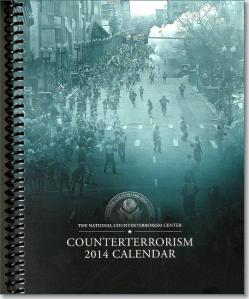 If you didn’t catch the Washington Post “In the Loop” article by Al Kamen this week entitled “Counter terror calendar 2014 is out!,” you’ll be pleased to know that yes, the 2014 edition of the National Counterterrorism Center’s annual Counterterrorism Desk Calendar is now available for ordering on the U.S. Government Bookstore.
Image: Cover of the 164-page 2014 Counterterrorism Calendar from the National Counterterrorism Center depicts the 2013 bombings at the Boston Marathon. Photo Credit: David L. Ryan / Boston Globe.
The goal behind the Counterterrorism Calendar is to educate and inform both professionals– first responders, military, intelligence, law enforcement and other counterterrorism personnel– as well as civilians about the threats of international terrorism and how to prevent, respond or mitigate these threats against the United States both at home and abroad.
History of U.S. Government Inviting Citizen Involvement in Domestic Security
Since its founding, America has had a history of inviting its citizens to participate in its own defense. Even with the danger of British sympathizers turning them in, brave revolutionaries posted recruiting posters on behalf of the Continental Congress such as the one below that invited Americans to “Take Notice” and help General Washington and the Continental Army defend against “the hostile designs of foreign enemies.”
 Image: This Revolutionary War recruiting poster urged brave and able-bodied young men to “take notice” and join forces with General Washington and the Continental Army in the fight against “foreign enemies,” in this case, the British. Photo Credit: Bettmann/CORBIS
In World War 2, the Federal Government issued numerous similar domestic campaigns reminding citizens that it was their civic duty to “defend America” and inviting citizens to help support the war industry and to be vigilant against spies, saboteurs and other actions by the enemy both at home and abroad.
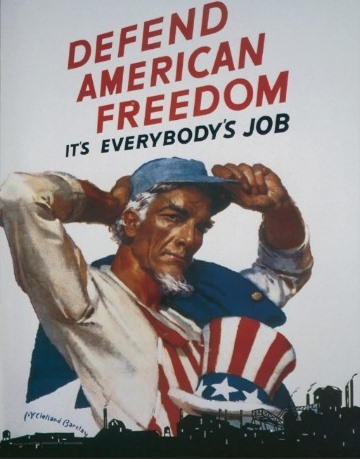 Image: U.S. Government World War II propaganda poster urging civilians to participate in the war effort. Source: University of North Texas Digital Library
Today, the war is a War on Terror, and the U.S. Government still needs involvement and vigilance of its citizens and allies, whether in the United States or abroad, to identify and protect against terrorists.
The 2014 Counterterrorism Calendar
Under the Office of the Director of National Intelligence, the National Counterterrorism Center or NCTC serves as the primary organization in the U.S. government for integrating and analyzing all intelligence possessed or acquired by the U.S. government about international terrorism, including data from U.S. Federal agencies like the CIA, NSA, Defense Intelligence Agency, and the FBI as well as other domestic and international sources.
First published in a spiral-bound daily planner format in 2003, just two years after the World Trade Center attacks, the Counterterrorism or CT Calendar from the NCTC is published annually. According to the NCTC, their 2014 Counterterrorism Calendar:
…provides information on known terrorist groups, individual terrorists, and technical information on topics such as biological and chemical threats.This edition, like others since the Calendar was first published in daily planner format in 2003, contains many features across the full range of issues pertaining to international terrorism: terrorist groups, wanted terrorists, and technical pages on various threat-related topics.
Features of the Calendar
In addition to serving as a desk calendar / event planner, the 164-page 2014 Counterterrorism Calendar also serves as a tutorial on international terrorism and a gallery of “most wanted” terrorists.
The right-hand page of the planner has the event planner dates along with key historical events of significance to terrorists that might be used to plan future terrorist activities. For example, on January 8, 1998, terrorist Ramzi Ahmed Yousef was sentenced to life plus 240 years for his role in the 1993 World Trade Center bombings.
On the left-hand pages are photos, maps and/or data on terrorists and terrorist organizations around the world, from Africa and the Middle East to Europe and the Americas.
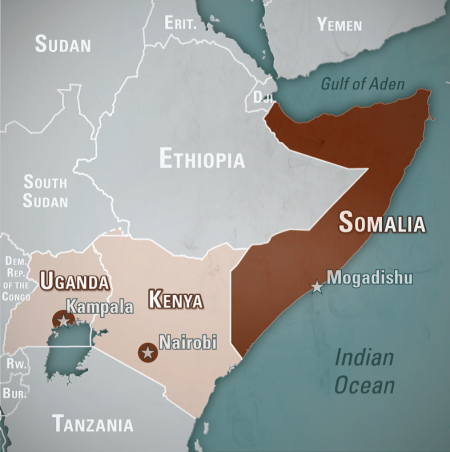 Image: Map denoting locations of major terrorist incidents likely committed by the Harakat Shabaab al-Mujahidin—commonly known as al-Shabaab, a “clan-based insurgent and terrorist group” operating in and around Somalia. Source: NCTC 2014 Counterterrorism Calendar
“Terrorism tutorial” information ranges from cultural—details about the Islamic Calendar; the spelling of Arabic names and terms; lists of Foreign Terrorist Organizations (FTOs), and logos used— to technical – information about Chemical-Biological-Radiological-Nuclear-Explosive (CBRNE) weapons commonly used by terrorists, from suicide bombs to sarin gas, and how to detect and mitigate them. For example, who among us would recognize the terrorist threat from these innocent-looking beans?
 Image: Photo of castor beans from which the deadly toxin ricin is extracted. Ricin is poisonous if inhaled, injected, or ingested. Source: NCTC 2014 Counterterrorism Calendar
“Wanted” Terrorists
Providing the real drama of the calendar are the full-page “Wanted” poster-style pages of an individual terrorist, complete with photo (if available), aliases, his terrorist activities, the reward offered, and how to report information about him.
One of the largest rewards, $25 Million, is offered for information leading to the capture of Ayman al-Zawahiri, also known as “The Teacher” or “The Doctor” who is a physician and the founder of the Egyptian Islamic Jihad. According to the CT Calendar:
“This organization opposes the secular Egyptian Government and seeks its overthrow through violent means. Al-Zawahiri is believed to have served as an advisor and doctor to Usama Bin Ladin. He has been indicted for his alleged role in the August 7, 1998, bombings of the US embassies in Dar es Salaam, Tanzania, and Nairobi, Kenya. The embassy bombings killed 224 civilians and wounded over 5,000 others.”
 Image: Extract from the “wanted” page of Ayman al-Zawahiri, Al-Qaida leader and founder of Egyptian Islamic Jihad. Source: NCTC 2014 Counterterrorism Calendar
Civilian Involvement
Finally, the NCTC carries on the civilian involvement tradition by including instructions for citizens of the U.S. and other countries on how they can help fight terrorism. Pages on” Indicators of False Travel Documents”, “Radicalization”, and how U.S. residents can report suspicions are provided. Additionally, the Rewards for Justice (RFJ) Program is described in detail, wherein the U.S. Secretary of State may offer rewards for information that prevents or favorably resolves acts of international terrorism against US persons or property worldwide.
On the last page is a Bomb Threat Call Procedures form with valuable details of questions to ask and information to note about the caller, such as his or her voice (accent, age, tone, language) and background sounds. Did you note if the caller was clearing his throat or had an accent? Were there sounds of machinery in the background? What kind? Any and all details could help law enforcement.
 Image: Table from the Bomb Threat Call Procedures form. Source: Page 160 of the 2014 Counterterrorism Calendar.
Forewarned is Forearmed
Like the tradition of the best Government civilian campaigns since the founding of the Nation, the National Counterterrorism Center’s annual Counterterrorism Calendar is simultaneously meant to alert and inform us, making both civilians and professionals alike aware of the very real dangers around us and educating us on what—and whom—to look for. With the cover photo depicting the 2013 bombings at the Boston Marathon– where ordinary citizens were instrumental in identifying and locating the terrorists responsible– the importance of having an informed and involved citizenry has never been clearer.
How can I get a copy of the National Counterterrorism Center’s 2014 Counterterrorism Calendar?
- Shop Online: You can purchase this calendar from the U.S. Government Online Bookstore at http://bookstore.gpo.gov by:
- Order by Phone: Call our Customer Contact Center Monday through Friday, 8 am to 5:30 pm Eastern (except US Federal holidays). From US and Canada, call toll-free 1.866.512.1800. DC or International customers call +1.202.512.1800.
- Shop our Retail Store: Buy a copy of any print editions from this collection at GPO’s retail bookstore at 710 North Capitol Street NW, Washington, DC 20401, open Monday–Friday, 9 a.m. to 4 p.m., except Federal holidays, Call (202) 512-0132 for information or to arrange in-store pick-up.
- Visit a Federal Depository Library: Search for it in a nearby Federal depository library or download a PDF version.
About the Author: Government Book Talk Editor Michele Bartram is Promotions Manager for GPO’s Publication and Information Sales Division in Washington, DC, and is responsible for online and offline marketing of the US Government Online Bookstore (http://bookstore.gpo.gov) and promoting Federal government content to the public.
15 Comments | Afghanistan, Calendars, Central Intelligence Agency (CIA), Civics and Citizenship, Defense Intelligence Agency, Department of Defense, Department of Homeland Security, Department of Justice, Department of State, Emergency Response, Federal Bureau of Investigation, Federal Government Role, Foreign Relations, International, Iraq, Law Enforcement, Middle East, Military History, Nuclear, Pakistan, Terrorism, U.S. Department of State, World History | Tagged: boston marathon bombings, community watch, counterterrorism, international terrorism, islamic terrorism, jihad, Middle East, most wanted list, most wanted terrorists, preventing terrorism, radical islam, radical jihadists, radicalization, terrorist attack | Permalink
Posted by Michele Bartram, U.S. Government Online Bookstore
December 23, 2013
 This article is Part 2 of a two-part series on NORAD’s Santa Tracker by Government Book Talk and explores the fascinating technology NORAD uses today to keep the Abominable Snowman, the mean Mr. Grinch, and Jack Frost from spoiling Santa’s big flight on Christmas Eve.
“Click here to read the popular Part 1 article, “Tracking “Big Red One”: NORAD’s Secret Santa Mission” which tells the history of how a fortunate advertising mistake in 1955 and a colonel’s heartwarming response to kids led to NORAD tracking Santa Claus.
In the North American Aerospace Defense Command (NORAD)’s 58-year history of tracking Santa Claus (Santa’s call sign for NORAD is “Big Red One”), it has continued to innovate and expand its Santa-support mission with the addition of new technology. 2013 is no exception.
Background of NORAD’s Santa Tracker
In Part 1 of our @NORADSanta Tracker series, we learned that NORAD’s mission of defending North America was expanded to include tracking Santa Claus’ flight on Christmas Eve back in 1955.
 Guarding What You Value Most: North American Aerospace Defense Command Celebrating 50 Years (available in Hardcover Print or as an eBook) is the terrific publication documenting NORAD’s illustrious 50+ years of history and provides easy-to-follow timelines of key NORAD events along with copious color photographs, maps and snippets of history of this important organization.
The publication also proudly covers the history of its favorite mission— Santa tracking— stating:
“Today, using the same technology used to perform their day-to-day mission— satellites, high-powered radars and jet fighters— NORAD tracks Santa Claus as he makes his Yuletide journey around the world.”
To learn what NORAD & NORTHCOM (USNORTHERN Command) do when they aren’t tracking Santa, you can also visit their Facebook page.
NORAD’s Santa Tracking Innovations
NORAD has been as busy as Santa’s workshop in 2013, updating their systems to provide the ultimate Santa tracking capability. In a November 27 press release, NORAD is ready to track Santa’s flight, NORAD cites some of these innovations:
From intelligence to weather, satellites to ships, missiles to manned aircraft, NORAD has a wide variety of technology and processes that are deployed to protect North America and support special missions like helping “Big Red One.”
Santa Drops in for a Sneak Peek
Santa dropped into the NORAD Command Center in September 2013 to get a sneak peek at some of the innovations. Said Santa during his visit:
“NORAD Tracks Santa defines my sleigh as a versatile, all-weather, multi-purpose, vertical short-take-off and landing vehicle capable of traveling vast distances without refueling. My reindeer and I call it the world’s most magical gift transporter. Ho ho ho!”
 Image: Santa Claus drops in for a sneak peek of the Santa Tracker preparations on Thursday, Sept. 26, 2013, at the NORAD and USNORTHCOM headquarters at Peterson Air Force, Colo. Photo Credit: Michael Kucharek
Santa Tracker Test Flight Reveals NORAD Technology
On November 15, 2013, NORAD held a test flight incorporating all the technological know-how and innovations. During the test flight, NORAD personnel from the United States and Canada ran through checks of the technology, systems, processes and intelligence in place that are normally used to defend against threats but during Christmas are used to help Santa Claus complete his mission.
A video of this test flight that includes an overview of this impressive technology can be viewed for the first time in a NORAD Tracks Santa Command Center video of the Santa 2013 Test Flight.
 Click here to view the NORAD Command Center video of the Santa 2013 Test Flight on YouTube.
The NORAD team takes their Santa Mission seriously. 😉
In the comms [communications] check during the Santa test flight, we learn that the “Intel” [Intelligence] team verified that Jack Frost and Abominable Snowman would not interrupt Santa’s important journey on Christmas Eve. The Cyber team ensured that the “anti-Grinch viral” was in place to ensure the nasty green guy doesn’t steal Christmas this year via cyber-attack. And other NORAD personnel confirmed their assessment of the “load-bearing capacity for all rooftops that Santa will be landing on.”
One of the more interesting tidbits is learning of the upgrades made to ground-based radar systems that can now detect heat signatures from smaller objects in the air, “like the heat generated from Rudolph the Reindeer’s red nose.”
Fighter Jet Controversy?
Strangely, the use of a fighter jet escort for Santa has generated some controversy this year, even though this is part of the NORAD Santa Tracker tradition that has been in place for years.
NORAD tells kids of the fighter jets:
“Did you know Santa flies faster than starlight? He flies even faster than our fighter jets and slows down for our jets to come up beside him. They tip their wings to say hello, he always waves back and then is off again in the twinkle of an eye!”
However, with some new concerns on the part of a children’s advocacy group which said that the animated video on the NORAD Tracks Santa website “injects militarism into Christmas by showing fighter jets escorting Santa’s sleigh,” NORAD issued this statement on December 3, 2013:
Hi Folks,
We know there have been some questions about our #NORAD fighter jets escorting #Santa this year; this isn’t new. Every year we use our military satellites, radars, fighter jets and Santa Cams to track #Santa during his Yuletide journey. These are the same assets we use to provide homeland defense for North America every day of the year. We talk about this every year.
Each year, we look for ways to update the #NORAD Tracks #Santa program to keep it fresh and interesting. We have always showcased our military assets for tracking Santa on our sites. In fact, each year, the Canadian #NORAD Region (CANR), announces the names of the escort fighter pilots responsible for accompanying #Santa across Canadian skies.
We know for many families that #NORAD Tracks #Santa has become part of your Holiday Traditions. We know that is a huge honor and responsibility. We are proud to track #Santa each year!
 You can see the two Canadian NORAD fighter jet pilots who were designated to escort Santa through North American airspace in 2012 (see minute 2:27 on the Headquarters NORAD Holiday Message 2012.)
Said the Canadian fighter jet escort pilots to Santa Claus:“We’re going to be your escort for this fantastic voyage… We’ve got your six.”
(Note: The Urban Dictionary defines this oft-used military phrase as follows:
“I got your six” basically means “I’ve got your back” or “I have you covered.” Comes from the old pilot system in which directions correspond to hours on the clock, where 12 o’clock is forward and 6 o’clock is behind. Thus anyone behind you is “at your six.”)
Santa Tracker Technology for Citizens on the Ground
Private citizens around the world can get into the Santa Tracker action as well. These new consumer-oriented innovations from NORAD and its over 55 private partners help you become part of the worldwide Santa Claus mission:
- New Website: The newly redesigned NORAD Tracks Santa website, www.noradsanta.org, went live on Sunday, December 1, 2013, featuring a holiday countdown, daily games and activities, videos, music and more. Beyond a new look, features such as a 3D globe and new interactive games take advantage of today’s modern web. The site is available in eight languages: English, French, Spanish, German, Italian, Japanese, Portuguese, and Chinese.
- BING Maps and Cesium 3-D: Starting at 12:01 a.m. Mountain Standard Time on Dec. 24, website visitors can watch Santa make preparations for his flight through the Bing maps and Cesium technology to show a 2D or realistic 3D, interactive, real-time view of Santa’s journey.
- Phone or Email: Then, at 4 a.m. MST (6 a.m. EST), trackers worldwide can speak with a live phone operator to ask about Santa’s whereabouts by dialing the toll-free number 1-877-Hi-NORAD (1-877-446-6723) or by sending an email to noradtrackssanta@outlook.com.
- OnStar: Americans and Canadians on the road won’t have to follow the North Star to see where Santa and his reindeer are on Christmas Eve. Subscribers to the automobile emergency support service OnStar can press the OnStar button in their vehicles to find Santa’s location any time on Dec. 24. See how OnStar is helping NORAD track Santa on this video.
- Santa Cams: NORAD’s newest “Santa Cams” will stream videos on the website as Santa makes his way over various locations in North America and all around the world.
- Santa Tracker goes Mobile: Get the #NoradSanta apps from Windows, Android, iPhone & tablet by clicking here! Count down to Santa’s journey and more!
This video gives a history of how the Santa Tracker started in 1955 and some of the user technology.
 Image: Santa reviews the images from the new Santa Cams at NORAD headquarters. Source: NORAD.
Play Reindeer Games instead of War Games
NORAD Santa Tracker has a number of games and interactive features to help citizens become involved in the Santa tracking mission and enjoy the holiday season:
 Click to visit Santa’s Village on NORAD Santa Tracker and hear music and play games.
How can I get a copy of “Guarding What You Value Most: North American Aerospace Defense Command Celebrating 50 Years, the wonderful hardcover book or eBook of 50 years of NORAD history chock full of color photos and anecdotes, including the Santa Tracker story?
- Shop Online: You can purchase these publications from the U.S. Government Online Bookstore at http://bookstore.gpo.gov by clicking on the links above in this blog post or:
- Order by Phone: Call our Customer Contact Center Monday through Friday, 8 am to 5:30 pm Eastern (except US Federal holidays). From US and Canada, call toll-free 1.866.512.1800. DC or International customers call +1.202.512.1800.
- Shop our Retail Store: Buy a copy of any print editions from this collection at GPO’s retail bookstore at 710 North Capitol Street NW, Washington, DC 20401, open Monday–Friday, 9 a.m. to 4 p.m., except Federal holidays, Call (202) 512-0132 for information or to arrange in-store pick-up.
- Visit a Federal Depository Library: Search for one of these publications in a nearby Federal depository library.
- [UPDATED FOR Dec. 2012]: And now, you can also buy the NORAD history publication as an eBook on Google Play or the Apple iTunes iBookstore.
About the Author: Government Book Talk Editor Michele Bartram is Promotions Manager for GPO’s Publication and Information Sales Division in Washington, DC, and is responsible for online and offline marketing of the US Government Online Bookstore (http://bookstore.gpo.gov) and promoting Federal government content to the public. She has been a faithful NORAD Tracks Santa fan for years!
19 Comments | Aviation, Children, Consumers, Department of Defense, Digital Publishing, Family, Gifts, Innovation, Military History, NORAD, Teachers and teaching, Technology, U.S. Air Force, U.S. History | Tagged: @NORADsanta, big red, big red one, canadian history, fighter jets, kris kringle, military history, NORAD, norad mission, norad santa claus, norad santa tracker, Papa Noel, Santa, santa radar, us military history | Permalink
Posted by Michele Bartram, U.S. Government Online Bookstore
 October 13 marks the 239th anniversary of the establishment of the United States Navy. Dating back to the early days of the revolution, the Navy was initially formed when the Continental Congress voted to “fit out” two sailing vessels. The sailing vessels armed with carriage and swivel guns and manned by small crews were sent out in an effort to stop transports that helped supply British forces during the American Revolution. This effort mandated by the Continental Congress on October 13, 1775 established the Continental Navy, and thus is now recognized as the official birthday of the U.S. Navy. Celebrate the remarkable history of the U.S. Navy with these publications currently available from the U.S. Government Bookstore:


![Battle-of-Fort-Stevens[1]](https://govbooktalk.gpo.gov/wp-content/uploads/2014/07/battle-of-fort-stevens1.jpg)
![battle-of-fort-stevens-925[1]](https://govbooktalk.gpo.gov/wp-content/uploads/2014/07/battle-of-fort-stevens-9251.jpg)


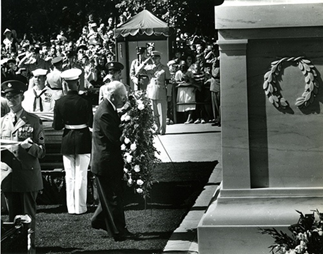


 govbooktalk
 Trudy Hawkins
