Federal Favorites: Our Best Selling Books of 2013

January 16, 2014

Ahhh…. It’s that time of the year again: Awards season! From the Golden Globes to the Academy Awards, red carpets abound with interviews of movie stars and other celebrities boasting about their best work during the past year.

We at the US Government Bookstore want to make sure our star publications and Federal agency publishers get their moment in the limelight, too. So, we are pleased to announce the winning publications that you, our readers, chose through your purchases over the past year: The US Government Bookstore Best Sellers of 2013!

Top-Government Books and Best-Sellers-of-2013 from the GPO US Government Online BookstoreHere are some of the more notable books, eBooks, posters and more that were winners in your eyes over the past year:

ART & TRAVEL

National Park System (Wall Map Poster)Americans love our national parks, so it’s no surprise the National Park System Wall Map Poster was a big hit.

Humanities-Magazine-2014-01Humanities is a bimonthly magazine published by the National Endowment for the Humanities (NEH) which covers NEH sponsored research in the humanities and NEH programs and projects, as well as information on recent and upcoming NEH grants.

HISTORY

With the 150th anniversary and reenactment of the Battle of Gettysburg last summer, The Gettysburg Campaign, June-July 1863 was a smash success (Read our post “Gettysburg, America’s Bloodiest Battle” for more information).

Perennial favorite Underground Railroad: Official Map and Guide (Read our post “The Underground Railroad Leaves its Tracks in History”) was joined by two publications commemorating 50th anniversaries:

Book Cover Image for Statistical Abstract of the United States 2012 (Paperback)Finally, the Statistical Abstract of the United States, the last official edition published in 2012 by the U.S. Census Bureau, contains a standardized summary of all official key statistics on the social, political, and economic organization of the United States (Read our post: “Statistical Abstract and Print Mashups in a Digital Age”).

TREES & FORESTS

Book Cover Image for The Little AcornI won’t be going out on a limb to say that our customers definitely wanted to hug trees this year, as books about Trees & Forests topped the lists. Why Would Anyone Cut a Tree Down? and The Little Acorn are extremely popular books for children explaining about the uses and life cycle of trees.

Image for Timber Management Field BookHow to Prune Trees and How To Recognize Hazardous Defects in Trees for amateur and professional gardeners, landscapers and foresters alike, and the Timber Management Field Book serves as the most popular reference handbook for forestry professionals.

(Read our posts “Oh, say, can you tree? American Christmas tree traditions,” “Pruning Trees” and “Dr. Seuss’ The Lorax Inspires Kids to Hug a Tree” for more information on these titles.)

BUSINESS AND LAW

A Basic Guide to Exporting for Small & Medium-Sized Businesses (10th Revised)International business entrepreneurs and would-be exporters have made A Basic Guide to Exporting: The Official Government Resource for Small and Medium-Sized Businesses a best-seller every year (Read our posts: “Exporting Made Simple and “Government eBooks Made Easy– and Sometimes Free” for more information).

Copyright Law of the United States in U.S. Code as of 12/2011Protecting intellectual property and privacy were extremely hot topics in 2013, making the Copyright Law of the United States and Related Laws and the Overview of the Privacy Act of 1974, 2012 Edition (extremely popular last year (Read our post: “The Privacy Act: What the Government Can Collect and Disclose about Youfor more information).

TRANSPORTATION AND NAVIGATION

TAstronomical Almanac for the Year 2014 and Its Companion the Astronomical Almanahe latest versions of the annual best-selling Astronomical Almanac for the Year 2014 (Combined Print plus Online Edition) and The Nautical Almanac for the Year 2014 are critical tools to aid commercial and private navigation by both air or water (Read our post: “Navigating by the Moon, Planets, and Starsfor more information).

Specifically for maritime navigation, Navigation Rules, International-Inland contains the latest international regulations for preventing Book Cover Image for FAA Safety Briefingcollisions at sea as well as the U.S. Inland Navigation Rules which have been in effect for all inland waters, including the Great Lakes.

The FAA Safety Briefing magazine provides updates on major Federal Aviation Administration rule changes and proposed changes, as well as refresher information on flight rules, maintenance air worthiness, avionics, accident analysis, and other aviation topics.

CITIZENSHIP AND CIVICS

Preparing to become a United States citizen and reaffirming knowledge of the American system of Government is extremely popular with our customers, and this year was no exception. Top civics and citizenship publications for 2013 included the Constitution of the United States and the Declaration of Independence (Pocket Edition) and materials for preparing for the U.S. Naturalization Test to become a United States citizen—

(Read our posts: “Quiz and History for Bill of Rights Day December 15”, “Quiz: Are you smarter than an 8th grade Civics student?”, and “Notable Documents 2009: Civics Flash Cardsfor more information on these products.)

Another patriotic publication that proved popular (Do you like the alliteration?:-) was Our Flag, which briefly describes the history of the American flag and sets forth the practices and observances appropriate to the display of Old Glory, was a top-seller.Book Cover Image for How Our Laws Are Made

The Congressional book, How Our Laws Are Made, provides citizens with a basic outline of the numerous steps of our Federal law-making process from the source of an idea for a legislative proposal through to its publication as a statute and becoming the “law of the land”.

HEALTH

Watching our weight and eating better were definitely on the minds of Americans this year as Diet & Nutrition books and posters were best sellers, including:

Book Cover Image for Special Operations Forces Medical HandbookHealthcare professionals turned often to the U.S. Government Bookstore for Physician References & Medical Handbooks, Medical & Health Research, and Military & Emergency Medicine publications in 2013. Top on the list were copies of the new Healthcare Law, as well as the Special Operations Forces Medical Handbook.

But also important were publications used to improve the quality of healthcare research and patient care and safety. These included the ORI: Introduction to the Responsible Conduct of Research  (also available in Packages of 50) which provides guidelines for Public Health Service-funded researchers, as well as the TeamSTEPPS patient care and safety training materials for healthcare personnel, such as the TeamSTEPPS Instructor Guide (Binder Kit) and TeamSTEPPS Pocket Guide that should be handed out to all healthcare personnel who attend TeamSTEPPS training.

SECURITY AND EMERGENCY MANAGEMENT

Emergency management personnel and first responders responded strongly to the many great safety and emergency response publications on the U.S. Government Bookstore.  These books and pocket guides topped their “must have” list in 2013:

Specifically for dealing with Hazardous Materials (HAZMAT) and Chemical-Biological-Radiological-Nuclear-Explosive (CBRNE) incidents, clean-up and response were these best-selling guides:

The importance of radio communications was underscored by the popularity of the United States Frequency Allocations: The Radio Spectrum Chart (Poster) of all assigned frequencies and the National Interoperability Field Operations Guide which contains radio guidelines for establishing or repairing emergency communications in a disaster area.

GOVERNMENT

Every year, the publications containing the President’s proposed Federal Budget for the upcoming fiscal year are on our best sellers list, and the Fiscal Year 2014 Budget publications followed this tradition. (Note: Stay tuned! The new Fiscal Year 2015 Budget publications will be coming out soon from the White House).

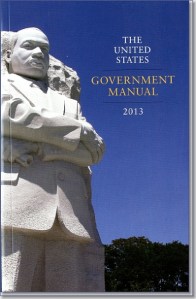
United States Government Manual 2013 lists all federal agenciesThe U.S. Government Manual, the ultimate handbook of all Federal agencies, was a hit as it is every year. Now you can get the new edition: United States Government Manual 2013 (Read about it on our Blog post:  “Understand How the U.S. Government is Organized”).

Other “Best of the Best” Government titles include:

How can I get these “Best-selling Books of 2013”?

  • Shop Online: You can purchase these publications from the U.S. Government Online Bookstore at http://bookstore.gpo.gov by clicking on the individual links above in this blog post. You may also click here to shop our entire “Best Sellers of 2013” collection.
  • Order by Phone: Call our Customer Contact Center Monday through Friday, 8 am to 5:30 pm Eastern (except US Federal holidays). From US and Canada, call toll-free 1.866.512.1800. DC or International customers call +1.202.512.1800.
  • Shop our Retail Store: Buy a copy of any print editions from this collection at GPO’s retail bookstore at 710 North Capitol Street NW, Washington, DC 20401, open Monday–Friday, 9 a.m. to 4 p.m., except Federal holidays, Call (202) 512-0132 for information or to arrange in-store pick-up.
  • Visit a Federal Depository Library: Search for one of these publications in a nearby Federal depository library.

About the Author: Government Book Talk Editor Michele Bartram is also Promotions and Ecommerce Manager for GPO’s Publication and Information Sales Division in Washington, DC, and is responsible for online and offline marketing of the US Government Online Bookstore (http://bookstore.gpo.gov) and promoting Federal government content to the public. Assistance provided by Stephanie Jaeger, Sales & Marketing Coordinator for GPO’s Sales & Marketing Division that markets GPO’s publishing services to the Federal sector.


Understand How the U.S. Government is Organized

January 13, 2014

The United States Government Manual 2013

United States US Government Manual 2013 ISBN: 9780160919510 Available from http://bookstore.gpo.gov/products/sku/069-000-00216-1?ctid=38The Government Manual is an essential guide to the United States Federal Government, where one can find the Declaration of Independence, the Constitution, and information on every U.S. Government agency. This official handbook on the Federal Government is published annually by the National Archives and Record Administration’s Office of the Federal Register.

Two years ago, Government Book Talk featured the Government Manual with the post “Browsing the Government Manual”. Here, we will take another look at this ultimate resource on the U.S. Government.

The 2013 Government Manual begins with the country’s founding documents, the Declaration of Independence and the Constitution, and then goes on to profile each agency, quasi-official agency, international organization in which the United States participates, board, commission, and committee found in the Legislative, Judicial, and Executive branches of the U.S. Government. The profiles include:

  • Organizational charts
  • List of principal officials
  • Summary statement of the agency’s purpose and role in the Federal Government
  • Brief history of the agency, including its legislative or executive authority
  • Description of its programs and activities
  • Information on consumer activities, contracts and grants, employment, publications, and contact information.

This organizational structure is beneficial for large executive branch agencies that have several departments each with their own mission and function.  For example, 20 pages of the manual are devoted to the nearly 40 different divisions, offices, and bureaus that make up the Department of Justice, which seems complex but pales in comparison to the Department of Defense and its behemoth structure.

The Government Manual concludes with the History of Agency Organization Structures. This section of the manual is arguably the highlight of this publication, as it provides a history of the lifetime and timeline of each agency as the U.S. Government grows with the country. For example, the Bureau of Immigration was created in 1891 as a branch of the Department of Treasury and cycled through to the Department of Commerce and Labor, the Department of Labor, the Department of Justice, and finally, after losing its name but keeping its functions, landed in the newly established Department of Homeland Security in 2002.

The Government Manual is not only a great resource on the United States Federal government and its functions, but also a goldmine of new information and interesting facts that are not commonly known about the U.S. Government and the country’s history.  So, if you would like  to understand how the U.S. Government is organized, then this is the book for you!

How can I get a copy of “The United States Government Manual 2013”?

About the Author: Our guest blogger is Emma Wojtowicz, Public Relations Specialist in GPO’s Office of Public Affairs. Additional content provided by Stephanie Jaeger, Sales & Marketing Coordinator for GPO’s Sales & Marketing Division and is responsible for marketing GPO’s publishing services to the Federal sector.


You Scream, I Scream for National Ice Cream Month

July 15, 2013

fruit-sorbetIce cream, long beloved by Americans, has a long, even pre-colonial history in the Americas. Some of my Mexican friends have told me that the Aztec emperor Moctezuma (popularly referred to today as Montezuma) had servants climb the snow-capped volcanic mountains for snow to mix with fruit juices as a hot-weather treat.

Image: Could this have been how the Aztec emperor was served his favorite icy dessert made of and served in natural fruit? Source. Cool Stuff Sorbet.

The United States got in on the game early, too. In 1744 Barbara Janssen Bladen, daughter of Lord Baltimore and wife of Proprietary Colonial Governor of Maryland Sir Thomas Bladen, first served ice cream in the American colonies. Ice cream, at that time, was a fashion of the well-heeled.

Williamsburg-Ice-Cream-MakingClick image to watch this Colonial Williamsburg, Virginia, video of how ice cream was made during the colonial era.

The French connectionjeffersonicecream

The sweet treat did not become popular in this country until after the American Revolution, when the Americans had continued contact with the French.

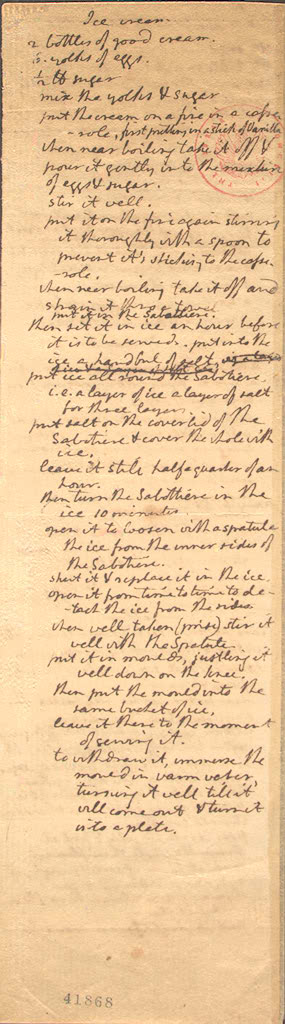
Thomas Jefferson learned how to make ice cream during his tenure in Paris as the United States’ Ambassador to France. He collected many recipes while in France, but ice cream was one of his favorites. In fact, the Library of Congress possesses a copy of a recipe for vanilla ice cream used by Thomas Jefferson written in Jefferson’s own hand.

Many visitors to Monticello, Jefferson’s home in Virginia, recorded enjoying ice cream during their meals there, probably fueling the dessert’s increasing national popularity.

Monticello-Garden-PartyImage: Monticello summer garden party where ice cream was sure to be served. Photo Credit: Jacob J. Gayer, National Geographic, December 1928

Ice cream gets added to the American “melting pot”

Americans’ fondness for ice cream has only increased over the years. Mary Todd Lincoln held berry parties which featured seasonal strawberries and ice cream served on the side.

An American named Abe Doumar is attributed by some as creating the first ice cream cone on July 23, 1904, at the World’s Fair at St. Louis, because the vendor ran out of ice cream dishes to use to serve it and resorted to rolled-up thin waffles. Having a cool container to keep our sweet treats in has certainly helped with our consumption of it.

Ice-cream-cones-Chicago-Worlds-fair

Image: Children and their mother enjoying the new sensation of ice cream cones at the 1904 St. Louis Exposition. Source: Aworldaffair blog.

According to the National Agriculture Statistics Service’s monthly publication Dairy Products, Americans consumed 163,544 pounds of ice cream (that’s hard and soft, full fat and low-fat combined) in May 2013.  It seems like we just can’t get enough of the sweet stuff.

I do declare…  It’s National Ice Cream Month

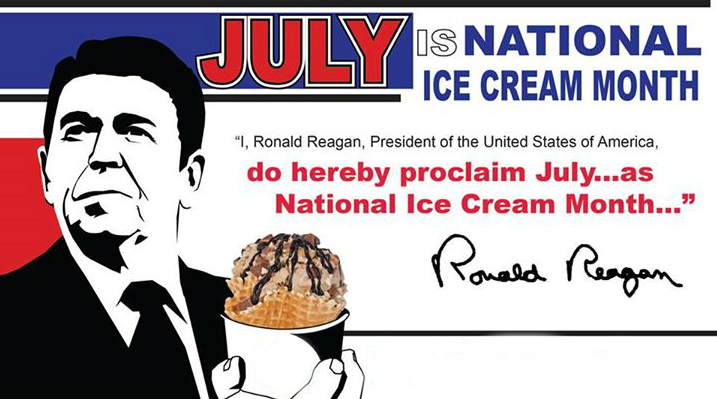
Ice cream is such a national institution that Congress passed a Joint Resolution favoring President Reagan’s declaration of July 15, 1984, as National Ice Cream Day and July as National Ice Cream Month. Presidential ice cream promotion continues to the present day.

Reagan-ice-cream-proclamation

Image: President Ronald Reagan conceived of National Ice Cream Month. Source: SubZero Ice Cream & Yogurt.

The Senate Inauguration Committee provided the recipe for the sour cream ice cream the White House chefs served at President Obama’s second inauguration. Whether it’s a result of the presidential lead, or simply ice cream’s yummy factor, hungry Americans and the dairy industry continue to celebrate every July as National Ice Cream Month.

Get the scoop and read all about ice cream

If you want to read more about American ice cream production, you can check out the aforementioned Dairy Products title, which reviews American dairy production, including all types of ice cream and frozen yogurt. Find the details of the American ice cream industry in 1997 Economic Census. Manufacturing. Industry series. Ice cream and frozen dessert manufacturing. To do some research about the history of ice cream in America, read some of the many excellent books and electronic resources recommended in this Library of Congress pathfinder.

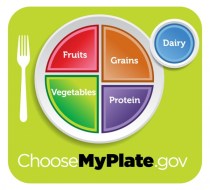
choosemyplateAfter all that consumption of ice cream related knowledge (and hopefully, some ice cream), you may find yourself worried about fitting into your trousers. Pick up a poster from the GPO Bookstore of What’s on Your Plate?: Choose My Plate  or Que Hay en Su Plato?: Mi Plato. They’ll inspire you to maintain your dietary goals of keeping healthy foods in balance with rich indulgences, such as ice cream.

quehayensuplatoI’m ready to get a copy of the poster for my office to keep my ice cream fixation in check. But first, if you’ll excuse me, it’s a hot summer day –I have an appointment with a double-scoop cone of Fear the Turtle.

How can I obtain these ice cream-related publications?

Federal Depository Librarians: You can find Dairy Products, Ice Cream and Frozen Dessert Manufacturing, and What’s On Your Plate? at your local Federal Depository library via the cataloging records in GPO’s Catalog of Government Publications, or buy them at the GPO Bookstore. You’re likely to find yourself hungry.

*Source: Davidson, Alan. The Oxford Companion to Food. Oxford, Oxford University Press, c1999.

About the author(s): Our guest blogger is Jennifer K. Davis from GPO’s Library Services & Content Management Division that supports the Federal Depository Libraries Program (FDLP). Additional content provided by Government Book Talk Editor-in-Chief and , GPO Promotions & Ecommerce Manager, Michele Bartram.


Glad Dad: Best Books and Sites for Fathers

June 11, 2013

Fathers-day-in-multiple-languagesMany of our personal characteristics, such as where we are born, the color of our eyes, our native language—are due to luck. If we get good parents, this is due to luck, too. When we become parents ourselves, though, we need to rely on our own hard work. Being a parent is the happiest and hardest job I’ve ever had, and I know many people say the same. Any help you can get with that job, whether it is from your own parents, friends, your child’s teachers, parents of your child’s friends, is welcome. As the African proverb goes, it takes a village to raise a child.

Image: How do you say Father? Source: Craftionary

The Federal government wants to be part of that village, and provide parents with any assistance it can give. And with Father’s Day this Sunday, the Government Printing Office wants to highlight these terrific Federal publications and websites to help Dads be all they can be. Whether he’s called Papi, Papa, Pop, Baba, Daddy, Da, Abbu or just plain Dad, celebrate the fathers– and father figures– you know by sharing these resources with them.

National Responsible Fatherhood Clearinghouse

Fatherhood.gov Despicable Me National Responsible Fatherhood ClearinghouseThe Government supports fathers in many ways; one of them is through the National Responsible Fatherhood Clearinghouse at Fatherhood.gov. Dads can check out this site to find fatherhood programs and resources, connect with mentors, read the latest blog posting on DadTalk, and take the Fatherhood Pledge.

Eleven Federal partners are involved in the Responsible Fatherhood Working Group: the Departments of Agriculture, Commerce, Education, Health and Human Services, Housing and Urban Development, Justice, Labor, Veterans Affairs, the Corporation for National and Community Service, the U.S. Equal Employment Opportunity Commission, and the Office of National Drug Control Policy. The level of Federal investment shows how seriously the President and the Federal Government takes this initiative. Another way to reap the benefits of Federal support of fathers is to read Federal government publications prepared in support of responsible fatherhood.

Promoting Responsible Fatherhood

Hero poster for FatherhoodFirst.org Promoting Responsible Fatherhood: Every Father Taking Responsibility for His Child’s Intellectual, Emotional, and Financial Well-Being discusses the various programs and initiatives that President Obama has been promoting as part of his Fatherhood and Mentoring Initiative, including the Head Start-sponsored Fatherhood First program (see poster on the left).

President Obama believes in the importance of fatherhood, as he said in 2009:

“I came to understand the importance of fatherhood through its absence—both in my life and in the lives of others. I came to understand that the hole a man leaves when he abandons his responsibility to his children is one that no government can fill” (p. 2).

To keep that void from opening, the Federal Government has started the aforementioned initiative, and the president has asked for Federal budget support for the Child Support Enforcement Program and to sustain funding for the Healthy Marriage and Responsible Fatherhood grants.

President Obama playing with daughters and new dog BoThis book discusses these and similar Federal Government programs started and/or supported by the Obama Administration, and what the programs have done to help fathers and their families.

Image: President Obama playing with his daughters Sasha and Malia along with then-new (and rambunctious) dog, Bo, on the White House lawn. Source: The White House

This volume is mostly a high-level program summary of interest to policy wonks, public policy workers, social workers, local government officials and students of those disciplines. However, the general public can also glean information about what resources they can get from the Federal Government to assist their families.

At the document’s end, there’s a list of things fathers, individuals, NGOs and places of worship can do to support fatherhood in their own communities as well. The document’s authors try to show how the Federal government stretches out a hand, but it ends on a note of helping oneself, much like the next volume.

Download an electronic copy of Promoting Responsible Fatherhood: Every Father Taking Responsibility for His Child’s Intellectual, Emotional, and Financial Well-Being for FREE from GPO. 

Dad’s Play Book: Coaching Kids to Read

Dad’s Play Book: Coaching Kids to ReadDad’s Play Book: Coaching Kids to Read is geared to get dads to help their kids to read, using case studies and helpful tips. The writers use two of the most important behavior modification tools at their disposal: we all want to be like our peers (hence the case studies) and men love sports (hence the extended coaching metaphor). Twenty dads are profiled on how they are helping their kids learn to read, giving their names, photos, occupations and ages, so they’re more relatable to readers.

The middle pages cover five skills that children need to have mastered to be readers by third grade; everyone who has responsibility for a pre-K through 3rd grade child should be taking some time to study this cheat sheet. Each tip has a paragraph subtitled, How Can a Dad Help? that gives specific suggestions for a dad to improve reading—for example, with fluency. This title is short but sweet; there’s a lot more to know about helping a child learn to read, but this friendly, picture-filled piece is definitely worth the time it takes not only to read it, but to study it and employ in your life as well.

You can either


How can I find these publications: Promoting Responsible Fatherhood: Every Father Taking Responsibility for His Child’s Intellectual, Emotional, and Financial Well-Being and Dad’s Play Book: Coaching Kids to Read?

About the author(s): Our guest blogger is Jennifer K. Davis from GPO’s Library Services & Content Management Division that supports the Federal Depository Libraries Program (FDLP). (Article was adapted by Government Book Talk Editor, Michele Bartram, GPO Promotions & Ecommerce Manager, from an original  post on the FDLP Community site blog by Ms. Davis.)


Dr. Seuss’ The Lorax Inspires Kids to Hug a Tree

April 23, 2013

Two publications show us the way… to care for trees this Arbor Day!

Lorax-Forest-Service-LaunchWith Earth Day yesterday and Arbor Day this Friday, April 26, and all week as National Parks Week, this is the perfect time to do something to help a tree grow or plant something new to celebrate the miracle of spring. If there are little ones in your life—children, grandchildren, nieces, nephews or friends of kids that you love—it’s a good time to teach them to love trees, plants, and flowers, too.

Image: The head of the Forest Service with the Lorax for the launch of the U.S. Forest Service’s Discover the Forest program which aims to inspire tweens (aged 8-12) and their parents to re-connect with nature, experiencing it first-hand. The campaign brings to life the joy and excitement kids have when they discover the wonders of nature, helping create interest in their environment and a lifelong relationship with it. Photo credit: U.S. Forest Service

The best way to get kids to appreciate nature, according to Dr. Seuss’ The Lorax Curriculum Guide, is to take them outdoors—and “according to the Institute for Social Research at the University of Michigan, children in the U.S. spend 50% less time outdoors than they did 20 years ago.” To counter the initial cries of “I want TV”, however, it helps to give kids directed activities when they go outside.

The U.S. Forest Service and the Ad Council have developed a partnership with Project Learning Tree and Universal Pictures to create an educational curriculum plan based on “The Lorax” film and story. The curriculum supports the Forest Service’s “Discover the Forest” campaign (See image caption above).

Lorax-Classroom-Guide_Plant-a-Tree

Image: “Plant a Tree” page 21 from the Lorax Classroom Guide.

Teachers can download for FREE the complete classroom guide of Dr. Seuss’ The Lorax Curriculum Guide as a PDF, or can download the individual activities to use in class (as long as it is for educational, and not commercial, purposes). There’s an interactive map of places you can go in the United States that have campgrounds, national forests, state campgrounds, etc. There’s a page of games and activities such as how to use a compass, take a virtual hike, create a leaf rubbing or become a Jr. Forest Ranger on the Web site.

The printed teacher’s guide has tests, bibliographies for the students, labs (plant a tree with the Lorax), and student pages for various grade levels (I saw K-4 and 6-8). Families are encouraged to use these activities, too.


Why would Anyone Cut a Tree Down? continues the ecological and conservation-minded discussion you might want to pursue with your kids or students this week.

However, this volume approaches conservation from a silvicultural perspective, rather than the Lorax’ perspective of promoting a child’s approach of nature generally. The age range for the publication is 8 and up, and the material might be a bit young for older middle school children—so its material is more directed to a specific age range. The Forest Service published this document also, and the authors are a writer/ editor / educator with the Forest Service and an illustrator with previous experience illustrating tree guides.

The book shows children the life cycle of trees, the need to remove sick trees, the uses for wood from cut trees, and types of trees that are dangerous, all so beautifully illustrated by Juliette Watts that they make the lessons come alive.

Purchase a copy from the GPO U.S. Government Online Bookstore, and flop under a tree canopy to read the story and appreciate all the gifts that nature has to give us.

As Dr. Seuss wrote, “Now that you’re here, the word of the Lorax seems perfectly clear. UNLESS someone like you cares a whole awful lot, nothing is going to get better. It’s not.”  It’s up to us (and the Forest Service and its partners) to encourage children to care a whole awful lot about our trees and forests. Using these publications is good a way to make that happen!


How can I find these publications?

1) Dr. Seuss’ The Lorax Curriculum Guide

  • You can find it via our PURL (Permanent URL)
  • Locate it through GPO’s Catalog of Government Publications CGP catalog record. GPO has cataloged both the print and the electronic versions to make things “a whole awful lot better” for the Federal Depository libraries that got it in the April 2013 record load.
  • Find it in a federal depository library near you.

2) Why would Anyone Cut a Tree Down?

  • Purchase it on GPO’s U.S. Government Online Bookstore.
  • Buy it at GPO’s Main (retail) Bookstore at 710 North Capitol Street NW, Washington, DC 20401, open Monday-Friday, 8:30am to 4pm Eastern Time, except Federal holidays. Call (202) 512-0132 for information.
  • Find it in a Federal Depository library.

About the Author(s):

Adapted by Government Book Talk Editor and U.S. Government Online Bookstore Manager Michele Bartram from a post written for the FDLP Community Blog by guest blogger Jennifer Davis from GPO’s Library Services & Content Management Division that supports the Federal Depository Libraries Program (FDLP).

From Prairies to Peaks with Rockies and Roosevelts

April 3, 2013

Guest blogger GPO Public Relations Specialist Emma Wojtowicz reviews this new publication by the U.S. Forest Service that explores the history of the Forest Service’s Rocky Mountain region, including the involvement of two Roosevelts.

From-Prairies-to-Peaks-US-Forest-ServiceThose traveling west-bound for spring break and summer vacation should check out From Prairies to Peaks: A History of the Rocky Mountain Region of the U.S. Forest Service, 1905-2012. This publication focuses on the Rocky Mountain region, which encompasses Colorado, Kansas, Nebraska, South Dakota and Wyoming and is home to 17 national forests and seven national grasslands.  In From Prairies to Peaks, author Anthony Godfrey takes readers on a tour of the Rocky Mountains to learn about the topography, climate and wildlife as well as the history stretching from when Native Americans originally inhabited the region to the preservation efforts made in recent decades by the Forest Service.

Readers must be true aficionados of the West and Rocky Mountains to digest this nearly 400-page publication. The history is very detailed, but very fascinating.  During the development of the West in the 19th century, it was believed that the United States had an abundance of forest resources, and millions of acres of trees were cleared as a result.

After the Civil War, the threat of a timber famine alerted the government to the problem and brought greater attention to forest management. Passed under President Theodore Roosevelt, the Federal Forest Transfer Act of 1905 moved control of the 63 million acres of national forest reserves from the Department of the Interior to the Department of Agriculture’s Bureau of Forestry, which was renamed the Forest Service.

President-Theodore-Roosevelt-1908-Cartoon-as-Practical-Forester

Image: 1908 editorial cartoon of President Theodore Roosevelt as “A Practical Forester.”  Source: St. Paul Minnesota “Pioneer Press”.

One of the most interesting time periods for the region was the 1920s-1930s. Upkeep and development of the Rocky Mountain region created many jobs for men through New Deal programs during the Great Depression.  In national forests, workers were assigned to tree planting and thinning, insect and rodent control, road building and improvement, telephone line construction, and lookout tower and house construction to increase communication for fire control and timber conservation.

Then during the Dust Bowl, the region played an important role in President Franklin Roosevelt’s Great Plains Shelterbelt Project from 1934-1942, which involved planting a shelterbelt or windbreak of drought-resistant trees and shrubs and from Canada to northern Texas to protect against the winds and prevent erosion.

10-row-shelterbelt-cross-sectionImage: Cross-section of a shelterbelt of various sized evergreens, large and small deciduous trees, and shrubs using the Forest Service-recommended standard of 10 rows that serve as a windbreak and wildlife shelter. Image source: MyFarmlife.com.

The Forest Service assigned the Rocky Mountain region with supervising the planting of more than 217 million trees and shrubs on the windward side of more than 30,000 individual farms. This is just a snapshot of the in-depth history chronicled in this publication.

Planting-first-shelterbelt-tree-OKFrom Prairies to Peaks provides a historical account of one of the lesser known regions in the United States. The West conjures images of cowboys, mountains, hikers and skiers, but there is more to the Rocky Mountain region.

This publication is a great resource for those interested in learning more about the West and the Forest Service. And for those already familiar with the Rocky Mountains region, this book will help you brush up on your history.

Image: Planting the first tree in the Nation’s first shelterbelt on the H.E. Curtis farm near Mangum in Greer county, Oklahoma, on March 18, 1935. Image source: Oklahoma Farm Report.

HOW DO I OBTAIN THIS  PUBLICATION: From Prairies to Peaks: A History of the Rocky Mountain Region of the U.S. Forest Service, 1905-2012?

  • Buy it online 24/7 at GPO’s Online Bookstore.
  • Buy it at GPO’s retail bookstore at 710 North Capitol Street NW, Washington, DC 20401, open Monday-Friday, 9am to 4pm, except Federal holidays, (202) 512-0132.
  • Find it in a library.

Earth Day

April 19, 2012

ImageAs we celebrate the 42nd Earth Day, the arrival of warm weather and the planting of summer gardens, our Guest Blogger — GPO Public Relations Specialist Emma Wojtowicz — takes a look at a few Federal publications focusing on the environment and how they play a role in our communities.

Congressional Budget Office: Potential Impacts of Climate Change in the United States

Published in May 2009, this report by the Congressional Budget Office (CBO) defines climate change and examines the causes and potential impact climate change has on North America. The report is brief (only 17 pages), concise and written in plain language, so you do not have to be a scientist to understand the focus of the paper. CBO effectively explains the scope of climate change and the effect is has on different parts of our environment. A few interesting takeaways:

  • Energy from the sun is absorbed by the Earth’s climate system and then radiated back into space. Greenhouse gases increase the amount of energy being held, thus warming the Earth’s surface.
  • Aerosol gases from volcanic eruptions have the opposite effect – they cool the Earth.
  • Climate change causes precipitation to be unevenly distributed: regions and seasons that already have greater precipitation will tend to get more and drier regions will tend to get less.
  • Rising surface temperature of the ocean increase the strength, size and intensity of hurricanes and typhoons.
  • Higher concentrations of carbon dioxide, a kind of greenhouse gas, will boost forest growth and timber production.

The Container Tree Nursery Manual, Volume Seven: Seedling Processing, Storage and Outplanting

A rite of spring and summer involves planning and preparing for outdoor landscaping and gardens, which means a trip to the nursery. Do you ever question where those trees come from? In the Container Tree Nursery Manual you will learn about the cultivation of trees from seed to what you purchase at the store. This publication is a bit dense with scientific processes and terminology, but once you get used to the tone of the book it makes for a fascinating read. Informative pictures, charts, graphs and diagrams help readers understand the content and “see” the entire life of a nursery tree from the planting, growing, storing, and shipping stages. For gardening enthusiasts, you can learn practical information that can be adapted to your own gardening endeavors. While you may not be planting trees in containers, the book emphasizes important growing techniques and considerations that you can apply to your own potted plants like the depth of the container for roots, water amount and frequency, as well as outside temperature.

Restorative Commons: Creating Health and Well-being through Urban Landscapes

This publication embodies the community spirit of Earth Day. Previously blogged about in August 2010, Restorative Commons is a lovely book about the importance and positive effect gardens and green landscapes have on urban communities. Urban gardening projects bring together neighbors and people of all ages giving them a common goal and a visible result to take pride in. The book explores the history of urban landscaping and ways community parks have shaped society; next it goes through various case studies of urban gardening initiatives in American cities and the impact they have on their communities; and then concludes with interviews with the people who lead the initiatives that beautify and strengthen their communities through urban gardens. Restorative Commons reflects the purpose and essence of Earth Day, which is to work with your neighbors to make a positive contribution to the community you live in and in turn an impression on greater global community.    

How do I obtain these Federal publications?

Congressional Budget Office: Potential Impacts of Climate Change in the United States

  • Buy it online 24/7 at GPO’s Online Bookstore
  • Buy it at GPO’s retail bookstore at 710 North Capitol Street NW, Washington, DC  20401, open Monday-Friday, 9am to 4pm, except Federal holidays, (202) 512-0132.
  • Find it in a library

The Container Tree Nursery Manual, Volume Seven: Seedling Processing, Storage and Outplanting

  • Buy it online 24/7 at GPO’s Online Bookstore
  • Buy it at GPO’s retail bookstore at710 North Capitol Street NW,Washington,DC20401, open Monday-Friday, 9am to 4pm, except Federal holidays, (202) 512-0132.
  • Find it in a library

Restorative Commons: Creating Health and Well-being through Urban Landscapes

  • Buy it online 24/7 at GPO’s Online Bookstore
  • Buy it at GPO’s retail bookstore at710 North Capitol Street NW,Washington,DC20401, open Monday-Friday, 9am to 4pm, except Federal holidays, (202) 512-0132.
  • Find it in a library

CIA’s World Factbook: Global intelligence for every thinker, traveler, soldier, spy

January 27, 2012

A great publication not only provides timely and valuable information, but it also allows us a glimpse into the times and events that necessitated its production.

Such is the case with the CIA’s World Factbook—which marks its 50th anniversary in 2012 for the classified version and over 40 years for the public version described here— and shows us a glimpse into how Pearl Harbor and the Cold War changed the way America began to gather information about all corners of the globe.

The Factbook has its origins in the aftermath of the Japanese attack on Pearl Harbor, and the realization by Congress and the White House that lack of coordinated intelligence across all Governmental departments had left the United States woefully unprepared for the attack, and determined to correct this as a national security necessity and priority.  According to the CIA historians:

During World War II, intelligence consumers realized that the production of basic intelligence by different components of the US Government resulted in a great duplication of effort and conflicting information.

Detailed and coordinated information was needed not only on such major powers as Germany and Japan, but also on places of little previous interest. In the Pacific Theater, for example, the Navy and Marines had to launch amphibious operations against many islands about which information was unconfirmed or nonexistent.

Image above: During WWII, OSS intelligence reviewed existing maps with the military. Source: Top Secret Writers

JANIS Drops In

To correct this deficiency, in 1943, General George B. Strong (G-2), Admiral H. C. Train (Office of Naval Intelligence – known as ONI), and General William J. Donovan (Director of the Office of Strategic Services – known as OSS, the precursor of the CIA) oversaw the formation of a Joint Intelligence Study Publishing Board to assemble, edit, coordinate, and publish the Joint Army Navy Intelligence Studies (JANIS).

JANIS was the first cross-departmental basic intelligence program to fulfill the needs of the US Government for an authoritative and coordinated appraisal of strategic basic intelligence.

All groups involved in the war agreed that finished basic intelligence was required that covered territories around the world where the war was being fought. They needed detailed, up-to-date maps and geography; basic understanding of the cultural, economical, political and historical issues of the people and the region.

Compiling and publishing this information for the Allied intelligence needs, JANIS became an indispensable reference for war planning and execution.

The Cold War Gives Birth to the CIA… and the National Intelligence Survey

But the Cold War that immediately followed World War II showed that there was just as much need for continued intelligence gathering as ever. In the 1946 publication “The Future of American Secret Intelligence,” national security author George S. Petee wrote: “The conduct of peace involves all countries, all human activities – not just the enemy and his war production.”

In acknowledgement of this, the Congress established the Central Intelligence Agency in 1947 which immediately took over responsibility for JANIS. The next year, the National Security Council authorized the National Intelligence Survey program as a peacetime replacement for the wartime JANIS program. By 1955, the Hoover Commission evaluating the CIA advised Congress that: “The National Intelligence Survey [NIS] is an invaluable publication which provides the essential elements of basic intelligence on all areas of the world. There will always be a continuing requirement for keeping the Survey up-to-date.

The Sum of All Facts: The World Factbook

Subsequently, the World Factbook was created as an “annual summary and update to the encyclopedic NIS studies.

Originally published only as a classified publication starting a half century ago in August 1962 (just prior to the Cuban Missile Crisis of October 1962), the World Factbook was first published in its declassified version for public consumption in June 1971, 40 years ago.

Image: CIA map produced for President Kennedy’s team estimating the range of Soviet missiles being set up in Cuba during the Cuban Missile Crisis in October 1962. Source: Canadian History Portal

Today’s World Factbook is the declassified version of the finished basic intelligence compiled by the U.S. Central Intelligence Agency (CIA) and coordinated across all the U.S. intelligence community. It uses only recognized, authoritative sources, not only CIA-gathered intelligence, but also a wide variety of U.S. Government agencies from the National Security Agency, Department of Defense, Department of State, Department of Agriculture, Defense Intelligence Agency, and hundreds of other published sources around the world.

Printed Version Provides an Annual Snapshot

Once a year, the Government Printing Office takes a snapshot of this information from the CIA as of January 1 and produces a printed version of the World Factbook. It provides unparalleled and succinct information about hundreds of countries in a format that provides an easy-to-use comparison.The Factbook has been available from GPO since 1975.

The 2011 version just published provides a two- to three-page summary of the history, people, government, economy, geography, communications, transportation, military, and transnational issues for 267 world entities, including U.S.-recognized countries, dependencies, and other areas in the world.

Each country has its own basic map and shows its flag, but of particular interest are the maps of the major world regions, as well three pull-out maps included in the publication: Physical Map of the World, Political Map of the World, and Standard Time Zones of the World Map, all of which can be used as wall maps.

Who Can Benefit from the World Factbook?

A perennial best seller in the GPO bookstore, The World Factbook is used by not only US Government officials, but is a must-have reference for researchers, news organizations, businesses, geographers, international travelers, teachers, professors, librarians, and students.

In short, after 40 years, the World Factbook is still the best source of  up-to-date, summarized intelligence about the world for any “thinker, traveler, soldier, or spy” of any age!

Image: Pupils at Crosby’s Valewood Primary School near Liverpool, England, dress up as ‘Spies’ as part of a creative project. Photographer: Andrew Teebay. Source: Liverpool Echo

To gather your own up-to-date intelligence about the world we live in, you can obtain the World Factbook 2011 at one of these locations:

How can you get this publication?

  • Buy the current version of the World Factbook and selected previous editions online 24/7 at GPO’s Online Bookstore.
  • Buy it at GPO’s retail bookstore at 710 North Capitol Street NW, Washington, DC 20401, open Monday-Friday, 9am to 4pm, except Federal holidays, (202) 512-0132.
  • Find it in a library.

Some Interesting “DID YOU KNOW?” Facts related to the CIA’s World Factbook:

  • Question: What separates “intelligence” from “information”?
    • Answer: According to the CIA: The Intelligence Cycle is the process by which information is acquired, converted into intelligence, and made available to policymakers. Information is raw data from any source, data that may be fragmentary, contradictory, unreliable, ambiguous, deceptive, or wrong. Intelligence is information that has been collected, integrated, evaluated, analyzed, and interpreted. Finished intelligence is the final product of the Intelligence Cycle ready to be delivered to the policymaker.

The three types of finished intelligence are: basic, current, and estimative. Basic intelligence provides the fundamental and factual reference material on a country or issue.

  • Question: “Why is the British Labour Party misspelled?”
    • Answer: When American and British spellings of common English words differ, The World Factbook always uses the American spelling, even when these common words form part of a proper name in British English.
  • Question: “What is a ‘doubly landlocked’ country and which are the only two in the world?”
    • Answer: A doubly landlocked country is one that is separated from an ocean or an ocean-accessible sea by two intervening countries. Uzbekistan and Liechtenstein are the only countries that fit this definition.
  • Question: “Why does the Factbook use metric units, even though Americans still use traditional units of measure like feet, pounds, and Fahrenheit?”
    • Answer: US Federal agencies are required by the Metric Conversion Act of 1975 (Public Law 94-168) and by Executive Order 12770 of July 1991 to use the International System of Units, commonly referred to as the metric system or SI. In addition, the metric system is used by over 95 percent of the world’s population.
  • Question: “Why is the European Union listed at the end of the Factbook entries? It’s not a country!”
    • Answer:  The European Union (EU) is not a country, but it has taken on many nation-like attributes and these may be expanded in the future. A more complete explanation on the inclusion of the EU into the Factbook can be found in the Preliminary statement.

About the Author:  Michele Bartram is Promotions Manager for GPO’s Publication and Information Sales Division and is responsible for online and offline marketing of the US Government Online Bookstore (Bookstore.gpo.gov) and promoting Federal government content to the public. She’s a big fan of the National Spy Museum and of spy movies, which she is going to enjoy for her birthday tomorrow.