Get to the Olympics with Help from these Free U.S. Government Resources

February 21, 2014

Guest blogger and GPO Supervisory Librarian Valerie Furino writes about U.S. Government publications that can help you achieve your Olympic ambitions.

The 2014 Sochi Winter Olympics are wrapping up, and they have been entertaining and full of surprises.  Many people watch the Olympics and dream of the magical moment of being awarded a medal (preferably gold).   However, that dreamy medal was earned through years of training and preparation.  If you want to give living the life of an Olympian a try, you’ll need to work hard.  You need to eat like an athlete – you need to train like an athlete – and you’ll actually need to GET to the Olympics – grab that suitcase!  Think you’ve got what it takes?  Let’s find out.

us-olympic-training-center-signImage: Tourists enjoying the Olympic Rings sign at the Headquarters for the U.S. Olympic Committee administration and the Olympic Training Center programs in Colorado Springs, Colorado.

Get into Competition Shape

First, let’s examine eating habits.  This should be easy – athletes are known for devouring lots of calories.  This handy chart illustrates typical calories burned, depending on a person’s weight – note that the Olympic sports ice hockey, ice skating, and skiing are all included.  (If all the activities on this chart were Olympic sports, I’d be a gold medalist shoo-in for “Operate Snow Blower” after this winter!)  However, you need to eat the right kind of calories.  You’ll need fuel to power you through those salchows and Axel jumps. Nutrition.gov provides a great starting place on various nutrition topics, including meal planning, label reading, and dietary supplements.

ChooseMyPlate_gov_Winter-Health-ChallengeImage: Winter Health Challenge from ChooseMyPlate.gov (February 2014).

Que hay en su plato- Spanish version of What's on My Plate from ChooseMyPlateFrom there, you can navigate to ChooseMyPlate.gov (or buy the What’s on Your Plate?: Choose My Plate -English Language Version or the Spanish language version, Que Hay en Su Plato?: Mi Plato) which contains helpful advice on what to eat.  No matter your circumstance – college student, vegetarian, pregnant – you’ll find great tips on nutrition and some helpful recipes.

OK, nutritional standards have been established.  Now let’s move on to physical training.  Depending on your sport preference, you’ll need to exercise specific muscles – for example, cross-country skiing requires a well-developed abdomen, arms, and lower back, while snowboarding needs a strong core and shoulders.  Health.gov is a good place to start, as it provides general information on both nutrition and activity.  It provides a helpful link to Let’s Move!, a well-known initiative supported by First Lady Michelle Obama that encourages physical activity.  The President’s Council on Fitness, Sports, and Nutrition has a fantastic site loaded with activity and nutrition tips.  If you’d like all your information in one publication, try the Physical Activity Guidelines for Americans; if you’re more a visual person, check out some videos .  All these resources are useful tools to get you in shape – or at least keep you towing the line on your fitness New Year’s resolutions.

First-Lady-Michelle-Obama-White-House-lawn-Lets-move-kidsImage: First Lady Michelle Obama exercising with kids on the White House lawn for the Let’s Move! initiative. Source: White House

Getting to the Games

Apply-for-US-passport-State-DepartmentYou’ve trained and you’ve been keeping excellent eating habits – you’re now ready to get to the games, whether as an athlete or a spectator!  (Hey, it takes a lot of climbing to get to your seat in an Olympic stadium.)   Besides the United States, the Olympics have been held in some beautiful and exotic places – London, Beijing, Athens,  Vancouver, and Torino.  If traveling out of your home country, be sure to check if any vaccinations are required.  Also check for any travel alerts.  Do you have a current passport?  Need a visa to travel to the host country? These convenient U.S. State Department sites will guide you.

world_factbook_12-13After taking care of logistics, spend some time reading up on the host nation.  The World FactBook updated annually by the CIA (you can also buy the World Factbook print edition complete with wall maps) and the Library of Congress Country Studies series (many also available in print from our Foreign Country Studies collection) are two excellent resources to help guide you through your host country.  And this handy worldwide wireless guide from the Federal Communications Commission will help you figure out how to use your phone while traveling abroad!

How can I get these publications?

  • Click on the Links: For the free resources, click on the links above in the blog post.
  • Visit a Federal Depository Library: Search for one of these publications in a nearby Federal depository library. (Librarians: You can find the records for most of these titles in the Catalog of U.S. Government Publications or CGP.)
  • Shop Online Anytime: You can buy any of the eBooks or print publications mentioned above—with FREE Standard Shipping worldwide— from the U.S. Government Online Bookstore at http://bookstore.gpo.gov.
  • Order by Phone: You may also order print editions mentioned in this blog post by calling our Customer Contact Center Monday through Friday, 8 am to 5:30 pm Eastern (except US Federal holidays). From US and Canada, call toll-free 1.866.512.1800. DC or International customers call +1.202.512.1800.
  • Shop our Retail Store: Buy a copy of any print editions mentioned in this blog post by visiting GPO’s retail bookstore at 710 North Capitol Street NW, Washington, DC 20401, open Monday–Friday, 9 a.m. to 4 p.m., except Federal holidays, Call (202) 512-0132 for information or to arrange in-store pick-up.

About the Author: Valerie Furino is a Supervisory Librarian for the Government Printing Office’s Library Services & Content Management (LSCM) Division.


“Are you Ready?” for Extreme Cold and Other Natural and Man-made Disasters

January 23, 2014

Image below: Graph depicts how variations in the polar vortex affect weather in the mid-latitudes. Courtesy: National Science Foundation

Polar-vortex-fall-to-winter-chartAs the United States shivers under the Arctic Express, Polar Vortex, Polar Cyclone, Polar Low, Circumpolar Whirl or whatever name you call it (I just call it FREEZING!!!!) with snow, ice, and some of the most extreme cold conditions in decades, Americans will be happy to know that the Federal Emergency Management Agency (FEMA) has help available in the form of its extremely useful new disaster preparedness guide, Are You Ready?: An In-Depth Guide to Citizen Preparedness.

FEMA Are You Ready?: An In-Depth Guide to Citizen Preparedness ISBN: 9780160920745Intended as both a reference source as well as a step-by-step manual, this easy-to-follow guide has been designed to help Americans “learn how to protect themselves and their families against all types of hazards”.

According to the FEMA authors:

The focus of the content is on how to develop, practice, and maintain emergency plans that reflect what must be done before, during, and after a disaster to protect people and their property. Also included is information on how to assemble a disaster supplies kit that contains the food, water, and other supplies in sufficient quantity for individuals and their families to survive following a disaster in the event they must rely on their own resources.

The guide advises on planning before a disaster, responding during a disaster, and recovering after a disaster and is organized into the following sections: Why Prepare, Part 1 Basic Preparedness, Part 2 Natural Hazards, Part 3 Technological Hazards, Part 4 Terrorism, and Part 5 Recovering from Disaster.

Each chapter has specific tips on preparation, what to do during the particular disaster, instructions for what to do afterwards, and where to go for more information, including links for free publications.

Disasters and emergencies cover the gamut in three areas:

a)      Natural Hazards, including: Floods, Tornadoes, Hurricanes, Thunderstorms and Lightning, Winter Storms and Extreme Cold,  Extreme Heat, Earthquakes, Volcanoes, Landslides and Debris Flow (Mudslide), Tsunamis, Fires and Wildfires;

b)      Technological Hazards, including:  Hazardous Materials Incidents, Household Chemical Emergencies, and Nuclear Power Plants

c)      Terrorism, including: General terrorist threats, Explosions, Biological Threats, Chemical Threats, Nuclear Blast, and Radiological Dispersion Device (RDD).

Are You Ready?… for Winter Storms and Extreme Cold

FEMA-Are-You-Ready_page-80-Winter-Storms-and-Extreme-ColdAs I was concerned about the extreme cold, I turned to Part 2, Natural Hazards, Section 2.5 Winter Storms and Extreme Cold.

In the preparation part, I found useful terminology such as the difference between sleet and freezing rain, protective measures and supplies to gather, tips on how to winterize my car (e.g., have you cleaned your car battery terminals and used gasoline additives to keep water out of your fuel lines?) and how to dress for the winter weather (did you know mittens are warmer than gloves?).

FEMA-Are-You-Ready_page-83-Winter-Dress-for-ColdDuring a winter storm, “Are you ready?” gives more advice, such as what to do if a blizzard traps you in the car and how to watch for signs of hypothermia.

[Signs of hypothermia]… include uncontrollable shivering, memory loss, disorientation, incoherence, slurred speech, drowsiness, and apparent exhaustion. If symptoms of hypothermia are detected, get the victim to a warm location, remove wet clothing, warm the center of the body first, and give warm, non-alcoholic beverages if the victim is conscious. Get medical help as soon as possible.

Other Useful Information in “Are You Ready?”

In addition to information on specific types of emergencies, the guide includes a number of other very useful resources.

Assembling a Disaster Supplies Kit:  A whole chapter is devoted to assembling a good general disaster supplies kit for multiple locations: home, work and vehicle.

Practice Makes Perfect: Advice on how to practice and maintain your emergency plan is under Section 1.6.

General Evacuation Guidelines:  Tells what to do to prepare your home if you have to evacuate, such as utility shut-off and safety, reviewing and securing of insurance and vital records, and so on.

Special Needs: Information on how to do disaster planning to accommodate someone with disabilities is included.

Pets: Caring for pets in emergencies is not forgotten, either.

FEMA Hazard Maps: It highlights how to get free hazard maps from FEMA in your area by accessing FEMA’s Hazard Mapping Portal.

Homeland-Security-Threat-Assessments-Color-MatrixWarning Systems and Signals: The guide explains different national alert systems such as the Emergency Alert System (EAS) and National Oceanic & Atmospheric Administration (NOAA) Weather Radio (NWR), as well as the Homeland Security Advisory System with its Threat Conditions thermometer.

Quizzes: The guide even includes some quizzes such as the Terrorism Knowledge Check on page 172 that asks such questions as:

What would you do, if you were at work and…

a. there was an explosion in the building?

b. you received a package in the mail that you considered suspicious?

c. you received a telephone call that was a bomb threat?

Mental Health Issues: Tips are included on how to recognize if children vs. adults may need crisis counseling or stress management assistance as well as how to ease disaster-related stress (such as attending memorial services). For children, guidelines are included by age range of common reactions to traumatic events, along with tips on how adults can reassure children after a disaster.

For additional information about Federal mental and medical emergency resources, read our previous blog post: “Help is Just a Call, Click or Page Away: Federal Disaster Helplines & Emergency Medical Resources.”

Family Forms: The guide is customizable to you and your family with forms to fill out for your own emergency plans. Included is a form for you to use to fill out information as you collect it from your local authorities on possible hazards and emergencies in your community, the Risk Level and how to reduce your risk, along with a “Community and Other Plans” form to use to record answers from your local officials about your community’s disaster and emergency plans.  Also included is a form to draw and to record your family’s specific evacuation route and another to record your Family Communications Plan.

Checklists and Appendices: The guide also includes some handy appendices: Appendix A: Water Conservation Tips, Appendix B: Disaster Supplies Checklist, and the all-important Appendix C: Family Communications Plan.

Preparedness Websites: One is a list of Disaster Public Education Websites from both the Federal Government such as FEMA’s own Ready.gov site (www.ready.gov), as well as non-Governmental sites, like the Institute for Business and Home Safety, www.ibhs.org.

Disaster Recovery Assistance: Finally, advice and resources for getting disaster recovery assistance are covered in the Are You Ready? guide, too.

FEMA Are You Ready?: An In-Depth Guide to Citizen Preparedness ISBN: 9780160920745How can I get a copy ofAre You Ready?: An In-Depth Guide to Citizen Preparedness”?

Whether you live near an active volcano; in Tornado Alley or a Hurricane Zone; in wildfire, mudslide or flood-prone areas; or just want to be prepared for any emergency—natural or man-made—this guide will help you save the day!

  • MULTIPLE COPIES: FEMA recommends having a completed guide for each location for your family members: home, work or school, and your vehicle(s). Fill out the customizable sections in each copy with your relevant family, workplace and community information.
  • Shop Online: You can buy this publication from the U.S. Government Online Bookstore at http://bookstore.gpo.gov by:

  • Order by Phone: Call our Customer Contact Center Monday through Friday, 8 am to 5:30 pm Eastern (except US Federal holidays). From US and Canada, call toll-free 1.866.512.1800. DC or International customers call +1.202.512.1800.
  • Shop our Retail Store: Buy a copy of any print editions from this collection at GPO’s retail bookstore at 710 North Capitol Street NW, Washington, DC 20401, open Monday–Friday, 9 a.m. to 4 p.m., except Federal holidays, Call (202) 512-0132 for information or to arrange in-store pick-up.
  • Digital: Find a PDF version on the FEMA site.
  • Visit a Federal Depository Library: Search for it in a nearby Federal depository library.

About the Author: Government Book Talk Editor Michele Bartram is Promotions Manager for GPO’s Publication and Information Sales Division in Washington, DC, and is responsible for online and offline marketing of the US Government Online Bookstore (http://bookstore.gpo.gov) and promoting Federal government content to the public.


Federal Favorites: Our Best Selling Books of 2013

January 16, 2014

Ahhh…. It’s that time of the year again: Awards season! From the Golden Globes to the Academy Awards, red carpets abound with interviews of movie stars and other celebrities boasting about their best work during the past year.

We at the US Government Bookstore want to make sure our star publications and Federal agency publishers get their moment in the limelight, too. So, we are pleased to announce the winning publications that you, our readers, chose through your purchases over the past year: The US Government Bookstore Best Sellers of 2013!

Top-Government Books and Best-Sellers-of-2013 from the GPO US Government Online BookstoreHere are some of the more notable books, eBooks, posters and more that were winners in your eyes over the past year:

ART & TRAVEL

National Park System (Wall Map Poster)Americans love our national parks, so it’s no surprise the National Park System Wall Map Poster was a big hit.

Humanities-Magazine-2014-01Humanities is a bimonthly magazine published by the National Endowment for the Humanities (NEH) which covers NEH sponsored research in the humanities and NEH programs and projects, as well as information on recent and upcoming NEH grants.

HISTORY

With the 150th anniversary and reenactment of the Battle of Gettysburg last summer, The Gettysburg Campaign, June-July 1863 was a smash success (Read our post “Gettysburg, America’s Bloodiest Battle” for more information).

Perennial favorite Underground Railroad: Official Map and Guide (Read our post “The Underground Railroad Leaves its Tracks in History”) was joined by two publications commemorating 50th anniversaries:

Book Cover Image for Statistical Abstract of the United States 2012 (Paperback)Finally, the Statistical Abstract of the United States, the last official edition published in 2012 by the U.S. Census Bureau, contains a standardized summary of all official key statistics on the social, political, and economic organization of the United States (Read our post: “Statistical Abstract and Print Mashups in a Digital Age”).

TREES & FORESTS

Book Cover Image for The Little AcornI won’t be going out on a limb to say that our customers definitely wanted to hug trees this year, as books about Trees & Forests topped the lists. Why Would Anyone Cut a Tree Down? and The Little Acorn are extremely popular books for children explaining about the uses and life cycle of trees.

Image for Timber Management Field BookHow to Prune Trees and How To Recognize Hazardous Defects in Trees for amateur and professional gardeners, landscapers and foresters alike, and the Timber Management Field Book serves as the most popular reference handbook for forestry professionals.

(Read our posts “Oh, say, can you tree? American Christmas tree traditions,” “Pruning Trees” and “Dr. Seuss’ The Lorax Inspires Kids to Hug a Tree” for more information on these titles.)

BUSINESS AND LAW

A Basic Guide to Exporting for Small & Medium-Sized Businesses (10th Revised)International business entrepreneurs and would-be exporters have made A Basic Guide to Exporting: The Official Government Resource for Small and Medium-Sized Businesses a best-seller every year (Read our posts: “Exporting Made Simple and “Government eBooks Made Easy– and Sometimes Free” for more information).

Copyright Law of the United States in U.S. Code as of 12/2011Protecting intellectual property and privacy were extremely hot topics in 2013, making the Copyright Law of the United States and Related Laws and the Overview of the Privacy Act of 1974, 2012 Edition (extremely popular last year (Read our post: “The Privacy Act: What the Government Can Collect and Disclose about Youfor more information).

TRANSPORTATION AND NAVIGATION

TAstronomical Almanac for the Year 2014 and Its Companion the Astronomical Almanahe latest versions of the annual best-selling Astronomical Almanac for the Year 2014 (Combined Print plus Online Edition) and The Nautical Almanac for the Year 2014 are critical tools to aid commercial and private navigation by both air or water (Read our post: “Navigating by the Moon, Planets, and Starsfor more information).

Specifically for maritime navigation, Navigation Rules, International-Inland contains the latest international regulations for preventing Book Cover Image for FAA Safety Briefingcollisions at sea as well as the U.S. Inland Navigation Rules which have been in effect for all inland waters, including the Great Lakes.

The FAA Safety Briefing magazine provides updates on major Federal Aviation Administration rule changes and proposed changes, as well as refresher information on flight rules, maintenance air worthiness, avionics, accident analysis, and other aviation topics.

CITIZENSHIP AND CIVICS

Preparing to become a United States citizen and reaffirming knowledge of the American system of Government is extremely popular with our customers, and this year was no exception. Top civics and citizenship publications for 2013 included the Constitution of the United States and the Declaration of Independence (Pocket Edition) and materials for preparing for the U.S. Naturalization Test to become a United States citizen—

(Read our posts: “Quiz and History for Bill of Rights Day December 15”, “Quiz: Are you smarter than an 8th grade Civics student?”, and “Notable Documents 2009: Civics Flash Cardsfor more information on these products.)

Another patriotic publication that proved popular (Do you like the alliteration?:-) was Our Flag, which briefly describes the history of the American flag and sets forth the practices and observances appropriate to the display of Old Glory, was a top-seller.Book Cover Image for How Our Laws Are Made

The Congressional book, How Our Laws Are Made, provides citizens with a basic outline of the numerous steps of our Federal law-making process from the source of an idea for a legislative proposal through to its publication as a statute and becoming the “law of the land”.

HEALTH

Watching our weight and eating better were definitely on the minds of Americans this year as Diet & Nutrition books and posters were best sellers, including:

Book Cover Image for Special Operations Forces Medical HandbookHealthcare professionals turned often to the U.S. Government Bookstore for Physician References & Medical Handbooks, Medical & Health Research, and Military & Emergency Medicine publications in 2013. Top on the list were copies of the new Healthcare Law, as well as the Special Operations Forces Medical Handbook.

But also important were publications used to improve the quality of healthcare research and patient care and safety. These included the ORI: Introduction to the Responsible Conduct of Research  (also available in Packages of 50) which provides guidelines for Public Health Service-funded researchers, as well as the TeamSTEPPS patient care and safety training materials for healthcare personnel, such as the TeamSTEPPS Instructor Guide (Binder Kit) and TeamSTEPPS Pocket Guide that should be handed out to all healthcare personnel who attend TeamSTEPPS training.

SECURITY AND EMERGENCY MANAGEMENT

Emergency management personnel and first responders responded strongly to the many great safety and emergency response publications on the U.S. Government Bookstore.  These books and pocket guides topped their “must have” list in 2013:

Specifically for dealing with Hazardous Materials (HAZMAT) and Chemical-Biological-Radiological-Nuclear-Explosive (CBRNE) incidents, clean-up and response were these best-selling guides:

The importance of radio communications was underscored by the popularity of the United States Frequency Allocations: The Radio Spectrum Chart (Poster) of all assigned frequencies and the National Interoperability Field Operations Guide which contains radio guidelines for establishing or repairing emergency communications in a disaster area.

GOVERNMENT

Every year, the publications containing the President’s proposed Federal Budget for the upcoming fiscal year are on our best sellers list, and the Fiscal Year 2014 Budget publications followed this tradition. (Note: Stay tuned! The new Fiscal Year 2015 Budget publications will be coming out soon from the White House).

United States Government Manual 2013 lists all federal agenciesThe U.S. Government Manual, the ultimate handbook of all Federal agencies, was a hit as it is every year. Now you can get the new edition: United States Government Manual 2013 (Read about it on our Blog post:  “Understand How the U.S. Government is Organized”).

Other “Best of the Best” Government titles include:

How can I get these “Best-selling Books of 2013”?

  • Shop Online: You can purchase these publications from the U.S. Government Online Bookstore at http://bookstore.gpo.gov by clicking on the individual links above in this blog post. You may also click here to shop our entire “Best Sellers of 2013” collection.
  • Order by Phone: Call our Customer Contact Center Monday through Friday, 8 am to 5:30 pm Eastern (except US Federal holidays). From US and Canada, call toll-free 1.866.512.1800. DC or International customers call +1.202.512.1800.
  • Shop our Retail Store: Buy a copy of any print editions from this collection at GPO’s retail bookstore at 710 North Capitol Street NW, Washington, DC 20401, open Monday–Friday, 9 a.m. to 4 p.m., except Federal holidays, Call (202) 512-0132 for information or to arrange in-store pick-up.
  • Visit a Federal Depository Library: Search for one of these publications in a nearby Federal depository library.

About the Author: Government Book Talk Editor Michele Bartram is also Promotions and Ecommerce Manager for GPO’s Publication and Information Sales Division in Washington, DC, and is responsible for online and offline marketing of the US Government Online Bookstore (http://bookstore.gpo.gov) and promoting Federal government content to the public. Assistance provided by Stephanie Jaeger, Sales & Marketing Coordinator for GPO’s Sales & Marketing Division that markets GPO’s publishing services to the Federal sector.


Oh, say, can you tree? American Christmas tree traditions

December 17, 2013

Victorian German style Christmas Xmas tree1899To anyone who enjoys Christmas trees, we say “Wie treu sind deine Blätter!” This means “how faithful are your branches”, a line from “O Tannenbaum,” the German Christmas carol. “O Tannenbaum” (Oh Christmas Tree)* was originally a folk song from Germany that’s been translated to English and sung here in the United States for years. In fact, Nat King Cole sang a classic version in German if you’re ever interested in hearing the original version. A bit of trivia: *The tune for “O Tannenbaum” is also used for the state song of Maryland—if you’re from there, or went to university there, you might have heard the state song if you haven’t heard the holiday version! Just like they got us hooked on the song about evergreens, Germany was instrumental in getting us hooked on the decorated Christmas tree tradition as well.

German immigrants really started the modern craze for Christmas trees that came to the United States in the early 1800s. Queen Victoria, who helped set fashions for the Western world in the mid to late 1800s, helped the trend along with her family Christmas tree (which she may have learned about from her German husband, Albert). (Image above depicts a Victorian era Christmas celebration.)

The evergreen tree is likely a Yule custom carried over and remade from Celtic and/or Scandinavian pagans. Regardless of the origins of the custom of bringing an evergreen into your dwelling place during the year’s darkest days, this much is for sure: having a Christmas tree is now a tried and true American holiday tradition.

Since Christmas trees have become more secular and are so popular, the Christmas tree industry is a huge business in the United States. In 2007, Americans spent over $460 million on cut trees. The Federal government wants to support this industry, and people’s holiday happiness.

TREE AND FIRE SAFETY

To help people keep their holidays safe, the Federal government publishes a number of Christmas tree fire safety publications, such as the U.S. Fire Safety Administration’s (USFA) Christmas/Christmas Tree Fires and December and Holiday Fires.

FEMA-USFA-holiday-fire-safety-infographicImage: US Fire Safety Administration’s Winter Holiday Fire Safety infographic.

According to the USFA, fire deaths increase by 50% between December 24 and 26, and injuries during that period increase by 61%.  As the USFA pointed out, “In residential structure fires where the ignition point is a Christmas tree or other holiday decoration, the fire is typically more severe in every measurable way (p.2)”. For tips on avoiding Christmas tree fires, and to view a video on proper Christmas tree safety, take a look at USFA’s Holiday & Christmas Tree Fire Safety Outreach Materials. You’ll be able to increase your awareness and look out for your family’s welfare while continuing to enjoy your household decorations.

CUTTING YOUR OWN TREE FROM A NATIONAL FOREST

If you and/or your family enjoy going out to pick a tree and cut it, you might be able to pick one up from a national forest. For example, the Federal government has harvested all of the Capitol Christmas trees from national forests. In fact, the 2009 tree was a blue spruce that came from the Apache-Sitgreaves National Forest.

Certain forests have designated areas where it is possible to cut Christmas trees, once you have paid for your cutting permit. Contact your local national forest for its policies; you’re especially likely to find Christmas tree cutting areas in the West. Some national forests post their Christmas tree maps online. You can download Kenai National Wildlife Refuge, Soldotna, Alaska: Christmas Tree Cutting Areas and Maps of 2013 Cutting Areas in the Apache and Sitgreaves National Forests. You’ll be pulling your tree from a prestigious tree-growing area, if you do decide to get a permit from a national forest.

The trees are for personal use only, and Forest Service allows only one tree per household. Permits for the trees are quite cheap, compared to what I paid at my local Washington, DC, area hardware store. You do have to factor into the cost a bit more money for the gas it takes to haul a tree out of the forest and get it home. However, some experiences, such as holiday traditions spent together with family and friends, are priceless.

PLANTING AND CARING FOR YOUR LIVE TREE

Why-would-anyone-cut-a-tree-down? by US Forest Service ISBN: 9780160916267Some families buy live Christmas trees then plant them when the holidays are over, while others use a cut tree for the holidays then plant a new tree in the spring as a symbol of renewal.

To explain to children the need for cutting trees as well as the value of this renewable resource, the Forest Service has published the best-selling publication “Why Would Anyone Cut a Tree Down?” It is full of explanations of need to remove trees for fire management and helping prevent overcrowding, and gives instructions on how to plant a tree as well.

How-to-Prune-Trees How-to-Recognize-Defects-in-TreesTo care for your live tree once it’s planted, be sure to check out How to Prune Trees to keep your tree looking and growing its best.

And the useful How To Recognize Hazardous Defects in Trees will help you identify problems in a tree that could be detrimental to its health.

FAMOUS WASHINGTON, DC AREA CHRISTMAS TREES

Here in the Nation’s capital, there are a number of famous Christmas trees.

National Christmas Tree and the Pathway of Peace

Since 1923, the United States has held a tradition of having a National Christmas Tree lighting in Washington, DC, starting with President Coolidge lighting the “First National Christmas Tree.” Starting in 1954, a “Pathway of Peace,” 56 smaller, decorated trees representing all 50 states, five territories, and the District of Columbia were planted surrounding the National Christmas Tree. They stay decorated through New Year’s Day.

2012-National-Tree_Pathway-of-PeaceImage: 2012 National Christmas Tree and Pathway of Peace on Ellipse behind the White House. Credit: National Park Service

Today, the annual lighting ceremony on the Ellipse—the grassy area south of the White House— is usually televised with tickets given by lottery in advance, with celebrities and the President and First Family doing the honors of lighting the National Christmas Tree and kicking off the season.

The Capitol Christmas Tree

The annual Capitol Christmas Tree lighting held on the West Lawn of the U.S. Capitol has been an American tradition since 1964 and is a great holiday event that you don’t want to miss. However, the official practice of lighting the “Capitol Christmas Tree” did not start until 1968 according to the Architect of the Capitol.

2013-Capitol-Xmas-TreeImage: 2013 Capitol Christmas Tree. Image source: Architect of the Capitol.

The Capitol Christmas Tree should not to be confused with the National Christmas Tree, which is planted near the White House and lighted every year by the President and First Lady. The Speaker of the House officially lights the Capitol Christmas Tree.

“Yule” Scream for the Norwegian Embassy Tree

A lesser known but charming Capital City tradition comes from Norway. Since 1996, the Royal Norwegian Embassy in Washington, D.C. has given a Christmas tree to the American people as a symbol of friendship between the United States and Norway. The lighted tree is usually decorated with both U.S. and Norwegian flags, and can be found in DC’s Union Station train station. As explained by the Norwegian ambassador in the annual lighting ceremony attended by high-level U.S. military  and Government officials as guests, the gift of the Norway-US friendship tree also express Norway’s gratitude for the assistance received from the United States during and after World War II.

Tusen-takk-Amerika or Thank you, America banner from the Norwegian Embassy's 2013 Friendship Christmas Tree at Union Station in Washington, DC. Photo copyright: Michele BartramImage: Norwegian Embassy’s “Thank you, America” (Tusen Takk, Amerika!) banner at base of the Norwegian-US Friendship Xmas tree at Washington, DC’s Union Station in 2013. Image credit: Michele Bartram

From a distance, all you see are the 20,000 lights and the American and Norwegian flags cascading up the 32-foot tree. Upon closer inspection, this year’s visitors found 700 little reflective screaming faces on ornaments Norwegian-Embassy-Tree-Edvard-Munch-Scream-ornament-2013 from the Norwegian Embassy's 2013 Friendship Christmas Tree at Union Station in Washington, DC. Photo copyright: Michele Bartramdepicting Norwegian artist Edward Munch’s infamous “Scream” painting—placed on the tree by the humorous Norwegians in honor of 2013’s 150th anniversary of Munch’s birth.

In a way, [the “Scream”] symbolizes all the angst in preparing for an excellent Christmas,” said Norwegian Ambassador Kare Aas to the Washington Post with tongue planted firmly in cheek.

Image: Edvard Munch “Scream” 2013 ornament and flag of Norway on the Norwegian Embassy Friendship Christmas Tree. Image credit: Michele Bartram

Just taking a drive around the National Mall on a December night, seeing the National Christmas Tree and the Pathway of Peace, the national menorah, the Capitol Christmas Tree, and the Norway-US Friendship Tree can put you in more of a holiday mood.

GIFTS FOR UNDER YOUR TREE

Incidentally, if you’re still looking for holiday gifts to go under your tree, GPO’s U.S. Government Bookstore has loads of gift suggestions on their Gift Guides & Calendars page. Or give an eBook for a great last-minute gift to anyone around the world.

Hanukkah is past this year and there are only a few days left before Christmas day, but then again, there are always gift opportunities on Hogmanay, New Year’s Day, and Three King’s Day (Los Reyes Magos)/ Epiphany, too!

HOW CAN YOU GET THE PUBLICATIONS LISTED HERE?

And remember, worldwide standard SHIPPING IS FREE on the U.S. Government Bookstore website, so shop away!

  • Shop Online: Download the free publications listed by clicking on the links in the article above.
    You can purchase the print and ebook publications mentioned from the U.S. Government Online Bookstore at http://bookstore.gpo.gov by clicking on the individual links above in this blog post or the links below:

  • Order by Phone: Call our Customer Contact Center Monday through Friday, 8 am to 5:30 pm Eastern (except US Federal holidays). From US and Canada, call toll-free 1.866.512.1800. DC or International customers call +1.202.512.1800.
  • Shop our Retail Store: Buy a copy of any print editions from this collection at GPO’s retail bookstore at 710 North Capitol Street NW, Washington, DC 20401, open Monday–Friday, 9 a.m. to 4 p.m., except Federal holidays, Call (202) 512-0132 for information or to arrange in-store pick-up.
  • Visit a Federal Depository Library: Search for one of these publications in a nearby Federal depository library.

About the author(s): Adapted and expanded by Government Book Talk Editor-in-Chief and the US Government Printing Office (GPO) Promotions & Ecommerce Manager, Michele Bartram, from an original blog post by Jennifer K. Davis from GPO’s Library Services & Content Management Division that supports the Federal Depository Libraries Program (FDLP). Happy holidays from us both!


Go Native and Get Healthy: Fight diabetes with a healthy Native American diet

November 21, 2013

It’s Native American Heritage Month! Let’s celebrate! Let’s have some pumpkin seeds and some corn silk tea!

American Indian girl with Navajo fry breadThis month is a month to honor Indian heritage, and many powwows* and festivals are being held to honor Indian culture, so you definitely want to do something festive. There are few Indian celebrations that do not include luscious frybread, with its accompaniment of Indian taco meat, honey or colored syrup. (Frybread or fry bread, a notable Native American food, is the official “state bread” of South Dakota!)

Image: Native American girl holding a plate of Navajo frybread. Photo credit: AP

The temptations of frybread aside, a better way to for you to celebrate would be with a healthy food, like an apple or a carrot stick. Maybe you’d even be interested in going hardcore by adopting a native foodways diet, like the foods eaten in the Decolonizing Diet Project.

Appropriately, November is also Diabetes Awareness Month, which ties in with Native American Heritage Month. The Centers for Disease Control and Prevention (CDC) has linked the two and created the Native Diabetes Wellness Program, since “American Indian and Alaska Native adults are twice as likely to have diagnosed type 2 diabetes than non-Hispanic whites” (Diabetes Among American Indians and Alaska Natives, CDC). It’s more important to stop this high incidence of type 2 diabetes and obesity among Native peoples, starting with the patients themselves—especially since 27.4% of Indians lack health care coverage, according to the 2012 American Community Survey from the Census Bureau. One way to do that is to encourage eating a healthy diet and getting regular exercise.

Living a Balanced Life With Diabetes: A Toolkit Addressing Psychosocial Issues for American Indian and Alaska Native Populations (Kit) ISBN: 9780160913662A number of Indian health professionals, writers and activists have written and promoted healthy habits for Indians. For adult American Indians and Alaska Natives, the Indian Health Service has developed the multimedia kit Living a Balanced Life With Diabetes: A Toolkit Addressing Psychosocial Issues for American Indian and Alaska Native Populations.

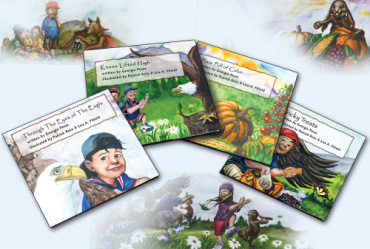
Of course, the earlier you start to create change within a population, the better chance you have of changing a trend in that society. Nambé Pueblo health education specialist Georgia Perez wrote the first four books of the “Eagle Books” series for children with this intention. The series includes the titles 1) Through the Eyes of the Eagle, 2) Knees Lifted High, 3) Plate Full of Color, 4) Tricky Treats. and 5) the middle school book, Coyote and the Turtle’s Dream.

CDC-Eagle-Book-Series for children using American Indian stories to teach healthy eating and preventing diabetesThe first four titles are folio-sized (large format) full-color picture books for story time reading, with a target audience of Indian children in second and third grade. Lisa A. Fifield, a member of the Oneida Tribe of Wisconsin (Black Bear Clan), and Patrick Rolo, a member of Bad River Band of Ojibwe, painted the lush watercolors that illustrate the first four books in the series. Perez and Lofton wrote the books from an Indian perspective with Indian characters, and Indians created the entire enterprise. With more than two million copies distributed to libraries, schools, Indian cultural centers, and more, according to the CDC, the program is a real success (The Story of Eagle Books, CDC).

All of the books are rooted in Indian cultural traditions, and advocate eating a healthy diet and exercising to avoid diabetes and maintain a healthy body. The CDC planned to continue the Eagle Books series with chapter books for middle school children, but unfortunately the agency was unable to continue the series after they published the first book, Coyote and the Turtle’s Dream, by Terry Lofton. The five volumes that CDC has published forward the message of harmony of the individual with nature, culture, and health. Ms. Perez makes particular points against type 2 diabetes.eagle-books-rain-that-dances-mr-eagle

The character of the Eagle talks with the Indian boy Thunder Cloud,

[Mr. Eagle] “Yesterday, I told Rain That Dances that many of your people are getting very sick from a disease called diabetes. Even some young people have diabetes now.”

[Thunder Cloud] “What is diabetes?”

[Mr. Eagle] “Diabetes is when your body does not use the food you eat the right way. So there is too much sugar, or glucose, in the blood. It can make people sick if it is not in balance. Just as your tummy is in balance when you eat the right amount of food — not too much, not too little, but just right — your body needs to have just the right balance of sugar in your blood. But someone who has diabetes can learn to take care of it and stay healthy. And you can do things to keep from getting this disease. One very good way is to do something every day to get your body moving” (Knees Lifted High, p. 2).

Balance is a key value among the cherished values of most Indian nations, and using this kind of language speaks to everyone, and most particularly to Indian children.

Although the author and illustrators dedicated the books to the idea of promoting Native American cultures and health, the messages provided in them can speak to any child. Eagle and Rabbit refer to “sometimes foods”, a phrase that will be familiar to any Cookie Monster fan that has been to Sesame Street. The art is so inviting that it will draw readers in to learn more and care about the characters, who are earnestly trying to improve their lives. You root for them to win. After reading these books, I was ready to trade in my frybread for a solid diet of cattail bread, wild rice salad and three sisters.

*For those unfamiliar with Indian culture, a powwow is a social gathering of Native Americans featuring dancing, drum music, singing, arts and crafts demonstrations and sales, and traditional tribal foods—and often, frybread and Indian tacos as well. Attendees include Indians and non-natives; the gatherings also provide an opportunity for elders to teach youth native tribal dances and other traditional practices.

How can I obtain these Native American and healthy eating publications?

1)    FOR THE PUBLIC

2)    FOR LIBRARIANS

Librarians can find the records for Tricky Treats, Knees Lifted High, Plate Full of Color, Through the Eyes of the Eagle and Coyote and the Turtle’s Dream in GPO’s Catalog of Government Publications or CGP.

About the author(s): Adapted from an original blog post by Jennifer K. Davis from GPO’s Library Services & Content Management Division that supports the Federal Depository Libraries Program (FDLP).


No-Vacation Nation? Take Time to Enjoy Our National Parks and Trails

August 13, 2013

Vacation-Time-Goes-Unused-in-USAmericans are generally extroverted, friendly, talkative—and apparently, workaholics. As the Europeans put it, Americans live to work, while they work to live.

Image source: From infographic on lack of vacation time in U.S. Produced by Column Five for Rasmussen College.

Studies by various travel companies and polling groups have shown that Americans are among the group of nationalities that take the least amount of vacation (others being the Japanese, Taiwanese, South Koreans, Singaporeans, and Mexicans). Part of the reason may be that the United States is the only developed nation in the world that does not guarantee any paid holidays for workers by law. The U.S. Bureau of Labor Statistics concluded in a recent report that only seventy-two percent of wage earners in the United States received both holidays and paid vacations voluntarily granted by their employers. The rest of the employed population does not get paid vacation.

It’s unfortunate that Americans regularly skip using all their allotted vacation days*. [*See also: Schwartz, Tony (February 10, 2013). “Relax! You’ll Be More ProductiveThe New York Times.] Surveys of people in the U.S. report that they do not feel their bosses support taking leave, and they fear that being away from work looks like they are not committed to their jobs. Understandably, workers are afraid to look less than absolutely dedicated in this job market. Looking at our lack of vacation days and our failure to take advantage of them, one could conclude that we are not a well-rested people.

????????????????????????????????

Image: December 2012 infographic on why Americans don’t take more vacation time. Created by: Ally Bank from various public sources.

However, health researchers, sleep researchers, and psychologists have found that there is a direct correlation between rest and good health, and rest and productivity. Taking your vacation is almost a tonic against occupational stress.

Stop and Smell the Roses at a National Park or Trail

National Park System Map and Guide  ISBN: 9780912627878 available from http://bookstore.gpo.govIf you do get a paid vacation and have been putting off your annual jaunt, it’s time to sit down and plan one before summer ends. Many Federal Government agencies offer great resources for planning your next vacation or recreational activity.

For example, three excellent publications from the National Park Service– National Trails System: Map and Guide, National Park System Map and Guide, and the National Park System (Wall Map Poster) — can aid you in planning your trip to America’s best vacation destinations, our national parks and trails!

While most Americans are familiar with our fabulous national parks, fewer are aware of our 45 year-old National Trails System which is…

National Trails System Map and Guide“…the network of scenic, historic, and recreation trails created by the National Trails System Act of 1968. These trails provide for outdoor recreation needs, promote the enjoyment, appreciation, and preservation of open-air, outdoor areas and historic resources, and encourage public access and citizen involvement.” (National Park Service)

With the help of these National Park Service maps, you can hike interesting trails and learn history while you are appreciating the outdoors and getting a workout. Or you can pick a national park you’ve never visited before, and experience something new to spur your creativity. If you enjoy visiting cities, pick a park not far outside of town so that you could get a taste of nature in addition to some cultural experiences.

For example, the Washington, DC, area where the Government Printing Office is headquartered is a prime tourist and staycation destination with its many national parks and historic sites. Our Washington DC Area Tourism & Recreation collection includes maps, history and guidebooks about the area, including the new 2013 Washington DC tourism map by the National Park Service that includes all the newest monuments and museums. and the wonderful Capital Engineers: The U.S. Army Corps of Engineers and the Development of Washington, D.C. 1790-2004, (reviewed earlier on Government Book Talk blog) that tells “The Untold Story Behind the Engineering of Washington DC” and its many famous landmarks.

Once you pick a park, search the Web site recreation.gov to find the activities available there. If you look at the National Park system map and find yourself spoiled for choice, you may be able to narrow down your options when you discover the types of activities available at the parks. And if you are interested in vacationing in a city or a resort, but want to hit a nearby recreation center, you can search for alternatives just by entering a city or zip code. For example, if you plan to visit Las Vegas, but you’d like some time to enjoy rock climbing, too, you might rent a car for the day and drive to Red Rock Canyon National Conservation Area, 12.57 miles from the city center. Most of the National Parks have guidebooks available to help you plan your trip: a number of them are available for sale from the U.S. Government Bookstore.

Of course, the money and time needed for a vacation are no joke. You may be one of the unlucky 28% that does not get a paid vacation. Or getting time off work may just be impossible. If any one of those factors applies to you, try a weekend getaway someplace nearby instead. The National Park Service has suggestions for quick breaks or “staycations” all the country. Once you’ve selected a site, you can fine-tune your plans with the information about reservations and camping available at recreation.gov.

Support for Your Pursuit of Happiness

As our nation has declared the pursuit of happiness a self-evident truth and an inalienable right, it seems we have a patriotic duty to pursue a holiday. The Federal government definitely supports your vacation. After all, each one of our modern presidents has set a prime example for the people by taking vacations to better handle the rigors of the job. As President Nixon put it: “Like other presidents, before and after me, I felt the need to get out of the White House and out of Washington in order to keep some sense of perception.”

Obamas-at-Grand-CanyonImage: U.S. President Barack Obama and family vacationing at the Grand Canyon National Park in August 2009. Source: White House. 

How can the public find these tourism and recreation maps and guidebooks?

How can Federal Depository librarians access these publications?

  • Find the records for these titles via the cataloging records in GPO’s Catalog of Government Publication or CGP.
  • Find them in a federal depository library.

About the author(s): Adapted from an original article on the FDLP Community Blog by Jennifer K. Davis from GPO’s Library Services & Content Management Division that supports the Federal Depository Libraries Program (FDLP). Editor and additional content by: Government Book Talk Editor-in-Chief and , GPO Promotions & Ecommerce Manager, Michele Bartram.


Parent Power: The Power to Make a Difference

July 25, 2013

In honor of National Parents’ Day, celebrated the fourth Sunday of July, Government Book Talk reviews this exemplary parenting guide from the Department of Education, Parent Power: Build the Bridge to Success.

parentpower The opening of the Department of Education’s Parent Power: Build the Bridge to Success is a quote from President Obama made in July 2009:

“To parents, we can’t tell our kids to do well in school and then fail to support them when they get home. You can’t just contract out parenting. For our kids to excel, we have to accept our responsibility to help them learn.”

PoderdelosPadresThe book’s introduction sets the reader up to learn the most important tip given in Parent Power and its Spanish version, Poder De Los Padres Para Trazar el Camino Hacia el Exito, This tip is simple to state, but hard work to follow: be responsible. Your responsibility for your child’s education begins with modeling at home. If your kids see you reading, they will want to read. If you drag your kid to every Civil War battle site because you are a Civil War buff, your child may ace his or her American history exams. When you volunteer at your child’s school, your kids are going to see how important their education is to you.

Other tips covered in the book include: be committed, be positive, be patient, be attentive, be precise, be diligent, be results-oriented, be innovative. These tips are good calls to action for parents. Parents are already tired from their jobs, long commuting hours, keeping their living spaces clean and finding a way to feed the family. Just managing the basic tasks of daily survival can take up all their time. When your child throws a temper tantrum because you’ve sent her to her room to do her homework rather than watch her favorite TV show, it’s tough to practice that “be patient” tip. Good parenting demands more effort than managing basic survival.

Likewise, it takes a great deal of work to follow the other tips, such as remembering to be innovative and to provide positive feedback. It’s more constructive for parents to be precise when praising their children. Instead of telling your child she is smart for completing a drawing, you should tell the child how much you appreciate her making the effort to color the Canadian flag with the right colors in the right places. Parents will evaluate many of their children’s performances, and it will take quite a bit of creativity to say “good job!” in a different way every time. The last tip given in all bold case letters, BE THERE, is a restatement of the popular saying, the best present parents can give their kids is their presence.

The book does give specific suggestions, listed by school age group: birth through preschool, elementary, middle and high school.

Parent Power_Page12Image:Parent Power, Page 12, recommends activities for Pre-Schoolers and Kindergarteners.

The authors recommend a large number of parent-child and pro-school activities. Some examples are reading aloud to your child each day starting at birth, taking your child to the library, playing games with your child, contacting his or her teachers, visiting his or her school. Many parental advice volumes contain advice that may not be revolutionary, but may break parents out of a rut that they had not previously considered. There is also a list of electronic resources to help parents research further. Hints and tips are a parent’s best friend when guiding a child through the various developmental stages.

If you’re doing the fun but difficult work of raising a child, help yourself to Parent Power: Build the Bridge to Success and/or Poder de los Padres: Para Trazar el Camino Hacia el Éxito. Get the hints and tips you need to encourage you. Children do not simply inherit their characters from their parents like magic. Parents are the driving force in their children’s lives, both by example and character—and that’s the power of parents. 

How can I find parenting publications from the Federal Government?

Federal Depository Librarians: How can I access these publications?

About the author(s): Our guest blogger is Jennifer K. Davis from GPO’s Library Services & Content Management Division that supports the Federal Depository Libraries Program (FDLP). Editor: Government Book Talk Editor-in-Chief and , GPO Promotions & Ecommerce Manager, Michele Bartram.


You Scream, I Scream for National Ice Cream Month

July 15, 2013

fruit-sorbetIce cream, long beloved by Americans, has a long, even pre-colonial history in the Americas. Some of my Mexican friends have told me that the Aztec emperor Moctezuma (popularly referred to today as Montezuma) had servants climb the snow-capped volcanic mountains for snow to mix with fruit juices as a hot-weather treat.

Image: Could this have been how the Aztec emperor was served his favorite icy dessert made of and served in natural fruit? Source. Cool Stuff Sorbet.

The United States got in on the game early, too. In 1744 Barbara Janssen Bladen, daughter of Lord Baltimore and wife of Proprietary Colonial Governor of Maryland Sir Thomas Bladen, first served ice cream in the American colonies. Ice cream, at that time, was a fashion of the well-heeled.

Williamsburg-Ice-Cream-MakingClick image to watch this Colonial Williamsburg, Virginia, video of how ice cream was made during the colonial era.

The French connectionjeffersonicecream

The sweet treat did not become popular in this country until after the American Revolution, when the Americans had continued contact with the French.

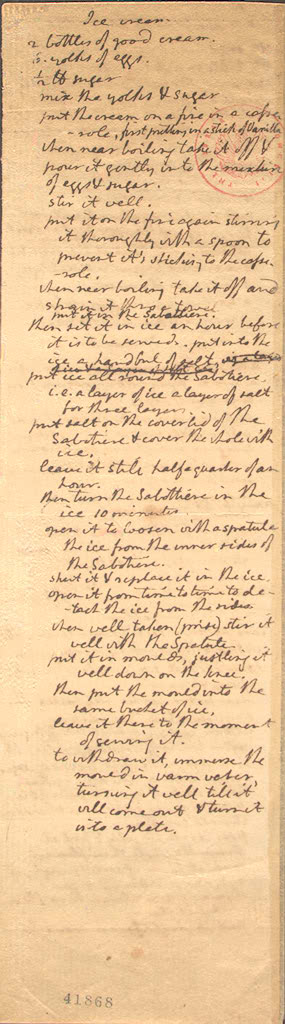
Thomas Jefferson learned how to make ice cream during his tenure in Paris as the United States’ Ambassador to France. He collected many recipes while in France, but ice cream was one of his favorites. In fact, the Library of Congress possesses a copy of a recipe for vanilla ice cream used by Thomas Jefferson written in Jefferson’s own hand.

Many visitors to Monticello, Jefferson’s home in Virginia, recorded enjoying ice cream during their meals there, probably fueling the dessert’s increasing national popularity.

Monticello-Garden-PartyImage: Monticello summer garden party where ice cream was sure to be served. Photo Credit: Jacob J. Gayer, National Geographic, December 1928

Ice cream gets added to the American “melting pot”

Americans’ fondness for ice cream has only increased over the years. Mary Todd Lincoln held berry parties which featured seasonal strawberries and ice cream served on the side.

An American named Abe Doumar is attributed by some as creating the first ice cream cone on July 23, 1904, at the World’s Fair at St. Louis, because the vendor ran out of ice cream dishes to use to serve it and resorted to rolled-up thin waffles. Having a cool container to keep our sweet treats in has certainly helped with our consumption of it.

Ice-cream-cones-Chicago-Worlds-fair

Image: Children and their mother enjoying the new sensation of ice cream cones at the 1904 St. Louis Exposition. Source: Aworldaffair blog.

According to the National Agriculture Statistics Service’s monthly publication Dairy Products, Americans consumed 163,544 pounds of ice cream (that’s hard and soft, full fat and low-fat combined) in May 2013.  It seems like we just can’t get enough of the sweet stuff.

I do declare…  It’s National Ice Cream Month

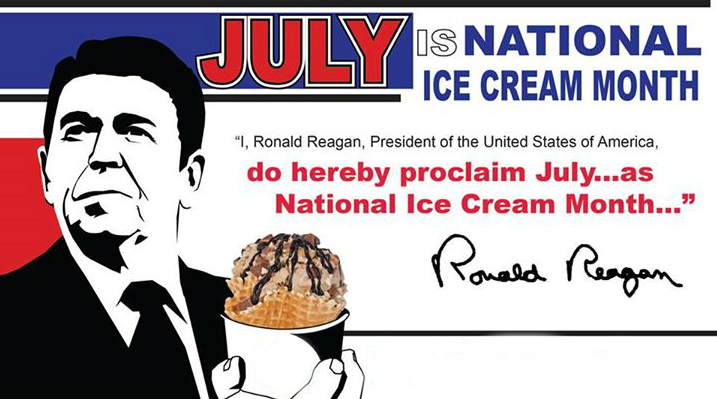
Ice cream is such a national institution that Congress passed a Joint Resolution favoring President Reagan’s declaration of July 15, 1984, as National Ice Cream Day and July as National Ice Cream Month. Presidential ice cream promotion continues to the present day.

Reagan-ice-cream-proclamation

Image: President Ronald Reagan conceived of National Ice Cream Month. Source: SubZero Ice Cream & Yogurt.

The Senate Inauguration Committee provided the recipe for the sour cream ice cream the White House chefs served at President Obama’s second inauguration. Whether it’s a result of the presidential lead, or simply ice cream’s yummy factor, hungry Americans and the dairy industry continue to celebrate every July as National Ice Cream Month.

Get the scoop and read all about ice cream

If you want to read more about American ice cream production, you can check out the aforementioned Dairy Products title, which reviews American dairy production, including all types of ice cream and frozen yogurt. Find the details of the American ice cream industry in 1997 Economic Census. Manufacturing. Industry series. Ice cream and frozen dessert manufacturing. To do some research about the history of ice cream in America, read some of the many excellent books and electronic resources recommended in this Library of Congress pathfinder.

choosemyplateAfter all that consumption of ice cream related knowledge (and hopefully, some ice cream), you may find yourself worried about fitting into your trousers. Pick up a poster from the GPO Bookstore of What’s on Your Plate?: Choose My Plate  or Que Hay en Su Plato?: Mi Plato. They’ll inspire you to maintain your dietary goals of keeping healthy foods in balance with rich indulgences, such as ice cream.
quehayensuplatoI’m ready to get a copy of the poster for my office to keep my ice cream fixation in check. But first, if you’ll excuse me, it’s a hot summer day –I have an appointment with a double-scoop cone of Fear the Turtle.

How can I obtain these ice cream-related publications?

Federal Depository Librarians: You can find Dairy Products, Ice Cream and Frozen Dessert Manufacturing, and What’s On Your Plate? at your local Federal Depository library via the cataloging records in GPO’s Catalog of Government Publications, or buy them at the GPO Bookstore. You’re likely to find yourself hungry.

*Source: Davidson, Alan. The Oxford Companion to Food. Oxford, Oxford University Press, c1999.

About the author(s): Our guest blogger is Jennifer K. Davis from GPO’s Library Services & Content Management Division that supports the Federal Depository Libraries Program (FDLP). Additional content provided by Government Book Talk Editor-in-Chief and , GPO Promotions & Ecommerce Manager, Michele Bartram.


Glad Dad: Best Books and Sites for Fathers

June 11, 2013

Fathers-day-in-multiple-languagesMany of our personal characteristics, such as where we are born, the color of our eyes, our native language—are due to luck. If we get good parents, this is due to luck, too. When we become parents ourselves, though, we need to rely on our own hard work. Being a parent is the happiest and hardest job I’ve ever had, and I know many people say the same. Any help you can get with that job, whether it is from your own parents, friends, your child’s teachers, parents of your child’s friends, is welcome. As the African proverb goes, it takes a village to raise a child.

Image: How do you say Father? Source: Craftionary

The Federal government wants to be part of that village, and provide parents with any assistance it can give. And with Father’s Day this Sunday, the Government Printing Office wants to highlight these terrific Federal publications and websites to help Dads be all they can be. Whether he’s called Papi, Papa, Pop, Baba, Daddy, Da, Abbu or just plain Dad, celebrate the fathers– and father figures– you know by sharing these resources with them.

National Responsible Fatherhood Clearinghouse

Fatherhood.gov Despicable Me National Responsible Fatherhood ClearinghouseThe Government supports fathers in many ways; one of them is through the National Responsible Fatherhood Clearinghouse at Fatherhood.gov. Dads can check out this site to find fatherhood programs and resources, connect with mentors, read the latest blog posting on DadTalk, and take the Fatherhood Pledge.

Eleven Federal partners are involved in the Responsible Fatherhood Working Group: the Departments of Agriculture, Commerce, Education, Health and Human Services, Housing and Urban Development, Justice, Labor, Veterans Affairs, the Corporation for National and Community Service, the U.S. Equal Employment Opportunity Commission, and the Office of National Drug Control Policy. The level of Federal investment shows how seriously the President and the Federal Government takes this initiative. Another way to reap the benefits of Federal support of fathers is to read Federal government publications prepared in support of responsible fatherhood.

Promoting Responsible Fatherhood

Hero poster for FatherhoodFirst.org Promoting Responsible Fatherhood: Every Father Taking Responsibility for His Child’s Intellectual, Emotional, and Financial Well-Being discusses the various programs and initiatives that President Obama has been promoting as part of his Fatherhood and Mentoring Initiative, including the Head Start-sponsored Fatherhood First program (see poster on the left).

President Obama believes in the importance of fatherhood, as he said in 2009:

“I came to understand the importance of fatherhood through its absence—both in my life and in the lives of others. I came to understand that the hole a man leaves when he abandons his responsibility to his children is one that no government can fill” (p. 2).

To keep that void from opening, the Federal Government has started the aforementioned initiative, and the president has asked for Federal budget support for the Child Support Enforcement Program and to sustain funding for the Healthy Marriage and Responsible Fatherhood grants.

President Obama playing with daughters and new dog BoThis book discusses these and similar Federal Government programs started and/or supported by the Obama Administration, and what the programs have done to help fathers and their families.

Image: President Obama playing with his daughters Sasha and Malia along with then-new (and rambunctious) dog, Bo, on the White House lawn. Source: The White House

This volume is mostly a high-level program summary of interest to policy wonks, public policy workers, social workers, local government officials and students of those disciplines. However, the general public can also glean information about what resources they can get from the Federal Government to assist their families.

At the document’s end, there’s a list of things fathers, individuals, NGOs and places of worship can do to support fatherhood in their own communities as well. The document’s authors try to show how the Federal government stretches out a hand, but it ends on a note of helping oneself, much like the next volume.

Download an electronic copy of Promoting Responsible Fatherhood: Every Father Taking Responsibility for His Child’s Intellectual, Emotional, and Financial Well-Being for FREE from GPO. 

Dad’s Play Book: Coaching Kids to Read

Dad’s Play Book: Coaching Kids to ReadDad’s Play Book: Coaching Kids to Read is geared to get dads to help their kids to read, using case studies and helpful tips. The writers use two of the most important behavior modification tools at their disposal: we all want to be like our peers (hence the case studies) and men love sports (hence the extended coaching metaphor). Twenty dads are profiled on how they are helping their kids learn to read, giving their names, photos, occupations and ages, so they’re more relatable to readers.
The middle pages cover five skills that children need to have mastered to be readers by third grade; everyone who has responsibility for a pre-K through 3rd grade child should be taking some time to study this cheat sheet. Each tip has a paragraph subtitled, How Can a Dad Help? that gives specific suggestions for a dad to improve reading—for example, with fluency. This title is short but sweet; there’s a lot more to know about helping a child learn to read, but this friendly, picture-filled piece is definitely worth the time it takes not only to read it, but to study it and employ in your life as well.

You can either


How can I find these publications: Promoting Responsible Fatherhood: Every Father Taking Responsibility for His Child’s Intellectual, Emotional, and Financial Well-Being and Dad’s Play Book: Coaching Kids to Read?

About the author(s): Our guest blogger is Jennifer K. Davis from GPO’s Library Services & Content Management Division that supports the Federal Depository Libraries Program (FDLP). (Article was adapted by Government Book Talk Editor, Michele Bartram, GPO Promotions & Ecommerce Manager, from an original  post on the FDLP Community site blog by Ms. Davis.)