April is Financial Literacy Month

April 1, 2016

aprilFinancial Literacy Month is a month dedicated to improving one’s education of personal finances in America. As we commemorate this month, GPO would like to make you aware of some excellent resources related to the topic.

First, the Financial Literacy Month website offers tips and advice for financial wellness. They have a 30 step program and a pledge you can take to make a commitment to your own financial literacy and wellness.

The US Senate’s Committee on Finance provides information about legislation regarding different aspects of finance, such as Social Security Benefits, taxes, and coverage.

Visit the IRS to get tax information. They also offer many resources to obtain information and assistance.

GPO’s Catalog of Government Publications offers many resources for both personal and commercial finances. These are a few:

Similarly, govinfo also offers many resources regarding personal, commercial, and national finances. Here are a few:

The US Government Bookstore also offers a variety of resources regarding this subject. Here are a few:cfpb_your_home_loan_toolkit_small_final_single_crop2_Page_01

HOW DO I OBTAIN THESE RESOURCES?

There are several ways to obtain these resources.

You can click the links on any of the publications to either read it for free or purchase it. If you want to do your own research you can also click on the links for the CGP, govinfo, or the Bookstore and use the search bar.

Shop Online Anytime: You can buy eBooks or print publications —with FREE Standard Shipping worldwide— from the U.S. Government Online Bookstore at http://bookstore.gpo.gov.

 Shop our Retail Store: Buy a copy of any print editions from this collection at GPO’s retail bookstore at 710 North Capitol Street NW, Washington, DC 20401, open Monday–Friday, 9 a.m. to 4 p.m., except Federal holidays, Call (202) 512-0132 for information or to arrange in-store pick-up.

Order by Phone: Call our Customer Contact Center Monday through Friday, 8 am to 5:30 pm Eastern (except US Federal holidays). From US and Canada, call toll-free 1.866.512.1800. DC or International customers call +1.202.512.1800.

Visit a Federal depository library: Search for U.S. Government publications in a nearby Federal depository library. You can find the records for most titles in GPO’s Catalog of U.S. Government Publications.

About the Author: Teresa Mock is an intern with GPO’s Library and Content Management division.


Two Bites from MyPlate Make Eating Right Fun for Kids

March 4, 2016

Fad diets appear to be fading in popularity these days. Healthful eating plans packed with flavorful foods are making headway. Sounds sensible for adults, right? But what about kids? Young children need help to make smart choices and grow up healthy. March is National Nutrition Month, a perfect time to chat about nutritiously fueling our youngsters.

GPO makes available two U.S. Department of Agriculture (USDA), Food and Nutrition Service (FNS) nutrition education eBooks for early childhood that make eating right fun for kids. Bonus: these books have great audio and interactivity!

Discover MyPlate: A MyPlate Meal (ePub)

DMP Emergent Reader about a complete MyPlate meal

“I have apples. Nate has peas.” It’s certainly not the introduction to A Tale of Two Cities but the simplicity does grab your attention. This zippy activity book has 8 pages of illustrations and 26 words in total. It’s very easy to digest (pun intended) and doubles as a coloring book.

MyPlate illustrates the five building block food groups in the structure of a plated meal that is designed to help children to identify foods within the food groups. It’s what kids know and relate to. The dietary brains at USDA FNS know that children learn best when they can chose and try and enjoy. This resource models eat well, play well habits for life.

The Two Bite Club (ePub)

First rule of the Two Bite Club is that we don’t talk about the Two Bite Club. Just joshin’. Allow Will the cat to give his take: “Each color on the plate in the picture is a different food group. My teacher told me that if we eat two bites from each food group we can be members of the Two Bite Club!”

9780160931352This publication is available in both English and Spanish language versions (Spanish version coming soon). The Two Bite Club, and El Club de los Dos Bocados, is colored with tasty grain, fruit, vegetable, protein, and diary illustrations. At the end of the booklet is a certificate from the Two Bite Club for bravery in trying new foods. How adorably empowering!

Anna, by the feline nudging of mom and brother, discovers that just one bite can change her nutrition worldview, or should I say foodview. The “try two bites and you might like it” guidance might be just the thing to change your child’s foodview, too.

HOW DO I OBTAIN THESE RESOURCES?

You can click on the links above in the blog or through any of these methods:

Shop Online Anytime: You can buy eBooks or print publications —with FREE Standard Shipping worldwide— from the U.S. Government Online Bookstore at http://bookstore.gpo.gov.

Shop our Retail Store: Buy a copy of any print editions from this collection at GPO’s retail bookstore at 710 North Capitol Street NW, Washington, DC 20401, open Monday–Friday, 9 a.m. to 4 p.m., except Federal holidays, Call (202) 512-0132 for information or to arrange in-store pick-up.

Order by Phone: Call our Customer Contact Center Monday through Friday, 8 am to 4:30 pm Eastern (except US Federal holidays). From US and Canada, call toll-free 1.866.512.1800. DC or International customers call +1.202.512.1800.

Visit a Federal depository library: Search for U.S. Government publications in a nearby Federal depository library. You can find the records for most titles in GPO’s Catalog of U.S. Government Publications.

About the author: Our guest blogger is Chelsea Milko, Public Relations Specialist in GPO’s Public Relations Office.


Steppin’ It Up With College Planning

February 18, 2016

Planning for college is a towering task. Paying for college can be a monumental challenge. My head hurts! I can hardly imagine any of it makes sense to middle and high school students. Until My Future, My Way: First Steps Toward College came along.

The Department of Education’s Federal Student Aid folks have assembled a top-shelf e-Pub booklet to frame the big, scary questions without oversimplifying them. The layout is arranged in a series of prompts, mythbusters, and graphics for the college and vocational school-bound. It tackles the “when should I begin thinking of college?” and “what can a college education do for me?” and “how will I pay for college?” sort of FAQs. And it features a nifty comparison of vocational, technical, and professional career choices as well.

065-300-00008-7The workbook is certainly not designed to replace traditional guidance counseling. The goal here is to get middle schoolers to start asking questions now that will make professional career planning less intimidating. As is often the case when undertaking something new, school kids might not even know what questions to ask. Give them a tailor-made activity book, such as My Future, My Way, and post-high school success will be that much more attainable.

Equipped with a few new life skills, 6th through 9th graders will hopefully be compelled to build a mentorship network. The workbook calls it a “college support team”—the people who can help youngsters get to college. It’s a sensible suggestion that doesn’t get enough airtime amid the all too important talk of money planning, test scores, and scholarships. Charts and checklists are great. Caring, informed people are better. As the booklet rightly points out, “Getting ready for college may seem like a lot to handle, but you don’t have to do it alone!”

Now my head doesn’t hurt as much! All joking aside, it’s nice to see real answers placed in the hands of students. A bit of good guidance is the sure footing needed for those first steps toward college.

HOW DO I OBTAIN THIS RESOURCE?

Shop Online Anytime: You can buy eBooks or print publications —with FREE Standard Shipping worldwide— from the U.S. Government Online Bookstore at http://bookstore.gpo.gov.

Shop our Retail Store: Buy a copy of any print editions from this collection at GPO’s retail bookstore at 710 North Capitol Street NW, Washington, DC 20401, open Monday–Friday, 9 a.m. to 4 p.m., except Federal holidays, Call (202) 512-0132 for information or to arrange in-store pick-up.

Order by Phone: Call our Customer Contact Center Monday through Friday, 8 am to 5:30 pm Eastern (except US Federal holidays). From US and Canada, call toll-free 1.866.512.1800. DC or International customers call +1.202.512.1800.

Visit a Federal depository library: Search for U.S. Government publications in a nearby Federal depository library. You can find the records for most titles in GPO’s Catalog of U.S. Government Publications.

About the author: Our guest blogger is Chelsea Milko, Public Relations Specialist in GPO’s Public Relations Office.


Elmo’s Fire-Safe World

February 2, 2016
Image source: http://www.sesameworkshop.org/

Happy Birthday, Elmo! Image source: www.sesameworkshop.org/

E-L-M-O! Any toddler goes bananas for that fuzzy mass who refers to himself only in third-person. Whenever my two-year-old niece sees a TV screen, she demands that Elmo appear like he’s some kind of omnipresent wizard. The falsetto-voiced Sesame Street pundit celebrates his birthday on February 3rd (he always turns 3 ½ that day). Insert high-decibel squeal of pre-K apostles who endorse the fire-engine red Muppet as their life coach. Fortunately for you, that’s a sound that cannot be conveyed in writing. So, instead, I will use this time to talk about Elmo and friend’s empowering fire safety message.

The message takes the form of the “Sesame Street Fire Safety Program Family Guide” from Federal Emergency Management Agency’s (FEMA) U.S. Fire Administration. Family coloring book. Fire literacy primer. A get-it-together-you-grown-ups safety guide. It’s all those things. FEMA and Sesame Street really deliver. Everybody do the Elmo happy dance! Yes, all of you. Hordes of zealous preschoolers are watching.

064-000-00067-5This guide is not just about Elmo. A proper shout out goes to Cookie Monster, Grover, and Telly Monster. Together, the fire brigade educates with catchphrases like “hot, hot, stay away. hot, hot, not for play” and “get outside and stay outside!” The playbook covers how to avoid hot things that burn, make a home escape map, family practice time, and simple steps to follow if the smoke alarm sounds. For parents and caregivers, there are kitchen safety tips for you, too.

Start a healthy discussion around a scary thing like a fire emergency. Demonstrate that preparation and prevention are skills that the entire family can work on together. Cultivate lifelong fire safety habits. Make it a fun process. As the guide says, “fire safety begins at home. The simple steps you take can make a big difference in staying safe from fires.”

So, grab a copy of “Sesame Street Fire Safety Program Family Guide” for your family. Think of it as a conversation starter to reduce the risk of a fire-starter. And remember, it’s Elmo’s fire-safe world. We just live in it.

HOW DO I OBTAIN THIS PUBLICATION?

Shop Online Anytime: You can buy eBooks or print publications —with FREE Standard Shipping worldwide— from the U.S. Government Online Bookstore at http://bookstore.gpo.gov.

 Shop our Retail Store: Buy a copy of any print editions from this collection at GPO’s retail bookstore at 710 North Capitol Street NW, Washington, DC 20401, open Monday–Friday, 9 a.m. to 4 p.m., except Federal holidays, Call (202) 512-0132 for information or to arrange in-store pick-up.

Order by Phone: Call our Customer Contact Center Monday through Friday, 8 am to 5:30 pm Eastern (except US Federal holidays). From US and Canada, call toll-free 1.866.512.1800. DC or International customers call +1.202.512.1800.

Visit a Federal depository library: Search for U.S. Government publications in a nearby Federal depository library. You can find the records for most titles in GPO’s Catalog of U.S. Government Publications.

About the author: Our guest blogger is Chelsea Milko, Public Relations Specialist in GPO’s Public Relations Office.


Understanding Memory Loss with Two NIH eBooklets

November 3, 2015

A recent National Institutes of Health-funded study found that out-of-pocket health care costs for dementia are greater than for any other disease. Such a serious disease with a serious price tag calls for comprehensive, accurate information to answer specific questions.

The NIH National Institute on Aging Alzheimer Disease Education and Referral Center (ADEAR, an appropriately reassuring acronym) has got you covered. Given that November is Alzheimer’s Awareness Month, it’s a fitting time to peruse their two free eBooks—available in English and Spanish—on the topics of Alzheimer’s disease and memory loss.

9780160930157Understanding Alzheimer’s Disease

Forgetfulness happens to everyone. We all have those foggy moments when we misplace car keys or blank on a person’s name. When those occurrences worsen over time, a more serious problem may exist. This digital booklet plainly outlines AD causes, signs, treatment, research, and caregiver guidance. In addition, there’s a section on how to join clinical trials looking into prevention and treatment of AD and Mild Cognitive Impairment (MCI).

Understanding Memory Loss

For those dealing with age-related cognitive degeneration, medical terminology can cause a cloud of confusion. This booklet, and as well as the publication above, contains a simplified “words to know” glossary. It also addresses signs of serious memory problems, provides tips for coping with cognitive decline, and lays out the difference between forgetfulness and real memory impairment.9780160930133

Maybe you’re a health professional searching for current information on cognitive health and memory loss. Maybe you’re a caretaker looking to educate a loved one on what to do when they have trouble remembering. The knowledge journey for memory loss sufferers and their support network is not easy—minds are astir with questions and hearts weigh heavy with concern. But it’s really good to know that important dementia research conducted by the U.S. Government is just a few clicks away.

How do I obtain these FREE downloadable eBooks?

Shop Online Anytime: You can buy eBooks or print publications —with FREE Standard Shipping worldwide— from the U.S. Government Online Bookstore at http://bookstore.gpo.gov.

Shop our Retail Store: Buy a copy of any print editions from this collection at GPO’s retail bookstore at 710 North Capitol Street NW, Washington, DC 20401, open Monday–Friday, 9 a.m. to 4 p.m., except Federal holidays, Call (202) 512-0132 for information or to arrange in-store pick-up.

Order by Phone: Call our Customer Contact Center Monday through Friday, 8 am to 5:30 pm Eastern (except US Federal holidays). From US and Canada, call toll-free 1.866.512.1800. DC or International customers call +1.202.512.1800.

Visit a Federal depository library: Search for U.S. Government publications in a nearby Federal depository library. You can find the records for most titles in GPO’s Catalog of U.S. Government Publications.

About the author: Our guest blogger is Chelsea Milko, Public Relations Specialist in GPO’s Office of Public Affairs. 


September 13: Kids Take Over the Kitchen Day

September 10, 2015

What do you think is the only job in the world that is 24 hours a day, 7 days a week, and no pay? I am sure you guessed it; parenthood. Although well worth it, being a parent is a hard, tiring job. Parents often find themselves bogged down after going through a full day of work to come home to work another full time shift; taking care of your children. As adults, it is recognized how busy and time consuming parenthood is. Parents do not ask for pity while doing their duty, but it is always nice to give parents a break every now and then. Parents must find time to play with their children, help them with homework, pick out their clothes, bathe them, and feed them, among many other things.

Parents often travel home every day asking themselves “what will we have for dinner tonight?” (And if they don’t ask themselves that, their kids will remind them really fast) Then depending on what they decide on, they then have to get the ingredients. Cooking a good, healthy dinner for a family can take a good amount of time and energy depending on the dish. I’m sure if kids, let’s say at the age of 10, fully recognized all the things that really goes into being a parent they would find themselves maybe asking “what can I help with to give my parent a little rest?”

017-001-00572-0I’m sure parents often find themselves saying “I really wish my kids knew how to cook.” Well that wish may not be too far off. The National Heart and Lung Institute presents Deliciously Healthy Family Meals (Cookbook) as a cookbook designed for families and parents that want to keep cooking a family affair. The book includes many kid-friendly recipes that are pretty easy to grasp without needing much assistance from a parent. Not only are these recipes and tips kid-friendly, but also heart-healthy. It is loaded with tips on meal planning, meal preparation, and nutritional facts to keep obesity and other health issues at bay. Deliciously Healthy Family Meals (Cookbook) also starts to teach children how to be self-sufficient by learning how to cook quality meals for themselves. Life skills and quality experience that will stay with them forever.

How do I obtain Deliciously Healthy Family Meals (Cookbook)?

Shop Online Anytime: You can buy eBooks or print publications —with FREE Standard Shipping worldwide— from the U.S. Government Online Bookstore at http://bookstore.gpo.gov.

Shop our Retail Store: Buy a copy of any print editions from this collection at GPO’s retail bookstore at 710 North Capitol Street NW, Washington, DC 20401, open Monday–Friday, 9 a.m. to 4 p.m., except Federal holidays, Call (202) 512-0132 for information or to arrange in-store pick-up.

Order by Phone: Call our Customer Contact Center Monday through Friday, 8 am to 5:30 pm Eastern (except US Federal holidays). From US and Canada, call toll-free 1.866.512.1800. DC or International customers call +1.202.512.1800.

Visit a Federal depository library: Search for U.S. Government publications in a nearby Federal depository library. You can find the records for most titles in GPO’s Catalog of U.S. Government Publications.

About the author: Avery Poole is a Summer Intern in GPO’s  Publication and Information Sales office.


Now Available: Scientific Report of the 2015 Dietary Guidelines Advisory Committee

March 4, 2015
(Image source nationalnutritionmonth.org)

(nationalnutritionmonth.org)

March is National Nutrition Month, a great time to focus on the importance of developing good eating habits. To coincide with this important event about maintaining a healthy diet, the Dietary Guidelines Advisory Committee has just released its 2015 scientific report. The report which includes recommendations that will eventually be incorporated into the Dietary Guidelines for Americans, 2015 provides new changes, in contrast to previous guidelines. For instance, until now, overconsumption of cholesterol was long considered to be bad for the American diet. However, according to the recommendations outlined in the new report, cholesterol is no longer “a nutrient of concern.” To read more about this and other eye opening revelations contained in the report, which is now available through the DietaryGuidelines.gov website, see information below.

From HHS Office of Disease Prevention and Health Promotion (ODPHP)

Get Involved: The “Scientific Report of the 2015 Dietary Guidelines Advisory Committee” (Advisory Report) is now open for public review and comment. An official announcement will also publish in the Federal Register. To read the Advisory Report and submit your comments, visit DietaryGuidelines.gov.

Advisory Report: An advisory committee of independent experts – the 2015 Dietary Guidelines Advisory Committee (or Committee) – has submitted its report to the Secretaries of the Department of Health and Human Services (HHS) and Agriculture (USDA). The “Scientific Report of the 2015 Dietary Guidelines Advisory Committee” describes findings from the Committee’s review of the scientific evidence on diet, nutrition, and health, and will help inform the next edition of the Dietary Guidelines.

Upcoming Public Meeting: HHS and USDA will host a public meeting at the National Institutes of Health in Bethesda, Maryland on Tuesday, March 24, 2015 to receive public oral comments on the “Scientific Report of the 2015 Dietary Guidelines Advisory Committee.” Meeting registration for in-person and webcast registration will open March 9, 2015 on www.DietaryGuidelines.gov.

Those interested in providing oral testimony will be able to specify their request upon registration. Capacity for oral testimony is limited to 70 individuals with 10 on stand-by. Testimony participants will be accepted on a first-come, first-served basis. The meeting facility provides ample space for in-person attendance and live webcast viewing will be available. Oral testimony can only be given in-person.

Next Steps: HHS and USDA will use the Advisory Report along with input from federal agencies and public comments to develop the next edition of the Dietary Guidelines for Americans. HHS and USDA will release the Dietary Guidelines for Americans, 2015 by end of the year.

Interested in more information on diet and nutrition? The U.S. Government Bookstore offers the following publications on diet, nutrition, and health.

About the author: Trudy Hawkins is Senior Marketing and Promotions Specialist in GPO’s Publication & Information Sales Division supporting the U.S. Government Online Bookstore (http://bookstore.gpo.gov).


Goblins, Ghosts and Witches, Oh My! Happy Halloween, October 2014

October 29, 2014

It’s nearly Halloween, and if you’re thinking about buying candy or pumpkins more than reading Federal government documents, it’s understandable. All the same, it would be regrettable if you missed reading some very relevant Federal government documents before preparing for your Halloween celebration.

halloween

(Image courtesy of CPSC: Click on image to enlarge)

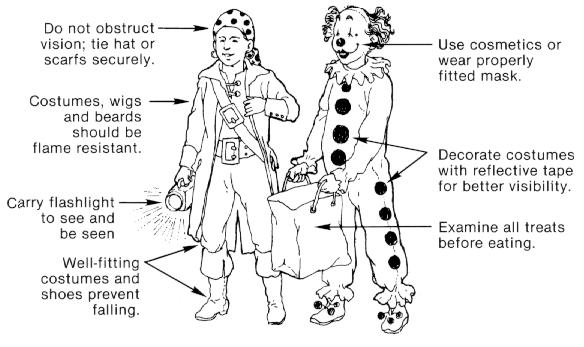
Whether you are pulling together a costume for yourself or for kids, you need to make sure the costume is safe to wear. There are a few basic tips to follow when you get ready for trick-or-treating, according to the CPSC’s Halloween Safety: Safety Alert.

  • Decorate costumes with reflective tape
  • Carry bright flashlights
  • Trim or hem long costumes to avoid tripping
  • Choose flame-resistant material
  • Wear good walking shoes
  • Prefer cosmetics over masks when possible
  • Wear masks and headgear that are securely tied and do not obscure the wearer’s vision

The FDA recommends getting professional help to avoid eye damage if you plan to wear decorative contact lenses as part of your costume. The safe costume tips from these documents are good hints for choosing Halloween party gear, as well.

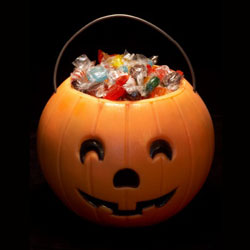
The CPSC also recommends that you stick to safe houses, make sure your children walk (and don’t run), and that you check children’s candy before letting them eat any, in case of evidence of tampering (although the history of Halloween candy tampering is spotty). Food safety overall is always a concern at Halloween, and reading the FDA’s Halloween Food Safety Tips for Parents is good preparation for anyone responsible for children attending Halloween parties and celebrations.

Those revelers staying in one location will want to follow guidelines given in Halloween Fires. House parties at Halloween frequently feature candles, bonfires, firepits and the like. The US Fire Academy says Halloween is a night when fires spike, with “a 63 percent increase in the daily occurrence of incendiary or suspicious structure fires for October and November. ….the peak in incendiary and suspicious structure fires on Halloween is slightly lower than the peak on July 5th but higher than New Year’s Day” (p. 12). Many of the fires on Halloween (and the night before Halloween, known as Devil’s Night), are the result of arson, and accidents play a role as well. Be aware and know the exit locations at the party you’re attending. If the party you are holding or attending has includes fire as part of the fun, have fire-extinguishing equipment nearby.

And if you’re planning to stay at home for Halloween, heighten your sense of the holiday mood and read some of the spooky traditions of Halloween in The Fantasy and Folklore of All Hallows, from the Library of Congress’ Folklife Center. You can learn about the origins of Halloween, originally a Celtic festival of the dead called Samhain. Samhain was the biggest holiday of the Celtic year, and served as a new year. The Celts lit bonfires for the dead to create a barrier between them and the living. Supposedly, the bonfires guided the dead back to the netherworld at this time of the year when the Celts believed the border between the dead and the living was thinnest. This brief monograph also covers how the Catholic Church appropriated Samhain from the Celtic natives to become All Hallows, and eventually Hallowe’en (Hallows evening). If you finish reading the piece wanting to know more, the author links a selected bibliography of resources on Halloween and related topics at the end of the text. You get to learn a bit of history and appreciate the author’s poetic text also. He closes the piece by noting that traditional American Halloween activities “…reaffirm… death and its place as a part of life in an exhilarating celebration of a holy and magic evening.”

There are records available for the electronic versions of Halloween Safety: Safety Alert and Halloween Fires in the Catalog of Government Publications. You can find the records for these documents in your local Federal depository library.

How can I access these publications?

In addition to clicking on the links in the article above to find the publications, you may find these publications from the following:

  • Visit a Federal Depository Library: Search for U.S. Government publications in a nearby Federal depository library.
  • Visit a Public Library: Ask your local public librarian about Federal Government books available to check out as well as Federal eBooks that may be available for library patrons to digitally download through the library’s Overdrive subscription.

And to find popular current Federal publications, you may:

  • Shop Online Anytime: You can buy eBooks as well as print publications (with FREE Standard Shipping worldwide) from the U.S. Government Online Bookstore website at http://bookstore.gpo.gov
  • Order by Phone: You may also Order print editions by calling GPO’s  Customer Contact Center Monday through Friday, 8 am to 5:30 pm Eastern (except US Federal holidays). From US and Canada, call toll-free 1.866.512.1800. DC or International customers call +1.202.512.1800.
  • Shop our Retail Store: Buy a copy of any print editions at GPO’s retail bookstore at 710 North Capitol Street NW, Washington, DC 20401, open Monday–Friday, 9 a.m. to 4 p.m., except Federal holidays, Call (202) 512-0132 for information or to arrange in-store pick-up.

About the author: Adapted by Trudy Hawkins, Government Book Talk Editor and Senior Marketing and Promotions Specialist for GPO’s Publication and Information Sales Division in Washington, DC, from an original post by Jennifer K. Davis, formerly from GPO’s Library Services & Content Management Division that supports the Federal Depository Libraries Program (FDLP).


Education Statistical Resources from the Federal Government

August 19, 2014

With the start of a new school year just around the corner, Government Book Talk takes a look at two recently released publications from the Department of Education that examine the latest trends and developments in American education.

The Condition of Education 2013 and the Digest of Education Statistics 2012,which are currently available from the GPO Bookstore, provide important statistical data on the progress of education in the United States.

065-000-01438-6_2The Condition of Education 2013 focuses on 42 indicators in the subject areas of population characteristics, participation in education, elementary and secondary education, and postsecondary education. Each indicator covers important developments and key indicators such as economic outcomes, preprimary education, school characteristics and climate, and finance and resources.

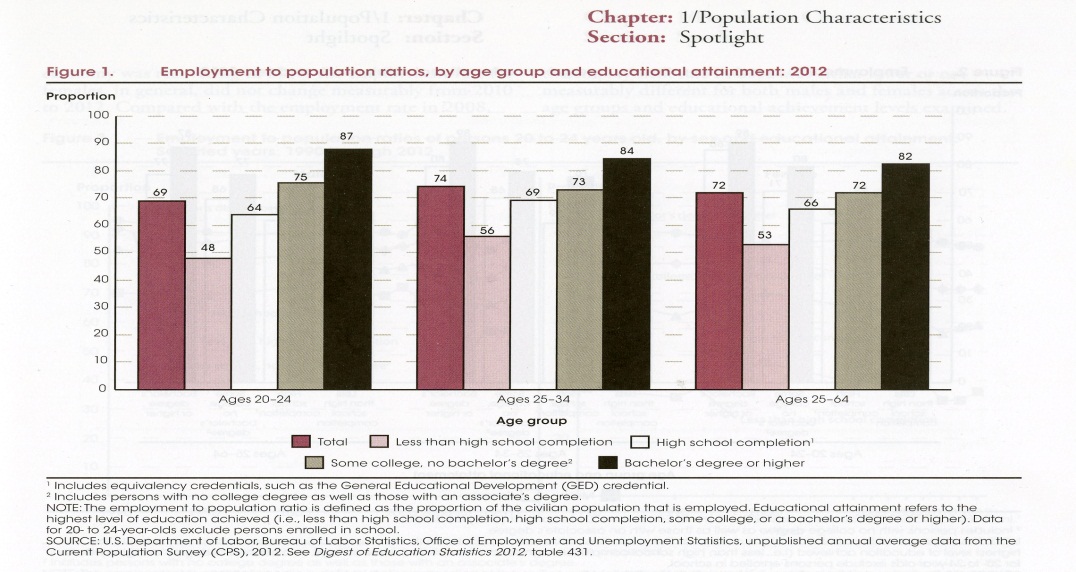
The report also features easy-to-read charts and graphs to illustrate the current trends within each indicator. For example, the chart below from the book illustrates trends in employment rates by age group and education attainment for 2012. According to the chart, in 2012, the employment rate for young adults was 87 percent for those with at least a bachelor’s degree, compared with 75 percent for those whose educational attainment was some college, 64 percent for high school graduates, and 48 percent for those who did not complete high school. Further analysis of the chart points out that older students that did not complete school—those aged 25-34 and 25-64 did slightly better in comparison to their younger counterparts, however, were still employed at a significantly lower rate than those with additional education. (CLICK ON IMAGE TO ENLARGE)

conditions employment chart 2012In addition to trends in employment rates by educational attainment, this year’s report focuses on kindergarten entry status, the status of rural education, and financing postsecondary education in the United States.

065-000-01439-4The Digest of Education Statistics 2012 provides a compilation of statistical information covering the broad field of American education from pre-kindergarten through graduate school. Like the Condition of Education, the data in this annual report was drawn from government and private sources, but especially from surveys and other activities led by NCES (National Center for Education Statistics) part of the Institute for Education Sciences (IES). The digest contains information on the number of schools, students, and teachers, as well as statistics on educational attainment, finances, libraries, technology, and international comparisons. Details on population trends, education attitudes, labor force characteristics, and federal aid supplies helpful background for evaluating the education data.

In addition to updating many of the statistics that have appeared in previous years, this edition contains new material, including:

  • Percentage distribution of 6- to 18-year olds, by parent’s highest level of educational attainment, household type (either two-parent or single-parent), and child’s race/ethnicity (table 12)
  • Enrollment and percentage distribution of enrollment in public elementary and secondary schools, by race/ethnicity and region (table 44)
  • Number and percentage of public school students participating in programs for English language learners, by state (table 47)
  • Children 3 to 21 years old served under Individuals with Disabilities Education Act, Part B, by age group and race/ethnicity (table 49)
  • Percentage of 3-, 4-, and 5-year-old children enrolled in preprimary programs, by attendance status, level of program, and selected child and family characteristics (table 57)
  • Number and enrollment of public elementary and secondary schools that have closed, by school level and type (table 109)
  • Number and percentage distribution of public school students eligible for free or reduced-price lunch, by school level, locale, and student race/ethnicity (table 112)

This statistical reference could be helpful to parents choosing schools for their children as well as for teachers, librarians, and public administrators as it tracks enrollment, population trends and key areas of studies with student progress.

How can I get these publications on education statistics?

Shop Online Anytime: You can buy these and other publications (with FREE Standard Shipping worldwide) from the U.S. Government Online Bookstore website at http://bookstore.gpo.gov:

Shop our Retail Store: Buy a copy of any print editions from this collection at GPO’s retail bookstore at 710 North Capitol Street NW, Washington, DC 20401, open Monday–Friday, 9 a.m. to 4 p.m., except Federal holidays, Call (202) 512-0132 for information or to arrange in-store pick-up.

Order by Phone: Call our Customer Contact Center Monday through Friday, 8 am to 5:30 pm Eastern (except US Federal holidays). From US and Canada, call toll-free 1.866.512.1800. DC or International customers call +1.202.512.1800.

Visit a Federal Depository Library: Search for these in a nearby Federal depository library. You can find the records for most titles in the Catalog of U.S. Government Publications or CGP.

About the author: Trudy Hawkins is a writer and marketing specialist in GPO’s Publication & Information Sales Division supporting the U.S. Government Online Bookstore (http://bookstore.gpo.gov).


Celebrating National Safety Month: Resources and Publications

June 19, 2014

2014SafetyMonth-FeatureJune is National Safety Month. The National Safety Council (NSC) sponsors this month-long event for calling attention to key safety issues, showcasing safety resources, and raising awareness for the prevention of safety concerns and hazards.

The NSC provides access to a variety of educational National Safety Month materials, available on their Web site for free to NSC members. If your organization isn’t already a member, you can join right from their site. They also provide access to many free materials for the general public. Anyone can sign up to receive the free materials via email.

The National Safety Month Web page also provides access to a free Home Safety Checklist to help you identify common risk areas within your home.

You can also follow the NSC’s safety chat on Twitter at #NSM14.

The U.S. Government Printing Office’s U.S. Government Bookstore offers an entire collection of publications devoted to safety issues: the Emergency Management and First Responders collection. Many of the publications in this collection have been highlighted in previous Government Book Talk posts, like this one from January 2014 that focused on preparing for extreme cold and other natural and man-made disasters and showcased the publication, “Are You Ready? An In-Depth Guide to Citizen Preparedness.” Also highlighted in the post are some books for kids on safety preparedness: “Ready…Set…Prepare! A Disaster Preparedness Activity Book for Ages 4-7,” “Ready…Set…Prepare! A Disaster Preparedness Activity Book for Ages 8-11,” and “Watch Out – Storms Ahead! Owlie Skywarn’s Weather Book.” The Federal Emergency Management Agency also has tons of resources on their site to help the public prepare for disasters of all kinds.

In addition, Federal depository libraries nationwide provide the public with free access to Federal Government publications on a wide variety of topics, including safety and emergency management and prevention. Locate a library in your area!

017-033-00508-7One publication in this collection is particularly interesting, especially in light of the frequent and tragic mine accidents we hear about on the news. “When Do You Take Refuge? Decisionmaking During Mine Emergency Escape – Instructor’s Guide and Lesson Plans” is an interesting booklet created by the National Institute for Occupational Safety and Health of the Centers for Disease Control and Prevention, Department of Health and Human Services. The training program was designed to help trainees practice correct decisionmaking skills during an underground mine emergency. It actually consists of three parts: a computer-based training that includes scenario simulation (included as a CD-ROM), the instructor’s guide and lesson plans, and an evaluation (both included in the booklet).

The material was designed for underground coal miners, but it is fascinating for anyone who wants a glimpse into this hazardous occupation. The lesson plan portion of the training is filled with real-life examples of emergency scenarios and “summary teaching points” to highlight the lessons. This interesting look into the life of a coal miner brings to light the need for strict safety measures in any occupation. National Safety Month reminds us that safety should be everyone’s priority, both at home and on the job.

How can I get this publication?

Shop Online Anytime: You can buy this and other publications mentioned in this blog (with FREE Standard Shipping worldwide) from the U.S. Government Online Bookstore website at http://bookstore.gpo.gov:

Shop our retail bookstore at 710 North Capitol Street NW, Washington, DC 20401, open Monday-Friday, 9am to 4pm, except Federal holidays, (202) 512-0132.

Order by Phone: Call our Customer Contact Center Monday through Friday, 8 am to 5:30 pm Eastern (except US Federal holidays). From US and Canada, call toll-free 1.866.512.1800. DC or International customers call +1.202.512.1800.

Visit a Federal Depository Library: Search for U.S. Government publications in a nearby Federal depository library. You can find the records for most titles in the Catalog of U.S. Government Publications or CGP.

About the author: Our guest blogger is Kelly Seifert, Lead Planning Specialist for GPO’s Library Services & Content Management Division that supports the Federal Depository Library Program.


Federal Resources for Food and Nutrition Planning

June 11, 2014

News concerning the debate over changes to the School Lunch Program has brought the topic of child nutrition and health to the forefront, in recent weeks. As government and school officials debate this important topic, Government Book Talk takes a look at the Food and Nutrition Information Center Resources CD-ROM currently available from the GPO Online Bookstore.

Resource Lists CD-ROMThe Food and Nutrition Information Center Resources CD-ROM from the U.S. Department of Agriculture (USDA), Food and Nutrition Information Center (FNIC) contains a plethora of useful information related to various food and nutrition programs, such as the National School Lunch Program. It particularly offers guidance to help nutrition professionals and consumers locate information and materials on specific food and nutrition topics, such as Child Nutrition and Health, Food and Nutrition Education, School Food Service, and much more. Compiled by Nutrition Information Specialists, these Resource Lists provide resources in a variety of formats including articles, pamphlets, books, audio-visuals, and Web links.

This resource list excerpt from 2008 for educators provides resource information on cultural and ethnic food nutrition.

This resource list excerpt from 2008 for educators provides resource information on cultural and ethnic food nutrition.

The vast information contained on this CD-ROM from the National Agriculture Library collection will prove to be a great resource for parents, educators, school food service professionals and child care providers. Child Nutrition Programs including before/after school and children’s summer municipal camp programs will also benefit from these resource lists for nutritional guidance and food planning for their summer and new school year child nutrition initiatives.

The FNIC website contains over 2500 links to current and reliable nutrition information.

The FNIC website contains over 2500 links to current and reliable nutrition information.

About the FNIC

According to its website, the FNIC is a leader in food and human nutrition information. Located at the National Agricultural Library (NAL) of USDA, the FNIC provides credible, accurate, and practical resources for nutrition and health professionals, educators, government personnel and consumers. To learn more about the FNIC and its various resource lists topics visit the FNIC website.

In addition to the Food and Nutrition Information Center Resources CD-ROM, the USDA has published the following print publication focusing on nutrition and diet, which is also available from the U.S. Government Bookstore.Dietary Guidelines for Americans

The Dietary Guidelines for Americans, 2010 offers advice regarding nutrition to promote health and to reduce risk for major chronic diseases through diet and physical activity. The publication is oriented toward policymakers, nutrition educators, nutritionists, and healthcare providers. It summarizes and synthesizes knowledge regarding individual nutrients and food components into recommendations for a pattern of eating that can be adopted by the public. Key Recommendations listed by chapter include: Balancing Calories to Manage Weight; Foods and Food Components to Reduce; Foods and Nutrients to Increase; Building Healthy Eating Patterns; and Helping Americans Make Healthy Choices. It also explains the new food plate which replaced the food pyramid.

How can I get these federal resources on Food and Nutrition Planning?

Shop Online Anytime: You can buy these and other publications (with FREE Standard Shipping worldwide) from the U.S. Government Online Bookstore website at http://bookstore.gpo.gov:

Shop our retail bookstore at 710 North Capitol Street NW, Washington, DC 20401, open Monday-Friday, 9am to 4pm, except Federal holidays, (202) 512-0132.

Order by Phone: Call our Customer Contact Center Monday through Friday, 8 am to 5:30 pm Eastern (except US Federal holidays). From US and Canada, call toll-free 1.866.512.1800. DC or International customers call +1.202.512.1800.

Visit a Federal Depository Library: Search for U.S. Government publications in a nearby Federal depository library. You can find the records for most titles in the Catalog of U.S. Government Publications or CGP.

About the author: Trudy Hawkins is a writer and marketing specialist in GPO’s Publication & Information Sales Division supporting the U.S. Government Online Bookstore (http://bookstore.gpo.gov).


Childhood Immunization: Protecting Our Children from Disease

April 29, 2014

National-Infant-Immunization-Week-2014The week of April 26-May 3 is National Infant Immunization Week and it is also the 20th anniversary of this observance. Vaccinations are becoming a more controversial topic among parents, doctors and schools. The New England Journal of Medicine suggests that the recent anti-vaccination movement is leading to an outbreak of whooping cough and the measles in some states.

A couple looks at Infant Care pamphlet at GPO Bookstore: GPO Archives.

A couple looks at Infant Care pamphlet at GPO Bookstore: GPO Archives.

Before you could Google information on vaccinations and family healthcare topics and have every answer at your fingertips, government publications were the go-to source for consumer information. This former trend is evident in the fact that a pamphlet entitled Infant Care is still to this day considered GPO’s all-time best seller. Infant Care was first published in 1914 by the Children’s Bureau and provided mothers with information in a low-cost form on how to care for their babies. (Read more about the history of the Children’s Bureau in The Children’s Bureau Legacy: Ensuring the Right to Childhood (ePub eBook) available on the U.S. Government Bookstore.) Over the course of seven decades it remained a bestseller with multiple editions published and translations in eight languages as well as Braille.

Excerpt on Vaccination from Infant Care pamphlet

100 years ago, this was the advice on vaccination of infants. Excerpt from 1914 Infant Care pamphlet.

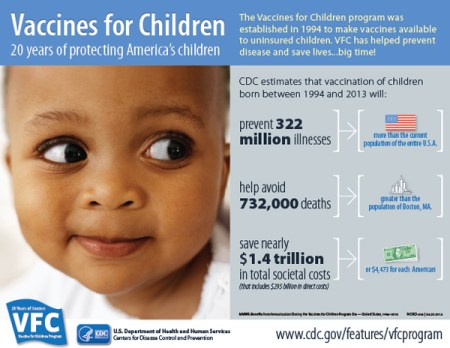
The original Infant Care pamphlets can be seen on this archive. However, Vaccines for Children (VCF), a federally funded program handled by the Centers for Disease Control and Prevention (CDC) provides no-cost vaccine services to help ensure that all children, from infancy to adolescent, have a better chance of getting their recommended vaccinations.

Image source courtesy of CDC http://www.cdc.gov/features/vfcprogram

Image source courtesy of CDC http://www.cdc.gov/features/vfcprogram

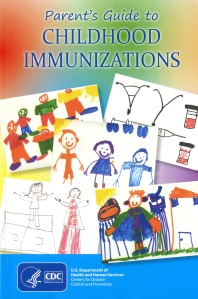
Like Infant Care, the government still has helpful publications to help parents and the public make health-related decisions. Parent’s Guide to Childhood Immunizations and Immunization Tool Kit are just two of the many government publications available on the immunization and vaccination topic.

017-022-01617-6Parent’s Guide to Childhood Immunizations is kind of like a “vaccinations for dummies.” It is a great resource that explains each disease, the vaccinations schedule, what to do before, during and after the immunization doctor visit, how vaccines work, other FAQs and additional print and electronic resources. The most helpful part of this booklet is the breakdown of each disease with information on what causes the disease, how it is spread, the signs and symptoms and complications. To brighten up what can be a scary subject, the booklet includes colorful child artwork.

immunization-tool-kitImmunization Tool Kit focuses on adult, military and childhood immunizations. This resource is made up of laminated 4X6 color coded cards held together by a ring for fast flipping making it durable and likely intended for military or health care providers, people who need a quick reference on the job. The cards are organized by immunizations for adults and the military and children with detailed information about each vaccine including a dosage, indications or who should get the vaccine, contraindications or reasons why someone should not be vaccinated and special considerations. Some of the cards have amusing caricatures of what the diseases look like. For medical personnel, there is a section on the storage and handling instructions of each vaccine. While the amount of information may seem overwhelming, the toolkit will be able to answer all or any question about vaccines.

HOW DO I OBTAIN THESE PUBLICATIONS ON VACCINATION?

Shop Online Anytime: You can buy these publications (with FREE Standard Shipping worldwide) from the U.S. Government Online Bookstore website at http://bookstore.gpo.gov:

Order by Phone: You may also Order print editions by calling our Customer Contact Center Monday through Friday, 8 am to 5:30 pm Eastern (except US Federal holidays). From US and Canada, call toll-free 1.866.512.1800. DC or International customers call +1.202.512.1800.

Shop our Retail Store:Buy a copy of any print editions from this collection at GPO’s retail bookstore at 710 North Capitol Street NW, Washington, DC 20401, open Monday–Friday, 9 a.m. to 4 p.m., except Federal holidays, Call (202) 512-0132 for information or to arrange in-store pick-up.

Visit a Federal Depository Library:Search for U.S. Government publications in a nearby Federal depository library. You can find the records for most titles in the Catalog of U.S. Government Publications or CGP.

About the author: Our guest blogger is Emma Wojtowicz, Public Relations Specialist in GPO’s Office of Public Affairs. 

Additional content, images and editing provided by Trudy Hawkins, a writer and marketing specialist in GPO’s Publication & Information Sales Division supporting the U.S. Government Online Bookstore (http://bookstore.gpo.gov).