Society through a Comic Lens

February 7, 2012

By Guest Blogger, Marianne Mason, Federal Information Librarian, Research and Library Instruction at The University of Iowa Libraries

Comic books are not really books and often not comic, but are serialized graphics-based stories expressed through political and cultural rhetoric.  Think Maus, a story of the Holocaust.  Think Peanuts’ ethics and theology.

O.K., not all comic books or graphic novels are Pulitzer Prize winners or speak to a deep sense of ethics.  The pure entertainment value of storytelling through sequential art can be worthy on its own merits.  However, the comics can inform, persuade, and encourage new behaviors in readers.  This is the purpose of comic books authored by U.S. government agencies.

Used as social program marketing tools for decades, the government-authored comic book format has been used to promote program benefits (Social Security Administration) and to educate (Consumer Product Safety Commission) using superhero/anti-hero models like Sprocket Man (reviewed in our April 9, 2010, blog post “Just for Fun: Sprocket Man!” ) and El Gato to capture the attention of the targeted audience and cross educational boundaries.

The Army made instruction manuals measurably more appealing to combat personnel in PS Magazine by incorporating sexual innuendo in both dialog and character illustration such as in this Preventive Maintenance manual shown below:

In October 2011 the University of Iowa hosted a scholarly symposium entitled “Comics, Creativity, and Culture: International and Interdisciplinary Perspectives”, a by-invitation-only event for scholars, artists and creators of the art and literature of comic books.  The Symposium spawned a semester-long series of complementary university sponsored events ranging from art exhibits, radio broadcasts, discussions, and interactive workshops for educators and K-12 students.  The University of Iowa Libraries contributed to the celebration by creating a Comic Book Café based on the Japanese “Manga Café” model.  Several specialized library collections, including Government Information, pooled their best examples for the café.

As the U.S. Government Information Librarian, I found that this event gave me an opportunity to draw attention to the characteristics and range of government authored comic books.  Creating a government comics research guide  gave me an opportunity to do a thorough survey of the collection,  access the content of the print collection and provide links to digitized collections from the broader government information community, including this latest online booklet from the Centers for Disease Control and Prevention: Preparedness 101: A Zombie Pandemic”.

In addition, the research guide provides database access to many Congressional hearings and reports in the UI collection from the 1950’s linking juvenile delinquency to explicit violence in comic books.

Whether quirky or more profound, all reflect changing societal norms that drive public policy initiatives.

On October 4th an “egg timer” book talk called Thought Balloons: Talking about Comics”, was held in the Café for creators and readers of comics to share insights and stories about connections to comic book literature.  One reader commented that when she and her boyfriend merged their comic book collections, she knew their love was here to stay!

Note regarding Images:

Images in order of mention: Sprocket Man, The 9 Lives of El Gato, PS Magazine, Comic Book Café, Zombie Pandemic (“broader gov. community”), Comic books and juvenile delinquency.  Serial Set 11815-1 (S. Rpt. 62, 84 Cong., 1st Session) 1955, Thought Balloons. Source: University of Iowa Libraries.

About our Guest Blogger:

Marianne Mason has worked with Government and legal resources in several law libraries and universities and at University of Iowa Libraries since 2001 as the regional librarian for the State of Iowa.  Her idea of a fine vacation involves clear water, forests, and the absence of machinery/technology noise.  She knows how to knit socks, two-at-a-time, toe up.


More resources about Government-created comics:


CIA’s World Factbook: Global intelligence for every thinker, traveler, soldier, spy

January 27, 2012

A great publication not only provides timely and valuable information, but it also allows us a glimpse into the times and events that necessitated its production.

Such is the case with the CIA’s World Factbook—which marks its 50th anniversary in 2012 for the classified version and over 40 years for the public version described here— and shows us a glimpse into how Pearl Harbor and the Cold War changed the way America began to gather information about all corners of the globe.

The Factbook has its origins in the aftermath of the Japanese attack on Pearl Harbor, and the realization by Congress and the White House that lack of coordinated intelligence across all Governmental departments had left the United States woefully unprepared for the attack, and determined to correct this as a national security necessity and priority.  According to the CIA historians:
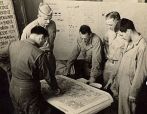
During World War II, intelligence consumers realized that the production of basic intelligence by different components of the US Government resulted in a great duplication of effort and conflicting information.

Detailed and coordinated information was needed not only on such major powers as Germany and Japan, but also on places of little previous interest. In the Pacific Theater, for example, the Navy and Marines had to launch amphibious operations against many islands about which information was unconfirmed or nonexistent.

Image above: During WWII, OSS intelligence reviewed existing maps with the military. Source: Top Secret Writers

JANIS Drops In

To correct this deficiency, in 1943, General George B. Strong (G-2), Admiral H. C. Train (Office of Naval Intelligence – known as ONI), and General William J. Donovan (Director of the Office of Strategic Services – known as OSS, the precursor of the CIA) oversaw the formation of a Joint Intelligence Study Publishing Board to assemble, edit, coordinate, and publish the Joint Army Navy Intelligence Studies (JANIS).

JANIS was the first cross-departmental basic intelligence program to fulfill the needs of the US Government for an authoritative and coordinated appraisal of strategic basic intelligence.

All groups involved in the war agreed that finished basic intelligence was required that covered territories around the world where the war was being fought. They needed detailed, up-to-date maps and geography; basic understanding of the cultural, economical, political and historical issues of the people and the region.

Compiling and publishing this information for the Allied intelligence needs, JANIS became an indispensable reference for war planning and execution.

The Cold War Gives Birth to the CIA… and the National Intelligence Survey

But the Cold War that immediately followed World War II showed that there was just as much need for continued intelligence gathering as ever. In the 1946 publication “The Future of American Secret Intelligence,” national security author George S. Petee wrote: “The conduct of peace involves all countries, all human activities – not just the enemy and his war production.”

In acknowledgement of this, the Congress established the Central Intelligence Agency in 1947 which immediately took over responsibility for JANIS. The next year, the National Security Council authorized the National Intelligence Survey program as a peacetime replacement for the wartime JANIS program. By 1955, the Hoover Commission evaluating the CIA advised Congress that: “The National Intelligence Survey [NIS] is an invaluable publication which provides the essential elements of basic intelligence on all areas of the world. There will always be a continuing requirement for keeping the Survey up-to-date.

The Sum of All Facts: The World Factbook

Subsequently, the World Factbook was created as an “annual summary and update to the encyclopedic NIS studies.

Originally published only as a classified publication starting a half century ago in August 1962 (just prior to the Cuban Missile Crisis of October 1962), the World Factbook was first published in its declassified version for public consumption in June 1971, 40 years ago.

Image: CIA map produced for President Kennedy’s team estimating the range of Soviet missiles being set up in Cuba during the Cuban Missile Crisis in October 1962. Source: Canadian History Portal

Today’s World Factbook is the declassified version of the finished basic intelligence compiled by the U.S. Central Intelligence Agency (CIA) and coordinated across all the U.S. intelligence community. It uses only recognized, authoritative sources, not only CIA-gathered intelligence, but also a wide variety of U.S. Government agencies from the National Security Agency, Department of Defense, Department of State, Department of Agriculture, Defense Intelligence Agency, and hundreds of other published sources around the world.

Printed Version Provides an Annual Snapshot

Once a year, the Government Printing Office takes a snapshot of this information from the CIA as of January 1 and produces a printed version of the World Factbook. It provides unparalleled and succinct information about hundreds of countries in a format that provides an easy-to-use comparison.The Factbook has been available from GPO since 1975.

The 2011 version just published provides a two- to three-page summary of the history, people, government, economy, geography, communications, transportation, military, and transnational issues for 267 world entities, including U.S.-recognized countries, dependencies, and other areas in the world.

Each country has its own basic map and shows its flag, but of particular interest are the maps of the major world regions, as well three pull-out maps included in the publication: Physical Map of the World, Political Map of the World, and Standard Time Zones of the World Map, all of which can be used as wall maps.

Who Can Benefit from the World Factbook?

A perennial best seller in the GPO bookstore, The World Factbook is used by not only US Government officials, but is a must-have reference for researchers, news organizations, businesses, geographers, international travelers, teachers, professors, librarians, and students.

In short, after 40 years, the World Factbook is still the best source of  up-to-date, summarized intelligence about the world for any “thinker, traveler, soldier, or spy” of any age!

Image: Pupils at Crosby’s Valewood Primary School near Liverpool, England, dress up as ‘Spies’ as part of a creative project. Photographer: Andrew Teebay. Source: Liverpool Echo

To gather your own up-to-date intelligence about the world we live in, you can obtain the World Factbook 2011 at one of these locations:

How can you get this publication?

  • Buy the current version of the World Factbook and selected previous editions online 24/7 at GPO’s Online Bookstore.
  • Buy it at GPO’s retail bookstore at 710 North Capitol Street NW, Washington, DC 20401, open Monday-Friday, 9am to 4pm, except Federal holidays, (202) 512-0132.
  • Find it in a library.

Some Interesting “DID YOU KNOW?” Facts related to the CIA’s World Factbook:

  • Question: What separates “intelligence” from “information”?
    • Answer: According to the CIA: The Intelligence Cycle is the process by which information is acquired, converted into intelligence, and made available to policymakers. Information is raw data from any source, data that may be fragmentary, contradictory, unreliable, ambiguous, deceptive, or wrong. Intelligence is information that has been collected, integrated, evaluated, analyzed, and interpreted. Finished intelligence is the final product of the Intelligence Cycle ready to be delivered to the policymaker.

The three types of finished intelligence are: basic, current, and estimative. Basic intelligence provides the fundamental and factual reference material on a country or issue.

  • Question: “Why is the British Labour Party misspelled?”
    • Answer: When American and British spellings of common English words differ, The World Factbook always uses the American spelling, even when these common words form part of a proper name in British English.
  • Question: “What is a ‘doubly landlocked’ country and which are the only two in the world?”
    • Answer: A doubly landlocked country is one that is separated from an ocean or an ocean-accessible sea by two intervening countries. Uzbekistan and Liechtenstein are the only countries that fit this definition.
  • Question: “Why does the Factbook use metric units, even though Americans still use traditional units of measure like feet, pounds, and Fahrenheit?”
    • Answer: US Federal agencies are required by the Metric Conversion Act of 1975 (Public Law 94-168) and by Executive Order 12770 of July 1991 to use the International System of Units, commonly referred to as the metric system or SI. In addition, the metric system is used by over 95 percent of the world’s population.
  • Question: “Why is the European Union listed at the end of the Factbook entries? It’s not a country!”
    • Answer:  The European Union (EU) is not a country, but it has taken on many nation-like attributes and these may be expanded in the future. A more complete explanation on the inclusion of the EU into the Factbook can be found in the Preliminary statement.

About the Author:  Michele Bartram is Promotions Manager for GPO’s Publication and Information Sales Division and is responsible for online and offline marketing of the US Government Online Bookstore (Bookstore.gpo.gov) and promoting Federal government content to the public. She’s a big fan of the National Spy Museum and of spy movies, which she is going to enjoy for her birthday tomorrow.


Beauty and the Best- Two calendars inspire New Year’s resolutions

January 18, 2012

In January of every year, people around the world find themselves making their New Year’s resolution. However, resolutions that come from the Government tend to be about serious topics like laws or declaring war. Case in point: George Washington himself famously said in a letter in 1775 justifying the American colony’s inevitable steps toward declaring independence: “We have, therefore, to resolve to conquer or die.”

Thus, you will be pleasantly surprised to know that the Federal Government can also help us with some of our personal resolutions as well. The most popular personal resolutions tend to be about getting fit, or finding more time to “stop and smell the roses” by relaxing and enjoying the beauty around us.

With their decorative and inspiring calendars for 2012, the National Park Service and the Marine Corps are ensuring that we can meet both these New Year’s resolutions with showing us both “Beauty” and “The Best”.


The National Historic Landmark 2012 Event Planner Calendar

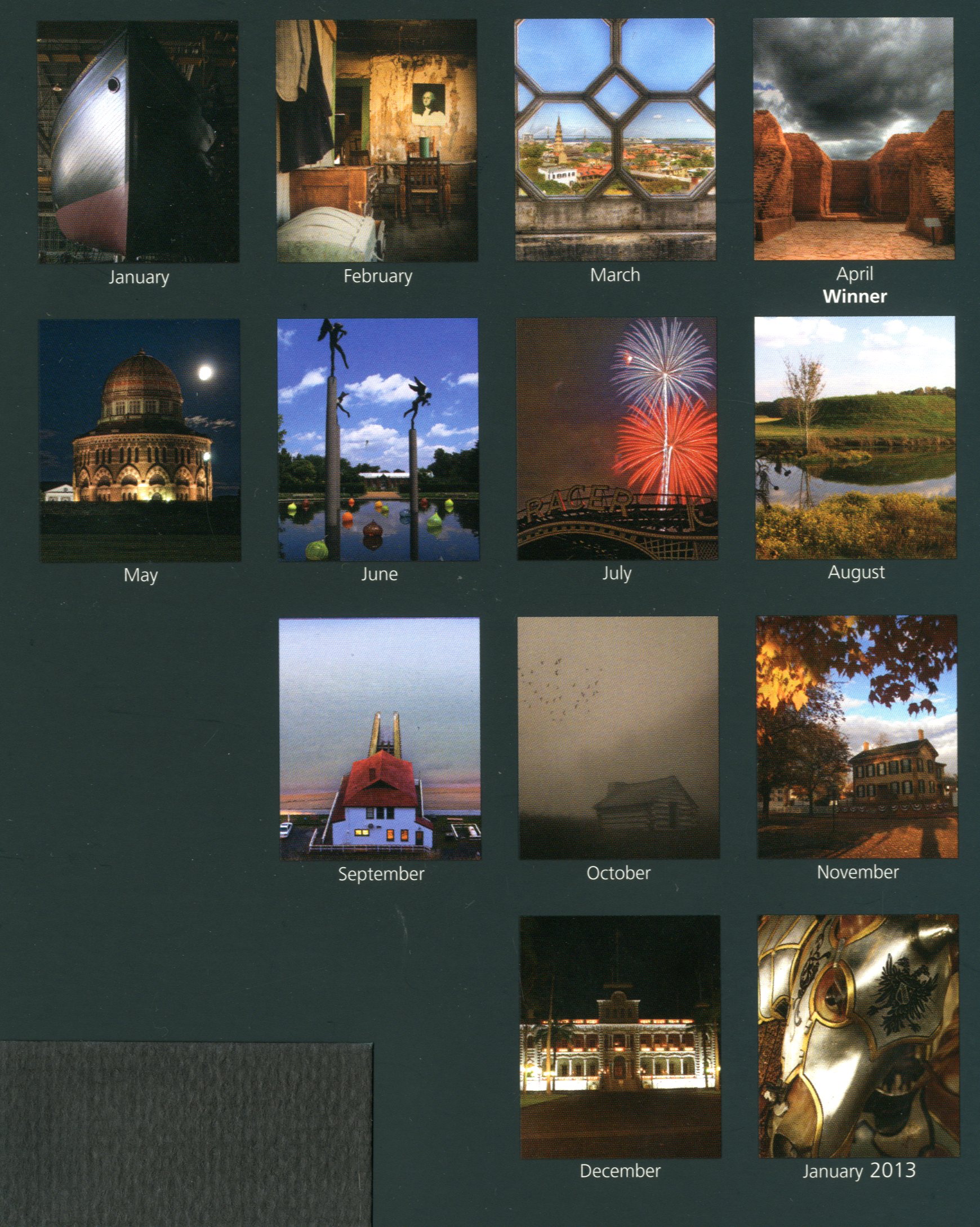
This 12-month wall calendar / event planner from The National Park Service features the winning photographs from their Twelfth Annual National Historic Landmarks (NHL) Photo Contest.

According to the contest rules, these original photos have to be “fantastic photographs that illustrate the significance of any of the over 2,500 National Historic Landmarks, our nation’s most significant treasures”.  One beautiful image from each National Park Service region and a stunning national winner were all chosen last fall from thousands of submissions for inclusion in this 2012 calendar, with the winning photograph gracing the cover.

The winning cover photo (shown above) by photographer Eric Vondy was of National Historic Landmark Pecos Pueblo, in South of Pecos, New Mexico. Park Service judges described it:

This evocative photograph inspires the imagination, yet this site’s real history is legendary. Led by an Indian guide called “The Turk,” famous Spanish explorer Coronado and his men set out from this pueblo to search for Quivira, one of the legendary “Seven Cities of Gold.” Abandoned in 1838, today the site, east of Santa Fe, is managed by Pecos National Historical Park.


Calendar Images: (Left) 1895 lumber schooner C.A. Thayer, San Francisco, California. Photographer: John Conway.  (Right) Missouri Botanical Gardens, St. Louis, Missouri. Photographer: Judy Hitzeman.

Want to see your photo win next year? If you’re a photographer, amateur or professional, you can participate in their next annual National Park Service photo contest. Read the details on their  Annual National Historic Landmarks (NHL) Photo Contest web site.

How do I get this 2012 National Historic Landmarks Photo Contest event planner calendar?

  • UPDATE AS OF 1/19/2012:  Due to the overwhelming customer response to this blog post, unfortunately GPO has sold out of its remaining stock of this calendar! If more should become available, we will update this post.

However, feel free to enjoy the beautiful images from the calendar on the National Park Service’s FlickR page for the National Historic Landmarks 2011 Photo Contest Winners.


Marine Corps Special Issue Semper Fit Sports Calendar 2011-2012

The second wall calendar is even more surprising and very inspiring as well to those who are resolved to living a healthier lifestyle through fitness.

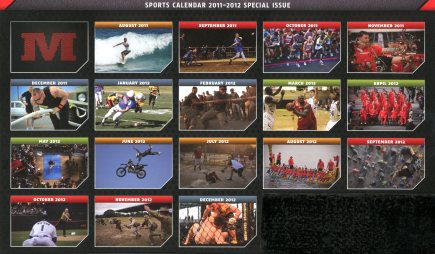
Issued by Marines Magazine, the Marine Corps’ Official Magazine, this colorful 17-month Sports Calendar (August 2011 – December 2012) recognizes some of the outstanding athlete “leathernecks” who participate in the Marine Corps’ “Semper Fit” sports, recreation and fitness program worldwide.  (“Semper Fit” is a nod to the Marine Corps motto of “Semper Fi” short for “Semper Fidelis” which is Latin for “Always Faithful” or “Always Loyal”).

One Marine base describes the Semper Fit program:

The mission at Semper Fit is to conduct, encourage and inspire the quality of life programs for that promote Healthy Lifestyles through recreation, athletics, physical fitness, the Single Marine Program and other health and wellness activities for Marine Corps active and retired members, their families and civilian workers.

The photographs on this calendar depict everything from individual sports such as the famous Marine Corps Marathon held annually in Washington, DC, and aerial motorcycle tricks…


Calendar Images: (Left) Start of the Marine Corps Marathon in Washington, DC. (Right) Motorbike aerialist and member of the “Metal Mulisha Troops” Marine stunt team.

…to intramural and varsity sports like baseball, basketball, wrestling, tug-of-war, the Dragon Boat Race, and the Warrior Games.


Calendar Images: (Left) Tug-of-war competition at Camp Leatherneck, Afghanistan. (Right) All-Marine team of active duty and veteran “wounded warriors” at opening ceremony of the all Armed Forces Warrior Games.

Many of the athletes included are recognized globally for their athletic ability, and others are Marines who stay at the top of their game no matter their age or disability, maintaining the extremely high physical fitness standards of the Corps.

The calendar also includes Federal holidays and key dates of significance to the Corps.

The Father of Semper Fit retires

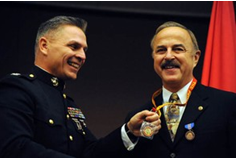
Ironically, last month after nearly 36 years of service as a Marine officer and a civilian whose final role was as Quantico’s head of recreation, Chris D’Orazio, the founder of the Semper Fit program retired.

Image: Col. Dan Choike, base commander, presents Chris D’Orazio, head of recreation, a challenge coin during D’Orazio’s retirement ceremony in the Main Ballroom at the Clubs of Quantico on Dec. 5, 2011. Source: Quantico Sentry newspaper

In an interview for the Quantico Sentry, D’Orazio explained how the Semper Fit program concept came to him back in 1985, D’Orazio when he read an article about the low life expectancy of retired Marines, whether officer or enlisted:

 “Marines, especially back then, played hard, worked hard, drank hard and smoked hard,” said D’Orazio. “I looked out the window and saw a young Marine put out a cigarette, finish a can of beer, then walk back inside the building.”

“I look down and thought to myself, based on this article, this guy’s going to live less than five years after he retires,” D’Orazio said. “After a career and everything they’ve worked for, they are probably going to die that soon; that’s terrible. That was pretty much the genesis of the word ‘Semper Fit.’”

In addition to the “Semper Fit” program for USMC, D’Orazio started the “Getting Stronger, Now” fitness program for the state of Maryland, both of which were pilot fitness programs under the President’s Council on Physical Fitness and Sports.

This 2012 Semper Fit calendar is a fitting tribute to a man who dedicated his life to, well, fitness!

And the photos are pretty inspiring to hang on anyone’s wall, too!

Calendar Image: Marines compete in the 37th annual Naha Dragon Boat Race in Naha, Japan.

How do I get this Marine Corps 2012 Semper Fit Sports calendar?

  • Buy it online 24/7 at GPO’s Online Bookstore.
  • Buy it at GPO’s retail bookstore at 710 North Capitol Street NW, Washington, DC 20401, open Monday-Friday, 9am to 4pm, except Federal holidays, (202) 512-0132.

So whether you aspire to find more beauty in the world around you or to be the best you can be, the Government is here to help you out!

Resolve to have a safe and happy 2012, America!


Vote for the top Government news story of 2011

December 26, 2011

2011 was a momentous year in Federal Government-related news and as such, it was a banner year for important Government publications, as demonstrated by our 2011 Year in Review collection available from the U.S. Government Printing Office (GPO).

But which Government news story was the most significant, in your opinion? Vote in our poll below, and then see the publications that follow that relate to these important stories:

Note 1:As of January 27, 2012, this poll is NOW CLOSED with the final results showing above, but feel free to click on the SHARE THIS link to pass on the results to others.
Note 2: This is a non-scientific user poll. Results are not statistically valid and cannot be assumed to reflect the views of the Government Printing Office customer as a group or the general population.

Following are the Federal Government publications that relate to each of these important 2011 stories:

2011 News Story   Related Federal Publication(s)
9/11 tenth anniversary   Ten years have passed since that tragic day, but the memories are still strong. 2011 saw some excellent publications about that day, including a 10th anniversary edition of Pentagon 9/11 and a reprinting of the 9/11 Commission Report, all of which you can find in our 9/11 Collection: A Decade of Remembrance.

Assassination of Osama bin Laden  FBI Terrorism Research and Analysis Project (TRAP) A Navy SEALS team located and killed Osama bin Laden this year, the mastermind behind the 9/11 attacks and many other Al Qaeda and insurgent terrorist attacks. This 2011 publication, Terrorism Research and Analysis Project (TRAP): A Collection of Research Ideas, Thoughts, and Perspectives, V. 1analyzes causes and possible responses to terrorism as presented at the FBI Terrorism Research and Analysis Project (TRAP) Symposium of international academics and law enforcement personnel.

Death of North Korea’s Kim Jong Il   The recent death of North Korea’s leader, Kim Jong Il, marks an uncertain time for the Korean Peninsula and the entire region. North Korea: A Country Studyreviews the history and the dominant social, political, economic, and military aspects of contemporary North Korea before this.

Deep Water BP Gulf oil disaster report  Deep Water: The Gulf Oil Disaster and the Future of Offshore Drilling, Report to the President, January 2011 In January of this year, the National Commission on the BP (British Petroleum) Deep Water Horizon Oil Spill and Offshore Drilling released its controversial Deep Water: The Gulf Oil Disaster and the Future of Offshore Drilling, Report to the President, January 2011. This best-selling publication offers the fullest account available of what happened in the Gulf of Mexico on April 20, 2010 and why, and proposes actions, changes in company behavior, reform of government oversight, and investments in research and technology that will be required to avert future disasters.

End of the war in Iraq  Battleground Iraq: Journal of a Company Commander There is an interesting White House timeline about the Iraq war at the end of which is a link to the Joining Forces initiative with which one can express one’s support for the troops. GPO’s bookstore has a number of books about Iraq, but two stand out as best-sellers. Battleground Iraq: Journal of a Company Commander gives a realistic account by Major Todd Brown of his experiences as a U.S. Army company commander in Iraq from April 2003 to March 2004. Hard Lessons: The Iraq Reconstruction Experienceexamines the Iraq reconstruction experience, and provides 13 take-away lessons for future contingency relief and reconstruction operations.

  • Buy them in our online bookstore:

a)      Battleground Iraq: Journal of a Company Commander

b)      Hard Lessons: The Iraq Reconstruction Experience

Japan earthquake and tsunami  Field Operations Guide for Foreign Disaster Assessment and Response Natural disasters were big in the news this year, and the Federal Government was involved in responding to them, from the National Guard in the U.S. to foreign response teams overseas. For example, in response to the tragic earthquake and resulting tsunami and nuclear reactor problems in Japan, the U.S. Agency for International Development (USAID), deployed a Disaster Assistance Response Team (DART) that included disaster response experts, urban search and rescue teams, and nuclear experts from the U.S. Department of Energy, Department of Health and Human Services, and the Nuclear Regulatory Commission. The Field Operations Guide for Disaster Assessment and Responseis used by USAID’s Office of U.S. Foreign Disaster Assistance (OFDA) for DART teams and other disaster assistance personnel when responding to foreign disasters like the Japan situation.

Last Space Shuttle flight  NASA and Space Shuttle publications including "Wings-in-Orbit" 2011 marked the end of NASA’s three-decade long space shuttle program when, on July 21, the final space shuttle mission ended with the shuttle Atlantis rolling to a stop at its home port, NASA’s Kennedy Space Center in Florida. NASA has published a number of terrific books about the program which you can find in our NASA and Space Shuttle Publications, along with a new set of beautiful color bookmarks, one for each shuttle and the best-selling Wings in Orbitbook.

U.S. economy and the Federal budget  Books about Government and Politics, including the Federal Budget and the Economy It seems every newscast this year has covered the US economy, Federal Government budgets and deficits and differing opinions about options to address them. You can find the President’s original budget submission published this year and subsequent analyses and responses to it in our collection of Books about the Government and Politics, including the Federal Budget and the Economy.

How can you find even more Federal Government publications? We have assembled many collections of Federal publications on our year-round Gift Guide and in our Special Collections page on GPO’s online bookstore.

About the Author: Michele Bartram is Promotions Manager for GPO’s Publication and Information Sales Division and is responsible for online and offline marketing of the US Government Online Bookstore (Bookstore.GPO.Gov) and promoting Federal government content to the public. 


The National Guard turns 375… and is still going strong

December 13, 2011

Guest blogger Emma Wojtowicz discusses a milestone for the United States National Guard.

Today the U.S. National Guard celebrates its 375th anniversary.

On December 13, 1636, the Massachusetts Bay Colony General Court issued a declaration that all able-bodied men between the ages of 16 and 60 were required to join the militia to defend against enemy attack and protect the settlements.

Image: The First Muster in 1637 took place after the December 13, 1636 Massachusetts General Court declaration established three regiments of “citizen soldiers” within the colony to defend against enemy attack and preserve villages established in the colony per English militia tradition. Source: “The First Muster” painting by Don Troiani.

Now, 375 years later, the National Guard still has the same mission and is an important part of the fabric that defends our country. The National Guard’s motto “Always Ready, Always There” is embodied in its founding when militias protected the colonies and today as the National Guard protects U.S. citizens at home and abroad.

In honor of this momentous occasion, the Government Printing Office has assembled a collection of National Guard publications, from history to present-day operations.

The National Guard and the War on Terror: Operation Iraqi Freedom is the third book in a series published by the National Guard Bureau about the National Guard’s role in major events from the first decade of the 21st century, including the terrorist attacks on September 11, 2001, Hurricane Katrina, the War in Afghanistan, and the Iraq War.

Operation Iraqi Freedom focuses on the early years of the Iraq War – the National Guard’s largest commitment of combat personnel since World War II.  Weaving together personal narratives, photographs, charts, and maps, the book tells the story of the Iraq War from the perspective of the National Guard’s citizen-soldiers and airmen and their role in the war from the lead up to war after the September 11, 2001 terrorist attacks to 2006 before the troop surge.

Operation Iraqi Freedom stresses that the National Guard has had a hand in every aspect of the United States’ engagement in Iraq from strategy and combat to stabilizing, training, and rebuilding the country. The author is very thorough in his explanations of conflicts and does not shy away from portraying the realities of war. Image: Never Forget! painting by Larry Selman shown in the Operation Iraqi Freedom book.

The book’s perspective rotates through National Guard units from various states detailing their missions and conveying to readers the national effort and representation of troops who are serving overseas. Operation Iraqi Freedom concludes with an “In Memoriam” tribute to members of the National Guard who have lost their lives during the Iraq War and a brief chronology of the war during the time period of the book from January 2002 to December 2006. These two closing features put the war in perspective considering other branches of the United States military that are also engaged in the Iraq War.

For 375 years, the National Guard has played a vital role in protecting the United States, which is illustrated in Operation Iraqi Freedom. This new role of supporting the other armed forces overseas in combat “warfight” missions is relatively new, but its other roles of homeland defense and security, emergency response here and abroad,and other domestic support missions are well-known and much appreciated by generations of Americans for the past 375 years.

Image: Varied missions of the National Guard. Source: National Guard Website Image Gallery

The National Guard’s almost four centuries of service is being recognized at the highest levels. It is important to note that on Monday, November 28, the U.S. Senate approved an amendment to the defense spending bill that– if passed in the final version by both houses–  would elevate the National Guard chief to the Joint Chiefs of Staff, joining the leaders of the Army, Navy, Air Force and Marines at the highest level of military and defense strategy.

Image:  DAKOTA DUNES, S.D. – A crew of Airmen with the 114th Fighter Wing of the South Dakota Air National Guard carefully place sandbags along a retaining wall where heavy equipment could not be used to reinforce the levee here on June 5, 2011. The Airmen are working alongside Army National Guard Soldiers to provide critical support to flood prevention operations as the Missouri River reached critical flood levels. Source: South Dakota National Guard; Photo by Sgt. Charlie Jacobson

How can you get The National Guard and the War on Terror: Operation Iraqi Freedom?


Digging Deep to Improve Mine Safety

December 8, 2011

A year ago April, America suffered its worst mining disaster in 40 years with the explosion at Massey Energy’s Upper Big Branch mine in West Virginia on April 5, 2010 that resulted in the death of 29 coal miners.

Image: Breaking news alert about mine explosion on April 5, 2010. Source: KATU TV.

This past Tuesday, December 6, 2011, the Mine Safety and Health Administration (MSHA) issued its final report on the causes of this tragedy.

Entitled “Report of Investigation: Fatal Underground Mine Explosion April 5, 2010”, the report reiterated earlier conclusions that blamed Massey Energy management for what MSHA investigators called total “systematic, intentional, and aggressive efforts to avoid compliance” with mine safety law.

Image: Kevin Stricklin, Administrator for Coal Mine Safety and Health, for the Mine Safety and Health Administration (MSHA), announcing the final report on the Upper Big Branch Mine disaster. Source:  http://articles.boston.com/

The report found that the accident was entirely preventable, but that deliberate actions by the company and inexplicable oversights and decisions by the Federal inspectors led to the tragic consequences.

Some of the more egregious issues cited in the report include:  falsifying records and keeping two sets of books; failure to perform examinations; failure to identify, record or correct obvious hazards; inadequate training; a culture of intimidation of the miners; allowing methane to accumulate without proper ventilation in place; and Federal investigators giving the company advanced notice of upcoming inspections.

Additional investigations are under way about MSHA’s role in this disaster as well.

History repeats itself…unfortunately

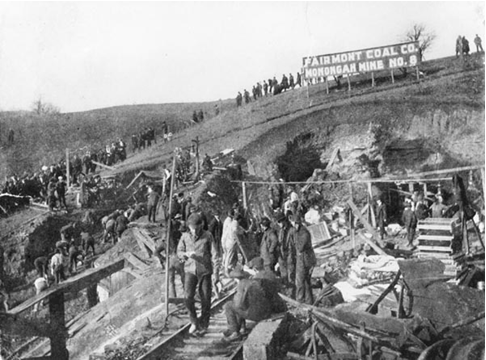
The December 6 date for the announcement of the Upper Big Branch report is significant since it marks the 104th anniversary of Monongah, the worst mining disaster in U.S. history in which 361 men and boys in West Virginia lost their lives, leaving over 250 widows and 1000 children without support.

Image:  Monongah Mine catastrophe, December 6, 1907. Source: West Virginia Division of Culture and History

Sadly, reports about the causes of the Monongah Mine explosion eerily echo the Upper Big Branch report’s findings, says Boise State history professor Dr. Nick Casner:

Thirteen days after the [Monongah Mine] accident, an official Federal government report on mining accidents and deaths was released. On December 19[, 1907,] The New York Times reported that the government document said the number of accidents due to mining explosions had steadily increased and the cause of these accidents were often caused by of “lack of proper and enforceable mine regulations.”

Does the punishment fit the crime? Were these violations even considered crimes?

The publishing of the final Upper Big Branch report this past Tuesday coincided with the announcement by U.S. Attorney Booth Goodwin, that the Federal Government had reached one of the largest mine disaster settlements ever—a $209 million civil and criminal settlement—with the company that bought Massey Energy earlier this year, Alpha Natural Resources. The settlement protects Alpha executives from prosecution, but not Massey management, 18 of which to date have refused to be interviewed by federal investigators, invoking their Fifth Amendment rights.

Image: Massey Energy Co. Chairman and CEO, Don Blankenship, second from right, attends a press conference with board directors, from left, Robert Foglesong, Bobby Inman, and Stanley Suboleski, Monday, April 26, 2010, in Charleston, W.Va. Source: Jeff Gentner, Associated Press.

However, a number of industry watchdog groups say that the current relatively weak mining safety laws may make it difficult for the Government to prosecute the people who ran Massey.

Why? Because under the current federal mine act, safety violations are only categorized as misdemeanors, with the exception of falsification of records.

How to prevent it from happening again… Congress explores solutions.

Families of this and other mining disasters as well as concerned citizens are asking what can and is being done to prevent this sort of tragedy from occurring again and killing more miners.

Image: Tuesday, April 5, 2011. Mine helmets and painted crosses at the entrance to Massey Energy’s Upper Big Branch coal mine in Montcoal, W.Va. serve as a memorial to the 29 coal miners who were killed in an explosion at the mine a year before. Source: MSNBC.com

On May 4 of this year, the U.S. House Education and the Workforce Committee held a hearing by its Subcommittee on Workforce Protections about “Modernizing Mine Safety.”

This hearing came about, according to Subcommittee Chairman Rep. Tim Walberg (R-MI), because:

[W]e want to determine whether these changes [proposed by the MSHA] will produce the safety results we hope to achieve. That is why the testimony from today’s witnesses is so important. Our witnesses have more than 100 years of combined mine safety experience, and their professional expertise and personal knowledge will help inform Congress about the current state of mine safety enforcement, whether MSHA – in their opinion – is on the right track, and what other tools are needed to safeguard the health and well-being of miners.

One of these witnesses, Cecil E. Roberts, President United Mine Workers of America, gave some examples in his testimony of problems with current MSHA criminal penalties, enforcement and advance notice of inspections:

In addition to needing more—and more up-to-date – equipment, MSHA’s enforcement tools should also be modernized. For example, MSHA’s criminal penalties have been so insignificant that they have not served to deter unlawful conduct.

In order to allow inspectors to observe actual mining practices, Congress mandated that MSHA’s periodic inspections be conducted on an unannounced, surprise basis. Therefore, it has been against the law for anyone to give advance notice of MSHA inspections. Yet, as we have learned from the Upper Big Branch investigation and the indictment the Assistant US Attorney issued against Hughie Elbert Stover, the head of security for Performance Coal Company, Mr. Stover regularly and continually used signals to give advance notice of MSHA inspections.

Miners from Upper Big Branch have also reported that they were directed to and did change their mining practices, making short-term adjustments only when they learned that government inspectors were coming to a section to inspect. 

How do I learn more about mine safety issues?

One of the more interesting and important roles the Government Printing Office has is to transcribe and formally publish the details of Congressional hearings such as these. Reading the testimony from mine safety experts and others in the mining industry gives some fascinating details about and insight into a world few of us get to see: from boardrooms high in office towers to deep underground, where mining operations are either decided or executed.

You can get your own  copy of the May 4, 2011, Mine Safety Hearing testimony by the following methods:

  • Purchase a printed copy of the Modernizing Mine Safety Hearing, May 4, 2011” testimony, contact GPO via one of the methods below, asking for GPO Stock Number 552-070-43024-5:
    • Mail your request for this publication to: U.S. Government Printing Office, Main Bookstore, 710 N. Capitol St., Washington, DC 20402-9315
    • Call toll-free 866-512-1800; or 202-512-1808 (DC metro area or international)
    • Fax 202-512-1355
    • E-mail mainbks@gpo.gov
    • Online:  Note: This item cannot be ordered online.
  • Find it on GPO’s FDSys document archive database.

Other Related Federal Publications about Mine Safety:  Additional official publications about mine safety laws and enforcement actions can be found on our online bookstore.

  • Amended Mine Act, Procedural Rules, and EAJA Rules  – This publication contains the updated version of Title I of the Federal Mine Safety and Health Act of 1977 (Mine Act) integrated with the provisions of the Mine Improvement and New Emergency Response Act of 2006 (MINER Act), and the Commission’s procedural and Equal Access to Justice Act rules.

About the Author:  Michele Bartram is Promotions Manager for GPO’s Publication and Information Sales Division and is responsible for online and offline marketing of the US Government Online Bookstore (Bookstore.gpo.gov) and promoting Federal government content to the public. Several generations back, some of her relatives came from the hard-working, coal-mining country around Huntington and Bartram, West Virginia.


In FRUS We Trust: 150 Years of US Foreign Relations History

December 2, 2011

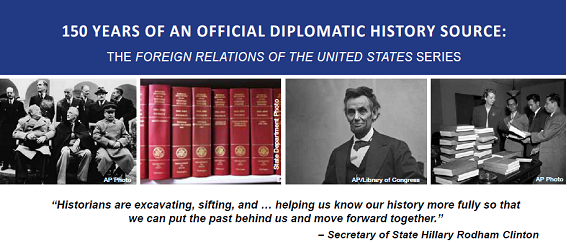
December 3, 2011, marks the 150th anniversary of the Foreign Relations of the United States (FRUS) series. The FRUS series, which is produced by the State Department’s Office of the Historian, was first published in 1861 in the same year that the Government Printing Office was founded and is the official documentary history of U.S. foreign policy decision-making and major diplomatic activity. Researchers and students of foreign policy have relied on the series to provide a “road map” of various major U.S. Government archival sources for many years.

Image: FRUS Series 150th Anniversary. Source: State Dept. Office of the Historian.

The FRUS series now comprises more than 450 individual volumes. A staff of approximately 20 historians and editors at the Office of the Historian in the Department of State compile and prepare the volumes for publication.  More recent volumes published over the last two decades increasingly containing declassified records from all the foreign affairs agencies who participate in a declassification review if their documents are selected for inclusion in a FRUS volume.

What will you find in a typical FRUS volume?

The State Department’s Office of the Historian describes the contents of FRUS volumes:

Foreign Relations volumes contain documents from Presidential libraries, Departments of State and Defense, National Security Council, Central Intelligence Agency, Agency for International Development, and other foreign affairs agencies as well as the private papers of individuals involved in formulating U.S. foreign policy.

In general, the editors choose documentation that illuminates policy formulation and major aspects and repercussions of its execution. Volumes published over the past few years have expanded the scope of the series in two important ways: first by including documents from a wider range of government agencies, particularly those involved with intelligence activity and covert actions, and second by including transcripts prepared from Presidential tape recordings.

They go on to add that currently “volumes on the Nixon, Ford, Carter, and Reagan administrations are now being researched, annotated, and prepared for publication.”

Contributing to an “Intelligent Public Opinion”

Although the FRUS was originally proposed as an unofficial Annual Report for the Secretary of State, its originators displayed very lofty goals for their now long-lived series.

In describing the history of how the FRUS series came about, Joshua Botts of the Office of the Historian at the U.S. Department of State explains:

The covering memorandum to the Secretary transmitting the Order for Secretary of State Frank Kellogg’s approval explained that FRUS “ought to contribute to the promotion of interest in questions of foreign policy and in turn assist in the maintenance of an intelligent public opinion.

In short, the Department intended for FRUS to serve an important public affairs function in addition to satisfying demands from the academic community.

Image: Frank Billings Kellogg, 45th Secretary of State under President Calvin Coolidge, 1925-29. Source: State Dept. Office of the Historian.

Thus, the editors of the Foreign Relations of the United States (FRUS) series act as the curators of American diplomatic history, sifting through our foreign affairs information to ensure there is a means for future generations of Americans to witness, decipher and interpret U.S. foreign policy decisions and actions.

150TH Anniversary Events for the FRUS series

1)      FRUS Research: To mark the 150th anniversary of FRUS, the Office of the Historian at the U.S. Department of State assembled extensive research on how the evolution of the series fits within many important themes in U.S. history, including the transformation of government institutions, changing conceptions of national security and transparency, and the increasingly important role that the United States has played in the world.

2)      Upcoming FRUS Events:  As part of the FRUS series sesquicentennial, the Office of the Historian has also embarked on an outreach initiative with public events. Even if you missed the commemorative events held to date, you can consult the list of events to see if a recording is available.

Video Recordings of Past FRUS 150th Events

a) Foreign Relations during the Civil War Era: A Video Interview with Dr. Aaron Marrs, Office of the Historian, U.S. State Department, December 1, 2011.

 President Lincoln’s Cottage and the Office of the Historian of the U.S. Department of State hosted a public program to commemorate the 150th anniversary of Foreign Relations of the United State, the flagship publication of the Department’s Office of the Historian. Burrus Carnahan, noted Civil War and Lincoln author and scholar, interviewed Dr. Aaron Marrs, Civil War-era specialist with the Office of the Historian, on Marrs’ new research that sheds light on foreign relations in the context of the Civil War.  Video part one is available here and part two is available here.

b) A Weapon of Mass Instruction?:  Discussion with Office of Historian Staff Members and University of Virginia Professors, November 7, 2011. 

The Miller Center of Public Affairs at the University of Virginia hosted a discussion between Office of the Historian staff members and University of Virginia professors on how the U.S. Government has historically struggled to balance security imperatives with its commitment to transparency and democratic accountability.  Video available on Miller Center website.

c) Out of the Frying Pan, Into the Fire: A Conversation on the 1955 Yalta Foreign Relations Volume October 12, 2011.

The story of the Yalta Foreign Relations of the United States volume is a Cold War tale of partisanship, of sensational global headlines and leaks, and of contentious debates about balancing security and openness … learn more about the Yalta papers by listening here to the discussion, “Out of the Frying Pan, Into the Fire,” at the New York Public Library.

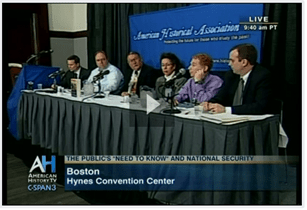
d)      Open Secrets: The Foreign Relations of the United States Series, Democracy’s ‘Need to Know,’ and National Security: American Historical Association Panel,  January, 9,  2011.

To hear how the FRUS editors sort through questions such as how much the public needs to know, what should be kept secret, are secrets political, and how long secrecy lasts, watch this fascinating panel discussion on how a democracy balances the public’s right to know against the need for preserving national security. This panel was held on January 9, 2011 at the American Historical Association Annual Meeting and included a roundtable of historians from the State Department and National Security Archive. The panel discussion can be viewed on CSPAN video or Youtube video.

Figure: FRUS panel entitled “Open Secrets: The Foreign Relations of the United States Series, Democracy’s ‘Need to Know,’ and National Security” at the American Historical Association Annual Meeting on January 9, 2011.


So from one 150 year-old to another, GPO wishes the Foreign Relations of the United States series a very well-deserved happy birthday!

How can you get copies of the Foreign Relations of the United States (FRUS) series?

Alerts about new releases of the Foreign Relations of the United States series

1) GPO Email Alerts:  Sign up to receive email alerts from the U.S. Government Bookstore about new publications in the FRUS series.

2) State Department FRUS RSS feed:  You can also keep up-to-date about new releases in the FRUS series by subscribing to the State Department’s FRUS Series RSS feed.

About the Author:  Michele Bartram is Promotions Manager for GPO’s Publication and Information Sales Division and is responsible for online and offline marketing of the US Government Online Bookstore (Bookstore.gpo.gov) and promoting Federal government content to the public.


Ponzimonium: How Scam Artists Are Ripping Off America

November 18, 2011

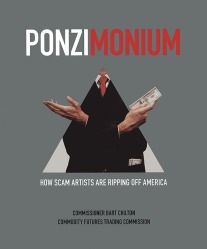
Every single day, someone somewhere makes a gigantic mistake by giving his or her money to a fraudster,” says Bart Chilton, one of the commissioners of the Commodity Futures Trading Commission (CFTC). Chilton is the author of Ponzimonium: How Scam Artists are Ripping Off America, a shocking new book available from GPO about some of the worst perpetrators of investment fraud in recent U.S. history.

Figure 1: Ponzimonium: How Scam Artists Are Ripping Off America available from GPO.

Ponzimonium looks to the CFTC’s own recent public case files stemming from fraud investigations that began with the recent economic downturn- talk about hitting people when they’re down! Because of the this, the book is generating a lot of positive buzz in The New York Times, TheStreet, and other media outlets.

The CFTC is an independent Federal agency with the mandate to regulate commodity futures and options markets in the United States. After the financial crisis of 2008, their authority was expanded under the 2010 Dodd-Frank Wall Street Reform and Consumer Protection Act to include over-the-counter derivatives markets and hopefully prevent and uncover more of these frauds.

What is a Ponzi scheme, you ask?

The world really learned about Ponzi schemes in December of 2008 when, as Chilton writes in his introduction, “legendary investment guru Bernard Madoff ‘made off’ with an estimated US$50 billion in what was called the ‘Mother of all Ponzi Schemes’.” (By the way, an interesting related read is the report about the Investigation of Failure of the Securities and Exchange Commission To Uncover Bernard Madoff’s Ponzi Scheme, also available from GPO.)

Unlike pure pyramid schemes in which it is mandatory that a new investor recruit others into the deal in order to receive payments, Ponzi schemes purport to offer investors a “too good to be true” deal by simply handing over their money. However, no real investment is made by the criminal.

Instead, Ponzi schemes, named after 1920’s postage stamp speculator-fraudster Charles Ponzi, are scams in which early “investors’—often friends, colleagues, and family members—are asked to invest in a this great “no risk” deal offering unbelievable returns.

Typically, the investor makes an initial investment and then some purported “phantom profits” are paid out by the con artist (really just money from other investors), prompting that investor to assume that his or her money has increased in value—and inspiring the investor to turn over more money to invest and tell others about it. In actuality, the perpetrators pocket the money for themselves.

This splendid infographic from the New York Times explains the concept visually:

Figure 2. Ponzi scheme infographic. Image source: The New York Times 12/21/2008 Week in Review.

Made in Madoff’s Image

Ponzimonium introduces some of the lesser known, but equally  despicable fraudsters that have been uncovered since 2008 by the CFTC and SEC (Securities and Exchange Commission).

The book lays out the fascinating and dramatic details behind the fraudulent schemes, their smooth-talking masterminds, and their many honest, hard-working victims, who often lose the money they’ve saved for their kids’ college funds, needed health care expenses, or their own retirement as a result of misplaced trust in these criminals.

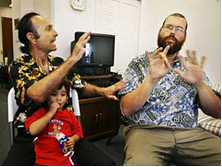
These stories are so engrossing— at times it felt like I was taking in a marathon of America’s Most Wanted or I Almost Got Away with It episodes— I found it hard to decide which of these criminals is the most despicable. Was it Beau Diamond of Diamond Ventures who wiped out his parents’ savings along with 200 other clients who invested US$37 million? Or how about Marvin R. Cooper of Billion Coupons, who created a combination Ponzi and pyramid scheme called an affinity fraud, to target and recruit fellow deaf community members in the U.S. and Japan? And there’s James Ossie of CRE Capital Corporation (CRE) who bilked investors out of US$25 million, including a desperate father’s US$200,000 he invested to fund his young daughter’s cancer treatments.

Figure 3. Fraudster Marvin R. Cooper and deaf client. Image source: BusinessInsider.com

The human side behind these frauds makes them all the more compelling… and contemptible.

The best way to avoid getting swindled, advises Chilton, is to “remember what your parents told you when you were little: ‘Don’t take candy from strangers’”, and my personal favorite, “Just because it is on the TV, Internet, etc. doesn’t mean it’s real!” That’s advice you can take to the bank.

Some “don’t miss” features of this book

Ponzimonium: How Scam Artists are Ripping Off America includes some very useful features for its readers that make this a valuable resource for any investor.

  • Red Flags of Fraud: Includes 20 red flags to look out for when considering an investment.
  • Investor Checklist: Detailed list of questions to ask before investing.
  • Investors’ Bill of Rights: Common sense advice and legal rights for any investor.
  • Resources: Useful contact information for victims or witnesses of a fraud.
  • Glossary of Fraud Terms: Definitions of legal and financial terms within each story.
  • The Loot: Color photos of the criminals’ misbegotten gains and lavish lifestyle.
  • The Numbers: Calculations of the staggering amounts collected, paid, lost, or stolen, and prison sentences and restitution.

How can you get this Ponzimonium eBook?

About the Author:  Michele Bartram is Promotions Manager for GPO’s Publication and Information Sales Division and is responsible for online and offline marketing of the US Government Online Bookstore (Bookstore.gpo.gov) and promoting Federal government content to the public. She has been researching identity theft and privacy issues for years, both on the web and in the real world, and is a big fan of more fraud protection for citizens.

Veterans Day and 100 Years of Flying Leathernecks

November 10, 2011

November 11, Americans celebrate Veterans Day, honoring the brave men and women who have served our Armed Forces in peacetime and in war.

This holiday dates back to the end of World War I when President Woodrow Wilson declared that this day be commemorated as Armistice Day after the warring sides declared an armistice:

On the 11th hour of the 11th day of the 11th month of 1918, an armistice, or temporary cessation of hostilities, was declared between the Allied nations and Germany in the First World War, then known as “the Great War.” (History.com)

Figure 1. Armistice Day poster. Source USFlagStore Blog

November 11th was celebrated as Armistice Day starting in 1919 and became a legal federal holiday in the United States in 1938. After World War II and the Korean War, Armistice Day became Veterans Day in the United States. November 11 is still celebrated as Armistice Day in France and Belgium, but is called Remembrance Day today in the British Commonwealth of Nations, and is known as the Day of Peace in the Flanders Fields.

While Veterans Day is typically a tribute to America’s living veterans, it is always appropriate to include a moment of silence in respect for those who gave their lives for their country.

Honor veterans past and present by pausing for a minute of silence at 11:11 on 11/11/11, “the eleventh hour on the eleventh day on the eleventh month.” and in this case, the 11th year of the century as well!

The “War to End All Wars” instead gave birth to aerial warfare

Idealistically, many thought that “The Great War” would be “The War That Will End War” , a term first coined by famed British author H.G. Wells in 1914 and later used as “a war to end war” in a speech by President Wilson.

Instead of being the end of wars, World War I was a first in many ways, including the first war to feature the large scale use of manned aircraft for both reconnaissance and aerial combat.

It also marked the introduction of Marine Corps Aviation.

Happy 100th, Marine Corps Aviation!

2012 will mark the hundredth anniversary of the founding of Marine Corps Aviation. To commemorate this noteworthy milestone, the US Marine Corps has produced a remarkable new publication entitled 1912-2012 100 Years of Marine Corps Aviation: An Illustrated History.

Figure 2. 1912-2012 100 Years of Marine Corps Aviation: An Illustrated History

A stirring snapshot of some of the key people, aircraft, and events that comprise this first century of Marine aviation, this book showcases the achievements of Marine aviation through seldom seen photographs and accounts of pivotal battles and events.

Intended as a “museum in a book,” 1912-2012 100 Years of Marine Corps Aviation: An Illustrated History includes an overview for each time period in Marine aviation, chapter introductions, feature articles, and a running timeline. A real plus is the bonus oral history CD that the Marine Corps has included in the back of the book, providing the text and photos along with first-hand accounts from select Marine aviators, which really bring the stories alive.

Particularly interesting are the exploits of legendary Marine aviators including Roy Geiger, Joseph Foss, Gregory “Pappy” Boyington, Keith McCutcheon, Frank Petersen Jr., and others, including aviator-turned-astronaut John Glenn Jr., who besides being the first American to orbit the earth, wrote the foreword for this book.

First Flying Leatherneck

Featured in the book is the man who started it all: A.A. Cunningham. On May 22, 1912, two years before the outset of World War I, Alfred A. Cunningham, then a First Lieutenant in the United States Marine Corps, first reported for “duty in connection with aviation”—i.e., flight instruction—to the new Naval Aviation Camp that had just been established at Annapolis, Maryland, home of the US Naval Academy.

Today considered “the father of Marine aviation,” Lt. Col. Alfred Austell Cunningham, better known to Marines as A.A. Cunningham, became the “de facto director of Marine Corps aviation.

Fun fact: A quick study, Cunningham received less than three hours of instruction before flying his first solo flight as a Marine aviator!

Figure 3. Lt. Alfred A. Cunningham floats in a Curtiss hydro-aeroplane in 1914.  Source: Marine Corps Air Station Cherry Point

Aces in the Air: The oldest Marine air attack squadron

Also mentioned in the publication is Marine Corps Air Station Cherry Point in Havelock, North Carolina, next to where I used to live in New Bern. MCAS Cherry Point is home to a number of Marine air squadrons, including VMAQ-1, VMAQ-2, VMA-223 and VMA-231, and hosts a phenomenal air show every year. Oo-rah to my old neighbors!

Formally established in 1919, Marine Attack Squadron 231 takes great pride in being the oldest squadron in the Marine Corps. After being re-designated the First Squadron, VMA-231 adopted the “Ace of Spades” moniker, since the Ace is the first card in the suit. The “A” in the upper left stands for “Air” and the “S” in the lower right stands for “Squadron”.

Figure 4. VMA-231 Ace of Spades logo. Source: Marine Corps

Where can you find this and other publications on aviation?

You can find 1912-2012 100 Years of Marine Corps Aviation: An Illustrated History on our online bookstore, in a library, or at our retail bookstore at 710 North Capitol Street NW, Washington, DC 20401.

For regular updates about today’s naval and marine aviation, you may wish to subscribe to these excellent magazines from the Navy and Marine Corps: quarterly magazine Naval Aviation News: Flagship Publication of Naval Aviation or the bi-monthly Approach: The Navy & Marine Corps Aviation Safety Magazine.

Aviation fans and practitioners in general should check out our Aviation Publications Collection on our online bookstore with books on aviation past and present and information for pilots, balloonists, and more.

Oh, and I would be remiss if I didn’t point out that you can sign up to receive Aviation email updates about new Federal Government aviation publications as they come out.

About the Author:  Michele Bartram is Promotions Manager for GPO’s Publication and Information Sales Division and is responsible for marketing the US Government Online Bookstore (Bookstore.gpo.gov) and promoting Federal government content to the public. She is a fan of military aviation, from growing up near Andrews Air Force Base in Maryland and watching Air Force One and the Blue Angels overhead, to living in New Bern, NC, near Marine Corps Air Station Cherry Point and watching the Harriers do practice fly over runs.


Losing our Shared National Experience?

October 31, 2011

Our blog post last week talked about GPO’s 150-year history of keeping America informed. But what does this mean in today’s media-saturated world?

Has the proliferation of media eroded our shared national experience?

[Figure 1. U.S. History Collage. Image courtesy of Mrs. Rice’s American History II class, Lexington High School, Lexington, Ohio.

Two weeks ago in a social media seminar for Federal Government, David Kirkpatrick (technology writer for the Daily Beast and Fortune magazine and author of a new insider book on Facebook) gave some startling statistics: 50% of Facebook’s 800 million users worldwide visit Facebook daily and up to 500 million have accessed Facebook on a single day, with the average Facebook user having over 130 “friends.”

But even more surprising, he said that 50% of Americans today now get their news and analysis about important events— sometimes edited or changed as it is passed along— from friends and family, often via social networks, text or email rather than from traditional media sources.

Prior to the 21st century, when Americans had only a few national media choices and limited local media, we would all receive the same original message at the same time, thus creating a shared American experience.

Today, in the U.S. alone Americans can choose to receive information from any of an estimated 1,476 daily newspapers; 1,500 television stations; 10,322 radio stations; 71 million cable television subscribers with hundreds of TV channels each; and more than 12 billion web pages and social media.

Kirkpatrick and others say the combination of the “Facebook effect”, media proliferation, and message selectivity have contributed to the erosion of our common, shared national experience.

GPO’s role in preserving our common American experience

As we mentioned in our blog last week, GPO’s mission for over 150 years has been “Keeping America Informed” about the three branches of the Federal Government.  This mission drives us to ensure the original information produced by Federal Agencies on behalf of the American people can be found by all Americans now and in the future.

What’s involved in capturing and disseminating our common Governmental information? It starts with gathering the content from Federal Agencies and publishing it in a professional format, whether print or digital. It then continues with authenticating the information to ensure Americans are getting the “genuine” unaltered information; creating permanent records with our catalog teams for our own FDSys digital database and Catalog of Government Publications; distributing these records to libraries in our Federal Depository Library Program and to worldwide library databases like WorldCat; and sending physical copies and/or ebooks to libraries, bookstores and book etailers.

View this video for an inside look at how GPO assembles and prints the Congressional Record—the official record of the proceedings, debates, and activities of Congress.

To keep America informed digitally, we allow users to subscribe to email newsletters by topic and are also now on social media, including Facebook, Twitter, YouTube, Foursquare and Yelp.

GPO Publications about shared American experiences

Here are some of my favorite Federal publications GPO has published that document significant shared American experiences over the past century. Do you remember when and how you learned of these events?

What are some of the significant national experiences that you will never forget and how did you learn about them and share them with others?

We would love to hear from you!


About the Author:  Michele Bartram is Promotions Manager for GPO’s Publication and Information Sales Division and is responsible for marketing the US Government Online Bookstore (Bookstore.gpo.gov) and promoting Federal government content to the public.


This Day in History: Lincoln visits the GPO

October 24, 2011

Guest blogger Emma Wojtowicz talks about an important day in GPO history.

On October 24, 1863 – 148 years ago today – President Abraham Lincoln visited the Government Printing Office, the only sitting president to visit the agency. To celebrate the anniversary of his visit, Government Book Talk is taking another look at GPO’s own publication, Keeping America Informed: The U.S. Government Printing Office, 150 Years of Service to our Nation (the book was previously featured on this blog on June 15).

GPO opened for business on the same day that Abraham Lincoln was inaugurated as President of the United States – March 4, 1861. The following year in September 1862, GPO printed the preliminary version of the Emancipation Proclamation issued by Lincoln as a general order. Then in 1863, Lincoln visited GPO by invitation from Public Printer John Defrees.

President Abraham Lincoln reads a draft of the Emancipation Proclamation to his Cabinet

Figure 1. First reading of the draft of the Emancipation Proclamation by Abraham Lincoln to his Cabinet on July 22, 1862.

[Painted by F.B. Carpenter ; engraved by A.H. Ritchie. Image courtesy of: The Library of Congress]

These unknown facts about Lincoln are part of GPO’s history and foundation. For 150 years, GPO has worked quietly and diligently behind-the-scenes for Congress, the White House, Federal agencies, and the public. Keeping America Informed tells the story of the United States from the different and unknown perspective of GPO employees and their consistent contribution to the workings of the Government. The book is full of “did you know?” facts and tidbits of information, often accompanied by an illustration or picture. For example, did you know that GPO has produced the United States passport since the 1920s?

Well, even if you did, you can learn a brief history of the passport – an idea originally conceptualized and produced by Benjamin Franklin, which identified the bearer as a trusted individual who was able to enter the U.S. The State Department took over control of the passport in 1856 and the single engraved page was produced by the Bureau of Engraving and Printing. When in the 1920s the League of Nations created an international standard for a booklet-style passport, the State Department sought GPO’s services to print it, and has remained a loyal customer ever since.

Earliest booklet-style US passports printed by the Government Printing Office (GPO)

Figure 2. First generation of booklet-style US passports. Printed by GPO. Source: “Keeping America Informed”

These types of facts and added background are what make Keeping America Informed a worthwhile read. Similar information can be found on the United Nations Charter, the Warren Commission, President George H. W. Bush’s 1991 inauguration, and the list goes on. In between, you can see historical photographs from GPO’s vast collection.

The book was written, edited, designed, and printed by GPO employees, which is entirely fitting because the message of the book is centered on GPO employees and how they have played a major role in the history of the United States. Abraham Lincoln visited GPO when the agency was still in its infancy, yet working around the clock in support of the war effort.

As the book details, GPO is a much different place today than when Lincoln visited; however, the mission of GPO remains the same. Keeping America Informed: The U.S. Government Printing Office, 150 Years of Service to our Nation is available through GPO’s online bookstore, retail bookstore, on our FDSys federal document database or in a library.

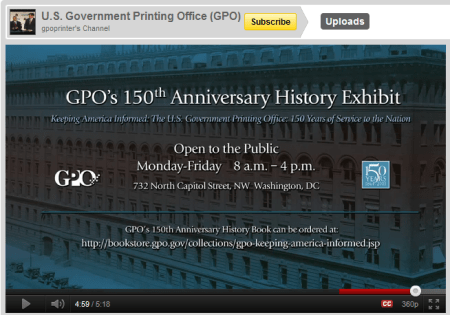
You can see the original printer’s proof of the Emancipation Proclamation in person at GPO’s 150th anniversary history exhibit now through December 2011!

To view an original copy of the preliminary version of the Emancipation Proclamation that was issued by President Lincoln and printed by GPO, visit our 150th anniversary history exhibit located at 732 North Capitol Street NW in Washington, DC. The Emancipation Proclamation is on loan from the Library of Congress only through December…

Click here to watch a video of our 150th anniversary exhibit on GPO’s YouTube channel.

The GPO 150th anniversary exhibit is open 8 a.m. to 4 p.m. Monday through Friday, except on Federal holidays.

Read more about Abraham Lincoln and his rise to the Presidency in the National Park Service’s recent work commemorating the 150th anniversary of Lincoln’s inauguration: Abraham Lincoln’s Journey to Greatness.


Statistical Abstract and Print Mashups in a Digital Age

October 13, 2011


Since 1878, the Statistical Abstract of the United States has been printed by the Government Printing Office on behalf of the Census Bureau.

The “Stat Abstract” is considered “the authoritative and comprehensive summary of statistics on the social, political, and economic organization of the United States,” and compiles data from multiple sources, including: the Census Bureau, Bureau of Labor Statistics, Bureau of Economic Analysis, and many other Federal agencies and private organizations. Each year, new tables and analyses are added to keep up with the issues and interests of the day.

As Jim Cameron mentioned in his February post about the 2011 edition,

“Family debt, manufacturing, national security, international statistics – there doesn’t seem to be anything that the Statistical Abstract doesn’t cover. At more than 1,000 pages, it’s an America watcher’s dream.”

This important publication has fulfilled a unique niche for over a century for students, educators, researchers and librarians throughout the country as the definitive source of US statistics. As one librarian put it, “The print edition is THE most used reference book in my collection.”

Why is having all this information in a single, compiled, cited, and referenced edition important to its users? Michael Fry, Senior Map Librarian for the National Geographic Society Library and Archives says:

“[W]hile the Census Bureau may be correct that the data is “available elsewhere,” the beauty of the Stat Abstract is that it obviated users’ need to know where “elsewhere” was. And that, as librarians know, can be (at least) half the battle.”

After fifteen years in the Internet industry, I am highly aware of how important it is to your intended audience to be able to quickly and easily find the information they are looking for, and how difficult this search task is made for the users by most web sites.

This has led to an entire field of search engine optimization also called SEO. Unfortunately, all the SEO in the world can’t overcome the amount of time and effort necessary to find all the content and data you need if it is scattered across many web pages and web sites.

In a world where time is money and convenience is king, the time savings in both finding the necessary data and knowing immediately the official source that produced that data are key benefits of a book like the Statistical Abstract. In a sense, this book is the ultimate printed “mashup” that blends data from multiple sources into a cohesive whole that is greater than the sum of its parts.

Who would have thought that a 134 year-old publication tradition would have such relevance in a digital age?  Unfortunately, compiling all this data and obtaining publication rights is increasingly expensive,  as many experts and a lot of effort are needed to pull together a work of this complexity. Thus, this may be the last year in its compiled format, since in its Fiscal Year 2012 budget submission to Congress, the Census Bureau requested “a decrease to terminate the Statistical Abstract program.

So, you may want to get what may be the last print edition of the Statistical Abstract of the United States at the US Government Bookstore in paperback or hardcover or find it in a library. Or you can see the tables online here.

Some interesting facts from the 2012 edition:

  • Increase in US Population: Between April 1, 2000 and April 1, 2010 there was a 9.7 percent increase in the resident population of the United States. The state with the highest percentage increase in resident population during the same time period was Nevada (35.1), while the only state that experienced a decrease was Michigan (-0.6). (Table 14)
  • Retail profits up: For retail trade corporations with assets of 50 billion dollars or more, net profit increased from 54.0 billion in 2008 to 84.1 billion in 2009. Profits per dollar of sales before taxes also increased from 2.6 cents per dollar of sales in 2008 up to 4.1 cents per dollar of sales in 2009. (Table 1052)
  • 80% has Internet access: In 2010, approximately 20 percent of households did not use the Internet…[, and] 80 percent of households had an Internet connection anywhere (at home or mobile etc). (Table 1155)


About the Author:  Michele Bartram is Promotions Manager for GPO’s Publication and Information Sales Division and is responsible for marketing the US Government Online Bookstore (Bookstore.gpo.gov) and promoting Federal government content to the public.