Get Sunwise and Block the Sun, Not the Fun

June 3, 2013

School’s out and the sun’s out, too, so it is time to teach kids about sun safety, particularly as June 2-8 is National Sun Safety Week. With children playing in the backyard, at the park, or in the pool or at the beach, it is important for parents to be aware of sun safety and for kids to be responsible for their own well-being when it comes to the sun.

The Environmental Protection Agency (EPA) has two great resources as part of their SunWise program. The Mission: Sunwise Activity Book 2013 is an educational, hands-on way for kids to learn about sun safety, and the companion website – SunWise – provides parents, teachers, and babysitters with additional resources for teaching children about the harmful effects of the sun.

Fulfill the Mission to Get “Sunwise”

mission_sunwise_activity_book_Page_01The Mission: SunWise Activity Book 2013 targets children in kindergarten through 8th grade and takes a more thorough approach to sun safety. Children learn about the ozone layer, ultraviolet rays, the UV Index, thermometers and preventative actions to protect themselves from the harmful effects of the sun.

There are more than a dozen activities including drawing and coloring, matching, word scrambles and fill in the blanks to engage children in sun safety lessons. The activity book doesn’t just tell kids to wear sun screen and play in the shade, but explains what causes sunburns and why it is important to be “sunwise.” [Says GovBookTalk Editor Michele Bartram: “My favorite page is the “Slip, Slop, Slap, Wrap, Check, Play” page!”]

Parent and Teacher Sun Safety Resources

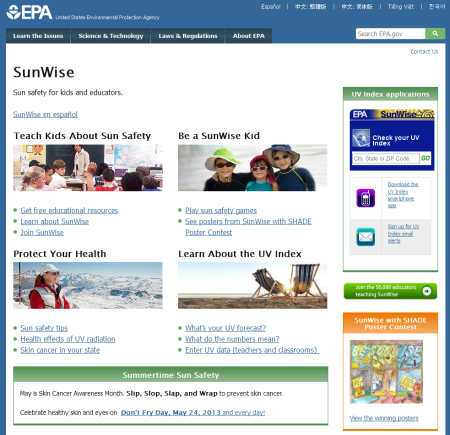
The EPA’s Sunwise sun safety website, http://www2.epa.gov/sunwise, has endless resources for adults and children. Teachers can download suggested lesson plans with PowerPoint presentations and sign-up for the SunWise Program to receive free toolkits that have age appropriate content and activities for their classrooms. Children can play interactive sun safety games, take quizzes and become “Sun Safety Certified.”

Together, adults and children can learn about the UV Index scale and the suggested precautions that go with each category and the health effects of overexposure to UV rays.  It even has Skin Cancer Fact Sheets by state showing the skin cancer rates and Action Steps for Sun Safety.

The website’s content is well-organized and can be translated into Spanish to reach a greater audience.
EPA-Sunwise-WebsiteAnother useful site is from the not-for-profit Sun Safety Alliance, (también en español) which offers its “Block the Sun, Not the Fun” program in addition to sponsoring National Sun Safety Week. 

Graphic-Skin-cancer-video-Sun-Safety-AllianceThe website includes resources for Educators, including this Teacher’s Guide; Healthcare Professionals; Parents and Early Childcare personnel; and a Kids site. It also has activities for children from infants and toddlerspre-school age, and kindergarten to 2nd grade, to grades 3 to 5, middle school,and  all the way through high school.

Image: From a video on the Sun Safety Alliance home page, showing the effects of skin cancer on a former suntan addict. She says, “I wish I knew then what I can see now!”

It is not fun to avoid the sun and sit inside all summer. So be proactive and start the summer out right by taking preventative actions to avoid sunburns. Keep in mind that there is more to sun safety than just putting on sun screen.

HOW DO I OBTAIN the “Mission: SunWise Activity Book 2013”?

  • Buy it online 24/7 on GPO’s U.S. Government Bookstore.
  • Buy it at GPO’s main retail bookstore at 710 North Capitol Street NW, Washington, DC 20401, open Monday-Friday, 9am to 4pm, except Federal holidays, (202) 512-0132.
  • Find it in a a federal depository library.

About the Authors: Our guest blogger is Emma Wojtowicz, Public Relations Specialist in GPO’s Office of Public Affairs. Additional content was provided by Government Book Talk Editor Michele Bartram, Promotions Manager for GPO’s Publication and Information Sales Division.


People Get Ready, There’s a Storm Coming

May 29, 2013

Hopefully, you’ve never had to live through a hurricane or a tornado. I count myself lucky to have escaped the worst of the major weather events; living in an area that gets spent hurricanes is bad enough.

nhpwBanner2013If you live near the Atlantic Coast, as I do, you do need to worry about hurricanes. You want to remember June 1 as a significant date. It’s the start of the hurricane season, which runs from June 1 to October 1. For that reason, NOAA’s National Hurricane Center (the National Oceanic and Atmospheric Administration) kicks off National Hurricane Preparedness Week every year before the season starts. If you can’t leave home to avoid being in the path of hurricanes, the next best thing you can do is be prepared.  Make plans for getting through a storm: family communication plans and buddy plans. Build your disaster kit.

After my family and I lived through a man-made disaster, we made an evacuation plan so we know how we’ll try to reach safety. You should talk with your family about emergency strategies. Having plans for a storm or disaster doesn’t mean you’ll be able to use them, but you’ll be far better off than if you don’t have a plan. Go through checklists you can find at www.ready.gov and find out everything you can to be organized.

Hurricanes: Information and Activity Booklet

For further children’s activities and tutorials, there’s Hurricanes: Information and Activity Booklet, designed for ages nine and older. The slim volume describes the history of the word “hurricane”, as well as the reasons NOAA attaches personal names to each hurricane. The work also explains hurricane wind scales, defines hurricanes and typhoons, and much more.

Of special note are the accompanying pictures of some of recent history’s most destructive storms—Irene, Dora, Kenneth, Rick, Katia and of course, Katrina—help students understand how colossal they are. The photos show the storms nestled up against landmasses that they overshadow. If you could not visualize how large and fearsome these storms were before, you’d know it after you saw their photos. The informative graphics, puzzles, tests and quizzes provided will give children a good basic understanding of hurricanes.

katrina_in_gulf_2005-08-28Image: NOAA satellite image of Hurricane Katrina, taken on Aug. 28, 2005, at 11:45 a.m. EDT, a day before the storm made landfall on the U.S. Gulf Coast. While in the Gulf of Mexico, Katrina’s winds peaked near 175 miles per hour. Credit: NOAA

After studying both Hurricanes and Watch Out-Storms Ahead!, your kids should be as intellectually prepared as they can be.

Ready…Set…Prepare!

ReadySetPrepareYou’ll want to pick up a copy of Ready…Set…Prepare! [for Ages 4-7] Reading it will help your kids learn how to help your family prepare for storms in a more practical sense. FEMA designed this activity book to teach kids ages four to seven how to prepare for disasters such as hurricanes and tornadoes.

Two cartoon kid characters—Angela and Mario, along with their emergency expert friends Bright Shinely and Newser—learn what they, too, can do to help their families prepare for disasters. (Parents and teachers of Dora and Diego fans, take note: these characters will seem eerily familiar. 😉

Each chapter gives the basic facts about evacuation plans, family communication plans, pet care plans, and the types of disasters. Practical lists are scattered throughout that may help adults as much as children, such as a disaster supply kit list. Fun exercises to color and flashcards to cut out with the child’s recently acquired scissoring skills are also included.

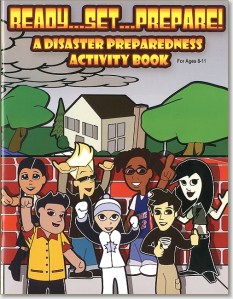
Ready-Set-Prepare_ages-8-11Your children will find some solid entertainment packed in with the lessons included in this book. They are likely to wind up exhorting you to get your emergency plan together—and what could be better than that? Getting yourself and the little people in your life ready for an emergency is one of the best things you could do to protect your most precious assets.

FEMA created another version of Ready…Set…Prepare! [for Ages 8-11]. This contains more sophisticated activities and lessons for the older elementary schooler to prepare for emergencies.

Watch Out…Storms Ahead! Owlie Skywarn’s Weather Book

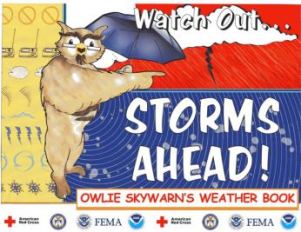
owlie-skywarn_coverAn important part of making these plans is educating the children in your life—your children, your students, etc. If you are working with school-aged children, a good place to start is the excellent picture/activity book, Watch Out-Storms Ahead! Owlie Skywarn’s Weather Book. This volume is a joint publication of NOAA, FEMA (the Federal Emergency Management Agency) and the American Red Cross, and it covers tornadoes, lightning, floods and winter storms as well as hurricanes.

The book shows children what they can do to help their families get ready. There are quizzes, warnings, preparation and evacuation tips, and statistics that will help kids understand the importance of being prepared. Since the pictures are black and white, your kids can color them too. Throw this book and a packet of crayons in your disaster kit.

Sample question from the quiz: “A hurricane [blank] means a hurricane is expected within 36 hours and winds could reach 74 mph or more.” (answer: Warning)

How can I obtain these publications?

About the author: Our guest blogger is Jennifer K. Davis from GPO’s Library Services & Content Management Division that supports the Federal Depository Libraries Program (FDLP). (Article is adapted from an original  post in the FDLP Community site blog by Government Book Talk Editor, Michele Bartram, GPO Promotions & Ecommerce Manager.)


All the President’s Men and Women: Sourcebook of the US Executive Agencies

May 24, 2013

The size of the federal government is a consistently politicized topic. Whether you think it is too big or too small or just right, you can learn more and develop an opinion with help from a first-of-its-kind publication by the Administrative Conference of the United States.

Sourcebook-US-Executive-Agencies-2012This first edition of the Sourcebook of the United States Executive Agencies was published in December 2012 to break down information and numbers by what they refer to as the “executive establishment,” which is the executive branch and all the other Federal agencies, offices, bureaus, and boards that serve the President that do not fall neatly under any of the three branches of the Federal government.

From Three to Many

The executive establishment traces its roots to 1789 when the first Congress created three executive departments: Treasury, War and State. For 60 years, these three departments carried out the nation’s essential functions and responsibilities regardless of whether they fit under the departments. Then in 1849, Congress created the Department of the Interior and after that the rest of the executive departments that we know today were established, reorganized and shuffled together over time. The Department of Homeland Security is the most recently established agency that was created in 2002 combining together 22 federal agencies from various departments.

Burgeoning Bureaucracy

Regarding the number of federal government employees, the most dramatic increase happened under FDR’s administration. During the New Deal era from 1933 to 1944, federal employment expanded from 600 thousand workers to 3.3 million workers.  In 2012, the executive establishment was made up of 2.85 million civilian employees compared to the legislative branch with 31 thousand civilian employees, the judicial branch with 32 thousand civilian employees and the military with 1.4 million service members.

These numbers do not include the number of contract employees and local and state employees whose salaries are paid for with federal funding.

The Role of the Political Appointee

The publication also explains the types of political appointees and their role in the executive establishment.  The top leadership positions in the executive establishment’s departments and agencies are political appointments that must be nominated by the President and confirmed by the Senate. In 2012, there were 1,130 positions in the executive establishment requiring Senate confirmation.

Another type of political appointee is the Senior Executive Service (SES), which is a corps made up of about 7,000 senior managers across the executive establishment. The Office of Personnel and Management determines the number of positions in each agency that will be filled by members of the SES. Then there are also Schedule C positions who serve at the pleasure of the head of the department of agency. Both SES and Schplum-book-2012edule C appointees do not require Senate confirmation.

For more information about political appointees, check out the Plum Book, to which this book is an important companion publication. Read about the Plum Book in our blog post, “A Plum Book of Political Positions”.

Conclusion

Thanks to the information and statistics provided in Sourcebook of the United States Executive Agencies, readers can develop an informed opinion about the size and organization of the government.

HOW DO I OBTAIN THE “Sourcebook of the United States Executive Agencies”?

About the Author: Our Guest blogger is Emma Wojtowicz, Public Relations Specialist in GPO’s Office of Public Affairs.


Agency of the Month: US Army Center of Military History

May 14, 2013

CMH_AgencyoftheMonth_Slide

We are starting a new series to feature various Federal agencies of note as Agency of the Month. With it being National Military Appreciation Month in May, Armed Forces Day this Friday and Memorial Day coming up in under two weeks, it is appropriate that we highlight one of our most distinguished and prolific agency publishers: the United States Army Center of Military History.

The Center’s Mission

What is the CMH’s mission? The Center of Military History (or CMH to military history buffs and cognoscenti) reports to the Administrative Assistant to the Secretary of the Army and is the primary historical branch for the Army. According to its website on its Origins, the Center is responsible for the appropriate use of history throughout the United States Army which encompasses these tasks:

  • Recording the official history of the Army in both peace and war, including written and oral history;
  • Advising the Army Staff on historical matters;
  • Providing historical support to the Army Secretariat and Staff, contributing essential background information for decision making, staff actions, command information programs, and public statements by Army officials;
  • Expanding its role in the vital areas of military history education, including working with Army schools to ensure that the study of history is a significant part of the training of officers and noncommissioned officers;
  • Managing the Army’s museum system and historical artifacts (See photo below);
  • Introducing automated data-retrieval systems and maintaining an Army history archive and publications list;
  • Maintaining the organizational history of Army units, allowing the Center to provide units of the Regular Army, the Army National Guard, and the Army Reserve with certificates of their lineage and honors and other historical material concerning their organizations.

Westphal-views-CMH-Museum

Image: (Fort Belvoir, Virginia, May 30, 2012)–Under Secretary of the Army Dr. Joseph W. Westphal visited the U.S. Army Center of Military History’s Museum Support Center Facility to view the impressive collection of over 16,000 pieces of American history housed in the state-of-the-art facility. Image Source: United States Army

Today, the Center is made up of a team of distinguished military historians, translators, editors, archivists, and even cartographers to accurately record, analyze and publish the Army’s history in all its forms.  These dedicated professionals live by early 20th century philosopher George Santayana’s motto, who wrote that “Those who cannot remember the past are condemned to repeat it.”

Research Focus Areas

Under the direction of the Chief of Military History and his principal adviser, the Army’s Chief Historian, CMH’s staff is involved in dozens of major writing projects at any one time. Topics can range from those that involve new research such as traditional studies in operational and administrative history (from the present on back) or the examination of such areas as procurement, peacekeeping, and the global war on terror, to name a few.

The Center serves as a clearing-house for all oral history programs in the Army, as well as conducting and preserving its own oral history collections, including those from the Vietnam War, Desert Storm, and the many recent operations.  Its famous end-of-tour interviews of officials within the Army Secretariat and Staff are critical for providing a basis for its annual histories of the Department of the Army.

“Famous and Favorite” CMH Publications

With hundreds of top-quality publications available from the Center of Military History, and many of these award-winning books, it’s hard to choose just a few, so I’ll highlight some currently available titles that are not only my personal favorites, but that also just happen to be customer favorites and best-sellers as well.

Civil War Sesquicentennial Series

The Center traces its lineage back to those historians under the Secretary of War who compiled the Official Records of the Rebellion, a monumental history of the Civil War begun in 1874. Today with America honoring the 150th anniversary of the Civil War, the Center returns to those roots by producing a series of commemorative campaign brochures for the Civil War Sesquicentennial.

The Civil-War-Begins: Opening Clashes 1861 a Center of Military History publication 75-2The first title in this series, The Civil War Begins: Opening Clashes, 1861, is already out and describes those confusing and bloody early battles. (Read our earlier review of this title on this blog, entitled First Blood: Year One of the War Between the States.)

How to obtain The Civil War Begins: Opening Clashes, 1861?  Order it from the U.S. Government Bookstore website:

Additional brochures covering Chancellorsville, Vicksburg and Gettysburg are due out after Memorial Day.

Army History Bulletin

One of the Center’s most popular publications for the public and military alike is its best-selling quarterly journal entitled “ Army History: The Professional Bulletin of Army History.”

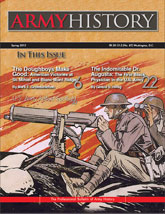
Army History: Professional Bulletin of U.S. Army History Spring-2013_AH87This full-color magazine has articles spanning the gamut of Army history topics by a myriad of knowledgeable authors. For example, the Spring 2013 issue features these guest articles:  “The Doughboys Make Good: American Victories at St. Mihiel and Blanc Mont Ridge“, by Mark E. Grotelueschen and “The Indomitable Dr. Augusta: The First Black Physician in the U.S. Army“, by Gerald S. Henig.

Regular columns in Army History include: News Notes, U.S. Army Artifact Spotlight, Book Reviews and Chief Historian’s Footnote.

How can I obtain the Army History: The Professional Bulletin of Army History?

World War II Collected Works

Perhaps my personal favorite is The U.S. Army and World War II: Collected Works (DVD). It is a comprehensive DVD compilation of PDFs of every book on World War II that the Center of Military History every published, which encompasses an astonishing 156 volumes!

The U.S. Army and World War II: Collected Works (DVD)For fans of World War 2 history, it doesn’t get any better—or more comprehensive—than this, as battles, tactics, and outcomes are sourced straight from those who were in the thick of things and analyzed by top historical experts.

How can I obtain “The U.S. Army and World War II: Collected Works (DVD)”?

Thus, as we honor our members of the Armed Forces this week and remember our lost servicemen and women on Memorial Day, we can be comforted by the fact that the dedicated team at the Center of Military History is there to ensure that their sacrifice, wisdom and experiences are not forgotten.

About the author: Government Book Talk Editor Michele Bartram is Promotions Manager for GPO’s Publication and Information Sales Division in Washington, DC, and is responsible for online and offline marketing of the US Government Online Bookstore (http://bookstore.gpo.gov) and promoting Federal government content to the public.


National Police Week: Exploring Law Enforcement Lives and Leadership

May 13, 2013

Being a police officer is a dangerous job. The officer’s family members worry every day that she or he will be safe while on duty. A police officer’s retirement party is a happier occasion than any other professional retirement: not only has the officer concluded a successful career, but the officer has also survived—it is a lucky day, since police officers do put their lives on the line every day.

Today as I took the Metro (Washington, DC’s subway), I saw dozens of law enforcement officials, friends and family all heading to the National Law Enforcement Officers Memorial for the 25th annual candlelight vigil tonight for the many fallen Federal, state and local law enforcement personnel, just as we were putting the finishing touches on our own collection of Law Enforcement books for the occasion.

National-Police-Week_Law-Enforcement-Books-at-GPO-BookstoreThus, we are reminded that it is National Police Week, an annual commemoration held every May to honor the work of law enforcement officers and to honor the sacrifices of officers who have fallen in the line of duty in the previous year and add their names to the memorial. GPO would like to honor the day as well, by discussing two recent titles that deal with the dangerous careers of law enforcement officials.

Two recent Federal publications that highlight the dangerous lives and leadership challenges of law enforcement officers include Police Leadership Challenges in a Changing World and 2011 The FBI Story.

Police Leadership Challenges in a Changing World

Police-Leadership-Challenges_Report-coverPolice Leadership Challenges in a Changing World is a report in PDF format that discusses the difficult issues relating to integrating a new generation of recruits into the force of established officers. Traditionally, police organizations foster a “paramilitary culture and industrial-type bureaucracy”. Younger officers come from a generation used to a more dynamic environment, in part due to their experiences of growing up in the Web generation. Police management staff will need to learn to adjust to these different experiences of the younger recruits and learn how to exploit their skill set as strengths for the organization. At the same time, management needs to work with older staff to grow them into the idea of utilizing the different dynamics of the younger recruits. Communication and a tight-knit team are key requirements for successful police work. Police leaders will have considerable issues that they can turn into significant resources with some thoughtful adaptation of older and younger officers’ working styles.

Police leaders—especially if they come from the “paramilitary culture” are going to have to struggle against their own habits if they want to make the organizational culture more open to change and accountability. According to the report, the paramilitary culture does not allow for change and accountability much—it’s designed to provide routine—and today’s citizens are going to have different expectations of the force that is supposed to protect them.

The FBI Story

2011-The-FBI-Story-ISBN 9780160902574

In the report 2011 The FBI Story, the writers cover the stories of major events that happened during the report year. Each page covers a different story.

Some of the stories are historical pieces, such as page 13, subtitled “A Byte Out of History: Early African-American Agents”, which gives brief but fascinating vignettes of early agents, including the probable first African-American agent of the FBI, James Wormley Jones, and a father and son team working in Los Angeles from the 1940s through the 1970s, Special Agents Jesse and Robert Strider.

Other interesting stories include the capture of James “Whitey” Bulger, the takedown of a casino cheating ring, the indictment of a human trafficking ring which involved 600 Thai victims, the Bureau’s ongoing search for the I-35 bank robber bandit in Texas, reviews of cutting edge forensic techniques and investigative technologies, and a quick look at some of the major cases of the report year. It’s a fascinating review of one of the more exciting government agencies, and the report is easily accessible for any adult audience to read.

If you’re curious to know what your police force is doing in their day-to-day service, reading one of these reports will give you a good idea of the challenges of being a police officer. The reports are also of high interest for criminal justice students, scholars, and law enforcement professionals from the uniformed service all the way to supervisory criminal investigators and chiefs.

And if you’re in Washington, DC, tonight, drop by the National Law Enforcement Officers Memorial, stop by the Candlelight Vigil and leave a rose in honor of those who sacrificed all to keep the rest of us safe. If not, click below to watch the live webcast online, United By Light, and to dedicate a candle to a special law enforcement officer:

2013-National-Police-Week-DC-United-by-Light-Candlelight-Vigil-Simulcast

How can I obtain a copy of these publications: Police Leadership Challenges in a Changing World and 2011 The FBI Story?

Or explore our entire collection of Law Enforcement print and electronic publications on the U.S. Government Online Bookstore.

Adapted by Government Book Talk Editor and U.S. Government Online Bookstore Manager Michele Bartram from a post written for the FDLP Community Blog by guest blogger Jennifer Davis from GPO’s Library Services & Content Management Division that supports the Federal Depository Libraries Program (FDLP).

¡Celebre! We have Spanish-language books for National Latino Books Month

May 10, 2013

We celebrated a holiday this week that has become an increasingly important celebration in the United States in recent years. It’s El Día de la Batalla de Puebla, or Cinco de Mayo (the fifth of May) to commemorate the Mexican victory over the French in the Battle of Puebla on May 5, 1862 when Zaragoza and the Mexican Army beat Maximilian’s French soldiers back to retreat. Not a Mexican national holiday, it is not widely celebrated in Mexico; in fact, it is a government holiday only in the states of Puebla and Veracruz.

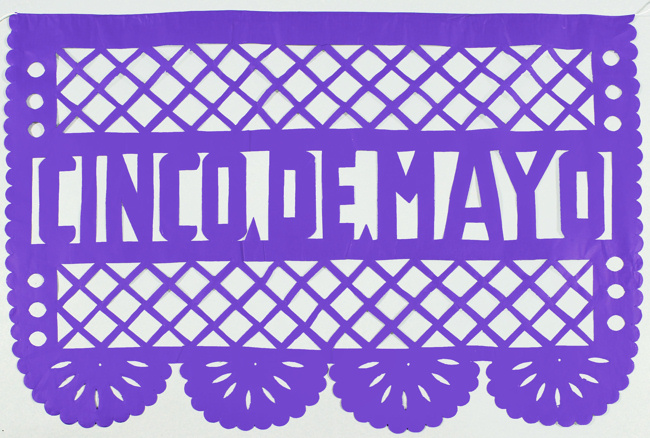
Cinco-de-mayo-Papel-PicadoSince the 1860s, Mexican American communities in the United States have been celebrating Cinco de Mayo.  In recent years, the holiday has become a great day to celebrate our rich Mexican heritage in this country. Today, Cinco de Mayo has become a BIG holiday. Huge. !Una fiesta grande! It’s a great reason to hang papel picado, play conjunto norteño and eat Mexican-style food, and practice speaking Spanish.

Image: Papel picado is a tradition from the Mexican state of Puebla to make hanging decorations with intricate designs cut out of colorful tissue paper. It is now used all over Mexico and in Mexican American celebrations of all kind. Image Credit: Amols.com

In fact, on June 7, 2005, Congress asked the President to issue a proclamation “…recognizing that struggle and calling upon the people of the United States to observe Cinco de Mayo with appropriate ceremonies and activities.” At the same time, May is also National Latino Books Month, celebrating books by and for Latinos.

Spanish Language books for National Latino Books Month at the GPO US Government BookstoreSo to commemorate this fun holiday and the great contributions of Latino and particularly Mexican culture, GPO would like to highlight a few of the many great Spanish language publications from the Federal Government.

Free Electronic Spanish Language Publications

GPO distributes a large number of publications and cataloging records to Federal Depository libraries– there were 288 Spanish language titles sent to libraries in 2012. A number of the items cataloged in Spanish in the April 2013 record load were related to public health– if you need documents on the flu shot, or cancer facts for people over age 50, forgetfulness or getting a good night’s sleep, the Federal Depository library’s got them. If you are interested in more technical documents, such as Malformaciones arteriovenosas y otras lesiones vasculares del sistema nervioso central — your Federal Depository library’s got those, too. Maybe you’re studying information about relations between the United States and Mexico; you’ll find source material such as Boundary Waters Minutes of the International Boundary and Water Commission, and the Environmental Cooperation: Border Area signed by the United States and Mexico in September and November 2012.

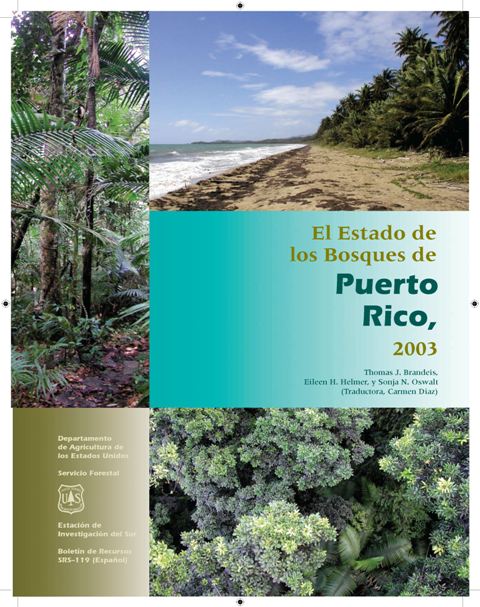
El Estado de los Bosques en Puerto Rico - The State of the Forests in Puero RicoA really beautiful book for you to seek out is El Estado de los bosques de Puerto Rico, 2003. The cover art and the photos are wonderfully colored and detailed– look at the picture of the coqui on the page in between the cover and title pages. Another helpful detail is the appendix at the end of the book that provides the species name, the name in English and the communal name in Puerto Rico. The Forest Service wrote this document for researchers, but it’s quite possible for grade school students or laypeople to read parts of this volume and glean useful information about Puerto Rico’s forests and natural resources.

Download the electronic version of this publication at one of your local Federal Depository libraries.

Print Editions of Spanish Language Publications at the US Government Bookstore

At the GPO U.S. Government Online Bookstore, you can find a number of Spanish language publications that will help individuals and families with parenting advice, citizenship tests, and learning more about Latinos in Congress and the Federal Government.

Libro Poder de los Padres - Parent Power book by the Department of EducationPoder de los padres para trazar el camino hacia el éxito is the Spanish-language version of the best-selling Department of Education book, Parent Power: Build the Bridge to Success, which advises parents on helping their children succeed at all stages of their high school careers, from pre-school through high school. The book contains a number of tips for parents to use, and give specific examples of how to put the tips into practice, for example: “Be positive. Praise goes a long way with children, especially those who struggle in school. Provide positive feedback.”

There are also checklists of developmental goals for the various age groups, for example: Middle school– “Is there a transition program for students leaving elementary school and entering middle or junior high school?” Tips and checklists like these can keep parents on target with a child’s developmental stages. Even if the parent is familiar with all of these talking points, it helps to have them clearly laid out for reference.

Another helpful Spanish language resource available from the GPO Bookstore is the Tarjetas de educación cívica para el examen de naturalización. As any cramming student (or former cramming student) knows, handheld flashcards are a key tool in memorizing information for a test, with a question on one side and the answer on the reverse. Previously only available in English, this new Spanish version of the perennial best-selling Civics Flash Cards for the Naturalization Test is highly useful not only for legal U.S. residents studying for their citizenship exam, but also for teachers and parents who teach standard civics lessons.

Tarjetas de Educacion Civica para ele Examen de Naturalizacion USASince the people who write the flash cards also set the test questions, the questions and answers are accurate (barring the warning about current appointments of specific officials). Instead of researching the answer to “¿Cuáles son dispuestos a nivel de gabinete?”, get the flash cards and be sure of the correct answer (hint: you’d be right if you said Secretario de Estado and Secretario del Tesoro, although there’s more than two right answers). If you teach citizenship or civics classes, or if you are studying for the test yourself or helping a friend or family member to study for the test, you are going to want to buy a copy of these cards. For a quick test of your knowledge of civics topics, take our Quiz: Are you smarter than an 8th grade Civics student?

All of this varied and valuable information, and more, is available en español at the GPO U.S. Government Bookstore and Federal Depository libraries nationwide.

How can I obtain a copy of these Spanish-language publications?

About the author: Our guest blogger is Jennifer K. Davis from GPO’s Library Services & Content Management Division that supports the Federal Depository Libraries Program (FDLP). (Article is adapted from an original  post in the FDLP Community site blog by Government Book Talk Editor, Michele Bartram, GPO Promotions & Ecommerce Manager.)


Over 1 Billion Served: GPO’s Pueblo Distribution Center Hits Historic Milestone Today

May 7, 2013

GPO_Pueblo_1_Billion-Shipped1 Billion.  One thousand million. Any way you count it, that’s a bundle! And at the US Government Printing Office Document Distribution Center in Pueblo, Colorado, we have reached that magic number. As of today, our Pueblo facility has shipped over 1 billion consumer publications, making it a bundle of bundles sent out to the American people!

GPO’s Western Expansion

Growing up, I always heard or read public service announcements from the Federal Government offering helpful advice on everything from how mortgages work to getting vaccinations. Each time, the commercial or ad would end with the same tag line: “To order this helpful free publication, contact us in Pueblo, Colorado” and an address and phone number (and today, a website address) would be given with ordering information.  I thought it amazing that all this great consumer information was available from one Colorado town.

Although unbeknownst to me at the time, it turns out this famous Pueblo location is actually one of two distribution facilities operated by the Government Printing Office’s Agency Distribution Services that stores and ships out Government publications on behalf of our Federal agency clients to the public –the other being in Laurel, Maryland.

In an effort led by House Appropriations Committee member Congressman Frank Evans, the GPO distribution facility was proposed and then approved on October 8, 1970, by the Joint Committee on Printing and the 15th Public Printer of the United States, Adolphus Nichol (Nick) Spence. The Pueblo Public Documents Distribution Center (PuDDC) was dedicated on October 8, 1971, and opened on October 11, 1971, to provide support for the expanding dissemination needs of Federal agencies, from books to posters to other products.

GPO_Pueblo_Congressman-Frank-Evans-Distribution-CenterLast year, President Barack Obama signed an act of the 111th Congress to rename the center the “Congressman Frank Evans US Government Printing Office Pueblo Document Distribution Center” after the former Congressman who passed away in June of 2010. It was re-dedicated on October 11, 2011, for the fortieth anniversary of the Pueblo facility.

Image: Renaming ceremony of the GPO Pueblo facility on October 11, 2011.

Today, GPO’s Pueblo Document Distribution Center provides distribution services to 10 federal agencies and other entities including: The Federal Citizen Information Center (FCIC), the Federal Trade Commission (FTC), Health and Human Service (HHS – Women’s Health), Office of Disability Employment Policy (ODEP), Federal Drug Administration (FDA), Federal Depository Library Program (FDLP), Consumer Financial Protection Bureau (CFPB) and three programs within the Department of Homeland Security  that produce items such as Transportation Security Administration (TSA) posters, bookmarks and baggage inserts.

Ruehlen-at-Pueblo-PuDDCImage: Jimmy Ruehlen has worked for Pueblo’s Government Printing Office Distribution Center since it began operations 40 years ago. Photo credit: The Pueblo Chieftain / Mike Sweeney (Photographer)

The Pueblo Distribution Center has processed over 105 million customer orders from the day it opened its doors through the end of April 2013, and as of today, May 2, 2013, the Center has distributed over 1 billion publications on behalf of its various Federal clients.

GPO Gets a “CIC” out of Distributing Consumer Publications

The Pueblo facility really got a kick-start when it signed an inter-agency agreement with the General Services Administration (GSA) in January of 1973 to take over the warehousing and distribution of the millions of printed consumer publications being provided through GSA’s then-new Consumer Information Center (or CIC), which itself has provided service to the GSA’s Federal Citizen Information Center (or FCIC), the U.S. Postal Service and the Department of Education.

Consumer-Info-Catalog-Winter-Spring-2013_coverThe gem in the FCIC’s crown is the Consumer Information Catalog, printed by GPO, which lists the latest and most popular of the many thousands of consumer publications available by topic and is updated several times a year.

Most of the print publications–the majority printed by GPO– in the Consumer Information Catalog are FREE for U.S. delivery if ordered online; the rest require only a nominal fee. Plus, a number of the publications are offered for FREE in electronic format for immediate download on the Publications.USA.gov website.

Some of the many categories of helpful consumer pamphlets and publications include: Education; Employment; Family including Pets; Federal Programs and Benefits, Food; Health including Drugs and Exercise & Diet (even information on braces, tattoos, and tanning!); Housing including Financing and Home Maintenance; the ever-popular Money category including Fraud, Credit Cards, Living Trusts, and Retirement Planning; even Small Business and Travel, and more.

Consumer-Info-Catalog-Winter-Spring-2013_Page_11

Image: Page from the Consumer Information Catalog Winter/ Spring 2013 Edition.

How can I get a copy of the Consumer Information Catalog and order publications?

Find the latest Consumer Information Catalog in PDF format online, or you can also order FREE print copies to be mailed to you at the same Publications.USA.gov website.

Consumer-Action-Handbook-2013The most popular document distributed by Pueblo remains the annual Consumer Action Handbook, a free trouble-shooting guide to help Americans solve all sorts of consumer problems. I’ve ordered five to share with family and friends!

In addition to ordering from GSA’s Publications.USA.gov website, you can find a number of these consumer publications on GPO’s US Government Online Bookstore.

Below are some of the more popular publications in the Consumer Information Catalog that are also available on GPO’s online bookstore:

You can also browse our Consumer, Home & Family category on our online bookstore.

With so many useful consumer publications available from the Federal Government, I’m sure it won’t be long until we distribute another billion items to help American consumers!

About the Author:

Government Book Talk Editor Michele Bartram is Promotions Manager for GPO’s Publication and Information Sales Division in Washington, DC, and is responsible for online and offline marketing of the US Government Online Bookstore (http://bookstore.gpo.gov) and promoting Federal government content to the public.


Fighting Enemies or Disease, Asian Americans Offer a Rich Heritage

May 1, 2013

As Asian-Pacific American Heritage Month kicks off, and the anniversary of WWII’s VE (Victory in Europe) Day approaches (May 8), it’s a good time to talk about a major contribution of Asian and Pacific-Islander Americans.

Japanese Americans’ Battle of Wits with the Japanese in WW II

Nisei-Linguists-CMH_70-99-1The book Nisei Linguists: Japanese Americans in the Military Intelligence Service During WWII published by the Army’s Center of Military History is an excellent starting point to examine that history. When the United States entered WWII in 1941, the War Department knew that their intelligence efforts would not be successful without understanding of Japanese language and culture. However, few Americans other than the 300,000 or so Japanese Americans living mainly on the West Coast and Hawaii had such knowledge.

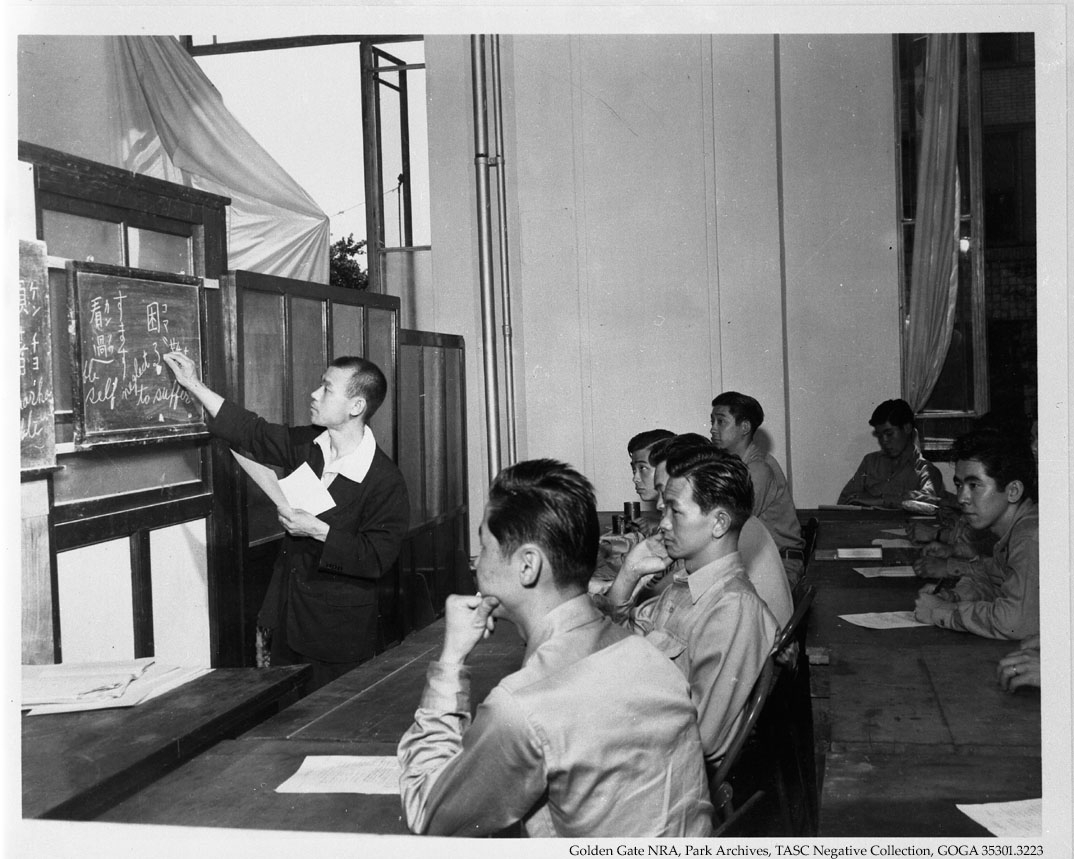
The War Department tapped the talents and skills of the second generation (Nisei) Japanese Americans. The Western Defense Command chose sixty Nisei soldiers for Japanese language training at the Fourth Army Intelligence School at the Presidio in San Francisco. The school moved to the Midwest after Pearl Harbor, first locating it in Camp Savage and later in Fort Snelling. The program, renamed the Military Intelligence Service Language School, ran until 1946. Nearly six thousand military linguists graduated from the school to enter the Military Intelligence Service (MIS).

MISCrissyField

Image: Nisei linguists undergoing training at MIS Crissy Field.

In addition to telling the story of the program and school, the book also describes how the Nisei served with every major unit and headquarters in the Pacific theater. It is testimony to the Nisei’s loyalty and smarts that it took the War Department only two years to get the Nisei military intelligence program up and running. The Nisei braved considerable prejudice to work for U.S. military intelligence, and there is no doubt their participation in American intelligence efforts made the war end earlier.

No one told the story of these linguists for years after WWII, and it was not until the 1980s and 1990s that people began to talk about their experiences with the program. Finally in 1994, Senator Daniel K. Akaka and some other Congressional members asked the Secretary of the Army to publish an official history of the Nisei linguists. This book is the result of that request.

Learn more about the Nisei language intelligence program by picking up a copy of this fascinating volume at the GPO Online Bookstore in Paperback edition or as an eBook.

Asian Americans Battle Disease Today

Epidemiologic-Profile-2010-Asians_coverHaving turned our thoughts to how Asian-Americans contributed to the care of our nation, it’s also a good time to think about how we care for the Asian-American and Pacific-Islander American portion of the United States population. The Center for Disease Control and Prevention (CDC) has just published Epidemiologic Profile 2010: Asians and Native Hawaiians and Other Pacific Islanders.

According to the CDC, “This Epidemiologic Profile is the first compilation of infectious disease-specific data in a single report that focuses on two racial groups in the United States: the Asian population and the Native Hawaiian and Other Pacific Islander population.” The volume includes a chapter in which the Census Bureau contributes to the description of the Asian and Native Hawaiian and Other Pacific Islander populations who reside in the United States.

The report tracks the involvement of Asians, Native Hawaiians and other Pacific Islanders in cases of endemic disease. Asians, Native Hawaiians and other Pacific Islanders make up a disproportionately large number of cases in some diseases (tuberculosis and hepatitis B), and in others, a smaller percentage of cases than their representation in the U.S. population (STDs and HIV). The report examines specific disease statistics, the challenges of public health education, treatment and disease risk factor mitigation for these populations.

Any public health official, student, social worker, or government employee who works with these populations would definitely want to read this book.

GPO has cataloged a record for the FREE electronic version that Federal depository libraries got in the April 2013 record load.

How can I access the records to both these publications?

How can I purchase Nisei Linguists: Japanese Americans in the Military Intelligence Service During WWII?

Our guest blogger is Jennifer K. Davis from GPO’s Library Services & Content Management Division that supports the Federal Depository Libraries Program (FDLP). (Article is adapted from an original  post in the FDLP Community site.)


Dr. Seuss’ The Lorax Inspires Kids to Hug a Tree

April 23, 2013

Two publications show us the way… to care for trees this Arbor Day!

Lorax-Forest-Service-LaunchWith Earth Day yesterday and Arbor Day this Friday, April 26, and all week as National Parks Week, this is the perfect time to do something to help a tree grow or plant something new to celebrate the miracle of spring. If there are little ones in your life—children, grandchildren, nieces, nephews or friends of kids that you love—it’s a good time to teach them to love trees, plants, and flowers, too.

Image: The head of the Forest Service with the Lorax for the launch of the U.S. Forest Service’s Discover the Forest program which aims to inspire tweens (aged 8-12) and their parents to re-connect with nature, experiencing it first-hand. The campaign brings to life the joy and excitement kids have when they discover the wonders of nature, helping create interest in their environment and a lifelong relationship with it. Photo credit: U.S. Forest Service

The best way to get kids to appreciate nature, according to Dr. Seuss’ The Lorax Curriculum Guide, is to take them outdoors—and “according to the Institute for Social Research at the University of Michigan, children in the U.S. spend 50% less time outdoors than they did 20 years ago.” To counter the initial cries of “I want TV”, however, it helps to give kids directed activities when they go outside.

The U.S. Forest Service and the Ad Council have developed a partnership with Project Learning Tree and Universal Pictures to create an educational curriculum plan based on “The Lorax” film and story. The curriculum supports the Forest Service’s “Discover the Forest” campaign (See image caption above).

Lorax-Classroom-Guide_Plant-a-Tree

Image: “Plant a Tree” page 21 from the Lorax Classroom Guide.

Teachers can download for FREE the complete classroom guide of Dr. Seuss’ The Lorax Curriculum Guide as a PDF, or can download the individual activities to use in class (as long as it is for educational, and not commercial, purposes). There’s an interactive map of places you can go in the United States that have campgrounds, national forests, state campgrounds, etc. There’s a page of games and activities such as how to use a compass, take a virtual hike, create a leaf rubbing or become a Jr. Forest Ranger on the Web site.

The printed teacher’s guide has tests, bibliographies for the students, labs (plant a tree with the Lorax), and student pages for various grade levels (I saw K-4 and 6-8). Families are encouraged to use these activities, too.


Why would Anyone Cut a Tree Down? continues the ecological and conservation-minded discussion you might want to pursue with your kids or students this week.

However, this volume approaches conservation from a silvicultural perspective, rather than the Lorax’ perspective of promoting a child’s approach of nature generally. The age range for the publication is 8 and up, and the material might be a bit young for older middle school children—so its material is more directed to a specific age range. The Forest Service published this document also, and the authors are a writer/ editor / educator with the Forest Service and an illustrator with previous experience illustrating tree guides.

The book shows children the life cycle of trees, the need to remove sick trees, the uses for wood from cut trees, and types of trees that are dangerous, all so beautifully illustrated by Juliette Watts that they make the lessons come alive.

Purchase a copy from the GPO U.S. Government Online Bookstore, and flop under a tree canopy to read the story and appreciate all the gifts that nature has to give us.

As Dr. Seuss wrote, “Now that you’re here, the word of the Lorax seems perfectly clear. UNLESS someone like you cares a whole awful lot, nothing is going to get better. It’s not.”  It’s up to us (and the Forest Service and its partners) to encourage children to care a whole awful lot about our trees and forests. Using these publications is good a way to make that happen!


How can I find these publications?

1) Dr. Seuss’ The Lorax Curriculum Guide

  • You can find it via our PURL (Permanent URL)
  • Locate it through GPO’s Catalog of Government Publications CGP catalog record. GPO has cataloged both the print and the electronic versions to make things “a whole awful lot better” for the Federal Depository libraries that got it in the April 2013 record load.
  • Find it in a federal depository library near you.

2) Why would Anyone Cut a Tree Down?

  • Purchase it on GPO’s U.S. Government Online Bookstore.
  • Buy it at GPO’s Main (retail) Bookstore at 710 North Capitol Street NW, Washington, DC 20401, open Monday-Friday, 8:30am to 4pm Eastern Time, except Federal holidays. Call (202) 512-0132 for information.
  • Find it in a Federal Depository library.

About the Author(s):

Adapted by Government Book Talk Editor and U.S. Government Online Bookstore Manager Michele Bartram from a post written for the FDLP Community Blog by guest blogger Jennifer Davis from GPO’s Library Services & Content Management Division that supports the Federal Depository Libraries Program (FDLP).


Immigration Issues and the Land of Opportunity 2.0

April 22, 2013

Americans are proud of their country being known as “the land of opportunity” and a wonderful place to live. Thus it is not surprising that so many want to move to the United States, making immigration a topic of extreme interest to citizens, lawmakers and immigrants alike.

United States map with faces of immigrants - the Land of Opportunity?

Image: U.S. map made up of immigrant faces. Image credit: Imerito blog

The introduction of a major border security and immigration reform bill in the Senate last week brings the topic to the forefront… and left many scrambling to research the issues affecting the “Land of Opportunity 2.0” in the twenty-first century.

The Government Printing Office has assembled a collection of both print and digital publications that run the gamut from proposed and existing border protection legislation to immigration reports and statistics, civics and English education for immigrants, and more to help all better comprehend the complex issues of immigration.

Here are a few notable publications from our U.S. Government Online Bookstore Immigration Collection:

  •  The Border Security, Economic Opportunity, and Immigration Modernization Act of 2013 (Print)

2013 Border Security and immigration reform bill Gang of Eight SenatorsImage: “Gang of Eight” U.S. Senators who worked on the immigration reform bill of 2013. Image Credit:  NPR blog.

The “Gang of Eight” senators who worked on this bipartisan bill includes four Democrats and four Republicans: Senators Chuck Schumer (D-N.Y.), Dick Durbin (D-Ill.), Bob Menendez (D-N.J.), Michael Bennet (D-Colo.), John McCain (R-Ariz.), Lindsey Graham (R-S.C.), Marco Rubio (R-Fla.) and Jeff Flake (R-Ariz.).

Immigration-Reform-Act-2013The goal of this bill is “to provide for comprehensive immigration reform and for other purposes” including bolstering border security, overhauling the legal immigration system, legalizing many of America’s 11 million undocumented immigrants and put them on a path to citizenship, and increasing enforcement and penalties against employers who hire unauthorized workers.

> Click here for information on how to order a printed copy of this bill

  • Yearbook of Immigration Statistics (Paperback)

2011-Yearbook-of-Immigration-StatisticsThe Yearbook of Immigration Statistics, 2011 is a compendium of tables that provides data on foreign nationals who, during a fiscal year, were granted lawful permanent residence (i.e., admitted as immigrants or became legal permanent residents), were admitted into the United States on a temporary basis (e.g., tourists, students, or workers), applied for asylum or refugee status, or were naturalized. The Yearbook also presents data on immigration enforcement actions, including alien apprehensions, removals, and returns.

> Click here for information on how to order this publication 

  • Customs and Border Protection Regulations of the United States (Print Subscription)

Customs-and-Border-Protection-Regulations-USPublished by the Department of Homeland Security’s Bureau of Customs and Border Protection (CBP), Office of International Trade Regulation and Rulings, the Customs and Border Protection Regulations of the United States, 2011 is a print subscription which contains regulations made and published for the purpose of carrying out customs and border protection laws administered by the Bureau of Customs and Border Protection. Former title: Regulations of United States Customs and Border Protection.

> Click here for information on how to order this print subscription

  • Expanding ESL, Civics, and Citizenship Education in Your Community: A Start-Up Guide (Paperback or ePub eBook)

Expanding-ESL-Civics-EducationFor groups and individuals whose goal it is to prepare the immigrant to assimilate into the Nation and to learn our language, this publication– both in print and ePub eBook format — from the Office of U.S. Citizenship and Immigration Services is very useful. It outlines a start-up process of gathering relevant information and resources to develop and sustain community ESL (English as a Second Language), civics, and citizenship education program, recruit and train volunteers, and recruit students. It also includes basic recommendations and sample forms and materials.

> Click here for information on how to order this print publication

> Click here for information on how to order this eBook

For more information on all the immigration publications from the Federal Government,

About the author:

Government Book Talk Editor Michele Bartram is Promotions Manager for GPO’s Publication and Information Sales Division in Washington, DC, and is responsible for online and offline marketing of the US Government Online Bookstore (http://bookstore.gpo.gov) and promoting Federal government content to the public.


Help is Just a Call, Click or Page Away: Federal Disaster Helplines & Emergency Medical Resources

April 19, 2013

Sadly, most adults in this country can remember some disaster or tragedy that’s happened to them or one of their loved ones in recent history. Most people in my office have their own exit strategy story from 9/11.  We all remember how we tried to cope, and we feel deep sympathy for fellow citizens in similar situations.

After the horrific events at the Boston Marathon and the Texas fertilizer factory explosion this past week, many Americans are again in the unfortunate position of needing assistance in the face of life-changing events. Your Federal government is here to help both the injured citizens and the local medical personnel who rush to their aid, both during and after the disaster occurs.Complementary Federal and local disaster response

Image credit: Vanderbilt University Medical Center Department of Emergency Preparedness  

I. Federal Disaster Resources for Civilians

The Disaster Distress Helpline (DDH) is, in the words of their own staff,

“…the first 24/7, year-round national crisis hotline exclusively dedicated to providing free, immediate and confidential crisis counseling and support to people in distress related to any natural or man-made disaster, such as the explosions in Boston. We offer this counseling 24/7/365 through phone (1-800-985-5990) and through SMS/text messaging (text ‘TalkWithUs’ to 66746) – and DDH is for those affected, family member and loved ones, as well as for responders.”

SAMHSA-Disaster-Distress-Helpline

Operated by the Department of Health and Human Services’ Substance Abuse and Mental Health Services Administration (SAMHSA), the Disaster Distress Helpline’s Web page www.disasterdistress.samhsa.gov also has a section devoted to incidents of mass violence.

If you are suffering from trauma related to the Boston Marathon attack, or similar events, reach out to the Disaster Distress Helpline. Get help, get some shelter. You’re going to wake up tomorrow, and the day after that. Make your day bearable; as Malcolm X said, “The future belongs to those who prepare for it today.”

Additional Federal disaster and emergency resources for civilians include:

GPO is helping in its own way; you can find the catalog record about the Disaster Distress Hotline in GPO’s Catalog of Government Publications or your local federal depository library.

II. Federal Disaster Resources for First Responders and Civilian Medical Personnel

With the tragic terrorist bombings in Boston,  fertilizer factory explosion in Texas, mass shootings in Sandy Hook, and other recent disasters, medical personnel, civilian first responders and mental health personnel have had to learn to deal with injuries both physical and mental that are usually only experienced on the battlefield.

With the experience gained in treating the wounded and traumatized in wars in Iraq and Afghanistan and mass violence and disasters in the US, the Departments of Defense, Health and Human Services, Homeland Security, Justice, and Transportation–

including FEMA, US Fire Administration, Pipeline and Hazardous Materials Safety Administration, Substance Abuse and Mental Health Services Administration, Center for Mental Health Services, US Special Operations Command, and particularly the Army’s Office of the Surgeon General, Walter Reed Army Medical Center, USAMRIID- US Army Medical Research Institute for Infectious Diseases, U.S. Army Medical Department Center and School, and the Borden Institute

— have produced a number of outstanding resources and publications which are of extreme value to emergency medical personnel, including EMTs and surgeons, mental health counselors, fire and rescue personnel, and first responders of all kinds.

[UPDATE 4/30/2013] One great resource for first responders is the Public Health Emergency website maintained by the US Department of Health and Human Services. This is meant to be a one-stop resource for all of the federal medical resources and information for emergency response. The military version, the Department of Defense Force Health Protection and Readiness National Disaster Medical System (NDMS) Page, is here.

[UPDATE 4/26/2013] One of the best resources we have seen was provided by one of our readers, a Regional Emergency Coordinator with the Department of Health and Human Services. It is a one-stop site for all emergency medical resources called the WMD, Emergency Management, and Medical Web Sites List. The author says it is updated every six months to keep it accurate, and it “is intended to provide an extremely “comprehensive list of internet sites of use for emergency planning and in particular Weapons of Mass Destruction (WMD) and medical emergency planning.

boston-marathon-emergency-medical-responseImage: First responders at the Boston Marathon bombings, including fire and rescue and emergency medical personnel. Image credit: EMSWorld

All of these Federal publications below can help civilian emergency response and medical personnel quickly learn from these Federal and military experts on how to respond to disasters and how to treat gunshot and blast wounds (such as from bombs and IEDs), amputations, and other combat-style injuries both in the field as well as the rehabilitation and psychological factors afterwards, including post-traumatic stress.

Some of the more pertinent disaster response and treatment publications that can be found on the U.S. Government Bookstore include:

About the Authors

Part I: Excerpted from a post on the FDLP Community Blog on April 18, 2013, by guest blogger Jennifer Davis from GPO’s Library Services & Content Management Division that supports the Federal Depository Libraries Program (FDLP) who wrote about the Disaster Distress Helpline.

Part II: Government Book Talk Editor Michele Bartram writes about the disaster and emergency response publications that can help civilian personnel respond to disasters with combat-style injuries. Ms. Bartram is Promotions Manager for GPO’s Publication and Information Sales Division in Washington, DC, and is responsible for online and offline marketing of the US Government Online Bookstore (http://bookstore.gpo.gov) and promoting Federal government content to the public.


Making Tax Time Less Taxing: Reproducible Tax Forms

April 11, 2013

Guest blogger Jennifer K. Davis from GPO’s Library Services & Content Management Division that supports the Federal Depository Libraries Program (FDLP) writes about reproducible tax forms from the Internal Revenue Service. (Originally posted in the FDLP Community site on April 9, 2013.)

It's Tax Time April 15 Federal IRS Tax Return Forms If you haven’t filed your tax return already, you’ve still got a little time left until April 15, the tax deadline day. Hopefully, you’ve got your tax forms from the Internal Revenue Service already.

One lucky thing about filing taxes in the U.S.? If you haven’t got those IRS tax forms, you can get copies of the forms almost anywhere. One sure bet is to drop in to your local Federal depository library for the reproducible copies. Most of them get the reproducible forms packet, which includes nearly all the basics. You can find the forms online, too, but if you don’t have a printer at home, the library’s your best bet.

People are usually checking out their library to do research, but shouldn’t miss out on the other resources that the libraries make available. Reproducible tax forms are one of the more obvious bonuses. Whether you need something really basic like a form 1040 to file your taxes, or an EIC (Earned Income Credit) to claim your qualifying child(ren), or a new W-4 to complete for work, your library’s got it.

Even if you’re searching for something less commonly used like a Schedule R (Credit for the Elderly or the Disabled), or a Form 8880 (Credit for Qualified Retirement Savings Contributions), you’ll find it all in the packet of reproducible tax forms. When you use a Federal Depository Library, you get to experience the benefits of your Federal taxes at work before you’ve even paid them.

648-004-00027-3[Note from Michele Bartram:] GPO also offers larger packages of pre-printed IRS tax forms for the convenience of tax preparation professionals on our Online Bookstore.  We also have DVDs and CD-ROMs of Federal tax forms. All purchasable tax publications as well as Federal audits and other accounting publications can be found on our U.S. Government Bookstore website under the Taxes, Audits & Accounting category found under our Business & Finance publications section.
For the annual tax forms, we have a special Tax Forms by Year category where you can find the IRS Tax Forms 2012 that includes the 2012 Tax Year IRS Tax Products DVD.
How can I access these individual Reproducible Tax Forms?

How can I purchase pre-printed tax forms and a tax publications DVD?