Congressional Pictorial Directory: A Great Memory Jogger

September 10, 2013

Do you ever have a problem putting a name to a face (or vice-versa)? The older I get, the more challenging the fast recall of names becomes.  For people who work on Capitol Hill, such as lobbyists and Congressional staffers, knowing who that person coming down the hall is can be pretty important.

2013 Congressional Pictorial Directory for the 113th Congress. Avasilable from http://bookstore.gpo.govA handy tool to help solve this conundrum is the Congressional Pictorial Directory. The directory provides a color photograph of each Member of the House of Representatives and the Senate and details each Member’s length of service, political party affiliation, and congressional district. The Pictorial Directory also contains pictures of the President, Vice President, and House and Senate officers and officials.  Senators and Representatives also are listed alphabetically, and are included in a separate listing of state delegations.

One of the nicer features of this publication is the size. It measures 4-1/2” by 6-1/4”, and can conveniently slip into a suit jacket pocket, purse or handbag. It is also available in both hardcover and paperback editions.

The U.S. Government Printing Office also makes the information from the Congressional Pictorial Directory– together with data from the Guide to the House and Senate Members– available as a free mobile site. This provides even more convenience by permitting the photo and other Member information to be accessed and displayed on a laptop, smartphone or other web-enabled mobile device.  The Mobile Member Guide mobile site for the 113th Congress provides the public with quick, easy access to information on Members of the 113th Congress. The app allows users to browse for Members of Congress by last name, state, chamber, or party. The public can take advantage of this free mobile Web site on major mobile device platforms.

How Do I Get a Copy of the Congressional Pictorial Directory or the Mobile Member Guide?

1) Buy Print Editions of the Congressional Pictorial Directory:

  • Shop Online: Print Editions of the Congressional Pictorial Directory may be ordered from the U.S. Government Online Bookstore under the Congressional Directories collection under Government Forms & Phone Directories.
  • Order by Phone: Call our Customer Contact Center Monday through Friday, 8 am to 5:30 pm Eastern (except US Federal holidays). From US and Canada, call toll-free 1.866.512.1800. Washington, DC area or International customers should call +1.202.512.1800.
  • Visit our Retail Store: Buy copies of the print edition at GPO’s retail bookstore at 710 North Capitol Street NW, Washington, DC 20401, open Monday–Friday, 9 a.m. to 4 p.m., except US Federal holidays, Call (202) 512-0132 for information or to arrange in-store pick-up.
  • Find it in a Library: Find this publication in a federal depository library.

2) Visit the FREE “Mobile Member Guide for the 113th Congress” mobile site from GPO: http://m.gpo.gov/memberguide/

  • This mobile site contains each Member’s picture, party affiliation, hometown, home state, and length of service. Users may use the app to search Members of Congress by name, state, chamber and party. (Read more…)
  • For more information on all GPO’s mobile apps and sites, visit http://www.gpo.gov/mobile/.

ABOUT THE AUTHOR: Guest Blogger Jeff Turner is Director of Sales and Marketing for GPO’s Publications and Information Sales Program.


Immigration Issues and the Land of Opportunity 2.0

April 22, 2013

Americans are proud of their country being known as “the land of opportunity” and a wonderful place to live. Thus it is not surprising that so many want to move to the United States, making immigration a topic of extreme interest to citizens, lawmakers and immigrants alike.

United States map with faces of immigrants - the Land of Opportunity?

Image: U.S. map made up of immigrant faces. Image credit: Imerito blog

The introduction of a major border security and immigration reform bill in the Senate last week brings the topic to the forefront… and left many scrambling to research the issues affecting the “Land of Opportunity 2.0” in the twenty-first century.

The Government Printing Office has assembled a collection of both print and digital publications that run the gamut from proposed and existing border protection legislation to immigration reports and statistics, civics and English education for immigrants, and more to help all better comprehend the complex issues of immigration.

Here are a few notable publications from our U.S. Government Online Bookstore Immigration Collection:

  •  The Border Security, Economic Opportunity, and Immigration Modernization Act of 2013 (Print)

2013 Border Security and immigration reform bill Gang of Eight SenatorsImage: “Gang of Eight” U.S. Senators who worked on the immigration reform bill of 2013. Image Credit:  NPR blog.

The “Gang of Eight” senators who worked on this bipartisan bill includes four Democrats and four Republicans: Senators Chuck Schumer (D-N.Y.), Dick Durbin (D-Ill.), Bob Menendez (D-N.J.), Michael Bennet (D-Colo.), John McCain (R-Ariz.), Lindsey Graham (R-S.C.), Marco Rubio (R-Fla.) and Jeff Flake (R-Ariz.).

Immigration-Reform-Act-2013The goal of this bill is “to provide for comprehensive immigration reform and for other purposes” including bolstering border security, overhauling the legal immigration system, legalizing many of America’s 11 million undocumented immigrants and put them on a path to citizenship, and increasing enforcement and penalties against employers who hire unauthorized workers.

> Click here for information on how to order a printed copy of this bill

  • Yearbook of Immigration Statistics (Paperback)

2011-Yearbook-of-Immigration-StatisticsThe Yearbook of Immigration Statistics, 2011 is a compendium of tables that provides data on foreign nationals who, during a fiscal year, were granted lawful permanent residence (i.e., admitted as immigrants or became legal permanent residents), were admitted into the United States on a temporary basis (e.g., tourists, students, or workers), applied for asylum or refugee status, or were naturalized. The Yearbook also presents data on immigration enforcement actions, including alien apprehensions, removals, and returns.

> Click here for information on how to order this publication 

  • Customs and Border Protection Regulations of the United States (Print Subscription)

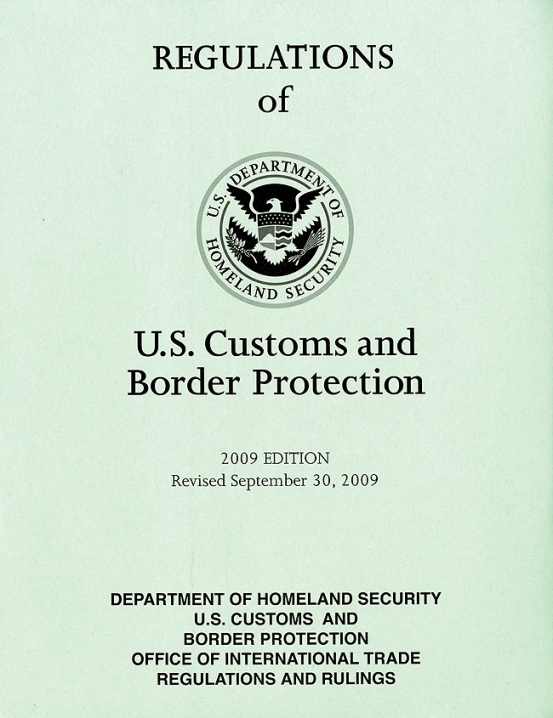
Customs-and-Border-Protection-Regulations-USPublished by the Department of Homeland Security’s Bureau of Customs and Border Protection (CBP), Office of International Trade Regulation and Rulings, the Customs and Border Protection Regulations of the United States, 2011 is a print subscription which contains regulations made and published for the purpose of carrying out customs and border protection laws administered by the Bureau of Customs and Border Protection. Former title: Regulations of United States Customs and Border Protection.

> Click here for information on how to order this print subscription

  • Expanding ESL, Civics, and Citizenship Education in Your Community: A Start-Up Guide (Paperback or ePub eBook)

Expanding-ESL-Civics-EducationFor groups and individuals whose goal it is to prepare the immigrant to assimilate into the Nation and to learn our language, this publication– both in print and ePub eBook format — from the Office of U.S. Citizenship and Immigration Services is very useful. It outlines a start-up process of gathering relevant information and resources to develop and sustain community ESL (English as a Second Language), civics, and citizenship education program, recruit and train volunteers, and recruit students. It also includes basic recommendations and sample forms and materials.

> Click here for information on how to order this print publication

> Click here for information on how to order this eBook

For more information on all the immigration publications from the Federal Government,

About the author:

Government Book Talk Editor Michele Bartram is Promotions Manager for GPO’s Publication and Information Sales Division in Washington, DC, and is responsible for online and offline marketing of the US Government Online Bookstore (http://bookstore.gpo.gov) and promoting Federal government content to the public.


History Was Made at the Women’s Rights National Historical Park

March 26, 2013

Guest blogger Jennifer K. Davis from GPO’s Library Services & Content Management Division that supports the Federal Depository Libraries Program (FDLP) writes about the Women’s Rights National Historical Park brochure in honor of National Women’s History Month. (Originally posted in the FDLP Community site on March 25, 2013.)

March is National Women’s History Month, and I am writing this posting on International Women’s Day. If I had the twelve hours–round trip– to hit the road, I’d head for the Women’s Rights National Historical Park in Seneca Falls, New York, and celebrate how far we have come as a nation.

Susan B. Anthony and Elizabeth Cady Stanton

It would definitely be a work-related trip. The U.S. Government Printing Office (GPO) printed Elizabeth Cady Stanton’s most famous– and in her estimation, her best– speech in 1915. She delivered her address, Solitude of Self, before the Committee on the Judiciary on January 18, 1892. She argued why the law needs to treat women as equal citizens under the law and she argued for women to get the vote via a law that would eventually became the Nineteenth Amendment to the Constitution.

Image: Susan B. Anthony (left) and Elizabeth Cady Stanton (right). Source: The Susan B. Anthony Center for Women’s Leadership.

Sadly, it took forty-two years after Stanton and fellow suffragist Susan B. Anthony first drafted the 19th amendment in 1872 and long after their deaths for the amendment to finally be ratified and made law in 1920. Since Stanton’s house is part of the park, it’s here that you can discover a very human portion of United States history and feel a renewed sense of the privilege that all United States citizens have to vote.

Not only can you learn about Stanton at the park, you can also get a wider view of the earliest stages of the women’s rights movement in the United States. Four historical properties and a visitor’s center make up the park. You can visit the Wesleyan Chapel in Seneca Falls where the leaders of the women’s rights movement held the First Women’s Rights Convention in August 1848. Stanton’s home is open from spring through fall. You can tour the house she referred to as “the Center of the Rebellion” where she raised her large family while networking with other women on women’s rights reforms.

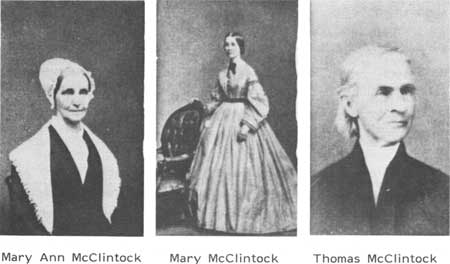
Another one of the four park properties, the M’Clintock House in nearby Waterloo, was the home of Mary Ann and Thomas M’Clintock.

MClintocksMrs. M’Clintock held the planning session for the First Women’s Rights Convention and drafted the Declaration of Sentiments at their home as well. (As an added bonus, the M’Clintocks were Quakers and their house was a stop on the Underground Railroad–so you can find out more about Quakers and belatedly celebrate African-American History Month while there.)

While in Waterloo, you can walk by the Hunt House, where Jane and Richard Hunt hosted Lucretia Mott and held an assembly for her where the attendees announced the plan for the First Women’s Right’s Convention. Although you can’t tour the Hunt House now as it is too fragile, the National Park Service (NPS) is making plans to restore it in the future. Visiting these locations brings home the exciting sense of purpose and activity of the American women’s rights movement of the late 1800s.

Information about all of these sites, as well as slideshows of the historical houses, the text of Stanton’s address, historical factoids, and photos of the major architects of the women’s rights movement and their supporters, are available at the Women’s Rights National Historical Park brochure online. Even if, like me, you can’t get to upstate New York to see these sites in person, you can (almost) feel like you’ve been there once you’ve given the park Web site a thorough visit.

It’s worth the time it takes to make the trip, whether actual or virtual. It’s amazing to see how far we’ve come as a nation in the advancement of personal rights, and how much all of society (men and women) have done to push our mothers, sisters, aunts and daughters forward. Having that perspective is one of the many advantages of learning about the park.

Continue your self-education by reading the park brochure at your local Federal depository library. You can find it either via the title’s PURL (Permanent URL) or through the Catalog of Government Publications (CGP) record that GPO cataloged for the Federal depository libraries in the March 2013 record load.

How can I access this publication, the Women’s Rights National Historical Park web brochure?

[Note from M. Bartram:] You can also purchase print publications and eBooks from GPO’s U.S. Government Online Bookstore related to the topics discussed in this article:


March Madness: New GPO Bookstore Website and Historic Anniversaries

March 22, 2013

March is traditionally a month of change and national excitement in the United States. Together with the change of seasons and college basketball frenzy, some important national milestones were reached this month that we should acknowledge, from new achievements to key anniversaries.

New U.S. Government Bookstore Website

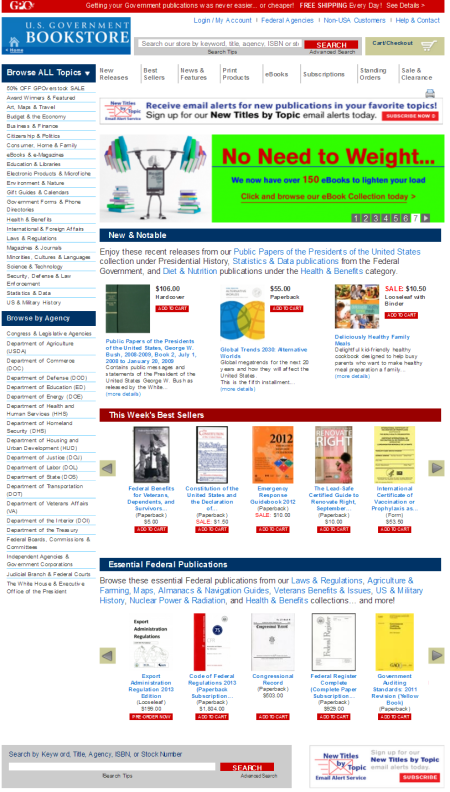
First, last week we launched our upgraded U.S. Government Bookstore ecommerce site, http://bookstore.gpo.gov/.  Our ecommerce website has gone through several iterations since its first version in 1999, each time adding functionality to keep up with the changing needs.  Today, GPO has over 4,000 Federal print publications and more than 150 eBooks available through our online bookstore.

New-US-Government-Online-Bookstore-website

Our new website includes the following user-friendly features:

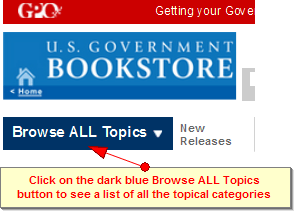
Browse-ALL-Topics-on-GPO-BookstoreClick on the dark blue Browse All Topics button on the site to see and browse by a list of all the topical categories.

These last two features—eBooks and new Categories—are particularly important in light of three other important milestones this month.

National Women’s History Month

March is National Women’s History Month in the United States, and we have a new main “Browse by Topic” category, Minorities, Cultures & Languages, where you can find books for and about African Americans, American Indians, Asian Americans & Pacific Islanders, Cultural Awareness, Disabled, Hispanics, LGBT, Minority Issues, Non-English Government Publications, Seniors & Elderly and Women, including dozens of books and eBooks about Women’s History.

Womens_History_Books_Slide

Harriet Tubman Centennial

One of the famous American heroines in the Women’s History collection is Harriet Tubman, who died 100 years ago this month making it her Centennial. Tubman escaped from slavery and returned to lead dozens of others to freedom in the mid-1800s. In addition to being the most well-known of Underground Railroad “conductors,” she was also a nurse, spy, suffragist, and more.

With all these roles, it is appropriate that we have created so many new “Browse by Topic” categories. One is Slavery & Underground Railroad (under US & Military History), where great books featuring Harriet Tubman and the Underground Railroad can be found.  Other new topics include Nursing under Health & Benefits and Intelligence & Espionage under Security, Defense & Law Enforcement.

Additional publications about National Parks can be found under the main category of Art, Maps & Travel, along with Posters & Prints and Maps, Almanacs & Navigation Guides.

BROWSE BY AGENCY: You can also find National Park Service (NPS) publications under Department of the Interior (DOI) in the Browse by Agency categories on the menu at the lower left side of the site, where publications are categorized by the Federal agency that published them. For example, our own Government Printing Office (GPO) publications are under Congress & Legislative Agencies.

Iraq War 10th Anniversary

Finally, this week is the tenth anniversary of the start of the Iraq War, which began on March 19, 2003, as Operation Iraqi Liberation, later renamed Operation Iraqi Freedom.

Iraq-War-10th-Anniversary_Books_Slide

President Obama, in an address about the Iraq war 10th anniversary this week said:

“As we mark the 10th anniversary of the beginning of the Iraq war, Michelle and I join our fellow Americans in paying tribute to all who served and sacrificed in one of our nation’s longest wars. We salute the courage and resolve of more than 1.5 million service members and civilians who during multiple tours wrote one of the most extraordinary chapters in military service. We honor the memory of the nearly 4,500 Americans who made the ultimate sacrifice to give the Iraqi people an opportunity to forge their own future after many years of hardship.”

Since the beginning of the war, the Defense Department has published dozens of excellent publications about the war, the strategies, Saddam Hussein, Iraq, reconstruction and the achievements and sacrifices made by our Armed Forces. You can find these publications featured under Iraq & Persian Gulf Wars which can be found under US & Military History > Battles & Wars categories.

It’s a Launch, Not a Landing

So, our new site marks the completion of over a year of hard work by our team here at the Government Printing Office, all aimed to make sure “we the people” can discover more about our Nation through excellent publications by our Federal Government. But there’s a good reason we call it a website launch and not a landing. This is only the beginning, with more great content and features to come! Enjoy!

So, please visit GPO’s new online bookstore website at http://bookstore.gpo.gov/ and tell us what you think!

About the Author:  Michele Bartram is Promotions Manager for GPO’s Publication and Information Sales Division in Washington, DC, and is responsible for online and offline marketing of the US Government Online Bookstore (http://bookstore.gpo.gov) and promoting Federal government content to the public. She was also in charge of the online bookstore relaunch!


Country Reports on Human Rights Practices

August 15, 2012

After watching Secretary of State Hillary Clinton’s interview about the State Department’s release of their Country Reports on Human Rights Practices for 2010, I had to blog about this important annual publication.

Image: U.S. Secretary of State Hillary Clinton presents latest Annual Human Rights Report (Read her remarks here.). Source:  State Department

In its 35th year for 2010, Country Reports on Human Rights Practices are Congressionally mandated reports produced by the U.S. Department of State that provide encyclopedic detail on human rights conditions in each of the 194 countries that are members of the United Nations.

The 2010 version available from GPO is a two-volume set that provides an overview of the human rights situation around the world as a means to raise awareness of human rights conditions, in particular as these conditions affect the well-being of women, children, racial and religious minorities, trafficking victims, members of indigenous groups and ethnic communities, persons with disabilities, sexual minorities, refugees, and members of other vulnerable groups.  Grouped by region, the country reports detail the situation in each member nation, and the set also provides an introduction and preface describing overall trends as well as detailed appendices.

What are Human Rights?

With the end of World War II, and the creation of the United Nations, the international community vowed to never allow atrocities like those experienced during the war to happen again. World leaders decided to complement the UN Charter with a road map to guarantee the rights of every individual everywhere, with the resulting document becoming The Universal Declaration of Human Rights.

 Image: In 1950, on the second anniversary of the adoption of the Universal Declaration of Human Rights, students at the UN International Nursery School in New York viewed a poster of the historic document. Source: United Nations

The Universal Declaration of Human Rights was proposed 64 years ago next month and adopted by the UN General Assembly on December 10, 1948. This defines the following universal human rights across all members of the United Nations:

Image: Universal human rights. Source: Jayara9re

The Best and the Worst List

The Country Reports also serve as a progress report in relation to previous years by outlining which countries are improving and which are backsliding as far as human rights are concerned. The 2010 reports praise Colombia, Guinea, and Indonesia for their marked improvements shown that year, and notes Ukraine for backsliding. Check the book for details on each country’s status.

Image: Human rights protestor in Syria holds sign in English aimed to worldwide audiences and media. Source: My San Antonio blog.

Three Trends Affecting Human Rights

The 2010 report discusses three important trends from the year including:

1)      Persecution of Vulnerable Groups: the continuing rise of violence, persecution, and official and societal discrimination of members of vulnerable groups, often racial, religious, or ethnic minorities or disempowered majorities;

2)      Repression of Civil Society and Growth of Advocacy Groups: the repression of civil society in different countries and the explosive growth of non-governmental advocacy organizations focused on a wide range of democracy and human rights issues and causes; and

3)      Rise of Web and Mobile Technology: “the dramatic growth of the Internet, mobile phones, and other connective technologies that allow instantaneous communications to billions of people across the globe.”

Further information on all three of these trends is more fully documented in the Introduction to this year’s report, as well as in specific country reports.

Persecution of “Vulnerable Groups”

The Country Reports on Human Rights Practices for 2010 outlined the negative trend of the continuing escalation of violence, persecution, and official and societal discrimination of members of vulnerable groups, often racial, religious, or ethnic minorities or disempowered majorities.

In many countries this pattern of discrimination extended to women; children; persons with disabilities; indigenous; lesbian, gay, bisexual, and transgender (LGBT) persons; and members of other vulnerable groups who lacked the political power to defend their own interests.

The report also notes that “often members of these groups were denied economic opportunity or the ability to abide by their social or cultural traditions or practices or were restricted in their ability to speak freely, to assemble peacefully, or to form associations or organizations.”

For example, the report notes that there is increasing exploitation of laborers and threats against workers for attempting to unionize in many countries, as well as increasing violence against members of the LGBT community.

Image: LGBT Human rights protestors in Honduras hold sign saying “Nuestros derechos también son humanos.” (“Our rights are also human.”). Source:  Ultima Hora (Honduras)

Civil societies rebel against repression: The rise of the “Arab Spring”

By the end of 2010 which is when this report finishes, the issues relating to repression of civil society were giving rise to the so-called “Arab Spring.” Maria Otero, Under Secretary for Democracy and Global Affairs at the U.S. State Department, noted that this report captured these conditions in Egypt and Iran that were leading to protests, and “some of the areas we are seeing changing in the Middle East as demonstrating the inability in those of societies of civil societies to express themselves as one of the problems that emerged.”

Tools of rebellion: The Internet, social media and mobile technology

One of the more interesting trends that added fuel to these rebellions was a key theme in the 2010 report, namely “the explosive way in which the Internet, mobile phones, and other types of types of technologies have emerged in order for different groups to be able to use them to promote democracy and to promote human rights.”

Image: Protestor holds sign that points out the importance of social media today to civil protests and movements. Source:  Linney Group

Smartphone-based social media such as Twitter, Facebook, YouTube and blogs played a critical role in extending the reach of opposition messages, which was validated by the University of Washington’s Project on Information Technology and Political Islam which assembled and analyzed data from more than 3 million tweets, gigabytes of YouTube content and thousands of blog posts about Tunisia and Egypt prior to the crisis in each country.

Image: Protester in Egypt holds up home-made sign at a protest rally that mentions both Facebook and the Egyptian uprising organizers’ Twitter hashtag #jan25. Inspired by the successful Tunisian Arab Spring revolution hashtag, #sidibouzid, the Egyptian hashtag #jan25 stands for January 25, 2011, the date the organizers launched the Egyptian civil uprising in Tahir Square. Photo by Essam Sharaf.

Who should read this?

Maria Otero says the State Department team sees this report as a “way of providing credible thoughtful, analytical information to all of those people around the world, whether it is non-governmental organizations, universities, other governments who are specifically looking at this issue.”

But in addition to serving scholars, reporters and analysts looking at the past, Otero says the State Department uses these reports as a source of information for present and future U.S. policy making, and sees them as a way activists and policy developers in this and other countries can help their own governments identify and decrease whatever abuses may exist, while at the same time increasing their own capacity to protect and to address the issues of human rights in their own countries.

It shows that there’s nothing wrong with reading about rights!

HOW CAN YOU OBTAIN a copy of the two-volume set of Country Reports on Human Rights Practices for 2010?

  • Buy it at GPO’s retail bookstore at 710 North Capitol Street NW, Washington, DC 20401, open Monday-Friday, 9am to 4pm, except Federal holidays, (202) 512-0132.
  • Find it in a library.

To find more U.S. government reports and publications about human rights reports,browse our online bookstore and search on “human rights”.

About the Author:  Michele Bartram is Promotions Manager for GPO’s Publication and Information Sales Division and is responsible for online and offline marketing of the US Government Online Bookstore (http://bookstore.gpo.gov) and promoting Federal government content to the public.


The End of Don’t Ask, Don’t Tell

June 25, 2012

On September 20, 2011, the 18-year old United States military official “Don’t Ask, Don’t Tell” (DADT) policy came to an end.

Six months later, a new book by J. Ford Huffman and Tammy S. Schultz was published by the Marine Corps University Press entitled, The End of Don’t Ask Don’t Tell: The Impact in Studies and Personal Essays by Service Members and Veterans.

This is a collection of four scholarly studies and 25 essays about the impact of living under this policy from a diverse group of gay and straight, current and former military members from the Army, Navy, Air Force and Marine Corps.

Since June is Lesbian, Gay, Bisexual and Transgendered (LGBT) Pride Month, we thought it appropriate to review this book available through GPO and give some background on the policy that led to it.

Rise of Don’t Ask, Don’t Tell

In the early 1990’s in the United States, a push for more rights for non-heterosexuals in both civilian and military life was rising.  Eventually, on June 2, 2000, President Bill Clinton declared June 2000 the first official “Gay & Lesbian Pride Month” in the United States. (This was later renamed by President Barack Obama in 2009 who declared June as Lesbian, Gay, Bisexual and Transgendered Pride Month which it is called today).

However, lawmakers and the military establishment in 1993 were not ready to allow openly gay, lesbian or bisexual individuals to serve in the U.S. Armed Forces.

As a compromise, United States federal law Pub.L. 103-160 (10 U.S.C. § 654 called the “Don’t Ask, Don’t Tell” Policy, nicknamed DADT, was passed and went into effect on December 21, 1993. It “prohibited military personnel from discriminating against or harassing closeted homosexual or bisexual service members or applicants, while barring openly gay, lesbian, or bisexual persons from military service” (Wikipedia).

Image: Web banner from the U.S. Army’s DADT website

Not Asking vs. Not Telling

The “Don’t Ask” part of the DADT policy specified that superiors should not initiate questioning or investigation of a military service member’s sexual orientation without first having witnessed disallowed behaviors or received credible evidence. Because of the number of unauthorized investigations and harassment of suspected servicemen and women, the policy was expanded to “don’t ask, don’t tell, don’t pursue, don’t harass.”

Under the “Don’t Tell” aspect of the policy, the military service members themselves were prohibited from disclosing their sexual orientation or homosexual relationships while actively serving in the United States Armed Forces.

Anyone who did disclose or were discovered to be homosexual could be separated (discharged) from the military, resulting in some 14,346 members of the military being discharged because of their sexual orientation under 18 years of the DADT policy.

Changing Times, Changing Military Needs Led to DADT’s Repeal

After nearly two decades under DADT and the increasing need to recruit and retain the best able service members to help fight wars on multiple fronts, many American military and political leaders felt it was time to repeal “Don’t Ask, Don’t Tell.” The Pentagon performed a detailed analysis of possible issues and recommendations for implementation in the November 30, 2010 Support Plan for Implementation: Report of the Comprehensive Review of the Issues Associated with a Repeal of “Don’t Ask, Don’t Tell”.

Image: Pentagon’s November 2010 implementation plan and report on the issues associated with DADT repeal. Source: Gawker.com

Bipartisan support in Congress led them to pass the “Don’t Ask, Don’t Tell Repeal Act of 2010.” The caveat was that the policy would remain in place until the President, the Secretary of Defense, and the Chairman of the Joint Chiefs of Staff of the military all certified that the repeal of DADT would not harm military readiness, followed by a 60-day waiting period. The required certification was sent to Congress on July 22, 2011, which set the end of DADT for September 20, 2011.

In a statement accompanying the certification, President Obama said:

Today’s report confirms that a strong majority of our military men and women and their families—more than two-thirds—are prepared to serve alongside Americans who are openly gay and lesbian. This report also confirms that, by every measure, from unit cohesion to recruitment and retention to family readiness, we can transition to a new policy in a responsible manner that ensures our military strength and national security.

Thus, on September 20, 2011, “Don’t Ask, Don’t Tell” was repealed. Said Sen. Susan Collins of Maine, a Republican credited with pulling together bipartisan support for the repeal: “Today, for the first time in our history, we will welcome the service of any qualified individual who’s willing to put on the uniform of our country,” (Source: CNN).

Image: President Obama signs the “Don’t Ask, Don’t Tell Repeal Act of 2010.” Source: AP

Covered in the Book

The first part of The End of Don’t Ask Don’t Tell book contains academic reports and research that “shed light on the way forward for the services and policy makers.” This includes a report by Dr. Nora Bensahel who conducted extensive research with RAND Corporation on experiences of the other 26 countries who allow homosexuals to openly serve in their militaries. Other reports by military officers include one discussing the importance of considering service members’ “family readiness,” as well as the prevailing views and culture in the military in 2010 toward “Don’t Ask, Don’t Tell.”

The second part of the book includes personal essays from both gay and straight members of the military who served under DADT, emphasizing their personal experience of living under this policy. In them, the authors either provided details or “assurances that they were willing to testify under oath regarding their experiences.” As described by editors Schultz and Huffman in their introduction: “These personal essays peel back the curtain of the shame, uncertainty, homophobia, anger, fear, and other emotions of living under DADT. These are the views, recollections and words of the authors alone.

In one essay, a former female Marine described herself as: “I was a woman. I was black. I was gay. ‘Don’t ask, don’t tell.’ I was invisible.”  She concludes her essay with hope that her story helps others:

 “Change and transition can be difficult, and there will be casualties along the way. If sharing my story helps someone in the military whether they are gay or straight, it will have been worth it. If it helps the leadership make different decisions that include and help everyone with the transition of the repeal of DADT, it will have been worth it.

An Air Force officer who was discharged after his superior searched his personal emails and discovered he was gay was gratified that so many members of his old unit said they’d be honored to serve with him again. He sums up his essay with:

Soon I hope to resume my career as an officer and leader in the Air Force without the mandatory silence of DADT and the constant fear that I will be fired… Now [after the repeal of DADT] our military can judge its men and women on their merit and not their sexual orientation.

Image: A sign at Naval Air Station Whidbey Island in Washington State. Source: Oregon Public Broadcasting

The Best Story Ends with a Non-Event

The most common argument by critics against DADT’s repeal was that changing the policy in the middle of multiple wars would be a distraction and could cost lives. This was the original opinion of Marine Commandant General James E. Amos who lobbied against allowing gays to serve openly when the repeal was first passed in 2010, even though the Pentagon’s own 2010 research had shown already that 70% of Service members said they would be able to “work together to get the job done” with a gay service member in their immediate units.

Today, Amos, as are other military leaders, are pleased with the progress of the Armed Forces’ implementation of the repeal, with mandatory training sessions for all levels of the military haven taken place. DADT support groups say they have received no reports of harassment, discrimination or negative experiences connected with the DADT repeal from gay and lesbian active military.

In fact, an April 2012 article in the Marine Corps Times seems to show just how smoothly the transition has gone, as demonstrated by this anecdote involving Amos and his wife, Bonnie, at the Marine Corps Birthday Ball in November 2011. During the Ball, a female Marine introduced her lesbian partner to Amos’ wife, General Amos explained: “Bonnie just looked at them and said, ‘Happy birthday ball. This is great. Nice to meet you…’ That is happening throughout the Marine Corps.

Image: General Amos & Bonnie Amos. Source: Black Tie International Magazine.

Retired Marine Col. Brendan Kearney predicted a smooth transition in one of the book’s essays: “I believe the demise of DADT will quickly become a non-event, and the services as a whole will get on with the business at hand: Defeating the enemies of our country.”

Co-editor Tammy Schultz believes The End of Don’t Ask Don’t Tell book outlines a “relatively smooth compliance with the new law” according to a Huffington Post article. She concludes: “That is not to say that challenges don’t remain ahead, and our book details some of those. But the U.S. military can more than handle it.

So in the case of the end of the Don’t Ask, Don’t Tell policy, the best story ending seems to be that it is a non-event.

UPDATE 2012/06/27: On June 26, 2012, the Defense Department hosted its first ever Lesbian, Gay, Bisexual & Transgender Pride Month event since the repeal of “Don’t Ask Don’t Tell” at the Pentagon. Click here to watch the program on C-SPAN.

HOW DO I OBTAIN The End of Don’t Ask Don’t Tell: The Impact in Studies and Personal Essays by Service Members and Veterans?

  • Buy it online 24/7 at GPO’s Online Bookstore.
  • Buy it at GPO’s retail bookstore at 710 North Capitol Street NW, Washington, DC 20401, open Monday-Friday, 9am to 4pm, except Federal holidays, (202) 512-0132.
  • Find it in a library.

About the Author:  Michele Bartram is Promotions Manager for GPO’s Publication and Information Sales Division and is responsible for online and offline marketing of the US Government Online Bookstore (http://bookstore.gpo.gov) and promoting Federal government content to the public.


Invest in Women, Invest in America

April 3, 2012

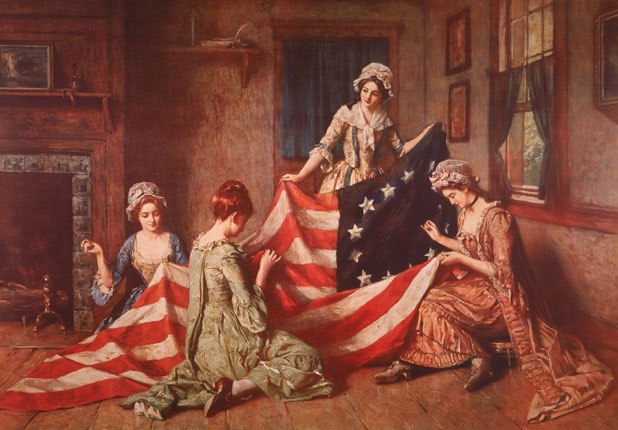
In honor of National Women’s History Month 2012 and its theme of “Women’s Education – Women’s Empowerment,” I wanted to write about a thought-provoking publication that just came across my desk about women and their evolving role in the U.S. workforce.  Since the founding of America, women like Betsy Ross have played a critical role in contributing to the economic fabric of the U.S. economy and  American households.

Image: Sewing circle presided by working mother Betsy Ross, who started out as first a home sewer before being educated as an upholstery apprentice. She  then ran an upholstery business with her husband, before managing her own business when her husband died by sewing tents, blankets and flags for the American Revolution.

Invest in Women, Invest in America: A Comprehensive Review of Women in the U.S. Economy was prepared by the Joint Economic Committee of Congress.

It forms part of GPO’s Online Bookstore National Women’s History Month collection of Government publications celebrating women’s contributions to America.

Outgoing Chair of the Committee, Congresswoman Carolyn B. Maloney, said in a December 2010 letter that the goal was to prepare a “comprehensive review of women in the U.S. economy so that policymakers could have a better understanding of women’s essential contributions to our economy and their potential to play a stronger role in our economic recovery.”

PART I: Invest in Women, Invest in America

Part I of this publication starts with an overview of the decades of progress of women in the workforce. For the first time, we learn that women now comprise half of the U.S. workforce.

Next, relating to this month’s theme of education providing empowerment for women, the report shows that women earn more college degrees than men at every level, from 57.4% of the bachelor’s degrees to over 60% of the Master’s degrees in the United States.

And it demonstrates just how important women’s earnings have become to overall household income, particularly in families with children. For example, by 2008 over 6 in 10 families with children under 6 have the mother working outside the home, and women are the sole job-holders in over a third of American families with children.

The “Invest in Women” publication discusses the three key factors that are still holding women back, including:

  1. underrepresentation in business leadership roles,
  2. a “persistent gender wage gap” in both public and private sectors, and
  3. an “out-of-date framework for social support.”

Factor 1: Underrepresentation of Women in the Executive Suite

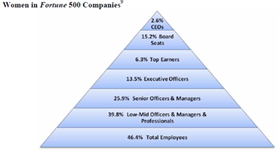
Under this factor, the report puts forth both current figures and possible causes about why “women remain dramatically underrepresented in corporate boardrooms and executive suites” in the United States. Some figures shared in the report show that while women comprise 46.4% of all Fortune 500 employees, they make up just 15.7% of board seats, 14.4% of executive officers, 7.6% of top earning executive officers, and only 2.4% of CEOs.

This contrasts to studies included in the report that demonstrated that “companies with more women board members, on average, significantly outperform those with fewer women by 53% on Return on Equity, 42% on Return on Sales, and a whopping 66% of Return on Invested Capital.

Factor 2: Persistent Gender Wage Gap

In the private sector, “Invest in Women” reports, “women working full-time earn only 77 cents for every dollar earned by men”— a gap the report says has not improved since 2001. This wage gap is true also for the Federal Government where “women managers earn 81 cents for every dollar earned by their male manager peers”.

Source:  Women’s Media

Factor 3: An Out-Of-Date Framework for Social Support

Here the report offers the premise that “our nation’s public policies are still rooted in the antiquated assumption that families rely on a single male breadwinner” when today’s “reality is that most families depend on two breadwinners.” Discussion of the issues relating to lack of paid leave, particularly sick leave and the burden it places on mothers who often “still bear the primary responsibility for their children’s health” are followed by sections on inflexible work arrangements and insufficient “quality, affordable early care and education.

This ends with an interesting analysis of the nation’s current retirement system and its effect on women. The report points out the lifetime earnings penalty—caused by the many interruptions over the span of a woman’s career to provide unpaid at-home care for children, elderly parents or ill family members— results in vastly decreased Social Security income for women, thus increasing women’s poverty rates later in life at a rate of 11.7% vs. 7.4% for elderly men.

Possible Policy Solutions to Improve Women’s Economic Position

Some possible policy solutions are put forward in this report as well, including:

  • “Stronger protections against wage discrimination;”
  • “Health reform;”
  • “Work-family policies” (including the right to request a flexible schedule and mandatory paid sick leave);
  • Financial regulatory reform and the “establishment of Offices of Minority and Women Inclusion at each federal financial services agency;”
  • “Value the Care Economy”, which, according to the authors, refers to boosting investment in quality early education  and child care programs, such as Early Head Start and Head Start; and
  •  Differentiating the impact of tax and entitlement reforms on women versus on men.

Part II: Compendium of JEC Reports and Hearings from the 111th Congress

The second part of the publication compiles various reports and hearings held by the Joint Economic Committee that referred to women’s issues covering four areas: Women in the Economy Today, Equal Pay, Access to Benefits and Retirement Security.

It is chock full of charts, tables, graphs and quotable quotes.


HOW DO I OBTAIN “Invest in Women, Invest in America: A Comprehensive Review of Women in the U.S. Economy”?

  • Buy it at GPO’s retail bookstore at 710 North Capitol Street NW, Washington, DC 20401, open Monday-Friday, 9am to 4pm, except Federal holidays, (202) 512-0132.
  • Find it in a library.

About the Author:  Michele Bartram is Promotions Manager for GPO’s Publication and Information Sales Division and is responsible for online and offline marketing of the US Government Online Bookstore (Bookstore.gpo.gov) and promoting Federal government content to the public.



Goodbye GPO Access, Hello FDsys

March 16, 2012

Guest blogger Kelly Seifert, Lead Planning Specialist for GPO’s Library Services & Content Management Division, writes about the final switchover from GPO Access to FDsys, GPO’s state-of-the-art digital database of Federal information.

Farewell, GPO Access! GPO’s Federal Digital System (FDsys) is here to stay and is better than ever.

Today, March 16, 2012, marks a momentous occasion for the Government Printing Office and its groundbreaking service, GPO Access. After 16 years of keeping America informed, the GPO Access website is shutting down and been replaced by its successor, GPO’s Federal Digital System (FDsys).

Image: Switchover notice from GPO Access to FDsys

All of the information the public had access to on GPO Access and more is available through FDsys (pronounced by “those in the know” as “F – D – sis”).

While not the traditional “Government book” discussed on this blog, we at GPO thought it only appropriate to blog about a service that provides free access to a vast number of Federal Government publications. FDsys provides the American public with free online access to about 50 different collections of U.S. Government information ranging from the Code of Federal Regulations to the U.S. Government Manual to the U.S. Budget.

Image: GPO’s Federal Digital System (FDsys) home page, www.FDsys.gov

GPO Access introduced electronic access to Government information

In 1993, Congress passed the U.S. Government Printing Office Electronic Information Access Enhancement Act (Public Law 103-40), which expanded GPO’s mission to provide access to Federal Government information not only in print, but also electronically. In June 1994, in response to that legislation, GPO launched GPO Access.

FDsys takes electronic access to new levels

Even the best of information systems have to evolve. Thus it was in January 2009 that GPO unveiled the next generation of Government information online with FDsys. The countdown to the shut-down of GPO Access began on December 20, 2010, when FDsys became GPO’s official system of record for free access to information and publications from all three branches of the Federal Government. In November 2011, GPO Access entered its “archive only” state and transitioned its status to historical reference archive. From that point forward, FDsys was GPO’s only resource for access to current, updated information, and now, GPO Access has shut down for good.

Image: FDSys Advanced Search results page

FDsys offers new, improved features to find Government publications

FDsys boasts key enhancements to GPO Access that allow users from librarians to scholars, researchers, lawyers and the public to:

  • Easily search across multiple Government publications;
  • Perform advanced searches against robust metadata about each publication;
  • Construct complex search queries;
  • Refine and narrow searches;
  • Retrieve individual Government documents and publications in seconds directly from each search result;
  • View more information about a publication and access multiple file formats for each search result;
  • Access metadata in standard XML formats;
  • Download content and metadata packaged together as a single ZIP file;
  • Browse FDsys alphabetically by collection, by Congressional committee, by date, and by Government author; and
  • Utilize extensive help tools and tutorials.

Image: List of collections of Federal Government publications available on FDSys

Links to printed versions of Government publications

In addition to providing free access to almost 50 different Government publications online, FDsys also directs you to GPO’s Online Bookstore, where you can buy those same publications, if you wish to have a bound and printed official copy.

As a GPO employee who has worked extensively with FDsys, I think you will really enjoy it and the new, enhanced features that are provided by FDsys for navigating Government information.

How do I find Federal Government publications?

  • Search GPO’s Federal Digital System (FDsys) at www.FDsys.gov.
  • Search GPO’s Catalog of Government Publications (CGP) at http://catalog.gpo.gov.
  • Shop GPO’s Online Bookstore at http://bookstore.gpo.gov/, 24 hours a day, 7 days a week, and 365 days a year.
  • Visit GPO’s Retail Bookstore at 710 North Capitol Street NW, Washington, DC 20401, open Monday through Friday, 9am to 4pm, except Federal holidays. Call (202) 512-0132 for more information.

The Underground Railroad Leaves its Tracks in History

February 27, 2012

Last week during National Black History Month, ground was broken on the National Mall in Washington, DC, for what will become the National Museum of African American History and Culture. In his remarks at the ceremony, President Obama mentioned that he wanted his daughters to see the famous African Americans like Harriet Tubman not as larger-than-life characters, but as inspiration of “how ordinary Americans can do extraordinary things.

Image: This original photo of Harriet Tubman in the handbook lists the many roles she played in addition to being a “conductor” on the Underground Railroad, including nurse, spy and scout for the Union army during the Civil War. Her quote: “I looked at my hands to see if I was the same person now I was free. There was such a glory over everything… I felt like I was in heaven.” Source: The Underground Railroad: Official National Park Handbook.

One of the most dramatic areas of African American history is the story of the fight against slavery and the profile in courage represented by the ordinary people who did extraordinary things while participating in the Underground Railroad.

The National Park Service (NPS) has produced a number of exemplary publications about it, with three of them available today from the U.S. Government Bookstore, including the

That these items are not your typical guidebooks about a single historic site is due to the fact that the Underground Railroad itself is not a typical American national park.

Congress and the National Park Service act to preserve the legacy of the Underground Railroad

Back in 1990, Congress instructed the National Park Service to perform a special resource study of the Underground Railroad, its routes and operations in order to preserve and interpret this aspect of United States history.

Following the study, the National Park Service was mandated by Public Law 105-203 in 1998 (you can read the law on GPO’s FDSys site) to commemorate and preserve this history through a new National Underground Railroad Network to Freedom Program to “educate the public about the importance of the Underground Railroad in the eradication of slavery, its relevance in fostering the spirit of racial harmony and national reconciliation, and the evolution of our national civil rights movement.”

What was the Underground Railroad?

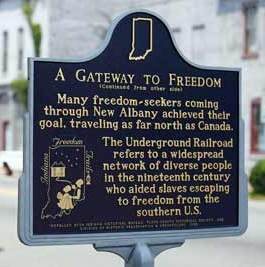
What was called the Underground Railroad was neither “underground” nor a “railroad,” but was instead a loose network of aid and assistance by antislavery sympathizers and freed blacks across the country that may have helped as many as one hundred thousand enslaved persons escape their bondage from before the American Revolution through the Civil War.

Image: NY State historical marker in Albany for the UGRR along the American Trails UGRR bicycle route.

Describing one of the most significant internal resistance movements ever, the National Park Service said in a 1996 press release that:

The Underground Railroad was perhaps the most dramatic protest against human bondage in United States history.  It was a clandestine operation that began during colonial times, grew as part of the organized abolitionist movement, and reached a peak between 1830 and 1865. The story is filled with excitement and triumph as well as tragedy –-individual heroism and sacrifice as well as cooperation to help enslaved people reach freedom. 

Where did the term “Underground Railroad” come from?

Historians cannot confirm the origins of the name, but one of the stories reported by the Park Service has the term coming out of Washington, DC, in 1839, when a recaptured fugitive slave allegedly claimed under torture that his escape plan instructions were to send him north, where “the railroad ran underground all the way to Boston.” However it came about, the term was widely in use by 1840, and is often shortened to “UGRR” by “those in the know.”

Image: An 1837 newspaper ad about a runaway slave from the book “The Underground Railroad from Slavery to Freedom” By Wilbur Henry Siebert, 1898. 

Underground Railroad Routes

Another byproduct of the UGRR special resource study was that the National Park Service carried out an analysis of slavery and abolitionism and identified the primary escape routes used on the UGRR.

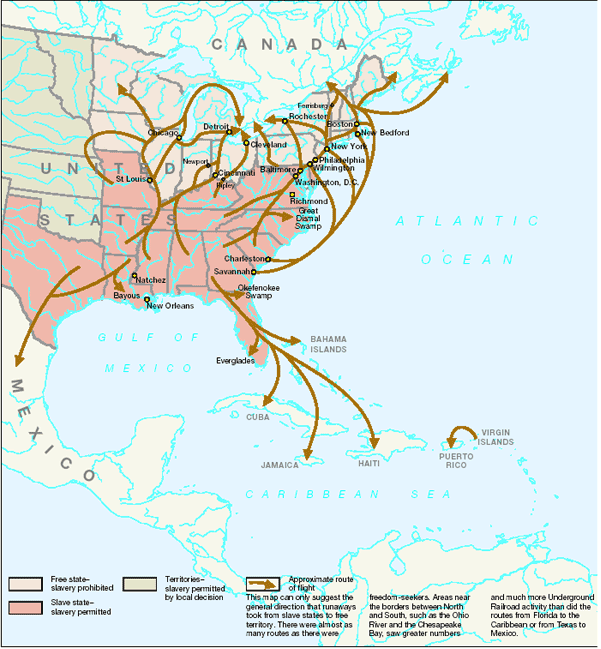
The map below is included in the Underground Railroad: Official Map and Guide, produced by the National Park Service Cartographic staff at Harpers Ferry Center, shows the general direction of escape routes. Contrary to popular belief, Canada was not the only destination for freedom-seeking slaves–since some fled to Mexico, Florida and the Caribbean– but it was the primary destination as the efforts to catch fugitives increased.

Image: Selected Routes of the Underground Railroad from the Underground Railroad: Official Map and Guide.

Additional outputs of the resource study and the subsequent research are the following three excellent Underground Railroad publications from the National Park Service.

Underground Railroad: Official National Park Handbook

The first book in our trio of publications is the Underground Railroad: Official National Park Handbook. It is comprised of a series of fascinating articles by top Underground Railroad historians that weave together a thorough view of the amazing stories behind the legend, illustrated with many drawings, court records, letters, paintings, photos, and other pictorial representations that help make this history come alive for the reader.

The handbook is broken into 3 major sections and 5 chapters:

  • Part I: An Epic in United States History:
    • 1- Myth and Reality by Larry Gara. This introductory chapter reviews and evaluates the truths vs. the legends that grew about the Underground Railroad.
  • Part II: From Bondage to Freedom:
    • 2- Slavery in America by Brenda E. Stevenson. In this chapter, the author details the rise of the institution of slavery in America and the harsh realities of life for the people who suffered under it. An interesting segment discusses the inequities of life for enslaved women vs. men.  
    • 3- The Underground Railroad by C. Peter Ripley. This fascinating chapter tells the courageous and often harrowing stories of freedom seekers and those who aided them, including Harriet Tubman who made nearly 20 trips to lead 300 slaves to freedom and Henry “Box” Brown who shipped himself in a 2X3’ wooden crate from Richmond to Philadelphia to escape. Sprinkled throughout are cameos of famous former fugitives and abolitionists including Sojourner Truth, Frederick Douglas, and abolitionists William Lloyd Garrison and Gerritt Smith, among many others.
  • Part III: Tracking the Past:
    • 4- Tracking the Past by the National Park Service. This chapter outlines some of the work done by the National Park Service and others to discover, verify and catalog the important people, places and artifacts related to the Underground Railroad.
    • 5- Further Reading by Marie Tyler McGraw. In this final chapter, the author provides a recommended reading list for interested researchers of the authoritative works related to different aspects of the Underground Railroad story.

Underground Railroad: Official Map and Guide

This map and guide includes drawings, blurbs, maps and chronologies about different aspects of the slave trade and the Underground Railroad.

Included in this fold-out map and guide are the escape routes map shown earlier, vignettes of key figures from key “conductors” on the Railroad to abolitionists, and even a short glossary of terms related to the UGRR.

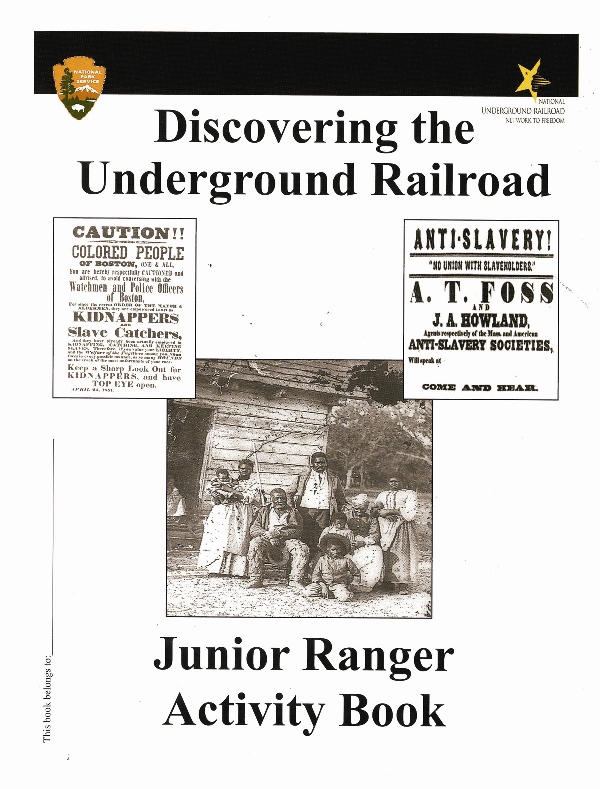
Discovering the Underground Railroad: Junior Ranger Activity Book

The final item in our trio of publications is the Discovering the Underground Railroad: Junior Ranger Activity Book.

Many National Parks offer visitors the opportunity to join the National Park Service Family as Junior Rangers. Interested students complete a series of activities during their park visit, share their answers with a park ranger, and receive an official Junior Ranger badge or patch and Junior Ranger certificate.

Since there is no one national park site for the Underground Railroad, the National Park Service came up with a different process with this activity book. Aspiring Underground Railroad Junior Rangers have to complete different numbers of activities in the book pertaining to their particular age level, then send the completed booklet in to the National Park Service’s Omaha office. There, “a ranger will go over your answers and then return your booklet along with an official Junior Ranger Badge for your efforts.

This fun booklet includes activities appropriate from ages 5 to 10 and older, from word finders and mazes to essays and historical fact matching.

How can you get these Underground Railroad publications?

About the Author:  Michele Bartram is Promotions Manager for GPO’s Publication and Information Sales Division and is responsible for online and offline marketing of the US Government Online Bookstore (Bookstore.gpo.gov) and promoting Federal government content to the public.


Society through a Comic Lens

February 7, 2012

By Guest Blogger, Marianne Mason, Federal Information Librarian, Research and Library Instruction at The University of Iowa Libraries

Comic books are not really books and often not comic, but are serialized graphics-based stories expressed through political and cultural rhetoric.  Think Maus, a story of the Holocaust.  Think Peanuts’ ethics and theology.

O.K., not all comic books or graphic novels are Pulitzer Prize winners or speak to a deep sense of ethics.  The pure entertainment value of storytelling through sequential art can be worthy on its own merits.  However, the comics can inform, persuade, and encourage new behaviors in readers.  This is the purpose of comic books authored by U.S. government agencies.

Used as social program marketing tools for decades, the government-authored comic book format has been used to promote program benefits (Social Security Administration) and to educate (Consumer Product Safety Commission) using superhero/anti-hero models like Sprocket Man (reviewed in our April 9, 2010, blog post “Just for Fun: Sprocket Man!” ) and El Gato to capture the attention of the targeted audience and cross educational boundaries.

The Army made instruction manuals measurably more appealing to combat personnel in PS Magazine by incorporating sexual innuendo in both dialog and character illustration such as in this Preventive Maintenance manual shown below:

In October 2011 the University of Iowa hosted a scholarly symposium entitled “Comics, Creativity, and Culture: International and Interdisciplinary Perspectives”, a by-invitation-only event for scholars, artists and creators of the art and literature of comic books.  The Symposium spawned a semester-long series of complementary university sponsored events ranging from art exhibits, radio broadcasts, discussions, and interactive workshops for educators and K-12 students.  The University of Iowa Libraries contributed to the celebration by creating a Comic Book Café based on the Japanese “Manga Café” model.  Several specialized library collections, including Government Information, pooled their best examples for the café.

As the U.S. Government Information Librarian, I found that this event gave me an opportunity to draw attention to the characteristics and range of government authored comic books.  Creating a government comics research guide  gave me an opportunity to do a thorough survey of the collection,  access the content of the print collection and provide links to digitized collections from the broader government information community, including this latest online booklet from the Centers for Disease Control and Prevention: Preparedness 101: A Zombie Pandemic”.

In addition, the research guide provides database access to many Congressional hearings and reports in the UI collection from the 1950’s linking juvenile delinquency to explicit violence in comic books.

Whether quirky or more profound, all reflect changing societal norms that drive public policy initiatives.

On October 4th an “egg timer” book talk called Thought Balloons: Talking about Comics”, was held in the Café for creators and readers of comics to share insights and stories about connections to comic book literature.  One reader commented that when she and her boyfriend merged their comic book collections, she knew their love was here to stay!

Note regarding Images:

Images in order of mention: Sprocket Man, The 9 Lives of El Gato, PS Magazine, Comic Book Café, Zombie Pandemic (“broader gov. community”), Comic books and juvenile delinquency.  Serial Set 11815-1 (S. Rpt. 62, 84 Cong., 1st Session) 1955, Thought Balloons. Source: University of Iowa Libraries.

About our Guest Blogger:

Marianne Mason has worked with Government and legal resources in several law libraries and universities and at University of Iowa Libraries since 2001 as the regional librarian for the State of Iowa.  Her idea of a fine vacation involves clear water, forests, and the absence of machinery/technology noise.  She knows how to knit socks, two-at-a-time, toe up.


More resources about Government-created comics:


Ponzimonium: How Scam Artists Are Ripping Off America

November 18, 2011

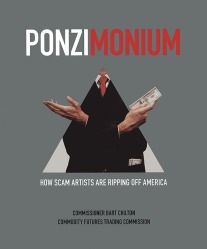
Every single day, someone somewhere makes a gigantic mistake by giving his or her money to a fraudster,” says Bart Chilton, one of the commissioners of the Commodity Futures Trading Commission (CFTC). Chilton is the author of Ponzimonium: How Scam Artists are Ripping Off America, a shocking new book available from GPO about some of the worst perpetrators of investment fraud in recent U.S. history.

Figure 1: Ponzimonium: How Scam Artists Are Ripping Off America available from GPO.

Ponzimonium looks to the CFTC’s own recent public case files stemming from fraud investigations that began with the recent economic downturn- talk about hitting people when they’re down! Because of the this, the book is generating a lot of positive buzz in The New York Times, TheStreet, and other media outlets.

The CFTC is an independent Federal agency with the mandate to regulate commodity futures and options markets in the United States. After the financial crisis of 2008, their authority was expanded under the 2010 Dodd-Frank Wall Street Reform and Consumer Protection Act to include over-the-counter derivatives markets and hopefully prevent and uncover more of these frauds.

What is a Ponzi scheme, you ask?

The world really learned about Ponzi schemes in December of 2008 when, as Chilton writes in his introduction, “legendary investment guru Bernard Madoff ‘made off’ with an estimated US$50 billion in what was called the ‘Mother of all Ponzi Schemes’.” (By the way, an interesting related read is the report about the Investigation of Failure of the Securities and Exchange Commission To Uncover Bernard Madoff’s Ponzi Scheme, also available from GPO.)

Unlike pure pyramid schemes in which it is mandatory that a new investor recruit others into the deal in order to receive payments, Ponzi schemes purport to offer investors a “too good to be true” deal by simply handing over their money. However, no real investment is made by the criminal.

Instead, Ponzi schemes, named after 1920’s postage stamp speculator-fraudster Charles Ponzi, are scams in which early “investors’—often friends, colleagues, and family members—are asked to invest in a this great “no risk” deal offering unbelievable returns.

Typically, the investor makes an initial investment and then some purported “phantom profits” are paid out by the con artist (really just money from other investors), prompting that investor to assume that his or her money has increased in value—and inspiring the investor to turn over more money to invest and tell others about it. In actuality, the perpetrators pocket the money for themselves.

This splendid infographic from the New York Times explains the concept visually:

Figure 2. Ponzi scheme infographic. Image source: The New York Times 12/21/2008 Week in Review.

Made in Madoff’s Image

Ponzimonium introduces some of the lesser known, but equally  despicable fraudsters that have been uncovered since 2008 by the CFTC and SEC (Securities and Exchange Commission).

The book lays out the fascinating and dramatic details behind the fraudulent schemes, their smooth-talking masterminds, and their many honest, hard-working victims, who often lose the money they’ve saved for their kids’ college funds, needed health care expenses, or their own retirement as a result of misplaced trust in these criminals.

These stories are so engrossing— at times it felt like I was taking in a marathon of America’s Most Wanted or I Almost Got Away with It episodes— I found it hard to decide which of these criminals is the most despicable. Was it Beau Diamond of Diamond Ventures who wiped out his parents’ savings along with 200 other clients who invested US$37 million? Or how about Marvin R. Cooper of Billion Coupons, who created a combination Ponzi and pyramid scheme called an affinity fraud, to target and recruit fellow deaf community members in the U.S. and Japan? And there’s James Ossie of CRE Capital Corporation (CRE) who bilked investors out of US$25 million, including a desperate father’s US$200,000 he invested to fund his young daughter’s cancer treatments.

Figure 3. Fraudster Marvin R. Cooper and deaf client. Image source: BusinessInsider.com

The human side behind these frauds makes them all the more compelling… and contemptible.

The best way to avoid getting swindled, advises Chilton, is to “remember what your parents told you when you were little: ‘Don’t take candy from strangers’”, and my personal favorite, “Just because it is on the TV, Internet, etc. doesn’t mean it’s real!” That’s advice you can take to the bank.

Some “don’t miss” features of this book

Ponzimonium: How Scam Artists are Ripping Off America includes some very useful features for its readers that make this a valuable resource for any investor.

  • Red Flags of Fraud: Includes 20 red flags to look out for when considering an investment.
  • Investor Checklist: Detailed list of questions to ask before investing.
  • Investors’ Bill of Rights: Common sense advice and legal rights for any investor.
  • Resources: Useful contact information for victims or witnesses of a fraud.
  • Glossary of Fraud Terms: Definitions of legal and financial terms within each story.
  • The Loot: Color photos of the criminals’ misbegotten gains and lavish lifestyle.
  • The Numbers: Calculations of the staggering amounts collected, paid, lost, or stolen, and prison sentences and restitution.

How can you get this Ponzimonium eBook?

About the Author:  Michele Bartram is Promotions Manager for GPO’s Publication and Information Sales Division and is responsible for online and offline marketing of the US Government Online Bookstore (Bookstore.gpo.gov) and promoting Federal government content to the public. She has been researching identity theft and privacy issues for years, both on the web and in the real world, and is a big fan of more fraud protection for citizens.


Losing our Shared National Experience?

October 31, 2011

Our blog post last week talked about GPO’s 150-year history of keeping America informed. But what does this mean in today’s media-saturated world?

Has the proliferation of media eroded our shared national experience?

[Figure 1. U.S. History Collage. Image courtesy of Mrs. Rice’s American History II class, Lexington High School, Lexington, Ohio.

Two weeks ago in a social media seminar for Federal Government, David Kirkpatrick (technology writer for the Daily Beast and Fortune magazine and author of a new insider book on Facebook) gave some startling statistics: 50% of Facebook’s 800 million users worldwide visit Facebook daily and up to 500 million have accessed Facebook on a single day, with the average Facebook user having over 130 “friends.”

But even more surprising, he said that 50% of Americans today now get their news and analysis about important events— sometimes edited or changed as it is passed along— from friends and family, often via social networks, text or email rather than from traditional media sources.

Prior to the 21st century, when Americans had only a few national media choices and limited local media, we would all receive the same original message at the same time, thus creating a shared American experience.

Today, in the U.S. alone Americans can choose to receive information from any of an estimated 1,476 daily newspapers; 1,500 television stations; 10,322 radio stations; 71 million cable television subscribers with hundreds of TV channels each; and more than 12 billion web pages and social media.

Kirkpatrick and others say the combination of the “Facebook effect”, media proliferation, and message selectivity have contributed to the erosion of our common, shared national experience.

GPO’s role in preserving our common American experience

As we mentioned in our blog last week, GPO’s mission for over 150 years has been “Keeping America Informed” about the three branches of the Federal Government.  This mission drives us to ensure the original information produced by Federal Agencies on behalf of the American people can be found by all Americans now and in the future.

What’s involved in capturing and disseminating our common Governmental information? It starts with gathering the content from Federal Agencies and publishing it in a professional format, whether print or digital. It then continues with authenticating the information to ensure Americans are getting the “genuine” unaltered information; creating permanent records with our catalog teams for our own FDSys digital database and Catalog of Government Publications; distributing these records to libraries in our Federal Depository Library Program and to worldwide library databases like WorldCat; and sending physical copies and/or ebooks to libraries, bookstores and book etailers.

View this video for an inside look at how GPO assembles and prints the Congressional Record—the official record of the proceedings, debates, and activities of Congress.

To keep America informed digitally, we allow users to subscribe to email newsletters by topic and are also now on social media, including Facebook, Twitter, YouTube, Foursquare and Yelp.

GPO Publications about shared American experiences

Here are some of my favorite Federal publications GPO has published that document significant shared American experiences over the past century. Do you remember when and how you learned of these events?

What are some of the significant national experiences that you will never forget and how did you learn about them and share them with others?

We would love to hear from you!


About the Author:  Michele Bartram is Promotions Manager for GPO’s Publication and Information Sales Division and is responsible for marketing the US Government Online Bookstore (Bookstore.gpo.gov) and promoting Federal government content to the public.