From Prairies to Peaks with Rockies and Roosevelts

April 3, 2013

Guest blogger GPO Public Relations Specialist Emma Wojtowicz reviews this new publication by the U.S. Forest Service that explores the history of the Forest Service’s Rocky Mountain region, including the involvement of two Roosevelts.

From-Prairies-to-Peaks-US-Forest-ServiceThose traveling west-bound for spring break and summer vacation should check out From Prairies to Peaks: A History of the Rocky Mountain Region of the U.S. Forest Service, 1905-2012. This publication focuses on the Rocky Mountain region, which encompasses Colorado, Kansas, Nebraska, South Dakota and Wyoming and is home to 17 national forests and seven national grasslands.  In From Prairies to Peaks, author Anthony Godfrey takes readers on a tour of the Rocky Mountains to learn about the topography, climate and wildlife as well as the history stretching from when Native Americans originally inhabited the region to the preservation efforts made in recent decades by the Forest Service.

Readers must be true aficionados of the West and Rocky Mountains to digest this nearly 400-page publication. The history is very detailed, but very fascinating.  During the development of the West in the 19th century, it was believed that the United States had an abundance of forest resources, and millions of acres of trees were cleared as a result.

After the Civil War, the threat of a timber famine alerted the government to the problem and brought greater attention to forest management. Passed under President Theodore Roosevelt, the Federal Forest Transfer Act of 1905 moved control of the 63 million acres of national forest reserves from the Department of the Interior to the Department of Agriculture’s Bureau of Forestry, which was renamed the Forest Service.

President-Theodore-Roosevelt-1908-Cartoon-as-Practical-Forester

Image: 1908 editorial cartoon of President Theodore Roosevelt as “A Practical Forester.”  Source: St. Paul Minnesota “Pioneer Press”.

One of the most interesting time periods for the region was the 1920s-1930s. Upkeep and development of the Rocky Mountain region created many jobs for men through New Deal programs during the Great Depression.  In national forests, workers were assigned to tree planting and thinning, insect and rodent control, road building and improvement, telephone line construction, and lookout tower and house construction to increase communication for fire control and timber conservation.

Then during the Dust Bowl, the region played an important role in President Franklin Roosevelt’s Great Plains Shelterbelt Project from 1934-1942, which involved planting a shelterbelt or windbreak of drought-resistant trees and shrubs and from Canada to northern Texas to protect against the winds and prevent erosion.

10-row-shelterbelt-cross-sectionImage: Cross-section of a shelterbelt of various sized evergreens, large and small deciduous trees, and shrubs using the Forest Service-recommended standard of 10 rows that serve as a windbreak and wildlife shelter. Image source: MyFarmlife.com.

The Forest Service assigned the Rocky Mountain region with supervising the planting of more than 217 million trees and shrubs on the windward side of more than 30,000 individual farms. This is just a snapshot of the in-depth history chronicled in this publication.

Planting-first-shelterbelt-tree-OKFrom Prairies to Peaks provides a historical account of one of the lesser known regions in the United States. The West conjures images of cowboys, mountains, hikers and skiers, but there is more to the Rocky Mountain region.

This publication is a great resource for those interested in learning more about the West and the Forest Service. And for those already familiar with the Rocky Mountains region, this book will help you brush up on your history.

Image: Planting the first tree in the Nation’s first shelterbelt on the H.E. Curtis farm near Mangum in Greer county, Oklahoma, on March 18, 1935. Image source: Oklahoma Farm Report.

HOW DO I OBTAIN THIS  PUBLICATION: From Prairies to Peaks: A History of the Rocky Mountain Region of the U.S. Forest Service, 1905-2012?

  • Buy it online 24/7 at GPO’s Online Bookstore.
  • Buy it at GPO’s retail bookstore at 710 North Capitol Street NW, Washington, DC 20401, open Monday-Friday, 9am to 4pm, except Federal holidays, (202) 512-0132.
  • Find it in a library.

History Was Made at the Women’s Rights National Historical Park

March 26, 2013

Guest blogger Jennifer K. Davis from GPO’s Library Services & Content Management Division that supports the Federal Depository Libraries Program (FDLP) writes about the Women’s Rights National Historical Park brochure in honor of National Women’s History Month. (Originally posted in the FDLP Community site on March 25, 2013.)

March is National Women’s History Month, and I am writing this posting on International Women’s Day. If I had the twelve hours–round trip– to hit the road, I’d head for the Women’s Rights National Historical Park in Seneca Falls, New York, and celebrate how far we have come as a nation.

Susan B. Anthony and Elizabeth Cady Stanton

It would definitely be a work-related trip. The U.S. Government Printing Office (GPO) printed Elizabeth Cady Stanton’s most famous– and in her estimation, her best– speech in 1915. She delivered her address, Solitude of Self, before the Committee on the Judiciary on January 18, 1892. She argued why the law needs to treat women as equal citizens under the law and she argued for women to get the vote via a law that would eventually became the Nineteenth Amendment to the Constitution.

Image: Susan B. Anthony (left) and Elizabeth Cady Stanton (right). Source: The Susan B. Anthony Center for Women’s Leadership.

Sadly, it took forty-two years after Stanton and fellow suffragist Susan B. Anthony first drafted the 19th amendment in 1872 and long after their deaths for the amendment to finally be ratified and made law in 1920. Since Stanton’s house is part of the park, it’s here that you can discover a very human portion of United States history and feel a renewed sense of the privilege that all United States citizens have to vote.

Not only can you learn about Stanton at the park, you can also get a wider view of the earliest stages of the women’s rights movement in the United States. Four historical properties and a visitor’s center make up the park. You can visit the Wesleyan Chapel in Seneca Falls where the leaders of the women’s rights movement held the First Women’s Rights Convention in August 1848. Stanton’s home is open from spring through fall. You can tour the house she referred to as “the Center of the Rebellion” where she raised her large family while networking with other women on women’s rights reforms.

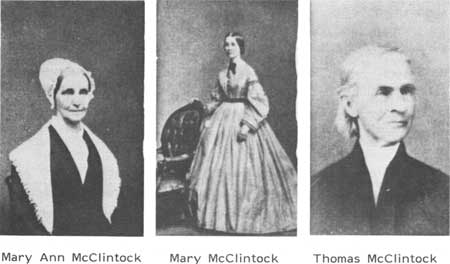
Another one of the four park properties, the M’Clintock House in nearby Waterloo, was the home of Mary Ann and Thomas M’Clintock.

MClintocksMrs. M’Clintock held the planning session for the First Women’s Rights Convention and drafted the Declaration of Sentiments at their home as well. (As an added bonus, the M’Clintocks were Quakers and their house was a stop on the Underground Railroad–so you can find out more about Quakers and belatedly celebrate African-American History Month while there.)

While in Waterloo, you can walk by the Hunt House, where Jane and Richard Hunt hosted Lucretia Mott and held an assembly for her where the attendees announced the plan for the First Women’s Right’s Convention. Although you can’t tour the Hunt House now as it is too fragile, the National Park Service (NPS) is making plans to restore it in the future. Visiting these locations brings home the exciting sense of purpose and activity of the American women’s rights movement of the late 1800s.

Information about all of these sites, as well as slideshows of the historical houses, the text of Stanton’s address, historical factoids, and photos of the major architects of the women’s rights movement and their supporters, are available at the Women’s Rights National Historical Park brochure online. Even if, like me, you can’t get to upstate New York to see these sites in person, you can (almost) feel like you’ve been there once you’ve given the park Web site a thorough visit.

It’s worth the time it takes to make the trip, whether actual or virtual. It’s amazing to see how far we’ve come as a nation in the advancement of personal rights, and how much all of society (men and women) have done to push our mothers, sisters, aunts and daughters forward. Having that perspective is one of the many advantages of learning about the park.

Continue your self-education by reading the park brochure at your local Federal depository library. You can find it either via the title’s PURL (Permanent URL) or through the Catalog of Government Publications (CGP) record that GPO cataloged for the Federal depository libraries in the March 2013 record load.

How can I access this publication, the Women’s Rights National Historical Park web brochure?

[Note from M. Bartram:] You can also purchase print publications and eBooks from GPO’s U.S. Government Online Bookstore related to the topics discussed in this article:


March Madness: New GPO Bookstore Website and Historic Anniversaries

March 22, 2013

March is traditionally a month of change and national excitement in the United States. Together with the change of seasons and college basketball frenzy, some important national milestones were reached this month that we should acknowledge, from new achievements to key anniversaries.

New U.S. Government Bookstore Website

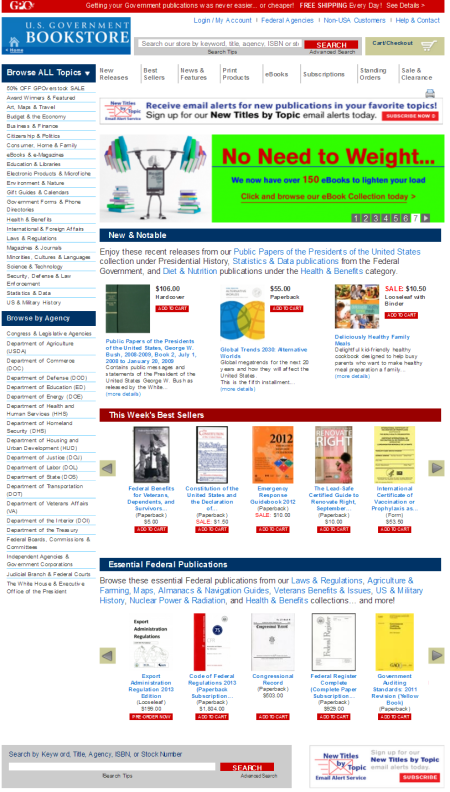
First, last week we launched our upgraded U.S. Government Bookstore ecommerce site, http://bookstore.gpo.gov/.  Our ecommerce website has gone through several iterations since its first version in 1999, each time adding functionality to keep up with the changing needs.  Today, GPO has over 4,000 Federal print publications and more than 150 eBooks available through our online bookstore.

New-US-Government-Online-Bookstore-website

Our new website includes the following user-friendly features:

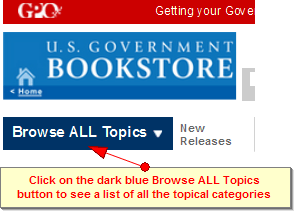
Browse-ALL-Topics-on-GPO-BookstoreClick on the dark blue Browse All Topics button on the site to see and browse by a list of all the topical categories.

These last two features—eBooks and new Categories—are particularly important in light of three other important milestones this month.

National Women’s History Month

March is National Women’s History Month in the United States, and we have a new main “Browse by Topic” category, Minorities, Cultures & Languages, where you can find books for and about African Americans, American Indians, Asian Americans & Pacific Islanders, Cultural Awareness, Disabled, Hispanics, LGBT, Minority Issues, Non-English Government Publications, Seniors & Elderly and Women, including dozens of books and eBooks about Women’s History.

Womens_History_Books_Slide

Harriet Tubman Centennial

One of the famous American heroines in the Women’s History collection is Harriet Tubman, who died 100 years ago this month making it her Centennial. Tubman escaped from slavery and returned to lead dozens of others to freedom in the mid-1800s. In addition to being the most well-known of Underground Railroad “conductors,” she was also a nurse, spy, suffragist, and more.

With all these roles, it is appropriate that we have created so many new “Browse by Topic” categories. One is Slavery & Underground Railroad (under US & Military History), where great books featuring Harriet Tubman and the Underground Railroad can be found.  Other new topics include Nursing under Health & Benefits and Intelligence & Espionage under Security, Defense & Law Enforcement.

Additional publications about National Parks can be found under the main category of Art, Maps & Travel, along with Posters & Prints and Maps, Almanacs & Navigation Guides.

BROWSE BY AGENCY: You can also find National Park Service (NPS) publications under Department of the Interior (DOI) in the Browse by Agency categories on the menu at the lower left side of the site, where publications are categorized by the Federal agency that published them. For example, our own Government Printing Office (GPO) publications are under Congress & Legislative Agencies.

Iraq War 10th Anniversary

Finally, this week is the tenth anniversary of the start of the Iraq War, which began on March 19, 2003, as Operation Iraqi Liberation, later renamed Operation Iraqi Freedom.

Iraq-War-10th-Anniversary_Books_Slide

President Obama, in an address about the Iraq war 10th anniversary this week said:

“As we mark the 10th anniversary of the beginning of the Iraq war, Michelle and I join our fellow Americans in paying tribute to all who served and sacrificed in one of our nation’s longest wars. We salute the courage and resolve of more than 1.5 million service members and civilians who during multiple tours wrote one of the most extraordinary chapters in military service. We honor the memory of the nearly 4,500 Americans who made the ultimate sacrifice to give the Iraqi people an opportunity to forge their own future after many years of hardship.”

Since the beginning of the war, the Defense Department has published dozens of excellent publications about the war, the strategies, Saddam Hussein, Iraq, reconstruction and the achievements and sacrifices made by our Armed Forces. You can find these publications featured under Iraq & Persian Gulf Wars which can be found under US & Military History > Battles & Wars categories.

It’s a Launch, Not a Landing

So, our new site marks the completion of over a year of hard work by our team here at the Government Printing Office, all aimed to make sure “we the people” can discover more about our Nation through excellent publications by our Federal Government. But there’s a good reason we call it a website launch and not a landing. This is only the beginning, with more great content and features to come! Enjoy!

So, please visit GPO’s new online bookstore website at http://bookstore.gpo.gov/ and tell us what you think!

About the Author:  Michele Bartram is Promotions Manager for GPO’s Publication and Information Sales Division in Washington, DC, and is responsible for online and offline marketing of the US Government Online Bookstore (http://bookstore.gpo.gov) and promoting Federal government content to the public. She was also in charge of the online bookstore relaunch!


Native Traditions Help Kids Unplug, Read and Be Healthy

March 1, 2013

Kids Take NEA Reader's Oath on National Read Across America DayToday, March 1, 2013, is the National Education Association’s Read Across America Day which kicks off Read Across America Week where people are encouraged to read to children and children are encouraged to read for themselves. And tomorrow is the birthday of Dr Seuss, who is known for writing children’s books. Coincidentally, from sunset tonight March 1 to sunset March 2 has also been declared National Day of Unplugging, when we are urged to unplug ourselves from all our gadgets and technology such as smartphones, laptops, and MP3 players.

Image: School children take NEA’s Read Across America Reader’s Oath. Source: NEA

Thus, it’s a perfect time to read to and with your kids. Reading events, both public and private, are being held nationwide, from schools and public libraries to houses of worship and homes as adults and children unplug and read.

The U.S. Department of Health and Human Services Centers for Disease Control and Prevention (CDC) Native Diabetes Wellness Program (Wellness Program), in collaboration with the Indian Health Service (IHS) Division of Diabetes Treatment and Prevention and the Tribal Leaders Diabetes Committee (TLDC), created the perfect series of children’s books to help encourage kids to read and live a healthy lifestyle.

CDC-Eagle-Book-Series for child diabetes prevention nutrition and physical fitnessCalled the Eagle Book Series. all of the stories reflect long-held traditional values of American Indian / Alaska Native people – respect, gratitude, and generosity – while teaching the universal wisdom of healthy eating and physical activity. Throughout the series, a young Native boy and his friends learn about healthy habits from Mr. Eagle, Miss Rabbit, and Coyote.

Vividly brought to life by the colorful illustrations of talented American Indian artists Patrick Rolo (Bad River Band of Ojibwe, Wisconsin) and Lisa A. Fifield (Black Bear Clan of the Oneida Tribe of Wisconsin), these charming and educational stories by Georgia Perez have become the award-winning Eagle Book series:

  1. Through the Eyes of the Eagle,
  2. Knees Lifted High,
  3. Plate Full of Color, and
  4. Tricky Treats.

Measuring 16 X 19 inches, these books are sized perfectly for reading to a group of first through third grade children at school, daycare, in a library, or at home.

Thru-Eyes-of-the-EagleThrough the Eyes of the Eagle

“Through the Eyes of the Eagle” is the first book in the Eagle Book Series and introduces the character of Mr. Eagle. Mr. Eagle befriends Rain That Dances, the primary child character in the book, to educate him about diabetes and how the lifestyles and health of the people have changed. Mr. Eagle has come to remind the children of the healthy ways of their ancestors so that they can be strong and healthy again.

Knees-Lifted-HighKnees Lifted High

“Knees Lifted High,” the second book in the Eagle Book Series, continues the story with Mr. Eagle and Rain That Dances, and introduces a new character, Thunder Cloud, Rain That Dances’ best friend. Mr. Eagle shares the knowledge that lack of movement (inadequate physical activity) contributes to development of type 2 diabetes. He encourages the boys to find ways of being active just as their ancestors were. He elicits ideas from the boys on ways to get their bodies up and moving

Plate-Full-of-colorPlate Full of Color

“Plate Full of Color,” the third book in the Eagle Book Series, introduces Miss Rabbit and the boys’ friend, Little Hummingbird. Miss Rabbit s a helper. She wants to teach the young children about ways they can prevent diabetes and help adults learn about preventing and controlling the disease. Rain That Dances, Thunder Cloud and Little Hummingbird listen to Miss Rabbit explain how Mother Earth provides wonderfully healthy things to eat.

Tricky-TreatsTricky Treats

“Tricky Treats,” the fourth book in the Eagle Book Series, continues the theme of healthy food by encouraging children to choose nutritional value in foods and beverages. This story introduces the character of Coyote who initially challenges the healthy messages offered by Mr. Eagle.

Tricksters, such as the coyote, are traditional characters in American Indian stories and literature who cannot be trusted because of their jokes and tricks. The trickster often comes around in the end as in this story. In the book, Mr. Eagle encourages the children to choose healthy snacks and not be tricked into using foods and beverages that are not healthy for them. Healthy foods are identified as “everyday foods,” while less optimal choices are described as “sometimes foods.” Mr. Eagle teaches the children about food safety and the importance of not taking things that belong to someone else.

NEA has a Read Across America Reader’s Oath by Debra Angstead, Missouri-NEA, a Read Across America song and this wonderful Dr. Seuss-inspired Read Across America poem that says it better than we can:

You’re never too old, too wacky, too wild,
To pick up a book and read with a child.
You’re never too busy, too cool, or too hot,
To pick up a book and share what you’ve got.

In schools and communities,
Let’s gather around,
Let’s pick up a book,
Let’s pass it around.

There are kids all around you,
Kids who will need
Someone to hug,
Someone to read.

Come join us March 1st
Your own special way
And make this America’s
Read to Kids Day.

How can I buy the Eagle Book Series?

About the Author:  Michele Bartram is Promotions Manager for GPO’s Publication and Information Sales Division in Washington, DC, and is responsible for online and offline marketing of the US Government Online Bookstore (http://bookstore.gpo.gov) and promoting Federal government content to the public.


BP in Hot Water over Deepwater

February 25, 2013

As the BP Oil Spill civil trial begins this week, the Federal Government will attempt to prove whether British Petroleum (BP) and/or any of its contractors such as Transocean (RIG), the owner and operator of the Deepwater Horizon oil rig, and Halliburton (HAL), which was responsible for pouring the cement plugs in the well, were “grossly negligent” and thus financially liable in causing the deadly BP Deepwater Horizon offshore oil rig explosion on April 10, 2010, and the blowout of the Macondo well.

BP-Deep-Water-Explosion-April-20-2010

Image: Explosion of the BP Deepwater Horizon rig at the Macondo prospect well. Photo credit: Associated Press.

The initial explosion killed 11 oil rig workers and triggered a subsequent oil spill which dumped millions of barrels of crude oil into the Gulf of Mexico, with the full extent of the long-term ecological and economic damage to the Gulf states and aquatic and wildlife still unknown.  With tar balls linked to the BP oil spill still washing ashore from Louisiana and Alabama to as far away as Australia, if BP is found “grossly negligent” instead of “simply negligent,” it will be on the hook for $17.6 billion in additional clean-up costs on top of the $4.5 billion fine for the criminal case settled in November 2012.

The National Commission on the BP Deep Water Horizon Oil Spill and Offshore Drilling produced two landmark and controversial reports about the oil spill causes and consequences that are critical in understanding the Government’s case against BP:

1)      Macondo: The Gulf Oil Disaster. Chief Counsel’s Report 2011, and

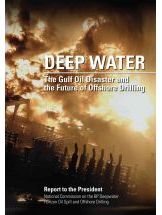
2)      Deep Water: The Gulf Oil Disaster and the Future of Offshore Drilling, Report to the President, January 2011.

THE MISSION

Established by Executive Order 13543 on May 21, 2010 by President Barack Obama, the mission of the National Commission on the BP Deep Water Horizon Oil Spill and Offshore Drilling Commission was to examine the relevant facts and circumstances concerning the root causes of the Deepwater Horizon explosion and develop options to guard against, and mitigate the impact of, any oil spills associated with offshore drilling in the future.

BP-Deep-Water-CommissionIn addition, they were to recommend any needed improvements to Federal laws, regulations, and industry practices concerning the oil and gas industry.

Image: Commissioners of the National Commission on the BP Deep Water Horizon Oil Spill and Offshore Drilling. Image credit: C-SPAN

Key areas of inquiry for the Commission included:

  • The Macondo Well Explosion and Drilling Safety
  • The Role of Offshore Oil Drilling in Domestic Energy Policy
  • Regulatory Oversight of Offshore Drilling
  • Oil Spill Response
  • Spill Impacts and Assessment
  • Restoration Approaches and Options

THE INVESTIGATION

Macondo-Oil-Spill-Report-9780160879630The first order of business for the Commission was to carry out the directive in the Executive Order to “examine the relevant facts and circumstances concerning the root causes of the Deepwater Horizon oil disaster.” They instructed the Commission‘s Chief Counsel Fred Bartlit and his investigative team to provide “the most comprehensive, coherent, and detailed account of the events leading up to the blowout and explosion” of Macondo, the name of BP’s offshore prospect in the Gulf of Mexico in the sector called the Mississippi Canyon Block 252, or MC252 where BP was drilling at the time of the accident.

The result was this report, Macondo: The Gulf Oil Disaster. Chief Counsel’s Report 2011, which provides additional details and documentation supporting the findings in the Commission’s final report.

The respected Library Journal, in selecting the Macondo report as one of its “Notable Government Documents” for 2011, said:

“The National Commission on the BP Deepwater Horizon Oil Spill was created by President Obama and charged with investigating the root causes of the largest accidental marine oil spill in the history of the petroleum industry. The committee concluded that the cause of the blowout was not mechanical. Instead, a number of poor management decisions, combined with an inadequate regulatory structure and an indifferent regulatory agency, overwhelmed the safeguards designed to prevent such disasters. Plenty of illustrations and photographs offer a glimpse into the technology of offshore oil rigs.” – LJ

For trial watchers, this publication is a must-read as much of the initial documentary evidence is included.

THE FINDINGS AND RECOMMENDATIONS

Deep-Water-Report-9780160873713The second and final report is the best-selling Deep Water: The Gulf Oil Disaster and the Future of Offshore Drilling, Report to the President, January 2011. It not only offers the full account of what happened in the Gulf of Mexico on April 20, 2010 and why, but also offers recommendations on proposed actions, changes in company behavior, reform of government oversight, and investments in research and technology that will be required to avert future disasters.

In Part I: The Path to Tragedy, “Chapters 1 through 3 describe the events of April 20th on the Deepwater Horizon, and, more important, the events leading up to it in the preceding decades—especially how the dramatic expansion of deepwater drilling in the Gulf was not met by regulatory oversight capable of ensuring the safety of those drilling operations.

In Part II: Explosion and Aftermath:  The Causes and Consequences of the Disaster, Chapters 4 through 7 lay out the results of the Commission’s investigation in detail, highlighting the crucial policy-related issues: the specific engineering and operating choices made in drilling the Macondo well, the attempts to contain and respond to the oil spill, and the impacts of the spill on the region’s natural resources, economy, and people—in the context of the progressive degradation of the Mississippi Delta environment.

BP-deepwater-2-yr-impact

Image: Chart illustrating some of the ongoing effects of the BP Macondo well oil spill two years after the Deepwater Horizon explosion. Infographic credit: ColorLines.com

In the final section, Part III: Lessons Learned: Industry, Government, Energy Policy, Chapters 8 through 10 present the Commission’s recommendations for reforms in business practices, regulatory oversight, and broader policy concerns.

Throughout the book, the Commission makes the case that outlines a number of primary conclusions, including these unsettling findings:

  • The explosive loss of the Macondo well could have been prevented.
  • The immediate causes of the Macondo well blowout can be traced to a series of identifiable mistakes made by BP, Halliburton, and Transocean that reveal such systematic failures in risk management that they place in doubt the safety culture of the entire industry.
  • Deepwater energy exploration and production, particularly at the frontiers of experience, involve risks for which neither industry nor government has been adequately prepared…
  • To assure human safety and environmental protection, regulatory oversight of leasing, energy exploration, and production require reforms even beyond those significant reforms already initiated…to ensure [the regulators’] political autonomy, technical expertise, and their full consideration of environmental protection concerns.
  • Because regulatory oversight alone will not be sufficient to ensure adequate safety, the oil and gas industry will need to take its own, unilateral steps to dramatically increase safety…
  • The technology, laws and regulations, and practices for containing, responding to, and cleaning up spills lag behind the real risks associated with deepwater drilling…
  • Scientific understanding of environmental conditions in sensitive environments in deep Gulf waters, along the region’s coastal habitats, and in areas proposed for more drilling, such as the Arctic, is inadequate. The same is true of the human and natural impacts of oil spills.

Delivered to the President on January 2011, the final report starts with a poignant dedication “to the 11 men who lost their lives on the Deepwater Horizon rig on April 20, 2010 and to their families, in hope that this report will help minimize the chance of another such disaster ever happening again.”

Will it help prevent another such disaster? Read these publications and decide for yourself.


How can I buy these BP oil spill publications?

  • Buy them at GPO’s retail bookstore at 710 North Capitol Street NW, Washington, DC 20401, open Monday–Friday, 9 a.m. to 4 p.m., except Federal holidays, (202) 512-0132.
  • Find them in a federal depository library.

About the Author:  Michele Bartram is Promotions Manager for GPO’s Publication and Information Sales Division in Washington, DC, and is responsible for online and offline marketing of the US Government Online Bookstore (http://bookstore.gpo.gov) and promoting Federal government content to the public.


Occupational Outlook Publications Help You Choose the Best Career

February 14, 2013

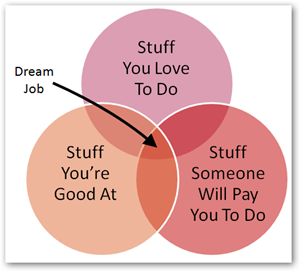
Dream job is where you do what you love and are good at and get paid for itHolding a job vs. having a career. Making a living vs. following your vocation. In today’s tough economic climate, many unemployed or underemployed would be happy with any job, and don’t dare aspire to a dream job. But what if you could have it all: a job that you love to do, you’re good at doing it, and is in demand so you will actually get paid to do it?

Image: Dream Job = sweet spot between passions, skills, and market demand. Image credit: TheUndercoverRecruiter.com

In President Obama’s State of the Union Address this week on Tuesday, February 12, 2013, one of the themes was the need for education and job training (and re-training) to help get Americans into the workforce or transition into more stable industries. But half the battle is knowing which profession matches your passions and talents, what skills and education you need to carry out that job, and what the current and future prospects are for that particular field so you have a better chance at keeping that job in the future.

Fortunately, the U.S. Department of Labor’s Bureau of Labor Statistics (known as BLS) has two complementary publications to help you choose the right career path.

Occupational Outlook Handbook U.S. Bureau of Labor StatisticsThe Occupational Outlook Handbook is the Federal Government’s premier source of career guidance featuring hundreds of occupations—both blue-collar and white-collar— from carpenters, firefighters and sports referees to teachers, medical professions, personal financial advisers, and even multimedia designers and scientists.  Revised every 2 years, the latest version contains employment projections for the 2010-20 decade.

Do you “dig” bones and ancient cultures? Read up on archeologist careers and learn their most recent media pay, entry-level education requirements or equivalent work experience, the number of jobs in this field today and the job outlook for this field over the next decade.

Currently, the top two fastest growing occupations are personal care aides and home health aides, to serve the aging baby boomers. The HGTV home renovation effect seems to have been a boon for tile/marble setters and stone and brick masons, and our nation’s kitty and puppy love for pets has made veterinary techs in high demand. The highest paying of the top 20 fastest growing occupations are physical therapists at $76,310 median annual pay and biomedical engineers at $81,540.

Occupational-Outlook-Handbook-20-Fastest-Growing-Occupations-2010

CLICK ON IMAGE TO SEE FULL SIZE

Image: Fastest growing occupations: 20 occupations with the highest percent change of employment between 2010-20. Source: U.S. Department of Labor Bureau of Labor Statistics (BLS).

Occupational-Outlook-QuarterlyFor those who want more regular updates with more in-depth articles, the Bureau of Labor Statistics (BLS) also offers its attractive magazine, the Occupational Outlook Quarterly, or the “OOQ” for those in the know. Suitable for job-seekers, students, teachers, parents, job and guidance counselors, this color magazine format features personal stories and detailed articles describing insiders’ views of what different jobs are like.

In the Winter 2012-13 edition of the OOQ, the feature article explained what certificates and certificate programs are, the differences between certificates and licenses or degree programs, and how certification might offer a quick way to enter a career. Another described the “hot” field of geothermal energy (pun intended) and the various careers to take advantage of this growing industry. Other articles provide tips for online resources for comparing colleges and available scholarships, life in the real estate or personal fitness professions by successful people in these occupations, and which types of careers tend to offer the best benefits and job perks.

OOQ-Winter-2012–13-Best-Job-Perks

CLICK ON IMAGE TO VIEW FULL SIZE

OOQ-Winter-2012-13_Professional-Santa-ClausHave a hankering to turn your “ho-ho-ho” into more than a hobby? The OOQ even included a fun article entitled “You’re a what? Santa Claus!” describing the jolly job of Phil Wenz who became a professional full-time Santa Claus and Santa historian at a Christmas theme park in Illinois.

Image: Full-time Santa and Santa lecturer and historian, Phil Wenz. Source: U.S. Department of Labor Bureau of Labor Statistics (BLS)

How can I buy these Occupational Outlook publications?

About the Author:  Michele Bartram is Promotions Manager for GPO’s Publication and Information Sales Division in Washington, DC, and is responsible for online and offline marketing of the US Government Online Bookstore (http://bookstore.gpo.gov) and promoting Federal government content to the public.


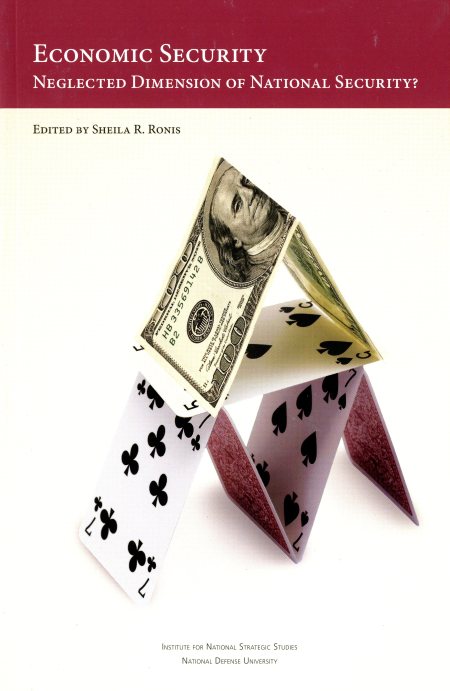
Economic Security: Neglected Dimension of National Security?

January 31, 2013

Guest blogger GPO Public Relations Specialist Emma Wojtowicz reviews this new publication asking whether our economic security is a neglected dimension of U.S. national security policy, a timely topic considering the recent national economic recession and yesterday’s news of the GDP drop.

The public generally agrees that the United States’ economic security is a vital component to the country’s overall national security. This is especially true in light of yesterday’s announcement that the U.S. gross domestic product (GDP)—the  measure of all goods and services produced by the economy—shrank an unexpected 0.1% annual rate in the fourth quarter of 2012, the first quarterly contraction since the second quarter of 2009 during the recession.

But what exactly does economic security mean in this context? This topic is explored in Economic Security: Neglected Dimension of National Security?, a publication by the Institute for National Strategic Studies of the National Defense University.

Economic Security: Neglected Dimension of National Security? ISBN 9780160898082The book’s editor, Sheila R. Ronis, argues that the economy has often been ignored and misunderstood in relation to national security and that economic strength is the foundation of national security. To make this argument, papers from a conference in 2010 that had the same title as the book comprise the publication and focus on the different factors that contribute to economic security.

Foundation: The first chapter explains how the economy works and provides the reader with a foundation for understanding economic components like budgets, debt, deficits, lenders, interest rates, GDP and so on. This is the best chapter of the book because it gives the reader perspective when considering the country’s economic security.

History:  Taking up 50 pages of this 110 page publication, the second chapter focuses on how the U.S. emerged after World War II as an economic and military superpower and how the boom in industrialization and commerce in the previous decades lead to America’s position after World War II. This approach to understanding the United States’ current economy is fascinating but the use of minute historical details to make the point is perhaps too in-depth for the casual reader, but will be of great interest to scholars, specialists and journalists.

Energy: The third and fourth chapters tackle the topic of energy security and how that relates to the country’s economic and national security. If you are not an energy aficionado, then the content may be over your head, but there are some fundamental facts that anyone can absorb. The U.S. spends $500 billion annually on energy and is the world’s largest energy consumer second to China. The United States’ energy consumption grows every year along with its energy imports.  These chapters strategize how to reform energy policy, thus strengthening the country’s economic and national security.

 Energy Security intersection of National Security, Economic Security and Environmental Security

Image: Energy security is a common topic in relation to economic and national security. Another professor, Massoud Amin at the University of Minnesota, describes energy security as the overlap between economic security, national security, and environmental security.  Source:  DialogueEarth.org

Education: Chapter five explores education in the U.S. and the skill set needed for the workforce of today and the future.  Science and technology are necessary skills for the country’s current workforce in order for the U.S. to play a role in the global economy. Those skills are also important for engaging the next generation of students who were born into an already technologically advanced society, well-versed in using computers, the Internet and mobile devices. This chapter takes a comprehensive approach to the topic of education and the long-term effect it will have on the country’s economic security.

Innovation: The author of the sixth and final chapter takes on the subject of innovation and its contribution to United States’ economic prosperity more so than its economic security. Building upon the previous chapter of education, innovation is the next step to strengthening the economy by creating jobs through new industries and products. The best take-away from this chapter is that while innovation is important and vital to the economy, it alone cannot ensure economic security.

President Obama’s Strategy for American Innovation Image: This image represents the President’s “Strategy for American Innovation” which, according to the White House, “seeks to harness the ingenuity of the American people to ensure economic growth that is rapid, broad-based, and sustained. This economic growth will bring greater income, higher quality jobs, and improved quality of life to all Americans.” Source: White House.

Economic Security: Neglected Dimension of National Security? does a good job of breaking down the issue of economic security making the reader more thoughtful and aware of this important, relevant topic.

HOW DO I OBTAIN THIS BOOK: “Economic Security: Neglected Dimension of National Security?

  • Buy it online 24/7 at GPO’s Online Bookstore.
  • Buy it at GPO’s retail bookstore at 710 North Capitol Street NW, Washington, DC 20401, open Monday-Friday, 9am to 4pm, except Federal holidays, (202) 512-0132.
  • Find it in a library.

Related Publications:


The Untold Story Behind the Engineering of Washington DC

January 24, 2013

Watching the many tourists visiting my hometown of Washington, DC this week for the Presidential Inauguration and enjoying the wonders of our beautiful neo-classical architecture in our monuments, buildings and museums, I was inspired to write this post on this intriguing new book by Washington, D.C. and architectural historian Pamela Scott entitled Capital Engineers: The U.S. Army Corps of Engineers and the Development of Washington, D.C. 1790-2004.

Capital Engineers: The U.S. Army Corps of Engineers and the Development of Washington, D.C. 1790-2004. ISBN-9780160795572Although best known for its “water resources and environmental work and its construction of facilities on military bases,” the U.S. Army Corps of Engineers played a pivotal role in the design and construction of our Nation’s capital: Washington, D.C.  Not only did Army Engineers fill the role of one of three commissioners who ran the city, they were instrumental in constructing a new and rapidly growing city on donated land, including literally creating land out of swampy terrain on the banks of the Potomac River where today National Airport, majestic monuments and sprawling public spaces can be found.

The purpose of this large, beautifully presented book is to bring to the public’s awareness the depth of involvement of the U.S. Army Corps of Engineers in the design, development, construction, and maintenance of our Nation’s capital by effectively chronicling its history and showcasing rare images, maps, and drawings of the Corps’ work.  In the preface we learn that many of these images were in poor condition and not accessible to the public before, but the advent of digital photography and scanning has made these available to stunning impact in this high-quality publication.

The book is broken into 6 sections covering periods from 1790 to 2004:

  1. The Grand Design, 1790-1800. During this period our first President George Washington hires French engineer Peter Charles L’Enfant (who had served with him in the Continental Army) to create a grand vision to lay out the city on the land donated for the purpose from Maryland and Virginia. In addition to creating the original plan for the capital city of this new nation that was reminiscent of Paris, L’Enfant also proposed the founding of the permanent Corps of Engineers to “play a key role in the development of the country’s public as well as military infrastructure.”
  2. The Antebellum City, 1800-1865, is a period where The Smithsonian Institution is built along with the start of the Capitol, and infrastructure begins to be laid.
  3. The Victorian City, 1865-1890, marks the building of the Washington Monument and the Library of Congress.
  4. The Progressive City, 1890-1915 delivers the Government Printing Office, The Lincoln Memorial, Rock Creek Park, and Potomac River bridges.
  5. The Expanding City, 1915-1950, is the period during two world wars, and noted is the building of the Pentagon among other Federal buildings and growing infrastructure.
  6. Metropolis, 1950-2004 is the final stage covered, when the city turns into a metropolis, and requires expanded infrastructure to support this.

However, the most fascinating part of the book is the many anecdotes sprinkled throughout, giving the reader a feel for the many strong personalities involved in building the beautiful city we have today and the many controversies that surfaced throughout the over two centuries since its founding.

For example, this year’s Inaugural Committee Chairman Charles Schumer (D-N.Y.) organized the 2013 Inauguration ceremony around a theme commemorating the completion of the Capitol Dome 150 years prior on December 2, 1863, two years ahead of President Lincoln’s second inauguration on March 4, 1865.  Said Senator Schumer on Monday as he kicked off the second inauguration of President Barack Obama and Vice President Joseph Biden:

When Abraham Lincoln took office [in 1861], two years earlier the dome above us was a half-built eyesore… Conventional wisdom was that it should be left unfinished until the war ended, given the travails and financial needs of the times. But to President Lincoln the half finished dome symbolized the half divided nation. Lincoln said, ‘If people see the Capitol going on it is a sign we intend the union shall go on.’ And so, despite the conflict which engulfed the nation, and surrounded the city, the dome continued to rise.”

Unfinished Capitol dome at Lincoln;s first inaugural

Image: First Inauguration of Abraham Lincoln, March 4, 1861, beneath the unfinished Capitol dome. Source: Library of Congress

To continue Lincoln’s vision to complete the construction in spite of the Civil War, the Corps continued work on the ambitious and tricky Capitol Dome, with the book showing rare photos and drawings of the work being done, including the planned design and engineering behind this magnificent structure.

Capitol-dome-cross-section

Image: Cross-section drawing by Thomas Ustick Walter for the dome of the United States Capitol building, circa, 1859. Source: Library of Congress.

Another story from the book is that General Thomas Lincoln Casey, Chief of Engineers at the time, decided to avoid both extensive congressional debate and public criticism in the building the Library of Congress and “embarked on the Library’s decorative scheme without prior approval of Congress.”  Using the time-honored Washington tradition of masking expenditures in generalities, Casey hid the hiring of sculptors under a generic heading of “marble work” and that of fine artists under “painting” in his annual reports.  Such was the faith in his work that Congress was not fazed by this deception when it was revealed.

An interesting chapter about the Washington Monument showed the Corps identified a need to shore up the foundation in order to build the obelisk to the necessary height in accordance with ancient Egyptian proportions. Such was the respect for their findings that Congress authorized additional funds for the Corps to build a new cement foundation to provide the long-lasting support desired.

Washington-monument-base

Image:  Cement foundation under the Washington Monument in May 1880. Source:  Library of Congress

Eventually, the foundation was covered with a beautiful lawn and the entire grounds landscaped by the Corps, to the delight– and relief– of all D.C. residents, expressed by local newspaper columnist George Alfred Townsend:

“The old grounds around the Washington Monument, which the very goats disdained to frequent and truant school-boys passed through with awe… were now brought into civilization… and a sense of gratitude toward the Engineer was felt by every thoughtful visitor.”

Skeptics throughout the history of the city from Washington’s cabinet to Abraham Lincoln’s own administration, did not see the vision of the completed city that the Corps of Engineers could. In fact, shortly before President Lincoln’s First Inaugural on March 4, 1861, aide John Hay ascended to the base of the Capitol’s yet-unconstructed dome and was quoted giving a bleak portrait of the unfinished city, saying:

Why did they attempt to build a city where no city was ever intended to be reared? It will never be a capital, except only in name; never a metropolis like Rome, or London, or Paris.

Fortunately, the book shows that Corps of Engineers had a broader vision and optimism, creating a major city with stunning vistas that rival those of major capitals throughout the world. All Americans owe, as Townsend said above, “a sense of gratitude” to the U.S. Army Corps of Engineers for our beautiful capital city!

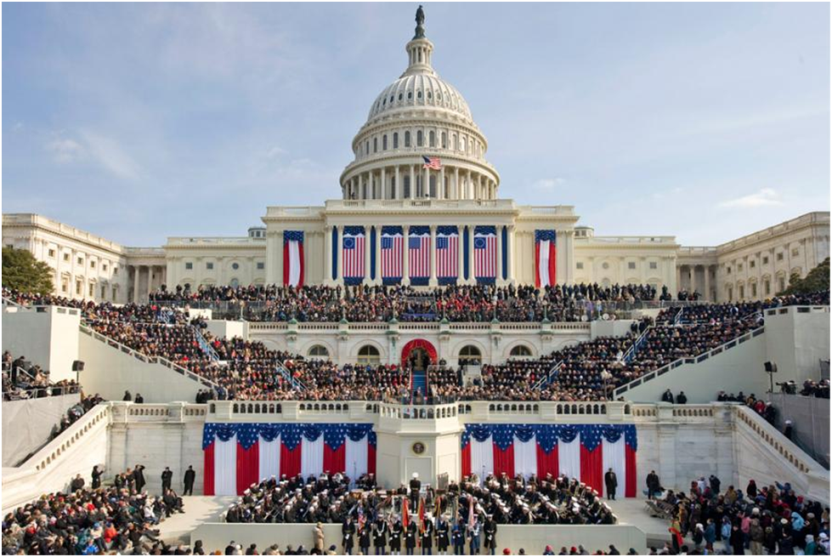
Capitol-at-2013-inauguration

Image: United States Capitol bedecked in red, white and blue for the Presidential Inauguration this past Monday, January 21, 2013. Note the magnificent dome with the statue of Freedom atop it, and compare it to President Lincoln’s inauguration above. Photo courtesy of MarthaStreet.com

How can I obtain a copy of Capital Engineers: The U.S. Army Corps of Engineers and the Development of Washington, D.C. 1790-2004?

  • Buy it online 24/7 at GPO’s Online Bookstore.
  • Buy it at GPO’s retail bookstore at 710 North Capitol Street NW, Washington, DC 20401, open Monday–Friday, 9 a.m. to 4 p.m., except Federal holidays, (202) 512-0132.
  • Find it in a federal depository library.

About the Author:  Michele Bartram is Promotions Manager for GPO’s Publication and Information Sales Division in Washington, DC, and is responsible for online and offline marketing of the US Government Online Bookstore (http://bookstore.gpo.gov) and promoting Federal government content to the public.


Shock and Awe: 3 Inspiring Wall Calendars for 2013

January 11, 2013

Shock and awe were the terms that came to mind when these three wall calendars / event planners came across my desk this week.

Shock came from the “I didn’t know that!?” response to the fascinating facts and awe as in “How did they take such awe-inspiring photos”? And the final “Awww” as in “Awww, shucks!” because there are only limited quantities available (under 100 each), so if you don’t act immediately, they’ll be gone! In fact, our supply of the National Park’s Service famous National Historic Landmarks calendar last year sold out in a few hours, and we expect this year to be more of the same.

In spite of our now digital world, wall calendars are still useful as a quick visual reference for you, your family or even your team at the office. And with these particular calendars on your wall this year, you will also be inspired to see the beauty in nature both far and near. As Anne Frank said, “Think of all the beauty still left around you and be happy.

Let’s take a peek at these three terrific calendars…


The National Historic Landmark 2013 Event Planner Calendar

Each fall, the National Park Service (NPS) holds a public photo contest to choose “fantastic photographs that illustrate the significance of any of the over 2,500 National Historic Landmarks, our nation’s most significant treasures.”  They select one image from each of the 13 National Park Service regions to be included in their annual calendar, with the winning photograph gracing the cover. (There is a separate photo contest for National Natural Landmarks as well.)

What is a U.S. National Historic Landmark, you ask? It may be “a historic building, site, structure, object, or district,” but it must be a “nationally significant historic place” that possesses “exceptional value or quality in illustrating or interpreting the heritage of the United States” as designated by the U.S. Secretary of the Interior.

The goal of their annual National Historic Landmark Photo Contest, says NPS:

“…is to encourage people to discover and explore landmark sites across the country and be inspired by our past. Based on this year’s pool of exceptional photographs, connections were made…Perhaps this year’s winning entries will spark the urge to explore the country’s vast array of more than 2,500 National Historic Landmarks, to seek out the stories that connect our rich history, and share your own views in next year’s contest.”

This 13-month wall calendar / event planner runs from January 2013 through January 2014 and features the winning photographs from the National Park Service’s Thirteenth Annual National Historic Landmarks (NHL) Photo Contest in 2012.

Different this year is the inclusion of bonus contest submission photos on each calendar page, giving even more eye candy every month for us lucky few who have the calendar.

National Historic Landmarks Photo Contest 2013 Calendar front cover

Image: Front of the 2013 NHL calendar shows some of the winning public photos. Listed from top down, left to right: 

  • This year’s winning image of Saugus Iron Works National Historic Site in Saugus, Massachusetts, takes us back in time to the early industry of the 17th century, represented by scenic waterwheels and forge. Here, European iron makers brought their much-needed skills to a young Massachusetts colony (Photo by Don Woods).
  • One of the “bonus” photos is of Hay House staircase in Macon, Georgia (Photo by Andrew Wood).
  • Holy Assumption Orthodox Church, Alaska, dates from the 1890s (Photo by Dawn Wilson).
  • Charleston Market Hall and Sheds, South Carolina, is one of the last surviving 19th century American market complexes (Photo by Steven Hyatt).
  • Stanton Hall, Mississippi, represents Natchez’s wealth and opulence on the eve of the Civil War (Photo by Mike Talplacido).
  • Pike’s Peak, Colorado, a National Historic Landmark, seen from Garden of the Gods, a National Natural Landmark (Photo by Dawn Wilson).
  • Nevada Northern Railway, East Ely Yards, Nevada, is the best-preserved, least-altered, and most complete main yard complex remaining from the steam railroad era (Photo by Jen Dalley).
  • Schooner Alma (NPS), California, built in 1891, is the only survivor of a once-typical American vessel (Photo by John Conway).

National Historic Landmark 2012 Photo Contest Bodie Historic District California

Image: One of the 2012 National Historic Landmark Photo Contest Honorable Mentions in this year’s calendar. Depicts Bodie Historic District, a genuine California gold-mining ghost town from the late 1800’s that was abandoned in the mid-1900’s. Bodie State Historic Park is located in the Bodie Hills east of the Sierra Nevada mountain range in Mono County, California, approximately 75 miles (120 km) southeast of Lake Tahoe (Photo by Joe Wenninger).


NASA Science 2013 Event Planner / Wall Calendar

For this second wall calendar we leave the confines of earth and reach for the stars with the NASA Science 2013: Changing the Way We View the Earth, Our Sun, and the Universe wall calendar.

NASA Science 2013 Calendar front cover

It features a vast array of rare or never-before-seen phenomena as seen from NASA space photography in stunning full color.

In addition to showing U.S. national holidays, the calendar also includes all the moon phases, a nice touch!

NASA Science 2013 Wall Calendar back cover

Image: Back of calendar shows insets of the monthly features, including:

  • a Deep Space Dragonfish nebula;
  • a massive cloud hole over Australia;
  • probing the edge of our atmosphere and jet streams;
  • an untouched crater on the Moon as a potential lunar settlement site;
  • a supernova stellar explosion;
  • blackouts in the East Coast from “derecho” thunderstorms;
  • Astronauts’ view of the Southern Lights that shifted unexpectedly;
  • NASA’s Curiosity rover lands safely on Mars;
  • tracking the fastest moving pulsar ever seen in space;
  • following the “greening” of the desert as Saudi Arabians tap ancient underground Ice Age water reserves;
  • rare “transit” of Venus passing in front of the sun; and
  • mapping impact craters on the planet Mercury.

Source: NASA / Jet Propulsion Laboratory-CalTech.

Space nuts (and “Big Bang Theory” fans) will be thrilled with this large calendar and its fascinating facts and stunning photos about space exploration and space-based science.


U.S. Geological Survey 2013 Event Planner/ Wall Calendar

This year’s U.S. Geological Survey’s calendar gives an eye-catching glimpse into the many facets of USGS and describes how their science is an integral part of decision-making in the U.S. and around the world. This calendar provides a dramatic glimpse at the changing world around us and how U.S. scientists are responding to these changes.

USGS 2013 Calendar front cover

For each month, descriptions of the various USGS service areas are shown along with dramatic full-color photographs or graphics giving timely examples, such as USGS work in: assessing invasive species like the high-leaping Asian carp; studying the effects of hydraulic fracturing or “fracking” on the environment; remote sensing to find precious metals in Afghanistan; tracking flooding such as happened in North Dakota; and mapping earthquakes.

USGS 2013 Calendar Eastern Earthquakes page

Image: The East Coast portion of the USGS National Seismic Hazard map showing all earthquakes of 3.0 magnitude or greater that have been detected since 1974. Certainly those of us in the Washington area felt it keenly when the 5.8 magnitude quake based in Mineral, Virginia, hit on August 23, 2011. Coincidentally, another quake occurred yesterday in the same spot… yikes! Luckily, it was only a 2.0.

This calendar is ideal for anyone interested in natural disasters and earth science, and stumping your friends with interesting science facts!

To learn more about the USGS, you may want to read our earlier blog post, US Geological Survey and the Science of Hurricanes.


How can I buy these wall calendars?

  • Buy them at GPO’s retail bookstore at 710 North Capitol Street NW, Washington, DC 20401, open Monday–Friday, 9 a.m. to 4 p.m., except Federal holidays, (202) 512-0132.

About the Author:  Michele Bartram is Ecommerce and Promotions Manager for GPO’s Publication and Information Sales Division in Washington, DC, and is responsible for online and offline marketing of the US Government Online Bookstore (http://bookstore.gpo.gov) and promoting Federal government content to the public.


Keeping the Kids Entertained… and Educated

December 27, 2012

This week as holiday breaks from school and winter weather keep the kids indoors, parents are looking for ways to keep them entertained–and educated– at the same time.

Fortunately, many Federal agencies this year provide the perfect solution with publications that are both fun AND educational, and with which the kids might actually learn something besides how to shoot down some “Angry Birds” on their new tablet! 😉 From dinosaurs to fossils, freedom runners to astronauts, these fun facts will prove more fascinating than fiction.

Here are a few that I (and my eight and six year-old nephews) particularly enjoy:

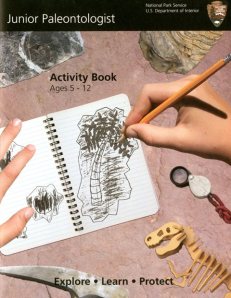
     Junior-Paleontologist Junior Paleontologist Activity Book, Ages 5-12, Explore, Learn, ProtectFor the kid who thinks dinosaurs are dynamite

In this illustrated color booklet, a child can learn about ancient life, complete fun activities, and explore some of the 230 national parks that preserve fossils and offer a look into the distant past.

And after completing the age-appropriate activities in this book, your child can then go online to request his or her free Junior Paleontologist badge from the National Park Service.

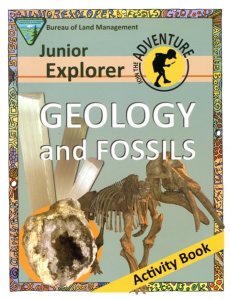
 Junior-Explorer-Geology-Fossils Junior Explorer Geology and Fossils Activity Book
For the kid who wants to be a “rock star”>/p>Fossils are the “rock stars” in this activity book as well. Includes fun facts, a crossword puzzle, and activities about rocks and fossils for explorers ages 8 to 12, along with a free Junior Explorer Certificate from the Bureau of Land Management (BLM).

Introduces basic kid-friendly concepts about geology, types of rocks and formations, and a glossary of terms. Focuses on Earth features– rock formations, canyons, caves, craters and more– that formed over long periods of time and that cannot be replaced as humans remove and make use of them, and the role of geologists to manage these non-renewable natural resources.

It also lists great public lands managed by the BLM that tourists can visit and explore these fossil-rich landscapes.

 Underground-Railroad-Activity-Book Discovering the Underground Railroad: Junior Ranger Activity BookFor the child who wants to change the world

Provides activities for children ages 5-12 to learn about the history of the underground railroad and the Emancipation Proclamation.

Children who finish the age-appropriate activities can send in to the National Underground Railroad Network to Freedom Program to receive a free Junior Ranger badge from the National Park Service.

Gently covers topics including: the meaning of freedom and slavery; the hardships and daily life of slaves; the importance and travel routes of the “Underground Railroad;” safe refuge choices; key dates and laws relating to slavery and emancipation; and key figures including Harriet Tubman, Frederick Douglas and abolitionists Levi and Catharine Coffin, among others.


Celebrating-Space-Shuttle_30-Years
Waving-Astronaut
Celebrating 30 Years of the Space Shuttle programFor the kid or teen with stars in his or her eyes

For older kids, teens and adults with stars in their eyes (and dreams of space), this could be the book for them.

A tribute to everything accomplished during NASA’s Space Shuttle program’s 30 years of operation, this colorful book is chock-full of stunning color photography and interesting facts of every shuttle mission and its crews, from deploying the Hubble Telescope to the inspirational Sally Ride, the first American woman in space.

From its first mission on April 12, 1981, to its last, on July 21, 2011, the Space Shuttle program defined NASA and served as an inspiration to future engineers and astronauts worldwide.

Beginning with the orbiter Columbia and continuing with Challenger, Discovery, Atlantis, and Endeavour, the National Aeronautics and Space Administration’s (NASA) Space Shuttle has carried people into orbit; launched, recovered, and repaired satellites; conducted cutting-edge research; and helped build the largest human made structure in space, the International Space Station.

All of these books can also be found at the following locations:

  • Buy it at GPO’s retail bookstore at 710 North Capitol Street NW, Washington, DC 20401, open Monday–Friday, 9 a.m. to 4 p.m., except Federal holidays, (202) 512-0132.
  • Find it in a federal depository library.

Hopefully, these books will help our readers beat the winter blahs as families have to stay indoors due to the weather.

After all, as this famous (albeit anonymous) quote says: “Education is the best gift you could ever receive, because once you have it, no one can ever take it from you.

About the Author:  Michele Bartram is Promotions Manager for GPO’s Publication and Information Sales Division in Washington, DC, and is responsible for online and offline marketing of the US Government Online Bookstore (http://bookstore.gpo.gov) and promoting Federal government content to the public.


First Blood: Year One of the War Between the States

November 22, 2012

On another Thanksgiving Day 150 years ago, America was embroiled in a bitter Civil War. A year later, expressing gratitude for the key Union Army victory at Gettysburg, President Abraham Lincoln would proclaim that the nation will celebrate an official annual Thanksgiving holiday on the fourth Thursday of November. But in 1862, 25 states and three territories were already celebrating the Thanksgiving holiday.

Thus it is fitting that we have this wonderful guest post about the newest book from the Army’s Center of Military History series about the U.S. Army Campaigns of the Civil War. Those who had survived these clashes had much to give thanks for that Thanksgiving Day- as do we all, particularly members of our military and diplomatic services and their families who have served in harm’s way. Enjoy the post and Happy Thanksgiving to you and yours,  Michele Bartram


Guest blogger Sonya Kunkle was a writer and editor for more than 15 years before she joined GPO’s Proof & Copy Markup section. Here she reviews a U.S. Government Bookstore booklet on a topic that caught her interest fairly recently—the American Civil War.

As a child growing up in the Washington, DC, suburbs, I once walked through the grassy fields of Antietam Battlefield (near Sharpsburg, MD) oblivious to the historical struggle waged under my feet. American history wasn’t my favorite subject in school, but as an adult my interest in the Civil War was sparked when I read “The Killer Angels,” a novel by Michael Shaara. “The Killer Angels,” a work of historical fiction, details the Battle of Gettysburg.

This is a good time to be a Civil War history enthusiast, with 2012 being part of the sesquicentennial (150-year anniversary) of America’s bloodiest war. To mark the occasion, the U.S. Government Bookstore has for sale a 64-page booklet, The Civil War Begins: Opening Clashes, 1861 published by the U.S. Army’s Center for Military History.

Image: (Cover of the booklet,. Detail from Capture of Ricketts’ Battery by Sidney E. King, courtesy of William V. Fleitz, Manassas Battlefield Park.

 In this booklet you can read about the reasons for going to war and why key players made many of the decisions they did during the first year of the conflict. The author, Dr. Jennifer M. Murray, also provides a lot of information in text and graphics on the troop movements of both the Federals and the Confederates during each of the key battles of 1861.

Strategic Setting

In his inaugural address, on March 4, President Lincoln declared that he didn’t intend to abolish slavery in states where it existed. Stating that he would not initiate a war, Lincoln informed Southerners, “In your hands … is the momentous issue of civil war …You can have no conflict, without being yourselves the aggressors.

If you look at the numbers, perhaps the Confederates were doomed from the start. The 1860 Census shows that the Union could call on 4 million military-age white males to build their army, whereas the Confederacy could assemble 1 million at most.

The Union also had 10 times the industrial capacity, not to mention better transportation capabilities. In spite of these disadvantages, the South started the Civil War with its first big move—firing on Federal Fort Sumter in South Carolina.

Operations—Fort Sumter

Charleston, South Carolina, was well fortified with Fort Sumter and other defenses. Sumter was built to guard against an enemy fleet, and the walls facing the city were much weaker than those facing the water, leaving the fort vulnerable to attack on land.

On April 11, the Southern Brigadier General Pierre G. T. Beauregard demanded that the Union forces evacuate Fort Sumter. The North’s ranking officer at Sumter, Major Robert Anderson, declined.

At 3 a.m. (or 0300; the author uses military time) on April 12, the Confederates notified Major Anderson that General Beauregard and company would open fire on Fort Sumter in one hour. Twenty minutes after the deadline, a single shell from nearby Fort Johnson, which the North had abandoned, exploded over Sumter. War had begun.

Into Virginia—Bull Run

Image: First Battle of Bull Run. 1889 chromolithograph by Kurz & Allison. Source: Library of Congress. CLICK TO ENLARGE.

In May the Confederates moved their capital from Montgomery, Alabama, to Richmond, Virginia. Richmond became a strategic target for the North, both for its industrial capability and its political importance. The two capitals, separated by only 100 miles, now figured prominently in both sides’ strategies.

The Civil War Begins: Opening Clashes, 1861 explains why the Union was determined to control Manassas Junction and why in May 10,600 Confederates defended the northern entrance to the Shenandoah Valley.

The author notes an interesting moment caused by the differing (and lack of) uniforms:

Viewing the Virginians, who were wearing civilian clothes, the Federal troops were unsure of their allegiance. To complicate matters further … Federal units were not uniformly dressed in blue; soldiers in the 11th New York, for instance, were dressed in colorful Zouave uniforms, which were also worn by some Confederate units. The Virginians clarified the matter by opening a deadly volley on the New Yorkers.”

Image: Brandy Station, VA, Band of the 114th Pennsylvania Infantry (Zouaves). Source: Library of Congress, Prints & Photographs Division, LC-B8171-7611 DLC. CLICK TO ENLARGE.

The Confederates won the fight, protecting their capital. The first battle of the Civil War resulted in the death of nearly 5,000 men.

The Fight for Missouri

While emotions roiled to the east, the majority of delegates attending a special Missouri secession convention voted to remain in the Union. This decision ran counter to Governor Claiborne F. Jackson’s personal preferences, and he mustered forces in favor of the Confederates.

This part of The Civil War Begins: Opening Clashes, 1861 provides details about how the Civil War reached into Missouri, with one of the key players being Union Brigadier General Nathaniel Lyon.

While directing his men on the front line, Lyon got hit in the calf by a bullet, so he left the field for medical treatment. When Lyon got back on the field, a bullet grazed his head.

Determined to continue the fight, and apparently not taking the hint, Lyon returned to the field. Moments later, a bullet hit him in the chest. He was the first Union general officer to die in the Civil War.

From Belmont to Port Royal

In The Civil War Begins: Opening Clashes, 1861 you can read about the Union Navy’s entry into the Civil War.

It’s an interesting read, with a little information about Southern pirates (pirates!) lurking inside the Outer Banks of North Carolina, pouncing on merchant vessels before Union warships could react. To thwart these outlaws, the Federal Navy designated the Outer Banks as its first target. Union forces prepared for the war’s first joint Army-Navy operation.

You learn something about the battle for Fort Hatteras and the naval tactic (and the Confederates’ faulty ammunition) that helped the Union win the day.

The North’s capture of Fort Hatteras and nearby Fort Clark improved the Union’s outlook soon after their defeat at Bull Run. Offering a “Congratulatory Order,” one Federal officer commented, “This gallant affair will not fail to stimulate the regulars and volunteers to greater exertions to prepare themselves for future and greater achievements.

The Union’s euphoria didn’t last long.

The Civil War Begins: Opening Clashes, 1861 describes what happened between the North and South about 35 miles north of Washington at Ball’s Bluff. Perhaps the statistics are most noteworthy—there were an evenly matched number of men fighting on both sides, but the outcome was lopsided in terms of soldiers wounded and captured. The battle’s uneven results favored the South.

This section also addresses the Union’s win at Port Royal, South Carolina. Here you also can read about what Brigadier General (and future U.S. President) Ulysses S. Grant did in the area of Belmont, MO, that earned him President Lincoln’s favor.

The chronological coverage of the war ends with Union Major General George B. McClellan’s training the Army of the Potomac outside of Manassas. McClellan said he believed that he controlled the “destinies of this great country.”  There was no further action along the Potomac as the curtain closed on 1861.

Analysis

Dr. Murray offers incisive analysis at the end of The Civil War Begins: Opening Clashes, 1861. She describes the early missteps of the secessionists, as well as what the South got right. She also notes the Union army’s mixed results.

Dr. Murray concludes, “As Federal forces grew more experienced and competent, they would gain key victories in 1862 that helped to shape the outcome of the Civil War.”

The last page of the booklet provides a short list of texts for further reading about the first year of the war.

Conclusion

The Civil War Begins: Opening Clashes, 1861 helps me to appreciate the history in my own backyard. Although I find all of the information about the armies’ positions and movements a bit overwhelming, the booklet tempts me to take the 70-mile trip from Baltimore, where I live now, to explore the fields of Bull Run at Manassas. Taking the booklet with me, I’ll have a better understanding of the history I’m walking through.

HOW DO I OBTAIN The Civil War Begins: Opening Clashes, 1861?

  • Buy it online 24/7 at GPO’s Online Bookstore.
  • Buy it at GPO’s retail bookstore at 710 North Capitol Street NW, Washington, DC 20401, open Monday–Friday, 9 a.m. to 4 p.m., except Federal holidays, (202) 512-0132.
  • Find it in a federal depository library.

Other Federal Titles about the Civil War

You may also be interested in these titles about the Civil War available from the U.S. Government Bookstore:


America Loves Quitters: Preventing Teen Tobacco Use

November 15, 2012

In an election month, young people across America learned a lot about making choices, and today they get the chance to make the choice to not use tobacco.

Today, November 15, 2012, marks the 37th Great American Smokeout, a day promoted by the American Cancer Society every third Thursday of November to encourage smokers to make a plan to quit smoking, or finally quit smoking altogether on that day. Research shows that quitting — even for one day — smokers will be taking an important step towards a healthier life – one that can lead to reducing cancer risk.

Image: Campaign banner for the Great American Smokeout 2012 by the American Cancer Society. 

Thus it was fortuitous that a copy of the three-volume set entitled “Preventing Tobacco Use Among Youth and Young Adults: A Report of the Surgeon General came across my desk this week.  Published by the Department of Health and Human Services, Centers for Disease Control and Prevention, National Center for Chronic Disease Prevention and Health Promotion, Office on Smoking and Health, this combines all the latest research and best thinking about how to combat tobacco use in children and teens. The three volumes in the set include:

1)      The full report from the Surgeon General with the detailed research: “Preventing Tobacco Use Among Youth and Young Adults: A Report of the Surgeon General”

2)      An “Executive Summary” of the report with the key evidence and conclusions

3)      A booklet of “Preventing Tobacco Use Among Youth and Young Adults: We Can Make the Next Generation Tobacco Free”.

This easy-to-read booklet aimed to parents, schools and community public health practitioners contains highlights from the 2012 Surgeon General’s report on tobacco use among youth and teens ages 12 through 17 and young adults ages 18 through 25. The first four pages are an overview of youth and young adult tobacco use, and the sections that follow provide details on health effects, factors that encourage young people to use tobacco, the role of the tobacco industry, and what we can do to solve the problem.

Here’s the Report. General

Reading through the full Surgeon General Report, I found it contains the following chapters:

  • Chapter 1. Introduction, Summary, and Conclusions

 This chapter gives an overview and summary of the report’s findings and conclusions. One startling fact: the high percentage of cigarette smokers starting even in middle school!

  • Chapter 2. The Health Consequences of Tobacco Use Among Young People

Starting tobacco use young—cigarettes, cigars, smokeless tobacco—has significant and sometimes unique health consequences outlined in this chapter.

  • Chapter 3. The Epidemiology of Tobacco Use Among Young People in the United States and Worldwide

In this chapter, the various surveys and methods used for gathering data for this landmark report were discussed.

  • Chapter 3 Appendices

Terrific for researchers, reporters and health professionals, the appendices provide the detailed data and tables that are such an important part of the study. For example one table showed the results of responses to use of multiple types of tobacco products expanding beyond just  cigarettes to increasing use of chewing tobacco, snuff, cigars, cigarillos or little cigars.

  • Chapter 4. Social, Environmental, Cognitive, and Genetic Influences on the Use of Tobacco Among Youth

In this chapter, the researchers explore the factors that influence tobacco use among youth—and why they have such devastating long-term effects.

  • Chapter 5. The Tobacco Industry’s Influences on the Use of Tobacco Among Youth

Twelve years after the Federal Government’s Master Settlement Agreement against the tobacco industry, it is exerting as much influence as ever, with sophisticated marketing efforts aimed at increasing tobacco use. This chapter also outlines the ineffectiveness of the anti-tobacco programs the tobacco industry was required to do as part of the Agreement.

  • Chapter 6. Efforts to Prevent and Reduce Tobacco Use Among Young People

This important chapter reviews the efforts to date to prevent tobacco use and what’s working and not.

Here is an example of the CDC’s current anti-tobacco campaign:

Smoking harms health from the very first puff. Learn more.

  • Chapter 7. A Vision for Ending the Tobacco Epidemic

Finally, it concludes with a vision from the research team on how communities, schools, parents and the public health programs can help end tobacco use.

Teen Tobacco Facts

 Some of the more startling—and disturbing—findings and conclusions:

  • In 2008, tobacco companies spent 48% more on cigarette marketing (totaling $9.94 billion) and 277% more on smokeless tobacco advertising (totaling $547 million) than in 1998, the year of the Federal Government’s Master Settlement Agreement against the tobacco industry.
  • For every person who dies due to smoking—more than 1,200 each day—at least two youth or young adults become regular smokers.
  • Among adults who become daily smokers, nearly all first use of cigarettes occurs by 18 years of age (88%), with 99% of first use by 26 years of age.
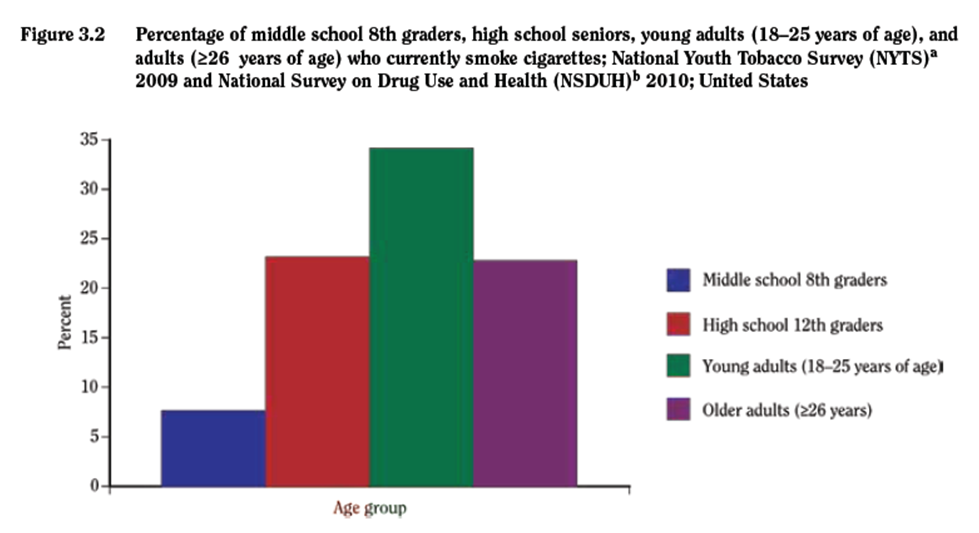
  • Almost one in four high school seniors is a current (in the past 30 days) cigarette smoker, compared with one in three young adults and one in five adults.
  • Among those who use tobacco, nearly one-third of high school females and more than one-half of high school males report using more than one tobacco product in the last 30 days.
  • Key influences include peer pressure, genetic predisposition toward addiction; family socioeconomic factors and educational attainment; sophisticated package and advertising design aimed toward kids, and depictions in popular media, particularly movies.
  • Smoking won’t help you lose weight, contrary to young people’s beliefs.
  • Adolescent smoking contributes to earlier onset of health problems, from asthma to cancer to heart and lung disease.

Additional Information

CDC: Finally, for more information and additional resources on preventing tobacco use among young people, go to www.cdc.gov/tobacco. If you smoke and want to quit smoking, cal l 1-800-QUIT NOW (784-8669).

American Cancer Society: Stay Away from Tobacco resources.

HOW DO I OBTAIN “Preventing Tobacco Use Among Youth and Young Adults: A Report of the Surgeon General?

  • Buy a print copy online 24/7 at GPO’s Online Bookstore
  • Buy it at GPO’s retail bookstore at 710 North Capitol Street NW, Washington, DC 20401, open Monday-Friday, 9am to 4pm, except Federal holidays, (202) 512-0132.

Find this and other books about Alcoholism, Smoking & Substance Abuse on our new online bookstore.

Another recommended book is How Tobacco Smoke Causes Disease: The Biology and Behavioral Basis for Smoking-Attributable Disease, A Report of the Surgeon General, which “explains beyond a shadow of a doubt how tobacco smoke causes disease, validates earlier findings, and expands and strengthens the science base. Describes in detail the ways tobacco smoke damages every organ in the body and causes disease and death. Substantiates the evidence that there is no safe level of exposure to cigarette smoke.

About the Author:  Michele Bartram is Promotions Manager for GPO’s Publication and Information Sales Division in Washington, DC, and is responsible for online and offline marketing of the US Government Online Bookstore (http://bookstore.gpo.gov) and promoting Federal government content to the public.