Dr. Seuss’ The Lorax Inspires Kids to Hug a Tree

April 23, 2013

Two publications show us the way… to care for trees this Arbor Day!

Lorax-Forest-Service-LaunchWith Earth Day yesterday and Arbor Day this Friday, April 26, and all week as National Parks Week, this is the perfect time to do something to help a tree grow or plant something new to celebrate the miracle of spring. If there are little ones in your life—children, grandchildren, nieces, nephews or friends of kids that you love—it’s a good time to teach them to love trees, plants, and flowers, too.

Image: The head of the Forest Service with the Lorax for the launch of the U.S. Forest Service’s Discover the Forest program which aims to inspire tweens (aged 8-12) and their parents to re-connect with nature, experiencing it first-hand. The campaign brings to life the joy and excitement kids have when they discover the wonders of nature, helping create interest in their environment and a lifelong relationship with it. Photo credit: U.S. Forest Service

The best way to get kids to appreciate nature, according to Dr. Seuss’ The Lorax Curriculum Guide, is to take them outdoors—and “according to the Institute for Social Research at the University of Michigan, children in the U.S. spend 50% less time outdoors than they did 20 years ago.” To counter the initial cries of “I want TV”, however, it helps to give kids directed activities when they go outside.

The U.S. Forest Service and the Ad Council have developed a partnership with Project Learning Tree and Universal Pictures to create an educational curriculum plan based on “The Lorax” film and story. The curriculum supports the Forest Service’s “Discover the Forest” campaign (See image caption above).

Lorax-Classroom-Guide_Plant-a-Tree

Image: “Plant a Tree” page 21 from the Lorax Classroom Guide.

Teachers can download for FREE the complete classroom guide of Dr. Seuss’ The Lorax Curriculum Guide as a PDF, or can download the individual activities to use in class (as long as it is for educational, and not commercial, purposes). There’s an interactive map of places you can go in the United States that have campgrounds, national forests, state campgrounds, etc. There’s a page of games and activities such as how to use a compass, take a virtual hike, create a leaf rubbing or become a Jr. Forest Ranger on the Web site.

The printed teacher’s guide has tests, bibliographies for the students, labs (plant a tree with the Lorax), and student pages for various grade levels (I saw K-4 and 6-8). Families are encouraged to use these activities, too.


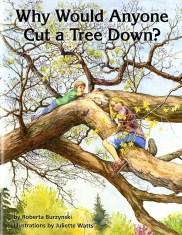
Why would Anyone Cut a Tree Down? continues the ecological and conservation-minded discussion you might want to pursue with your kids or students this week.

However, this volume approaches conservation from a silvicultural perspective, rather than the Lorax’ perspective of promoting a child’s approach of nature generally. The age range for the publication is 8 and up, and the material might be a bit young for older middle school children—so its material is more directed to a specific age range. The Forest Service published this document also, and the authors are a writer/ editor / educator with the Forest Service and an illustrator with previous experience illustrating tree guides.

The book shows children the life cycle of trees, the need to remove sick trees, the uses for wood from cut trees, and types of trees that are dangerous, all so beautifully illustrated by Juliette Watts that they make the lessons come alive.

Purchase a copy from the GPO U.S. Government Online Bookstore, and flop under a tree canopy to read the story and appreciate all the gifts that nature has to give us.

As Dr. Seuss wrote, “Now that you’re here, the word of the Lorax seems perfectly clear. UNLESS someone like you cares a whole awful lot, nothing is going to get better. It’s not.”  It’s up to us (and the Forest Service and its partners) to encourage children to care a whole awful lot about our trees and forests. Using these publications is good a way to make that happen!


How can I find these publications?

1) Dr. Seuss’ The Lorax Curriculum Guide

  • You can find it via our PURL (Permanent URL)
  • Locate it through GPO’s Catalog of Government Publications CGP catalog record. GPO has cataloged both the print and the electronic versions to make things “a whole awful lot better” for the Federal Depository libraries that got it in the April 2013 record load.
  • Find it in a federal depository library near you.

2) Why would Anyone Cut a Tree Down?

  • Purchase it on GPO’s U.S. Government Online Bookstore.
  • Buy it at GPO’s Main (retail) Bookstore at 710 North Capitol Street NW, Washington, DC 20401, open Monday-Friday, 8:30am to 4pm Eastern Time, except Federal holidays. Call (202) 512-0132 for information.
  • Find it in a Federal Depository library.

About the Author(s):

Adapted by Government Book Talk Editor and U.S. Government Online Bookstore Manager Michele Bartram from a post written for the FDLP Community Blog by guest blogger Jennifer Davis from GPO’s Library Services & Content Management Division that supports the Federal Depository Libraries Program (FDLP).


From Prairies to Peaks with Rockies and Roosevelts

April 3, 2013

Guest blogger GPO Public Relations Specialist Emma Wojtowicz reviews this new publication by the U.S. Forest Service that explores the history of the Forest Service’s Rocky Mountain region, including the involvement of two Roosevelts.

From-Prairies-to-Peaks-US-Forest-ServiceThose traveling west-bound for spring break and summer vacation should check out From Prairies to Peaks: A History of the Rocky Mountain Region of the U.S. Forest Service, 1905-2012. This publication focuses on the Rocky Mountain region, which encompasses Colorado, Kansas, Nebraska, South Dakota and Wyoming and is home to 17 national forests and seven national grasslands.  In From Prairies to Peaks, author Anthony Godfrey takes readers on a tour of the Rocky Mountains to learn about the topography, climate and wildlife as well as the history stretching from when Native Americans originally inhabited the region to the preservation efforts made in recent decades by the Forest Service.

Readers must be true aficionados of the West and Rocky Mountains to digest this nearly 400-page publication. The history is very detailed, but very fascinating.  During the development of the West in the 19th century, it was believed that the United States had an abundance of forest resources, and millions of acres of trees were cleared as a result.

After the Civil War, the threat of a timber famine alerted the government to the problem and brought greater attention to forest management. Passed under President Theodore Roosevelt, the Federal Forest Transfer Act of 1905 moved control of the 63 million acres of national forest reserves from the Department of the Interior to the Department of Agriculture’s Bureau of Forestry, which was renamed the Forest Service.

President-Theodore-Roosevelt-1908-Cartoon-as-Practical-Forester

Image: 1908 editorial cartoon of President Theodore Roosevelt as “A Practical Forester.”  Source: St. Paul Minnesota “Pioneer Press”.

One of the most interesting time periods for the region was the 1920s-1930s. Upkeep and development of the Rocky Mountain region created many jobs for men through New Deal programs during the Great Depression.  In national forests, workers were assigned to tree planting and thinning, insect and rodent control, road building and improvement, telephone line construction, and lookout tower and house construction to increase communication for fire control and timber conservation.

Then during the Dust Bowl, the region played an important role in President Franklin Roosevelt’s Great Plains Shelterbelt Project from 1934-1942, which involved planting a shelterbelt or windbreak of drought-resistant trees and shrubs and from Canada to northern Texas to protect against the winds and prevent erosion.

10-row-shelterbelt-cross-sectionImage: Cross-section of a shelterbelt of various sized evergreens, large and small deciduous trees, and shrubs using the Forest Service-recommended standard of 10 rows that serve as a windbreak and wildlife shelter. Image source: MyFarmlife.com.

The Forest Service assigned the Rocky Mountain region with supervising the planting of more than 217 million trees and shrubs on the windward side of more than 30,000 individual farms. This is just a snapshot of the in-depth history chronicled in this publication.

Planting-first-shelterbelt-tree-OKFrom Prairies to Peaks provides a historical account of one of the lesser known regions in the United States. The West conjures images of cowboys, mountains, hikers and skiers, but there is more to the Rocky Mountain region.

This publication is a great resource for those interested in learning more about the West and the Forest Service. And for those already familiar with the Rocky Mountains region, this book will help you brush up on your history.

Image: Planting the first tree in the Nation’s first shelterbelt on the H.E. Curtis farm near Mangum in Greer county, Oklahoma, on March 18, 1935. Image source: Oklahoma Farm Report.

HOW DO I OBTAIN THIS  PUBLICATION: From Prairies to Peaks: A History of the Rocky Mountain Region of the U.S. Forest Service, 1905-2012?

  • Buy it online 24/7 at GPO’s Online Bookstore.
  • Buy it at GPO’s retail bookstore at 710 North Capitol Street NW, Washington, DC 20401, open Monday-Friday, 9am to 4pm, except Federal holidays, (202) 512-0132.
  • Find it in a library.

March Madness: New GPO Bookstore Website and Historic Anniversaries

March 22, 2013

March is traditionally a month of change and national excitement in the United States. Together with the change of seasons and college basketball frenzy, some important national milestones were reached this month that we should acknowledge, from new achievements to key anniversaries.

New U.S. Government Bookstore Website

First, last week we launched our upgraded U.S. Government Bookstore ecommerce site, http://bookstore.gpo.gov/.  Our ecommerce website has gone through several iterations since its first version in 1999, each time adding functionality to keep up with the changing needs.  Today, GPO has over 4,000 Federal print publications and more than 150 eBooks available through our online bookstore.

New-US-Government-Online-Bookstore-website

Our new website includes the following user-friendly features:

Browse-ALL-Topics-on-GPO-BookstoreClick on the dark blue Browse All Topics button on the site to see and browse by a list of all the topical categories.

These last two features—eBooks and new Categories—are particularly important in light of three other important milestones this month.

National Women’s History Month

March is National Women’s History Month in the United States, and we have a new main “Browse by Topic” category, Minorities, Cultures & Languages, where you can find books for and about African Americans, American Indians, Asian Americans & Pacific Islanders, Cultural Awareness, Disabled, Hispanics, LGBT, Minority Issues, Non-English Government Publications, Seniors & Elderly and Women, including dozens of books and eBooks about Women’s History.

Womens_History_Books_Slide

Harriet Tubman Centennial

One of the famous American heroines in the Women’s History collection is Harriet Tubman, who died 100 years ago this month making it her Centennial. Tubman escaped from slavery and returned to lead dozens of others to freedom in the mid-1800s. In addition to being the most well-known of Underground Railroad “conductors,” she was also a nurse, spy, suffragist, and more.

With all these roles, it is appropriate that we have created so many new “Browse by Topic” categories. One is Slavery & Underground Railroad (under US & Military History), where great books featuring Harriet Tubman and the Underground Railroad can be found.  Other new topics include Nursing under Health & Benefits and Intelligence & Espionage under Security, Defense & Law Enforcement.

Additional publications about National Parks can be found under the main category of Art, Maps & Travel, along with Posters & Prints and Maps, Almanacs & Navigation Guides.

BROWSE BY AGENCY: You can also find National Park Service (NPS) publications under Department of the Interior (DOI) in the Browse by Agency categories on the menu at the lower left side of the site, where publications are categorized by the Federal agency that published them. For example, our own Government Printing Office (GPO) publications are under Congress & Legislative Agencies.

Iraq War 10th Anniversary

Finally, this week is the tenth anniversary of the start of the Iraq War, which began on March 19, 2003, as Operation Iraqi Liberation, later renamed Operation Iraqi Freedom.

Iraq-War-10th-Anniversary_Books_Slide

President Obama, in an address about the Iraq war 10th anniversary this week said:

“As we mark the 10th anniversary of the beginning of the Iraq war, Michelle and I join our fellow Americans in paying tribute to all who served and sacrificed in one of our nation’s longest wars. We salute the courage and resolve of more than 1.5 million service members and civilians who during multiple tours wrote one of the most extraordinary chapters in military service. We honor the memory of the nearly 4,500 Americans who made the ultimate sacrifice to give the Iraqi people an opportunity to forge their own future after many years of hardship.”

Since the beginning of the war, the Defense Department has published dozens of excellent publications about the war, the strategies, Saddam Hussein, Iraq, reconstruction and the achievements and sacrifices made by our Armed Forces. You can find these publications featured under Iraq & Persian Gulf Wars which can be found under US & Military History > Battles & Wars categories.

It’s a Launch, Not a Landing

So, our new site marks the completion of over a year of hard work by our team here at the Government Printing Office, all aimed to make sure “we the people” can discover more about our Nation through excellent publications by our Federal Government. But there’s a good reason we call it a website launch and not a landing. This is only the beginning, with more great content and features to come! Enjoy!

So, please visit GPO’s new online bookstore website at http://bookstore.gpo.gov/ and tell us what you think!

About the Author:  Michele Bartram is Promotions Manager for GPO’s Publication and Information Sales Division in Washington, DC, and is responsible for online and offline marketing of the US Government Online Bookstore (http://bookstore.gpo.gov) and promoting Federal government content to the public. She was also in charge of the online bookstore relaunch!


Earth Day

April 19, 2012

ImageAs we celebrate the 42nd Earth Day, the arrival of warm weather and the planting of summer gardens, our Guest Blogger — GPO Public Relations Specialist Emma Wojtowicz — takes a look at a few Federal publications focusing on the environment and how they play a role in our communities.

Congressional Budget Office: Potential Impacts of Climate Change in the United States

Published in May 2009, this report by the Congressional Budget Office (CBO) defines climate change and examines the causes and potential impact climate change has on North America. The report is brief (only 17 pages), concise and written in plain language, so you do not have to be a scientist to understand the focus of the paper. CBO effectively explains the scope of climate change and the effect is has on different parts of our environment. A few interesting takeaways:

  • Energy from the sun is absorbed by the Earth’s climate system and then radiated back into space. Greenhouse gases increase the amount of energy being held, thus warming the Earth’s surface.
  • Aerosol gases from volcanic eruptions have the opposite effect – they cool the Earth.
  • Climate change causes precipitation to be unevenly distributed: regions and seasons that already have greater precipitation will tend to get more and drier regions will tend to get less.
  • Rising surface temperature of the ocean increase the strength, size and intensity of hurricanes and typhoons.
  • Higher concentrations of carbon dioxide, a kind of greenhouse gas, will boost forest growth and timber production.

The Container Tree Nursery Manual, Volume Seven: Seedling Processing, Storage and Outplanting

A rite of spring and summer involves planning and preparing for outdoor landscaping and gardens, which means a trip to the nursery. Do you ever question where those trees come from? In the Container Tree Nursery Manual you will learn about the cultivation of trees from seed to what you purchase at the store. This publication is a bit dense with scientific processes and terminology, but once you get used to the tone of the book it makes for a fascinating read. Informative pictures, charts, graphs and diagrams help readers understand the content and “see” the entire life of a nursery tree from the planting, growing, storing, and shipping stages. For gardening enthusiasts, you can learn practical information that can be adapted to your own gardening endeavors. While you may not be planting trees in containers, the book emphasizes important growing techniques and considerations that you can apply to your own potted plants like the depth of the container for roots, water amount and frequency, as well as outside temperature.

Restorative Commons: Creating Health and Well-being through Urban Landscapes

This publication embodies the community spirit of Earth Day. Previously blogged about in August 2010, Restorative Commons is a lovely book about the importance and positive effect gardens and green landscapes have on urban communities. Urban gardening projects bring together neighbors and people of all ages giving them a common goal and a visible result to take pride in. The book explores the history of urban landscaping and ways community parks have shaped society; next it goes through various case studies of urban gardening initiatives in American cities and the impact they have on their communities; and then concludes with interviews with the people who lead the initiatives that beautify and strengthen their communities through urban gardens. Restorative Commons reflects the purpose and essence of Earth Day, which is to work with your neighbors to make a positive contribution to the community you live in and in turn an impression on greater global community.    

How do I obtain these Federal publications?

Congressional Budget Office: Potential Impacts of Climate Change in the United States

  • Buy it online 24/7 at GPO’s Online Bookstore
  • Buy it at GPO’s retail bookstore at 710 North Capitol Street NW, Washington, DC  20401, open Monday-Friday, 9am to 4pm, except Federal holidays, (202) 512-0132.
  • Find it in a library

The Container Tree Nursery Manual, Volume Seven: Seedling Processing, Storage and Outplanting

  • Buy it online 24/7 at GPO’s Online Bookstore
  • Buy it at GPO’s retail bookstore at710 North Capitol Street NW,Washington,DC20401, open Monday-Friday, 9am to 4pm, except Federal holidays, (202) 512-0132.
  • Find it in a library

Restorative Commons: Creating Health and Well-being through Urban Landscapes

  • Buy it online 24/7 at GPO’s Online Bookstore
  • Buy it at GPO’s retail bookstore at710 North Capitol Street NW,Washington,DC20401, open Monday-Friday, 9am to 4pm, except Federal holidays, (202) 512-0132.
  • Find it in a library

The Buzz on Native Bees

June 29, 2011

I’m second to none in my admiration for the great rhythm and blues singer Lavern Baker. Her hit records, like “Jim Dandy,” “I Cried a Tear,” and “Saved” led to her 1991 induction into the Rock and Roll Hall of Fame. Even the greats can go astray, though. In her 1960 recording of “Bumble Bee,” she sang “You hurt me like a bee/a bumble bee, an evil bumble bee.” Wrong! Bumblebees rarely sting and, as native bees, play a little-known but vital role in pollinating  flowers and crops. In fact, growers of greenhouse tomatoes deliberately establish bumblebee colonies in their facilities for pollination purposes.

Thanks to Bee Basics: An Introduction to our Native Bees, a 2011 Library Journal notable Government document co-produced by the U.S. Department of Agriculture’s U.S. Forest Service and the Pollinator Partnership, I now know that bumblebees and other native bees are responsible for 75 percent of the pollination of flowers and crops in the U.S. Given the many news stories in recent years regarding the mysterious “colony collapse disorder” affecting the non-native honey bee, the value of native bees described in this neat little booklet really “stung” me into a new awareness of these amazing and varied creatures. (By the way, native bees rarely sting, and many of their stings are mild.)

As I learned from Bee Basics, aside from bumblebees, most other species of native bees are solitary. They build nests in the ground, in dead trees and, in the case of a number of parasitic “cuckoo” bees, in the nests of other species. Thousands of species exist, many with very specialized tastes in pollen and nectar, those protein-laced plant products that convinced prehistoric wasps to give up their carnivorous wasp-ness in favor of a vegetarian diet.  The southern blueberry bee pollinates – wait for it – blueberry bushes, while squash bees pollinate cucurbits (pumpkins, squash, and zucchini to me). Competition from honey bees, environmental degradation, and pesticides all are hurting many of these interesting and literally life-giving insects so, to quote Arthur Miller, “attention must be paid” by all of us who benefit so mightily from them.

Bee Basics is written for the layperson, provides a huge amount of biological and ecological information in fewer than 50 pages, and is available here for you to read. You can also find it in a library.

As for Lavern Baker, I bear no hard feelings. I still love her version of “Bumble Bee!”


Cooking (and Eating) With Uncle Sam

June 20, 2011

 The National Archives  just opened a new exhibit that has piqued my interest. “What’s Cooking, Uncle Sam?” is intended to “explore the records of the National Archives that trace the Government’s effect on what Americans eat.” Although I haven’t had a chance to visit the exhibit yet, it’s been getting great press in the New York Times (subscription required, I’m afraid) and the Washington Post.

Awhile back I discussed one of the Government’s efforts to inform the public about food preparation: Aunt Sammy’s Radio Recipes. In those days, thrifty, filling meals were the order of the day – comfort food that could nourish people struggling through the Great Depression with very little spare cash.The Government is still a player in the food game today, but now the problem seems to be obesity rather than malnutrition. The Department of Agriculture (USDA) has replaced its venerable Food Pyramid with MyPlate, but the aim remains the same: educating the public on portion control and which foods to increase or decrease in the American diet.

This brings me to another 2011 Library Journal notable Government document: the USDA Food and Nutrition Service’s Grow It, Try It, Like It: Preschool Fun with Fruits and Vegetables, a kit aimed at parents and teachers who want to provide young children with food and nutrition information in a fun way while teaching them all kinds of other things, like growing and cooking vegetables. Kids can improve their small motor skills while getting their hands dirty in a constructive way and then serve up the results – and maybe even acquire a taste for fruits and veggies, that perennial hope of parents everywhere. The kit includes seven booklets, with names like “Spinach Lane,” “Sweet Potato Hill,” and “Peach Tree Orchard,” each one explaining a particular fruit or vegetable’s nutritional value, how to grow it, recipes, and lots more. There are plenty of puzzles and other fun activities, too. Since we’re way past Aunt Sammy these days, technologically speaking, the kit also includes a CD-ROM with more information and a DVD of “Cool Puppy Pup’s Picnic and Lunch Parties.”

So what’s cooking at the Federal level? Quite a bit! You can view Grow It, Try It, Like It here or browse through its components in a library. I suspect that even a lot of us who are way past the Cool Puppy Pup stage might learn something from these booklets – I didn’t inherit my grandmother’s green thumb, so maybe they could actually help me grow some of this stuff!


The Invaders are Coming – and They’re Green!

June 13, 2011

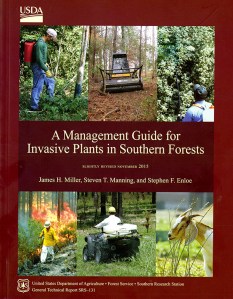
I have green aliens living in my backyard. They looked so nice when they arrived, but now…I really don’t know what to do. I blame the Government for this – specifically the U.S. Department of Agriculture, Forest Service, Southern Research Station. I was a happy man until I started reading the book they’ve published – A Field Guide for the Identification of Invasive Plants in Southern Forests – and now I’m a guilt-ridden shell.

When I started reading this book, which was named as one of Library Journal’s Notable Government Documents, I nodded knowledgeably as I looked through the beautiful color photographs of invasive trees that increasingly are infesting 13 southern states. Who wouldn’t recognize the ubiquitous Tree-of-Heaven, or ailanthus, which seems to line every roadway where I live in Northern Virginia? Then there’s the tungoil tree, whose name rang a bell because its oil is used as a wood drying and finishing agent. It’s now considered invasive and  is running wild in Louisiana, Mississippi, Alabama, and Georgia.

All very interesting, I thought to myself, as I started paging through the invasive shrubs section. Then it happened. “Sacred Bamboo, Nandina.” What? No! It’s in our back and  front yards! We got it from a friend, and it looks so nice! “Widely planted as an ornamental, now escaped and spreading from around old homes and recent landscape plantings.” Well, maybe there’s an answer; according to the Guide, “Sterile-seeded, reddish cultivars available.”

Shaken, I got into the invasive vines section. English ivy? Uh-oh, we have lots of that, but it was here when we moved in. Vinca (periwinkle)? Oh, great, we planted that ourselves! It was all I could do to finish going through this veritable rogue’s gallery. I may have rushed a little, lest even more aliens catch my eye – I feel bad enough as it is.

Seriously, this is an eye-opening look at how many invasive plants are running rampant though the woodlands of the South and crowding out native species. Since many of them were imported for use as ornamentals, they look great in the photographs, but they literally are a blight on the landscape when they escape into the wild. I’ve had an interest in using native plants in my yard, and this book is really motivating me to do more. Anyone living in the South should be aware of the problem, and this book is an excellent place to start. You can read it here, get a copy here or here, or find it in a library.


The Key to a Healthy Life

September 3, 2010

This week’s guest blogger is Ingrid Reyes-Arias, a former GPO intern and new staffer with GPO’s Library Services and Content Management area.

How often do we make plans to be “healthier”? Easier said than done, right? Luckily for us, there are plenty of Government publications that provide us with nutritional information.  A good example is Dietary Guidelines for Americans 2005

The goal is to live a long healthy life and minimize the risk of chronic diseases, and we can achieve this by undertaking the recommendations that this publication provides.  This is a user-friendly book that has information about adequate nutrients, weight management, physical activity, food groups, and food safety. The most difficult component of health is applying it to daily life.  Dietary Guidelines for Americans 2005 has been able to take highly important information and make it available and easy to understand for those learning to be healthy.  The first portion of the book provides information on adequate nutrients, plus a sample of the USDA Food Guide and estimated Calorie Requirements for each gender and age group, ranked by the levels of physical activity.  This leads to another important aspect of weight and health management, which is regular physical activity that makes a contribution to minimizing the risk of chronic diseases.  Not only is it an easy read, but the information is provided and endorsed by the U.S. Department of Health and Human Services, so why not take this useful advice?

This publication can serve as reference for future endeavors in becoming healthy and maintaining weight.  It is tailored for the average person with a desire to change his or her health habits. It also includes tables with the food sources for different vitamins and minerals.  The key recommendation tables allow you to focus on the importance of each section, which can lead to successful comprehension of the specific recommendations. 

Take the time to read and embrace the importance of leading a healthy life. Don’t hesitate to take a look on the US Government Bookstore for a copy! You can also find it in a library or read it here.


Pruning Trees

August 6, 2010

Our summer intern guest blogger for this post is Alex Ronchetti, a rising sophomore at American University.

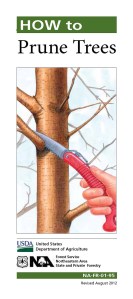
In high school I worked a summer job doing landscaping for houses around town.  Part of that job required me to prune trees so that they didn’t grow onto sidewalks or utility lines.  I picked up how to prune properly from watching others and by practicing, because I thought there was no instruction manual on how to do this.  Imagine my surprise when I was searching through the GPO’s Bookstore and saw a Forest Service guidebook called How to Prune Trees.

This is a short how-to manual developed by the Department of Agriculture and the Forest Service, but it’s chock full of good information.  It describes the three main reasons you should be pruning; safety, health of the tree, and aesthetic value.  It then talks about the proper ways to prune trees also showing diagrams that show where to cut on the branch.  The writing is easy to understand and the diagrams certainly help show examples of what the authors are talking about.  There is also a section on proper cleaning of cutting tools and treating wounds that gave me insights that I hadn’t had before.

 A short and sweet title that provides good information on the proper care of trees, you can purchase it from the GPO here, read it online here, or find it in a library near you here.


Notable Documents: Gardens and Urban Landscapes

August 4, 2010

“Touching” is not a word usually applied to Government publications, but it’s an appropriate one for “Memoryscape,” one of the case studies in Restorative Commons: Creating the Health and Well-Being through Urban Landscapes. This U.S. Forest Service publication, one of Library Journal’s 2009 Notable Government Documents, is an attractively packaged and well-illustrated collection of thought pieces, case studies, and interviews focused on the idea that biophilia – the basic human need for contact with nature – can and must be fostered in urban settings. As Oliver Sacks says in his Foreword, “I would even suggest that a sort of subtype of biophilia may be hortophilia, or a special desire for gardens….In many cases, gardens and nature are more powerful than any medication.” I know that whenever I pass an urban common garden, it always evokes positive feelings in me, even though I’m not a gardener myself. A walk or hike in a park definitely takes me out of myself and my problems, and it seems to work that way for most folks I know.

All the more pressing then, is the need to make nature and gardens available in such places as Rikers Island (a jail), Red Hook (a blighted urban neighborhood in New York City), Fresh Kills Park (a landfill), and Bosnia-Herzegovina (the site of horrific ethnic cleansing in the 1990’s).The essays and interviews in Restorative Commons describe the innovative garden/landscape projects in these places and others, along with the stories of the people who are running the programs and those benefiting from them vocationally and psychologically.

And then there’s “Memoryscape,” about the place in Westfield, Massachusetts known as “100 acres.” Brian Murphy, his brother Harold, and many of their friends used this area – an area of trees, dirt roads, and wildlife – as their “romping grounds.” Brian was killed at the World Trade Center, and Harold used his skills as a real estate developer with an interest in open space conservation to have 30 acres of this urban landscape permanently preserved. He takes his brother’s kids there to show them their dad’s “place” and, aside from a planned trail, it will stay as it is, rusted train trestle and all, so they and future generations can romp there, too. There are informal 9/11 memorials like this in the Boston and LA areas, where the planes took off, in the Greater New York area and adjoining suburbs, and in the DC area, too. (We could see the smoke from the Pentagon from our office windows that day).

 This is an inspiring and hope-filled book. You can get,view, or order your own copy here or find it in a library here.


Follow

Get every new post delivered to your Inbox.

Join 2,026 other followers

%d bloggers like this: