Uncle Sam wants to help you… get a job

May 4, 2012

If you are one of the millions of Americans hunting for a job, the U.S. Government wants you… to be prepared for the job search.

According to figures released by the Bureau of Labor Statistics on April 10, 2012, called “Job Openings and Labor Turnover – February 2012”, the number of job openings has been climbing:

The number of job openings in the United States in February 2012 was 3.5 million…  Although the number of job openings remained below the 4.3 million openings when the recession began in December 2007, the number of job openings has increased 46 percent since the end of the recession in June 2009.

Image: Uncle Sam: “I want you to get a real job” poster. Source: SF Weekly

And today’s numbers from the Labor Department showed that the U.S. economy added 115,000 jobs in April while the unemployment rate fell to 8.1 percent.

Together with graduating college and high school seniors, this makes this a prime time for many Americans to start or re-start their job search.

Fortunately, the Federal Government has produced a number of helpful job and employment publications and resources to help you find that job, from researching careers, industries and salaries, to preparing resumes, writing cover letters and honing your interviewing skills.

Step 1: Identify the Right Career for You

Many job hunters have had to leave their original profession due to changes in the marketplace. To help them identify what types of jobs are out there and what skills are needed, here are some Federal publications:

  Occupational Outlook Handbook, 2010-11 (Paperback)
The must-have book for every career counselor, The Occupational Outlook Handbook is exceedingly useful for job hunters, particularly those who are changing careers or in an industry that is undergoing transition. It describes about 250 occupations in detail, covering what the types of tasks workers do on a particular type of job, the working conditions, the training and education needed, earnings, and expected job prospects.
  High-Earning Workers Who Don’t Have A Bachelor’s Degree
This publication is still valid today, as it reviews occupations that earn relatively high salaries without requiring expensive college degrees. Ranges from accountants, to plumbers and electricians, repair people and mechanics, registered nurses and health technicians, managers and supervisors of all types, and more. Gives percentages of these that do not have bachelor’s degrees and typical weekly earnings (circa 1999).

Additional information on job training can be found at CareerOneStop’s Explore Careers section.

Step 2:  Determine Whether You Should Get Additional Education and Training

Many job seekers need to acquire new skills or update their existing skills to become or stay competitive. These publications talk about the value of training

  What It’s Worth: Field of Training and Economic Status in 2001
If you’ve ever doubted the value of education on your earning potential, the Census Bureau assembled these figures on what additional training is worth to one’s economic status and earnings.
  Apprenticeships: Career Training, Credentials, and a Paycheck in Your Pocket
Some professions require going through apprenticeship training. This publication explains how apprenticeship works, listing apprenticeable occupations, and the years of training estimated for each occupation.

Additional information and resources about job-related education and training can be found at CareerOneStop’s Education & Training section.

Step 3: Preparing Your Work Credentials and Interviewing Skills

The next step is to hone your credentials and interviewing skills for the active job search. The following excellent publications and resources will help you ensure you put your best foot forward.

  Resumes, Applications, and Cover Letters
With this update of a popular publication, you will find out the best ways to present your credentials to prospective employers. Illustrations include a sample chronological resume, a sample functional resume, and a sample cover letter. The ‘for more information’ section lists some useful, established websites that contain advice about 21st century job hunting and resume writing.
  Getting Back to Work: Returning to the Labor Force After an Absence
Many job seekers today have what is called an imperfect employment history due to layoffs, underemployment or other career gaps. This publication helps these returning workers know what to do and what to expect when returning to the labor force can help ease the transition back to work. Part 1 offers tips on how to identify, and prepare for, your ideal job. Part 2 helps you get set for the workforce. Part 3 suggests ways to maintain work-life balance. In sidebars throughout the article, you’ll find suggestions for some special re-entry situations as well as lists of additional resources.
  Employment Interviewing: Seizing the Opportunity and the Job
This booklet gives useful advice on what to do before, during, and after a job interview to help you get that job. It also includes tips about job fairs.

Additional information and resources about resumes, interviewing and job-related education and training can be found at CareerOneStop’s Resumes + Interviews section.

Step 4: Start Your Job Search

Federal Government Jobs:

A useful publication for anyone seeking to apply for a Federal government job is “How to Get a Job in the Federal Government”. Read our previous blog post about this publication, entitled “Information about Getting a Federal Government Job”.

Once you are ready to apply, you can find all current Federal jobs openings on the Federal job site, USAJobs.gov.

Private Sector and State Government Jobs:

Information and resources about where and how to conduct your job hunt can be found at CareerOneStop’s Job Search section.

Step 5:  Research Typical Salary and Benefits

Hopefully, at this point you are receiving job offers and negotiating salary and benefits. These Federal publications can give you some ballpark figures of salaries for various occupations as well as unemployment laws in different states.

  National Compensation Survey: Occupational Earnings in the United States, 2006
This Multimedia booklet and CD-ROM report on earnings for occupations common to a wide variety of establishments. Coverage includes office clerical, professional and technical, maintenance, custodial and material movement occupations.
  Occupational Employment and Wages, 2006
This guide provides occupational employment and wage data from across the United States.
  Employment and Wages Annual Averages, 2005
This Multimedia booklet and CD-ROM present 2005 employment and wages data as defined in the North American Industry Classification System. Data pertain to workers covered by State unemployment insurance laws and the Unemployment Compensation for Federal Employees (UCFE) program in all 50 States, the District of Columbia, Puerto Rico, and the Virgin Islands.
  Comparison of State Unemployment Insurance Laws, 2005
This valuable publication provides state-by-state information on workers covered by unemployment insurance, benefit eligibility, methods of financing, and other areas of interest in the unemployment insurance program

More information and resources about salary and benefits can be found at CareerOneStop’s Salary + Benefits section and the Publications section of the Bureau of Labor Statistics website.

Other Federal Job Hunting Resources:

  • Occupational Outlook Quarterly – This periodical subscription service offered by the Government Printing Office is issued quarterly by the US Department of Labor Bureau of Labor Statistics and provides current information on employment trends and outlook, supplementing and bringing up to date information in Occupational Outlook Handbook.
  • CareerOneStop: The Labor Department has created an excellent website for American job seekers. Called CareerOneStop.org, this job hunting portal helps you find the information and resources you need about careers, training, educational financial aid, job banks and more.
    • It also has a Service Locator to help all job seekers and the unemployed find Federal, state and local employment resources in your area.
    • Veterans now can find job-hunting help at their Veterans ReEmployment initiatives section.

How Can I Obtain the Publications Mentioned in this Post?  

About the Author:  Michele Bartram is Promotions Manager for GPO’s Publication and Information Sales Division and is responsible for online and offline marketing of the US Government Online Bookstore (Bookstore.gpo.gov) and promoting Federal government content to the public.


Earth Day

April 19, 2012

ImageAs we celebrate the 42nd Earth Day, the arrival of warm weather and the planting of summer gardens, our Guest Blogger — GPO Public Relations Specialist Emma Wojtowicz — takes a look at a few Federal publications focusing on the environment and how they play a role in our communities.

Congressional Budget Office: Potential Impacts of Climate Change in the United States

Published in May 2009, this report by the Congressional Budget Office (CBO) defines climate change and examines the causes and potential impact climate change has on North America. The report is brief (only 17 pages), concise and written in plain language, so you do not have to be a scientist to understand the focus of the paper. CBO effectively explains the scope of climate change and the effect is has on different parts of our environment. A few interesting takeaways:

  • Energy from the sun is absorbed by the Earth’s climate system and then radiated back into space. Greenhouse gases increase the amount of energy being held, thus warming the Earth’s surface.
  • Aerosol gases from volcanic eruptions have the opposite effect – they cool the Earth.
  • Climate change causes precipitation to be unevenly distributed: regions and seasons that already have greater precipitation will tend to get more and drier regions will tend to get less.
  • Rising surface temperature of the ocean increase the strength, size and intensity of hurricanes and typhoons.
  • Higher concentrations of carbon dioxide, a kind of greenhouse gas, will boost forest growth and timber production.

The Container Tree Nursery Manual, Volume Seven: Seedling Processing, Storage and Outplanting

A rite of spring and summer involves planning and preparing for outdoor landscaping and gardens, which means a trip to the nursery. Do you ever question where those trees come from? In the Container Tree Nursery Manual you will learn about the cultivation of trees from seed to what you purchase at the store. This publication is a bit dense with scientific processes and terminology, but once you get used to the tone of the book it makes for a fascinating read. Informative pictures, charts, graphs and diagrams help readers understand the content and “see” the entire life of a nursery tree from the planting, growing, storing, and shipping stages. For gardening enthusiasts, you can learn practical information that can be adapted to your own gardening endeavors. While you may not be planting trees in containers, the book emphasizes important growing techniques and considerations that you can apply to your own potted plants like the depth of the container for roots, water amount and frequency, as well as outside temperature.

Restorative Commons: Creating Health and Well-being through Urban Landscapes

This publication embodies the community spirit of Earth Day. Previously blogged about in August 2010, Restorative Commons is a lovely book about the importance and positive effect gardens and green landscapes have on urban communities. Urban gardening projects bring together neighbors and people of all ages giving them a common goal and a visible result to take pride in. The book explores the history of urban landscaping and ways community parks have shaped society; next it goes through various case studies of urban gardening initiatives in American cities and the impact they have on their communities; and then concludes with interviews with the people who lead the initiatives that beautify and strengthen their communities through urban gardens. Restorative Commons reflects the purpose and essence of Earth Day, which is to work with your neighbors to make a positive contribution to the community you live in and in turn an impression on greater global community.    

How do I obtain these Federal publications?

Congressional Budget Office: Potential Impacts of Climate Change in the United States

  • Buy it online 24/7 at GPO’s Online Bookstore
  • Buy it at GPO’s retail bookstore at 710 North Capitol Street NW, Washington, DC  20401, open Monday-Friday, 9am to 4pm, except Federal holidays, (202) 512-0132.
  • Find it in a library

The Container Tree Nursery Manual, Volume Seven: Seedling Processing, Storage and Outplanting

  • Buy it online 24/7 at GPO’s Online Bookstore
  • Buy it at GPO’s retail bookstore at710 North Capitol Street NW,Washington,DC20401, open Monday-Friday, 9am to 4pm, except Federal holidays, (202) 512-0132.
  • Find it in a library

Restorative Commons: Creating Health and Well-being through Urban Landscapes

  • Buy it online 24/7 at GPO’s Online Bookstore
  • Buy it at GPO’s retail bookstore at710 North Capitol Street NW,Washington,DC20401, open Monday-Friday, 9am to 4pm, except Federal holidays, (202) 512-0132.
  • Find it in a library

1940 Census Goes Digital

April 11, 2012

Last week, on April 2, 2012, the 1940 United States census was released to the public in digital format by the National Archives in conjunction with the U.S Census Bureau at http://1940census.archives.gov

Image: 1940 Census Poster urging Americans to “Help the Ten-Year Roll Call”. Source:U.S.Census Bureau

Reports National Public Radio:

Veiled in secrecy for 72 years because of privacy protections, the 1940 U.S. census is the first historical federal decennial survey to be made available on the Internet initially rather than on microfilm.

In a great example of a private/public partnership, Archives.com’s parent company partnered with the National Archives to provide the public with free digital access to the 1940 Federal Population Census.

Miriam Kleiman, spokeswoman for the U.S. National Archives, told The Associated Press that the Archives’ 1940 census site registered more than 22 million hits in just four hours from almost 2 million users on its very first day of release. It is extremely popular already with librarians, researchers and genealogists researching their family tree.

Data from the Great Depression

Archivist Connie Potter, in an entertaining video about the Archives’ digitization project, explains that the reason this census is so amazing is because it describes “the country during the Great Depression.  It reflects all of the economic dislocation, how many people were immigrants, how many people had what level of education.

Last week’s release of digitized information covers detailed records on 132 million people living in the United States at the end of the Depression and a year before Pearl Harbor.

The census data was transferred to microfilm during World War II, and in 2009, National Archives personnel began digitizing those records, culminating in the release of the database last week.

Over 3.9 million images were digitized, providing a bonanza for researchers.

Some interesting facts about the 1940 Census

Image: An enumerator interviews a woman with her 10 children around her for the 1940 census. Source: National Archives at College Park

The Census Bureau began the 1940 census with extensive long-term planning, recruiting and training.  Back in 1940, about 120,000 census-takers, called enumerators, spread out across the U.S. and territories, going door-to-door to interview families.

Enumerators both then and now can face challenging situations when gathering the data to tabulate the census, from trudging through fields or mushing a dog sled across the snow.

Image: Rural visit by a U.S. Census taker in connection with the 16th decennial census of 1940  Source: Library of Congress image number LC-USZ62-91199

Image: The Alaska Territory saw the census enumerator arrive in his dog sled, 1940 – 1941 Source: National Archives Research Catalog

Questions from the 1940 Census

It’s interesting to note the questions that were asked on the 1940 census form.  One of the fifty questions the enumerators asked Americans in 1940 reflected the more formal societal structures of the time: “What was the Relationship of this person to the head of the household, as wife, daughter, father, mother-in-law, grandson, lodger, lodger’s wife, servant, hired hand, etc.?”  

Another question was very relevant for a Depression-era nation where children as young as 14 still worked, and millions of out-of-work Americans were given “public emergency” jobs around the country under Franklin Roosevelt’s New Deal programs. One was the Works Project Administration (originally the Works Progress Administration) or WPA, which was the “largest and most ambitious New Deal agency and employed millions of unskilled workers to carry out public works projects,including the construction of public buildings, roads and dams, as well as operating large arts, drama, media, and literacy projects.

Image: WPA Federal Arts poster. Source: Smithsonian Archives of American Art

Another New Deal program mentioned in the census was the Civilian Conservation Corps or CCC . It was designed to provide employment mostly for young men in relief families who had difficulty finding jobs during the Great Depression (there were separate programs for veterans and Native Americans), while at the same time implementing a general natural resource conservation program in every state and territory for the “conservation and development of natural resources in rural lands” owned by federal, state and local governments. Many trees were planted and national and state parks built and preserved by the CCC.

Image: Illinois CCC recruiting poster. Source: Archives.gov

Another youth-focused program referenced was the National Youth Administration or NYA that focused on providing work and education for young Americans between the ages of 16 and 25.

Thus, it makes sense that this 1940 census question asked Persons 14 Years Old and Over” to classify their employment status during the time of the census-taking (March 24-30, 1940) as follows:

  • Was this person AT WORK for pay or profit in private or non-emergency Government work during week of March 24-30? (Yes or No).
  • If not, was he at work on, or assigned to, public EMERGENCY WORK (WPA, NYA, CCC, etc.) during week of March 24-30? (Yes or No).

How to Use the 1940 Census

Even for those not steeped in genealogy research will find it thrilling, like I do, to see the excitement build over the release of these images.  It might be fun to look up my ancestors because I know my grandfather worked for the W.P.A.   I’m also interested in looking at the various trends and metrics available on housing to see if there is any correlation to the current economic situations.

Visit the National Archives pages to see the various resource location aids, enumerator training videos, and question templates that have been gathered for your use.  Based on the times, there were specific instructions for enumerators to get a count of temporary housing such as huts, tents, and cabins as of a point in time.   Here’s one bit of instruction to help clarify how to count the large transient population: “Persons in hotels, tourist or trailer camps, missions, and cheap one night lodging houses (flophouses) will all be enumerated as of the evening of April 8th”.

Help Tag the Images

The Census Bureau is appealing to the public for help indexing and meta tagging the images.  This is a genealogy crowdsourcing project to ensure the 3.8 million images are indexed and freely searchable online. You, too, can register to be a 1940 Census Blog Ambassador and get a nifty badge for your page!

You can follow the 1940 Census via Twitter at: #1940Census #Genealogy #history. 

How can you get other Census Bureau publications today?

The release of the historic images will be made at 1940census.archives.gov.

For those interested in more current information, take a look at the resources in GPO’s U.S. Government Bookstore.  The subscription series help keep you updated on the Census and Population statistics as they are released.

  • Buy them at GPO’s retail bookstore at 710 North Capitol Street NW,Washington, DC 20401. Open Monday-Friday, 9am to 4pm, except Federal holidays. Call 1.(202) 512-0132 for more information.
  • Find them in a Federal Depository Library.

Guest blogger: Nancy Faget, one of our federal librarians in GPO’s Library Services & Content Management Division who writes often about NASA “rocket scientists” and digital innovations in the library field.


Invest in Women, Invest in America

April 3, 2012

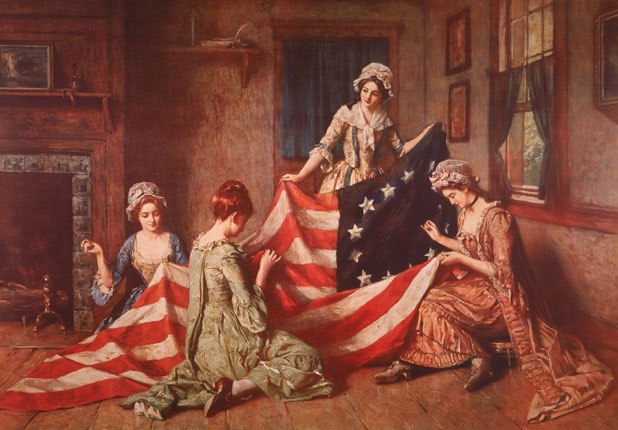
In honor of National Women’s History Month 2012 and its theme of “Women’s Education – Women’s Empowerment,” I wanted to write about a thought-provoking publication that just came across my desk about women and their evolving role in the U.S. workforce.  Since the founding of America, women like Betsy Ross have played a critical role in contributing to the economic fabric of the U.S. economy and  American households.

Image: Sewing circle presided by working mother Betsy Ross, who started out as first a home sewer before being educated as an upholstery apprentice. She  then ran an upholstery business with her husband, before managing her own business when her husband died by sewing tents, blankets and flags for the American Revolution.

Invest in Women, Invest in America: A Comprehensive Review of Women in the U.S. Economy was prepared by the Joint Economic Committee of Congress.

It forms part of GPO’s Online Bookstore National Women’s History Month collection of Government publications celebrating women’s contributions to America.

Outgoing Chair of the Committee, Congresswoman Carolyn B. Maloney, said in a December 2010 letter that the goal was to prepare a “comprehensive review of women in the U.S. economy so that policymakers could have a better understanding of women’s essential contributions to our economy and their potential to play a stronger role in our economic recovery.”

PART I: Invest in Women, Invest in America

Part I of this publication starts with an overview of the decades of progress of women in the workforce. For the first time, we learn that women now comprise half of the U.S. workforce.

Next, relating to this month’s theme of education providing empowerment for women, the report shows that women earn more college degrees than men at every level, from 57.4% of the bachelor’s degrees to over 60% of the Master’s degrees in the United States.

And it demonstrates just how important women’s earnings have become to overall household income, particularly in families with children. For example, by 2008 over 6 in 10 families with children under 6 have the mother working outside the home, and women are the sole job-holders in over a third of American families with children.

The “Invest in Women” publication discusses the three key factors that are still holding women back, including:

  1. underrepresentation in business leadership roles,
  2. a “persistent gender wage gap” in both public and private sectors, and
  3. an “out-of-date framework for social support.”

Factor 1: Underrepresentation of Women in the Executive Suite

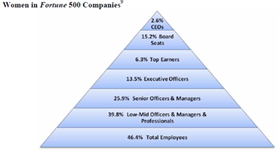
Under this factor, the report puts forth both current figures and possible causes about why “women remain dramatically underrepresented in corporate boardrooms and executive suites” in the United States. Some figures shared in the report show that while women comprise 46.4% of all Fortune 500 employees, they make up just 15.7% of board seats, 14.4% of executive officers, 7.6% of top earning executive officers, and only 2.4% of CEOs.

This contrasts to studies included in the report that demonstrated that “companies with more women board members, on average, significantly outperform those with fewer women by 53% on Return on Equity, 42% on Return on Sales, and a whopping 66% of Return on Invested Capital.

Factor 2: Persistent Gender Wage Gap

In the private sector, “Invest in Women” reports, “women working full-time earn only 77 cents for every dollar earned by men”— a gap the report says has not improved since 2001. This wage gap is true also for the Federal Government where “women managers earn 81 cents for every dollar earned by their male manager peers”.

Source:  Women’s Media

Factor 3: An Out-Of-Date Framework for Social Support

Here the report offers the premise that “our nation’s public policies are still rooted in the antiquated assumption that families rely on a single male breadwinner” when today’s “reality is that most families depend on two breadwinners.” Discussion of the issues relating to lack of paid leave, particularly sick leave and the burden it places on mothers who often “still bear the primary responsibility for their children’s health” are followed by sections on inflexible work arrangements and insufficient “quality, affordable early care and education.

This ends with an interesting analysis of the nation’s current retirement system and its effect on women. The report points out the lifetime earnings penalty—caused by the many interruptions over the span of a woman’s career to provide unpaid at-home care for children, elderly parents or ill family members— results in vastly decreased Social Security income for women, thus increasing women’s poverty rates later in life at a rate of 11.7% vs. 7.4% for elderly men.

Possible Policy Solutions to Improve Women’s Economic Position

Some possible policy solutions are put forward in this report as well, including:

  • “Stronger protections against wage discrimination;”
  • “Health reform;”
  • “Work-family policies” (including the right to request a flexible schedule and mandatory paid sick leave);
  • Financial regulatory reform and the “establishment of Offices of Minority and Women Inclusion at each federal financial services agency;”
  • “Value the Care Economy”, which, according to the authors, refers to boosting investment in quality early education  and child care programs, such as Early Head Start and Head Start; and
  •  Differentiating the impact of tax and entitlement reforms on women versus on men.

Part II: Compendium of JEC Reports and Hearings from the 111th Congress

The second part of the publication compiles various reports and hearings held by the Joint Economic Committee that referred to women’s issues covering four areas: Women in the Economy Today, Equal Pay, Access to Benefits and Retirement Security.

It is chock full of charts, tables, graphs and quotable quotes.


HOW DO I OBTAIN “Invest in Women, Invest in America: A Comprehensive Review of Women in the U.S. Economy”?

  • Buy it at GPO’s retail bookstore at 710 North Capitol Street NW, Washington, DC 20401, open Monday-Friday, 9am to 4pm, except Federal holidays, (202) 512-0132.
  • Find it in a library.

About the Author:  Michele Bartram is Promotions Manager for GPO’s Publication and Information Sales Division and is responsible for online and offline marketing of the US Government Online Bookstore (Bookstore.gpo.gov) and promoting Federal government content to the public.


Goodbye GPO Access, Hello FDsys

March 16, 2012

Guest blogger Kelly Seifert, Lead Planning Specialist for GPO’s Library Services & Content Management Division, writes about the final switchover from GPO Access to FDsys, GPO’s state-of-the-art digital database of Federal information.

Farewell, GPO Access! GPO’s Federal Digital System (FDsys) is here to stay and is better than ever.

Today, March 16, 2012, marks a momentous occasion for the Government Printing Office and its groundbreaking service, GPO Access. After 16 years of keeping America informed, the GPO Access website is shutting down and been replaced by its successor, GPO’s Federal Digital System (FDsys).

Image: Switchover notice from GPO Access to FDsys

All of the information the public had access to on GPO Access and more is available through FDsys (pronounced by “those in the know” as “F – D – sis”).

While not the traditional “Government book” discussed on this blog, we at GPO thought it only appropriate to blog about a service that provides free access to a vast number of Federal Government publications. FDsys provides the American public with free online access to about 50 different collections of U.S. Government information ranging from the Code of Federal Regulations to the U.S. Government Manual to the U.S. Budget.

Image: GPO’s Federal Digital System (FDsys) home page, www.FDsys.gov

GPO Access introduced electronic access to Government information

In 1993, Congress passed the U.S. Government Printing Office Electronic Information Access Enhancement Act (Public Law 103-40), which expanded GPO’s mission to provide access to Federal Government information not only in print, but also electronically. In June 1994, in response to that legislation, GPO launched GPO Access.

FDsys takes electronic access to new levels

Even the best of information systems have to evolve. Thus it was in January 2009 that GPO unveiled the next generation of Government information online with FDsys. The countdown to the shut-down of GPO Access began on December 20, 2010, when FDsys became GPO’s official system of record for free access to information and publications from all three branches of the Federal Government. In November 2011, GPO Access entered its “archive only” state and transitioned its status to historical reference archive. From that point forward, FDsys was GPO’s only resource for access to current, updated information, and now, GPO Access has shut down for good.

Image: FDSys Advanced Search results page

FDsys offers new, improved features to find Government publications

FDsys boasts key enhancements to GPO Access that allow users from librarians to scholars, researchers, lawyers and the public to:

  • Easily search across multiple Government publications;
  • Perform advanced searches against robust metadata about each publication;
  • Construct complex search queries;
  • Refine and narrow searches;
  • Retrieve individual Government documents and publications in seconds directly from each search result;
  • View more information about a publication and access multiple file formats for each search result;
  • Access metadata in standard XML formats;
  • Download content and metadata packaged together as a single ZIP file;
  • Browse FDsys alphabetically by collection, by Congressional committee, by date, and by Government author; and
  • Utilize extensive help tools and tutorials.

Image: List of collections of Federal Government publications available on FDSys

Links to printed versions of Government publications

In addition to providing free access to almost 50 different Government publications online, FDsys also directs you to GPO’s Online Bookstore, where you can buy those same publications, if you wish to have a bound and printed official copy.

As a GPO employee who has worked extensively with FDsys, I think you will really enjoy it and the new, enhanced features that are provided by FDsys for navigating Government information.

How do I find Federal Government publications?

  • Search GPO’s Federal Digital System (FDsys) at www.FDsys.gov.
  • Search GPO’s Catalog of Government Publications (CGP) at http://catalog.gpo.gov.
  • Shop GPO’s Online Bookstore at http://bookstore.gpo.gov/, 24 hours a day, 7 days a week, and 365 days a year.
  • Visit GPO’s Retail Bookstore at 710 North Capitol Street NW, Washington, DC 20401, open Monday through Friday, 9am to 4pm, except Federal holidays. Call (202) 512-0132 for more information.

School safety by the numbers

March 9, 2012

Guest blogger GPO Public Relations Specialist Emma Wojtowicz discusses a publication about safety in schools.

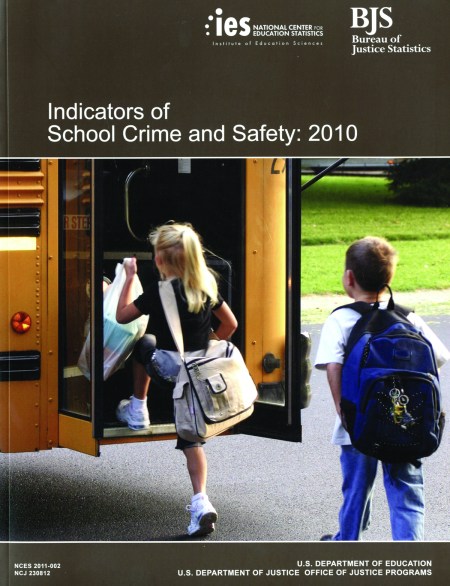
School safety is a concern. The recent school shooting at the public high school in Chardon, Ohio, reminds us that any school is susceptible to violence and tragedy. Indicators of School Crime and Safety: 2010, a publication by the Department of Education and Department of Justice, thoroughly examines the various indicators that threaten the safety of our nation’s schools.

The information and data in this report was collected through surveys conducted from 2007-2009. While this report is regularly published to help policymakers and schools develop ways to keeps schools safe and prevent crime and violence, it makes for an interesting read given recent events.

The report identifies 21 indicators that threaten the safety of schools. The indicators encompass a variety of problems like victimization, bullying, injury, fights, use of drugs and alcohol and weapons possession. Charts and graphs illustrate the data collected about each of the problems with breakdowns by age, ethnicity, gender, public versus private school, and urban versus rural school location.

Is your child afraid at school? For example, this chart shows the number of students from 12-18 who feel threatened at school or away from school. Here, Black students feel the most afraid at school, with Hispanics second, but Hispanic students feel more threatened outside of school than any other group. (CLICK ON IMAGE TO ENLARGE.)

There are also comparisons for some indicators between being at school and outside of school.

Who’s carrying? For example, the above graph from the book shows the percentage of high school students who carried a weapon on and off school property at least once in the last 30 days. The highest weapon-carrying groups were American Indians, Pacific Islanders and White students, with Asian and Black students as the lowest groups. (CLICK ON IMAGE TO ENLARGE.)

The content is organized well with a brief explanation about each indicators followed by the data depicted through charts and graphs making for easy navigation if there is a specific topic you are interested in.

Some interesting findings during the 2007-2008 school year:

  • Victims of bullying are about same for males and females: 30% of male students and 33% of female students reported being bullied
  • 5% of students reported being afraid of attack or harm at school
  • 1% of public schools have daily metal detector checks and 5% of public school have random metal detector checks
  • 6% of students reported carrying a weapon to school and 17% of students reported carrying a weapon anywhere in a 30-day period
  • 21 school-associated homicides occurred
  • 43% of public schools reported they have an electronic notification system for a school-wide emergency in place

It is difficult to analyze these statistics and determine whether or not schools are safe. From scanning the various line graphs, it is easy to notice there has been a decline over the years from the mid-1990s to 2009 regarding most of the indicators. Hopefully, this data is used to improve and strengthen the safety of schools. As our country was reminded on February 27 in Chardon, Ohio, any school is at risk and we must be steadfast in the effort to reduce the risks that leads to tragedy.

What measures are in place to keep your child safe at school? This chart from the book shows what school security measures have been put in place overall since 1999, the year of the Columbine High School in Littleton, Colorado. While all measures increased since 1999, many have dropped from a former high rate in 2003-5, such as use of security guards, metal detectors, locker checks or visible student ID badges. The only measures that have consistently grown over the years are: use of security cameras, instituting a code of student conduct, locked entrance and exit doors during the day, and a requirement that visitors to the school sign in. (CLICK ON IMAGE TO ENLARGE.)

HOW DO I OBTAIN THIS “Indicators of School Crime and Safety: 2010” BOOK?

  • Buy it online 24/7 at GPO’s Online Bookstore.
  • Buy it at GPO’s retail bookstore at 710 North Capitol Street NW, Washington, DC 20401, open Monday-Friday, 9am to 4pm, except Federal holidays, (202) 512-0132.
  • Find it in a library.

The U.S. military storms to the rescue in foreign disaster relief

March 5, 2012

Last year, the United States suffered a record number of devastating weather and climate disasters, including hurricanes, tornadoes, wildfires and floods, causing the President to issue a record 99 “major disaster declarations” during 2011.

Image: Natural disaster word collage Source: JimKimmartin.com

(And just this week, as I write this post, we are faced with the news about a line of dozens of deadly tornadoes that hit the Midwest, striking Indiana, Illinois, Kentucky, Missouri, and Kansas, with particular devastation to the towns of Harrisburg, IL and Henryville, IN.  See the end of this article for a links to terrific Federal disaster preparedness and response publications for citizens and professionals.)

However, the U.S. unfortunately had a lot of company as the entire world endured one of the worst years ever for catastrophic natural disasters.

Record Number of Catastrophic Natural Disasters Worldwide

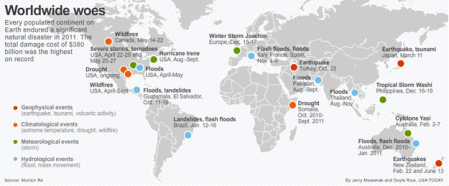
2011 was the costliest year on record in terms of global property damage, with more than a third of a trillion dollars in damages worldwide, according to Munich Re, a multinational that insures insurance companies. The single worst and costliest natural disaster of the year was Japan’s earthquake and subsequent tsunami and nuclear disaster.

But some of the other worst disasters in the world in 2011 included: floods and landslides in Thailand, Guatemala, El Salvador, Pakistan and Brazil; earthquakes in New Zealand and Turkey; severe spring storms and tornadoes in the USA; Hurricane Irene in the USA; Cyclone Yasi and flooding in Australia; drought in the USA and Somalia; wildfires in the USA and Canada; and the violent winter storm Joachim that swept across western Europe in December.

Image: The world’s natural disasters of 2011. Source: “2011 was costliest year in world disasters” USA Today, January 4, 2012.

Fortunately, while the total number of disasters was about average, the loss of life was below average. Still, many lives were lost around the world, including 15,840 fatalities reported in Japan’s disaster alone.

DoD to the Rescue 

To help local governments around the world respond to these disasters, the United States Government often comes to the rescue with supplies, personnel and logistical support. But sometimes civilian agency response is not sufficient. In these cases, the U.S. Department of State and U.S. Agency for International Development may ask for support from the U.S. military.

Image: The crew of a U.S. Navy MH-53E Sea Dragon helicopter from the aircraft carrier USS Carl Vinson (CVN 70) unloads food and supplies at the airport in Port-au-Prince, Haiti, on Jan. 15, 2010. Source: Defense.gov

U.S. Government and Department of Defense (DoD) joint task forces may also coordinate with International Organizations such as the United Nations and International Red Cross and Red Crescent and other Intergovernmental Organizations (IGO) and Non-Governmental Organizations (NGO).

In total, the U.S. Government on average responds to approximately 70 to 80 natural disasters worldwide annually, but the Department of Defense (DoD) only lends support to 10-15 percent of these disaster responses.

The DoD describes their foreign disaster relief assistance as follows:

“DoD disaster assistance can range from a single aircraft delivering relief supplies, to a fullscale deployment of a brigade-size or larger task force. Though the overall percentage of disasters requiring DoD support is relatively small, these disasters tend to be crises of the largest magnitude and/or the greatest complexity.”

Some of the past disaster response efforts with which the U.S. military has assisted include the 2004 tsunami in Southeast Asia; 2005 earthquake and 2010 flooding in Pakistan;  and the 2010 earthquake in Haiti.

Handy Handbook for All Those Who Give a Hand

To assist their personnel who are engaged in foreign disaster relief operations, the Department of Defense prepared a handbook which “offers an overarching guide and reference for military responders in foreign disaster relief operations,” particularly for Joint Task Force (JTF) Commanders and below.

INTENDED FOR ANYONE INVOLVED IN US FOREIGN DISASTER RELIEF OPERATIONS: Fortunately, DoD also released an unclassified version that can be used not only by the military, but also by anyone involved in U.S. foreign disaster response operations, including U.S. Government agencies, international organizations, Intergovernmental Organizations (IGO) and Non-Governmental Organizations (NGO).

CONTENTS: This public version of the “Department of Defense Support to Foreign Disaster Relief Handbook” (ISBN:  9780160888632) is divided into 4 major sections:

  • Section I: Introduction: Provides the background, legal authorities and guidance for performing foreign disaster relief (FDR) operations. Includes info on the U.S. Government’s FDR response processes, international and humanitarian guidelines and principles.
  • Section II: Operational Context and Planning Factors.
  • Details the types of missions that DoD units may participate in and the roles of Joint Task Force members. Also provides a five-phase FDR operation and metrics of success, and how to protect responders. Of particular interest in Chapter 6 are the characteristics of natural disasters, including hazards expected from different disaster types, and in Chapter 7, guidelines for talking to the media.
  • Section III: Supported and Supporting Organizations
    • This section provides a broad overview of functional commands and the cross-cutting organizations roles and missions, including Geographic Combatant Commands (GCC) and typical DOD tactical FDR units. Even shows photos to help identify different U.S. military transportation vehicles that could be used.

  • Section IV: Appendices: A number of extremely useful appendices are included that come in handy for anyone involved in Foreign Disaster Relief.
    • Appendix A presents the legal aspects of FDR operations, such as the list of laws and guidance documents allowing DoD participation in humanitarian relief efforts overseas. For example, the principal authority for DOD to conduct foreign disaster relief is the Foreign Assistance Act of 1961 (Public Law 87-195) (See p. 15 of this compilation of Legislation on Foreign Relations) which “provides the legal guidance for U.S. Government engagement with friendly nations.
    • Appendix B provides the DoD guidelines for interaction with NGOs in a permissive environment. More importantly, it provides excellent color charts showing how civil and military operation centers interact and differ. The page below is an example of how interaction between various civil and military operations in an operations center.

    • Appendix C provides sample formats that are useful to staff who support FDR operations, including excellent example worksheets and sample reports.
    • Appendix D provides a list of useful FDR agency and resources websites.
    • Appendix E provides a list of training courses, both from the Department of Defense and other U.S. agencies like the State Department and the Peace Corps.
    • Appendix F lists references useful in planning and executing FDR missions.
    • Appendix G is a list of acronyms used in this handbook, a must-have for dealing with the military especially, but includes acronyms for international organizations as well. For example, did you know that “OCONUS” means “Outside the continental United States” and “SPINS” means “Special Instructions”?

EASY-TO-READ, PORTABLE FORMAT: Throughout the Handbook are color flowcharts, organizational charts, checklists, notes and warnings, making this easier to read than one would expect from a military handbook.  And because of its rugged spiral bound format and smaller size, I found this handbook particularly easy to hold in one hand while writing with another, since it could lying totally flat and fold back on itself.  Considering that online versions are not convenient in disaster areas, I can see why this is a must-pack item in any U.S. foreign disaster responder’s emergency bag.

Overall, the Department of Defense Support to Foreign Disaster Relief (Handbook for JTF Commanders and Below) provides a fascinating and useful insight into how to respond to natural disasters wherever they may happen around the globe.

HOW CAN I OBTAIN THIS “Department of Defense Support to Foreign Disaster Relief Handbook “?

  • Buy it online 24/7 at GPO’s Online Bookstore.
  • Buy it at GPO’s retail bookstore at 710 North Capitol Street NW, Washington, DC 20401, open Monday-Friday, 9am to 4pm, except Federal holidays, (202) 512-0132.
  • Find it in a library.
  • Find some of the information online.

OTHER DISASTER RELIEF PUBLICATIONS FROM THE U.S. GOVERNMENT:

  • Field Operations Guide for Disaster Assessment and Response by the Office of U.S. Foreign Disaster Assistance (OFDA), print edition available from GPO.  This handbook comes at the topic from the U.S. civilian agency perspective, helping members of a Disaster Assistance Response Team (DART) get quickly oriented while on site at a disaster.
  • National Interoperability Field Operations Guide Version 1.4 Provides a waterproof, pocket-sized guide that contains radio regulations, tables of radio channels, and technical reference information, and is a must-have tool for establishing or repairing emergency communications in a disaster area.
  • U.S. Foreign Disaster Assistance Reference Guide from the United States Department of State and U.S. Agency for International Development (online version only). Included are basic fact sheets for 19 funding accounts, each containing citations of important underlying laws, itemizing primary activities (such as Bilateral Economic Assistance, Humanitarian Assistance, Multilateral Economic Assistance, Military Assistance and Law Enforcement Assistance), outlining recent funding history, and describing important statutory restrictions.
  • Legislation on Foreign Relations is a list of U.S. laws governing all aspects of foreign relations, including disaster relief, compiled by both Congressional committees: U.S. House Committee on Foreign Affairs and the U.S. Senate Committee on Foreign Relations.
  • Are You Ready? An In-depth Guide to Citizen Preparedness. This FREE online guide provides a step-by-step approach to disaster preparedness by walking the reader through how to get informed about local emergency plans, how to identify hazards that affect their local area and how to develop and maintain an emergency communications plan and disaster supplies kit. It is produced by Ready.gov, a national public service advertising campaign designed to educate and empower Americans to prepare for and respond to emergencies including natural and man-made disasters.
  • FREE Tornado Safety Guide from the Federal Emergency Management Administration (FEMA) Ready.gov website has important tips on what to do before, during and after a tornado.

About the Author:  Michele Bartram is Promotions Manager for GPO’s Publication and Information Sales Division and is responsible for online and offline marketing of the US Government Online Bookstore (Bookstore.gpo.gov) and promoting Federal government content to the public.


The Underground Railroad Leaves its Tracks in History

February 27, 2012

Last week during National Black History Month, ground was broken on the National Mall in Washington, DC, for what will become the National Museum of African American History and Culture. In his remarks at the ceremony, President Obama mentioned that he wanted his daughters to see the famous African Americans like Harriet Tubman not as larger-than-life characters, but as inspiration of “how ordinary Americans can do extraordinary things.

Image: This original photo of Harriet Tubman in the handbook lists the many roles she played in addition to being a “conductor” on the Underground Railroad, including nurse, spy and scout for the Union army during the Civil War. Her quote: “I looked at my hands to see if I was the same person now I was free. There was such a glory over everything… I felt like I was in heaven.” Source: The Underground Railroad: Official National Park Handbook.

One of the most dramatic areas of African American history is the story of the fight against slavery and the profile in courage represented by the ordinary people who did extraordinary things while participating in the Underground Railroad.

The National Park Service (NPS) has produced a number of exemplary publications about it, with three of them available today from the U.S. Government Bookstore, including the

That these items are not your typical guidebooks about a single historic site is due to the fact that the Underground Railroad itself is not a typical American national park.

Congress and the National Park Service act to preserve the legacy of the Underground Railroad

Back in 1990, Congress instructed the National Park Service to perform a special resource study of the Underground Railroad, its routes and operations in order to preserve and interpret this aspect of United States history.

Following the study, the National Park Service was mandated by Public Law 105-203 in 1998 (you can read the law on GPO’s FDSys site) to commemorate and preserve this history through a new National Underground Railroad Network to Freedom Program to “educate the public about the importance of the Underground Railroad in the eradication of slavery, its relevance in fostering the spirit of racial harmony and national reconciliation, and the evolution of our national civil rights movement.”

What was the Underground Railroad?

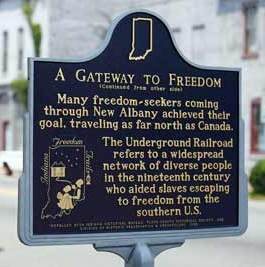
What was called the Underground Railroad was neither “underground” nor a “railroad,” but was instead a loose network of aid and assistance by antislavery sympathizers and freed blacks across the country that may have helped as many as one hundred thousand enslaved persons escape their bondage from before the American Revolution through the Civil War.

Image: NY State historical marker in Albany for the UGRR along the American Trails UGRR bicycle route.

Describing one of the most significant internal resistance movements ever, the National Park Service said in a 1996 press release that:

The Underground Railroad was perhaps the most dramatic protest against human bondage in United States history.  It was a clandestine operation that began during colonial times, grew as part of the organized abolitionist movement, and reached a peak between 1830 and 1865. The story is filled with excitement and triumph as well as tragedy –-individual heroism and sacrifice as well as cooperation to help enslaved people reach freedom. 

Where did the term “Underground Railroad” come from?

Historians cannot confirm the origins of the name, but one of the stories reported by the Park Service has the term coming out of Washington, DC, in 1839, when a recaptured fugitive slave allegedly claimed under torture that his escape plan instructions were to send him north, where “the railroad ran underground all the way to Boston.” However it came about, the term was widely in use by 1840, and is often shortened to “UGRR” by “those in the know.”

Image: An 1837 newspaper ad about a runaway slave from the book “The Underground Railroad from Slavery to Freedom” By Wilbur Henry Siebert, 1898. 

Underground Railroad Routes

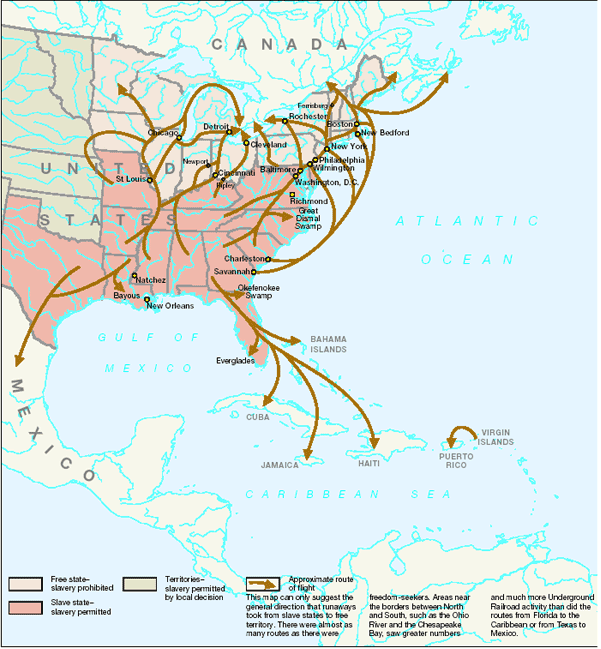
Another byproduct of the UGRR special resource study was that the National Park Service carried out an analysis of slavery and abolitionism and identified the primary escape routes used on the UGRR.

The map below is included in the Underground Railroad: Official Map and Guide, produced by the National Park Service Cartographic staff at Harpers Ferry Center, shows the general direction of escape routes. Contrary to popular belief, Canada was not the only destination for freedom-seeking slaves–since some fled to Mexico, Florida and the Caribbean– but it was the primary destination as the efforts to catch fugitives increased.

Image: Selected Routes of the Underground Railroad from the Underground Railroad: Official Map and Guide.

Additional outputs of the resource study and the subsequent research are the following three excellent Underground Railroad publications from the National Park Service.

Underground Railroad: Official National Park Handbook

The first book in our trio of publications is the Underground Railroad: Official National Park Handbook. It is comprised of a series of fascinating articles by top Underground Railroad historians that weave together a thorough view of the amazing stories behind the legend, illustrated with many drawings, court records, letters, paintings, photos, and other pictorial representations that help make this history come alive for the reader.

The handbook is broken into 3 major sections and 5 chapters:

  • Part I: An Epic in United States History:
    • 1- Myth and Reality by Larry Gara. This introductory chapter reviews and evaluates the truths vs. the legends that grew about the Underground Railroad.
  • Part II: From Bondage to Freedom:
    • 2- Slavery in America by Brenda E. Stevenson. In this chapter, the author details the rise of the institution of slavery in America and the harsh realities of life for the people who suffered under it. An interesting segment discusses the inequities of life for enslaved women vs. men.  
    • 3- The Underground Railroad by C. Peter Ripley. This fascinating chapter tells the courageous and often harrowing stories of freedom seekers and those who aided them, including Harriet Tubman who made nearly 20 trips to lead 300 slaves to freedom and Henry “Box” Brown who shipped himself in a 2X3’ wooden crate from Richmond to Philadelphia to escape. Sprinkled throughout are cameos of famous former fugitives and abolitionists including Sojourner Truth, Frederick Douglas, and abolitionists William Lloyd Garrison and Gerritt Smith, among many others.
  • Part III: Tracking the Past:
    • 4- Tracking the Past by the National Park Service. This chapter outlines some of the work done by the National Park Service and others to discover, verify and catalog the important people, places and artifacts related to the Underground Railroad.
    • 5- Further Reading by Marie Tyler McGraw. In this final chapter, the author provides a recommended reading list for interested researchers of the authoritative works related to different aspects of the Underground Railroad story.

Underground Railroad: Official Map and Guide

This map and guide includes drawings, blurbs, maps and chronologies about different aspects of the slave trade and the Underground Railroad.

Included in this fold-out map and guide are the escape routes map shown earlier, vignettes of key figures from key “conductors” on the Railroad to abolitionists, and even a short glossary of terms related to the UGRR.

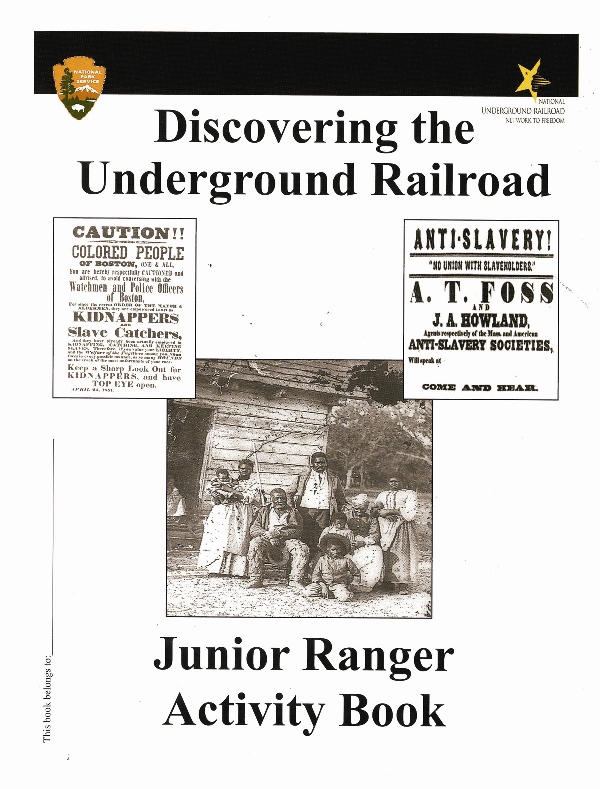
Discovering the Underground Railroad: Junior Ranger Activity Book

The final item in our trio of publications is the Discovering the Underground Railroad: Junior Ranger Activity Book.

Many National Parks offer visitors the opportunity to join the National Park Service Family as Junior Rangers. Interested students complete a series of activities during their park visit, share their answers with a park ranger, and receive an official Junior Ranger badge or patch and Junior Ranger certificate.

Since there is no one national park site for the Underground Railroad, the National Park Service came up with a different process with this activity book. Aspiring Underground Railroad Junior Rangers have to complete different numbers of activities in the book pertaining to their particular age level, then send the completed booklet in to the National Park Service’s Omaha office. There, “a ranger will go over your answers and then return your booklet along with an official Junior Ranger Badge for your efforts.

This fun booklet includes activities appropriate from ages 5 to 10 and older, from word finders and mazes to essays and historical fact matching.

How can you get these Underground Railroad publications?

About the Author:  Michele Bartram is Promotions Manager for GPO’s Publication and Information Sales Division and is responsible for online and offline marketing of the US Government Online Bookstore (Bookstore.gpo.gov) and promoting Federal government content to the public.

Society through a Comic Lens

February 7, 2012

By Guest Blogger, Marianne Mason, Federal Information Librarian, Research and Library Instruction at The University of Iowa Libraries

Comic books are not really books and often not comic, but are serialized graphics-based stories expressed through political and cultural rhetoric.  Think Maus, a story of the Holocaust.  Think Peanuts’ ethics and theology.

O.K., not all comic books or graphic novels are Pulitzer Prize winners or speak to a deep sense of ethics.  The pure entertainment value of storytelling through sequential art can be worthy on its own merits.  However, the comics can inform, persuade, and encourage new behaviors in readers.  This is the purpose of comic books authored by U.S. government agencies.

Used as social program marketing tools for decades, the government-authored comic book format has been used to promote program benefits (Social Security Administration) and to educate (Consumer Product Safety Commission) using superhero/anti-hero models like Sprocket Man (reviewed in our April 9, 2010, blog post “Just for Fun: Sprocket Man!” ) and El Gato to capture the attention of the targeted audience and cross educational boundaries.

The Army made instruction manuals measurably more appealing to combat personnel in PS Magazine by incorporating sexual innuendo in both dialog and character illustration such as in this Preventive Maintenance manual shown below:

In October 2011 the University of Iowa hosted a scholarly symposium entitled “Comics, Creativity, and Culture: International and Interdisciplinary Perspectives”, a by-invitation-only event for scholars, artists and creators of the art and literature of comic books.  The Symposium spawned a semester-long series of complementary university sponsored events ranging from art exhibits, radio broadcasts, discussions, and interactive workshops for educators and K-12 students.  The University of Iowa Libraries contributed to the celebration by creating a Comic Book Café based on the Japanese “Manga Café” model.  Several specialized library collections, including Government Information, pooled their best examples for the café.

As the U.S. Government Information Librarian, I found that this event gave me an opportunity to draw attention to the characteristics and range of government authored comic books.  Creating a government comics research guide  gave me an opportunity to do a thorough survey of the collection,  access the content of the print collection and provide links to digitized collections from the broader government information community, including this latest online booklet from the Centers for Disease Control and Prevention: Preparedness 101: A Zombie Pandemic”.

In addition, the research guide provides database access to many Congressional hearings and reports in the UI collection from the 1950’s linking juvenile delinquency to explicit violence in comic books.

Whether quirky or more profound, all reflect changing societal norms that drive public policy initiatives.

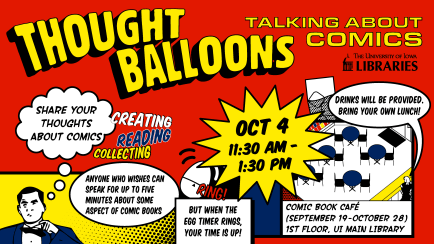
On October 4th an “egg timer” book talk called Thought Balloons: Talking about Comics”, was held in the Café for creators and readers of comics to share insights and stories about connections to comic book literature.  One reader commented that when she and her boyfriend merged their comic book collections, she knew their love was here to stay!

Note regarding Images:

Images in order of mention: Sprocket Man, The 9 Lives of El Gato, PS Magazine, Comic Book Café, Zombie Pandemic (“broader gov. community”), Comic books and juvenile delinquency.  Serial Set 11815-1 (S. Rpt. 62, 84 Cong., 1st Session) 1955, Thought Balloons. Source: University of Iowa Libraries.

About our Guest Blogger:

Marianne Mason has worked with Government and legal resources in several law libraries and universities and at University of Iowa Libraries since 2001 as the regional librarian for the State of Iowa.  Her idea of a fine vacation involves clear water, forests, and the absence of machinery/technology noise.  She knows how to knit socks, two-at-a-time, toe up.


More resources about Government-created comics:


CIA’s World Factbook: Global intelligence for every thinker, traveler, soldier, spy

January 27, 2012

A great publication not only provides timely and valuable information, but it also allows us a glimpse into the times and events that necessitated its production.

Such is the case with the CIA’s World Factbook—which marks its 50th anniversary in 2012 for the classified version and over 40 years for the public version described here— and shows us a glimpse into how Pearl Harbor and the Cold War changed the way America began to gather information about all corners of the globe.

The Factbook has its origins in the aftermath of the Japanese attack on Pearl Harbor, and the realization by Congress and the White House that lack of coordinated intelligence across all Governmental departments had left the United States woefully unprepared for the attack, and determined to correct this as a national security necessity and priority.  According to the CIA historians:

During World War II, intelligence consumers realized that the production of basic intelligence by different components of the US Government resulted in a great duplication of effort and conflicting information.

Detailed and coordinated information was needed not only on such major powers as Germany and Japan, but also on places of little previous interest. In the Pacific Theater, for example, the Navy and Marines had to launch amphibious operations against many islands about which information was unconfirmed or nonexistent.

Image above: During WWII, OSS intelligence reviewed existing maps with the military. Source: Top Secret Writers

JANIS Drops In

To correct this deficiency, in 1943, General George B. Strong (G-2), Admiral H. C. Train (Office of Naval Intelligence – known as ONI), and General William J. Donovan (Director of the Office of Strategic Services – known as OSS, the precursor of the CIA) oversaw the formation of a Joint Intelligence Study Publishing Board to assemble, edit, coordinate, and publish the Joint Army Navy Intelligence Studies (JANIS).

JANIS was the first cross-departmental basic intelligence program to fulfill the needs of the US Government for an authoritative and coordinated appraisal of strategic basic intelligence.

All groups involved in the war agreed that finished basic intelligence was required that covered territories around the world where the war was being fought. They needed detailed, up-to-date maps and geography; basic understanding of the cultural, economical, political and historical issues of the people and the region.

Compiling and publishing this information for the Allied intelligence needs, JANIS became an indispensable reference for war planning and execution.

The Cold War Gives Birth to the CIA… and the National Intelligence Survey

But the Cold War that immediately followed World War II showed that there was just as much need for continued intelligence gathering as ever. In the 1946 publication “The Future of American Secret Intelligence,” national security author George S. Petee wrote: “The conduct of peace involves all countries, all human activities – not just the enemy and his war production.”

In acknowledgement of this, the Congress established the Central Intelligence Agency in 1947 which immediately took over responsibility for JANIS. The next year, the National Security Council authorized the National Intelligence Survey program as a peacetime replacement for the wartime JANIS program. By 1955, the Hoover Commission evaluating the CIA advised Congress that: “The National Intelligence Survey [NIS] is an invaluable publication which provides the essential elements of basic intelligence on all areas of the world. There will always be a continuing requirement for keeping the Survey up-to-date.

The Sum of All Facts: The World Factbook

Subsequently, the World Factbook was created as an “annual summary and update to the encyclopedic NIS studies.

Originally published only as a classified publication starting a half century ago in August 1962 (just prior to the Cuban Missile Crisis of October 1962), the World Factbook was first published in its declassified version for public consumption in June 1971, 40 years ago.

Image: CIA map produced for President Kennedy’s team estimating the range of Soviet missiles being set up in Cuba during the Cuban Missile Crisis in October 1962. Source: Canadian History Portal

Today’s World Factbook is the declassified version of the finished basic intelligence compiled by the U.S. Central Intelligence Agency (CIA) and coordinated across all the U.S. intelligence community. It uses only recognized, authoritative sources, not only CIA-gathered intelligence, but also a wide variety of U.S. Government agencies from the National Security Agency, Department of Defense, Department of State, Department of Agriculture, Defense Intelligence Agency, and hundreds of other published sources around the world.

Printed Version Provides an Annual Snapshot

Once a year, the Government Printing Office takes a snapshot of this information from the CIA as of January 1 and produces a printed version of the World Factbook. It provides unparalleled and succinct information about hundreds of countries in a format that provides an easy-to-use comparison.The Factbook has been available from GPO since 1975.

The 2011 version just published provides a two- to three-page summary of the history, people, government, economy, geography, communications, transportation, military, and transnational issues for 267 world entities, including U.S.-recognized countries, dependencies, and other areas in the world.

Each country has its own basic map and shows its flag, but of particular interest are the maps of the major world regions, as well three pull-out maps included in the publication: Physical Map of the World, Political Map of the World, and Standard Time Zones of the World Map, all of which can be used as wall maps.

Who Can Benefit from the World Factbook?

A perennial best seller in the GPO bookstore, The World Factbook is used by not only US Government officials, but is a must-have reference for researchers, news organizations, businesses, geographers, international travelers, teachers, professors, librarians, and students.

In short, after 40 years, the World Factbook is still the best source of  up-to-date, summarized intelligence about the world for any “thinker, traveler, soldier, or spy” of any age!

Image: Pupils at Crosby’s Valewood Primary School near Liverpool, England, dress up as ‘Spies’ as part of a creative project. Photographer: Andrew Teebay. Source: Liverpool Echo

To gather your own up-to-date intelligence about the world we live in, you can obtain the World Factbook 2011 at one of these locations:

How can you get this publication?

  • Buy the current version of the World Factbook and selected previous editions online 24/7 at GPO’s Online Bookstore.
  • Buy it at GPO’s retail bookstore at 710 North Capitol Street NW, Washington, DC 20401, open Monday-Friday, 9am to 4pm, except Federal holidays, (202) 512-0132.
  • Find it in a library.

Some Interesting “DID YOU KNOW?” Facts related to the CIA’s World Factbook:

  • Question: What separates “intelligence” from “information”?
    • Answer: According to the CIA: The Intelligence Cycle is the process by which information is acquired, converted into intelligence, and made available to policymakers. Information is raw data from any source, data that may be fragmentary, contradictory, unreliable, ambiguous, deceptive, or wrong. Intelligence is information that has been collected, integrated, evaluated, analyzed, and interpreted. Finished intelligence is the final product of the Intelligence Cycle ready to be delivered to the policymaker.

The three types of finished intelligence are: basic, current, and estimative. Basic intelligence provides the fundamental and factual reference material on a country or issue.

  • Question: “Why is the British Labour Party misspelled?”
    • Answer: When American and British spellings of common English words differ, The World Factbook always uses the American spelling, even when these common words form part of a proper name in British English.
  • Question: “What is a ‘doubly landlocked’ country and which are the only two in the world?”
    • Answer: A doubly landlocked country is one that is separated from an ocean or an ocean-accessible sea by two intervening countries. Uzbekistan and Liechtenstein are the only countries that fit this definition.
  • Question: “Why does the Factbook use metric units, even though Americans still use traditional units of measure like feet, pounds, and Fahrenheit?”
    • Answer: US Federal agencies are required by the Metric Conversion Act of 1975 (Public Law 94-168) and by Executive Order 12770 of July 1991 to use the International System of Units, commonly referred to as the metric system or SI. In addition, the metric system is used by over 95 percent of the world’s population.
  • Question: “Why is the European Union listed at the end of the Factbook entries? It’s not a country!”
    • Answer:  The European Union (EU) is not a country, but it has taken on many nation-like attributes and these may be expanded in the future. A more complete explanation on the inclusion of the EU into the Factbook can be found in the Preliminary statement.

About the Author:  Michele Bartram is Promotions Manager for GPO’s Publication and Information Sales Division and is responsible for online and offline marketing of the US Government Online Bookstore (Bookstore.gpo.gov) and promoting Federal government content to the public. She’s a big fan of the National Spy Museum and of spy movies, which she is going to enjoy for her birthday tomorrow.


Beauty and the Best- Two calendars inspire New Year’s resolutions

January 18, 2012

In January of every year, people around the world find themselves making their New Year’s resolution. However, resolutions that come from the Government tend to be about serious topics like laws or declaring war. Case in point: George Washington himself famously said in a letter in 1775 justifying the American colony’s inevitable steps toward declaring independence: “We have, therefore, to resolve to conquer or die.”

Thus, you will be pleasantly surprised to know that the Federal Government can also help us with some of our personal resolutions as well. The most popular personal resolutions tend to be about getting fit, or finding more time to “stop and smell the roses” by relaxing and enjoying the beauty around us.

With their decorative and inspiring calendars for 2012, the National Park Service and the Marine Corps are ensuring that we can meet both these New Year’s resolutions with showing us both “Beauty” and “The Best”.


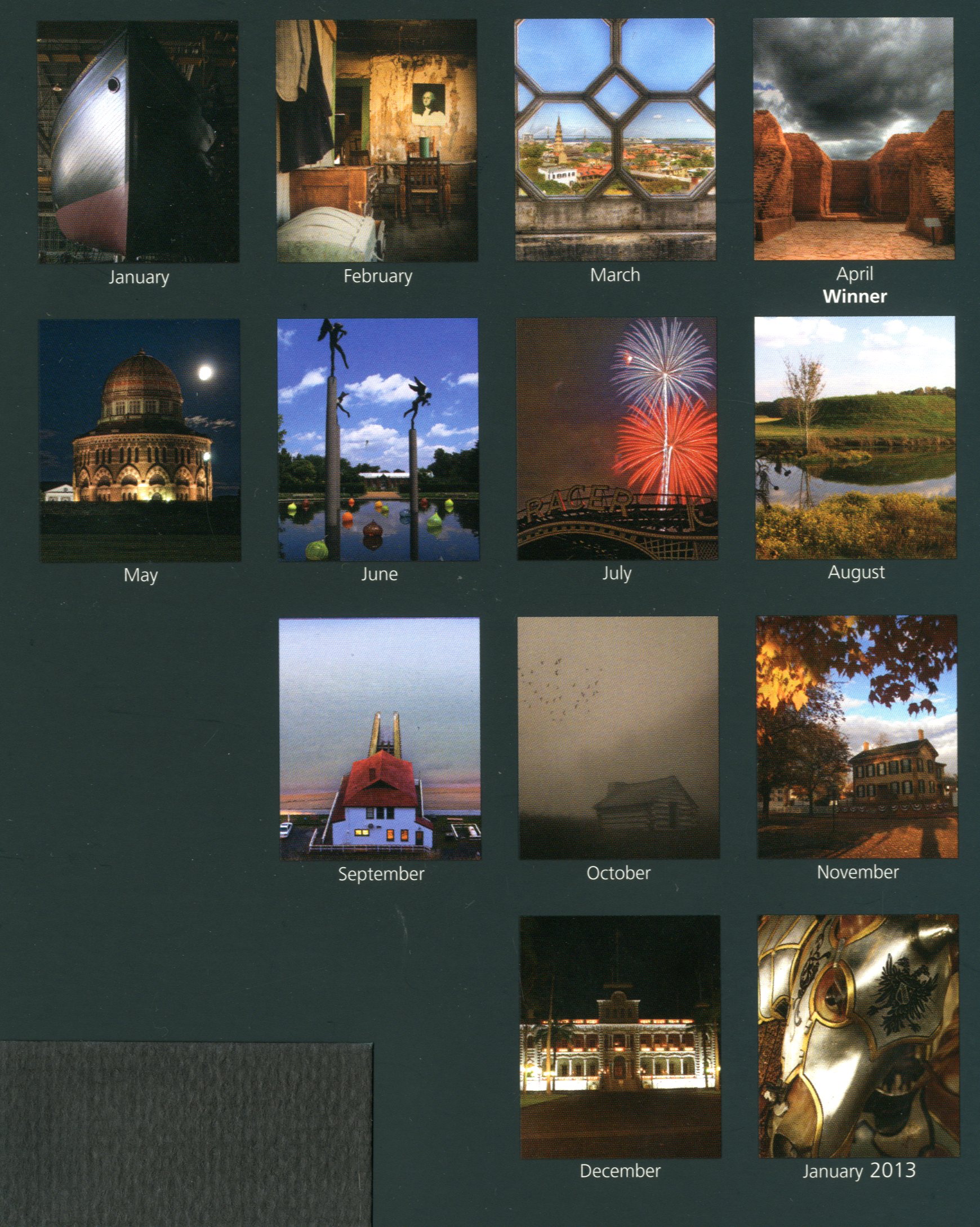
The National Historic Landmark 2012 Event Planner Calendar

This 12-month wall calendar / event planner from The National Park Service features the winning photographs from their Twelfth Annual National Historic Landmarks (NHL) Photo Contest.

According to the contest rules, these original photos have to be “fantastic photographs that illustrate the significance of any of the over 2,500 National Historic Landmarks, our nation’s most significant treasures”.  One beautiful image from each National Park Service region and a stunning national winner were all chosen last fall from thousands of submissions for inclusion in this 2012 calendar, with the winning photograph gracing the cover.

The winning cover photo (shown above) by photographer Eric Vondy was of National Historic Landmark Pecos Pueblo, in South of Pecos, New Mexico. Park Service judges described it:

This evocative photograph inspires the imagination, yet this site’s real history is legendary. Led by an Indian guide called “The Turk,” famous Spanish explorer Coronado and his men set out from this pueblo to search for Quivira, one of the legendary “Seven Cities of Gold.” Abandoned in 1838, today the site, east of Santa Fe, is managed by Pecos National Historical Park.


Calendar Images: (Left) 1895 lumber schooner C.A. Thayer, San Francisco, California. Photographer: John Conway.  (Right) Missouri Botanical Gardens, St. Louis, Missouri. Photographer: Judy Hitzeman.

Want to see your photo win next year? If you’re a photographer, amateur or professional, you can participate in their next annual National Park Service photo contest. Read the details on their  Annual National Historic Landmarks (NHL) Photo Contest web site.

How do I get this 2012 National Historic Landmarks Photo Contest event planner calendar?

  • UPDATE AS OF 1/19/2012:  Due to the overwhelming customer response to this blog post, unfortunately GPO has sold out of its remaining stock of this calendar! If more should become available, we will update this post.

However, feel free to enjoy the beautiful images from the calendar on the National Park Service’s FlickR page for the National Historic Landmarks 2011 Photo Contest Winners.


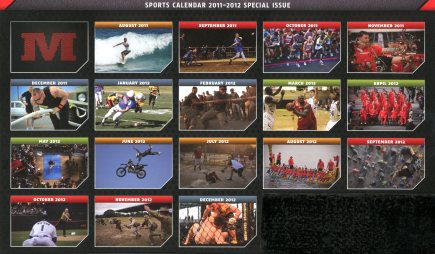
Marine Corps Special Issue Semper Fit Sports Calendar 2011-2012

The second wall calendar is even more surprising and very inspiring as well to those who are resolved to living a healthier lifestyle through fitness.

Issued by Marines Magazine, the Marine Corps’ Official Magazine, this colorful 17-month Sports Calendar (August 2011 – December 2012) recognizes some of the outstanding athlete “leathernecks” who participate in the Marine Corps’ “Semper Fit” sports, recreation and fitness program worldwide.  (“Semper Fit” is a nod to the Marine Corps motto of “Semper Fi” short for “Semper Fidelis” which is Latin for “Always Faithful” or “Always Loyal”).

One Marine base describes the Semper Fit program:

The mission at Semper Fit is to conduct, encourage and inspire the quality of life programs for that promote Healthy Lifestyles through recreation, athletics, physical fitness, the Single Marine Program and other health and wellness activities for Marine Corps active and retired members, their families and civilian workers.

The photographs on this calendar depict everything from individual sports such as the famous Marine Corps Marathon held annually in Washington, DC, and aerial motorcycle tricks…


Calendar Images: (Left) Start of the Marine Corps Marathon in Washington, DC. (Right) Motorbike aerialist and member of the “Metal Mulisha Troops” Marine stunt team.

…to intramural and varsity sports like baseball, basketball, wrestling, tug-of-war, the Dragon Boat Race, and the Warrior Games.


Calendar Images: (Left) Tug-of-war competition at Camp Leatherneck, Afghanistan. (Right) All-Marine team of active duty and veteran “wounded warriors” at opening ceremony of the all Armed Forces Warrior Games.

Many of the athletes included are recognized globally for their athletic ability, and others are Marines who stay at the top of their game no matter their age or disability, maintaining the extremely high physical fitness standards of the Corps.

The calendar also includes Federal holidays and key dates of significance to the Corps.

The Father of Semper Fit retires

Ironically, last month after nearly 36 years of service as a Marine officer and a civilian whose final role was as Quantico’s head of recreation, Chris D’Orazio, the founder of the Semper Fit program retired.

Image: Col. Dan Choike, base commander, presents Chris D’Orazio, head of recreation, a challenge coin during D’Orazio’s retirement ceremony in the Main Ballroom at the Clubs of Quantico on Dec. 5, 2011. Source: Quantico Sentry newspaper

In an interview for the Quantico Sentry, D’Orazio explained how the Semper Fit program concept came to him back in 1985, D’Orazio when he read an article about the low life expectancy of retired Marines, whether officer or enlisted:

 “Marines, especially back then, played hard, worked hard, drank hard and smoked hard,” said D’Orazio. “I looked out the window and saw a young Marine put out a cigarette, finish a can of beer, then walk back inside the building.”

“I look down and thought to myself, based on this article, this guy’s going to live less than five years after he retires,” D’Orazio said. “After a career and everything they’ve worked for, they are probably going to die that soon; that’s terrible. That was pretty much the genesis of the word ‘Semper Fit.’”

In addition to the “Semper Fit” program for USMC, D’Orazio started the “Getting Stronger, Now” fitness program for the state of Maryland, both of which were pilot fitness programs under the President’s Council on Physical Fitness and Sports.

This 2012 Semper Fit calendar is a fitting tribute to a man who dedicated his life to, well, fitness!

And the photos are pretty inspiring to hang on anyone’s wall, too!

Calendar Image: Marines compete in the 37th annual Naha Dragon Boat Race in Naha, Japan.

How do I get this Marine Corps 2012 Semper Fit Sports calendar?

  • Buy it online 24/7 at GPO’s Online Bookstore.
  • Buy it at GPO’s retail bookstore at 710 North Capitol Street NW, Washington, DC 20401, open Monday-Friday, 9am to 4pm, except Federal holidays, (202) 512-0132.

So whether you aspire to find more beauty in the world around you or to be the best you can be, the Government is here to help you out!

Resolve to have a safe and happy 2012, America!


Vote for the top Government news story of 2011

December 26, 2011

2011 was a momentous year in Federal Government-related news and as such, it was a banner year for important Government publications, as demonstrated by our 2011 Year in Review collection available from the U.S. Government Printing Office (GPO).

But which Government news story was the most significant, in your opinion? Vote in our poll below, and then see the publications that follow that relate to these important stories:

Note 1:As of January 27, 2012, this poll is NOW CLOSED with the final results showing above, but feel free to click on the SHARE THIS link to pass on the results to others.
Note 2: This is a non-scientific user poll. Results are not statistically valid and cannot be assumed to reflect the views of the Government Printing Office customer as a group or the general population.

Following are the Federal Government publications that relate to each of these important 2011 stories:

2011 News Story   Related Federal Publication(s)
9/11 tenth anniversary   Ten years have passed since that tragic day, but the memories are still strong. 2011 saw some excellent publications about that day, including a 10th anniversary edition of Pentagon 9/11 and a reprinting of the 9/11 Commission Report, all of which you can find in our 9/11 Collection: A Decade of Remembrance.

Assassination of Osama bin Laden  FBI Terrorism Research and Analysis Project (TRAP) A Navy SEALS team located and killed Osama bin Laden this year, the mastermind behind the 9/11 attacks and many other Al Qaeda and insurgent terrorist attacks. This 2011 publication, Terrorism Research and Analysis Project (TRAP): A Collection of Research Ideas, Thoughts, and Perspectives, V. 1analyzes causes and possible responses to terrorism as presented at the FBI Terrorism Research and Analysis Project (TRAP) Symposium of international academics and law enforcement personnel.

Death of North Korea’s Kim Jong Il   The recent death of North Korea’s leader, Kim Jong Il, marks an uncertain time for the Korean Peninsula and the entire region. North Korea: A Country Studyreviews the history and the dominant social, political, economic, and military aspects of contemporary North Korea before this.

Deep Water BP Gulf oil disaster report  Deep Water: The Gulf Oil Disaster and the Future of Offshore Drilling, Report to the President, January 2011 In January of this year, the National Commission on the BP (British Petroleum) Deep Water Horizon Oil Spill and Offshore Drilling released its controversial Deep Water: The Gulf Oil Disaster and the Future of Offshore Drilling, Report to the President, January 2011. This best-selling publication offers the fullest account available of what happened in the Gulf of Mexico on April 20, 2010 and why, and proposes actions, changes in company behavior, reform of government oversight, and investments in research and technology that will be required to avert future disasters.

End of the war in Iraq  Battleground Iraq: Journal of a Company Commander There is an interesting White House timeline about the Iraq war at the end of which is a link to the Joining Forces initiative with which one can express one’s support for the troops. GPO’s bookstore has a number of books about Iraq, but two stand out as best-sellers. Battleground Iraq: Journal of a Company Commander gives a realistic account by Major Todd Brown of his experiences as a U.S. Army company commander in Iraq from April 2003 to March 2004. Hard Lessons: The Iraq Reconstruction Experienceexamines the Iraq reconstruction experience, and provides 13 take-away lessons for future contingency relief and reconstruction operations.

  • Buy them in our online bookstore:

a)      Battleground Iraq: Journal of a Company Commander

b)      Hard Lessons: The Iraq Reconstruction Experience

Japan earthquake and tsunami  Field Operations Guide for Foreign Disaster Assessment and Response Natural disasters were big in the news this year, and the Federal Government was involved in responding to them, from the National Guard in the U.S. to foreign response teams overseas. For example, in response to the tragic earthquake and resulting tsunami and nuclear reactor problems in Japan, the U.S. Agency for International Development (USAID), deployed a Disaster Assistance Response Team (DART) that included disaster response experts, urban search and rescue teams, and nuclear experts from the U.S. Department of Energy, Department of Health and Human Services, and the Nuclear Regulatory Commission. The Field Operations Guide for Disaster Assessment and Responseis used by USAID’s Office of U.S. Foreign Disaster Assistance (OFDA) for DART teams and other disaster assistance personnel when responding to foreign disasters like the Japan situation.

Last Space Shuttle flight  NASA and Space Shuttle publications including "Wings-in-Orbit" 2011 marked the end of NASA’s three-decade long space shuttle program when, on July 21, the final space shuttle mission ended with the shuttle Atlantis rolling to a stop at its home port, NASA’s Kennedy Space Center in Florida. NASA has published a number of terrific books about the program which you can find in our NASA and Space Shuttle Publications, along with a new set of beautiful color bookmarks, one for each shuttle and the best-selling Wings in Orbitbook.

U.S. economy and the Federal budget  Books about Government and Politics, including the Federal Budget and the Economy It seems every newscast this year has covered the US economy, Federal Government budgets and deficits and differing opinions about options to address them. You can find the President’s original budget submission published this year and subsequent analyses and responses to it in our collection of Books about the Government and Politics, including the Federal Budget and the Economy.

How can you find even more Federal Government publications? We have assembled many collections of Federal publications on our year-round Gift Guide and in our Special Collections page on GPO’s online bookstore.

About the Author: Michele Bartram is Promotions Manager for GPO’s Publication and Information Sales Division and is responsible for online and offline marketing of the US Government Online Bookstore (Bookstore.GPO.Gov) and promoting Federal government content to the public.