Over 1 Billion Served: GPO’s Pueblo Distribution Center Hits Historic Milestone Today

May 7, 2013

GPO_Pueblo_1_Billion-Shipped1 Billion.  One thousand million. Any way you count it, that’s a bundle! And at the US Government Printing Office Document Distribution Center in Pueblo, Colorado, we have reached that magic number. As of today, our Pueblo facility has shipped over 1 billion consumer publications, making it a bundle of bundles sent out to the American people!

GPO’s Western Expansion

Growing up, I always heard or read public service announcements from the Federal Government offering helpful advice on everything from how mortgages work to getting vaccinations. Each time, the commercial or ad would end with the same tag line: “To order this helpful free publication, contact us in Pueblo, Colorado” and an address and phone number (and today, a website address) would be given with ordering information.  I thought it amazing that all this great consumer information was available from one Colorado town.

Although unbeknownst to me at the time, it turns out this famous Pueblo location is actually one of two distribution facilities operated by the Government Printing Office’s Agency Distribution Services that stores and ships out Government publications on behalf of our Federal agency clients to the public –the other being in Laurel, Maryland.

In an effort led by House Appropriations Committee member Congressman Frank Evans, the GPO distribution facility was proposed and then approved on October 8, 1970, by the Joint Committee on Printing and the 15th Public Printer of the United States, Adolphus Nichol (Nick) Spence. The Pueblo Public Documents Distribution Center (PuDDC) was dedicated on October 8, 1971, and opened on October 11, 1971, to provide support for the expanding dissemination needs of Federal agencies, from books to posters to other products.

GPO_Pueblo_Congressman-Frank-Evans-Distribution-CenterLast year, President Barack Obama signed an act of the 111th Congress to rename the center the “Congressman Frank Evans US Government Printing Office Pueblo Document Distribution Center” after the former Congressman who passed away in June of 2010. It was re-dedicated on October 11, 2011, for the fortieth anniversary of the Pueblo facility.

Image: Renaming ceremony of the GPO Pueblo facility on October 11, 2011.

Today, GPO’s Pueblo Document Distribution Center provides distribution services to 10 federal agencies and other entities including: The Federal Citizen Information Center (FCIC), the Federal Trade Commission (FTC), Health and Human Service (HHS – Women’s Health), Office of Disability Employment Policy (ODEP), Federal Drug Administration (FDA), Federal Depository Library Program (FDLP), Consumer Financial Protection Bureau (CFPB) and three programs within the Department of Homeland Security  that produce items such as Transportation Security Administration (TSA) posters, bookmarks and baggage inserts.

Ruehlen-at-Pueblo-PuDDCImage: Jimmy Ruehlen has worked for Pueblo’s Government Printing Office Distribution Center since it began operations 40 years ago. Photo credit: The Pueblo Chieftain / Mike Sweeney (Photographer)

The Pueblo Distribution Center has processed over 105 million customer orders from the day it opened its doors through the end of April 2013, and as of today, May 2, 2013, the Center has distributed over 1 billion publications on behalf of its various Federal clients.

GPO Gets a “CIC” out of Distributing Consumer Publications

The Pueblo facility really got a kick-start when it signed an inter-agency agreement with the General Services Administration (GSA) in January of 1973 to take over the warehousing and distribution of the millions of printed consumer publications being provided through GSA’s then-new Consumer Information Center (or CIC), which itself has provided service to the GSA’s Federal Citizen Information Center (or FCIC), the U.S. Postal Service and the Department of Education.

Consumer-Info-Catalog-Winter-Spring-2013_coverThe gem in the FCIC’s crown is the Consumer Information Catalog, printed by GPO, which lists the latest and most popular of the many thousands of consumer publications available by topic and is updated several times a year.

Most of the print publications–the majority printed by GPO– in the Consumer Information Catalog are FREE for U.S. delivery if ordered online; the rest require only a nominal fee. Plus, a number of the publications are offered for FREE in electronic format for immediate download on the Publications.USA.gov website.

Some of the many categories of helpful consumer pamphlets and publications include: Education; Employment; Family including Pets; Federal Programs and Benefits, Food; Health including Drugs and Exercise & Diet (even information on braces, tattoos, and tanning!); Housing including Financing and Home Maintenance; the ever-popular Money category including Fraud, Credit Cards, Living Trusts, and Retirement Planning; even Small Business and Travel, and more.

Consumer-Info-Catalog-Winter-Spring-2013_Page_11

Image: Page from the Consumer Information Catalog Winter/ Spring 2013 Edition.

How can I get a copy of the Consumer Information Catalog and order publications?

Find the latest Consumer Information Catalog in PDF format online, or you can also order FREE print copies to be mailed to you at the same Publications.USA.gov website.

Consumer-Action-Handbook-2013The most popular document distributed by Pueblo remains the annual Consumer Action Handbook, a free trouble-shooting guide to help Americans solve all sorts of consumer problems. I’ve ordered five to share with family and friends!

In addition to ordering from GSA’s Publications.USA.gov website, you can find a number of these consumer publications on GPO’s US Government Online Bookstore.

Below are some of the more popular publications in the Consumer Information Catalog that are also available on GPO’s online bookstore:

You can also browse our Consumer, Home & Family category on our online bookstore.

With so many useful consumer publications available from the Federal Government, I’m sure it won’t be long until we distribute another billion items to help American consumers!

About the Author:

Government Book Talk Editor Michele Bartram is Promotions Manager for GPO’s Publication and Information Sales Division in Washington, DC, and is responsible for online and offline marketing of the US Government Online Bookstore (http://bookstore.gpo.gov) and promoting Federal government content to the public.


March Madness: New GPO Bookstore Website and Historic Anniversaries

March 22, 2013

March is traditionally a month of change and national excitement in the United States. Together with the change of seasons and college basketball frenzy, some important national milestones were reached this month that we should acknowledge, from new achievements to key anniversaries.

New U.S. Government Bookstore Website

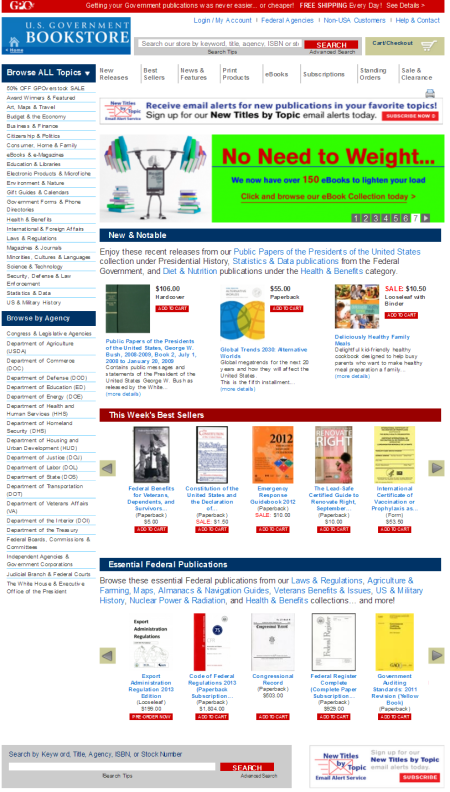
First, last week we launched our upgraded U.S. Government Bookstore ecommerce site, http://bookstore.gpo.gov/.  Our ecommerce website has gone through several iterations since its first version in 1999, each time adding functionality to keep up with the changing needs.  Today, GPO has over 4,000 Federal print publications and more than 150 eBooks available through our online bookstore.

New-US-Government-Online-Bookstore-website

Our new website includes the following user-friendly features:

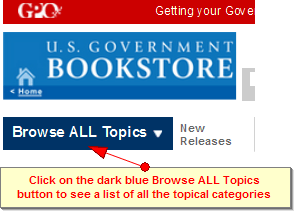
Browse-ALL-Topics-on-GPO-BookstoreClick on the dark blue Browse All Topics button on the site to see and browse by a list of all the topical categories.

These last two features—eBooks and new Categories—are particularly important in light of three other important milestones this month.

National Women’s History Month

March is National Women’s History Month in the United States, and we have a new main “Browse by Topic” category, Minorities, Cultures & Languages, where you can find books for and about African Americans, American Indians, Asian Americans & Pacific Islanders, Cultural Awareness, Disabled, Hispanics, LGBT, Minority Issues, Non-English Government Publications, Seniors & Elderly and Women, including dozens of books and eBooks about Women’s History.

Womens_History_Books_Slide

Harriet Tubman Centennial

One of the famous American heroines in the Women’s History collection is Harriet Tubman, who died 100 years ago this month making it her Centennial. Tubman escaped from slavery and returned to lead dozens of others to freedom in the mid-1800s. In addition to being the most well-known of Underground Railroad “conductors,” she was also a nurse, spy, suffragist, and more.

With all these roles, it is appropriate that we have created so many new “Browse by Topic” categories. One is Slavery & Underground Railroad (under US & Military History), where great books featuring Harriet Tubman and the Underground Railroad can be found.  Other new topics include Nursing under Health & Benefits and Intelligence & Espionage under Security, Defense & Law Enforcement.

Additional publications about National Parks can be found under the main category of Art, Maps & Travel, along with Posters & Prints and Maps, Almanacs & Navigation Guides.

BROWSE BY AGENCY: You can also find National Park Service (NPS) publications under Department of the Interior (DOI) in the Browse by Agency categories on the menu at the lower left side of the site, where publications are categorized by the Federal agency that published them. For example, our own Government Printing Office (GPO) publications are under Congress & Legislative Agencies.

Iraq War 10th Anniversary

Finally, this week is the tenth anniversary of the start of the Iraq War, which began on March 19, 2003, as Operation Iraqi Liberation, later renamed Operation Iraqi Freedom.

Iraq-War-10th-Anniversary_Books_Slide

President Obama, in an address about the Iraq war 10th anniversary this week said:

“As we mark the 10th anniversary of the beginning of the Iraq war, Michelle and I join our fellow Americans in paying tribute to all who served and sacrificed in one of our nation’s longest wars. We salute the courage and resolve of more than 1.5 million service members and civilians who during multiple tours wrote one of the most extraordinary chapters in military service. We honor the memory of the nearly 4,500 Americans who made the ultimate sacrifice to give the Iraqi people an opportunity to forge their own future after many years of hardship.”

Since the beginning of the war, the Defense Department has published dozens of excellent publications about the war, the strategies, Saddam Hussein, Iraq, reconstruction and the achievements and sacrifices made by our Armed Forces. You can find these publications featured under Iraq & Persian Gulf Wars which can be found under US & Military History > Battles & Wars categories.

It’s a Launch, Not a Landing

So, our new site marks the completion of over a year of hard work by our team here at the Government Printing Office, all aimed to make sure “we the people” can discover more about our Nation through excellent publications by our Federal Government. But there’s a good reason we call it a website launch and not a landing. This is only the beginning, with more great content and features to come! Enjoy!

So, please visit GPO’s new online bookstore website at http://bookstore.gpo.gov/ and tell us what you think!

About the Author:  Michele Bartram is Promotions Manager for GPO’s Publication and Information Sales Division in Washington, DC, and is responsible for online and offline marketing of the US Government Online Bookstore (http://bookstore.gpo.gov) and promoting Federal government content to the public. She was also in charge of the online bookstore relaunch!


Librarians Pick Notable Federal Books- 2012 Edition

July 3, 2012

It’s that exciting time of year again if you’re a publisher of Federal publications. It’s the equivalent of the Academy Awards, the Emmy Awards or the Grammy Awards… Well, maybe that’s pushing it, but when the American Library Association’s (ALA) Government Documents Round Table or GODORT convenes the Notable Documents Panel of its Publications Committee to choose the top government-produced publications of the previous year, we can’t help but get caught up in the excitement.

Each year, this ALA GODORT Notable Documents Panel selects what it considers to be the most “Notable Government Documents” published during the previous year by Federal, state, and local governments and includes the list of winners in its prestigious Library Journal (LJ).

According to its website, Library Journal is “the most trusted and respected publication for the library community. LJ provides groundbreaking features and analytical news reports covering technology, management, policy and other professional concerns to public, academic and institutional libraries. Its hefty reviews sections evaluate 8000+ reviews annually of books, ebooks, audiobooks, videos/DVDs, databases, systems and websites.

This year, as usual, many of the Federal publications the panel selected are available through the Government Printing Office’s Federal Depository Library Program (FDLP) libraries and GPO’s Sales Program.

Out of all of the Federal Government documents LJ looked at in the past year, here are some of those it found most notable:

  Keeping America Informed: The United States Government Printing Office 150 Years of Service to the Nation

Publisher: Government Printing Office (GPO)

GPO’s own role in producing excellent Government publications in its 150 years of history gained it a place on the GODORT list for the past year:“Liberally illustrated with historical photographs and facsimiles of famous government documents, this volume will appeal to a wider audience than depository librarians. Historians and history buffs who have an interest in government and how it interacts with both the private sector and public employee unions will find a compelling story that focuses on the federal government’s obligation to keep citizens informed about its activities.” – LJ

  Statistical Abstract of the United States 2012 (Hardcover)

Statistical Abstract of the United States 2012 (Paperback)

Publisher: Commerce Department, U.S. Census Bureau

The Statistical Abstract of the United States, published since 1878, is the standard summary of statistics on the social, political, and economic organization of the United States. It is designed to serve as a convenient volume for statistical reference and as a guide to other statistical publications and sources. The latter function is served by the introductory text to each section, the source note appearing below each table, and Appendix I, which comprises the Guide to Sources of Statistics, the Guide to State Statistical Abstracts, and the Guide to Foreign Statistical Abstracts.

The Library Journal adds an important update about this: “In addition to being the quintessential statistical resource of all time, Statistical Abstract is a Notable Document for 2011 simply because this edition will be the last produced by the Census Bureau and distributed through FDLP. Future editions will be published commercially, so librarians will still have options for maintaining the continuity of their print collections. A classic reference tool.” – LJ

  Macondo: The Gulf Oil Disaster. Chief Counsel’s Report 2011

Publisher: National Commission on the BP Deepwater Horizon Oil Spill and Offshore Drilling

“The National Commission on the BP Deepwater Horizon Oil Spill was created by President Obama and charged with investigating the root causes of the largest accidental marine oil spill in the history of the petroleum industry. The committee concluded that the cause of the blowout was not mechanical. Instead, a number of poor management decisions, combined with an inadequate regulatory structure and an indifferent regulatory agency, overwhelmed the safeguards designed to prevent such disasters. Plenty of illustrations and photographs offer a glimpse into the technology of offshore oil rigs.” – LJ

  Then Came the Fire: Personal Accounts From the Pentagon, 11 September 2001

Publisher: Defense Dept., Army, Center of Military History

“In 2011, there were many publications designed to commemorate the tenth anniversary of the attacks of September 11, 2001. In addition to the 59 people aboard the flight that struck the Pentagon, 125 people in the Pentagon were killed. The editors of this memorial volume have collected the stories of eyewitnesses, including the military and civilian personnel who escaped the burning building and first responders and reporters at the scene. It also includes hundreds of photographs.”- LJ

  Freedom by the Sword: The U.S. Colored Troops, 1862-1867

Publisher: Defense Dept., Army, Center of Military History“

In what may be the definitive operational history of black troops in action during the Civil War, [author] Dobak describes the differences in how freedmen and runaway slaves were recruited, how they lived, and how they were trained. Most important, it considers how gallantly these men performed in combat at a time when many of their own leaders questioned whether they would be willing to fight for their own freedom and for that of their families. Much of the documentation comes from the ‘War of the Rebellion’ series.” – LJ

  Legacy of Excellence: The Armed Forces Institute of Pathology 1862-2011 

Publisher: Defense Dept., Army, US Army Medical Department Center and Schoo1, Armed Forces Institute of Pathology, Public Affairs Office, Borden Institute

“In 1862, shortly after the Battle of Antietam, army surgeon general Brigadier Gen. William Hammond ordered the establishment of the Army Medical Museum. Surgeons working on Civil War battlefields were encouraged to preserve anatomical specimens, such as severed limbs and diseased organs, and send them to the museum for further research. From the start, the museum made its displays of specimens and instruments, as well as its medical library, available to the general public. Under the leadership of later curators, such as John Billings and Walter Reed, the museum evolved into the Armed Forces Institute of Pathology. Readers interested in the history of science, especially medical science or in the devastating effects of Civil War weaponry on the human body, will be fascinated by the hundreds of graphic photographs.” – LJ

And a hearty congratulations to all the winning Federal agency publishers for an excellent job!

How can you get these publications from this year’s Federal Notable Government Documents collection?

  • Buy any of these publications online 24/7 by shopping the Notable Government Documents 2012 collection at GPO’s Online Bookstore.
  • Buy them at GPO’s retail bookstore at 710 North Capitol Street NW, Washington, DC 20401, open Monday-Friday, 9am to 4pm, except Federal holidays, (202) 512-0132.
  • Find these publications in a library near you.

About the Author:  Michele Bartram is Promotions Manager for GPO’s Publication and Information Sales Division and is responsible for online and offline marketing of the US Government Online Bookstore (http://bookstore.gpo.gov) and promoting Federal government content to the public.


Ponzimonium: How Scam Artists Are Ripping Off America

November 18, 2011

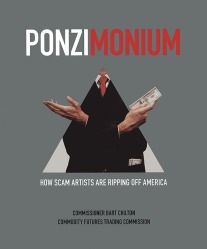
Every single day, someone somewhere makes a gigantic mistake by giving his or her money to a fraudster,” says Bart Chilton, one of the commissioners of the Commodity Futures Trading Commission (CFTC). Chilton is the author of Ponzimonium: How Scam Artists are Ripping Off America, a shocking new book available from GPO about some of the worst perpetrators of investment fraud in recent U.S. history.

Figure 1: Ponzimonium: How Scam Artists Are Ripping Off America available from GPO.

Ponzimonium looks to the CFTC’s own recent public case files stemming from fraud investigations that began with the recent economic downturn- talk about hitting people when they’re down! Because of the this, the book is generating a lot of positive buzz in The New York Times, TheStreet, and other media outlets.

The CFTC is an independent Federal agency with the mandate to regulate commodity futures and options markets in the United States. After the financial crisis of 2008, their authority was expanded under the 2010 Dodd-Frank Wall Street Reform and Consumer Protection Act to include over-the-counter derivatives markets and hopefully prevent and uncover more of these frauds.

What is a Ponzi scheme, you ask?

The world really learned about Ponzi schemes in December of 2008 when, as Chilton writes in his introduction, “legendary investment guru Bernard Madoff ‘made off’ with an estimated US$50 billion in what was called the ‘Mother of all Ponzi Schemes’.” (By the way, an interesting related read is the report about the Investigation of Failure of the Securities and Exchange Commission To Uncover Bernard Madoff’s Ponzi Scheme, also available from GPO.)

Unlike pure pyramid schemes in which it is mandatory that a new investor recruit others into the deal in order to receive payments, Ponzi schemes purport to offer investors a “too good to be true” deal by simply handing over their money. However, no real investment is made by the criminal.

Instead, Ponzi schemes, named after 1920’s postage stamp speculator-fraudster Charles Ponzi, are scams in which early “investors’—often friends, colleagues, and family members—are asked to invest in a this great “no risk” deal offering unbelievable returns.

Typically, the investor makes an initial investment and then some purported “phantom profits” are paid out by the con artist (really just money from other investors), prompting that investor to assume that his or her money has increased in value—and inspiring the investor to turn over more money to invest and tell others about it. In actuality, the perpetrators pocket the money for themselves.

This splendid infographic from the New York Times explains the concept visually:

Figure 2. Ponzi scheme infographic. Image source: The New York Times 12/21/2008 Week in Review.

Made in Madoff’s Image

Ponzimonium introduces some of the lesser known, but equally  despicable fraudsters that have been uncovered since 2008 by the CFTC and SEC (Securities and Exchange Commission).

The book lays out the fascinating and dramatic details behind the fraudulent schemes, their smooth-talking masterminds, and their many honest, hard-working victims, who often lose the money they’ve saved for their kids’ college funds, needed health care expenses, or their own retirement as a result of misplaced trust in these criminals.

These stories are so engrossing— at times it felt like I was taking in a marathon of America’s Most Wanted or I Almost Got Away with It episodes— I found it hard to decide which of these criminals is the most despicable. Was it Beau Diamond of Diamond Ventures who wiped out his parents’ savings along with 200 other clients who invested US$37 million? Or how about Marvin R. Cooper of Billion Coupons, who created a combination Ponzi and pyramid scheme called an affinity fraud, to target and recruit fellow deaf community members in the U.S. and Japan? And there’s James Ossie of CRE Capital Corporation (CRE) who bilked investors out of US$25 million, including a desperate father’s US$200,000 he invested to fund his young daughter’s cancer treatments.

Figure 3. Fraudster Marvin R. Cooper and deaf client. Image source: BusinessInsider.com

The human side behind these frauds makes them all the more compelling… and contemptible.

The best way to avoid getting swindled, advises Chilton, is to “remember what your parents told you when you were little: ‘Don’t take candy from strangers’”, and my personal favorite, “Just because it is on the TV, Internet, etc. doesn’t mean it’s real!” That’s advice you can take to the bank.

Some “don’t miss” features of this book

Ponzimonium: How Scam Artists are Ripping Off America includes some very useful features for its readers that make this a valuable resource for any investor.

  • Red Flags of Fraud: Includes 20 red flags to look out for when considering an investment.
  • Investor Checklist: Detailed list of questions to ask before investing.
  • Investors’ Bill of Rights: Common sense advice and legal rights for any investor.
  • Resources: Useful contact information for victims or witnesses of a fraud.
  • Glossary of Fraud Terms: Definitions of legal and financial terms within each story.
  • The Loot: Color photos of the criminals’ misbegotten gains and lavish lifestyle.
  • The Numbers: Calculations of the staggering amounts collected, paid, lost, or stolen, and prison sentences and restitution.

How can you get this Ponzimonium eBook?

About the Author:  Michele Bartram is Promotions Manager for GPO’s Publication and Information Sales Division and is responsible for online and offline marketing of the US Government Online Bookstore (Bookstore.gpo.gov) and promoting Federal government content to the public. She has been researching identity theft and privacy issues for years, both on the web and in the real world, and is a big fan of more fraud protection for citizens.