Just for Fun: Aunt Sammy’s Radio Recipes

April 19, 2010

When I first got the idea to blog about Aunt Sammy’s Radio Recipes, I figured that I’d be shedding light on a totally forgotten Government publication. I remembered Aunt Sammy as the title character of an odd-sounding booklet that GPO was selling in my early days here. When I searched the Internet, though, she was everywhere. Cooking sites, old time radio sites, newspaper sites – who knew?
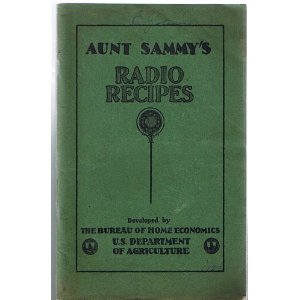
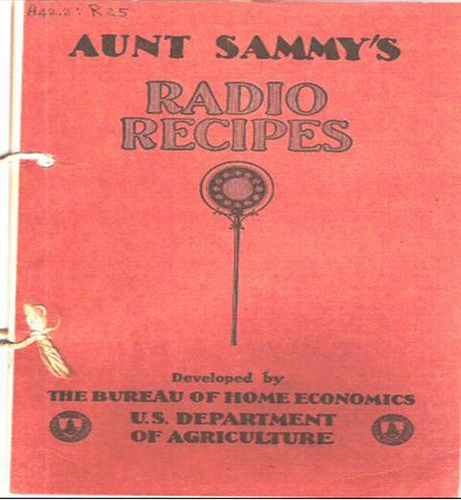
On October 4, 1926, the U.S. Department of Agriculture (USDA) Bureau of Home Economics and the Radio Service launched its Housekeeper’s Chat show, featuring Aunt Sammy – Uncle Sam’s wife, of course. In addition to meals and recipes, she talked about all kinds of other household matters, but it was the recipes that got listeners’ attention. In 1927 USDA put the most popular recipes into a pamphlet: Aunt Sammy’s Radio Recipes. According to the introduction to the 1976 USDA reprint (the one I remembered hearing about),  “The demand was so great that it had to be reprinted after only a month. ‘Aunt Sammy’s Radio Recipes’ was revised and enlarged three times between 1927 and 1931. In 1932 it became the first cookbook published in braille.”
Aunt Sammy vanished in 1934 and the show did likewise in 1946, yet her memory lingers on. I discovered that the 1931 edition has been reprinted by a private publisher and is still available. I like the 1976 edition, which you can find here, because it has contemporary recipes from USDA as well as some 1920’s favorites. It’s all what I think of as “hearty fare” or “comfort food” – definitely BA (before arugula). What with diners and such making a comeback, our Aunt Sammy may be more contemporary than we think. Maybe I’ll have meatloaf tonight…


Fun With the GPO Style Manual

April 15, 2010


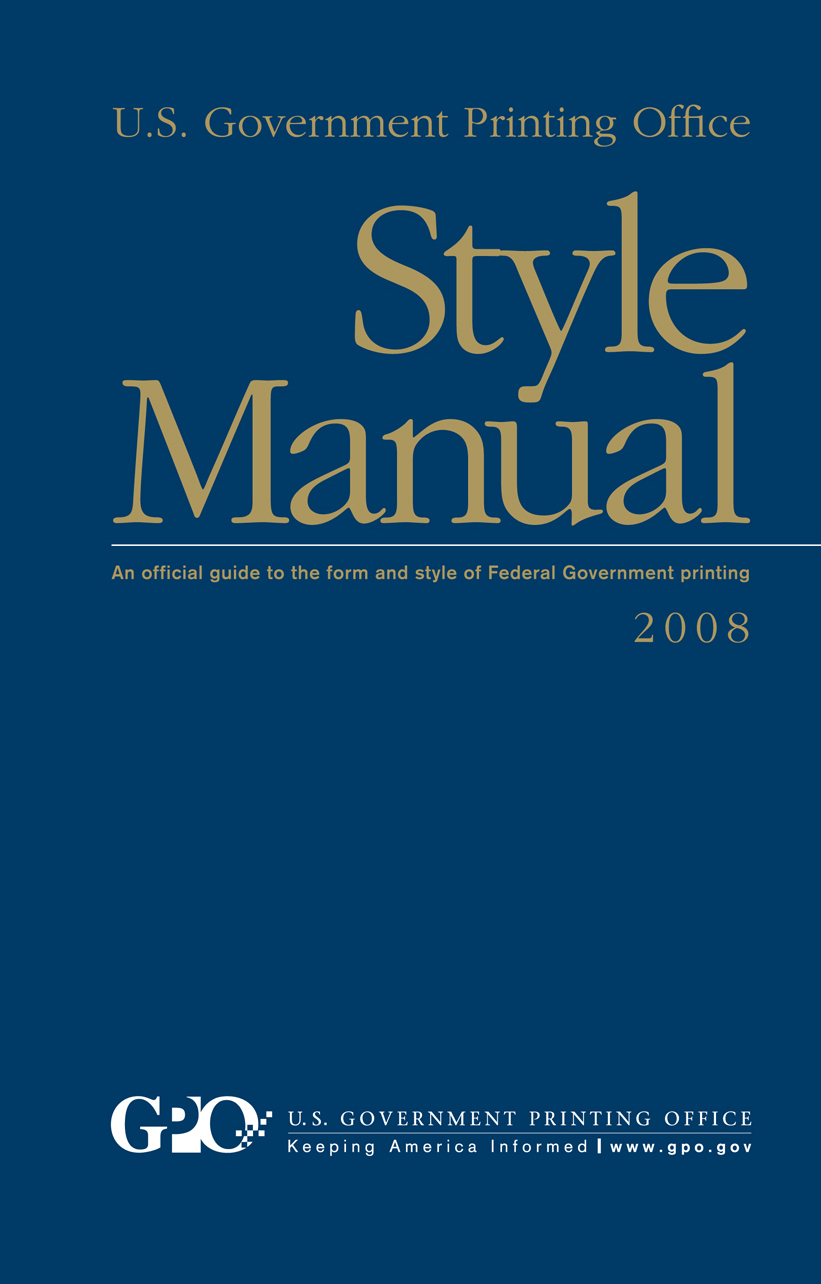
It’s National Library Week, which prompted me to think about my favorite Government reference book – the U.S. Government Printing Office Style Manual, which since 1894 has been the Federal Government’s  guide to form and style in printing and a standard reference for professionals in the field. Although I’ve used the Style Manual for years in a number of different jobs I’ve had at GPO, the real reason it’s my favorite is, I confess, that I’m a member of the GPO Style Board. For many months prior to the publication of the latest edition, our little group met for two hours each week to discuss spelling, capitalization, and the myriad of other details that collectively make up any book of this sort. The best part – it was a lot of fun. As one of the members said to me one day, “This is the high point of my week!” For a word person, spending time on this stuff was really a plum assignment. Some of my colleagues were old acquaintances, while others were new to me. The one thing they all had in common was a  depth of  knowledge and a dedication to producing the best possible product that was truly awesome. I also found out what a demonym is: “Demonym is a name given to a people or inhabitants of a place. ” (See Chapter 17, Useful Tables, Pages 332-334.)

My favorite new features of the 2008 edition: A list of information technology acronyms and initialisms; a chapter on capitalization  with totally updated examples of proper names (a lot of research went into this, believe me!); and a clean, contemporary new design and typeface, thanks to GPO Creative Services.

Despite my obvious bias in favor of the Style Manual, many other Government books and periodicals are worthy of inclusion in the library reference pantheon – you can find a few of them here.


URL Update

April 15, 2010

Effective today, the new URL for Government Book Talk is http://govbooktalk.gpo.gov. The old URL, https://govbooktalk.wordpress.com, will redirect to the new one. Thanks!


Nothing but Praise: A History of the 1321st Engineer General Service Regiment

April 12, 2010

When I drew up a list of possible blog topics, this new book from the Army Corps of Engineers was an obvious choice for someone like me, who likes to investigate less well- known historical subjects. There were three reasons for me to be interested. Although key to the success of any army, Engineer units tend to labor in the shade of more “glamorous” branches. Also, even though African-Americans made up the bulk of enlisted personnel in World War II-era engineer outfits, their accomplishments are even less well-known that those of the Corps overall. Finally, Nothing but Praise was written by the 1321st’s commanding officer, Aldo H. Bagnulo. It consists of his unpublished history of the unit, a diary he kept during the war, and an extensive array of photographs of  unit personnel and activities. (The book was carefully edited and annotated by Corps historian Michael J. Brodhead).

The 1321st was an Engineer General Service regiment, which means that its personnel were well-trained in the various building and engineering trades before deployment overseas. The regiment’s job was to build and maintain bridges, roads, and various structures needed to keep wartime supplies stored and supply lines moving. In the course of its service in France and Germany, from December 1944 until several months after Germany’s surrender, the 1321st worked diligently and well in all kinds of weather and quasi-combat conditions in highly creditable fashion, as documented by the receipt of the Bronze Star by six officers and nine enlisted men. Viewed from this perspective, Bagnulo sheds welcome light on the crucial but often neglected role of the Army Corps of Engineers in supporting the logistics of war.

Bagnulo’s treatment of the racial aspects of his command is intriguing. His unpublished manuscript never refers to race at all. Reading it out of the context of this published edition makes it sound like every other small military unit – the rigors of training, the weeding out of the less fit, the occasional wild party, terrible weather, back-breaking work, intense fear, and finally a feeling of accomplishment duly rewarded by official recognition of a job well done.

In his diary, Bagnulo does mention race a few times. It’s clear that, although a man of his time, he made a conscious effort to eschew prejudice. One issue he cites as productive of tension after V-E Day sprang from his African-American officers’ concern about fairness in promotion; Bagnulo strongly endorsed merit promotion in two meetings with them, which he seemed to think was helpful. He was clearly comfortable with addressing such issues head-on, which must have been unusual in those days.

In mid-1945, the 1321st shipped out to the Pacific theater, didn’t get there before the surrender of Japan, and spent several months building roads and bridges in Korea before demobilization. Afterward, Bagnulo had a long career in the Army and at NASA before retiring.

The verdict: A valuable read for anyone interested in the sinews of war and the story of  race relations in America. Nothing but Praise is available from GPO.

For more about the creation of Nothing but Praise, check out this Army Corps of Engineers video. Note: GPO’s Creative Services organization did a great job in designing this book.


Just for Fun: Sprocket Man!

April 9, 2010

Government Book Talk has had a busy couple of weeks getting up and running, so it’s time to kick back, relax,  and talk about one of the many unexplored corners of the world of Federal publications. Sprocket Man, the Consumer Product Safety Commission’s superhero for safe biking, began in 1975 as a comic book character created at Stanford University for the California  Department of Public Safety and the nonprofit Urban Bikeway Design Collaborative. Somewhere along the line, he and his comic books were picked up by the Commission. I know that the GPO sales program carried them at one time, although I don’t know if we sold them singly or in packages. (I checked, and we don’t sell them anymore).

Thanks to the depository library program, you can find Sprocket Man here. Although at first the idea of a superhero dedicated to bicycle safety seems a bit…overdone, I can see how he’s a good way to reach younger bikers. He’s pretty intense, but he gets his message across. Although a few comic buffs seem to scorn him, Sprocket Man is still available for download at a number of safety-oriented Web sites and for collectors at several comic book sites.

 Tune in next Friday for another trip down the one of the many byways of Government books, and don’t forget to wear your helmet!


Charley Harper Posters

April 7, 2010

It’s easy to become blasé about the things you deal with on the job. For years, I’ve been seeing a variety of National Park Service posters whose design was along similar lines. They depicted stylized birds and animals, evoking, at least for me, a sort of Native American sensibility. I admit, though, that this is more thought than I actually put into them. If asked, I would have surmised vaguely that the stylistic resemblance was due to some kind of “look” the Park Service was trying to achieve, rather than because they were the work of a particular artist.

Recently, we reprinted a number of these posters and our content acquisition staff kept referring to them as “Charley Harper” posters. Then we got an inquiry from the depository library side of the house about “Charley Harper” posters. My first response: Who’s he? Well, Charley Harper (1922-2007) was a noted American artist, particularly esteemed for his wildlife posters, prints, and illustrations in a style he described as “minimal realism.” He’s also an eminently collectible artist, so once again Government publications suddenly appear in a new guise,  far removed from the tired old stereotype.

These posters are sold by stores in the various national parks and also are available from GPO. It’s easy to pick them out! To see all of the posters and handbooks produced by our Park Service colleagues in Harpers Ferry, West Virginia, go here, where you’ll also find a link to the various parks associations that sell Park Service products.


Health Care Legislation Update

April 6, 2010

The other day I replied to a comment about the availability of the new health care law. Since then, we’ve received other questions, so I thought it might be helpful to provide the latest information we have available. First, GPO’s Federal Digital System (FDsys) has various documents here and printed copies are available for purchase here. The Congressional Record, V. 156, No. 43, Book 2, March 21, 2010 includes the text of the Patient Protection and Affordable Care Act.  Public Law 111-148, Patient Protection and Affordable Care Act, is being printed and is currently expected to be available around May 25. Public Law 111-152, Health Care and Education Reconciliation Act, which contains changes to the initial Act and provisions related to education, has just been submitted for printing. I hope this helps!


RSS Feeds

March 31, 2010

Since we’ve had numerous requests for an RSS feed, there is now a page where you can sign up: https://govbooktalk.wordpress.com/feed/. Thanks for this constructive input.


Dr. Seuss, U.S. Army

March 31, 2010

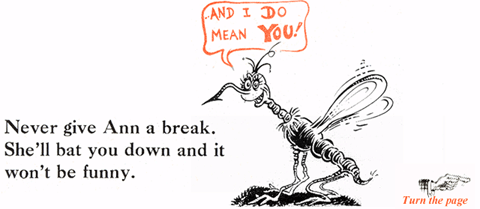
When I was a kid, I loved to rummage through a bunch of pamphlets that had belonged to my Uncle Teddy. I never knew my uncle because he went missing in action in the Pacific during World War II, so for me his memory was perpetuated mainly by these little U.S. Government booklets about getting along in China, North Africa, Iran, and other wartime hot spots. One of my favorites was “Meet Ann…She’s Dying to Meet You,” a 36-pager about the perils of contracting malaria from the Anopheles mosquito. The illustrations were cartoons, usually showing some poor sap (it’s easy to fall back into the slang of the era) getting bitten by Ann or failing to employ mosquito netting.

Fast forward a good many years to a Federal depository library conference featuring a talk on “Government Publications as Rare Books.” The presenter said, “This booklet goes for $600 and up” and flashed the cover of “Meet Ann” on the screen. Yikes! The cartoonist was Dr. Seuss when he was Captain Ted Geisel, U.S. Army, and this little pamphlet is one of his hardest to find publications. The author of the text was no slouch, either: Munro Leaf, author of “Ferdinand the Bull.” As soon as I got home, I put my little pamphlet in a safer place! My copy probably would be worth even more if I hadn’t “autographed” it on the back cover when I was about 10. Oh, well…

 If you’d like to take a peek at “Meet Ann” online, try this USDA site.


March Madness

March 30, 2010

College basketball playoffs are wildly popular and followed by millions of fans, including some in our office. Last year, we came up with the idea of doing a “Sweet 16” playoff of Government publications on GPO’s online bookstore. After working with our web support team, which is both creative and very patient, we launched our first playoff last year. We sent out a message to all of our customers who have requested information about our products and sat back to see if anything would happen. It did! By the time our “tournament” was over, we received more than 139,000 votes and a mention in the New York Times business blog.

I think this proves that Government publications have fans, and highly motivated fans at that. The winner? You can find it here.

Now it’s March again, and this year it’s a National Parks Playoff, featuring eight National Park Service handbooks and eight posters by the noted artist Charley Harper (who will be the subject of a future posting here). If you get a chance, stop by and vote!


Welcome!

March 30, 2010

Welcome to the U.S. Government Printing Office’s (GPO) Government Book Talk! Our goal is to raise the profile of some of the best publications from the Federal Government, past and present.  We’ll be reviewing new and popular publications, providing information about new publications in the offing, and talking about some out-of-print classics. The goal is to spotlight the amazing variety of Government publications and their impact on ourselves and our world – and have fun while doing it.

 About the agency: GPO opened its doors on March 4, 1861 and is part of the legislative branch of the federal government.  GPO employees have been Keeping America Informed on the documents of our democracy, in both printed and electronic form, for the last 150 years.  The agency produces the Congressional Record, Federal Register, the nation’s passports, and other Federal Government documents.

About the blogger: My name is Jim Cameron (not the movie director). I’m a long-time GPO employee, working mainly for the agency’s publications sales program in the areas of writing, editing, and outreach, but I also have a good deal of  experience with the Federal depository library side of the house. I’m a serious book person – my wife claims that I own several thousand books, but I’m sure that’s an exaggeration. My interests lie mainly in the areas of history and biography – perfect for someone involved with Government books.

But, as they say, enough about me. I’d like this online conversation to be as informative and enjoyable as one we’d have in a book club. If you have thoughts about a post, more information about a topic, or ideas about books to discuss, let me know. I see this blog not as a single voice, but as a community of book lovers, be those books print or electronic. Let the discussion begin!