Keeping Her “Army Strong”: Musculoskeletal Injuries in Military Women

July 30, 2012

Guest blogger, GPO Public Relations Specialist Emma Wojtowicz, reviews a new publication addressing the prevention, diagnosis, treatment, and rehabilitation of musculoskeletal injuries in women serving in the Army and National Guard.

The transition in the 1970’s from a drafted military to a volunteer-based military opened up more opportunities for women to join the military and serve in different capacities. As of September 2010, women account for 14% of active duty service members and 18% of Reserve and National Guard service members. With the opportunity to serve comes the risk of being injured.

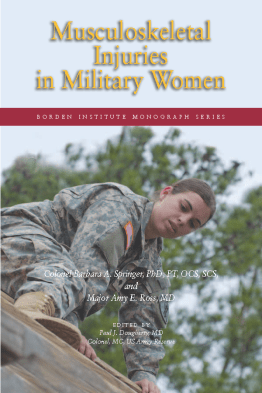
Musculoskeletal Injuries in Military Women by the United States Army Borden Institute focuses on risk factors, prevention, diagnosis, treatment, and rehabilitation of musculoskeletal injuries in women. This is the most recently released publication of the Borden Institute Monograph Series.

This publication is slim and targeted to a specific audience of the medical community, military, and those afflicted by the described injuries, including athletes and soldiers alike. It is of particular value to those who work with this sort of injury, from diagnosis to treatment to rehabilitation, including physical therapists, orthopedists and sports medicine professionals, both civilian and military.

According to the publication, women serving in the Army have a higher incidence of injury compared to men due to the female anatomy and physiology. More women become injured during the Army’s basic combat training and associated activities compared to men and their female counterparts in the Air Force and Navy.

Image: Female soldiers negotiate obstacles during the U.S. Army Special Operations Command’s cultural support program which prepares all-female Soldier teams to serve as enablers supporting Army special operations combat forces in and around secured objective areas. The Army is working to improve women’s health throughout the Army, thus contributing to force readiness. (Photo by Staff Sgt. Russell Klika, USAJFKSWCS. Source: Soldiers Magazine)

Overuse injuries, primarily in the bone and tendons, account for 75 percent of women’s injuries from activities like running, marching, and repetitive jumping. The book’s authors identify running shoes as the most important equipment during training to prevent injury and give advice on how to select the right running shoe (See image below).

Musculoskeletal Injuries in Military Women thoroughly and succinctly details each potential musculoskeletal injury. The musculoskeletal system provides form, support, stability, and movement to the body. The injury descriptions are broken down by risk factors, prevention, diagnosis, treatment, and rehabilitation. Most injury descriptions are accompanied by detailed instructions and pictures showing what the injury looks like, ways to test for the injury, and appropriate therapeutic exercises.

The content of the publication is not limited only to only military women, but can be beneficial to female athletes and physically active women who suffer from the described injuries and require physical therapy or rehabilitation.

Military injuries, whether suffered by men or women, have an effect on the readiness of the military and force levels. Musculoskeletal Injuries in Military Women reminds readers that injury is possible at any time, not only in combat.

HOW DO I OBTAIN Musculoskeletal Injuries in Military Women?

  • Buy it online 24/7 at GPO’s Online Bookstore.
  • Buy it at GPO’s retail bookstore at 710 North Capitol Street NW, Washington, DC 20401, open Monday-Friday, 9am to 4pm, except Federal holidays, (202) 512-0132.
  • Find it in a library.

Other Titles about Rehabilitation and Physical Therapy

You may also be interested in the Journal of Rehabilitation Research and Development.  This journal is known in the industry as the JRRD and is an international, peer-reviewed rehabilitation research journal sponsored by the U.S. Department of Veterans Affairs. The JRRD accepts original manuscripts from domestic and international researchers on a broad range of topics, including assistive technology, cognitive disorders, rehabilitation, prosthetics, SCI, traumatic brain injury, and telemedicine, and more.

The JRRD is available via subscription from the U.S. Government Printing Office in two formats:

1) Print Journal: Buy a year’s subscription to the JRRD from our GPO Online Bookstore

2) Digital Journal:  The electronic subscription (ISSN: 0748-7711) for tablets, desktop computers and smartphones can be purchased through our e-magazine partner, Zinio.com:


War, Will and Warlords: An Interview, Part II

July 23, 2012


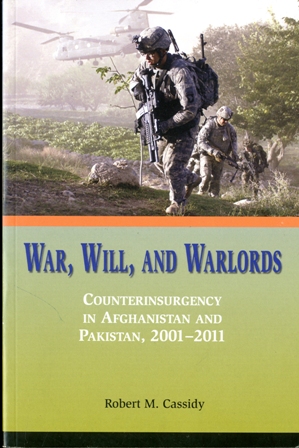
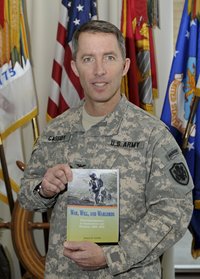
In this second part of a two-part interview by Government Book Talk blog editor Michele Bartram,  Col. Robert M. Cassidy, author of the new, critically acclaimed book, War, Will, and Warlords: Counterinsurgency in Afghanistan and Pakistan, 2001-2011, describes the lessons learned after ten years of war in Afghanistan. Click here to read Part I of the interview.

GovBookTalk: In Chapter 5 of War, Will, and Warlords, you refer to Pakistan’s prospects of doing what needs to be done as “hard, not hopeful, but not impossible.”  What role does Pakistan play today in 2012 in this counterinsurgency, and how do you rate these prospects today on the scale of hopeful vs. impossible?

Cassidy: There is currently not much at all to be sanguine about in relation to Pakistan, as it has done the most odious things in terms of regenerating and sustaining the Afghan Taliban and other groups.  And, the Coalition and the international community have allowed Pakistan to get away with this—murders, literally.  Pakistan poses as a friend, but performs as a foe. The Afghan Taliban would have withered away over the last several years of the surge if Pakistan had stopped supporting the regeneration, resting, recruitment, and retraining of militants, improvised explosive device makers, technology, and components in its tribal sanctuaries and in Baluchistan.

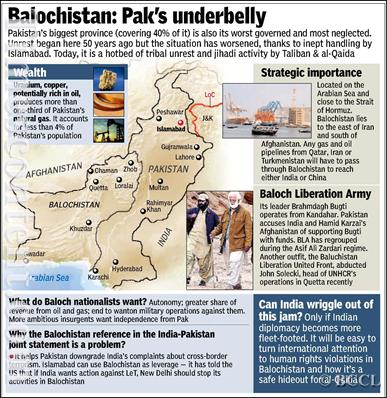
Image: Balochistan’s strategic importance. Source: Intellibriefs

Pakistan has employed terrorism and unconventional warfare to ostensibly achieve strategic depth by supporting its proxies in Afghanistan for almost four decades.

However, the United States has not yet crafted a Pakistan strategy that employs its substantial leverage to modify Pakistan’s strategic calculus.  A genuine Pakistan strategy, coupled with unambiguous momentum and perseverance in Afghanistan, could compel Pakistan to alter its strategic rationale and reduce support to the Afghan Taliban and the Haqqani network. 

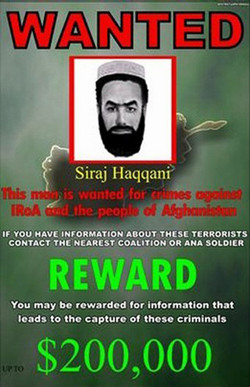
Image: [GovBookTalk] The Haqqani Network,an insurgent group allied with the Taliban and operating on both sides of the Afghanistan-Pakistan border, is one of the most dangerous groups fighting U.S.-led Coalition forces and the Afghan government. Originating in Afghanistan during the mid-1970s, it was nurtured by the U.S. Central Intelligence Agency (CIA) and Pakistan’s Inter-Services Intelligence (ISI) during the 1980s Soviet war in Afghanistan. Maulvi Jalaluddin Haqqani and his son Sirajuddin Haqqani lead the group. A reward of $200,000-USD was offered by Coalition forces for information leading to the arrest of Siraj Haqqani. Source: Wikipedia.

The United States needs a strategy for Pakistan, one which is logically and temporally linked and integrated with the imperatives in Afghanistan.  A viable strategy must first recognize that the U.S. does have considerable leverage over Pakistan.  America must demand discernible results for the steady diet of carrots it has been feeding Pakistan for the perfidious abetting of enemies who kill and maim the Afghan and Coalition civilians and military forces trying to stabilize the country in some lasting way.

GovBookTalk: After wars in Iraq and Afghanistan, what lessons has the US military learned about fighting a counterinsurgency campaign— in strategy, training, equipment, communications with locals, relations with coalition nations and neighboring regions?

Cassidy: Let me clarify at the outset that counterinsurgency is not a strategy in and of itself, but more of the art and method of an operational campaign to defeat or neutralize an insurgency.  The first and most paramount thing we should learn is not to unlearn or expunge what we know of previous counterinsurgencies’ best practices.  In 2001-2003 when we undertook those wars, there was very little thinking, knowledge, doctrine, or awareness of the requirements for prosecuting counterinsurgency to a successful conclusion.   The American military was compelled to adapt in the crucible of combat and it ultimately changed over time, and we now see the most seasoned counterinsurgent forces in our history.

Image: [GovBookTalk]: This is an actual PowerPoint slide shown by Gen. Stanley McChrystal, commander of U.S. and NATO forces in Afghanistan in the summer of 2009 to portray the complexity of U.S. strategy. Source: Charles V. Peña. Click on image above to enlarge.

Cassidy: Notwithstanding, it is negligence of criminal magnitude to prepare soldiers with the doctrine, the equipment, and the leadership savvy for countering insurgents only after the fighting has begun.  Also, in many ways and instances, it was the early methods of American military forces in Iraq and Afghanistan that helped catalyze support for the insurgencies by alienating large parts of those populations.  Here are some pithy things we should retain:

  • Knowledge empowers and the one who thinks, wins:  analyze and understand the environment.
  • Good counterinsurgency campaigns fully integrate both general purpose and special forces.
  • Start with simple and clear, not convoluted and cumbersome, command and control.
  • Match action and information to address grievances to win the war of ideas.
  • If the insurgency benefits from unimpeded sanctuary, ruthlessly shut this down.
  • Start with the end— what should the indigenous security capacity be when we leave?
  • Show moral rectitude:  kill precisely the insurgent leaders and protect most of the people.

GovBookTalk: If you had to do it all over again, would you change anything in this book?

Cassidy: Two things: one, I would have added a chapter that explained how we need to rethink and reframe our relationship with Pakistan after the bin Laden raid; and two, I would have made one more look to minimize any redundancy between the first chapter and the last chapter because the last chapter was something I developed apart from the main manuscript when I was last in Afghanistan during 2011.

GovBookTalk: Did you personally learn anything from writing this book and what was it?   

Cassidy: I deepened and broadened my knowledge about the enduring and deplorable perfidy of the Pakistani ISI in Afghanistan over almost four decades of war in the region.

Image: Pakistan spy chief (right), Lt. Gen. Shuja Pasha, is head of  the Pakistan Directorate for Inter-Services Intelligence or ISI, whose headquarters are shown to the left. Source: Jagran Post. [GovBookTalk] Note that the ISI continually denies links to the Taliban and terrorism, in spite of accusations by Coalition allies of ISI ties to the 7/7/2005 terrorist attacks in London, the attempted assassination of President Karzai, the bombing of the Indian embassy, supporting terrorist groups and other acts. Source: The Council on Foreign Relations 

GovBookTalk: Are there additional resources where readers can go for more information, assistance with this topic?

Cassidy: Some useful resources include the websites of the Afghan Analysts Network (AAN), the New America Foundation Counterterrorism Strategy Initiative Policy Paper series, the Congressional Research Service (CRS) [link to Stanford University’s archives of CRS reports], the Institute for the Study of War (ISW), The Council on Foreign Relations  and the U.S. Government 1230 and 1231 reports on the progress in Afghanistan.  Also, they could start with the bibliography of this book.

GovBookTalk: What are the next upcoming projects for you?  

I am drafting an outline for a new book with the draft title of, On Raw War:  The wages of the American way of strategy and war.  This will start with a theoretical chapter that distills the best thinkers on strategy and war and then it will proceed to explore American wars after Vietnam, from the Persian Gulf War up until Afghanistan to assess how practices compared to the theory.

GovBookTalk: Do you have anything specific that you want to say to your readers in parting, a memorable quote?

Cassidy: The Roger Ascham quote in Chapter 1:  “it is a costly wisdom that is bought by experience;” juxtaposed with the famous Bismarck quote that “fools say they learn from experience; I prefer to learn from the experience of others.”

GovBookTalk: Thank you for your insights, Col. Cassidy!
HOW CAN YOU OBTAIN a copy of War, Will, and Warlords: Counterinsurgency in Afghanistan and Pakistan, 2001-2011?

  • Buy it online 24/7 at GPO’s Online Bookstore.
  • Buy it at GPO’s retail bookstore at 710 North Capitol Street NW, Washington, DC 20401, open Monday-Friday, 9am to 4pm, except Federal holidays, (202) 512-0132.
  • Find it in a library.

To learn more about America’s involvement in Afghanistan, browse our new Afghanistan Collection of Federal publications.

About the author: Colonel Robert M. Cassidy, USA, is a military professor at the U.S. Naval War College, a senior fellow with the Center for Advanced Defense Studies, and a member of the RUSI Advisory Board. His experience and scholarship focus on strategy and irregular warfare. He has served on deployments to Iraq, Afghanistan, the Persian Gulf, Egypt, and Grenada. He most recently served as a special assistant to the senior operational commander in Afghanistan in 2011. Colonel Cassidy has published a number of articles and two previous books on stability operations and irregular war:  1) Peacekeeping in the Abyss: British and American Peacekeeping Doctrine and Practice after the Cold War and 2) Counterinsurgency and the Global War on Terror: Military Culture and Irregular War. He has a Ph.D. from the Fletcher School of Law and Diplomacy at Tufts University.


War, Will and Warlords: An Interview, Part I

July 17, 2012

Government Book Talk editor Michele Bartram writes a two-part interview with author Col. Robert Cassidy about his new, critically acclaimed book, War, Will, and Warlords: Counterinsurgency in Afghanistan and Pakistan, 2001-2011, which covers the causes and consequences of counterinsurgency in that troubled region and recommendations for future American approaches there and in similar operations. Part I goes into the cause of the war there and explanations of the key concepts. Click here to read Part II of the interview.


Since World War II, the character of the wars America has fought has changed radically. Traditional methods of warfare, technology, training and strategies designed to counter national armed forces, are not suited for today’s counterinsurgency operations often where civilians mingle freely with enemy combatants in complex urban terrain or remote encampments, and which can be carried out by local warlord-led troops, small guerrilla groups or even individual insurgents. First in Iraq and now honed by the war in Afghanistan, American military (operations), tactics and technology have required reengineering to adapt to this new reality of war.

Soldier-scholar Col. Robert Cassidy, Ph.D., is a military professor at the U.S. Naval War College and a senior fellow with the Center for Advanced Defense Studies who served on operations in Grenada, Egypt, the Persian Gulf, Iraq, and most recently as the special assistant to the commander of ISAF Joint Command in Afghanistan from June 2010 to June 2011.

As an expert in strategy and irregular warfare, Cassidy has authored the recently published War, Will, and Warlords: Counterinsurgency in Afghanistan and Pakistan, 2001-2011 which is featured this month in our U.S. Government Bookstore’s special War in Afghanistan collection.

Foreign Policy magazine lauds War, Will, and Warlords as a “must read for all scholars, policymakers, diplomats, and military practitioners seeking to understand the Afghanistan-Pakistan nexus” which provides invaluable analysis “concerning uneven U.S. involvement in the region, the contradictions of Pakistan, and the counterinsurgency (COIN) approaches implemented on both sides of the porous region” between Pakistan and Afghanistan.

Some refer to the War in Afghanistan as America’s longest war, but to Afghans, conflict has been going on there continuously for almost four decades. Today, July 17, 2012, actually marks the 39-year anniversary of when continual tumult and conflict began in Afghanistan. In July 1973 Afghanistan’s last King or Padishah, Mohammed Zahir Shah, was ousted in a coup d’état by his first cousin and former Prime Minister Mohammed Daoud Khan, who established a republican government. Years of conflict followed, including war with the Soviet Union, rise and fall of the Taliban, Al-Qaeda and today’s insurgency.

Image: (Left) Zahir Shah, King of Afghanistan, with his first cousin and Prime Minister Daoud Khan (right) who later deposed Zahir in 1973, beginning Afghanistan’s slide towards forty years of war. Source: CivFanatics Forum.

AN INTERVIEW WITH THE AUTHOR

In this two-part special feature, Government Book Talk was pleased to be able to interview Col. Cassidy about the book, his personal observations about the conflict and the countries, and his recommendations for the future.

Government Book Talk: What inspired you to write this book?  

Colonel Robert Cassidy: I had written a study about the Soviet War in Afghanistan at the French École de Guerre in 2000-2001 and I continued to study our war in Afghanistan after September 2001.   The proximate reason was that I was at the Naval War College in 2009-2010 between tours in Afghanistan and I thought it would be helpful to capture and compare what happened for the first eight years to those years after the surge.  Also, I knew that researching and writing this book would make me more knowledgeable and useful as an adviser in Afghanistan during my tour in 2010-2011.

GovBookTalk: I understand that this was not the original title for the book. How did you arrive at the final choice?

Cassidy: Two initial titles were vetoed. First, I suggested “Malice in Wonderstan,” and my editor then suggested “Ten Years Gone,” which I liked because of its triple reference to the Afghan War’s length, the Led Zeppelin classic song, and the subject of that song, an ancient Greek war.  In the end, I picked “War, Will and Warlords” because these three things are so salient in terms of Afghanistan and what we have done or not done there since we supported the anti-Soviet insurgency in the 1980s.

In the excerpted piece of the preface below, I explain the meaning behind the title because “War, will, and warlords…are central to any understanding of what has transpired in Pakistan and Afghanistan.”

WAR: First, the Afghan people have faced tumult, conflict, and war since July 1973… A corollary to this is the fact that the Pakistani state has helped foment insurgent proxy war and terrorism in Afghanistan since 1973. In fact, fomenting insurgencies in Afghanistan by proxy is in the metaphorical DNA of the Pakistani security apparatus.

WILL: Second, protracted irregular wars are a contest of will, as insurgents use the art of the ambush, armed propaganda in the form of spectacular violence, and cross-border sanctuaries to protract the war to erode the will of the counterinsurgents so they give up the fight. The insurgents can win if they can prolong the war while not exhausting their own will.

WARLORDS: Third, warlords, or feudal barons, run criminal patronage fiefs or insurgent-terrorist networks that operate across the borders and exist outside and inside the states as well as serve as state proxies in some cases. Patronage has long been a reality in South Asia. However, the growth and scope of warlord-led insurgent and criminal networks that began before the Soviet-Afghan War… have helped catalyze support for the insurgencies.

Image: Afghan warlords and power brokers. Source: WorldNews,

GovBookTalk: What is the overall message in the book that you want readers to grasp?  

Cassidy: To understand the catalysts for and the ineluctable links between security and insurgency in both Pakistan and Afghanistan; to know the grave consequences if we ultimately fail, and to fathom the odious role of Pakistan’s perfidy in its persistent support of terrorism and insurgency in Afghanistan.

GovBookTalk: You have been on multiple tours in Afghanistan. What surprised you most about either the people or the country itself? 

Cassidy: I would not use the word surprised, but what intrigued me and enthralled me were the country’s beautiful diversity and the Afghan people’s formidable resiliency.

GovBookTalk: What was the single most important “don’t miss” chapter and page in your book and why?

Cassidy: The most important chapter is Chapter 3 because it explains why and how the Taliban regenerated from sanctuary in Pakistan and what catalyzed the Pakistani Taliban’s insurgency within and against that state.

The most important single page is page 6 because it elucidates why and how the tribal areas in Pakistan along the Durand Line are the most dangerous places on earth in terms of the terrorist and militant machinations to support attacks on the U.S., other western states, and non-western states.

Image: [GovBookTalk] The Durand Line: Established in an 1893 treaty between Amir Abdul Rahman Khan of Afghanistan and Sir Mortimer Durand, the foreign secretary of the British Indian government, the Durand line set up the border between Afghanistan and then British India/now present-day Pakistan. Not recognized today by Afghanistan and a source of contention with Pakistan, this poorly marked buffer zone cuts through the Pashtun tribal areas, dividing ethnic Pashtuns (Afghans) on both sides of the border. It is considered to be one of the most dangerous places in the world. Source: IntelliBriefs and Wikipedia.

READ PART II: In PART II of this interview, Cassidy describes Pakistan’s role, hard lessons learned, useful resources and more…

HOW CAN YOU OBTAIN a copy of War, Will, and Warlords: Counterinsurgency in Afghanistan and Pakistan, 2001-2011?

  • Buy it online 24/7 at GPO’s Online Bookstore.
  • Buy it at GPO’s retail bookstore at 710 North Capitol Street NW, Washington, DC 20401, open Monday-Friday, 9am to 4pm, except Federal holidays, (202) 512-0132.
  • Find it in a library.

To learn more about America’s involvement in Afghanistan, browse our new Afghanistan Collection of Federal publications:


Reagan, Intelligence and the End of the Cold War

July 9, 2012

Guest blogger, GPO Public Relations Specialist Emma Wojtowicz, reviews a publication with an inside look at intelligence and the end of the Cold War:

In this election year, President Ronald Reagan has been  mentioned by Democrats and Republicans alike regarding his stance on tax policy. However, another association is the Cold War and President Reagan’s famous declaration about the Berlin Wall, “Mr. Gorbachev, tear down this wall!

Ronald Reagan, Intelligence and the End of the Cold War is a multimedia book and DVD recently published in November 2011 by the Ronald Reagan Presidential Library and the Historical Collections at the Central Intelligence Agency. It shares declassified documents from latter years of the Cold War with a focus on relations between General Secretary of the Soviet Union Mikhail Gorbachev and the Reagan administration.

Declassified documents are the primary focus of the book, but there is also an introduction and brief overview on intelligence, including President Reagan’s experience with the intelligence community prior to his presidency and his approach to intelligence as president; the role the intelligence community played in monitoring and anticipating the collapse of the Soviet Union; and expectations the public should have of the intelligence community.

Ronald Reagan, Intelligence and the End of the Cold War poses the question, “Should the U.S. intelligence community have done a better job foreseeing the collapse of the Soviet Union?” It does not answer the question for you, rather puts the subject of intelligence in context and provides declassified documents so readers can decide for themselves.

The book itself only contains a handful of declassified documents, but it comes with a DVD where readers have access to more than 200 declassified documents as well as photos from President Reagan’s administration, videos of press conferences and summits between the U.S. and Soviet Union, and an interactive timeline of the Cold War during the Reagan administration. The content of the book is also available on the DVD.

Image: Ronald Reagan Cold War timeline. Source: Ronald Reagan, Intelligence and the End of the Cold War (CLICK TO ENLARGE)

Highlights of the collection include video briefings for the Reagan Administration produced by the CIA’s Directorate of Intelligence on such topics as the Soviet space program, the Andropov succession, the Chernobyl disaster, and the Soviet media portrait of America. These briefings represent the first time the Agency used videos on a regular basis to deliver intelligence to policymakers. The entire collection marks the first substantial release of such historical material.

The amount of available declassified documents is a bit overwhelming. The content falls across a wide range of topics with a substantial focus on nuclear weapons and disarmament, but what is more interesting are the analyses of the Soviet Union’s politics and leaders, economy, society,  labor force, relationship with satellite countries, energy policy, and foreign policy.

One example is a memo on civil unrest in the Soviet Union that analyzes the number of instances of strikes, demonstrations, and riots, where they occurred, and the cause – each individual instance is thoroughly recorded. Another is on the volatile leadership situation in the USSR.

Image: Declassified CIA memorandum on the volatile leadership situation in the USSR; September 27, 1988. Source:  Ronald Reagan, Intelligence and the End of the Cold War

A particularly popular topic among the documents is Mikhail Gorbachev, both the man and the leader. Many documents focus on Gorbachev’s personality, goals and strategy of implanting his goals, the way he is perceived by citizens and other communist leaders, and his impact on the Soviet Union. It is clear from the documents that Gorbachev was viewed by the Reagan administration as a capable leader, who understood the problems the Soviet Union was facing, and had the potential to turn the Soviet Union around.

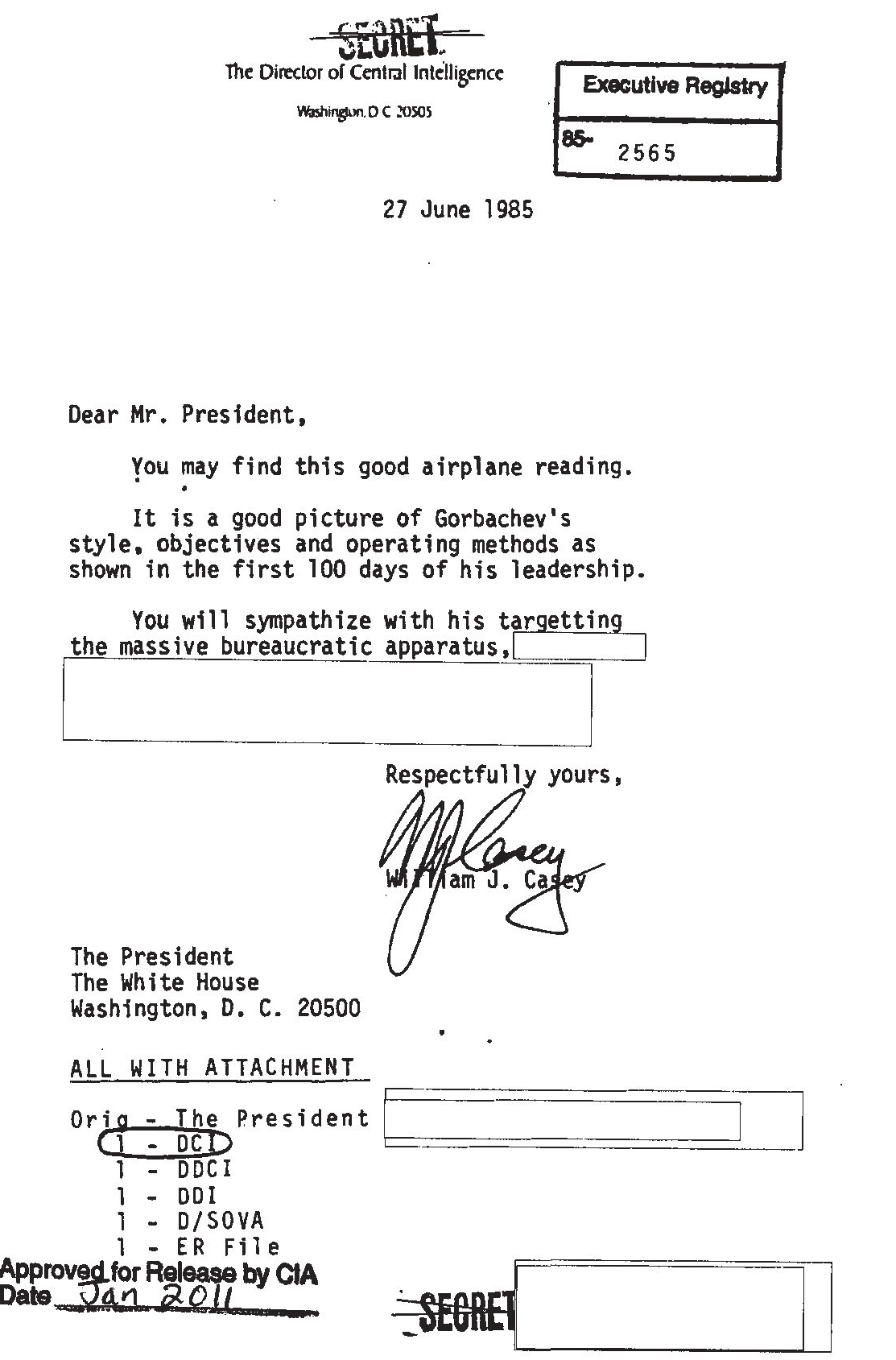
Image: Cover letter to President Ronald Reagan by William Casey of the recently declassified CIA assessment of Mikhail Gorbachev after this first 100 days in office. Source: Ronald Reagan, Intelligence and the End of the Cold War

An insightful comment is made in the introduction, “Deep down, officials seem to want intelligence to make decisions for them, when, in reality, it rarely can.

This sentiment is reflected in the declassified documents– they provide a wealth of information that is deeply analytical, but they do not spell out the best plans or policies for dealing with the Soviet Union or determine when it will cease to exist.

HOW DO I OBTAIN THIS “Ronald Reagan, Intelligence and the End of the Cold War”?

  • Buy it online 24/7 at GPO’s Online Bookstore.
  • Buy it at GPO’s retail bookstore at 710 North Capitol Street NW, Washington, DC 20401, open Monday-Friday, 9am to 4pm, except Federal holidays, (202) 512-0132.
  • Find it in a library.

Librarians Pick Notable Federal Books- 2012 Edition

July 3, 2012

It’s that exciting time of year again if you’re a publisher of Federal publications. It’s the equivalent of the Academy Awards, the Emmy Awards or the Grammy Awards… Well, maybe that’s pushing it, but when the American Library Association’s (ALA) Government Documents Round Table or GODORT convenes the Notable Documents Panel of its Publications Committee to choose the top government-produced publications of the previous year, we can’t help but get caught up in the excitement.

Each year, this ALA GODORT Notable Documents Panel selects what it considers to be the most “Notable Government Documents” published during the previous year by Federal, state, and local governments and includes the list of winners in its prestigious Library Journal (LJ).

According to its website, Library Journal is “the most trusted and respected publication for the library community. LJ provides groundbreaking features and analytical news reports covering technology, management, policy and other professional concerns to public, academic and institutional libraries. Its hefty reviews sections evaluate 8000+ reviews annually of books, ebooks, audiobooks, videos/DVDs, databases, systems and websites.

This year, as usual, many of the Federal publications the panel selected are available through the Government Printing Office’s Federal Depository Library Program (FDLP) libraries and GPO’s Sales Program.

Out of all of the Federal Government documents LJ looked at in the past year, here are some of those it found most notable:

  Keeping America Informed: The United States Government Printing Office 150 Years of Service to the Nation

Publisher: Government Printing Office (GPO)

GPO’s own role in producing excellent Government publications in its 150 years of history gained it a place on the GODORT list for the past year:“Liberally illustrated with historical photographs and facsimiles of famous government documents, this volume will appeal to a wider audience than depository librarians. Historians and history buffs who have an interest in government and how it interacts with both the private sector and public employee unions will find a compelling story that focuses on the federal government’s obligation to keep citizens informed about its activities.” – LJ

  Statistical Abstract of the United States 2012 (Hardcover)

Statistical Abstract of the United States 2012 (Paperback)

Publisher: Commerce Department, U.S. Census Bureau

The Statistical Abstract of the United States, published since 1878, is the standard summary of statistics on the social, political, and economic organization of the United States. It is designed to serve as a convenient volume for statistical reference and as a guide to other statistical publications and sources. The latter function is served by the introductory text to each section, the source note appearing below each table, and Appendix I, which comprises the Guide to Sources of Statistics, the Guide to State Statistical Abstracts, and the Guide to Foreign Statistical Abstracts.

The Library Journal adds an important update about this: “In addition to being the quintessential statistical resource of all time, Statistical Abstract is a Notable Document for 2011 simply because this edition will be the last produced by the Census Bureau and distributed through FDLP. Future editions will be published commercially, so librarians will still have options for maintaining the continuity of their print collections. A classic reference tool.” – LJ

  Macondo: The Gulf Oil Disaster. Chief Counsel’s Report 2011

Publisher: National Commission on the BP Deepwater Horizon Oil Spill and Offshore Drilling

“The National Commission on the BP Deepwater Horizon Oil Spill was created by President Obama and charged with investigating the root causes of the largest accidental marine oil spill in the history of the petroleum industry. The committee concluded that the cause of the blowout was not mechanical. Instead, a number of poor management decisions, combined with an inadequate regulatory structure and an indifferent regulatory agency, overwhelmed the safeguards designed to prevent such disasters. Plenty of illustrations and photographs offer a glimpse into the technology of offshore oil rigs.” – LJ

  Then Came the Fire: Personal Accounts From the Pentagon, 11 September 2001

Publisher: Defense Dept., Army, Center of Military History

“In 2011, there were many publications designed to commemorate the tenth anniversary of the attacks of September 11, 2001. In addition to the 59 people aboard the flight that struck the Pentagon, 125 people in the Pentagon were killed. The editors of this memorial volume have collected the stories of eyewitnesses, including the military and civilian personnel who escaped the burning building and first responders and reporters at the scene. It also includes hundreds of photographs.”- LJ

  Freedom by the Sword: The U.S. Colored Troops, 1862-1867

Publisher: Defense Dept., Army, Center of Military History“

In what may be the definitive operational history of black troops in action during the Civil War, [author] Dobak describes the differences in how freedmen and runaway slaves were recruited, how they lived, and how they were trained. Most important, it considers how gallantly these men performed in combat at a time when many of their own leaders questioned whether they would be willing to fight for their own freedom and for that of their families. Much of the documentation comes from the ‘War of the Rebellion’ series.” – LJ

  Legacy of Excellence: The Armed Forces Institute of Pathology 1862-2011 

Publisher: Defense Dept., Army, US Army Medical Department Center and Schoo1, Armed Forces Institute of Pathology, Public Affairs Office, Borden Institute

“In 1862, shortly after the Battle of Antietam, army surgeon general Brigadier Gen. William Hammond ordered the establishment of the Army Medical Museum. Surgeons working on Civil War battlefields were encouraged to preserve anatomical specimens, such as severed limbs and diseased organs, and send them to the museum for further research. From the start, the museum made its displays of specimens and instruments, as well as its medical library, available to the general public. Under the leadership of later curators, such as John Billings and Walter Reed, the museum evolved into the Armed Forces Institute of Pathology. Readers interested in the history of science, especially medical science or in the devastating effects of Civil War weaponry on the human body, will be fascinated by the hundreds of graphic photographs.” – LJ

And a hearty congratulations to all the winning Federal agency publishers for an excellent job!

How can you get these publications from this year’s Federal Notable Government Documents collection?

  • Buy any of these publications online 24/7 by shopping the Notable Government Documents 2012 collection at GPO’s Online Bookstore.
  • Buy them at GPO’s retail bookstore at 710 North Capitol Street NW, Washington, DC 20401, open Monday-Friday, 9am to 4pm, except Federal holidays, (202) 512-0132.
  • Find these publications in a library near you.

About the Author:  Michele Bartram is Promotions Manager for GPO’s Publication and Information Sales Division and is responsible for online and offline marketing of the US Government Online Bookstore (http://bookstore.gpo.gov) and promoting Federal government content to the public.


The End of Don’t Ask, Don’t Tell

June 25, 2012

On September 20, 2011, the 18-year old United States military official “Don’t Ask, Don’t Tell” (DADT) policy came to an end.

Six months later, a new book by J. Ford Huffman and Tammy S. Schultz was published by the Marine Corps University Press entitled, The End of Don’t Ask Don’t Tell: The Impact in Studies and Personal Essays by Service Members and Veterans.

This is a collection of four scholarly studies and 25 essays about the impact of living under this policy from a diverse group of gay and straight, current and former military members from the Army, Navy, Air Force and Marine Corps.

Since June is Lesbian, Gay, Bisexual and Transgendered (LGBT) Pride Month, we thought it appropriate to review this book available through GPO and give some background on the policy that led to it.

Rise of Don’t Ask, Don’t Tell

In the early 1990’s in the United States, a push for more rights for non-heterosexuals in both civilian and military life was rising.  Eventually, on June 2, 2000, President Bill Clinton declared June 2000 the first official “Gay & Lesbian Pride Month” in the United States. (This was later renamed by President Barack Obama in 2009 who declared June as Lesbian, Gay, Bisexual and Transgendered Pride Month which it is called today).

However, lawmakers and the military establishment in 1993 were not ready to allow openly gay, lesbian or bisexual individuals to serve in the U.S. Armed Forces.

As a compromise, United States federal law Pub.L. 103-160 (10 U.S.C. § 654 called the “Don’t Ask, Don’t Tell” Policy, nicknamed DADT, was passed and went into effect on December 21, 1993. It “prohibited military personnel from discriminating against or harassing closeted homosexual or bisexual service members or applicants, while barring openly gay, lesbian, or bisexual persons from military service” (Wikipedia).

Image: Web banner from the U.S. Army’s DADT website

Not Asking vs. Not Telling

The “Don’t Ask” part of the DADT policy specified that superiors should not initiate questioning or investigation of a military service member’s sexual orientation without first having witnessed disallowed behaviors or received credible evidence. Because of the number of unauthorized investigations and harassment of suspected servicemen and women, the policy was expanded to “don’t ask, don’t tell, don’t pursue, don’t harass.”

Under the “Don’t Tell” aspect of the policy, the military service members themselves were prohibited from disclosing their sexual orientation or homosexual relationships while actively serving in the United States Armed Forces.

Anyone who did disclose or were discovered to be homosexual could be separated (discharged) from the military, resulting in some 14,346 members of the military being discharged because of their sexual orientation under 18 years of the DADT policy.

Changing Times, Changing Military Needs Led to DADT’s Repeal

After nearly two decades under DADT and the increasing need to recruit and retain the best able service members to help fight wars on multiple fronts, many American military and political leaders felt it was time to repeal “Don’t Ask, Don’t Tell.” The Pentagon performed a detailed analysis of possible issues and recommendations for implementation in the November 30, 2010 Support Plan for Implementation: Report of the Comprehensive Review of the Issues Associated with a Repeal of “Don’t Ask, Don’t Tell”.

Image: Pentagon’s November 2010 implementation plan and report on the issues associated with DADT repeal. Source: Gawker.com

Bipartisan support in Congress led them to pass the “Don’t Ask, Don’t Tell Repeal Act of 2010.” The caveat was that the policy would remain in place until the President, the Secretary of Defense, and the Chairman of the Joint Chiefs of Staff of the military all certified that the repeal of DADT would not harm military readiness, followed by a 60-day waiting period. The required certification was sent to Congress on July 22, 2011, which set the end of DADT for September 20, 2011.

In a statement accompanying the certification, President Obama said:

Today’s report confirms that a strong majority of our military men and women and their families—more than two-thirds—are prepared to serve alongside Americans who are openly gay and lesbian. This report also confirms that, by every measure, from unit cohesion to recruitment and retention to family readiness, we can transition to a new policy in a responsible manner that ensures our military strength and national security.

Thus, on September 20, 2011, “Don’t Ask, Don’t Tell” was repealed. Said Sen. Susan Collins of Maine, a Republican credited with pulling together bipartisan support for the repeal: “Today, for the first time in our history, we will welcome the service of any qualified individual who’s willing to put on the uniform of our country,” (Source: CNN).

Image: President Obama signs the “Don’t Ask, Don’t Tell Repeal Act of 2010.” Source: AP

Covered in the Book

The first part of The End of Don’t Ask Don’t Tell book contains academic reports and research that “shed light on the way forward for the services and policy makers.” This includes a report by Dr. Nora Bensahel who conducted extensive research with RAND Corporation on experiences of the other 26 countries who allow homosexuals to openly serve in their militaries. Other reports by military officers include one discussing the importance of considering service members’ “family readiness,” as well as the prevailing views and culture in the military in 2010 toward “Don’t Ask, Don’t Tell.”

The second part of the book includes personal essays from both gay and straight members of the military who served under DADT, emphasizing their personal experience of living under this policy. In them, the authors either provided details or “assurances that they were willing to testify under oath regarding their experiences.” As described by editors Schultz and Huffman in their introduction: “These personal essays peel back the curtain of the shame, uncertainty, homophobia, anger, fear, and other emotions of living under DADT. These are the views, recollections and words of the authors alone.

In one essay, a former female Marine described herself as: “I was a woman. I was black. I was gay. ‘Don’t ask, don’t tell.’ I was invisible.”  She concludes her essay with hope that her story helps others:

 “Change and transition can be difficult, and there will be casualties along the way. If sharing my story helps someone in the military whether they are gay or straight, it will have been worth it. If it helps the leadership make different decisions that include and help everyone with the transition of the repeal of DADT, it will have been worth it.

An Air Force officer who was discharged after his superior searched his personal emails and discovered he was gay was gratified that so many members of his old unit said they’d be honored to serve with him again. He sums up his essay with:

Soon I hope to resume my career as an officer and leader in the Air Force without the mandatory silence of DADT and the constant fear that I will be fired… Now [after the repeal of DADT] our military can judge its men and women on their merit and not their sexual orientation.

Image: A sign at Naval Air Station Whidbey Island in Washington State. Source: Oregon Public Broadcasting

The Best Story Ends with a Non-Event

The most common argument by critics against DADT’s repeal was that changing the policy in the middle of multiple wars would be a distraction and could cost lives. This was the original opinion of Marine Commandant General James E. Amos who lobbied against allowing gays to serve openly when the repeal was first passed in 2010, even though the Pentagon’s own 2010 research had shown already that 70% of Service members said they would be able to “work together to get the job done” with a gay service member in their immediate units.

Today, Amos, as are other military leaders, are pleased with the progress of the Armed Forces’ implementation of the repeal, with mandatory training sessions for all levels of the military haven taken place. DADT support groups say they have received no reports of harassment, discrimination or negative experiences connected with the DADT repeal from gay and lesbian active military.

In fact, an April 2012 article in the Marine Corps Times seems to show just how smoothly the transition has gone, as demonstrated by this anecdote involving Amos and his wife, Bonnie, at the Marine Corps Birthday Ball in November 2011. During the Ball, a female Marine introduced her lesbian partner to Amos’ wife, General Amos explained: “Bonnie just looked at them and said, ‘Happy birthday ball. This is great. Nice to meet you…’ That is happening throughout the Marine Corps.

Image: General Amos & Bonnie Amos. Source: Black Tie International Magazine.

Retired Marine Col. Brendan Kearney predicted a smooth transition in one of the book’s essays: “I believe the demise of DADT will quickly become a non-event, and the services as a whole will get on with the business at hand: Defeating the enemies of our country.”

Co-editor Tammy Schultz believes The End of Don’t Ask Don’t Tell book outlines a “relatively smooth compliance with the new law” according to a Huffington Post article. She concludes: “That is not to say that challenges don’t remain ahead, and our book details some of those. But the U.S. military can more than handle it.

So in the case of the end of the Don’t Ask, Don’t Tell policy, the best story ending seems to be that it is a non-event.

UPDATE 2012/06/27: On June 26, 2012, the Defense Department hosted its first ever Lesbian, Gay, Bisexual & Transgender Pride Month event since the repeal of “Don’t Ask Don’t Tell” at the Pentagon. Click here to watch the program on C-SPAN.

HOW DO I OBTAIN The End of Don’t Ask Don’t Tell: The Impact in Studies and Personal Essays by Service Members and Veterans?

  • Buy it online 24/7 at GPO’s Online Bookstore.
  • Buy it at GPO’s retail bookstore at 710 North Capitol Street NW, Washington, DC 20401, open Monday-Friday, 9am to 4pm, except Federal holidays, (202) 512-0132.
  • Find it in a library.

About the Author:  Michele Bartram is Promotions Manager for GPO’s Publication and Information Sales Division and is responsible for online and offline marketing of the US Government Online Bookstore (http://bookstore.gpo.gov) and promoting Federal government content to the public.

Today in History: War of 1812 and Army Chaplains

June 18, 2012

Two hundred years ago today, on June 18, 1812, President James Madison signed into law the United States of America’s declaration of war against Great Britain to start the War of 1812.

Image: Naval services’ 1812 Bicentennial logo. Source: Navy History

Madison’s War

Fought for a myriad of reasons from the illegal impressment of American sailors onto British Navy ships to help them fight France to land grab ambitions against Canada, the War of 1812 was derisively called “Mr. Madison’s War” initially by many Americans, particularly in the Northeast.  Ill-prepared for the war with many untrained militia and without initial support from many individual states, America suffered a number of defeats, up to the capture and burning of Washington, D.C, including the White House and the Capitol building, in August 1814.

There were a number of American triumphs at sea with a much smaller American navy, and eventually, America was able to turn back British invasions in New York; Baltimore, with the famous battle at Fort McHenry where Francis Scott Key wrote the poem “Defence of Fort McHenry” that became our national anthem, “The Star-Spangled Banner;” and finally at New Orleans. (Remember Johnny Horton’s 1959 song “The Battle of New Orleans”?)

Eventually, the War of 1812 united Americans and became known as “America’s Second War of Independence.”

Army Chaplains during the War of 1812

In the book, Reliable and Religious: U.S. Army Chaplains and the War of 1812 by Kenneth E. Lawson, and published by the Office of the Chief of Chaplains of the Department of the Army, the heretofore untold story of Army Chaplains during the War of 1812 is explained in detail.

Historically, during the Revolutionary War, “there were 174 Continental Army chaplains and 93 militia chaplains.” A number of New England clerics served at Concord in, with some even shouldering muskets and fighting alongside their fellow soldiers. This continued to be true in the War of 1812, as many United States Army chaplains even fought alongside the soldiers they served.

Most of the chaplains (over 200) who served in the War of 1812 were militia chaplains. Only 13 official regular army chaplains served during the war, either directly with units or headquarters. One of the chaplains ministered to West Point cadets. Regular army chaplains were classified as  ”those of the rank of major and captain” and “received the same pay, rations and forage as a surgeon,” since presumably they “healed men’s souls.”

All 13 U.S. Army ministers were Protestant, and they came from all over the United States—from Vermont all the way down to South Carolina. Two chaplains, Rev. Carter Tarrant and Rev. James Wilmer, died while serving as military chaplains.

Reverend Joshua Thomas, “Parson of the Islands”

Reliable and Religious gives detailed accounts of the war and religious situation and chaplaincy activities in each state and territory during the War of 1812, including biographies of the chaplains who served in the campaigns in each state.

One of the more famous chaplains was Reverend Joshua Thomas, a fisherman turned Methodist minister who  founded churches and preached along Virginia and Maryland’s Eastern Shore, often using his log canoe. Joshua and his wife Rachel were living on Tangier Island just below the Maryland-Virginia border during the War of l812, when the British took possession of the Island and used it as build the 100-acre Fort Albion as their center of operations as they plundered the Chesapeake Bay shoreline and prepared for their invasion of Baltimore.

Image. Reverend Joshua Thomas, “Parson of the Islands”. Source: Findagrave.com.

Thomas, dubbed “Parson of the Islands”, was held in esteem by the infamous Admiral Cockburn who asked the minister to preach to 12,000 British troops as they prepared to go to war against Ft. McHenry in Baltimore.

On September 11th, 1814, on Tangier Island, Parson delivered his famous, fiery sermon, “Thou Shalt Not Kill,” with its dire prediction to the British that they would be defeated at the upcoming Battle of Baltimore.

Image: Rev. Joshua Thomas gives his “Thou Shalt Not Kill” sermon to British troops before the Battle of Baltimore in 1814 on Tangier Island. Source: “The Parson of the Islands” by Adam Wallace.

According to Lawson’s research, Rev. Thomas warned the British “of the danger and distress they would bring upon themselves and others by going to Baltimore with the object they had in view” and told them “it was given to me by the Almighty that they [the British] could not take Baltimore and would not succeed in their expedition.” His sermon turned out to be correct, as the Redcoats were turned back at Fort McHenry, with Francis Scott Key looking on and scribbling away.

To this day, the coastal Maryland celebrates “Joshua Thomas Day” in his honor.

Today’s Army Chaplains

During the Civil War, the Army Chaplaincy developed many procedures still in place, and most chaplains became less a “fighting parson”, and more “spiritual” in their emphasis. After the Civil War, in fact, chaplains were no longer permitted to carry weapons and are presently supposed to be issued a Geneva Convention Identity Card.

Today, the United States Army Chaplain Corps consists of highly educated (college degree plus theological graduate degree required) chaplains who are ordained clergy and endorsed by their particular faith group to serve all people, regardless of religious or non-religious affiliation. Most are typically embedded with the troops in deployed combat units, at service schools, military hospitals in the field and at military installations around the world.

Image: U.S. Army Chaplaincy image. Source: U.S. Army

According to the Office of the Chief of Chaplains’ website, the Army Chaplaincy has a long and distinguished record of proving aid and comfort to America’s soldiers around the world:

Since July 29, 1775, approximately 25,000 Army Chaplains have served as religious and spiritual leaders for 25 million Soldiers and their Families. Always present with their Soldiers in war and in peace, [U.S.] Army Chaplains have served in more than 270 major wars and combat engagements. Nearly 300 Army Chaplains have laid down their lives in battle. Six have been awarded the Medal of Honor… Currently, over 2,900 Chaplains are serving the Total Army representing over 130 different religious organizations… Their love of God, Country and the American Soldier has been a beacon of light and a message of hope for all those who have served our nation.

The Army Chaplain Corps’ mission is to provide “religious support to America’s Army while assisting commanders in ensuring the right of free exercise of religion for all Soldiers. In short, we nurture the living, care for the wounded, and honor the fallen.

Knowing this, it is probable that the Army Chaplains from the War of 1812 sang more loudly this forgotten stanza from Francis Scott Key’s original “Star-Spangled Banner” poem:

Blest with victory and peace, may the heav’n rescued land
Praise the Power that hath made and preserved us a nation.
Then conquer we must, when our cause it is just,
And this be our motto: “In God is our trust.”
And the star-spangled banner in triumph shall wave
O’er the land of the free and the home of the brave!

Image: Francis Scott Key standing on boat, with right arm stretched out toward the US flag– The Star-Spangled Banner– flying over Fort McHenry, Baltimore, Maryland, during the War of 1812. Source: National Archives

Find War of 1812 Bicentennial information and events in the United States and Canada at www.Visit1812.com. I’m off to see the War of 1812 Bicentennial “Star-Spangled Sailabration” in Baltimore Harbor!

HOW DO I OBTAIN the Reliable and Religious: U.S. Army Chaplains and the War of 1812 publication?

  • Buy it online 24/7 at GPO’s Online Bookstore.
  • Buy it at GPO’s retail bookstore at 710 North Capitol Street NW, Washington, DC 20401, open Monday-Friday, 9am to 4pm, except Federal holidays, (202) 512-0132.
  • Find it in a library.

About the Author:  Michele Bartram is Promotions Manager for GPO’s Publication and Information Sales Division and is responsible for online and offline marketing of the US Government Online Bookstore (http://bookstore.gpo.gov) and promoting Federal government content to the public.


Going “GAGAS” for the GAO Yellow Book

June 7, 2012

The name “Yellow Book” to many conjures memories of big yellow phone directories used with rotary dial phones.

However, in the Government auditing world, “Yellow Book” is the moniker given to the Government Auditing Standards manual, with its distinctive bright yellow cover that is issued by the Comptroller General of the United States in the Government Accountability Office (GAO). This was just revised for 2011 to replace the 2007 version.

For those not familiar with it, an audit is defined as “a systematic process of objectively obtaining and evaluating the accounts or financial records of a governmental, business, or other entity.” Any entity that receives Federal Government funding must have a periodic independent audit.

Auditors are going “GAGAS” over the Government Auditing Standards 2011 Revision

The motto of the Government Accountability Office (GAO) is “Accountability, Integrity, Reliability” and the “Yellow Bookpublication provides the standards for all government auditors to deliver on these same goals. Specifically, the GAO describes the book as follows:

Government Auditing Standards (the “Yellow Book”) contains standards for audits of government organizations, programs, activities, and functions, and of government assistance received by contractors, nonprofit organizations, and other nongovernment organizations.

These standards, often referred to as Generally Accepted Government Auditing Standards or GAGAS, are to be followed by auditors and audit organizations when required by law, regulation, agreement, contract, or policy.

Who updates the GAGAS?

The GAO doesn’t go it alone in setting the standards. Instead, the Comptroller General of the United States appoints an Advisory Council on Government Auditing Standards to review the standards periodically and recommend necessary changes. The Council includes around 25 experts in financial and performance auditing drawn from federal, state and local government; private enterprise; public accounting; and academia.

Main Topics in the Yellow Book

US taxpayers should know that the “Yellow Book” helps ensure that government auditors know how to adhere to strict ethical principles and that observing integrity, objectivity and independence;  serving the public interest; and honoring the public trust are the primary goals of the Government auditing standards.

The types of findings auditors are instructed to provide in the “Yellow Book” include: deficiencies in internal control of the organization being audited; noncompliance with laws, regulations, contracts or grant agreements; and fraud or abuse.

I found the specific examples of what types of problems auditors were to look for particularly interesting:

  • Examples of Deficiencies in Internal Control:  Examples of possible control deficiencies that could be found include “insufficient control consciousness within the organization,” “evidence of intentional override of internal control by those in the authority to the detriment of the overall objectives”, and “employees or management who lack the qualifications and training to fulfill their assigned functions.”
  • Examples of Abuse: As if drawn straight from the news headlines, these examples of abuse include everything from “making travel choices that are contrary to existing travel policies or are unnecessarily extravagant or expensive” to “misusing the official’s position for personal gain.”
  • Examples of Fraud Risk: These point out problematic organizational circumstances that could give rise to fraud, such as “the organizational structure is unstable or unnecessarily complex,” “the entity has a history of impropriety,” or “economic or entity operating conditions threaten the entity’s financial stability, viability or budget.”
  • Threats to Independence: This guidance is for auditors to ensure they and their auditing organizations are sufficiently objective to perform the audit. Threats listed here include an audit organization having prepared the original data that are the subject of the current audit, “an auditor having biases associated with political, ideological, or social conditions…that could impact the auditor’s objectivity,” or “undue external interference” in how the audit is performed.

All in all, U.S. taxpayers will be pleased to know that such stringent Government auditing standards exist to ensure your money is being spent appropriately, and that the GAO’s Government Auditing Standards “Yellow Book” is there to show the way.

Source: Accounting-Financial-Tax

HOW DO I OBTAIN the Government Auditing Standards 2011 Revision publication?

  • Buy it online 24/7 at GPO’s Online Bookstore.
  • Buy it at GPO’s retail bookstore at 710 North Capitol Street NW, Washington, DC 20401, open Monday-Friday, 9am to 4pm, except Federal holidays, (202) 512-0132.
  • Find it in a library.

About the Author:  Michele Bartram is Promotions Manager for GPO’s Publication and Information Sales Division and is responsible for online and offline marketing of the US Government Online Bookstore (Bookstore.gpo.gov) and promoting Federal government content to the public.


Understanding America’s Longest War

May 25, 2012

Memorial Day in the United States is a time to remember those members of the military who have died in service to our country.  Originally known as Decoration Day, this federal holiday originated after the American Civil War to commemorate the fallen Union soldiers as widows would turn out to decorate the graves.

In fact, as I write this, all available members of the 3rd U.S. Infantry Regiment, also known as The Old Guard, are a just a mile away from GPO headquarters at Arlington National Cemetery, planting over 280,000 small U.S. flags—one at each grave marker— that will stay in place just for Memorial Day weekend, carrying on an annual “Flags In” tradition started in 1948.

Image: “Old Guard” soldier and son place flags in Arlington Cemetery during “Flags in”, Memorial Day 2008. Source: Arlington Cemetery FlickR

Remembering—and understanding—the war in Afghanistan

Many on this day take the time to reflect on the various military missions that resulted in the losses of brave service men and women, with our current war in Afghanistan offering the most recent opportunity for reflection.

A master at providing this analysis is Joseph J. Collins, author and professor at the National War College, who wrote the new book from the National Defense University called “Understanding War in Afghanistan” in order to provide military leaders, civil servants, diplomats, students and civilians the lessons in history of war and strife in that troubled nation.

Thoughtful questions, thought-provoking answers

Collins asks—and answers—a number of thought-provoking questions about the current war in Afghanistan:

  1. How did the United States and its allies get to where they are today?
  2. How can that coalition understand the many wars in Afghanistan over the past 33 years?
  3. How should it define its interests today?
  4. How can this coalition of nearly 50 nations help to bring this war to an end?

To answer these questions, Professor Collins provides both historical background and analysis to put it into context, finishing with a look towards possible next steps:

  • Chapter 1- Afghan history and culture:  Says Collins, “It is important to first examine the land, [the Afghan] people, and their culture.
  • Chapters 2 through 5- Prior wars: Next, Collins reviews the war-fraught Afghan history, the Soviet-Afghan War and the conflicts that followed it, including their Civil War, the rise of the Taliban, their role in 9/11, and the first war against the Taliban government.
  • Chapter 6- Insurgency: This chapter helps us “understand the basic theory and concepts that underpin Afghan counterinsurgency in the 21st century”.
  • Chapter 7 & 8- 2nd War against the Taliban, Rebuilding and the Surge: These chapters enable us to comprehend what happened during 2002-2010 as the coalition attempted to fight the Taliban while rebuilding this battle-weary land.
  • Chapter 9: – Assessment and Options:  Collins completes his book with a frank assessment of the “potential choices that national leaders face for the future” in Afghanistan.

Enduring lessons and legacy of Operation Enduring Freedom

Now in its twelfth year, the Afghanistan War is the longest war in U.S. history, surpassing even the Vietnam War.  Operation Enduring Freedom, with over 1,892 fallen servicemen and women just from the United States and over 1,000 casualties from other nations who form part of the coalition, is in the minds of many this Memorial Day.

Following the mantra of Spanish born American philosopher and writer George Santayana who wrote “Those who do not learn from history are doomed to repeat it,” Understanding War in Afghanistan helps provide us the basis to learn the lessons of history in this particular conflict in order to inform our future course.

Dan Caldwell, Distinguished Professor at Pepperdine University, agrees, saying of Professor Collins’ book:

“This is the required text for ‘Afghanistan 101’—a primer that skillfully explains the realities of a complicated country and America’s longest war. It is written in a clear, informative way that is accessible to citizens, students, and civilian and military personnel who want or need to learn more about one of the most important issues of our time.”

What better way to remember those who have fallen in Afghanistan than to learn about the cause for which they sacrificed all?

How Do I Obtain Understanding War in Afghanistan?

  • Buy it online 24/7 at GPO’s Online Bookstore.
  • Buy it at GPO’s retail bookstore at 710 North Capitol Street NW, Washington, DC 20401, open Monday-Friday, 9am to 4pm, except Federal holidays, (202) 512-0132.
  • Find it in a library.

About the Author:  Michele Bartram is Promotions Manager for GPO’s Publication and Information Sales Division and is responsible for online and offline marketing of the US Government Online Bookstore (Bookstore.gpo.gov) and promoting Federal government content to the public.


Earth Day

April 19, 2012

ImageAs we celebrate the 42nd Earth Day, the arrival of warm weather and the planting of summer gardens, our Guest Blogger — GPO Public Relations Specialist Emma Wojtowicz — takes a look at a few Federal publications focusing on the environment and how they play a role in our communities.

Congressional Budget Office: Potential Impacts of Climate Change in the United States

Published in May 2009, this report by the Congressional Budget Office (CBO) defines climate change and examines the causes and potential impact climate change has on North America. The report is brief (only 17 pages), concise and written in plain language, so you do not have to be a scientist to understand the focus of the paper. CBO effectively explains the scope of climate change and the effect is has on different parts of our environment. A few interesting takeaways:

  • Energy from the sun is absorbed by the Earth’s climate system and then radiated back into space. Greenhouse gases increase the amount of energy being held, thus warming the Earth’s surface.
  • Aerosol gases from volcanic eruptions have the opposite effect – they cool the Earth.
  • Climate change causes precipitation to be unevenly distributed: regions and seasons that already have greater precipitation will tend to get more and drier regions will tend to get less.
  • Rising surface temperature of the ocean increase the strength, size and intensity of hurricanes and typhoons.
  • Higher concentrations of carbon dioxide, a kind of greenhouse gas, will boost forest growth and timber production.

The Container Tree Nursery Manual, Volume Seven: Seedling Processing, Storage and Outplanting

A rite of spring and summer involves planning and preparing for outdoor landscaping and gardens, which means a trip to the nursery. Do you ever question where those trees come from? In the Container Tree Nursery Manual you will learn about the cultivation of trees from seed to what you purchase at the store. This publication is a bit dense with scientific processes and terminology, but once you get used to the tone of the book it makes for a fascinating read. Informative pictures, charts, graphs and diagrams help readers understand the content and “see” the entire life of a nursery tree from the planting, growing, storing, and shipping stages. For gardening enthusiasts, you can learn practical information that can be adapted to your own gardening endeavors. While you may not be planting trees in containers, the book emphasizes important growing techniques and considerations that you can apply to your own potted plants like the depth of the container for roots, water amount and frequency, as well as outside temperature.

Restorative Commons: Creating Health and Well-being through Urban Landscapes

This publication embodies the community spirit of Earth Day. Previously blogged about in August 2010, Restorative Commons is a lovely book about the importance and positive effect gardens and green landscapes have on urban communities. Urban gardening projects bring together neighbors and people of all ages giving them a common goal and a visible result to take pride in. The book explores the history of urban landscaping and ways community parks have shaped society; next it goes through various case studies of urban gardening initiatives in American cities and the impact they have on their communities; and then concludes with interviews with the people who lead the initiatives that beautify and strengthen their communities through urban gardens. Restorative Commons reflects the purpose and essence of Earth Day, which is to work with your neighbors to make a positive contribution to the community you live in and in turn an impression on greater global community.    

How do I obtain these Federal publications?

Congressional Budget Office: Potential Impacts of Climate Change in the United States

  • Buy it online 24/7 at GPO’s Online Bookstore
  • Buy it at GPO’s retail bookstore at 710 North Capitol Street NW, Washington, DC  20401, open Monday-Friday, 9am to 4pm, except Federal holidays, (202) 512-0132.
  • Find it in a library

The Container Tree Nursery Manual, Volume Seven: Seedling Processing, Storage and Outplanting

  • Buy it online 24/7 at GPO’s Online Bookstore
  • Buy it at GPO’s retail bookstore at710 North Capitol Street NW,Washington,DC20401, open Monday-Friday, 9am to 4pm, except Federal holidays, (202) 512-0132.
  • Find it in a library

Restorative Commons: Creating Health and Well-being through Urban Landscapes

  • Buy it online 24/7 at GPO’s Online Bookstore
  • Buy it at GPO’s retail bookstore at710 North Capitol Street NW,Washington,DC20401, open Monday-Friday, 9am to 4pm, except Federal holidays, (202) 512-0132.
  • Find it in a library

1940 Census Goes Digital

April 11, 2012

Last week, on April 2, 2012, the 1940 United States census was released to the public in digital format by the National Archives in conjunction with the U.S Census Bureau at http://1940census.archives.gov

Image: 1940 Census Poster urging Americans to “Help the Ten-Year Roll Call”. Source:U.S.Census Bureau

Reports National Public Radio:

Veiled in secrecy for 72 years because of privacy protections, the 1940 U.S. census is the first historical federal decennial survey to be made available on the Internet initially rather than on microfilm.

In a great example of a private/public partnership, Archives.com’s parent company partnered with the National Archives to provide the public with free digital access to the 1940 Federal Population Census.

Miriam Kleiman, spokeswoman for the U.S. National Archives, told The Associated Press that the Archives’ 1940 census site registered more than 22 million hits in just four hours from almost 2 million users on its very first day of release. It is extremely popular already with librarians, researchers and genealogists researching their family tree.

Data from the Great Depression

Archivist Connie Potter, in an entertaining video about the Archives’ digitization project, explains that the reason this census is so amazing is because it describes “the country during the Great Depression.  It reflects all of the economic dislocation, how many people were immigrants, how many people had what level of education.

Last week’s release of digitized information covers detailed records on 132 million people living in the United States at the end of the Depression and a year before Pearl Harbor.

The census data was transferred to microfilm during World War II, and in 2009, National Archives personnel began digitizing those records, culminating in the release of the database last week.

Over 3.9 million images were digitized, providing a bonanza for researchers.

Some interesting facts about the 1940 Census

Image: An enumerator interviews a woman with her 10 children around her for the 1940 census. Source: National Archives at College Park

The Census Bureau began the 1940 census with extensive long-term planning, recruiting and training.  Back in 1940, about 120,000 census-takers, called enumerators, spread out across the U.S. and territories, going door-to-door to interview families.

Enumerators both then and now can face challenging situations when gathering the data to tabulate the census, from trudging through fields or mushing a dog sled across the snow.

Image: Rural visit by a U.S. Census taker in connection with the 16th decennial census of 1940  Source: Library of Congress image number LC-USZ62-91199

Image: The Alaska Territory saw the census enumerator arrive in his dog sled, 1940 – 1941 Source: National Archives Research Catalog

Questions from the 1940 Census

It’s interesting to note the questions that were asked on the 1940 census form.  One of the fifty questions the enumerators asked Americans in 1940 reflected the more formal societal structures of the time: “What was the Relationship of this person to the head of the household, as wife, daughter, father, mother-in-law, grandson, lodger, lodger’s wife, servant, hired hand, etc.?”  

Another question was very relevant for a Depression-era nation where children as young as 14 still worked, and millions of out-of-work Americans were given “public emergency” jobs around the country under Franklin Roosevelt’s New Deal programs. One was the Works Project Administration (originally the Works Progress Administration) or WPA, which was the “largest and most ambitious New Deal agency and employed millions of unskilled workers to carry out public works projects,including the construction of public buildings, roads and dams, as well as operating large arts, drama, media, and literacy projects.

Image: WPA Federal Arts poster. Source: Smithsonian Archives of American Art

Another New Deal program mentioned in the census was the Civilian Conservation Corps or CCC . It was designed to provide employment mostly for young men in relief families who had difficulty finding jobs during the Great Depression (there were separate programs for veterans and Native Americans), while at the same time implementing a general natural resource conservation program in every state and territory for the “conservation and development of natural resources in rural lands” owned by federal, state and local governments. Many trees were planted and national and state parks built and preserved by the CCC.

Image: Illinois CCC recruiting poster. Source: Archives.gov

Another youth-focused program referenced was the National Youth Administration or NYA that focused on providing work and education for young Americans between the ages of 16 and 25.

Thus, it makes sense that this 1940 census question asked Persons 14 Years Old and Over” to classify their employment status during the time of the census-taking (March 24-30, 1940) as follows:

  • Was this person AT WORK for pay or profit in private or non-emergency Government work during week of March 24-30? (Yes or No).
  • If not, was he at work on, or assigned to, public EMERGENCY WORK (WPA, NYA, CCC, etc.) during week of March 24-30? (Yes or No).

How to Use the 1940 Census

Even for those not steeped in genealogy research will find it thrilling, like I do, to see the excitement build over the release of these images.  It might be fun to look up my ancestors because I know my grandfather worked for the W.P.A.   I’m also interested in looking at the various trends and metrics available on housing to see if there is any correlation to the current economic situations.

Visit the National Archives pages to see the various resource location aids, enumerator training videos, and question templates that have been gathered for your use.  Based on the times, there were specific instructions for enumerators to get a count of temporary housing such as huts, tents, and cabins as of a point in time.   Here’s one bit of instruction to help clarify how to count the large transient population: “Persons in hotels, tourist or trailer camps, missions, and cheap one night lodging houses (flophouses) will all be enumerated as of the evening of April 8th”.

Help Tag the Images

The Census Bureau is appealing to the public for help indexing and meta tagging the images.  This is a genealogy crowdsourcing project to ensure the 3.8 million images are indexed and freely searchable online. You, too, can register to be a 1940 Census Blog Ambassador and get a nifty badge for your page!

You can follow the 1940 Census via Twitter at: #1940Census #Genealogy #history. 

How can you get other Census Bureau publications today?

The release of the historic images will be made at 1940census.archives.gov.

For those interested in more current information, take a look at the resources in GPO’s U.S. Government Bookstore.  The subscription series help keep you updated on the Census and Population statistics as they are released.

  • Buy them at GPO’s retail bookstore at 710 North Capitol Street NW,Washington, DC 20401. Open Monday-Friday, 9am to 4pm, except Federal holidays. Call 1.(202) 512-0132 for more information.
  • Find them in a Federal Depository Library.

Guest blogger: Nancy Faget, one of our federal librarians in GPO’s Library Services & Content Management Division who writes often about NASA “rocket scientists” and digital innovations in the library field.


Invest in Women, Invest in America

April 3, 2012

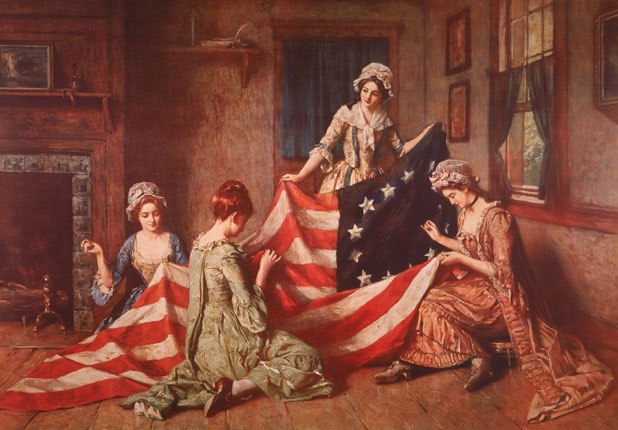
In honor of National Women’s History Month 2012 and its theme of “Women’s Education – Women’s Empowerment,” I wanted to write about a thought-provoking publication that just came across my desk about women and their evolving role in the U.S. workforce.  Since the founding of America, women like Betsy Ross have played a critical role in contributing to the economic fabric of the U.S. economy and  American households.

Image: Sewing circle presided by working mother Betsy Ross, who started out as first a home sewer before being educated as an upholstery apprentice. She  then ran an upholstery business with her husband, before managing her own business when her husband died by sewing tents, blankets and flags for the American Revolution.

Invest in Women, Invest in America: A Comprehensive Review of Women in the U.S. Economy was prepared by the Joint Economic Committee of Congress.

It forms part of GPO’s Online Bookstore National Women’s History Month collection of Government publications celebrating women’s contributions to America.

Outgoing Chair of the Committee, Congresswoman Carolyn B. Maloney, said in a December 2010 letter that the goal was to prepare a “comprehensive review of women in the U.S. economy so that policymakers could have a better understanding of women’s essential contributions to our economy and their potential to play a stronger role in our economic recovery.”

PART I: Invest in Women, Invest in America

Part I of this publication starts with an overview of the decades of progress of women in the workforce. For the first time, we learn that women now comprise half of the U.S. workforce.

Next, relating to this month’s theme of education providing empowerment for women, the report shows that women earn more college degrees than men at every level, from 57.4% of the bachelor’s degrees to over 60% of the Master’s degrees in the United States.

And it demonstrates just how important women’s earnings have become to overall household income, particularly in families with children. For example, by 2008 over 6 in 10 families with children under 6 have the mother working outside the home, and women are the sole job-holders in over a third of American families with children.

The “Invest in Women” publication discusses the three key factors that are still holding women back, including:

  1. underrepresentation in business leadership roles,
  2. a “persistent gender wage gap” in both public and private sectors, and
  3. an “out-of-date framework for social support.”

Factor 1: Underrepresentation of Women in the Executive Suite

Under this factor, the report puts forth both current figures and possible causes about why “women remain dramatically underrepresented in corporate boardrooms and executive suites” in the United States. Some figures shared in the report show that while women comprise 46.4% of all Fortune 500 employees, they make up just 15.7% of board seats, 14.4% of executive officers, 7.6% of top earning executive officers, and only 2.4% of CEOs.

This contrasts to studies included in the report that demonstrated that “companies with more women board members, on average, significantly outperform those with fewer women by 53% on Return on Equity, 42% on Return on Sales, and a whopping 66% of Return on Invested Capital.

Factor 2: Persistent Gender Wage Gap

In the private sector, “Invest in Women” reports, “women working full-time earn only 77 cents for every dollar earned by men”— a gap the report says has not improved since 2001. This wage gap is true also for the Federal Government where “women managers earn 81 cents for every dollar earned by their male manager peers”.

Source:  Women’s Media

Factor 3: An Out-Of-Date Framework for Social Support

Here the report offers the premise that “our nation’s public policies are still rooted in the antiquated assumption that families rely on a single male breadwinner” when today’s “reality is that most families depend on two breadwinners.” Discussion of the issues relating to lack of paid leave, particularly sick leave and the burden it places on mothers who often “still bear the primary responsibility for their children’s health” are followed by sections on inflexible work arrangements and insufficient “quality, affordable early care and education.

This ends with an interesting analysis of the nation’s current retirement system and its effect on women. The report points out the lifetime earnings penalty—caused by the many interruptions over the span of a woman’s career to provide unpaid at-home care for children, elderly parents or ill family members— results in vastly decreased Social Security income for women, thus increasing women’s poverty rates later in life at a rate of 11.7% vs. 7.4% for elderly men.

Possible Policy Solutions to Improve Women’s Economic Position

Some possible policy solutions are put forward in this report as well, including:

  • “Stronger protections against wage discrimination;”
  • “Health reform;”
  • “Work-family policies” (including the right to request a flexible schedule and mandatory paid sick leave);
  • Financial regulatory reform and the “establishment of Offices of Minority and Women Inclusion at each federal financial services agency;”
  • “Value the Care Economy”, which, according to the authors, refers to boosting investment in quality early education  and child care programs, such as Early Head Start and Head Start; and
  •  Differentiating the impact of tax and entitlement reforms on women versus on men.

Part II: Compendium of JEC Reports and Hearings from the 111th Congress

The second part of the publication compiles various reports and hearings held by the Joint Economic Committee that referred to women’s issues covering four areas: Women in the Economy Today, Equal Pay, Access to Benefits and Retirement Security.

It is chock full of charts, tables, graphs and quotable quotes.


HOW DO I OBTAIN “Invest in Women, Invest in America: A Comprehensive Review of Women in the U.S. Economy”?

  • Buy it at GPO’s retail bookstore at 710 North Capitol Street NW, Washington, DC 20401, open Monday-Friday, 9am to 4pm, except Federal holidays, (202) 512-0132.
  • Find it in a library.

About the Author:  Michele Bartram is Promotions Manager for GPO’s Publication and Information Sales Division and is responsible for online and offline marketing of the US Government Online Bookstore (Bookstore.gpo.gov) and promoting Federal government content to the public.