Librarians Pick Notable Federal Books- 2012 Edition

July 3, 2012

It’s that exciting time of year again if you’re a publisher of Federal publications. It’s the equivalent of the Academy Awards, the Emmy Awards or the Grammy Awards… Well, maybe that’s pushing it, but when the American Library Association’s (ALA) Government Documents Round Table or GODORT convenes the Notable Documents Panel of its Publications Committee to choose the top government-produced publications of the previous year, we can’t help but get caught up in the excitement.

Each year, this ALA GODORT Notable Documents Panel selects what it considers to be the most “Notable Government Documents” published during the previous year by Federal, state, and local governments and includes the list of winners in its prestigious Library Journal (LJ).

According to its website, Library Journal is “the most trusted and respected publication for the library community. LJ provides groundbreaking features and analytical news reports covering technology, management, policy and other professional concerns to public, academic and institutional libraries. Its hefty reviews sections evaluate 8000+ reviews annually of books, ebooks, audiobooks, videos/DVDs, databases, systems and websites.

This year, as usual, many of the Federal publications the panel selected are available through the Government Printing Office’s Federal Depository Library Program (FDLP) libraries and GPO’s Sales Program.

Out of all of the Federal Government documents LJ looked at in the past year, here are some of those it found most notable:

  Keeping America Informed: The United States Government Printing Office 150 Years of Service to the Nation

Publisher: Government Printing Office (GPO)

GPO’s own role in producing excellent Government publications in its 150 years of history gained it a place on the GODORT list for the past year:“Liberally illustrated with historical photographs and facsimiles of famous government documents, this volume will appeal to a wider audience than depository librarians. Historians and history buffs who have an interest in government and how it interacts with both the private sector and public employee unions will find a compelling story that focuses on the federal government’s obligation to keep citizens informed about its activities.” – LJ

  Statistical Abstract of the United States 2012 (Hardcover)

Statistical Abstract of the United States 2012 (Paperback)

Publisher: Commerce Department, U.S. Census Bureau

The Statistical Abstract of the United States, published since 1878, is the standard summary of statistics on the social, political, and economic organization of the United States. It is designed to serve as a convenient volume for statistical reference and as a guide to other statistical publications and sources. The latter function is served by the introductory text to each section, the source note appearing below each table, and Appendix I, which comprises the Guide to Sources of Statistics, the Guide to State Statistical Abstracts, and the Guide to Foreign Statistical Abstracts.

The Library Journal adds an important update about this: “In addition to being the quintessential statistical resource of all time, Statistical Abstract is a Notable Document for 2011 simply because this edition will be the last produced by the Census Bureau and distributed through FDLP. Future editions will be published commercially, so librarians will still have options for maintaining the continuity of their print collections. A classic reference tool.” – LJ

  Macondo: The Gulf Oil Disaster. Chief Counsel’s Report 2011

Publisher: National Commission on the BP Deepwater Horizon Oil Spill and Offshore Drilling

“The National Commission on the BP Deepwater Horizon Oil Spill was created by President Obama and charged with investigating the root causes of the largest accidental marine oil spill in the history of the petroleum industry. The committee concluded that the cause of the blowout was not mechanical. Instead, a number of poor management decisions, combined with an inadequate regulatory structure and an indifferent regulatory agency, overwhelmed the safeguards designed to prevent such disasters. Plenty of illustrations and photographs offer a glimpse into the technology of offshore oil rigs.” – LJ

  Then Came the Fire: Personal Accounts From the Pentagon, 11 September 2001

Publisher: Defense Dept., Army, Center of Military History

“In 2011, there were many publications designed to commemorate the tenth anniversary of the attacks of September 11, 2001. In addition to the 59 people aboard the flight that struck the Pentagon, 125 people in the Pentagon were killed. The editors of this memorial volume have collected the stories of eyewitnesses, including the military and civilian personnel who escaped the burning building and first responders and reporters at the scene. It also includes hundreds of photographs.”- LJ

  Freedom by the Sword: The U.S. Colored Troops, 1862-1867

Publisher: Defense Dept., Army, Center of Military History“

In what may be the definitive operational history of black troops in action during the Civil War, [author] Dobak describes the differences in how freedmen and runaway slaves were recruited, how they lived, and how they were trained. Most important, it considers how gallantly these men performed in combat at a time when many of their own leaders questioned whether they would be willing to fight for their own freedom and for that of their families. Much of the documentation comes from the ‘War of the Rebellion’ series.” – LJ

  Legacy of Excellence: The Armed Forces Institute of Pathology 1862-2011 

Publisher: Defense Dept., Army, US Army Medical Department Center and Schoo1, Armed Forces Institute of Pathology, Public Affairs Office, Borden Institute

“In 1862, shortly after the Battle of Antietam, army surgeon general Brigadier Gen. William Hammond ordered the establishment of the Army Medical Museum. Surgeons working on Civil War battlefields were encouraged to preserve anatomical specimens, such as severed limbs and diseased organs, and send them to the museum for further research. From the start, the museum made its displays of specimens and instruments, as well as its medical library, available to the general public. Under the leadership of later curators, such as John Billings and Walter Reed, the museum evolved into the Armed Forces Institute of Pathology. Readers interested in the history of science, especially medical science or in the devastating effects of Civil War weaponry on the human body, will be fascinated by the hundreds of graphic photographs.” – LJ

And a hearty congratulations to all the winning Federal agency publishers for an excellent job!

How can you get these publications from this year’s Federal Notable Government Documents collection?

  • Buy any of these publications online 24/7 by shopping the Notable Government Documents 2012 collection at GPO’s Online Bookstore.
  • Buy them at GPO’s retail bookstore at 710 North Capitol Street NW, Washington, DC 20401, open Monday-Friday, 9am to 4pm, except Federal holidays, (202) 512-0132.
  • Find these publications in a library near you.

About the Author:  Michele Bartram is Promotions Manager for GPO’s Publication and Information Sales Division and is responsible for online and offline marketing of the US Government Online Bookstore (http://bookstore.gpo.gov) and promoting Federal government content to the public.


Today in History: War of 1812 and Army Chaplains

June 18, 2012

Two hundred years ago today, on June 18, 1812, President James Madison signed into law the United States of America’s declaration of war against Great Britain to start the War of 1812.

Image: Naval services’ 1812 Bicentennial logo. Source: Navy History

Madison’s War

Fought for a myriad of reasons from the illegal impressment of American sailors onto British Navy ships to help them fight France to land grab ambitions against Canada, the War of 1812 was derisively called “Mr. Madison’s War” initially by many Americans, particularly in the Northeast.  Ill-prepared for the war with many untrained militia and without initial support from many individual states, America suffered a number of defeats, up to the capture and burning of Washington, D.C, including the White House and the Capitol building, in August 1814.

There were a number of American triumphs at sea with a much smaller American navy, and eventually, America was able to turn back British invasions in New York; Baltimore, with the famous battle at Fort McHenry where Francis Scott Key wrote the poem “Defence of Fort McHenry” that became our national anthem, “The Star-Spangled Banner;” and finally at New Orleans. (Remember Johnny Horton’s 1959 song “The Battle of New Orleans”?)

Eventually, the War of 1812 united Americans and became known as “America’s Second War of Independence.”

Army Chaplains during the War of 1812

In the book, Reliable and Religious: U.S. Army Chaplains and the War of 1812 by Kenneth E. Lawson, and published by the Office of the Chief of Chaplains of the Department of the Army, the heretofore untold story of Army Chaplains during the War of 1812 is explained in detail.

Historically, during the Revolutionary War, “there were 174 Continental Army chaplains and 93 militia chaplains.” A number of New England clerics served at Concord in, with some even shouldering muskets and fighting alongside their fellow soldiers. This continued to be true in the War of 1812, as many United States Army chaplains even fought alongside the soldiers they served.

Most of the chaplains (over 200) who served in the War of 1812 were militia chaplains. Only 13 official regular army chaplains served during the war, either directly with units or headquarters. One of the chaplains ministered to West Point cadets. Regular army chaplains were classified as  ”those of the rank of major and captain” and “received the same pay, rations and forage as a surgeon,” since presumably they “healed men’s souls.”

All 13 U.S. Army ministers were Protestant, and they came from all over the United States—from Vermont all the way down to South Carolina. Two chaplains, Rev. Carter Tarrant and Rev. James Wilmer, died while serving as military chaplains.

Reverend Joshua Thomas, “Parson of the Islands”

Reliable and Religious gives detailed accounts of the war and religious situation and chaplaincy activities in each state and territory during the War of 1812, including biographies of the chaplains who served in the campaigns in each state.

One of the more famous chaplains was Reverend Joshua Thomas, a fisherman turned Methodist minister who  founded churches and preached along Virginia and Maryland’s Eastern Shore, often using his log canoe. Joshua and his wife Rachel were living on Tangier Island just below the Maryland-Virginia border during the War of l812, when the British took possession of the Island and used it as build the 100-acre Fort Albion as their center of operations as they plundered the Chesapeake Bay shoreline and prepared for their invasion of Baltimore.

Image. Reverend Joshua Thomas, “Parson of the Islands”. Source: Findagrave.com.

Thomas, dubbed “Parson of the Islands”, was held in esteem by the infamous Admiral Cockburn who asked the minister to preach to 12,000 British troops as they prepared to go to war against Ft. McHenry in Baltimore.

On September 11th, 1814, on Tangier Island, Parson delivered his famous, fiery sermon, “Thou Shalt Not Kill,” with its dire prediction to the British that they would be defeated at the upcoming Battle of Baltimore.

Image: Rev. Joshua Thomas gives his “Thou Shalt Not Kill” sermon to British troops before the Battle of Baltimore in 1814 on Tangier Island. Source: “The Parson of the Islands” by Adam Wallace.

According to Lawson’s research, Rev. Thomas warned the British “of the danger and distress they would bring upon themselves and others by going to Baltimore with the object they had in view” and told them “it was given to me by the Almighty that they [the British] could not take Baltimore and would not succeed in their expedition.” His sermon turned out to be correct, as the Redcoats were turned back at Fort McHenry, with Francis Scott Key looking on and scribbling away.

To this day, the coastal Maryland celebrates “Joshua Thomas Day” in his honor.

Today’s Army Chaplains

During the Civil War, the Army Chaplaincy developed many procedures still in place, and most chaplains became less a “fighting parson”, and more “spiritual” in their emphasis. After the Civil War, in fact, chaplains were no longer permitted to carry weapons and are presently supposed to be issued a Geneva Convention Identity Card.

Today, the United States Army Chaplain Corps consists of highly educated (college degree plus theological graduate degree required) chaplains who are ordained clergy and endorsed by their particular faith group to serve all people, regardless of religious or non-religious affiliation. Most are typically embedded with the troops in deployed combat units, at service schools, military hospitals in the field and at military installations around the world.

Image: U.S. Army Chaplaincy image. Source: U.S. Army

According to the Office of the Chief of Chaplains’ website, the Army Chaplaincy has a long and distinguished record of proving aid and comfort to America’s soldiers around the world:

Since July 29, 1775, approximately 25,000 Army Chaplains have served as religious and spiritual leaders for 25 million Soldiers and their Families. Always present with their Soldiers in war and in peace, [U.S.] Army Chaplains have served in more than 270 major wars and combat engagements. Nearly 300 Army Chaplains have laid down their lives in battle. Six have been awarded the Medal of Honor… Currently, over 2,900 Chaplains are serving the Total Army representing over 130 different religious organizations… Their love of God, Country and the American Soldier has been a beacon of light and a message of hope for all those who have served our nation.

The Army Chaplain Corps’ mission is to provide “religious support to America’s Army while assisting commanders in ensuring the right of free exercise of religion for all Soldiers. In short, we nurture the living, care for the wounded, and honor the fallen.

Knowing this, it is probable that the Army Chaplains from the War of 1812 sang more loudly this forgotten stanza from Francis Scott Key’s original “Star-Spangled Banner” poem:

Blest with victory and peace, may the heav’n rescued land
Praise the Power that hath made and preserved us a nation.
Then conquer we must, when our cause it is just,
And this be our motto: “In God is our trust.”
And the star-spangled banner in triumph shall wave
O’er the land of the free and the home of the brave!

Image: Francis Scott Key standing on boat, with right arm stretched out toward the US flag– The Star-Spangled Banner– flying over Fort McHenry, Baltimore, Maryland, during the War of 1812. Source: National Archives

Find War of 1812 Bicentennial information and events in the United States and Canada at www.Visit1812.com. I’m off to see the War of 1812 Bicentennial “Star-Spangled Sailabration” in Baltimore Harbor!

HOW DO I OBTAIN the Reliable and Religious: U.S. Army Chaplains and the War of 1812 publication?

  • Buy it online 24/7 at GPO’s Online Bookstore.
  • Buy it at GPO’s retail bookstore at 710 North Capitol Street NW, Washington, DC 20401, open Monday-Friday, 9am to 4pm, except Federal holidays, (202) 512-0132.
  • Find it in a library.

About the Author:  Michele Bartram is Promotions Manager for GPO’s Publication and Information Sales Division and is responsible for online and offline marketing of the US Government Online Bookstore (http://bookstore.gpo.gov) and promoting Federal government content to the public.


Understanding America’s Longest War

May 25, 2012

Memorial Day in the United States is a time to remember those members of the military who have died in service to our country.  Originally known as Decoration Day, this federal holiday originated after the American Civil War to commemorate the fallen Union soldiers as widows would turn out to decorate the graves.

In fact, as I write this, all available members of the 3rd U.S. Infantry Regiment, also known as The Old Guard, are a just a mile away from GPO headquarters at Arlington National Cemetery, planting over 280,000 small U.S. flags—one at each grave marker— that will stay in place just for Memorial Day weekend, carrying on an annual “Flags In” tradition started in 1948.

Image: “Old Guard” soldier and son place flags in Arlington Cemetery during “Flags in”, Memorial Day 2008. Source: Arlington Cemetery FlickR

Remembering—and understanding—the war in Afghanistan

Many on this day take the time to reflect on the various military missions that resulted in the losses of brave service men and women, with our current war in Afghanistan offering the most recent opportunity for reflection.

A master at providing this analysis is Joseph J. Collins, author and professor at the National War College, who wrote the new book from the National Defense University called “Understanding War in Afghanistan” in order to provide military leaders, civil servants, diplomats, students and civilians the lessons in history of war and strife in that troubled nation.

Thoughtful questions, thought-provoking answers

Collins asks—and answers—a number of thought-provoking questions about the current war in Afghanistan:

  1. How did the United States and its allies get to where they are today?
  2. How can that coalition understand the many wars in Afghanistan over the past 33 years?
  3. How should it define its interests today?
  4. How can this coalition of nearly 50 nations help to bring this war to an end?

To answer these questions, Professor Collins provides both historical background and analysis to put it into context, finishing with a look towards possible next steps:

  • Chapter 1- Afghan history and culture:  Says Collins, “It is important to first examine the land, [the Afghan] people, and their culture.
  • Chapters 2 through 5- Prior wars: Next, Collins reviews the war-fraught Afghan history, the Soviet-Afghan War and the conflicts that followed it, including their Civil War, the rise of the Taliban, their role in 9/11, and the first war against the Taliban government.
  • Chapter 6- Insurgency: This chapter helps us “understand the basic theory and concepts that underpin Afghan counterinsurgency in the 21st century”.
  • Chapter 7 & 8- 2nd War against the Taliban, Rebuilding and the Surge: These chapters enable us to comprehend what happened during 2002-2010 as the coalition attempted to fight the Taliban while rebuilding this battle-weary land.
  • Chapter 9: – Assessment and Options:  Collins completes his book with a frank assessment of the “potential choices that national leaders face for the future” in Afghanistan.

Enduring lessons and legacy of Operation Enduring Freedom

Now in its twelfth year, the Afghanistan War is the longest war in U.S. history, surpassing even the Vietnam War.  Operation Enduring Freedom, with over 1,892 fallen servicemen and women just from the United States and over 1,000 casualties from other nations who form part of the coalition, is in the minds of many this Memorial Day.

Following the mantra of Spanish born American philosopher and writer George Santayana who wrote “Those who do not learn from history are doomed to repeat it,” Understanding War in Afghanistan helps provide us the basis to learn the lessons of history in this particular conflict in order to inform our future course.

Dan Caldwell, Distinguished Professor at Pepperdine University, agrees, saying of Professor Collins’ book:

“This is the required text for ‘Afghanistan 101’—a primer that skillfully explains the realities of a complicated country and America’s longest war. It is written in a clear, informative way that is accessible to citizens, students, and civilian and military personnel who want or need to learn more about one of the most important issues of our time.”

What better way to remember those who have fallen in Afghanistan than to learn about the cause for which they sacrificed all?

How Do I Obtain Understanding War in Afghanistan?

  • Buy it online 24/7 at GPO’s Online Bookstore.
  • Buy it at GPO’s retail bookstore at 710 North Capitol Street NW, Washington, DC 20401, open Monday-Friday, 9am to 4pm, except Federal holidays, (202) 512-0132.
  • Find it in a library.

About the Author:  Michele Bartram is Promotions Manager for GPO’s Publication and Information Sales Division and is responsible for online and offline marketing of the US Government Online Bookstore (Bookstore.gpo.gov) and promoting Federal government content to the public.

The U.S. military storms to the rescue in foreign disaster relief

March 5, 2012

Last year, the United States suffered a record number of devastating weather and climate disasters, including hurricanes, tornadoes, wildfires and floods, causing the President to issue a record 99 “major disaster declarations” during 2011.

Image: Natural disaster word collage Source: JimKimmartin.com

(And just this week, as I write this post, we are faced with the news about a line of dozens of deadly tornadoes that hit the Midwest, striking Indiana, Illinois, Kentucky, Missouri, and Kansas, with particular devastation to the towns of Harrisburg, IL and Henryville, IN.  See the end of this article for a links to terrific Federal disaster preparedness and response publications for citizens and professionals.)

However, the U.S. unfortunately had a lot of company as the entire world endured one of the worst years ever for catastrophic natural disasters.

Record Number of Catastrophic Natural Disasters Worldwide

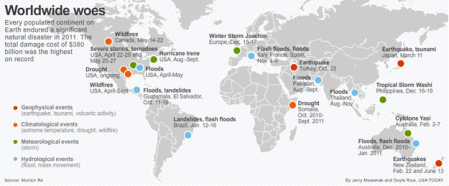
2011 was the costliest year on record in terms of global property damage, with more than a third of a trillion dollars in damages worldwide, according to Munich Re, a multinational that insures insurance companies. The single worst and costliest natural disaster of the year was Japan’s earthquake and subsequent tsunami and nuclear disaster.

But some of the other worst disasters in the world in 2011 included: floods and landslides in Thailand, Guatemala, El Salvador, Pakistan and Brazil; earthquakes in New Zealand and Turkey; severe spring storms and tornadoes in the USA; Hurricane Irene in the USA; Cyclone Yasi and flooding in Australia; drought in the USA and Somalia; wildfires in the USA and Canada; and the violent winter storm Joachim that swept across western Europe in December.

Image: The world’s natural disasters of 2011. Source: “2011 was costliest year in world disasters” USA Today, January 4, 2012.

Fortunately, while the total number of disasters was about average, the loss of life was below average. Still, many lives were lost around the world, including 15,840 fatalities reported in Japan’s disaster alone.

DoD to the Rescue 

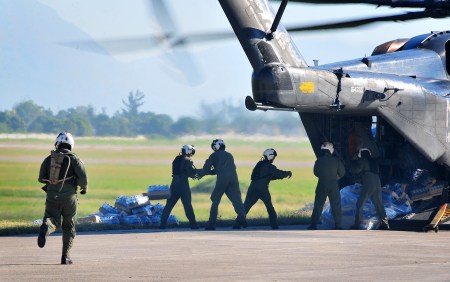
To help local governments around the world respond to these disasters, the United States Government often comes to the rescue with supplies, personnel and logistical support. But sometimes civilian agency response is not sufficient. In these cases, the U.S. Department of State and U.S. Agency for International Development may ask for support from the U.S. military.

Image: The crew of a U.S. Navy MH-53E Sea Dragon helicopter from the aircraft carrier USS Carl Vinson (CVN 70) unloads food and supplies at the airport in Port-au-Prince, Haiti, on Jan. 15, 2010. Source: Defense.gov

U.S. Government and Department of Defense (DoD) joint task forces may also coordinate with International Organizations such as the United Nations and International Red Cross and Red Crescent and other Intergovernmental Organizations (IGO) and Non-Governmental Organizations (NGO).

In total, the U.S. Government on average responds to approximately 70 to 80 natural disasters worldwide annually, but the Department of Defense (DoD) only lends support to 10-15 percent of these disaster responses.

The DoD describes their foreign disaster relief assistance as follows:

“DoD disaster assistance can range from a single aircraft delivering relief supplies, to a fullscale deployment of a brigade-size or larger task force. Though the overall percentage of disasters requiring DoD support is relatively small, these disasters tend to be crises of the largest magnitude and/or the greatest complexity.”

Some of the past disaster response efforts with which the U.S. military has assisted include the 2004 tsunami in Southeast Asia; 2005 earthquake and 2010 flooding in Pakistan;  and the 2010 earthquake in Haiti.

Handy Handbook for All Those Who Give a Hand

To assist their personnel who are engaged in foreign disaster relief operations, the Department of Defense prepared a handbook which “offers an overarching guide and reference for military responders in foreign disaster relief operations,” particularly for Joint Task Force (JTF) Commanders and below.

INTENDED FOR ANYONE INVOLVED IN US FOREIGN DISASTER RELIEF OPERATIONS: Fortunately, DoD also released an unclassified version that can be used not only by the military, but also by anyone involved in U.S. foreign disaster response operations, including U.S. Government agencies, international organizations, Intergovernmental Organizations (IGO) and Non-Governmental Organizations (NGO).

CONTENTS: This public version of the “Department of Defense Support to Foreign Disaster Relief Handbook” (ISBN:  9780160888632) is divided into 4 major sections:

  • Section I: Introduction: Provides the background, legal authorities and guidance for performing foreign disaster relief (FDR) operations. Includes info on the U.S. Government’s FDR response processes, international and humanitarian guidelines and principles.
  • Section II: Operational Context and Planning Factors.
  • Details the types of missions that DoD units may participate in and the roles of Joint Task Force members. Also provides a five-phase FDR operation and metrics of success, and how to protect responders. Of particular interest in Chapter 6 are the characteristics of natural disasters, including hazards expected from different disaster types, and in Chapter 7, guidelines for talking to the media.
  • Section III: Supported and Supporting Organizations
    • This section provides a broad overview of functional commands and the cross-cutting organizations roles and missions, including Geographic Combatant Commands (GCC) and typical DOD tactical FDR units. Even shows photos to help identify different U.S. military transportation vehicles that could be used.

  • Section IV: Appendices: A number of extremely useful appendices are included that come in handy for anyone involved in Foreign Disaster Relief.
    • Appendix A presents the legal aspects of FDR operations, such as the list of laws and guidance documents allowing DoD participation in humanitarian relief efforts overseas. For example, the principal authority for DOD to conduct foreign disaster relief is the Foreign Assistance Act of 1961 (Public Law 87-195) (See p. 15 of this compilation of Legislation on Foreign Relations) which “provides the legal guidance for U.S. Government engagement with friendly nations.
    • Appendix B provides the DoD guidelines for interaction with NGOs in a permissive environment. More importantly, it provides excellent color charts showing how civil and military operation centers interact and differ. The page below is an example of how interaction between various civil and military operations in an operations center.

    • Appendix C provides sample formats that are useful to staff who support FDR operations, including excellent example worksheets and sample reports.
    • Appendix D provides a list of useful FDR agency and resources websites.
    • Appendix E provides a list of training courses, both from the Department of Defense and other U.S. agencies like the State Department and the Peace Corps.
    • Appendix F lists references useful in planning and executing FDR missions.
    • Appendix G is a list of acronyms used in this handbook, a must-have for dealing with the military especially, but includes acronyms for international organizations as well. For example, did you know that “OCONUS” means “Outside the continental United States” and “SPINS” means “Special Instructions”?

EASY-TO-READ, PORTABLE FORMAT: Throughout the Handbook are color flowcharts, organizational charts, checklists, notes and warnings, making this easier to read than one would expect from a military handbook.  And because of its rugged spiral bound format and smaller size, I found this handbook particularly easy to hold in one hand while writing with another, since it could lying totally flat and fold back on itself.  Considering that online versions are not convenient in disaster areas, I can see why this is a must-pack item in any U.S. foreign disaster responder’s emergency bag.

Overall, the Department of Defense Support to Foreign Disaster Relief (Handbook for JTF Commanders and Below) provides a fascinating and useful insight into how to respond to natural disasters wherever they may happen around the globe.

HOW CAN I OBTAIN THIS “Department of Defense Support to Foreign Disaster Relief Handbook “?

  • Buy it online 24/7 at GPO’s Online Bookstore.
  • Buy it at GPO’s retail bookstore at 710 North Capitol Street NW, Washington, DC 20401, open Monday-Friday, 9am to 4pm, except Federal holidays, (202) 512-0132.
  • Find it in a library.
  • Find some of the information online.

OTHER DISASTER RELIEF PUBLICATIONS FROM THE U.S. GOVERNMENT:

  • Field Operations Guide for Disaster Assessment and Response by the Office of U.S. Foreign Disaster Assistance (OFDA), print edition available from GPO.  This handbook comes at the topic from the U.S. civilian agency perspective, helping members of a Disaster Assistance Response Team (DART) get quickly oriented while on site at a disaster.
  • National Interoperability Field Operations Guide Version 1.4 Provides a waterproof, pocket-sized guide that contains radio regulations, tables of radio channels, and technical reference information, and is a must-have tool for establishing or repairing emergency communications in a disaster area.
  • U.S. Foreign Disaster Assistance Reference Guide from the United States Department of State and U.S. Agency for International Development (online version only). Included are basic fact sheets for 19 funding accounts, each containing citations of important underlying laws, itemizing primary activities (such as Bilateral Economic Assistance, Humanitarian Assistance, Multilateral Economic Assistance, Military Assistance and Law Enforcement Assistance), outlining recent funding history, and describing important statutory restrictions.
  • Legislation on Foreign Relations is a list of U.S. laws governing all aspects of foreign relations, including disaster relief, compiled by both Congressional committees: U.S. House Committee on Foreign Affairs and the U.S. Senate Committee on Foreign Relations.
  • Are You Ready? An In-depth Guide to Citizen Preparedness. This FREE online guide provides a step-by-step approach to disaster preparedness by walking the reader through how to get informed about local emergency plans, how to identify hazards that affect their local area and how to develop and maintain an emergency communications plan and disaster supplies kit. It is produced by Ready.gov, a national public service advertising campaign designed to educate and empower Americans to prepare for and respond to emergencies including natural and man-made disasters.
  • FREE Tornado Safety Guide from the Federal Emergency Management Administration (FEMA) Ready.gov website has important tips on what to do before, during and after a tornado.

About the Author:  Michele Bartram is Promotions Manager for GPO’s Publication and Information Sales Division and is responsible for online and offline marketing of the US Government Online Bookstore (Bookstore.gpo.gov) and promoting Federal government content to the public.


CIA’s World Factbook: Global intelligence for every thinker, traveler, soldier, spy

January 27, 2012

A great publication not only provides timely and valuable information, but it also allows us a glimpse into the times and events that necessitated its production.

Such is the case with the CIA’s World Factbook—which marks its 50th anniversary in 2012 for the classified version and over 40 years for the public version described here— and shows us a glimpse into how Pearl Harbor and the Cold War changed the way America began to gather information about all corners of the globe.

The Factbook has its origins in the aftermath of the Japanese attack on Pearl Harbor, and the realization by Congress and the White House that lack of coordinated intelligence across all Governmental departments had left the United States woefully unprepared for the attack, and determined to correct this as a national security necessity and priority.  According to the CIA historians:

During World War II, intelligence consumers realized that the production of basic intelligence by different components of the US Government resulted in a great duplication of effort and conflicting information.

Detailed and coordinated information was needed not only on such major powers as Germany and Japan, but also on places of little previous interest. In the Pacific Theater, for example, the Navy and Marines had to launch amphibious operations against many islands about which information was unconfirmed or nonexistent.

Image above: During WWII, OSS intelligence reviewed existing maps with the military. Source: Top Secret Writers

JANIS Drops In

To correct this deficiency, in 1943, General George B. Strong (G-2), Admiral H. C. Train (Office of Naval Intelligence – known as ONI), and General William J. Donovan (Director of the Office of Strategic Services – known as OSS, the precursor of the CIA) oversaw the formation of a Joint Intelligence Study Publishing Board to assemble, edit, coordinate, and publish the Joint Army Navy Intelligence Studies (JANIS).

JANIS was the first cross-departmental basic intelligence program to fulfill the needs of the US Government for an authoritative and coordinated appraisal of strategic basic intelligence.

All groups involved in the war agreed that finished basic intelligence was required that covered territories around the world where the war was being fought. They needed detailed, up-to-date maps and geography; basic understanding of the cultural, economical, political and historical issues of the people and the region.

Compiling and publishing this information for the Allied intelligence needs, JANIS became an indispensable reference for war planning and execution.

The Cold War Gives Birth to the CIA… and the National Intelligence Survey

But the Cold War that immediately followed World War II showed that there was just as much need for continued intelligence gathering as ever. In the 1946 publication “The Future of American Secret Intelligence,” national security author George S. Petee wrote: “The conduct of peace involves all countries, all human activities – not just the enemy and his war production.”

In acknowledgement of this, the Congress established the Central Intelligence Agency in 1947 which immediately took over responsibility for JANIS. The next year, the National Security Council authorized the National Intelligence Survey program as a peacetime replacement for the wartime JANIS program. By 1955, the Hoover Commission evaluating the CIA advised Congress that: “The National Intelligence Survey [NIS] is an invaluable publication which provides the essential elements of basic intelligence on all areas of the world. There will always be a continuing requirement for keeping the Survey up-to-date.

The Sum of All Facts: The World Factbook

Subsequently, the World Factbook was created as an “annual summary and update to the encyclopedic NIS studies.

Originally published only as a classified publication starting a half century ago in August 1962 (just prior to the Cuban Missile Crisis of October 1962), the World Factbook was first published in its declassified version for public consumption in June 1971, 40 years ago.

Image: CIA map produced for President Kennedy’s team estimating the range of Soviet missiles being set up in Cuba during the Cuban Missile Crisis in October 1962. Source: Canadian History Portal

Today’s World Factbook is the declassified version of the finished basic intelligence compiled by the U.S. Central Intelligence Agency (CIA) and coordinated across all the U.S. intelligence community. It uses only recognized, authoritative sources, not only CIA-gathered intelligence, but also a wide variety of U.S. Government agencies from the National Security Agency, Department of Defense, Department of State, Department of Agriculture, Defense Intelligence Agency, and hundreds of other published sources around the world.

Printed Version Provides an Annual Snapshot

Once a year, the Government Printing Office takes a snapshot of this information from the CIA as of January 1 and produces a printed version of the World Factbook. It provides unparalleled and succinct information about hundreds of countries in a format that provides an easy-to-use comparison.The Factbook has been available from GPO since 1975.

The 2011 version just published provides a two- to three-page summary of the history, people, government, economy, geography, communications, transportation, military, and transnational issues for 267 world entities, including U.S.-recognized countries, dependencies, and other areas in the world.

Each country has its own basic map and shows its flag, but of particular interest are the maps of the major world regions, as well three pull-out maps included in the publication: Physical Map of the World, Political Map of the World, and Standard Time Zones of the World Map, all of which can be used as wall maps.

Who Can Benefit from the World Factbook?

A perennial best seller in the GPO bookstore, The World Factbook is used by not only US Government officials, but is a must-have reference for researchers, news organizations, businesses, geographers, international travelers, teachers, professors, librarians, and students.

In short, after 40 years, the World Factbook is still the best source of  up-to-date, summarized intelligence about the world for any “thinker, traveler, soldier, or spy” of any age!

Image: Pupils at Crosby’s Valewood Primary School near Liverpool, England, dress up as ‘Spies’ as part of a creative project. Photographer: Andrew Teebay. Source: Liverpool Echo

To gather your own up-to-date intelligence about the world we live in, you can obtain the World Factbook 2011 at one of these locations:

How can you get this publication?

  • Buy the current version of the World Factbook and selected previous editions online 24/7 at GPO’s Online Bookstore.
  • Buy it at GPO’s retail bookstore at 710 North Capitol Street NW, Washington, DC 20401, open Monday-Friday, 9am to 4pm, except Federal holidays, (202) 512-0132.
  • Find it in a library.

Some Interesting “DID YOU KNOW?” Facts related to the CIA’s World Factbook:

  • Question: What separates “intelligence” from “information”?
    • Answer: According to the CIA: The Intelligence Cycle is the process by which information is acquired, converted into intelligence, and made available to policymakers. Information is raw data from any source, data that may be fragmentary, contradictory, unreliable, ambiguous, deceptive, or wrong. Intelligence is information that has been collected, integrated, evaluated, analyzed, and interpreted. Finished intelligence is the final product of the Intelligence Cycle ready to be delivered to the policymaker.

The three types of finished intelligence are: basic, current, and estimative. Basic intelligence provides the fundamental and factual reference material on a country or issue.

  • Question: “Why is the British Labour Party misspelled?”
    • Answer: When American and British spellings of common English words differ, The World Factbook always uses the American spelling, even when these common words form part of a proper name in British English.
  • Question: “What is a ‘doubly landlocked’ country and which are the only two in the world?”
    • Answer: A doubly landlocked country is one that is separated from an ocean or an ocean-accessible sea by two intervening countries. Uzbekistan and Liechtenstein are the only countries that fit this definition.
  • Question: “Why does the Factbook use metric units, even though Americans still use traditional units of measure like feet, pounds, and Fahrenheit?”
    • Answer: US Federal agencies are required by the Metric Conversion Act of 1975 (Public Law 94-168) and by Executive Order 12770 of July 1991 to use the International System of Units, commonly referred to as the metric system or SI. In addition, the metric system is used by over 95 percent of the world’s population.
  • Question: “Why is the European Union listed at the end of the Factbook entries? It’s not a country!”
    • Answer:  The European Union (EU) is not a country, but it has taken on many nation-like attributes and these may be expanded in the future. A more complete explanation on the inclusion of the EU into the Factbook can be found in the Preliminary statement.

About the Author:  Michele Bartram is Promotions Manager for GPO’s Publication and Information Sales Division and is responsible for online and offline marketing of the US Government Online Bookstore (Bookstore.gpo.gov) and promoting Federal government content to the public. She’s a big fan of the National Spy Museum and of spy movies, which she is going to enjoy for her birthday tomorrow.


9/11 at the Pentagon – 10 Years Later

September 6, 2011

It’s hard to believe that the 10th anniversary of the 9/11 attacks is almost here. It was one of those events, like Pearl Harbor or the Kennedy assassination, which remains in the memory with startling clarity. From where I was working in the Government Printing Office (GPO), we could see the column of smoke from the strike on the Pentagon. Later, after Federal Government facilities in the DC area closed down, I walked from GPO to the Smithsonian’s National Museum of American History (I still remember a woman telling a Smithsonian guard that she had seen someone on the building’s roof – and who could tell what that meant in a world spinning out of control?) to meet my wife, who by some miracle got into the District and picked me up. On the way home, we drove past the Pentagon. It looked like the set of a disaster movie, the windows in the stricken area appearing as little orange rectangles of flame in a floodtide of black smoke. Several years later, after a reconstruction that left no sign of the horrific damage, I was in the Pentagon on business and our escort mentioned that we were walking in the corridor through which Flight 77 smashed – an awesome and saddening moment.

Several years ago, the Office of the Secretary of Defense published what must be considered the definitive story of September 11, 2001 at the Pentagon. Pentagon 9/11 is packed with eyewitness accounts of the strike, the fires, the deaths, and the heroism of rescuers in the face of almost unimaginable disaster. It’s chilling to read eyewitness descriptions of Flight 77 flying into the Pentagon (more than 1,300 interviews went into the development of this book), and uplifting to find out how some badly injured staffers and outside rescuers helped others to escape the resulting inferno. As the book notes, “There could not have been as many survivors of the attack on the Pentagon without the persistent and selfless acts of others – military and civilian – who were themselves caught in the maelstrom or came unhesitatingly from elsewhere in the building to respond to the desperate circumstances facing the many victims trapped in the wreckage.”

Another chapter describes the efforts of firefighters to extinguish those orange rectangles of flame I saw that day, fed by thousands of gallon of jet fuel. Other sections cover medical treatment of the victims, securing the building, helping the survivors and the families of the victims, and the gigantic effort that allowed the Pentagon to be declared “open for business” on September 12. It’s a dramatic story, and Pentagon 9/11 tells it both factually and with compassion.

You can access this excellent book in multiple ways. To browse though it, go here. GPO still has copies of the first edition and will soon have a 10th anniversary edition with a new Foreword by Secretary of Defense Leon Panetta. You can also find an eBook version here. Finally, it’s also available in many libraries. Whichever format you choose, you’ll be rewarded by an unforgettable reading experience.