Get Sunwise and Block the Sun, Not the Fun

June 3, 2013

School’s out and the sun’s out, too, so it is time to teach kids about sun safety, particularly as June 2-8 is National Sun Safety Week. With children playing in the backyard, at the park, or in the pool or at the beach, it is important for parents to be aware of sun safety and for kids to be responsible for their own well-being when it comes to the sun.

The Environmental Protection Agency (EPA) has two great resources as part of their SunWise program. The Mission: Sunwise Activity Book 2013 is an educational, hands-on way for kids to learn about sun safety, and the companion website – SunWise – provides parents, teachers, and babysitters with additional resources for teaching children about the harmful effects of the sun.

Fulfill the Mission to Get “Sunwise”

mission_sunwise_activity_book_Page_01The Mission: SunWise Activity Book 2013 targets children in kindergarten through 8th grade and takes a more thorough approach to sun safety. Children learn about the ozone layer, ultraviolet rays, the UV Index, thermometers and preventative actions to protect themselves from the harmful effects of the sun.

There are more than a dozen activities including drawing and coloring, matching, word scrambles and fill in the blanks to engage children in sun safety lessons. The activity book doesn’t just tell kids to wear sun screen and play in the shade, but explains what causes sunburns and why it is important to be “sunwise.” [Says GovBookTalk Editor Michele Bartram: “My favorite page is the “Slip, Slop, Slap, Wrap, Check, Play” page!”]

Parent and Teacher Sun Safety Resources

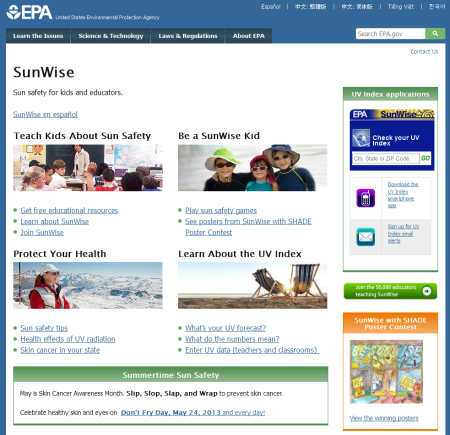
The EPA’s Sunwise sun safety website, http://www2.epa.gov/sunwise, has endless resources for adults and children. Teachers can download suggested lesson plans with PowerPoint presentations and sign-up for the SunWise Program to receive free toolkits that have age appropriate content and activities for their classrooms. Children can play interactive sun safety games, take quizzes and become “Sun Safety Certified.”

Together, adults and children can learn about the UV Index scale and the suggested precautions that go with each category and the health effects of overexposure to UV rays.  It even has Skin Cancer Fact Sheets by state showing the skin cancer rates and Action Steps for Sun Safety.

The website’s content is well-organized and can be translated into Spanish to reach a greater audience.

EPA-Sunwise-WebsiteAnother useful site is from the not-for-profit Sun Safety Alliance, (también en español) which offers its “Block the Sun, Not the Fun” program in addition to sponsoring National Sun Safety Week. 

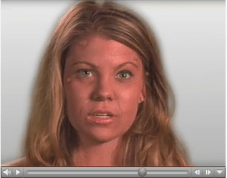
Graphic-Skin-cancer-video-Sun-Safety-AllianceThe website includes resources for Educators, including this Teacher’s Guide; Healthcare Professionals; Parents and Early Childcare personnel; and a Kids site. It also has activities for children from infants and toddlerspre-school age, and kindergarten to 2nd grade, to grades 3 to 5, middle school,and  all the way through high school.

Image: From a video on the Sun Safety Alliance home page, showing the effects of skin cancer on a former suntan addict. She says, “I wish I knew then what I can see now!”

It is not fun to avoid the sun and sit inside all summer. So be proactive and start the summer out right by taking preventative actions to avoid sunburns. Keep in mind that there is more to sun safety than just putting on sun screen.

HOW DO I OBTAIN the “Mission: SunWise Activity Book 2013”?

  • Buy it online 24/7 on GPO’s U.S. Government Bookstore.
  • Buy it at GPO’s main retail bookstore at 710 North Capitol Street NW, Washington, DC 20401, open Monday-Friday, 9am to 4pm, except Federal holidays, (202) 512-0132.
  • Find it in a a federal depository library.

About the Authors: Our guest blogger is Emma Wojtowicz, Public Relations Specialist in GPO’s Office of Public Affairs. Additional content was provided by Government Book Talk Editor Michele Bartram, Promotions Manager for GPO’s Publication and Information Sales Division.


People Get Ready, There’s a Storm Coming

May 29, 2013

Hopefully, you’ve never had to live through a hurricane or a tornado. I count myself lucky to have escaped the worst of the major weather events; living in an area that gets spent hurricanes is bad enough.

nhpwBanner2013If you live near the Atlantic Coast, as I do, you do need to worry about hurricanes. You want to remember June 1 as a significant date. It’s the start of the hurricane season, which runs from June 1 to October 1. For that reason, NOAA’s National Hurricane Center (the National Oceanic and Atmospheric Administration) kicks off National Hurricane Preparedness Week every year before the season starts. If you can’t leave home to avoid being in the path of hurricanes, the next best thing you can do is be prepared.  Make plans for getting through a storm: family communication plans and buddy plans. Build your disaster kit.

After my family and I lived through a man-made disaster, we made an evacuation plan so we know how we’ll try to reach safety. You should talk with your family about emergency strategies. Having plans for a storm or disaster doesn’t mean you’ll be able to use them, but you’ll be far better off than if you don’t have a plan. Go through checklists you can find at www.ready.gov and find out everything you can to be organized.

Hurricanes: Information and Activity Booklet

For further children’s activities and tutorials, there’s Hurricanes: Information and Activity Booklet, designed for ages nine and older. The slim volume describes the history of the word “hurricane”, as well as the reasons NOAA attaches personal names to each hurricane. The work also explains hurricane wind scales, defines hurricanes and typhoons, and much more.

Of special note are the accompanying pictures of some of recent history’s most destructive storms—Irene, Dora, Kenneth, Rick, Katia and of course, Katrina—help students understand how colossal they are. The photos show the storms nestled up against landmasses that they overshadow. If you could not visualize how large and fearsome these storms were before, you’d know it after you saw their photos. The informative graphics, puzzles, tests and quizzes provided will give children a good basic understanding of hurricanes.

katrina_in_gulf_2005-08-28Image: NOAA satellite image of Hurricane Katrina, taken on Aug. 28, 2005, at 11:45 a.m. EDT, a day before the storm made landfall on the U.S. Gulf Coast. While in the Gulf of Mexico, Katrina’s winds peaked near 175 miles per hour. Credit: NOAA

After studying both Hurricanes and Watch Out-Storms Ahead!, your kids should be as intellectually prepared as they can be.

Ready…Set…Prepare!

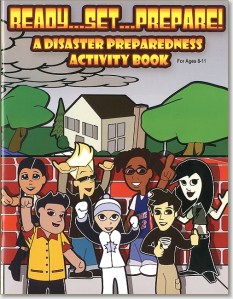
ReadySetPrepareYou’ll want to pick up a copy of Ready…Set…Prepare! [for Ages 4-7] Reading it will help your kids learn how to help your family prepare for storms in a more practical sense. FEMA designed this activity book to teach kids ages four to seven how to prepare for disasters such as hurricanes and tornadoes.

Two cartoon kid characters—Angela and Mario, along with their emergency expert friends Bright Shinely and Newser—learn what they, too, can do to help their families prepare for disasters. (Parents and teachers of Dora and Diego fans, take note: these characters will seem eerily familiar. 😉

Each chapter gives the basic facts about evacuation plans, family communication plans, pet care plans, and the types of disasters. Practical lists are scattered throughout that may help adults as much as children, such as a disaster supply kit list. Fun exercises to color and flashcards to cut out with the child’s recently acquired scissoring skills are also included.

Ready-Set-Prepare_ages-8-11Your children will find some solid entertainment packed in with the lessons included in this book. They are likely to wind up exhorting you to get your emergency plan together—and what could be better than that? Getting yourself and the little people in your life ready for an emergency is one of the best things you could do to protect your most precious assets.

FEMA created another version of Ready…Set…Prepare! [for Ages 8-11]. This contains more sophisticated activities and lessons for the older elementary schooler to prepare for emergencies.

Watch Out…Storms Ahead! Owlie Skywarn’s Weather Book

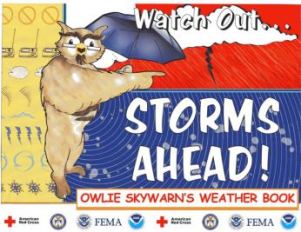
owlie-skywarn_coverAn important part of making these plans is educating the children in your life—your children, your students, etc. If you are working with school-aged children, a good place to start is the excellent picture/activity book, Watch Out-Storms Ahead! Owlie Skywarn’s Weather Book. This volume is a joint publication of NOAA, FEMA (the Federal Emergency Management Agency) and the American Red Cross, and it covers tornadoes, lightning, floods and winter storms as well as hurricanes.

The book shows children what they can do to help their families get ready. There are quizzes, warnings, preparation and evacuation tips, and statistics that will help kids understand the importance of being prepared. Since the pictures are black and white, your kids can color them too. Throw this book and a packet of crayons in your disaster kit.

Sample question from the quiz: “A hurricane [blank] means a hurricane is expected within 36 hours and winds could reach 74 mph or more.” (answer: Warning)

How can I obtain these publications?

About the author: Our guest blogger is Jennifer K. Davis from GPO’s Library Services & Content Management Division that supports the Federal Depository Libraries Program (FDLP). (Article is adapted from an original  post in the FDLP Community site blog by Government Book Talk Editor, Michele Bartram, GPO Promotions & Ecommerce Manager.)


¡Celebre! We have Spanish-language books for National Latino Books Month

May 10, 2013

We celebrated a holiday this week that has become an increasingly important celebration in the United States in recent years. It’s El Día de la Batalla de Puebla, or Cinco de Mayo (the fifth of May) to commemorate the Mexican victory over the French in the Battle of Puebla on May 5, 1862 when Zaragoza and the Mexican Army beat Maximilian’s French soldiers back to retreat. Not a Mexican national holiday, it is not widely celebrated in Mexico; in fact, it is a government holiday only in the states of Puebla and Veracruz.

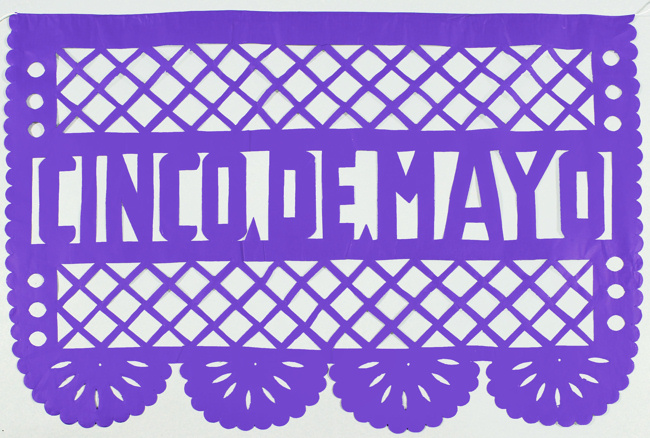
Cinco-de-mayo-Papel-PicadoSince the 1860s, Mexican American communities in the United States have been celebrating Cinco de Mayo.  In recent years, the holiday has become a great day to celebrate our rich Mexican heritage in this country. Today, Cinco de Mayo has become a BIG holiday. Huge. !Una fiesta grande! It’s a great reason to hang papel picado, play conjunto norteño and eat Mexican-style food, and practice speaking Spanish.

Image: Papel picado is a tradition from the Mexican state of Puebla to make hanging decorations with intricate designs cut out of colorful tissue paper. It is now used all over Mexico and in Mexican American celebrations of all kind. Image Credit: Amols.com

In fact, on June 7, 2005, Congress asked the President to issue a proclamation “…recognizing that struggle and calling upon the people of the United States to observe Cinco de Mayo with appropriate ceremonies and activities.” At the same time, May is also National Latino Books Month, celebrating books by and for Latinos.

Spanish Language books for National Latino Books Month at the GPO US Government BookstoreSo to commemorate this fun holiday and the great contributions of Latino and particularly Mexican culture, GPO would like to highlight a few of the many great Spanish language publications from the Federal Government.

Free Electronic Spanish Language Publications

GPO distributes a large number of publications and cataloging records to Federal Depository libraries– there were 288 Spanish language titles sent to libraries in 2012. A number of the items cataloged in Spanish in the April 2013 record load were related to public health– if you need documents on the flu shot, or cancer facts for people over age 50, forgetfulness or getting a good night’s sleep, the Federal Depository library’s got them. If you are interested in more technical documents, such as Malformaciones arteriovenosas y otras lesiones vasculares del sistema nervioso central — your Federal Depository library’s got those, too. Maybe you’re studying information about relations between the United States and Mexico; you’ll find source material such as Boundary Waters Minutes of the International Boundary and Water Commission, and the Environmental Cooperation: Border Area signed by the United States and Mexico in September and November 2012.

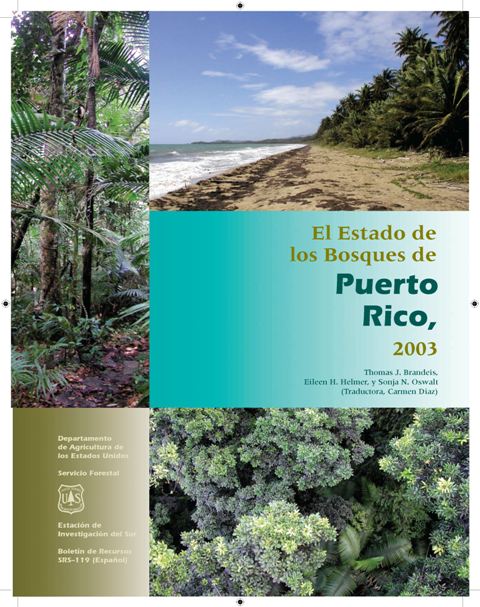
El Estado de los Bosques en Puerto Rico - The State of the Forests in Puero RicoA really beautiful book for you to seek out is El Estado de los bosques de Puerto Rico, 2003. The cover art and the photos are wonderfully colored and detailed– look at the picture of the coqui on the page in between the cover and title pages. Another helpful detail is the appendix at the end of the book that provides the species name, the name in English and the communal name in Puerto Rico. The Forest Service wrote this document for researchers, but it’s quite possible for grade school students or laypeople to read parts of this volume and glean useful information about Puerto Rico’s forests and natural resources.

Download the electronic version of this publication at one of your local Federal Depository libraries.

Print Editions of Spanish Language Publications at the US Government Bookstore

At the GPO U.S. Government Online Bookstore, you can find a number of Spanish language publications that will help individuals and families with parenting advice, citizenship tests, and learning more about Latinos in Congress and the Federal Government.

Libro Poder de los Padres - Parent Power book by the Department of EducationPoder de los padres para trazar el camino hacia el éxito is the Spanish-language version of the best-selling Department of Education book, Parent Power: Build the Bridge to Success, which advises parents on helping their children succeed at all stages of their high school careers, from pre-school through high school. The book contains a number of tips for parents to use, and give specific examples of how to put the tips into practice, for example: “Be positive. Praise goes a long way with children, especially those who struggle in school. Provide positive feedback.”

There are also checklists of developmental goals for the various age groups, for example: Middle school– “Is there a transition program for students leaving elementary school and entering middle or junior high school?” Tips and checklists like these can keep parents on target with a child’s developmental stages. Even if the parent is familiar with all of these talking points, it helps to have them clearly laid out for reference.

Another helpful Spanish language resource available from the GPO Bookstore is the Tarjetas de educación cívica para el examen de naturalización. As any cramming student (or former cramming student) knows, handheld flashcards are a key tool in memorizing information for a test, with a question on one side and the answer on the reverse. Previously only available in English, this new Spanish version of the perennial best-selling Civics Flash Cards for the Naturalization Test is highly useful not only for legal U.S. residents studying for their citizenship exam, but also for teachers and parents who teach standard civics lessons.

Tarjetas de Educacion Civica para ele Examen de Naturalizacion USASince the people who write the flash cards also set the test questions, the questions and answers are accurate (barring the warning about current appointments of specific officials). Instead of researching the answer to “¿Cuáles son dispuestos a nivel de gabinete?”, get the flash cards and be sure of the correct answer (hint: you’d be right if you said Secretario de Estado and Secretario del Tesoro, although there’s more than two right answers). If you teach citizenship or civics classes, or if you are studying for the test yourself or helping a friend or family member to study for the test, you are going to want to buy a copy of these cards. For a quick test of your knowledge of civics topics, take our Quiz: Are you smarter than an 8th grade Civics student?

All of this varied and valuable information, and more, is available en español at the GPO U.S. Government Bookstore and Federal Depository libraries nationwide.

How can I obtain a copy of these Spanish-language publications?

About the author: Our guest blogger is Jennifer K. Davis from GPO’s Library Services & Content Management Division that supports the Federal Depository Libraries Program (FDLP). (Article is adapted from an original  post in the FDLP Community site blog by Government Book Talk Editor, Michele Bartram, GPO Promotions & Ecommerce Manager.)


Over 1 Billion Served: GPO’s Pueblo Distribution Center Hits Historic Milestone Today

May 7, 2013

GPO_Pueblo_1_Billion-Shipped1 Billion.  One thousand million. Any way you count it, that’s a bundle! And at the US Government Printing Office Document Distribution Center in Pueblo, Colorado, we have reached that magic number. As of today, our Pueblo facility has shipped over 1 billion consumer publications, making it a bundle of bundles sent out to the American people!

GPO’s Western Expansion

Growing up, I always heard or read public service announcements from the Federal Government offering helpful advice on everything from how mortgages work to getting vaccinations. Each time, the commercial or ad would end with the same tag line: “To order this helpful free publication, contact us in Pueblo, Colorado” and an address and phone number (and today, a website address) would be given with ordering information.  I thought it amazing that all this great consumer information was available from one Colorado town.

Although unbeknownst to me at the time, it turns out this famous Pueblo location is actually one of two distribution facilities operated by the Government Printing Office’s Agency Distribution Services that stores and ships out Government publications on behalf of our Federal agency clients to the public –the other being in Laurel, Maryland.

In an effort led by House Appropriations Committee member Congressman Frank Evans, the GPO distribution facility was proposed and then approved on October 8, 1970, by the Joint Committee on Printing and the 15th Public Printer of the United States, Adolphus Nichol (Nick) Spence. The Pueblo Public Documents Distribution Center (PuDDC) was dedicated on October 8, 1971, and opened on October 11, 1971, to provide support for the expanding dissemination needs of Federal agencies, from books to posters to other products.

GPO_Pueblo_Congressman-Frank-Evans-Distribution-CenterLast year, President Barack Obama signed an act of the 111th Congress to rename the center the “Congressman Frank Evans US Government Printing Office Pueblo Document Distribution Center” after the former Congressman who passed away in June of 2010. It was re-dedicated on October 11, 2011, for the fortieth anniversary of the Pueblo facility.

Image: Renaming ceremony of the GPO Pueblo facility on October 11, 2011.

Today, GPO’s Pueblo Document Distribution Center provides distribution services to 10 federal agencies and other entities including: The Federal Citizen Information Center (FCIC), the Federal Trade Commission (FTC), Health and Human Service (HHS – Women’s Health), Office of Disability Employment Policy (ODEP), Federal Drug Administration (FDA), Federal Depository Library Program (FDLP), Consumer Financial Protection Bureau (CFPB) and three programs within the Department of Homeland Security  that produce items such as Transportation Security Administration (TSA) posters, bookmarks and baggage inserts.

Ruehlen-at-Pueblo-PuDDCImage: Jimmy Ruehlen has worked for Pueblo’s Government Printing Office Distribution Center since it began operations 40 years ago. Photo credit: The Pueblo Chieftain / Mike Sweeney (Photographer)

The Pueblo Distribution Center has processed over 105 million customer orders from the day it opened its doors through the end of April 2013, and as of today, May 2, 2013, the Center has distributed over 1 billion publications on behalf of its various Federal clients.

GPO Gets a “CIC” out of Distributing Consumer Publications

The Pueblo facility really got a kick-start when it signed an inter-agency agreement with the General Services Administration (GSA) in January of 1973 to take over the warehousing and distribution of the millions of printed consumer publications being provided through GSA’s then-new Consumer Information Center (or CIC), which itself has provided service to the GSA’s Federal Citizen Information Center (or FCIC), the U.S. Postal Service and the Department of Education.

Consumer-Info-Catalog-Winter-Spring-2013_coverThe gem in the FCIC’s crown is the Consumer Information Catalog, printed by GPO, which lists the latest and most popular of the many thousands of consumer publications available by topic and is updated several times a year.

Most of the print publications–the majority printed by GPO– in the Consumer Information Catalog are FREE for U.S. delivery if ordered online; the rest require only a nominal fee. Plus, a number of the publications are offered for FREE in electronic format for immediate download on the Publications.USA.gov website.

Some of the many categories of helpful consumer pamphlets and publications include: Education; Employment; Family including Pets; Federal Programs and Benefits, Food; Health including Drugs and Exercise & Diet (even information on braces, tattoos, and tanning!); Housing including Financing and Home Maintenance; the ever-popular Money category including Fraud, Credit Cards, Living Trusts, and Retirement Planning; even Small Business and Travel, and more.

Consumer-Info-Catalog-Winter-Spring-2013_Page_11

Image: Page from the Consumer Information Catalog Winter/ Spring 2013 Edition.

How can I get a copy of the Consumer Information Catalog and order publications?

Find the latest Consumer Information Catalog in PDF format online, or you can also order FREE print copies to be mailed to you at the same Publications.USA.gov website.

Consumer-Action-Handbook-2013The most popular document distributed by Pueblo remains the annual Consumer Action Handbook, a free trouble-shooting guide to help Americans solve all sorts of consumer problems. I’ve ordered five to share with family and friends!

In addition to ordering from GSA’s Publications.USA.gov website, you can find a number of these consumer publications on GPO’s US Government Online Bookstore.

Below are some of the more popular publications in the Consumer Information Catalog that are also available on GPO’s online bookstore:

You can also browse our Consumer, Home & Family category on our online bookstore.

With so many useful consumer publications available from the Federal Government, I’m sure it won’t be long until we distribute another billion items to help American consumers!

About the Author:

Government Book Talk Editor Michele Bartram is Promotions Manager for GPO’s Publication and Information Sales Division in Washington, DC, and is responsible for online and offline marketing of the US Government Online Bookstore (http://bookstore.gpo.gov) and promoting Federal government content to the public.

Ponzimonium: How Scam Artists Are Ripping Off America

November 18, 2011

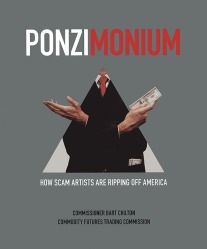
Every single day, someone somewhere makes a gigantic mistake by giving his or her money to a fraudster,” says Bart Chilton, one of the commissioners of the Commodity Futures Trading Commission (CFTC). Chilton is the author of Ponzimonium: How Scam Artists are Ripping Off America, a shocking new book available from GPO about some of the worst perpetrators of investment fraud in recent U.S. history.

Figure 1: Ponzimonium: How Scam Artists Are Ripping Off America available from GPO.

Ponzimonium looks to the CFTC’s own recent public case files stemming from fraud investigations that began with the recent economic downturn- talk about hitting people when they’re down! Because of the this, the book is generating a lot of positive buzz in The New York Times, TheStreet, and other media outlets.

The CFTC is an independent Federal agency with the mandate to regulate commodity futures and options markets in the United States. After the financial crisis of 2008, their authority was expanded under the 2010 Dodd-Frank Wall Street Reform and Consumer Protection Act to include over-the-counter derivatives markets and hopefully prevent and uncover more of these frauds.

What is a Ponzi scheme, you ask?

The world really learned about Ponzi schemes in December of 2008 when, as Chilton writes in his introduction, “legendary investment guru Bernard Madoff ‘made off’ with an estimated US$50 billion in what was called the ‘Mother of all Ponzi Schemes’.” (By the way, an interesting related read is the report about the Investigation of Failure of the Securities and Exchange Commission To Uncover Bernard Madoff’s Ponzi Scheme, also available from GPO.)

Unlike pure pyramid schemes in which it is mandatory that a new investor recruit others into the deal in order to receive payments, Ponzi schemes purport to offer investors a “too good to be true” deal by simply handing over their money. However, no real investment is made by the criminal.

Instead, Ponzi schemes, named after 1920’s postage stamp speculator-fraudster Charles Ponzi, are scams in which early “investors’—often friends, colleagues, and family members—are asked to invest in a this great “no risk” deal offering unbelievable returns.

Typically, the investor makes an initial investment and then some purported “phantom profits” are paid out by the con artist (really just money from other investors), prompting that investor to assume that his or her money has increased in value—and inspiring the investor to turn over more money to invest and tell others about it. In actuality, the perpetrators pocket the money for themselves.

This splendid infographic from the New York Times explains the concept visually:

Figure 2. Ponzi scheme infographic. Image source: The New York Times 12/21/2008 Week in Review.

Made in Madoff’s Image

Ponzimonium introduces some of the lesser known, but equally  despicable fraudsters that have been uncovered since 2008 by the CFTC and SEC (Securities and Exchange Commission).

The book lays out the fascinating and dramatic details behind the fraudulent schemes, their smooth-talking masterminds, and their many honest, hard-working victims, who often lose the money they’ve saved for their kids’ college funds, needed health care expenses, or their own retirement as a result of misplaced trust in these criminals.

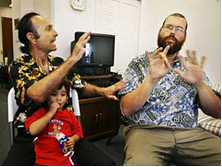
These stories are so engrossing— at times it felt like I was taking in a marathon of America’s Most Wanted or I Almost Got Away with It episodes— I found it hard to decide which of these criminals is the most despicable. Was it Beau Diamond of Diamond Ventures who wiped out his parents’ savings along with 200 other clients who invested US$37 million? Or how about Marvin R. Cooper of Billion Coupons, who created a combination Ponzi and pyramid scheme called an affinity fraud, to target and recruit fellow deaf community members in the U.S. and Japan? And there’s James Ossie of CRE Capital Corporation (CRE) who bilked investors out of US$25 million, including a desperate father’s US$200,000 he invested to fund his young daughter’s cancer treatments.

Figure 3. Fraudster Marvin R. Cooper and deaf client. Image source: BusinessInsider.com

The human side behind these frauds makes them all the more compelling… and contemptible.

The best way to avoid getting swindled, advises Chilton, is to “remember what your parents told you when you were little: ‘Don’t take candy from strangers’”, and my personal favorite, “Just because it is on the TV, Internet, etc. doesn’t mean it’s real!” That’s advice you can take to the bank.

Some “don’t miss” features of this book

Ponzimonium: How Scam Artists are Ripping Off America includes some very useful features for its readers that make this a valuable resource for any investor.

  • Red Flags of Fraud: Includes 20 red flags to look out for when considering an investment.
  • Investor Checklist: Detailed list of questions to ask before investing.
  • Investors’ Bill of Rights: Common sense advice and legal rights for any investor.
  • Resources: Useful contact information for victims or witnesses of a fraud.
  • Glossary of Fraud Terms: Definitions of legal and financial terms within each story.
  • The Loot: Color photos of the criminals’ misbegotten gains and lavish lifestyle.
  • The Numbers: Calculations of the staggering amounts collected, paid, lost, or stolen, and prison sentences and restitution.

How can you get this Ponzimonium eBook?

About the Author:  Michele Bartram is Promotions Manager for GPO’s Publication and Information Sales Division and is responsible for online and offline marketing of the US Government Online Bookstore (Bookstore.gpo.gov) and promoting Federal government content to the public. She has been researching identity theft and privacy issues for years, both on the web and in the real world, and is a big fan of more fraud protection for citizens.