Commemorate the Anniversary of Arlington National Cemetery through Government Documents

May 20, 2014

150th ANCThis year marks the 150th anniversary of the designation of Arlington National Cemetery. On May 13, 1864, the body of Private William Henry Christman of Pennsylvania was laid to rest on the grounds of Arlington House, the former home of Gen. Robert E. Lee until the Civil War. Private Christman was the first soldier laid to rest at Arlington National Cemetery, one month prior to its official establishment as a military cemetery. The first of many events to be held this summer commemorating this important anniversary, began on May 13, 2014 with the laying of a wreath at Private Christman’s grave. Special Guided Tours are also planned, through the months of May and June. The events conclude with a laying of a wreath at the Tomb of the Unknown Soldier on June 16th.

A wreath is placed at the grave of Army Private William Christman, the first person laid to rest at Arlington National Cemetery. Image source: www.dcmilitary.com

A wreath is placed at the grave of Army Private William Christman, the first person laid to rest at Arlington National Cemetery. Image source: http://www.dcmilitary.com

There are many Government documents available to learn more about the Civil War, Arlington House, and the designation and history of Arlington National Cemetery. For a brief history, check out the U.S. Department of Veterans Affairs publication, Arlington National Cemetery. You can also check out this fact sheet about the history and development of all VA National Cemeteries.

Arlington House and the development of Arlington National Cemetery

The National Park Service (NPS) has published several publications regarding the remarkable history of Arlington House, including the following publications, which are currently available from the U.S. Government Bookstore:

arlington houseArlington House: A Guide to Arlington House, The Robert E. Lee Memorial, Virginia. Although small in size like most NPS handbooks, this publication provides a wealth of information on the history of Arlington House. The publication opens with an introduction of General Lee and Arlington House. It also presents a brief historical account of the house and its occupants, the Custises and the Lees, as well as providing concise information on the house and its grounds.

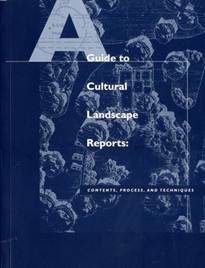
cultural landscape reportThe National Park Service also published a Cultural Landscape Report about Arlington House in 2001. As stated in the report, “It’s hard to imagine today what the grounds of Arlington House originally looked like because of the graves of Arlington National Cemetery that surround the house. Arlington National Cemetery almost overwhelms Arlington House.” This Cultural Landscape Report and Site History about Arlington House, tells the story of the creation and use of Arlington House and its link to the formation and design of our national cemetery. It compiles in one place the site’s heritage, documents the changes over time, and establishes what is important to preserve. To learn more about Cultural Landscape Reports read A Guide to Cultural Landscape Reports: Contents, Process, and Techniques available from the GPO Bookstore. You can also read Custis-Lee Mansion: The Robert E. Lee Memorial online from the National Park Service, or check out a print copy at a local Federal depository library.custis-lee mansion

National Cemetery Burial Eligibility

Arlington National Cemetery holds about 27 funerals each week. There are several House Committee Reports regarding veterans’ eligibility for burial in Arlington. H.R. 3211 of the 105th Congress, as well as H.R. 3423 from the 107th Congress amended Title 38 of the U.S. Code to modify eligibility of burial in Arlington National Cemetery. You can access hearings, as well as the legislative history for H.R. 3423 and other bills online. You can also visit a Federal depository library for older reports concerning burials, such as a 1921 report before a subcommittee on the Expenses of burial in Arlington Cemetery of an unknown member of the Expeditionary Forces. You can also browse the volumes of “The war of the rebellion: a compilation of the official records of the Union and Confederate armies” for any records of the history of Arlington House and the appropriation of the land by the Federal government after the war. The volumes are available at many Federal depository libraries.

Arlington National Cemetery Memorials

There are many memorials at Arlington National Cemetery commemorating wars, notable military figures, presidents, and service men and women. If you visit a Federal depository library you could check out a copy of “In Remembrance of a Sailor: a shrine to America’s heroes”, a 1990 publication from the U.S. Navy Department. Information about other memorials in the cemetery can be found on the Arlington Cemetery website.

The Tomb of the Unknown Soldier

President Dwight D. Eisenhower places a wreath at the Tomb of the Unknown Soldier of World War I during interment ceremonies for the Unknown Servicemen of World War II and the Korean Conflict, at Arlington National Cemetery. Image source: Old Guard

President Dwight D. Eisenhower places a wreath at the Tomb of the Unknown Soldier of World War I during interment ceremonies for the Unknown Servicemen of World War II and the Korean Conflict, at Arlington National Cemetery. Image source: Old Guard

The Tomb of the Unknown Soldier was approved by Congress on March 4, 1921. Details of the act can be found in the Congressional Record from that period. You can visit a Federal depository library to access historic copies of the Congressional Record and view the enabling legislation for the Tomb of the Unknowns. The remains of soldiers from World War I, World War II, and the Korean War lay in state and are honored by The Old Guard. In 1984, the remains of an unknown Vietnam War soldier were interred in the Tomb of the Unknown. A document about this soldier, “The Unknown Serviceman of the Vietnam War Era” was created by the U.S. Army Center of Military History. You can read more about it at a Federal depository library, or online from the HathiTrust. Pictures of the Tomb of the Unknowns can be found on the Old Guard Pinterest Board.

If you’re not in the Washington, DC area to participate in any of the events mentioned in this blog, curl up with these documents and immerse yourself in the history and stories of the men and women who fought for our country and were laid to rest on the grounds of the National Cemetery.

How can I get these publications about the history of Arlington House and Arlington National Cemetery?

Shop Online Anytime: You can buy these and other publications (with FREE Standard Shipping worldwide) from the U.S. Government Online Bookstore website at http://bookstore.gpo.gov:

Order by Phone: You may also Order print editions by calling our Customer Contact Center Monday through Friday, 8 am to 5:30 pm Eastern (except US Federal holidays). From US and Canada, call toll-free 1.866.512.1800. DC or International customers call +1.202.512.1800.

Shop our Retail Store: Buy a copy of any print editions from this collection at GPO’s retail bookstore at 710 North Capitol Street NW, Washington, DC 20401, open Monday–Friday, 9 a.m. to 4 p.m., except Federal holidays, Call (202) 512-0132 for information or to arrange in-store pick-up.

Visit a Federal Depository Library: Search for U.S. Government publications in a nearby Federal depository library. You can find the records for most titles in the Catalog of U.S. Government Publications or CGP.

About the author: Cathy Wagner is an outreach librarian with the Education & Outreach team in the Library Services & Content Management (LSCM) division at the Government Printing Office.

Additional content, images and editing provided by Trudy Hawkins, a writer and marketing specialist in GPO’s Publication & Information Sales Division supporting the U.S. Government Online Bookstore (http://bookstore.gpo.gov).


National Military Appreciation Month: Celebrating Our Troops

May 12, 2014

may military appreciation monthMay is National Military Appreciation Month (NMAM), a time to recognize and celebrate the contributions of the courageous men and women who have served or are currently serving in the United States Armed Forces.

Designated by Congress, NMAM encourages Americans to publicly show their appreciation for the sacrifices—and accomplishments—made by our military personnel. During this important month, Americans have the opportunity to come together to thank our military for their patriotic service in support of our country, at several national events planned throughout the month.

loyalty dayLoyalty Day, which is celebrated May 1 of each year, kicks off our Nation’s month-long celebration of military appreciation. In his proclamation of Loyalty Day, 2014, President Barack Obama reminded Americans of the significance of this important day: “On this day, let us reaffirm our allegiance to the United States of America and pay tribute to the heritage of American freedom.”

Image source courtesy of DOD http://www.defense.gov/afd/

Image source courtesy of DOD http://www.defense.gov/afd/

Other important events honoring our military’s achievements include Victory in Europe (VE) Day celebrated on May 8, Military Spouse Appreciation Day celebrated on May 9, Armed Forces Day celebrated on May 17, and Memorial Day celebrated on May 26. Armed Forces Day and Memorial Day are the best known of the May military-themed holidays. Armed Forces Day, which was created to honor all branches of the U.S. Military, replaced separate Army, Navy and Air Force Days. And Memorial Day commemorates the men and women who died while serving in military service.

A man looks at the Vietnam Veterans Memorial on Memorial Day 2013: Image source nps.gov

A man looks at the Vietnam Veterans Memorial on Memorial Day 2013: Image source nps.gov

In observance of NMAM and the other important events around the country honoring our military this month, Government Book Talk is highlighting several of our bestselling military journals and magazines.

army historyArmy History is published by the U.S. Army Center of Military History (CMH). It is a professional military magazine devoted to informing the military history community about new work on the Army’s history. Issues include illustrated articles, commentaries, book reviews, and news about Army history and the U.S. Army Center of Military History.

naval avaition newsNaval Aviation News is the flagship publication of naval aviation. It covers all aspects of naval air operations. Featured articles review the latest technological advances in aircraft and weapon systems and the influence of U.S. naval air power in global events. Issues include historical profiles of aircraft, aviation ships, important aviators, and organizations that affected the Navy’s control of the air.

military review2As one of the premier military magazines/military journals, Military Review provides a forum for original thought and debate on the art and science of land warfare and other issues of current interest to the U.S. Army and the Department of Defense.

Joint Force Quarterly is designed for national security professionals in and out of the U.S. Government to promote understanding of the integrated employment of land, sea, air, space, and special operations forces. This journal focuses on joint doctrine, integrated operations, coalition warfare, contingency planning, military operations conducted across the spectrum of conflict, and joint force development.joint force quarterly

army al&tArmy AL&T Magazine is a quarterly professional journal published
by the U.S. Army Acquisition Support Center within the Office of the Assistant Secretary of the Army for Acquisition, Logistics, and Technology or AL&T. This official military magazine reports on Army research, development and acquisition and includes articles relative to state-of-the-art technology, capabilities, processes, procedures, techniques, and management philosophy, focusing heavily on lessons learned and best business practices.

How can I get these military magazine/journal publications?

Shop Online Anytime: You can buy these publications (with FREE Standard Shipping worldwide) from the U.S. Government Online Bookstore website at http://bookstore.gpo.gov:
Click here to purchase Army History

Click here to purchase Naval Aviation News

Click here to purchase Military Review

Click here to purchase Joint Force Quarterly

Click here to purchase Army AL&T

Shop our entire Military Journals and Magazines collection

Order by Phone: You may also Order print editions by calling our Customer Contact Center Monday through Friday, 8 am to 5:30 pm Eastern (except US Federal holidays). From US and Canada, call toll-free 1.866.512.1800. DC or International customers call +1.202.512.1800.

Shop our Retail Store: Buy a copy of any print editions from this collection at GPO’s retail bookstore at 710 North Capitol Street NW, Washington, DC 20401, open Monday–Friday, 9 a.m. to 4 p.m., except Federal holidays, Call (202) 512-0132 for information or to arrange in-store pick-up.

Visit a Federal Depository Library: Search for U.S. Government publications in a nearby Federal depository library. You can find the records for most titles in the Catalog of U.S. Government Publications or CGP.

About the author: Trudy Hawkins is a writer and marketing specialist in GPO’s Publication & Information Sales Division supporting the U.S. Government Online Bookstore (http://bookstore.gpo.gov).


Childhood Immunization: Protecting Our Children from Disease

April 29, 2014

National-Infant-Immunization-Week-2014The week of April 26-May 3 is National Infant Immunization Week and it is also the 20th anniversary of this observance. Vaccinations are becoming a more controversial topic among parents, doctors and schools. The New England Journal of Medicine suggests that the recent anti-vaccination movement is leading to an outbreak of whooping cough and the measles in some states.

A couple looks at Infant Care pamphlet at GPO Bookstore: GPO Archives.

A couple looks at Infant Care pamphlet at GPO Bookstore: GPO Archives.

Before you could Google information on vaccinations and family healthcare topics and have every answer at your fingertips, government publications were the go-to source for consumer information. This former trend is evident in the fact that a pamphlet entitled Infant Care is still to this day considered GPO’s all-time best seller. Infant Care was first published in 1914 by the Children’s Bureau and provided mothers with information in a low-cost form on how to care for their babies. (Read more about the history of the Children’s Bureau in The Children’s Bureau Legacy: Ensuring the Right to Childhood (ePub eBook) available on the U.S. Government Bookstore.) Over the course of seven decades it remained a bestseller with multiple editions published and translations in eight languages as well as Braille.

Excerpt on Vaccination from Infant Care pamphlet

100 years ago, this was the advice on vaccination of infants. Excerpt from 1914 Infant Care pamphlet.

The original Infant Care pamphlets can be seen on this archive. However, Vaccines for Children (VCF), a federally funded program handled by the Centers for Disease Control and Prevention (CDC) provides no-cost vaccine services to help ensure that all children, from infancy to adolescent, have a better chance of getting their recommended vaccinations.

Image source courtesy of CDC http://www.cdc.gov/features/vfcprogram

Image source courtesy of CDC http://www.cdc.gov/features/vfcprogram

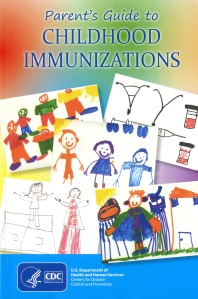
Like Infant Care, the government still has helpful publications to help parents and the public make health-related decisions. Parent’s Guide to Childhood Immunizations and Immunization Tool Kit are just two of the many government publications available on the immunization and vaccination topic.

017-022-01617-6Parent’s Guide to Childhood Immunizations is kind of like a “vaccinations for dummies.” It is a great resource that explains each disease, the vaccinations schedule, what to do before, during and after the immunization doctor visit, how vaccines work, other FAQs and additional print and electronic resources. The most helpful part of this booklet is the breakdown of each disease with information on what causes the disease, how it is spread, the signs and symptoms and complications. To brighten up what can be a scary subject, the booklet includes colorful child artwork.

immunization-tool-kitImmunization Tool Kit focuses on adult, military and childhood immunizations. This resource is made up of laminated 4X6 color coded cards held together by a ring for fast flipping making it durable and likely intended for military or health care providers, people who need a quick reference on the job. The cards are organized by immunizations for adults and the military and children with detailed information about each vaccine including a dosage, indications or who should get the vaccine, contraindications or reasons why someone should not be vaccinated and special considerations. Some of the cards have amusing caricatures of what the diseases look like. For medical personnel, there is a section on the storage and handling instructions of each vaccine. While the amount of information may seem overwhelming, the toolkit will be able to answer all or any question about vaccines.

HOW DO I OBTAIN THESE PUBLICATIONS ON VACCINATION?

Shop Online Anytime: You can buy these publications (with FREE Standard Shipping worldwide) from the U.S. Government Online Bookstore website at http://bookstore.gpo.gov:

Order by Phone: You may also Order print editions by calling our Customer Contact Center Monday through Friday, 8 am to 5:30 pm Eastern (except US Federal holidays). From US and Canada, call toll-free 1.866.512.1800. DC or International customers call +1.202.512.1800.

Shop our Retail Store:Buy a copy of any print editions from this collection at GPO’s retail bookstore at 710 North Capitol Street NW, Washington, DC 20401, open Monday–Friday, 9 a.m. to 4 p.m., except Federal holidays, Call (202) 512-0132 for information or to arrange in-store pick-up.

Visit a Federal Depository Library:Search for U.S. Government publications in a nearby Federal depository library. You can find the records for most titles in the Catalog of U.S. Government Publications or CGP.

About the author: Our guest blogger is Emma Wojtowicz, Public Relations Specialist in GPO’s Office of Public Affairs. 

Additional content, images and editing provided by Trudy Hawkins, a writer and marketing specialist in GPO’s Publication & Information Sales Division supporting the U.S. Government Online Bookstore (http://bookstore.gpo.gov).


Keeping Our Skies Safe, Part 2 of 2: Aviation safety rules and regulations

April 24, 2014

About this blog series: In this two-part blog post “Keeping Our Skies Safe”, we review the many processes and policies in place to regulate United States airspace and to protect air travelers, flight personnel and all sorts of aircraft flying U.S. skies. In “Keeping Our Skies Safe, Part 1 of 2: Aviation safety planning & response,” we covered the many aviation safety publications produced by the United States Federal Government, future plans to keep ahead of evolving flight safety issues, and U.S. emergency response.

In this post, “Keeping Our Skies Safe, Part 2 of 2: Aviation safety rules and regulations,” I wanted to go over some of the key U.S. regulations that govern the United States airspace including aircraft certifications, flight crew member certifications, pilot preparation, and airspace monitoring.

So, I began my search for information with the United States Code of Federal Regulations, commonly referred to as the CFR or CFRs, the codification or standardization of the general and permanent rules published in the Federal Register by all the departments and agencies across the entire U.S. Federal Government. Each agency’s regulations are divided among the 50 volumes of the Code of Federal Regulations. For aviation safety, we must turn to the popular Title 14, Aeronautics and Space, which covers both the US Department of Transportation — Federal Aviation Administration (FAA) regulations as well as those for the National Aeronautics and Space Administration (NASA).

Where can you find the US standards for airplane maintenance—referred to as the “airworthiness standards”— as well as the certification procedures for both large and small aircraft parts and products, such as engines?

CFR-2014-PURPLECode of Federal Regulations, Title 14, Aeronautics and Space, Pt. 1-59, Revised as of January 1, 2014

Part 1-59 primarily covers the definitions and scope of the Federal Aviation Administration within the US Department of Transportation. The section specifically includes rulemaking as well as some nuts and bolts of our US air space, such as the airworthiness standards for transport category airplanes and commuter category airplanes, manned air balloons, engines, and propellers, rotary aircraft and transport rotary aircraft, plus certification procedures for parts and products, noise standards, aircraft registration and identification markings, and more.

Where is the best place to search for U.S. regulations covering flying certification for pilots, as well as their medical standards and certifications required for them to be able to take a plane up into U.S. airspace?

Google Images- Photo image  compliments of www.flyertalk.com

Google Images- Photo image compliments of http://www.flyertalk.com

Code of Federal Regulations, Title 14, Aeronautics and Space, Pt. 60-109, Revised as of January 1, 2014

Part 60-109 covers more regulations relating to the Federal Aviation Administration within the US Department of Transportation. Specifically, this volume covers certification for pilots, flight instructors, ground instructors, flight crew members other than pilots and certification for airmen other than flight crew members. This part also includes medical standards and certifications. Air space routes, special use air space, general operating and flight rules, as well as special air traffic rules and standard instrument procedures are also included in this volume.

How about the U.S. regulations about the flight crew including flight duty limitations and drug and alcohol testing?

Google Images- Photo image compliments of pilotlights.net

Google Images- Photo image compliments of pilotlights.net

Code of Federal Regulations, Title 14, Aeronautics and Space, Pt. 110-199, Revised as of January 1, 2014

Parts 110-199 cover more regulations pertaining to the Federal Aviation Administration within the US Department of Transportation. The primary focus of this volume is the flight crew. It includes the following: General requirements, Flight duty limitations and rest requirements for flight crew members, drug and alcohol testing program. It also covers the operational requirements and certification for airplanes having a seating capacity of more than 20 passengers and covers the foreign operations and foreign operators of U.S. registered aircraft engage in common carriage. This volume also includes the operating requirements for commuter and on-demand operations and rules governing persons on board such aircraft. Pilot schools, training centers, aviation maintenance schools are also covered with regulations in this volume. Aviation insurance requirements and airport certification, property and noise compatibility planning are also covered in this volume.

Google images- Photo image compliments of flysfo.com

Google images- Photo image compliments of flysfo.com

Are there any U.S. regulations relating to tarmac delay data, domestic baggage liabilities and international cargo and passenger transportation?

Code of Federal Regulations, Title 14, Aeronautics and Space, Pt. 200-1199, Revised as of January 1, 2014

Parts 200-399 covers items, such as: the scheduled air carrier and charter trips of the United Sates; terms, conditions, and limitations on foreign air carriers, charter trips and commuter air carriers. It also covers the reporting statistics of foreign air carriers in civilian scheduled charter and non-scheduled services.

This part also contains regulations relating to airline service quality reports, tarmac delay data, direct airport-to-airport mileage records, domestic baggage liabilities, interstate cargo operations air transportation and international cargo and passenger transportation. Foreign freight forwarders and foreign cooperative shippers associations are also included in this part.

Parts 400-1199 covers license applications, safety approvals, and some regulations for the commercial space transportation including definitions, scope, rulemaking, investigations, and enforcement.

Google Images-Photo image compliments of Hawaii.gov

Google Images-Photo image compliments of Hawaii.gov

These volumes may interest the general public concerned about requirements for US flight crew members, and aircraft, especially in light of the disappearance of Malaysia Flight 370 . Aviation specialists, especially pilots and flight crew members that need to be aware of the US regulations relating certifications, airport routes, to aviation and airspace within the United Sates will also want to be aware of these essential regulations.

An online version of these volumes of the Code of Federal Regulations (CFR) can be found for free on GPO’s Federal Digital System at: http://www.gpo.gov/fdsys/browse/collectionCfr.action?collectionCode=CFR or can be purchased through the US Government Bookstore at this link: http://bookstore.gpo.gov/CFR

How can I get these Code of Federal Regulations (CFR) publications ?

  • Shop Online Anytime: You can buy these print publications (with FREE Standard Shipping worldwide) from the U.S. Government Online Bookstore website at http://bookstore.gpo.gov:
  • Order by Phone: You may also order print editions by calling our Customer Contact Center Monday through Friday, 8 am to 5:30 pm Eastern (except US Federal holidays). From US and Canada, call toll-free 1.866.512.1800. DC or International customers call +1.202.512.1800.
  • Shop our Retail Store: Buy a copy of any print editions from this collection at GPO’s retail bookstore at 710 North Capitol Street NW, Washington, DC 20401, open Monday–Friday, 9 a.m. to 4 p.m., except Federal holidays, Call (202) 512-0132 for information or to arrange in-store pick-up.
  • Visit a Federal Depository Library: Search for U.S. Government publications in a nearby Federal depository library. You can find the records for most titles in the Catalog of U.S. Government Publications or CGP.

About the Author – This week’s blog contributor is Maureen Whelan, Senior Marketing Team Leader for GPO’s Publication & Information Sales division program office in Washington, DC.  Maureen oversees print and digital content dissemination strategy and manages third party free and paid content distribution platforms and vendors such as Apple iBookstore, Google Play eBookstore, EBSCOhost, Overdrive, and more. Additionally, Maureen’s commercial publishing industry experience with publishing requirements, copyrights, product formats and content metadata and search optimization have helped Federal agencies publications be more discoverable through these consumer channels. A few examples of commercially popular Federal print books that were successfully migrated to digital include The Healthy Woman and The Basic Guide to Exporting.


Keeping Our Skies Safe, Part 1 of 2: Aviation safety planning and response

April 23, 2014

If you’re like me, hearing the speculation about the disappearance of Malaysia Flight 370 has created a number of questions in your mind about air safety in America and why the United States is taking an active role in this mystery.

malaysia-370In this two-part blog post “Keeping Our Skies Safe”, we review the many processes and policies in place to regulate United States airspace and to protect air travelers, flight personnel and all sorts of aircraft flying U.S. skies. In “Keeping Our Skies Safe, Part 1 of 2: Aviation safety planning & response,” we will cover the many aviation safety publications produced by the United States Federal Government, future plans to keep ahead of evolving flight safety issues, and U.S. emergency response.

“Keeping Our Skies Safe, Part 2 of 2: Aviation safety rules and regulations” will cover the many laws and regulations the United States has put in place to enforce these aviation best practices on everything from gliders and balloons to commercial jet airplanes.

Part 1 of 2: Aviation Safety Planning & Response

International and national aviation safety practices and adherence to them is one of the first places investigators look when reviewing an accident or disappearance of a plane such as is presumed to have happened with Flight 370. In the United States, the Federal Aviation Administration or FAA within the Department of Transportation is the Federal agency charged with the “continuing mission… to provide the safest, most efficient aerospace system in the world.” The FAA produces a number of vital publications for the entire aviation industry with guidelines, research, analysis and best practices.

SAFETY BRIEFINGS

faa-safety-briefingThe FAA Safety Briefing magazine provides updates on major US Federal Aviation Administration rule changes and proposed changes, as well as refresher information on flight rules, maintenance airworthiness, avionics, accident analysis, and other topics. A must-have for pilots, air traffic controllers, airplane maintenance personnel and anyone involved in ensuring flying safely.

(6 issues per year. Subscription price covers issues for 1 year)

FAA Safety Briefing magazine is available on a subscription basis from the US Government Bookstore and can be found here to order print copies: http://bookstore.gpo.gov/products/sku/750-002-00000-5?ctid=1736

FAA Safety Briefings individual issues can be found online here at US Federal Aviation Administration: http://www.faa.gov/

The Future of U.S. Air Travel?

What is the Federal Aviation Administration planning in order to deliver a better travel experience in the future with fewer delays and enhanced safety? How is the U.S. Federal Aviation Administration incorporating the passengers’ point of view when thinking about the future plans for the aviation experience? The answers are delivered in the Next Generation (aka “NextGen”) Plan for the FAA.

faa-next-genThe 2013 edition of the NextGen Plan serves as a roadmap of the Federal Aviation Administration’s (FAA’s) ongoing transition to NextGen and provides an overview of the benefits aircraft operators and passengers are receiving from recent NextGen improvements. NextGen is the shift to smarter, satellite-based and digital technologies and new procedures to make air travel more convenient, predictable and environmentally friendly.

Highlights of the Plan include the latest on metroplex initiatives, Performance Based Navigation growth, Automatic Dependent Surveillance-Broadcast deployments, surface collaboration and plans for future benefits. The plan devotes an entire chapter to general aviation and recognizes the growing role of this important stakeholder. The outreach document provides FAA stakeholders — including the aviation community, Congress, government oversight entities and the general public — with the latest progress in the transformation of the National Airspace System.

NextGen offers a better travel experience, with fewer delays, more predictable trips and enhanced safety.People who live near airports may experience less aircraft noise and fewer emissions. NextGen will increase the predictability and reliability of airport operations, enhancing the role of airports as economic engines for the communities they serve. NextGen is vital to preserving aviation’s significant contributions to our national economy.

You can download the FREE ePub NextGen Implementation Plan available here: http://bookstore.gpo.gov/products/sku/050-300-00005-6  or from the FAA agency website.

The U.S. Navy’s Role in Aviation Safety

us-navy-logo(Google Images –Photo image compliments of en.wikipedia.org)

The US Navy is very involved with the mysterious disappearance of Malaysia Flight 370. What do our Navy personnel responsible for protecting American by use of the oceans know about recovery of “black boxes”?

An Underwater Ice Station Zebra: Recovering a KH-9 Hexagon Capsule From 16,400 Feet Below the Pacific Ocean: Selected Declassified CIA DocumentsOne reason why the US Navy may be involved with the tracking of the submersion of the Malaysia Flight 370” black box” may be attributed to their significant expertise in this area. In fact, the US Navy has been involved in deep sea recovery for decades. As you read the story of An Underwater Ice Station Zebra: Recovering a KH-9 Hexagon Capsule From 16,400 Feet Below the Pacific Ocean: Selected Declassified CIA Documents, you will learn that the U.S. Navy ‘s advanced method at deep submersible recovery began in 1972 with the Trieste II (DSV-1). Publicly called a “data package,” the object was actually part of a U.S. spy satellite, codenamed HEXAGON. Before today’s digital technology, photo reconnaissance satellites used film, which returned to Earth in capsules ejected from the satellite. The capsules, called “buckets,” reentered Earth’s atmosphere and deployed a parachute to slow their descent.

During the first HEXAGON mission in 1971, the parachute broke off causing the bucket to crash into the ocean. This release includes photos of the capsule on the ocean floor, pictures of the Trieste II (DSV-1), and an article recounting the deepest undersea salvage then attempted.

If you would like to read about the US Navy’s fascinating recovery of the HEXAGON, you can purchase this title at the US Government Bookstore at this link: http://bookstore.gpo.gov/products/sku/041-015-00294-5

U.S. Emergency Response

When disaster strikes including transportation accidents, the US Federal Government often provides expertise to emergency responders. The U.S. has expanded its emergency response knowledge base and capacity since the World Trade Center and Pentagon attacks on 9/11 and now has many bestselling titles available relating to Disaster / Emergency Response.

Emergency Response Guidebook 2012 available at http://bookstore.gpo.govThe official Emergency Response Guidebook (ERG) is a guide for use by transporters, firefighters, police, and other emergency services personnel who may be the first to arrive at the scene of a transportation incident involving a hazardous material, such as an oil or chemical spill. It is used by first responders in:

(1) quickly identifying the specific or generic classification of the material(s) involved in the incident, and

(2) protecting themselves and the general public during this initial response phase of the incident.

The ERG is updated every three to four years to accommodate new products and technology.

This title is available for purchase at the US Government Bookstore at this link: http://bookstore.gpo.gov/products/sku/050-000-00596-8

U.S. Coast Guard Incident Management Handbook assists Coast Guard personnel in response to oil spills, search and rescue operations and other emergency situations on the water.

us-coast-guard-incident-handbookThe Coast Guard Incident Management Handbook (IMH) is designed to assist Coast Guard personnel in the use of the National Incident Management System (NIMS) Incident Command System (ICS) during multi-contingency response operations and planned events. The Incident Management Handbook is an easy reference job aid for responders. Also useful for other waterway rescue and police operations.Read the table of contents and purchase this title at this link on the US Government Bookstore: http://bookstore.gpo.gov/products/sku/050-012-00465-0

This title is also available in a Spanish-language version,Manual Para el Manejo de Incidentes / Servicios de Guardacostas and can be purchased here: http://bookstore.gpo.gov/products/sku/050-012-00473-1
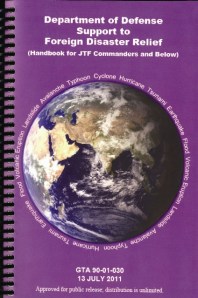
Department of Defense Support to Foreign Disaster Relief Handbook And finally, Department of Defense Support to Foreign Disaster Relief (Handbook for JTF Commanders and Below) is a manual for personnel involved in a foreign disaster relief mission, including a search for a missing airplane.

A classified version exists only for certain military personnel, but the U.S. Department of Defense (DoD) also released this unclassified version that can be used not only by members of the military, but also by anyone involved in U.S. foreign disaster response JTF (Joint Task Force) operations, including U.S. Government agencies, international organizations, Intergovernmental Organizations (IGO) and Non-Governmental Organizations (NGO).

This handbook covers the: legal authority and principles; operational context and planning factors; both supporting groups and supported foreign disaster relief organizations; and DOD guidelines for interaction with the U.S. Department of State and US Agency for International Development (US-AID) and NGOs and International Organizations such as the United Nations and International Red Cross and Red Crescent.

Read more about this information-packed handbook in our previous blog post: The U.S. military storms to the rescue in foreign disaster relief.”

How Can I get these aviation safety publications ?

  • Shop Online Anytime: You can buy these eBooks and print publications (with FREE Standard Shipping worldwide) from the U.S. Government Online Bookstore website at http://bookstore.gpo.gov:
  • Order by Phone: You may also order print editions by calling our Customer Contact Center Monday through Friday, 8 am to 5:30 pm Eastern (except US Federal holidays). From US and Canada, call toll-free 1.866.512.1800. DC or International customers call +1.202.512.1800.
  • Shop our Retail Store: Buy a copy of any print editions from this collection at GPO’s retail bookstore at 710 North Capitol Street NW, Washington, DC 20401, open Monday–Friday, 9 a.m. to 4 p.m., except Federal holidays, Call (202) 512-0132 for information or to arrange in-store pick-up.
  • Visit a Federal Depository Library: Search for U.S. Government publications in a nearby Federal depository library. You can find the records for most titles in the Catalog of U.S. Government Publications or CGP.

About the Author – This week’s blog contributor is Maureen Whelan, Senior Marketing Team Leader for GPO’s Publication & Information Sales division program office in Washington, DC.  Maureen oversees print and digital content dissemination strategy and manages third party free and paid content distribution platforms and vendors such as Apple iBookstore, Google Play eBookstore, EBSCOhost, Overdrive, and more. Additionally, Maureen’s commercial publishing industry experience with publishing requirements, copyrights, product formats and content metadata and search optimization have helped Federal agencies publications be more discoverable through these consumer channels. A few examples of commercially popular Federal print books that were successfully migrated to digital include The Healthy Woman and The Basic Guide to Exporting.


1940 Census Goes Digital

April 11, 2012

Last week, on April 2, 2012, the 1940 United States census was released to the public in digital format by the National Archives in conjunction with the U.S Census Bureau at http://1940census.archives.gov

Image: 1940 Census Poster urging Americans to “Help the Ten-Year Roll Call”. Source:U.S.Census Bureau

Reports National Public Radio:

Veiled in secrecy for 72 years because of privacy protections, the 1940 U.S. census is the first historical federal decennial survey to be made available on the Internet initially rather than on microfilm.

In a great example of a private/public partnership, Archives.com’s parent company partnered with the National Archives to provide the public with free digital access to the 1940 Federal Population Census.

Miriam Kleiman, spokeswoman for the U.S. National Archives, told The Associated Press that the Archives’ 1940 census site registered more than 22 million hits in just four hours from almost 2 million users on its very first day of release. It is extremely popular already with librarians, researchers and genealogists researching their family tree.

Data from the Great Depression

Archivist Connie Potter, in an entertaining video about the Archives’ digitization project, explains that the reason this census is so amazing is because it describes “the country during the Great Depression.  It reflects all of the economic dislocation, how many people were immigrants, how many people had what level of education.

Last week’s release of digitized information covers detailed records on 132 million people living in the United States at the end of the Depression and a year before Pearl Harbor.

The census data was transferred to microfilm during World War II, and in 2009, National Archives personnel began digitizing those records, culminating in the release of the database last week.

Over 3.9 million images were digitized, providing a bonanza for researchers.

Some interesting facts about the 1940 Census

Image: An enumerator interviews a woman with her 10 children around her for the 1940 census. Source: National Archives at College Park

The Census Bureau began the 1940 census with extensive long-term planning, recruiting and training.  Back in 1940, about 120,000 census-takers, called enumerators, spread out across the U.S. and territories, going door-to-door to interview families.

Enumerators both then and now can face challenging situations when gathering the data to tabulate the census, from trudging through fields or mushing a dog sled across the snow.

Image: Rural visit by a U.S. Census taker in connection with the 16th decennial census of 1940  Source: Library of Congress image number LC-USZ62-91199

Image: The Alaska Territory saw the census enumerator arrive in his dog sled, 1940 – 1941 Source: National Archives Research Catalog

Questions from the 1940 Census

It’s interesting to note the questions that were asked on the 1940 census form.  One of the fifty questions the enumerators asked Americans in 1940 reflected the more formal societal structures of the time: “What was the Relationship of this person to the head of the household, as wife, daughter, father, mother-in-law, grandson, lodger, lodger’s wife, servant, hired hand, etc.?”  

Another question was very relevant for a Depression-era nation where children as young as 14 still worked, and millions of out-of-work Americans were given “public emergency” jobs around the country under Franklin Roosevelt’s New Deal programs. One was the Works Project Administration (originally the Works Progress Administration) or WPA, which was the “largest and most ambitious New Deal agency and employed millions of unskilled workers to carry out public works projects,including the construction of public buildings, roads and dams, as well as operating large arts, drama, media, and literacy projects.

Image: WPA Federal Arts poster. Source: Smithsonian Archives of American Art

Another New Deal program mentioned in the census was the Civilian Conservation Corps or CCC . It was designed to provide employment mostly for young men in relief families who had difficulty finding jobs during the Great Depression (there were separate programs for veterans and Native Americans), while at the same time implementing a general natural resource conservation program in every state and territory for the “conservation and development of natural resources in rural lands” owned by federal, state and local governments. Many trees were planted and national and state parks built and preserved by the CCC.

Image: Illinois CCC recruiting poster. Source: Archives.gov

Another youth-focused program referenced was the National Youth Administration or NYA that focused on providing work and education for young Americans between the ages of 16 and 25.

Thus, it makes sense that this 1940 census question asked Persons 14 Years Old and Over” to classify their employment status during the time of the census-taking (March 24-30, 1940) as follows:

  • Was this person AT WORK for pay or profit in private or non-emergency Government work during week of March 24-30? (Yes or No).
  • If not, was he at work on, or assigned to, public EMERGENCY WORK (WPA, NYA, CCC, etc.) during week of March 24-30? (Yes or No).

How to Use the 1940 Census

Even for those not steeped in genealogy research will find it thrilling, like I do, to see the excitement build over the release of these images.  It might be fun to look up my ancestors because I know my grandfather worked for the W.P.A.   I’m also interested in looking at the various trends and metrics available on housing to see if there is any correlation to the current economic situations.

Visit the National Archives pages to see the various resource location aids, enumerator training videos, and question templates that have been gathered for your use.  Based on the times, there were specific instructions for enumerators to get a count of temporary housing such as huts, tents, and cabins as of a point in time.   Here’s one bit of instruction to help clarify how to count the large transient population: “Persons in hotels, tourist or trailer camps, missions, and cheap one night lodging houses (flophouses) will all be enumerated as of the evening of April 8th”.

Help Tag the Images

The Census Bureau is appealing to the public for help indexing and meta tagging the images.  This is a genealogy crowdsourcing project to ensure the 3.8 million images are indexed and freely searchable online. You, too, can register to be a 1940 Census Blog Ambassador and get a nifty badge for your page!

You can follow the 1940 Census via Twitter at: #1940Census #Genealogy #history. 

How can you get other Census Bureau publications today?

The release of the historic images will be made at 1940census.archives.gov.

For those interested in more current information, take a look at the resources in GPO’s U.S. Government Bookstore.  The subscription series help keep you updated on the Census and Population statistics as they are released.

  • Buy them at GPO’s retail bookstore at 710 North Capitol Street NW,Washington, DC 20401. Open Monday-Friday, 9am to 4pm, except Federal holidays. Call 1.(202) 512-0132 for more information.
  • Find them in a Federal Depository Library.

Guest blogger: Nancy Faget, one of our federal librarians in GPO’s Library Services & Content Management Division who writes often about NASA “rocket scientists” and digital innovations in the library field.