The All-in-One Guide to All Federal Assistance Programs

March 27, 2014

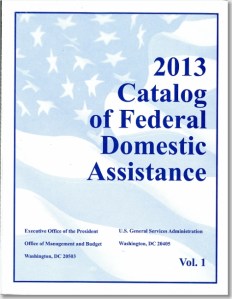
Catalog-of-Federal-Domestic-Assistance_2013_cover imageDid you know that the U.S. Government offers more than 2,200 Federal assistance programs to the American public? It does, and these programs serve a variety of purposes and provide a range of benefits to state and local governments, non-profit organizations, institutions, and individuals.

The one characteristic shared by these Federal assistance programs is their goal of supporting the American public. The benefits available through these programs include, but are not limited to, financial assistance and the exchange of property or services.

With so many Federal assistance programs and services available, it can be understandably difficult to keep track of them all or know where to start when looking for assistance. That’s where the Catalog of Federal Domestic Assistance — known fondly as the CFDA– comes into play! The General Services Administration maintains a database of all of these programs and publishes a comprehensive guide to the programs annually.

The 2013 Catalog of Federal Domestic Assistance assists users in identifying programs that meet their needs and obtaining general information about the program-such as how to apply for assistance, the approval process, related programs, and contact information.

What categories of U.S. Government Federal Assistance Programs are there and what information is provided on each?

Some types of Federal Assistance funding are issued via grants. To search for and track all Federal Government grants, visit Grants.gov.

Some types of Federal Assistance funding are issued via grants. To search for, apply to, and track all sorts of Federal Government grants, visit the Grants.gov website.

Each program is detailed in the CFDA, and potential users can review the details including each program’s Objectives, Types of Assistance, and the rules for applying for and using this program, including Uses and Use Restriction and Eligibility Requirements for both the grant applicant and beneficiary(ies).

Each entry also includes any Credentials/Documentation required and the Application and Award Process that must be followed to apply for , from Preapplication Coordination and Application Procedures to Award Procedure and Deadlines for submitting your application (if required).

Types of Federal assistance programs run the gamut from Formula or Project Grants to Cooperative Agreements; Direct Payments for either a specified or unrestricted use; Direct Loans or Guaranteed / Insured Loans; Insurance; Sale, exchange, or donation of Federal property or goods; Use of Federal property, facilities, or equipment; even Investigation of complaints and Advisory Services and Counseling; plus many more.

Sampling of some of the Federal Assistance Programs available

Image: Break-down of CFDA program distribution for the top five issuing agencies by dollars provided. Source: CFDA Website

Image: Break-down of CFDA program distribution for the top five issuing agencies by dollars provided. Source: CFDA.gov Website

In order to demonstrate the broad scope of these Federal assistance programs a bit more, here’s a look at some of the more interesting programs offered by these top 5 agencies that provide the most program offerings:

U.S. Department of Health and Human Services (HHS)

  • Nutrition Services Incentive Program
  • Mental Health Research Grants
  • Grants to Increase Organ Donations
  • Poison Center Support and Enhancement Grant Program

U.S. Department of the Interior (DOI)

  • Earthquake Hazards Reduction Program
  • American Battlefield Protection Grants
  • Coastal Wetlands Planning, Protection and Restoration Act Grants
  • Cooperative Endangered Species Conservation Fund

U.S. Department of Agriculture (USDA)

  • Collaborative Forest Restoration Project
  • Farmers’ Market Promotion Program
  • Animal Health and Disease Research Grants
  • Emergency Community Water Assistance Grants

U.S. Department of Justice (DOJ)

  • Missing Children’s Assistance Grants
  • Community-Based Violence Prevention Program
  • Juvenile Mentoring Program
  • Economic High-Tech and Cyber Crime Prevention Grants

U.S. Department of Housing and Urban Development (HUD)

  • Housing Counseling Assistance Program
  • Appalachia Economic Development Initiative
  • Lead-Based Paint Hazard Control Grants
  • Veterans Homelessness Prevention Program
Veterans-Homelessness-Prevention-Program
This last program, for example, the Veterans Homelessness Prevention Demonstration Program, or VHPD, is a Project Grant type assistance program which has the following stated objective:
“The purpose of the Veterans Homelessness Prevention Demonstration Program (VHPD) is to explore ways for the Federal Government to offer early intervention homelessness prevention, primarily to veterans returning from wars in Iraq and Afghanistan. The authorizing statutory language for the VHPD acknowledges the increasing number of female veterans, veterans with families especially with a single head of household, as well as those from the National Guard and Reserve who are being discharged from the military and whose unique needs should be more closely examined.”

The VHPD grant money funding is to be…

“used for short-term housing assistance, including security deposits, up to 18 months of rent assistance, rental and/or utility arrearages, or related housing assistance. Grantees may also use funding for appropriate services for veterans and their families, including, but not limited to, child care, family services and case management.”

As you can see, Federal assistance programs exist to benefit the American public in many different arenas and through a variety of methods. Whether the goal is to reduce veterans’ homelessness, to mitigate the impact of earthquakes, or to provide mentorship for young people, the 2013 Catalog of Federal Domestic Assistance is the ultimate resource and all-in-one guide for learning about the programs that are available from the U.S. Government.

After all, the public needs to be aware of these programs in order to take advantage of what they have to offer!

How can I get these and other Federal Government publications on Federal Benefits?

In addition to clicking on the links in the article above to find the publications, you may find other benefits publications from the following:

About the Authors: Guest blogger Stephanie Jaeger is Sales & Marketing Coordinator for GPO’s Sales & Marketing Division that markets GPO’s publishing services to the Federal sector.

Government Book Talk Editor Michele Bartram is Promotions and Ecommerce Manager for GPO’s Publication and Information Sales Division in Washington, DC, and is responsible for online and offline marketing of the US Government Online Bookstore (http://bookstore.gpo.gov) and promoting Federal government content to the public.


Spring forward into the garden

March 20, 2014
Baby chick hides among yellow daffodils

Image: Chick with daffodils (Source: Argonne National Laboratory, U.S. Department of Energy

Ah, spring: the season of rebirth, renewal, and growth. Breathe in the air full of the fresh blossoms of flowers, feel the first warm breezes, gaze at the profusion of color, and listen to the birds chirping and insects buzzing.

Most of the United States just went into daylight saving time on March 9 with instructions to “spring forward” with our clocks. On Thursday, March 20, 2014, we spring forward for real as it is the Spring or Vernal Equinox, fondly known as the official first day of spring. After a brutal winter and the first full month of spring and National Garden Month—April– just around the corner, many minds turn toward planting and gardening with their promise of getting back in touch with nature.

Play the Zone

Before you pull on the mud boots and pick up your gloves and tools, you’ll want to determine where you are in the USDA Plant Hardiness Zone Map for the United States. The climate where you garden affects the fruits and vegetables that you can grow successfully. Local nurseries and garden centers will typically stock plants that perform well in your climate, but it’s important to know your planting zone if you are ordering seeds, bulbs, or plants from non-local establishments.

USDA-Plant-Hardiness-Zones-Map across the U.S.

Image: USDA Plant Hardiness Zone Map (Source: USDA)

How does your garden grow?

If you pore over seed catalogs, browse gardening Web sites, stroll the store aisles of soil, pots, and plants, and read gardening books in the dark winter months, then you probably have the gardening bug. You can also learn to recognize the real insects that you have in your garden with The Bug Book: A Garden Field Guide from the EPA. Gardeners can toil away only to find that someone else is enticed by the new plants; that’s when some choose to control pests by using chemicals. Be extra safe and learn about the effects of pest control, especially if you have children. Greenscaping (see this EPA guide) is an alternative method of dealing with those tiny invaders in your garden.

Lady bugs clustered on an oak branch

Image: Lady bugs gathering on an oak branch (Source: NPS)

Practice safe gardening

EPA's Mission: Sunwise Activity Book for sun safety ISBN  9780160917097In any outdoor activity, you want to be safe and healthy in the garden. While you are digging away and pulling weeds, you can get quite a sunburn or get dehydrated. The EPA’s Mission: Sunwise Activity Book helps educate kids on how to be safe in the sun and to use sunscreen. Check out these health and safety tips so that you can continue to enjoy the time spent outdoors.

How to Prune Trees by the U.S. Forest Service ISBN: 9780160913761How-to-Recognize-Hazardous Defects-in-Trees ISBN: 9780160913778When it comes to tackling bigger projects, read up first to learn what to look for in your own backyard, starting with those stately trees. How to Prune Trees is a best-selling quick guide to smart practices on trimming branches for optimum tree health. How to Recognize Hazardous Defects in Trees is an overview of common issues with trees.

Removing a tree altogether is sometimes the only safe option; Why Would Anyone Cut a Tree Down? is a book for children that explains how taking away an unhealthy tree can benefit the overall environment of the garden.Why Would Anyone Cut a Tree Down? U.S. Forest Service ISBN: 9780160916267

As always, with any larger gardening issues, you’ll want to consult a professional arborist for concerns with your trees.

Mighty oaks from little acorns grow

Gardening is an ideal activity for children. Not only are they out in nature and physically active, but they also learn about where healthy food comes from while observing the weather, biology, zoology, and conservation. The First Lady of the United States, Michelle Obama, has been teaching the message of healthy living through nutritious, locally grown food in her White House Kitchen Garden. Plants grown right outside the White House in Washington, DC, end up on the dining table of the President’s family. Whether you are building a kitchen garden, a school garden, or a community garden, Let’s Move has more information for you, including a diagram of the White House Kitchen Garden if you want to recreate it in your own backyard.

The Little Acorn - USDA children's book ISBN: 9780160817014Schools are well aware of the educational benefits of gardening; it begins as early as pre-school. (Download the free “Grow It, Try It, Like It! Preschool Fun with Fruits and Vegetables” garden-themed nutrition education kit.) Teachers can find resources and lesson plans from the EPA to incorporate gardening into their school curriculum. And if April showers are in the forecast, little ones can still learn about nature by curling up with a delightful illustrated book about The Little Acorn, which tells of the cycle of growth and change in the garden that starts with just one seed.

Watch the video below as First Lady Michelle Obama and White House chef Sam Kass tell the story of the first garden on White House grounds since Eleanor Roosevelt’s Victory Garden during World War II.

First Lady and White House chef explain history of the first White House kitchen garden since WW2

Inside the White House: The Kitchen Garden” video of First Lady Michelle Obama and White House chef Sam Kass telling the story of the first garden on White House grounds since Eleanor Roosevelt’s Victory Garden during World War II. This new garden was planted in the Spring of 2009 with the help of local elementary school children and has yielded a constant supply fresh produce for the First Family and White House events. Published May 10, 2012. (Source: White House Let’s Move YouTube Channel)

You can find more White House garden videos and gardening ideas for kids on the Let’s Move Gardening Guide web page.

Look for inspiration in public spaces

A Botanic Garden for the Nation: The United States Botanic Garden (ePub eBook) ISBN: 9780160869129 for out-of-print ISBN: 9780160767722Some folks are lucky enough to own a big garden plot; others grow plants in containers on a balcony or place herb pots by a sunny window. No matter how you garden, you can always look for inspiration for your gardening pursuits. There are a number of places to visit in spring to see the variety of plants. It’s especially helpful to visit places where plants are labeled so that you know what to look for at a local nursery or plant sale.

Cymbidium ‘Hearts of Gold’ orchid in bloom at the U.S. Botanic Garden

Image: Cymbidium ‘Hearts of Gold’ orchid in bloom at the U.S. Botanic Garden

In the nation’s capital, Washington, DC you can go to the United States Botanic Garden and see what’s in bloom or learn how to attract butterflies to your garden.

You can also purchase A Botanic Garden for the Nation: the United States Botanic Garden (ePub eBook), a GPO Online Bookstore perennial favorite (pun intended).

Girl's face peeking out from pink azaleas at National Arboretum in Washington, DC

Peeking out from among the azaleas at the National Arboretum in Washington, DC.

While in the DC area, don’t miss the United States National Arboretum. You can see every single plant contained there, search for individual plants and see exactly where they are located on this interactive map.

Find out what’s in bloom during the month of your visit. (If visiting in April, don’t miss their world-famous display of azaleas / rhododendrons which bloom sometime in April. Check their Azalea page for current bloom conditions.)

The arboretum also has full color posters to help you identify crape myrtles, shrubs, and trees.

U.S. National Arboretum Crape Myrtles Guide

Image: Guide to Lagerstroemia, commonly known as crape myrtle or crepe myrtle, from the National Arboretum. (Source: U.S. National Arboretum)

Learn about gardening by joining others

Restorative Commons: Creating Health and Well-Being Through Urban Landscapes ISBN: 9780160864162You can learn so much about gardening by meeting other like-minded folks. If you don’t have your own garden, you might want to join a community garden or find a local gardening group or volunteer at a gardening club. Urban soils have their own unique characteristics and benefits; find out how to grow gardens in urban soil, then enjoy the benefits that come from gardening in urban landscapes in Restorative Commons: Creating Health and Well-Being Through Urban Landscapes, available from GPO’s U.S. Government Online Bookstore.

Urban gardeners at work planting new seedlings

Image: Urban gardeners at work planting new seedlings (Source: NIH)

It’s food for thought

Fruitful Legacy: A Historic Context of Orchards in the United States, with Technical Information for Registering Orchards in the National Register of Historic Places ISBN: 9780160821271The first presidents were known not only for their political endeavors, but also for their farms, gardens and orchards. If planted and maintained well, gardens and orchards can last for decades, even centuries.

Learn more about the legacy and preservation of historic orchards in the U.S. with these two publications available from GPO’s U.S. Government Online Bookstore:

Happy gardening!

Image: Uncle Sam promoting gardening during wartimeSource: National Archives

Image: World War II USDA poster promoting Victory gardens: “Uncle Sam says GARDEN to Cut Food Costs” (Source: National Archives)

How can I get these and other Federal Government publications on Gardening?

In addition to clicking on the links in the article above to find the publications, you may find gardening publications from the following:

About the author: Kristina Bobe is a Senior Planning and Development Specialist for the U.S. Government Printing Office’s Library Services & Content Management (LSCM) Division. Additional content, images and editing provided by Michele Bartram, Government Book Talk Editor and Promotions Manager for GPO’s Publication and Information Sales Division in Washington, DC.


Happy 25th Birthday, World Wide Web!

March 12, 2014

World Wide Web 25TH Anniversary logo. Happy 25 birthday, WWW, March 12 1989 to 2014Twenty-five years ago on March 12, 1989, Sir Tim Berners-Lee, a British scientist at CERN, the European Organization for Nuclear Research, wrote a paper proposing the system now known as the World Wide Web. (Left: 25 Years logo courtesy Marketing Magazine UK.) It was originally conceived and developed as an improved means for instantaneous information-sharing between scientists around the world.

From DOD’s ARPANet to an Internet

The Internet itself had actually started as a creation of the U.S. Government’s Department of Defense’s Advanced Research Projects Agency (ARPA) together with U.S. universities. It was in response to the Cold War need for a backup communications method in case the traditional phone networks were knocked out. The resulting mainframe-to-mainframe computer network in 1969 was called ARPANet, the foundation for today’s Internet. (Read the History Channel’s history of the invention of the Internet here.) Soon, other organizations, mostly universities and military, created their own private networks. When the University College in London and the Royal Radar Establishment in Norway) connected to ARPANET in 1973, the term Internet was born.

In 1974, the first Internet Service Provider (ISP) was launched with the introduction of a commercial version of ARPANET, known as Telenet, thus expanding the availability of the Internet. After the introduction of a new protocol called TCP/IP by computer scientists Vinton Cerf and Robert Kahn (called “The Fathers of the Internet”) in 1974, diverse computer networks could easily interconnect with each other, transforming the “Internet” into a truly global network by the end of the 1970s.

However, by 1990, frustrated CERN scientists were using the text-only Internet with its bulletin boards and limited mainframe messaging, but it was not user-friendly for either the end users or the publishers of content.

From a text-only Internet to a graphical World Wide Web

After Berners-Lee’s proposal received the go-ahead from his boss at CERN, he went on to write software in his spare time, creating the first World Wide Web server (“httpd”) and the first web client “WorldWideWeb.”

This “World Wide Web browser” was a WYSIWYG (what-you-see-is-what-you-get) hypertext browser/editor that would install on their client (end user) computers, providing them with the first graphical interface for accessing Internet content (think of clicking on hyperlinks, viewing  photos and other graphical images, seeing text in different fonts, colors and sizes).

The World Wide Web was launched publicly on August 6, 1991, forever after providing the world a way to “browse the World Wide Web.”

Sir Tim Berners-Lee First World Wide Web Server 1990

Image: This NeXT workstation (a NeXTcube) was used by Sir Tim Berners-Lee in 1990-1 as the first Web server on the World Wide Web. Source: Wikipedia

In a guest blog post today on Google’s official blog, Sir Tim Berners-Lee explains the results of his World Wide Web idea:

In 1993, after much urging, CERN declared that WWW technology would be available to all, without paying royalties, forever.

This decision enabled tens of thousands to start working together to build the web. Now, about 40 percent of us are connected and creating online. The web has generated trillions of dollars of economic value, transformed education and healthcare and activated many new movements for democracy around the world. And we’re just getting started.

So, thank you, Sir Tim! The rest, as they say, is history.

Below is a timeline of Internet history from 1990 to 2007:

Internet timeline including World Wide Web and social media. Courtesy: Harbott.com

Internet timeline including World Wide Web and social media. Courtesy: Harbott.com

GPO’s History on the World Wide Web

GPO is joining in the celebration by commemorating our own moments in World Wide Web history:

1993:    The Government Printing Office Electronic Information Access Enhancement Act of 1993 was enacted (Public Law 103-40).

1994:    GPO Access launched (available by subscription; free to Federal depository libraries)

1995:    GPO Access became free to all users.

1995:    GPO began selling Government publications online with its “Sales Product Catalog” (now the site known as the U.S. Government Bookstore)

1996:    GPO’s Federal Depository Library Program Web site, “FDLP Administration,” launched (later named the FDLP Desktop and now FDLP.gov)

2000:    GPO’s kids’ site, Ben’s Guide to U.S. Government, launched.

Image: Home page of Ben's Guide to U.S. Government for Kids as of March 12, 2014.

Image: Home page of Ben’s Guide to U.S. Government for Kids as of March 12, 2014.

2006:    The Catalog of U.S. Government Publications, launched.

2009:    GPO’s Federal Digital System (FDsys) launched.

2010:    GPO entered the world of social media, first with the launch of its YouTube Channel.

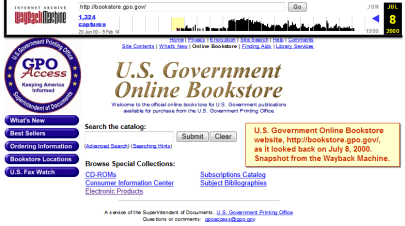
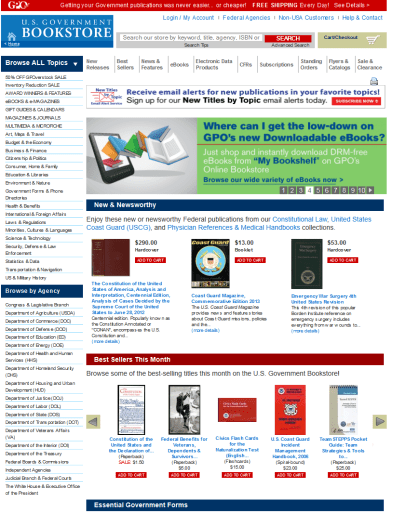
2013:      GPO relaunches its newly redesigned U.S. Government Bookstore ecommerce site at http://bookstore.gpo.gov/.

BEFORE (U.S. Government Online Bookstore 2000):

US_ Government_Online Bookstore_Wayback-Machine_20000708

Image: Snapshot of the home page of the U.S. Government Online Bookstore http://bookstore.gpo.gov/ as of July 8, 2000. Source: Internet Archive Wayback Machine http://archive.org/web/

AFTER (U.S. Government Online Bookstore today in 2014):

Image: Today's U.S. Government Online Bookstore home page as of March 12, 2014.

Image: Today’s U.S. Government Online Bookstore home page http://bookstore.gpo.gov/ as of March 12, 2014.

To see how your favorite websites looked in years past, visit the Internet Archive Wayback Machine at http://archive.org/web/ which archives snapshots of web pages since the World Wide Web launched.

Federal Publications for the Digital Age

The U.S. Government Online Bookstore carries a number of Federal publications that highlight the triumphs and the challenges of the digital age.

A History of Army Communications and Electronics at Fort Monmouth, New Jersey, 1917-2007 (Hardcover) or Ebook  ISBN: 9780160813597 or 9780160869105One interesting read is, “A History of Army Communications and Electronics at Fort Monmouth, New Jersey, 1917-2007 (Hardcover) and eBook.” This book details ninety years of communications-electronics achievements carried out by the scientists, engineers, logisticians and support staff at Fort Monmouth, NJ. It’s a fascinating read, as it details communications ranging from homing pigeons to frequency hopping tactical radios!

YouTube War: Fighting in a World of Cameras in Every Cell Phone and Photoshop on Every Computer by US Army War College & Strategic Studies InstituteAlso check out “YouTube War: Fighting in a World of Cameras in Every Cell Phone and Photoshop on Every Computer,” from the U.S. Army War College, Strategic Studies Institute. This publication discusses the digital environment in which we live that enables terrorists to film and instantly share their attacks within minutes of staging them. It also describes possible courses of action for the Army and the U.S. military as they seek to respond to an enemy in this type of environment.

Computers Take Flight: A History of NASA's Pioneering Digital Fly-by-wire Project ISBN: 9780160914423You might also be interested in, “Computers Take Flight: A History Of NASA’s Pioneering Digital Fly-by-wire Project.” This book details the flight research project which validated the principal concepts of all-electric flight control systems now used on nearly all modern high-performance aircraft and on military and civilian transports.

These, and a wide array of other interesting publications on related topics, can be found by browsing the U.S. Government Bookstore under the “Computers and Electronics” category. In addition, the World Wide Web has made obtaining eBooks possible, so our wide selection of free and/or inexpensive eBooks for consumers, industry, academia, military, law enforcement, legal community and more would be worth viewing as well.

How can I get these technology-related Federal publications?

  • Shop Online Anytime: You can buy this eBook or any other eBook, as well as print publications (with FREE Standard Shipping worldwide) from the U.S. Government Online Bookstore website at http://bookstore.gpo.gov:
  • Order by Phone: You may also Order print editions by calling our Customer Contact Center Monday through Friday, 8 am to 5:30 pm Eastern (except US Federal holidays). From US and Canada, call toll-free 1.866.512.1800. DC or International customers call +1.202.512.1800.
  • Shop our Retail Store: Buy a copy of any print editions from this collection at GPO’s retail bookstore at 710 North Capitol Street NW, Washington, DC 20401, open Monday–Friday, 9 a.m. to 4 p.m., except Federal holidays, Call (202) 512-0132 for information or to arrange in-store pick-up.
  • Visit a Federal Depository Library: Search for U.S. Government publications in a nearby Federal depository library. (Librarians: You can find the records for most titles in the Catalog of U.S. Government Publications or CGP.)

About the authors: Guest blogger Kelly Seifert, Lead Planning Specialist for GPO’s Library Services & Content Management Division, writes about the World Wide Web’s 25th birthday and the array of Government publications available on the topics of computers and electronics.

Government Book Talk Editor Michele Bartram. Bartram is Promotions and Ecommerce Manager for GPO’s Publication and Information Sales Division in Washington, DC, and is responsible for online and offline marketing of the US Government Online Bookstore and promoting Federal government content to the public. A computer scientist and digital expert, Bartram remembers those early pre-WWW days using mainframe-based Internet and email and then using a web browser to “surf” the World Wide Web for the first time.


The History of eBooks from 1930’s “Readies” to Today’s GPO eBook Services

March 10, 2014

To some it might seem strange that the Government Printing Office, the printer of Federal publications for over 150 years, is blogging about eBooks for “Read an eBook” Week and the 25th anniversary of the World Wide Web . However, GPO has been working with digital publications for years and is fully immersed in eBooks.

History of the Ebook and E-Reader Devices

While many know that the paperback book came to us in the 1930s, few know that the concept for electronic books arose at the same time. According to Wikipedia, the idea of the e-reader came to writer and impresario Bob Brown after watching his first “talkie” (movies with sound). In 1930, he wrote an entire book on this invention and titled it “The Readies” [/reed-eeze/] playing off the name of the “talkie.” (Read about Brown in this New York Times article.)

simultaneous_reading_machine

Image: Fantasy exhibit of an electronic simultaneous reading machine. Source: The Architecture of Possibility

Wrote Brown: “The written word hasn’t kept up with the age… The movies have outmaneuvered it. We have the talkies, but as yet no Readies.” He explained why it was needed, saying: “To continue reading at today’s speed, I must have a machine.” He described his ideal future e-reader as: “A simple reading machine which I can carry or move around, attach to any old electric light plug and read hundred-thousand-word novels in 10 minutes if I want to, and I want to.” Furthermore, this machine would “allow readers to adjust the type size and avoid paper cuts.

Free-eBooks-from-Project-GutenbergIt would take over 40 years for Brown’s prescient vision to become reality. Starting back in 1971, Michael S. Hart launched Project Gutenberg and digitized the U.S. Declaration of Independence, becoming the first eBook in the world. (To put the date into context, 1971 was the year that the first email message was ever sent– between two mainframe computers!) In 1985, the Voyager Company, a pioneer in CD-ROMs, was founded and published “expanded books” on CD-ROM including Michael Crichton’s Jurassic Park, and in 1993, Digital Book, Inc. offered the first 50 digital books on floppy disk.

Fast forward to 1998, and four important events happened: 1) the first dedicated eBook readers were launched: Rocket Ebook and Softbook; 2) the first ISBN issued to an eBook was obtained; 3) US Libraries began providing free eBooks to the public through their web sites and associated services; and 4) Google was founded by Larry Page and Sergey Brin.

In 2000, the same year Blu-Ray discs were launched, Stephen King offered his novella Riding the Bullet as a digital-only computer-readable file, and two years later, Random House and HarperCollins started to sell digital versions of their publications. In 2004 Sony released its Sony Librie e-reader and then its Sony Reader in 2006.

2007 changed the world of reading forever with Amazon’s launch of the Kindle eBook reader in the U.S. and the launch of the iPhone by Apple. In 2009, Barnes & Noble introduced the Nook, and Sony linked with libraries via the Overdrive digital network to enable library patrons to borrow eBooks from their local library.
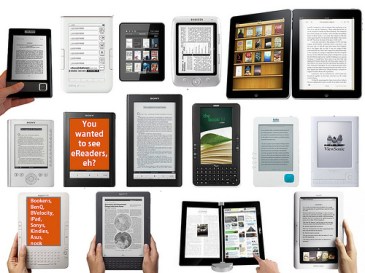
ereaders-ebook-devices

Image: Wide variety of eReaders and eBook reading devices. Courtesy: eBookAnoid

2010 was a banner year for eBooks as: 1) Apple released the iPad along with iBooks and its iBookstore on iTunes, selling half a million eBooks in less than a month; 2) Google’s eBookstore launched; and 3) Amazon reported that for the first time, its eBook sales outnumbered its hardcover book sales.

By January 2011, eBook sales at Amazon had outpaced its paperback sales, and by the end of the first quarter of 2012, eBook sales in the United States surpassed all hardcover book sales for the first time, topping over $3 Billion in revenue nationwide. And as of the end of 2013, the Association of American Publishers announced that eBooks now accounted for about 20% of all U.S. book sales.

Types and Formats of Digital Publications

Today, one sees many kinds of digital publications. “Electronic” or digital books can come as printable PDFs, enhanced PDFs with hyperlinks and embedded files, or “true eBook” formats: EPUB or MOBI files. EPUB is the most common and non-proprietary format, used by most Government agencies, commercial publishers, and libraries, and can be used on a variety of devices and software from different vendors. MOBI or AZW is used by Amazon for its Kindle readers and software.

EPUB and MOBI are “true eBook” formats because they offer resizable and reflowable text, automatically adjusting to the font and screen size and orientation (portrait or landscape) set on the e-reading device or software being used. (For more information, read our blog post “Government eBooks Made Easy– and Sometimes Free.”)

Readers either download digital publications onto their dedicated eReader like a Kindle or Nook, or they download it to their desktop or laptop computer, smart phone or tablet computer to read. If it is not a dedicated eReader device, the user must first have software on his device to allow him to read the format of eBooks he has downloaded.  To learn more about eBook formats and find FREE software to read EPUB eBooks on your computer or mobile device, read our detailed eBook Readers & Formats page on the U.S. Government Bookstore.
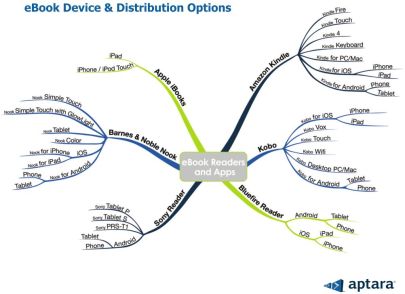
Image: Infographic of different eBook readers and apps options Source: Digital Book World

Image: Aptara’s infographic of different eBook readers and apps options Source: Digital Book World

Magazines are also available digitally, but their typically image-heavy content makes them more suited for reading on color tablets and desktop computers than smartphones or black-and-white eReaders with smaller screen sizes or no color. Zinio.com, touted as “The World’s Largest Newsstand”, is one of the sites where readers can search for and subscribe to digital magazines or buy individual issues.

GPO Digital Publication Services: “Helping Federal Agencies keep America informed”

In addition to helping Federal agencies design, print, promote and distribute physical publications, GPO has, for a number of years now, been helping our Federal agency partners design, convert, disseminate, and promote digital publications as well. From eBooks to audiobooks, PDFs to e-periodicals, MP3s to mobile sites, GPO is working with Federal agencies to not only assist them in producing the best digital publications in the right formats, but to also augment their own outreach efforts by helping spread the word to gain the largest audience possible for their publications.

Today we offer five areas of digital (and print) publication services to U.S. Federal Government agencies in the Executive, Legislative or Judicial branches:

  1. Image: Choosing the right format and content for your publication is made easier with GPO's publication consulting services.

    Image: Choosing the right format and content for your publication is made easier with GPO’s publication consulting services.

    Publication Consultation services: Do you need advice on what formats are best for your content? Need to know how to best structure and build your digital publication to ensure its broadest use and dissemination? We offer free consulting services to Federal agencies to help you get these projects on the right track.

  2. Design services: Does your agency need assistance in developing and producing digital or print publications, from photography, videography, copy, layouts and more? Our fee-based Creative Services can be hired to do this for you, with only an inter-agency memo required to get started.

    GPO-Creative-Digital-Media-Services

    GPO’s Creative & Digital Media Services helps Federal Agencies design the perfect publication in any format, print or digital.

  3. eBook Conversion services: Are you a Federal agency that already has a print book or magazine you want to turn into a digital publication? Or do have one digital format like a plain PDF that you need to convert to another format so more customers can use it? We offer fee-based conversion services to turn that publication into digital formats ready for commercial distribution.
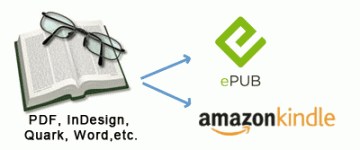
    GPO offers ebook conversion services to Federal agencies

    Image: GPO can help Federal Agencies convert their existing publications into alternative formats. See our eBooks & Digital Services page for more information.

  4. Dissemination services: After all this work creating the perfect digital books and magazines, you need to make sure it reaches the widest intended audience possible. GPO’s Sales Program provides a network of the top print and eBook distribution services and sites in the world, including Google Play, Apple iTunes, Barnes & Noble, MyiLibrary, Overdrive, and Zinio (for e-magazines and journals), to name a few.Whether an agency has print books or posters, maps or  MP3s, eBooks or audio books, GPO can help agencies disseminate their publications through the top channels worldwide. Learn more in the eBook Channels for Federal Publications section below or visit our eBooks & Digital Services page. (Note that libraries can find links to published U.S. Government eBooks in GPO’s Federal Depository Library Program’s special eBooks at GPO page.)

    Image: GPO's Publication & Information Sales team helps Federal Agencies attain the broadest dissemination possible through our many worldwide eBook distribution partnerships.

    Image: GPO’s Publication & Information Sales team helps Federal Agencies attain the broadest dissemination possible through our many worldwide eBook distribution partnerships.

  5. Promotional services: Once your digital publication shows up on all these channels, how do you drive customers to find it?  For items in GPO’s Sales Program, we market our Federal agency partners’ digital publications through a variety of methods that could include: posts on this widely-read Government Book Talk blog; posts on other social media such as Pinterest, Twitter, Facebook and more; targeted outreach and press releases; flyers, catalogs and other direct mail; live events and webinars; search marketing; alerts to Federal Depository Libraries about the title; and our free New Titles by Topic email subscription service, to name just a few of our many promotional tools.

    Image: GPO's Publication & Information Sales team helps get the word about our Federal Agency Partners' publications through integrated marketing and outreach.

    Image: GPO’s Publication & Information Sales team helps get the word about our Federal Agency Partners’ publications through integrated marketing and outreach to the public, book dealers, industry and consumer organizations and more.

GPO Sales Program Manages eBook Channels for Federal Government

Thus, GPO has established the most robust dissemination program available for Federal agencies to “get their eBooks out where users are looking for them,” by signing partnerships with the top eBook and eMagazine distribution services in the world and expanding our own online bookstore to offer eBooks.

In order to take advantage of the sophisticated technology and distribution partnerships GPO has put in place for the Federal Government, Federal agencies can choose one of two models for GPO to disseminate their digital publications:

a)     PAID CONTENT: Under this model, instead of having the Federal agency pay GPO for dissemination and promotion, the costs for GPO’s dissemination and promotional services (including elaborate metadata and search optimization) are recovered by selling the eBook to the public at a reasonable price.

b)     FREE CONTENT: However, if the Federal agency determines that the digital publication needs to be free to the public through all the commercial channels, the agency may pay GPO a modest fee for dissemination and promotional services, and the eBook will be offered for free to the public.

Image: Extract from GPO's U.S. Government Bookstore home page at http://bookstore.gpo.gov, which has print and digital publications available.

Image: Extract from GPO’s U.S. Government Bookstore home page at http://bookstore.gpo.gov, which has both physical products (print books, CD-ROMs and DVDs, posters, flashcards, etc.) and DRM-free digital publications (eBooks, audio books, PDFs, etc.) available.

eBook Channels for Federal Publications
All ebooks available on GPO's U.S. Government Bookstore are DRM-free

All ebooks available on GPO’s U.S. Government Bookstore are DRM-free, with no restrictive Digital Rights Management.

Because we have optimized the navigation and search on our site specifically to make it easy to find Federal eBooks by Agency, Topic and/or Format, many titles are seeing more downloads here than out on commercial sites like Google or iTunes or even on agencies’ own websites.

Also contributing to the surging popularity with the public of obtaining eBooks from the U.S. Government Bookstore is the fact that unlike eBooks purchased from some of the proprietary eBook distributors, digital publications on the U.S. Government Online Bookstore are DRM-free (no Digital Rights Management), meaning they are not restricted to a single device or manufacturer and can be downloaded multiple times.

  • Commercial eBook Channels: Apple iTunes iBookstore, Google Play eBookstore, Barnes & Noble Nook Book Store, Powell’s, eBookPie, Diesel eBookStore, (United States), and more.
  • U.S. Public Libraries: Overdrive’s Library Digital Distribution provides eBooks to public library patrons nationwide.
  • Academic eBook Channels: EBSCO, MYiLibrary, AcademicPub and others.
  • Digital Magazine Channels: Zinio.com worldwide distribution of digital magazines and journals.

Featured eBooks Available Now on the U.S. Government Bookstore

Shop GPO's extensive selection of all DRM-free Federal ebooks.

FREE EBOOKS: Some of the best FREE ebooks available now from the U.S. Government Bookstore include:

OTHER POPULAR TITLES:  Here are some of the newer and more popular DRM-free Federal eBooks available from the U.S. Government Bookstore:

  • Free Trade Agreements: 20 Ways to Grow Your Business (ePub eBook) The book provides detailed information on best prospects, insights on the economic and political situation, tips on business culture, free and low-cost assistance for entering each country market where the U.S. government has negotiated preferential access for U.S. companies.
  • The U.S. Army and the Lewis and Clark Expedition (ePub eBook) is an engaging account of the U.S. Army’s role in the Lewis and Clark Expedition, officially designated the “Corps of Volunteers for North Western Discovery.”
  • Sources of Weapon Systems Innovation in the Department of Defense: The Role of In-House Research and Development, 1945-2000 (ePub eBook) explores the historical evolution of this process during the Cold War to the end of the twentieth century, focusing specifically on the content, scope, organizational structure, and management of in-house research and development (R&D) in the Army, the Navy, and the Air Force. It is not merely a comprehensive history of U.S. military R&D, but is rather a broad historical overview of changing institutional patterns of technological innovation within the Defense Department’s major weapons laboratories.
  • Deep Water: The Gulf Oil Disaster and the Future of Offshore Drilling, Report to the President, January 2011 (ePub eBook) is the official report of Presidential Commission assigned to investigate the Deepwater Horizon oil spill disaster, analyze its causes and effects, and recommend the actions necessary to minimize such risks in the future. The Commission’s report offers the American public and policymakers alike the fullest account available of what happened in the Gulf and why, and proposes actions—changes in company behavior, reform of government oversight, and investments in research and technology—required as industry moves forward to meet the nation’s energy needs.
  • Black Americans in Congress, 1870-2007 (ePub eBook) is a comprehensive history of the more than 120 African Americans who have served in the United States Congress through 2007. Written for a general audience, this eBook contains a profile of each African-American Member, including notables such as Hiram Revels, Joseph Rainey, Oscar De Priest, Adam Clayton Powell, Shirley Chisholm, Gus Hawkins, and Barbara Jordan.
  • HAP: Henry H. Arnold, Military Aviator (ePub eBook) Aviation and military history buffs will enjoy reading about Colonel Henry Harley Arnold or “HAP” Arnold, one of the first two active U.S. Army pilots. Also available in Print, this eBook is available currently through third party eBooksellers.

How can I get Federal Government eBooks and digital magazines?

  • Shop Online Anytime: You can buy eBooks as well as print publications (with FREE Standard Shipping worldwide) from GPO’s U.S. Government Online Bookstore website at http://bookstore.gpo.gov:
  • Shop Commercial eBook Channels:  Search these sites for the ISBN or exact title of the Federal eBook. Also, GPO’s Online Bookstore lists third party eBooksellers where the title can be found for eBooks in our eBook Sales program.
  • Visit the Federal Agency’s website: Often, PDFs of the publication are posted on Federal Agencies’ websites.
  • Visit a Federal Depository Library: Search for U.S. Government publications in a nearby Federal depository library. Librarians: You can find the records for most titles in the Catalog of U.S. Government Publications (CGP), or search for published U.S. Government eBooks in GPO’s Federal Depository Library Program’s special eBooks at GPO page.
  • Visit a Public Library: Ask your local public librarian about Federal eBooks that may be available for library patrons to check out through the library’s Overdrive subscription.

About the author: Government Book Talk Editor Michele Bartram is Promotions Manager for GPO’s Publication and Information Sales Division in Washington, DC, and is responsible for online and offline marketing of the US Government Online Bookstore (http://bookstore.gpo.gov) and promoting Federal government content to the public.