Planning a Vacation? How About a Place Less Frequented?

April 15, 2011

Guest blogger Tina Perantonakis likes to check out lesser-known national parks – and some of them are free!
Growing up as a native Washingtonian, my knowledge of our national parks was limited to the sites in and surrounding the National Mall, such as the Lincoln Memorial and the Jefferson Memorial. As I started traveling more throughout the United States, I had the opportunity to visit some of the most popular national parks, including Yellowstone, Redwood, and Golden Gate, but I gained the most pleasure in discovering and exploring those that are lesser known. Most recently, I visited Mesa Verde National Park in Colorado.  Mesa Verde houses arguably the most impressive cliff dwellings of the Ancestral Pueblo people. 
 
To commemorate National Park Week, which is April 16-24, 2011, I am highlighting a book published by the National Park Service: The National Parks: Index 2009-2011. This book has become indispensable in my travel planning, as it contains listings of National Park System areas by state, in addition to National Heritage Areas, National Wild and Scenic Rivers System, and the National Trails System. Although the Index is not intended to be a guidebook, nor does it contain standard guidebook information such as visiting hours, trails, and campground locations, it does provide the administrative addresses and brief descriptions of the sites – and these descriptions often include interesting facts.  Did you know that there is a national park in American Samoa devoted to protecting tropical rainforests, coral reefs, and fruit bats?  I certainly did not – until I read the entry in the National Parks Index.

This year, the National Park Service will be offering several fee-free days at more than 100 parks that usually charge an entrance fee.  I plan to take advantage of the fee-free days by visiting several Civil War historical sites, including Antietam National Battlefield  in Maryland and Appomattox Court House National Historical Park inVirginia.

For more information on National Parks Week, visit here. To take advantage of the National Park Service free entrance days, visit here.  To purchase a copy of The National Parks: Index 2009-2011, visit here.  You can also find it in a library.


The First Collection of President Obama’s Public Papers

April 13, 2011

I think that the Public Papers of the Presidents is one of the Federal Government’s most distinguished series of publications – and not just because my name once appeared in one of its volumes. Each President since Herbert Hoover (except Franklin Delano Roosevelt, whose papers were published privately prior to the inauguration of the official series) has had his papers and speeches printed in these imposing and austerely handsome volumes, usually issued twice a year by the National Archives and Records Administration’s Office of the Federal Register.

I bring this up because the first volume of President Barack Obama’s Public Papers has just hit the Government Book Talk main desk (at 1,030 pages, plus an extensive index, it hit with great impact, too.) Every President gets his own binding color, and President Obama’s is a navy blue, with the usual cool gold stamping. In addition to the text, it includes a few color photographs of the President and First Lady – in all, a fine example of GPO’s expertise in traditional printing even as it continues to innovate in the digital arena. (The President gets his own special leather-bound copy personally delivered by the Public Printer of the United States – and as he points out, we don’t do many of those!) To see how GPO does it, click here.

Well, it’s great that these are such beautiful books, but what about the content? It shows that Presidents turn up everywhere, from the Tonight show (page 301) to Riyadh, Saudi Arabia (page 759) to a town hall meeting in Green Bay, Wisconsin (page 802). The topics of his speeches, interviews, and news conferences are as diverse as the duties of America’s Chief Executive – health care, foreign relations, economic crises, and even history, as shown by his visit to the Buchenwald concentration camp (page 781). I was particularly touched by his brief statement regarding the victims of a horrendous 2009 Metro subway crash here in DC (page 873) – it happened not long after I rode the same subway line home from work that day.

Perhaps no book better conveys the range of responsibility our Presidents must shoulder every day of their terms. It’s a volume for browsing, revisiting the issues of President Obama’s first six months in office, and wondering how any President deals with the myriad demands on his time, energy, and intellect. You can do your own browsing here or add a copy to your personal library from here. For other volumes in this fine series, you can visit GPO’s Federal Digital System for those issued since 1991 or check our online bookstore by searching under “public papers” to see which ones are still in print.


“Uncivilized Warfare”: Defeating the Kaiser’s U-Boats

April 8, 2011

I’ve been on a bit of a World War I binge lately. In addition to my own at-home reading (most recently a book on naval battles of the First World War and a biography of Colonel Edward M. House, Woodrow Wilson’s closest foreign policy advisor during and immediately after the war), in recent weeks I’ve blogged about World War I aerial reconnaissance, Army nurses, and Stars and Stripes, the doughboys’ newspaper. Maybe it’s because of the recent death of Frank Buckles, the last American veteran of the Great War, or because in another three years we’ll be hearing about the centennial of the war’s outbreak. Given that “the war to end all wars” kicked off what many historians view as one war that lasted from 1914 to 1945 with a 20-year intermission, that its repercussions still echo today, and that it was fought on or near every continent, I find the subject to be one of endless, multifaceted interest.

Because Americans tend to focus on such incidents as the sinking of the Lusitania, it’s easy to forget how deadly a weapon the German U-Boat was on an ongoing basis and how close it came to success. According to Defeating the U-boat: Inventing Antisubmarine Warfare, a new book from the U.S. Naval War College, after a meeting between U. S. Rear Admiral William Sims and the Royal navy’s Admiral of the Fleet Sir John Jellicoe in which the struggle against the U-boats was discussed, Sims cabled Washington to say “briefly stated, I consider that at the present moment we are losing the war.” A major part of the problem was England’s utter unpreparedness to fight an anti-submarine war. This was partly due to the belief that no “civilized” nation would engage in unrestricted submarine warfare, i.e. firing torpedoes at non-military vessels without warning and making no effort to aid or pick up survivors. After trying anti-submarine patrols,  “barrages” or barriers in the Strait of Dover, mines, and the employment of Q-ships (freighters and other civilian craft with concealed/camouflaged guns that could snag U-boats playing by the old “fair warning” rules), it was the development of the convoy system that proved most decisive. Yet such was the ambivalence of many officers (and even Winston Churchill) about the “defensive-mindedness” of convoys that even in World War II it took far too long for Allied navies, including the American navy, to use the convoy against Nazi U-boats.

In its concluding chapter, the author, Jan S. Breemer, reflects on the general tendency of large bureaucracies in general avoid decisions that involve risk.  It also makes the specific point that the Royal Navy in World War I viewed the protection of shipping and the sinking of U-boats as separate issues instead of the two parts of a strategic whole. In other words, combine sluggish bureaucracy and blinkered strategy and you come up with an almost lethal combination. As the great naval historian Arthur Marder put it, “sinking submarines is a bonus, not a necessity.” It took a long while for this lesson to sink in (excuse the pun!)

Defeating the U-boat is a neat little book that’s readable and furnishes a lot of useful information very concisely. It would be a great asset to any World War I buff’s collection. You can read it here, get that copy for your collection here, or seek it out at a library.


A Closer Look at the FBI

April 7, 2011

Guest blogger Kelly Seifert has found a real page-turner of a Government book.

There’s something captivating about the inner workings and countless cases of the FBI. Who hasn’t thought about how interesting it must be to serve as an FBI agent? I think there’s something mysterious and fascinating about the professionals working around the globe to protect the Nation and its citizens.

In 2008, the FBI celebrated its 100 anniversary and, as part of that celebration, released, The FBI: A Centennial History, 1908-2008. This 130-page coffee table book features detailed accounts of more than 40 famous FBI cases; over 300 photographs, including many never before seen by the public; and abundant reference materials on fallen agents, FBI Directors, and more.

The book traces the FBI’s journey from fledgling startup to one of the most respected and recognized names in national security. It covers World War I and the early days of terrorism, the gangster era of the 1920s and 30s, World War II and the Cold War, the 60s and its civil rights movement, the Watergate years, the rise of global terror and crime, and the post 9/11 era.

Especially intriguing is the FBI’s transformation over time. The advances in technology and instruments the Bureau uses in protecting our national security, combined with its growth from 34 to 30,000 agents over the years, makes for an exciting and absorbing read. Find The FBI: A Centennial History, 1908-2008 online, get your own copy and settle in for a thrilling ride here, or investigate it at a library.


Raising and Preserving Native Plants

April 6, 2011

It’s been a cool and rainy spring so far, but my yard is starting to green up. I planted a native beautyberry bush (Callicarpa americana) last year and I’m anxious to see whether we’ll see the berries this time around. Since growing things – especially native plants – is on my mind, I naturally turned to the U.S. Department of Agriculture’s U.S. Forest Service for both inspiration and instruction.

I’m not quite ready to start my own nursery, but if I were, the Nursery Manual for Native Plants: A Guide for Tribal Nurseries would be a big help. Although this book had its origin in several meetings with tribal members to discuss their needs for native plants, facilities, and training, and it uses plants important to Native Americans as examples, anyone interested in the propagation of native species of plants can find a lot to interest them here.

Take seeds, for instance. Although there are commercial sources for some native plants, it’s obviously possible to head into the woods and gather your own – but would you know what to look for, and at what time of year? You need to know when plants flower (and for many species, that’s not so obvious) and the best timing to gather a given seed crop. Another essay in the book talks about how to get seeds to germinate. To propagate some species, you need to use scarification – disrupting an impermeable seedcoat so water and oxygen can enter dormant seeds. Some seeds need fire (there’s a section on smoking them as a technique), digestive acids in the stomachs of animals, or abrasion by blowing sand or ice. I guess I won‘t be trying this kind of thing at home, but it’s great for budding nursery growers and interesting to read about.

Because the Nursery Manual for Native Plants is filled with the wonderful common names of such species, occasionally you can find bits of “found poetry”, like this one:

Common Dioecious Plants

ash

buffaloberry

cottonwood

fourwing saltbush

joint fir

maple

silverberry

willow

Nursery Manual for Native Plants holds great charm for feeble home gardeners like me, as well as a trove of great information for Native Americans or anyone else with a serious commitment to propagating and harvesting America’s unparalleled herbaceous and woody wealth. You can browse through it here, get your own copy here, or find it in a library.


Rights to Safety

March 30, 2011

Guest blogger Ingrid Reyes-Arias reminds us that workplace safety is everyone’s concern.

As an employee, I rarely think about safety issues within my office.  Ever walk near a spill and seen a Caution sign? I have, plenty of times, but I’ve never thought about why it was there in the first place.  While working as a server for a restaurant, I took many falls due to wet floors and my non-stick shoes not working so well.  There were signs throughout the premises, but I never paid attention to them until a co-worker fell and broke his arm.  After this incident, I began to realize that there are many actions that employers and employees can take to prevent falls and other incidents.

The Occupational Safety and Health Administration (OSHA), a part of U.S. Department of Labor, has several publications and items that focus on different aspects of work, such as safety and employee rights, which help lead to greater awareness.  As part of its commitment to workers, OSHA provides safety training in the language you prefer: many of these documents are provided in three different languages: English, Spanish, and Vietnamese.  They are great tools to help communicate safety issues to all of us.  OSHA provides the public with Fact Sheets on different safety topics, including Asbestos, Avian Flu, Fire Safety, Flood Cleanup, Mold, and many more. If you find something applicable to your work place, take the opportunity to promote safety!

Safety information is also available as magnets to place around the office or home, as well as posters and pocket guides.  These materials can be used in a safety session or as fun facts to distribute to other employees.  Keep in mind that this information is made available to everyone. Ever have a question on safety? Don’t hesitate to visit OSHA here.  Learn from my experience and keep safe!


GPO and the Stars and Stripes

March 28, 2011

Because this year marks the 150th anniversary of the Government Printing Office, I’ve been trying to highlight some of its history by featuring some unusual Government publications with a GPO connection. How’s this for unusual: a newspaper that was not printed through GPO, not printed in the United States, and staffed by a number of distinguished authors and critics as well as a future Public Printer.  It took advertising, had 526,000 readers at its peak, yet only stayed in business for about a year and a half. It was, gentle readers, the original Stars and Stripes, the paper of choice for the American doughboys of World War I. (Stars and Stripes currently is published as a non-Government, DoD-authorized newspaper: http://www.stripes.com/customer-service/about-us).

Thanks to the estimable American Memory project of the Library of Congress, the entire run of the U.S. Army’s Stars and Stripes, published in France from February 8, 1918 to June 13, 1919, is available online for browsing. A special American Memory presentation, “A Closer Look at The Stars and Stripes,” highlights the contributions of such luminaries as New Yorker founding editor Harold Ross, drama critic (“Old Vitriol and Violets”) Alexander Woollcott, literary critic John Winterich, sportswriter Grantland Rice, and columnist and “Information Please” radio show panelist Franklin P. Adams (greatly admired in his day and now sunk without trace – who now remembers “The Diary of our own Samuel Pepys”)?  The “Closer Look” also examines soldier-authored material, censorship, and other issues affecting Stars and Stripes. Some of the doughboys’ poetry even transcends doggerel, although not always by much.

Finally, a roster of Stars and Stripes staff reveals the name of Augustus E. Giegengack – a euphonious cognomen, to be sure (hmm – I must be channeling Alexander Woollcott) –   the future Public Printer to whom I referred above. Sergeant Giegengack is listed as working in Circulation, but he started out in charge of printing the paper and expanded his reach to various circulation, delivery, and other tasks. As a poem in Stars and Stripes put it:

“Mail, wrapping, typing, couriers – his duties are a score,

Whenever we can think of it we’ll give him twenty more;

I often wonder how one man can handle such a batch –

When does this great executive get time to stop and scratch?

Nothing neglected, nothing slack

In the department Giegengack.”

After his discharge from the Army, the sergeant returned to the printing industry until his nomination as Public Printer by Franklin Delano Roosevelt, following which he ran GPO from 1934 until 1948 – the longest serving Public Printer in GPO history. He’s also the only GPO chief ever to be profiled in the New Yorker – a three-parter in 1943. He seems to have been both a colorful character and a very efficient GPO chief executive, and the profile is well worth seeking out (New Yorker subscribers can access it online). Many libraries also have extensive runs.

The Stars and Stripes was not only a fine newspaper, but perusing its pages takes one back nearly 100 years to see how the soldiers of the day viewed the war, their situation, and their country. (I wonder if many of today’s soldiers write doggerel?). Even the ads are fun to read! A product of the well-managed “department Giegengack,” it’s a paper that’s still readable and thought-provoking today, when the last American World War I veteran has just left us for “Over There.”


A Civil War Battle of the Books and the Battle for Washington DC

March 18, 2011

For the third year in a row, GPO is doing its own version of the NCAA basketball playoffs. This year’s theme, appropriately enough, given that GPO opened for business shortly before Confederate forces fired on Fort Sumter, is the Civil War. Since I’m a minor Civil War buff myself, I’ve blogged about several of the “competitors,” including Clara Barton: Clara Barton National Historic Site, Battle of Ball’s Bluff and, just a week or so ago, Abraham Lincoln’s Journey to Greatness.

A couple of the books in this year’s tournament are National Park Service Cultural Resources Studies, which are detailed assessments of a particular park’s history, cultural landscape, and historical materials. Monocacy National Battlefield: Cultural Resources Study is meaningful to me because I’ve visited that Maryland park a number of times over the years, beginning when it first opened to the public. As a GPO employee, references to Jubal Early’s 1864 raid, which actually penetrated as far as Fort Stevens in Northwest Washington, DC, remind me that GPO employees actually were mustered into service for a day or two to help defend the city. If Early’s force had arrived a day earlier, it could have been a disaster for the Union, but the hastily assembled force at Monocacy commanded by General Lew Wallace provided just enough delay to ensure the safety of the capital. Wallace, who was criticized, not altogether fairly, for his generalship at Shiloh in 1862, was credited by General Grant for blocking Early at Monocacy. Later, Wallace had the last laugh by writing what is arguably one of the bestselling novels of his century – Ben Hur. To add to his fame, during his post-war career as governor of the New Mexico Territory, Wallace met Billy the Kid, which ensured his regular appearance in movies and TV westerns – giving him a great deal more fame than many more successful Civil War generals.

Monocacy is also a beautiful park, with a walking trail near the Monocacy River and a neat little visitor’s center. Now that spring is on the way, I’m ready to walk those trails again. You can read more about the park itself here, browse the cultural resources study here, or get your own copy via GPO. The study is also available in libraries.

Above all, don’t forget to vote for your favorites at the Civil War Super 16 Tournament. After 150 years, it’s time for a rematch!


Army Nurses in Wartime

March 16, 2011

Although GPO’s 150th anniversary has been on my mind lately, March is also Women’s History Month. A couple of years ago, Answering the Call: The U.S. Army Nurse Corps, 1917-1919, an excellent photographic history published by the Office of the Surgeon General’s Office of Medical History was one of the American Library Association’s Notable Government Documents. Established in 1901, the Corps had sent nurses to Vera Cruz, Mexico during General Pershing’s Punitive Expedition, but World War I saw Corps nurses mobilized on a much larger scale.

 At first, Army nurses served in six British general hospital units while American troops were trained and mobilized for service in France. As American troops arrived, some nurses assigned to special teams wound up in the front lines, dealing with shock, surgical, gas, and orthopedic cases. Answering the Call is profusely illustrated by Signal Corps photographs of the grim reality of modern warfare, including truckloads of wounded soldiers and grim-faced stretcher bearers carrying casualties to the closest dressing stations. Nurses also served in field hospitals and mobile units that ferried the injured back from the front lines. Owing to accidents and the great influenza epidemic of 1918, some Army nurses  died while serving their country, as depicted in moving photos of military funerals and grave sites.

It wasn’t all, grim, though. Answering the Call also shows nurses relaxing as best they could, participating in patriotic plays, and enjoying whatever opportunities for distraction they could find. I’m not a historian of photography, but it does seem that this decade marks a departure from the predominance of unsmiling group photos – smiles make those photographed appear more contemporary and individual, despite the period uniforms and poses.

This book opens a window to an organization and a period seldom mentioned in histories of American involvement in World War I. Both the images and text work to conjure up yet another aspect of women’s history that should be better known. Answering the Call is available here or in a library.

Quite a few Notable Government Documents came our way in 2008. I’ve blogged about a few of them, but looking over the list reminded me that there are some really good ones I haven’t gotten to yet – so stay tuned!


Lincoln on the Threshold of Greatness

March 9, 2011

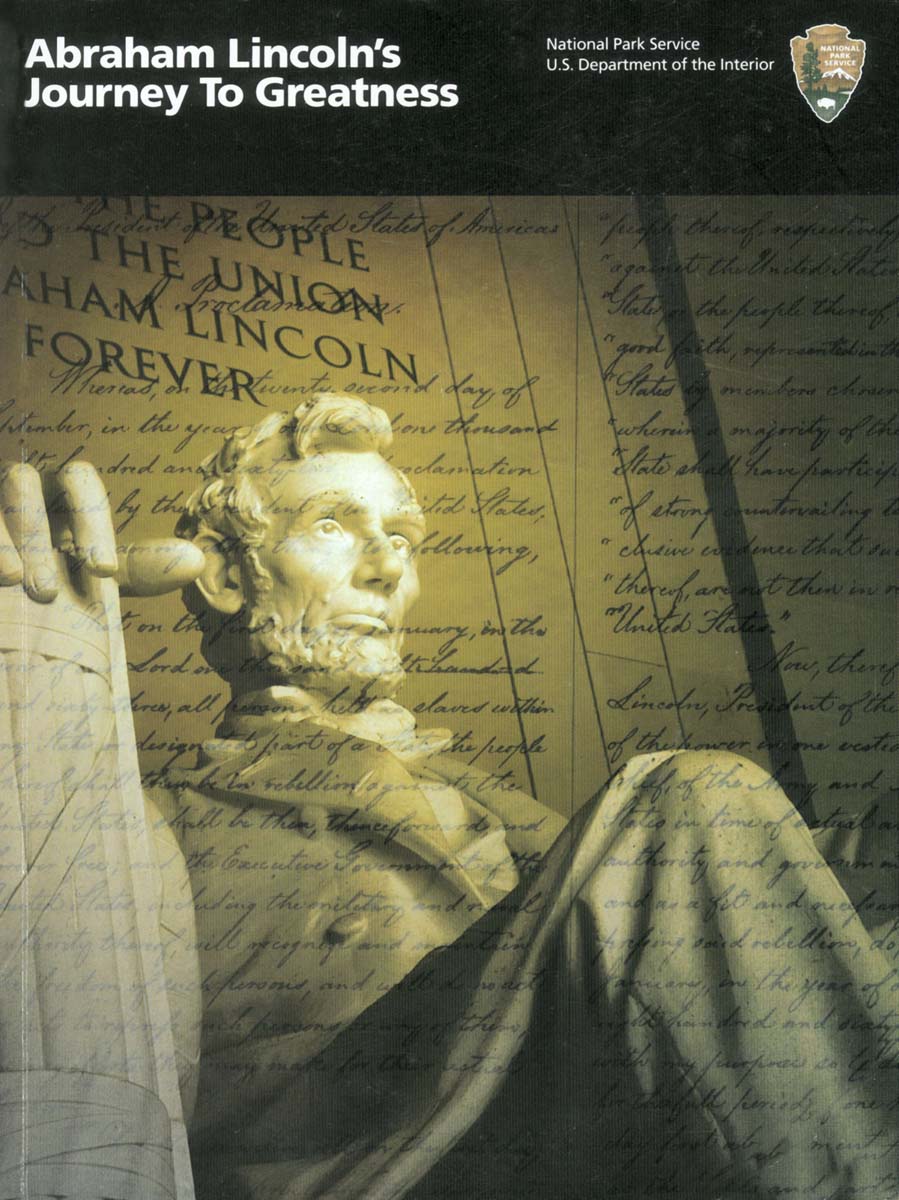
As I mentioned in my last post, the Government Printing Office celebrated its 150th birthday last Friday. Around here, we like to say that there were really two inaugurations on March 4, 1861 – President Lincoln’s and ours. Lincoln is also, as far as we know, the only sitting President ever to have visited GPO. Coincidentally, given these connections, a new book from the National Park Service (NPS) just hit my desk: Abraham Lincoln’s Journey to Greatness. Our 16th President is also special to the NPS. According to the introductory copy, it manages five National Park sites solely dedicated to Lincoln, four more with strong Lincoln connections, like Mount Rushmore, and a total of 47 “that include Lincoln and the Civil war stories as primary interpretive themes.” If you add in sites that deal in some way with slavery and Civil Rights stories, the total jumps to 75 – almost a quarter of all NPS sites!

I must say, though, that I wasn’t sure what to expect when I opened this handsome little volume. After all, hasn’t every Lincoln angle been covered by now? I should have paid more attention to the title. After a brief account of the Lincoln-Douglas debates and the election of 1860, the bulk of the book is an account of President-elect Lincoln’s train trip from Springfield, Illinois to Washington, DC – a literal “journey to greatness.”

In addition to brief descriptions of his welcomes to various cities along the way, the book includes quotations, such as numerous comments on his determination to preserve the Union and cogent remarks on immigration to the German Industrial Association of Cincinnati, Ohio. It also features classic vignettes from his trip, including his salute to Grace Bedell of Westfield, New York who, in a letter to candidate Lincoln, had suggested he grow a beard (“The President left the car, and the crowd making way for him, he reached her, and gave her several hearty kisses, and amid the yells of delight from the excited crowd, he bade her good-bye.”) My favorite of these, because it’s a reminder of the slyly humorous man sometimes overshadowed by the solemn national icon, is his appearance at the Leaman Place, Pennsylvania: “Loud calls being made for Mrs. Lincoln, Mr. L. brought her out, and said he had concluded to give them ‘the long and short of it!’ This remark – with the disparity between the length of himself and wife – produced a loud burst of laughter, followed by enthusiastic cheers as the train moved off.” 

Abraham Lincoln’s Journey to Greatness is a great way to look at Lincoln the man and the statesman as he began what still remains the most trying period in the history of the Republic. When I finished it, I was ready to rally round the flag! You can find a copy of this new book here or find it in a library.


GPO, FDR, and The Malta Citation

March 4, 2011

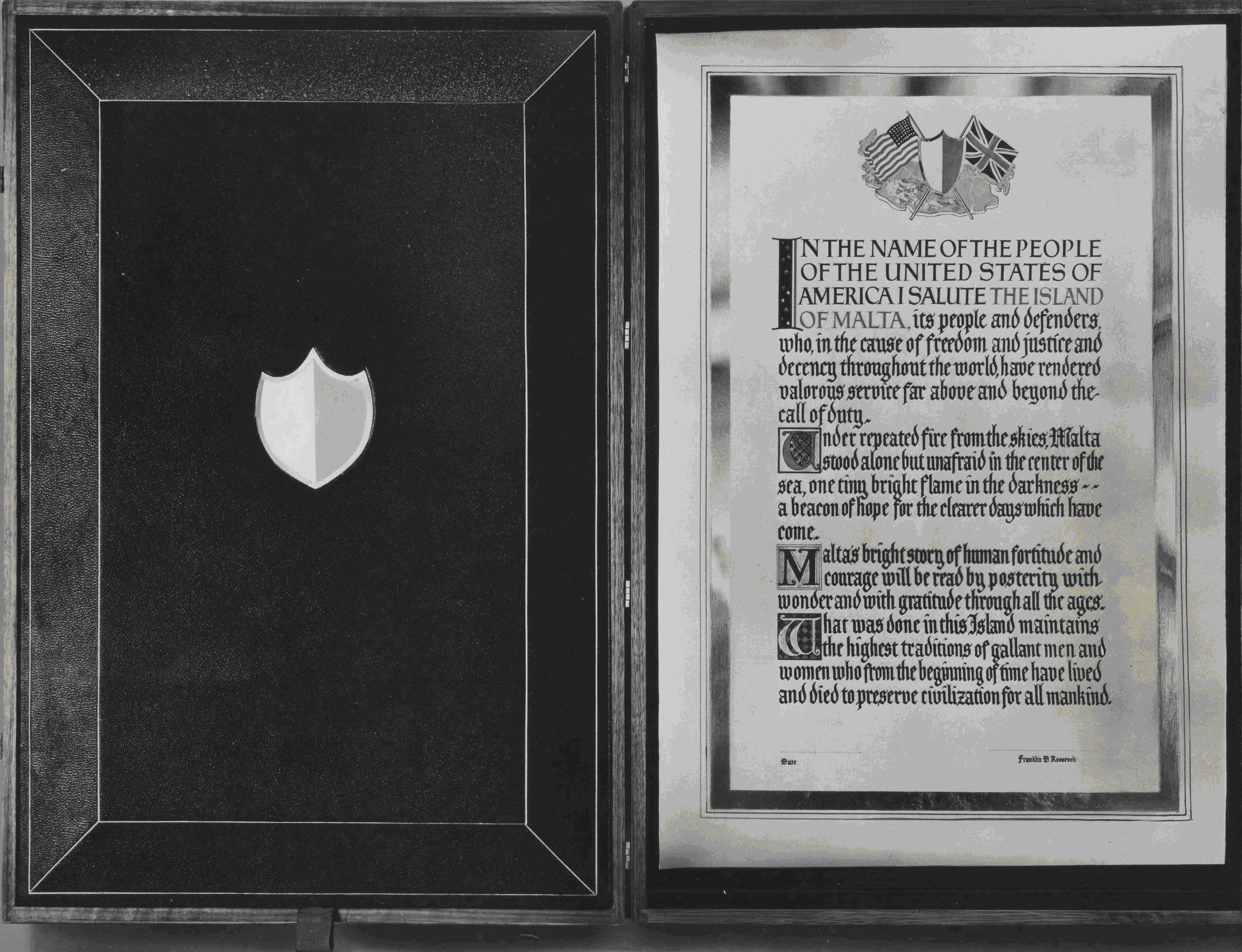
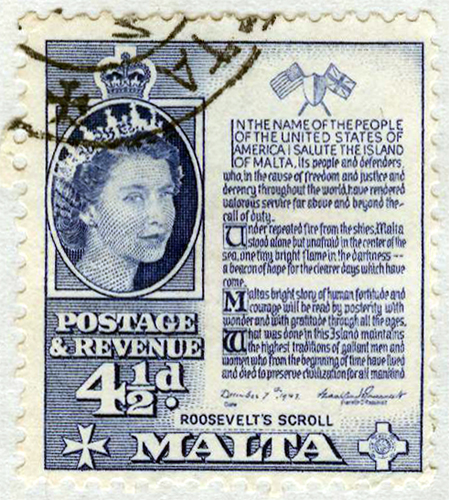
On March 4, 1861 – exactly 150 years ago today – the United States Government Printing Office opened for business. On such an auspicious occasion, Government Book Talk examines a unique Federal Government document. Ordered by the President on the tightest possible deadline for a purpose of international importance, only one copy was created by GPO. It is also, as far as I know, the only GPO product ever reproduced in its entirety on a postage stamp. Here’s the story of the Malta Citation.

From 1940 to 1943, the British Crown Colony of Malta endured prolonged and brutal air attacks launched by Nazi Germany and Fascist Italy. The Axis was determined to bomb or starve the people of Malta into submission  to deprive Great Britain of a vital naval base and, in so doing, dominate the Mediterranean. Despite saturation bombing and near starvation conditions caused by submarine attacks on British supply convoys, the Maltese people carried on with exemplary courage until the Allied invasions of North Africa and Sicily ended this threat. To honor their resistance to Nazi aggression, King George VI awarded the George Cross to Malta and its people in recognition of an entire nation’s collective valor. In November 1943, President Franklin Delano Roosevelt decided that America also should salute the people of Malta. He decided to visit the islands after the “Big Three” conference with Churchill and Stalin in Teheran and present the Maltese people with a citation that expressed the sentiments that Malta’s defense had inspired in the American people. The text was composed at the White House, but it fell to GPO to transform that text into an appropriate form.

The order for the Malta Citation was forwarded to GPO from the White House on November 15. Delivery was required not later than 3 p.m. on November 24 to meet the deadline for transport halfway around the world. The President suggested that the citation should be about 16 by 24 inches with lettering resembling that of medieval illuminated manuscripts. The details of color and design were left up to GPO. A complicating factor was secrecy. For reasons of security, the President’s visit to Malta could not be allowed to leak out. This combined need for speed, secrecy, and artistic excellence made the Malta Citation one of GPO’s most exacting and unusual wartime assignments.

The Malta project was assigned to GPO’s Division of Typography and Design. Its Director, Frank H. Mortimer, was given complete responsibility for the design and execution of the Citation. Because of the need for secrecy, and because only one copy was required, Mortimer decided to do the job by hand rather than experiment with type faces. He chose to work with genuine sheepskin parchment, feeling that its qualities of endurance and its capacity to retain freshness of lettering in both black and colored inks made it the most logical choice. He used steel and crow quill pens, drawing letters in the gothic style he had selected. Two sketches were prepared and submitted to the President, who chose the simpler version. Once the design was approved, Mortimer set to work. He used red and black inks for the 1-page text, with initials illuminated in blue, red, and gold. Pure gold leaf was used in the surrounding border, along with two fine lines of blue and red on the outside. An ornamental design consisting of the shield of Malta with the flags of the United States and Great Britain, all superimposed upon an aerial contour map of the main island, was placed above the text.

 To house the Citation, GPO’s Carpenter and Paint Shop produced a specially constructed case of solid, highly polished walnut, lined with royal blue plush. It was designed so that the right half contained the text while the left served as a cover. A weight to hold the parchment flat when the case was closed was placed inside the left half. This was produced in the GPO Bindery and consisted of laminated wood covered with dark blue morocco leather trimmed with lines in gold leaf and faced with the shield of Malta. Public Printer Augustus E. Giegengack personally delivered the completed citation in its case to the White House at 2:45 p.m. on November 24, beating the deadline by 15 minutes. On December 18 he received a letter from the President containing this tribute: “I wish to congratulate you and your craftsmen on the splendid workmanship displayed on the scroll which was presented by me to the people of the Island of Malta. It was very beautifully done, and I am sure we can all be proud of this product of our Government Printing Office.”

And the postage stamp? In 1956, Malta issued a stamp (left) that reproduced the Citation’s text, documenting  its importance to the Maltese and serving as a reminder of the huge variety and high quality of work that GPO has produced for the last century and a half. Happy birthday, GPO!


Perusing the 2011 Statistical Abstract

February 28, 2011

Can a blog about Government books not talk about Census Bureau’s Statistical Abstract? I don’t think so. The 2011 edition is now available and, as usual, it’s filled with all kinds of data that tell us who and what we are as a nation and a people. Of course, many of its tables have appeared in edition after edition, but I like to focus on those that seem most in tune with current concerns and interests. After all, the Abstract’s ability to remain relevant accounts for its longevity (since 1878!)

Take, for example, Table 191, Insufficient Rest or Sleep by Number of Days and Selected Characteristics: 2008. I’m writing this on a Monday morning and feeling as if I haven’t had sufficient sleep since the late 1980s. You can’t get any more relevant than that! Data that seems ripped from the headlines is in Table 336, Financial Crimes: 2003 to 2009. Corporate fraud, securities and commodities fraud, mass marketing fraud…you get the picture.

There’s a lot of more upbeat information, too. Table 295 tells us that more and more Americans are receiving degrees every year, while Table 1237 indicates how many of us are turning out for the arts – something personally cheering for me is that 7.8 million people went to a jazz concert in 2008.

Family debt, manufacturing, national security, international statistics – there doesn’t seem to be anything that the Statistical Abstract doesn’t cover. At more than 1,000 pages, it’s an America watcher’s dream. You can lose yourself in its pages here, get a personal copy here, or peruse it in a library. Meanwhile, let me see if I can find anything on book blogs…