In FRUS We Trust: 150 Years of US Foreign Relations History

December 2, 2011

December 3, 2011, marks the 150th anniversary of the Foreign Relations of the United States (FRUS) series. The FRUS series, which is produced by the State Department’s Office of the Historian, was first published in 1861 in the same year that the Government Printing Office was founded and is the official documentary history of U.S. foreign policy decision-making and major diplomatic activity. Researchers and students of foreign policy have relied on the series to provide a “road map” of various major U.S. Government archival sources for many years.
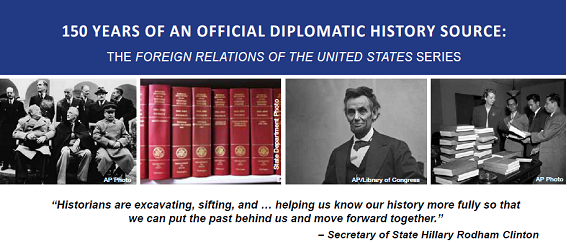
Image: FRUS Series 150th Anniversary. Source: State Dept. Office of the Historian.

The FRUS series now comprises more than 450 individual volumes. A staff of approximately 20 historians and editors at the Office of the Historian in the Department of State compile and prepare the volumes for publication.  More recent volumes published over the last two decades increasingly containing declassified records from all the foreign affairs agencies who participate in a declassification review if their documents are selected for inclusion in a FRUS volume.

What will you find in a typical FRUS volume?

The State Department’s Office of the Historian describes the contents of FRUS volumes:

Foreign Relations volumes contain documents from Presidential libraries, Departments of State and Defense, National Security Council, Central Intelligence Agency, Agency for International Development, and other foreign affairs agencies as well as the private papers of individuals involved in formulating U.S. foreign policy.

In general, the editors choose documentation that illuminates policy formulation and major aspects and repercussions of its execution. Volumes published over the past few years have expanded the scope of the series in two important ways: first by including documents from a wider range of government agencies, particularly those involved with intelligence activity and covert actions, and second by including transcripts prepared from Presidential tape recordings.

They go on to add that currently “volumes on the Nixon, Ford, Carter, and Reagan administrations are now being researched, annotated, and prepared for publication.”

Contributing to an “Intelligent Public Opinion”

Although the FRUS was originally proposed as an unofficial Annual Report for the Secretary of State, its originators displayed very lofty goals for their now long-lived series.

In describing the history of how the FRUS series came about, Joshua Botts of the Office of the Historian at the U.S. Department of State explains:

The covering memorandum to the Secretary transmitting the Order for Secretary of State Frank Kellogg’s approval explained that FRUS “ought to contribute to the promotion of interest in questions of foreign policy and in turn assist in the maintenance of an intelligent public opinion.

In short, the Department intended for FRUS to serve an important public affairs function in addition to satisfying demands from the academic community.

Image: Frank Billings Kellogg, 45th Secretary of State under President Calvin Coolidge, 1925-29. Source: State Dept. Office of the Historian.

Thus, the editors of the Foreign Relations of the United States (FRUS) series act as the curators of American diplomatic history, sifting through our foreign affairs information to ensure there is a means for future generations of Americans to witness, decipher and interpret U.S. foreign policy decisions and actions.

150TH Anniversary Events for the FRUS series

1)      FRUS Research: To mark the 150th anniversary of FRUS, the Office of the Historian at the U.S. Department of State assembled extensive research on how the evolution of the series fits within many important themes in U.S. history, including the transformation of government institutions, changing conceptions of national security and transparency, and the increasingly important role that the United States has played in the world.

2)      Upcoming FRUS Events:  As part of the FRUS series sesquicentennial, the Office of the Historian has also embarked on an outreach initiative with public events. Even if you missed the commemorative events held to date, you can consult the list of events to see if a recording is available.

Video Recordings of Past FRUS 150th Events

a) Foreign Relations during the Civil War Era: A Video Interview with Dr. Aaron Marrs, Office of the Historian, U.S. State Department, December 1, 2011.

 President Lincoln’s Cottage and the Office of the Historian of the U.S. Department of State hosted a public program to commemorate the 150th anniversary of Foreign Relations of the United State, the flagship publication of the Department’s Office of the Historian. Burrus Carnahan, noted Civil War and Lincoln author and scholar, interviewed Dr. Aaron Marrs, Civil War-era specialist with the Office of the Historian, on Marrs’ new research that sheds light on foreign relations in the context of the Civil War.  Video part one is available here and part two is available here.

b) A Weapon of Mass Instruction?:  Discussion with Office of Historian Staff Members and University of Virginia Professors, November 7, 2011. 

The Miller Center of Public Affairs at the University of Virginia hosted a discussion between Office of the Historian staff members and University of Virginia professors on how the U.S. Government has historically struggled to balance security imperatives with its commitment to transparency and democratic accountability.  Video available on Miller Center website.

c) Out of the Frying Pan, Into the Fire: A Conversation on the 1955 Yalta Foreign Relations Volume October 12, 2011.

The story of the Yalta Foreign Relations of the United States volume is a Cold War tale of partisanship, of sensational global headlines and leaks, and of contentious debates about balancing security and openness … learn more about the Yalta papers by listening here to the discussion, “Out of the Frying Pan, Into the Fire,” at the New York Public Library.

d)      Open Secrets: The Foreign Relations of the United States Series, Democracy’s ‘Need to Know,’ and National Security: American Historical Association Panel,  January, 9,  2011.

To hear how the FRUS editors sort through questions such as how much the public needs to know, what should be kept secret, are secrets political, and how long secrecy lasts, watch this fascinating panel discussion on how a democracy balances the public’s right to know against the need for preserving national security. This panel was held on January 9, 2011 at the American Historical Association Annual Meeting and included a roundtable of historians from the State Department and National Security Archive. The panel discussion can be viewed on CSPAN video or Youtube video.
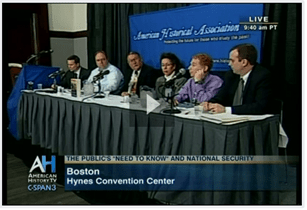
Figure: FRUS panel entitled “Open Secrets: The Foreign Relations of the United States Series, Democracy’s ‘Need to Know,’ and National Security” at the American Historical Association Annual Meeting on January 9, 2011.


So from one 150 year-old to another, GPO wishes the Foreign Relations of the United States series a very well-deserved happy birthday!

How can you get copies of the Foreign Relations of the United States (FRUS) series?

Alerts about new releases of the Foreign Relations of the United States series

1) GPO Email Alerts:  Sign up to receive email alerts from the U.S. Government Bookstore about new publications in the FRUS series.

2) State Department FRUS RSS feed:  You can also keep up-to-date about new releases in the FRUS series by subscribing to the State Department’s FRUS Series RSS feed.

About the Author:  Michele Bartram is Promotions Manager for GPO’s Publication and Information Sales Division and is responsible for online and offline marketing of the US Government Online Bookstore (Bookstore.gpo.gov) and promoting Federal government content to the public.


Ponzimonium: How Scam Artists Are Ripping Off America

November 18, 2011

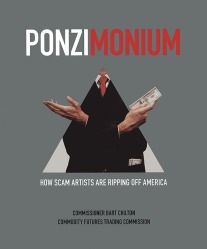
Every single day, someone somewhere makes a gigantic mistake by giving his or her money to a fraudster,” says Bart Chilton, one of the commissioners of the Commodity Futures Trading Commission (CFTC). Chilton is the author of Ponzimonium: How Scam Artists are Ripping Off America, a shocking new book available from GPO about some of the worst perpetrators of investment fraud in recent U.S. history.

Figure 1: Ponzimonium: How Scam Artists Are Ripping Off America available from GPO.

Ponzimonium looks to the CFTC’s own recent public case files stemming from fraud investigations that began with the recent economic downturn- talk about hitting people when they’re down! Because of the this, the book is generating a lot of positive buzz in The New York Times, TheStreet, and other media outlets.

The CFTC is an independent Federal agency with the mandate to regulate commodity futures and options markets in the United States. After the financial crisis of 2008, their authority was expanded under the 2010 Dodd-Frank Wall Street Reform and Consumer Protection Act to include over-the-counter derivatives markets and hopefully prevent and uncover more of these frauds.

What is a Ponzi scheme, you ask?

The world really learned about Ponzi schemes in December of 2008 when, as Chilton writes in his introduction, “legendary investment guru Bernard Madoff ‘made off’ with an estimated US$50 billion in what was called the ‘Mother of all Ponzi Schemes’.” (By the way, an interesting related read is the report about the Investigation of Failure of the Securities and Exchange Commission To Uncover Bernard Madoff’s Ponzi Scheme, also available from GPO.)

Unlike pure pyramid schemes in which it is mandatory that a new investor recruit others into the deal in order to receive payments, Ponzi schemes purport to offer investors a “too good to be true” deal by simply handing over their money. However, no real investment is made by the criminal.

Instead, Ponzi schemes, named after 1920’s postage stamp speculator-fraudster Charles Ponzi, are scams in which early “investors’—often friends, colleagues, and family members—are asked to invest in a this great “no risk” deal offering unbelievable returns.

Typically, the investor makes an initial investment and then some purported “phantom profits” are paid out by the con artist (really just money from other investors), prompting that investor to assume that his or her money has increased in value—and inspiring the investor to turn over more money to invest and tell others about it. In actuality, the perpetrators pocket the money for themselves.

This splendid infographic from the New York Times explains the concept visually:

Figure 2. Ponzi scheme infographic. Image source: The New York Times 12/21/2008 Week in Review.

Made in Madoff’s Image

Ponzimonium introduces some of the lesser known, but equally  despicable fraudsters that have been uncovered since 2008 by the CFTC and SEC (Securities and Exchange Commission).

The book lays out the fascinating and dramatic details behind the fraudulent schemes, their smooth-talking masterminds, and their many honest, hard-working victims, who often lose the money they’ve saved for their kids’ college funds, needed health care expenses, or their own retirement as a result of misplaced trust in these criminals.

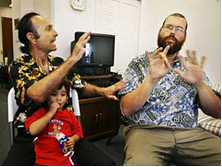
These stories are so engrossing— at times it felt like I was taking in a marathon of America’s Most Wanted or I Almost Got Away with It episodes— I found it hard to decide which of these criminals is the most despicable. Was it Beau Diamond of Diamond Ventures who wiped out his parents’ savings along with 200 other clients who invested US$37 million? Or how about Marvin R. Cooper of Billion Coupons, who created a combination Ponzi and pyramid scheme called an affinity fraud, to target and recruit fellow deaf community members in the U.S. and Japan? And there’s James Ossie of CRE Capital Corporation (CRE) who bilked investors out of US$25 million, including a desperate father’s US$200,000 he invested to fund his young daughter’s cancer treatments.

Figure 3. Fraudster Marvin R. Cooper and deaf client. Image source: BusinessInsider.com

The human side behind these frauds makes them all the more compelling… and contemptible.

The best way to avoid getting swindled, advises Chilton, is to “remember what your parents told you when you were little: ‘Don’t take candy from strangers’”, and my personal favorite, “Just because it is on the TV, Internet, etc. doesn’t mean it’s real!” That’s advice you can take to the bank.

Some “don’t miss” features of this book

Ponzimonium: How Scam Artists are Ripping Off America includes some very useful features for its readers that make this a valuable resource for any investor.

  • Red Flags of Fraud: Includes 20 red flags to look out for when considering an investment.
  • Investor Checklist: Detailed list of questions to ask before investing.
  • Investors’ Bill of Rights: Common sense advice and legal rights for any investor.
  • Resources: Useful contact information for victims or witnesses of a fraud.
  • Glossary of Fraud Terms: Definitions of legal and financial terms within each story.
  • The Loot: Color photos of the criminals’ misbegotten gains and lavish lifestyle.
  • The Numbers: Calculations of the staggering amounts collected, paid, lost, or stolen, and prison sentences and restitution.

How can you get this Ponzimonium eBook?

About the Author:  Michele Bartram is Promotions Manager for GPO’s Publication and Information Sales Division and is responsible for online and offline marketing of the US Government Online Bookstore (Bookstore.gpo.gov) and promoting Federal government content to the public. She has been researching identity theft and privacy issues for years, both on the web and in the real world, and is a big fan of more fraud protection for citizens.


Veterans Day and 100 Years of Flying Leathernecks

November 10, 2011

November 11, Americans celebrate Veterans Day, honoring the brave men and women who have served our Armed Forces in peacetime and in war.

This holiday dates back to the end of World War I when President Woodrow Wilson declared that this day be commemorated as Armistice Day after the warring sides declared an armistice:

On the 11th hour of the 11th day of the 11th month of 1918, an armistice, or temporary cessation of hostilities, was declared between the Allied nations and Germany in the First World War, then known as “the Great War.” (History.com)

Figure 1. Armistice Day poster. Source USFlagStore Blog

November 11th was celebrated as Armistice Day starting in 1919 and became a legal federal holiday in the United States in 1938. After World War II and the Korean War, Armistice Day became Veterans Day in the United States. November 11 is still celebrated as Armistice Day in France and Belgium, but is called Remembrance Day today in the British Commonwealth of Nations, and is known as the Day of Peace in the Flanders Fields.

While Veterans Day is typically a tribute to America’s living veterans, it is always appropriate to include a moment of silence in respect for those who gave their lives for their country.

Honor veterans past and present by pausing for a minute of silence at 11:11 on 11/11/11, “the eleventh hour on the eleventh day on the eleventh month.” and in this case, the 11th year of the century as well!

The “War to End All Wars” instead gave birth to aerial warfare

Idealistically, many thought that “The Great War” would be “The War That Will End War” , a term first coined by famed British author H.G. Wells in 1914 and later used as “a war to end war” in a speech by President Wilson.

Instead of being the end of wars, World War I was a first in many ways, including the first war to feature the large scale use of manned aircraft for both reconnaissance and aerial combat.

It also marked the introduction of Marine Corps Aviation.

Happy 100th, Marine Corps Aviation!

2012 will mark the hundredth anniversary of the founding of Marine Corps Aviation. To commemorate this noteworthy milestone, the US Marine Corps has produced a remarkable new publication entitled 1912-2012 100 Years of Marine Corps Aviation: An Illustrated History.

Figure 2. 1912-2012 100 Years of Marine Corps Aviation: An Illustrated History

A stirring snapshot of some of the key people, aircraft, and events that comprise this first century of Marine aviation, this book showcases the achievements of Marine aviation through seldom seen photographs and accounts of pivotal battles and events.

Intended as a “museum in a book,” 1912-2012 100 Years of Marine Corps Aviation: An Illustrated History includes an overview for each time period in Marine aviation, chapter introductions, feature articles, and a running timeline. A real plus is the bonus oral history CD that the Marine Corps has included in the back of the book, providing the text and photos along with first-hand accounts from select Marine aviators, which really bring the stories alive.

Particularly interesting are the exploits of legendary Marine aviators including Roy Geiger, Joseph Foss, Gregory “Pappy” Boyington, Keith McCutcheon, Frank Petersen Jr., and others, including aviator-turned-astronaut John Glenn Jr., who besides being the first American to orbit the earth, wrote the foreword for this book.

First Flying Leatherneck

Featured in the book is the man who started it all: A.A. Cunningham. On May 22, 1912, two years before the outset of World War I, Alfred A. Cunningham, then a First Lieutenant in the United States Marine Corps, first reported for “duty in connection with aviation”—i.e., flight instruction—to the new Naval Aviation Camp that had just been established at Annapolis, Maryland, home of the US Naval Academy.

Today considered “the father of Marine aviation,” Lt. Col. Alfred Austell Cunningham, better known to Marines as A.A. Cunningham, became the “de facto director of Marine Corps aviation.

Fun fact: A quick study, Cunningham received less than three hours of instruction before flying his first solo flight as a Marine aviator!

Figure 3. Lt. Alfred A. Cunningham floats in a Curtiss hydro-aeroplane in 1914.  Source: Marine Corps Air Station Cherry Point

Aces in the Air: The oldest Marine air attack squadron

Also mentioned in the publication is Marine Corps Air Station Cherry Point in Havelock, North Carolina, next to where I used to live in New Bern. MCAS Cherry Point is home to a number of Marine air squadrons, including VMAQ-1, VMAQ-2, VMA-223 and VMA-231, and hosts a phenomenal air show every year. Oo-rah to my old neighbors!

Formally established in 1919, Marine Attack Squadron 231 takes great pride in being the oldest squadron in the Marine Corps. After being re-designated the First Squadron, VMA-231 adopted the “Ace of Spades” moniker, since the Ace is the first card in the suit. The “A” in the upper left stands for “Air” and the “S” in the lower right stands for “Squadron”.

Figure 4. VMA-231 Ace of Spades logo. Source: Marine Corps

Where can you find this and other publications on aviation?

You can find 1912-2012 100 Years of Marine Corps Aviation: An Illustrated History on our online bookstore, in a library, or at our retail bookstore at 710 North Capitol Street NW, Washington, DC 20401.

For regular updates about today’s naval and marine aviation, you may wish to subscribe to these excellent magazines from the Navy and Marine Corps: quarterly magazine Naval Aviation News: Flagship Publication of Naval Aviation or the bi-monthly Approach: The Navy & Marine Corps Aviation Safety Magazine.

Aviation fans and practitioners in general should check out our Aviation Publications Collection on our online bookstore with books on aviation past and present and information for pilots, balloonists, and more.

Oh, and I would be remiss if I didn’t point out that you can sign up to receive Aviation email updates about new Federal Government aviation publications as they come out.

About the Author:  Michele Bartram is Promotions Manager for GPO’s Publication and Information Sales Division and is responsible for marketing the US Government Online Bookstore (Bookstore.gpo.gov) and promoting Federal government content to the public. She is a fan of military aviation, from growing up near Andrews Air Force Base in Maryland and watching Air Force One and the Blue Angels overhead, to living in New Bern, NC, near Marine Corps Air Station Cherry Point and watching the Harriers do practice fly over runs.

Losing our Shared National Experience?

October 31, 2011

Our blog post last week talked about GPO’s 150-year history of keeping America informed. But what does this mean in today’s media-saturated world?

Has the proliferation of media eroded our shared national experience?

[Figure 1. U.S. History Collage. Image courtesy of Mrs. Rice’s American History II class, Lexington High School, Lexington, Ohio.

Two weeks ago in a social media seminar for Federal Government, David Kirkpatrick (technology writer for the Daily Beast and Fortune magazine and author of a new insider book on Facebook) gave some startling statistics: 50% of Facebook’s 800 million users worldwide visit Facebook daily and up to 500 million have accessed Facebook on a single day, with the average Facebook user having over 130 “friends.”

But even more surprising, he said that 50% of Americans today now get their news and analysis about important events— sometimes edited or changed as it is passed along— from friends and family, often via social networks, text or email rather than from traditional media sources.

Prior to the 21st century, when Americans had only a few national media choices and limited local media, we would all receive the same original message at the same time, thus creating a shared American experience.

Today, in the U.S. alone Americans can choose to receive information from any of an estimated 1,476 daily newspapers; 1,500 television stations; 10,322 radio stations; 71 million cable television subscribers with hundreds of TV channels each; and more than 12 billion web pages and social media.

Kirkpatrick and others say the combination of the “Facebook effect”, media proliferation, and message selectivity have contributed to the erosion of our common, shared national experience.

GPO’s role in preserving our common American experience

As we mentioned in our blog last week, GPO’s mission for over 150 years has been “Keeping America Informed” about the three branches of the Federal Government.  This mission drives us to ensure the original information produced by Federal Agencies on behalf of the American people can be found by all Americans now and in the future.

What’s involved in capturing and disseminating our common Governmental information? It starts with gathering the content from Federal Agencies and publishing it in a professional format, whether print or digital. It then continues with authenticating the information to ensure Americans are getting the “genuine” unaltered information; creating permanent records with our catalog teams for our own FDSys digital database and Catalog of Government Publications; distributing these records to libraries in our Federal Depository Library Program and to worldwide library databases like WorldCat; and sending physical copies and/or ebooks to libraries, bookstores and book etailers.

View this video for an inside look at how GPO assembles and prints the Congressional Record—the official record of the proceedings, debates, and activities of Congress.

To keep America informed digitally, we allow users to subscribe to email newsletters by topic and are also now on social media, including Facebook, Twitter, YouTube, Foursquare and Yelp.

GPO Publications about shared American experiences

Here are some of my favorite Federal publications GPO has published that document significant shared American experiences over the past century. Do you remember when and how you learned of these events?

What are some of the significant national experiences that you will never forget and how did you learn about them and share them with others?

We would love to hear from you!


About the Author:  Michele Bartram is Promotions Manager for GPO’s Publication and Information Sales Division and is responsible for marketing the US Government Online Bookstore (Bookstore.gpo.gov) and promoting Federal government content to the public.


This Day in History: Lincoln visits the GPO

October 24, 2011

Guest blogger Emma Wojtowicz talks about an important day in GPO history.

On October 24, 1863 – 148 years ago today – President Abraham Lincoln visited the Government Printing Office, the only sitting president to visit the agency. To celebrate the anniversary of his visit, Government Book Talk is taking another look at GPO’s own publication, Keeping America Informed: The U.S. Government Printing Office, 150 Years of Service to our Nation (the book was previously featured on this blog on June 15).

GPO opened for business on the same day that Abraham Lincoln was inaugurated as President of the United States – March 4, 1861. The following year in September 1862, GPO printed the preliminary version of the Emancipation Proclamation issued by Lincoln as a general order. Then in 1863, Lincoln visited GPO by invitation from Public Printer John Defrees.

President Abraham Lincoln reads a draft of the Emancipation Proclamation to his Cabinet

Figure 1. First reading of the draft of the Emancipation Proclamation by Abraham Lincoln to his Cabinet on July 22, 1862.

[Painted by F.B. Carpenter ; engraved by A.H. Ritchie. Image courtesy of: The Library of Congress]

These unknown facts about Lincoln are part of GPO’s history and foundation. For 150 years, GPO has worked quietly and diligently behind-the-scenes for Congress, the White House, Federal agencies, and the public. Keeping America Informed tells the story of the United States from the different and unknown perspective of GPO employees and their consistent contribution to the workings of the Government. The book is full of “did you know?” facts and tidbits of information, often accompanied by an illustration or picture. For example, did you know that GPO has produced the United States passport since the 1920s?

Well, even if you did, you can learn a brief history of the passport – an idea originally conceptualized and produced by Benjamin Franklin, which identified the bearer as a trusted individual who was able to enter the U.S. The State Department took over control of the passport in 1856 and the single engraved page was produced by the Bureau of Engraving and Printing. When in the 1920s the League of Nations created an international standard for a booklet-style passport, the State Department sought GPO’s services to print it, and has remained a loyal customer ever since.

Earliest booklet-style US passports printed by the Government Printing Office (GPO)

Figure 2. First generation of booklet-style US passports. Printed by GPO. Source: “Keeping America Informed”

These types of facts and added background are what make Keeping America Informed a worthwhile read. Similar information can be found on the United Nations Charter, the Warren Commission, President George H. W. Bush’s 1991 inauguration, and the list goes on. In between, you can see historical photographs from GPO’s vast collection.

The book was written, edited, designed, and printed by GPO employees, which is entirely fitting because the message of the book is centered on GPO employees and how they have played a major role in the history of the United States. Abraham Lincoln visited GPO when the agency was still in its infancy, yet working around the clock in support of the war effort.

As the book details, GPO is a much different place today than when Lincoln visited; however, the mission of GPO remains the same. Keeping America Informed: The U.S. Government Printing Office, 150 Years of Service to our Nation is available through GPO’s online bookstore, retail bookstore, on our FDSys federal document database or in a library.

You can see the original printer’s proof of the Emancipation Proclamation in person at GPO’s 150th anniversary history exhibit now through December 2011!

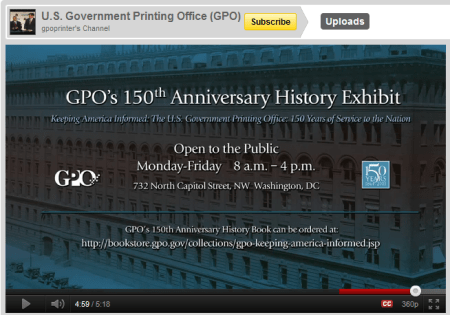
To view an original copy of the preliminary version of the Emancipation Proclamation that was issued by President Lincoln and printed by GPO, visit our 150th anniversary history exhibit located at 732 North Capitol Street NW in Washington, DC. The Emancipation Proclamation is on loan from the Library of Congress only through December…

Click here to watch a video of our 150th anniversary exhibit on GPO’s YouTube channel.

The GPO 150th anniversary exhibit is open 8 a.m. to 4 p.m. Monday through Friday, except on Federal holidays.

Read more about Abraham Lincoln and his rise to the Presidency in the National Park Service’s recent work commemorating the 150th anniversary of Lincoln’s inauguration: Abraham Lincoln’s Journey to Greatness.


Statistical Abstract and Print Mashups in a Digital Age

October 13, 2011


Since 1878, the Statistical Abstract of the United States has been printed by the Government Printing Office on behalf of the Census Bureau.

The “Stat Abstract” is considered “the authoritative and comprehensive summary of statistics on the social, political, and economic organization of the United States,” and compiles data from multiple sources, including: the Census Bureau, Bureau of Labor Statistics, Bureau of Economic Analysis, and many other Federal agencies and private organizations. Each year, new tables and analyses are added to keep up with the issues and interests of the day.

As Jim Cameron mentioned in his February post about the 2011 edition,

“Family debt, manufacturing, national security, international statistics – there doesn’t seem to be anything that the Statistical Abstract doesn’t cover. At more than 1,000 pages, it’s an America watcher’s dream.”

This important publication has fulfilled a unique niche for over a century for students, educators, researchers and librarians throughout the country as the definitive source of US statistics. As one librarian put it, “The print edition is THE most used reference book in my collection.”

Why is having all this information in a single, compiled, cited, and referenced edition important to its users? Michael Fry, Senior Map Librarian for the National Geographic Society Library and Archives says:

“[W]hile the Census Bureau may be correct that the data is “available elsewhere,” the beauty of the Stat Abstract is that it obviated users’ need to know where “elsewhere” was. And that, as librarians know, can be (at least) half the battle.”

After fifteen years in the Internet industry, I am highly aware of how important it is to your intended audience to be able to quickly and easily find the information they are looking for, and how difficult this search task is made for the users by most web sites.

This has led to an entire field of search engine optimization also called SEO. Unfortunately, all the SEO in the world can’t overcome the amount of time and effort necessary to find all the content and data you need if it is scattered across many web pages and web sites.

In a world where time is money and convenience is king, the time savings in both finding the necessary data and knowing immediately the official source that produced that data are key benefits of a book like the Statistical Abstract. In a sense, this book is the ultimate printed “mashup” that blends data from multiple sources into a cohesive whole that is greater than the sum of its parts.

Who would have thought that a 134 year-old publication tradition would have such relevance in a digital age?  Unfortunately, compiling all this data and obtaining publication rights is increasingly expensive,  as many experts and a lot of effort are needed to pull together a work of this complexity. Thus, this may be the last year in its compiled format, since in its Fiscal Year 2012 budget submission to Congress, the Census Bureau requested “a decrease to terminate the Statistical Abstract program.

So, you may want to get what may be the last print edition of the Statistical Abstract of the United States at the US Government Bookstore in paperback or hardcover or find it in a library. Or you can see the tables online here.

Some interesting facts from the 2012 edition:

  • Increase in US Population: Between April 1, 2000 and April 1, 2010 there was a 9.7 percent increase in the resident population of the United States. The state with the highest percentage increase in resident population during the same time period was Nevada (35.1), while the only state that experienced a decrease was Michigan (-0.6). (Table 14)
  • Retail profits up: For retail trade corporations with assets of 50 billion dollars or more, net profit increased from 54.0 billion in 2008 to 84.1 billion in 2009. Profits per dollar of sales before taxes also increased from 2.6 cents per dollar of sales in 2008 up to 4.1 cents per dollar of sales in 2009. (Table 1052)
  • 80% has Internet access: In 2010, approximately 20 percent of households did not use the Internet…[, and] 80 percent of households had an Internet connection anywhere (at home or mobile etc). (Table 1155)


About the Author:  Michele Bartram is Promotions Manager for GPO’s Publication and Information Sales Division and is responsible for marketing the US Government Online Bookstore (Bookstore.gpo.gov) and promoting Federal government content to the public.


Steve Jobs and our Innovation Nation

October 11, 2011

Last week we lost one of America’s great geniuses of innovation, Apple’s founder and CEO, Steve Jobs.

I can remember each time I first used one of Apple’s products. While working for IBM as a systems engineer right out of college and working with both mainframe systems and some not-always-so-friendly early PC operating systems (remember DOS?), I got to use a friend’s Macintosh and was blown away by how easy it was to use. Fast forward through the introduction of the iPod; iTunes online music and apps store; the iPhone—the first touchscreen smartphone; and now the iPad, first touchscreen tablet; and we now have a world that couldn’t conceive of life without Steve Jobs’ innovations.

One of Jobs’ secret to success was treating Apple as an idea and business incubator to continually research and fund what could possibly be the “next great thing” in the future, but was still only a germ of an idea from some engineer or scientist.

The Federal Government as an Incubator of Innovation

Like Apple, one of the key roles of the US Federal Government is to serve as an incubator of innovation.

Here at GPO, for example, we are embracing innovation by producing eBooks, digital downloads, information portals and databases in response to the changing needs of our increasingly digital society, which have been driven in part by Apple inventions introduced by Steve Jobs.

Most of the work products from the Federal Government can be and are used freely by private industry or other areas of Government to spur their own innovations. From statistics to research, processes to products, the Government has provided the seeds to innovation for American industry throughout the years.

Looking through our recent catalog on the US Government Bookstore website, I came across these publications which provide examples of innovation both within the Federal Government and in partnership with the private sector:

 
  • Spinoff Innovative Partnerships Program 2009, provides an in-depth look at how NASA’s initiatives in aeronautics and space exploration have resulted in beneficial commercial technologies in the fields of health and medicine, transportation, public safety, consumer goods, environmental protection, computer technology and industrial productivity.  Some innovation spinoffs over the years include:
    • lightweight breathing system adapted for firefighters;
    • Teflon-coated fiberglass fabric for astronaut spacesuits is now used as a permanent roofing material for buildings and stadiums;
    • remote-controlled robotic arms are now being used for robotic surgical operations; and
    • artificial heart pump based on the design of NASA’s space shuttle main engine fuel pumps.
    • You can get a print copy of this book now at the US Government Bookstore or find it in a library.


About the Author:  I am Michele Bartram, Promotions Manager for GPO’s Publication and Information Sales Division.  My duties include marketing for the US Government Online Bookstore (Bookstore.gpo.gov) and promoting Federal government content to the public. Due to the retirement of Jim Cameron, my duties now also include taking the helm as Blogger for Government Book Talk. I have been in the Internet marketing and ecommerce field for over 15 years.

We at GPO wish Jim all the best in his retirement, and will continue to do our best to spotlight the amazing variety of Government publications and their impact on ourselves and our world – and have fun while doing it.


Browsing the U.S. Government Manual

September 29, 2011

What with invisible ink, yetis, and earthquakes, the world of Government publications can be so diverse and intriguing that it’s easy to lose track of sober perennials like the U.S. Government Manual. I’ve used this great book throughout my career in the Federal Government to get contact information for the right part of a large Federal agency or verify that a smaller, more obscure one actually existed – and what it really did. Thanks to the diligent folks at the National Archives and Records Administration’s  Office of the Federal Register, you can ferret out phone numbers, mailing addresses and URLs that really work, or just read through each agency entry to better understand its particular missions and activities. It’s perhaps the premier annual reference book for all three branches of Government.

Of course, this wouldn’t be Government Book Talk if I didn’t come at my subject from a slightly skewed angle. My favorite section to browse isn’t the main listing of agencies, the quasi-official agencies, or even the international organizations – it’s the History of Organizational Changes. For scholars or other researchers, this section is valuable because it allows them to trace the institutional evolution of a Government function or track down the ultimate fate of a defunct bureau or commission. For me (although I’ve used it for these worthy purposes), it’s mainly a way to arouse bemused curiosity about how Federal entities were christened in years past. Did you know that we once had a Bureau of Efficiency (1916-1933)? Did it fade away because we got too efficient? Doubtful, I’m afraid. What about the Office of Facts and Figures (1941-1942)? I know we haven’t run out of them…

Some innocuous agency names conceal more interesting activities. There couldn’t be a blander, more bureaucratic sounding name than The Office of  the Coordinator of Information (1942). It quickly changed to the Office of Strategic Services (OSS) which, under the charismatic leader of William J. “Wild Bill” Donovan, conducted U.S.espionage and sabotage activities for the European Theater of Operations in World War II and was the progenitor of today’s Central Intelligence Agency (CIA). Then there was the Virgin Islands Company (1934-1966), a New Deal Government corporation established to grow and refine sugar cane and manufacture and sell rum in that beautiful U.S. possession. It marketed rum under the name “Government House.” The label (left) featured a sailing ship, a palm tree, and a harbor, and supposedly was designed by President Franklin D. Roosevelt himself. How else could I find out about this stuff if not through the pages of the U.S. Government Manual?

If you need a source of the latest information about any Government agency, or if you’re just curious about the innumerable nooks and crannies of the Federal establishment, the U.S. Government Manual is for you. You can browse it here, get a print copy of the 2011 edition here, or find it in a library.


Yetis and Extraterrestrials?

September 22, 2011

Alert Government Book Talk reader Deb Christmas tipped me off to this document which, although not the kind of thing I usually discuss here, has a couple of things going for it. First, what’s not to like about an American diplomatic memo outlining the special procedures required by the Nepalese government for those engaged in yeti-hunting expeditions?  The diplomat involved may have wondered exactly how he wound up drafting such a memo, but I hope he derived some amusement from it. I also wonder how many intrepid explorers received this excellent advice prior to launching themselves into the high Himalayas. The other aspect of this little “Foreign Service Despatch”  that stimulated what pass as my thought processes is the juxtaposition of an official, rather bureaucratic Government memo regarding a subject widely considered to be…well…paranormal. Since this blog already has discussed the possibly occult nature of the mysterious Voynich Manuscript, how could I pass up the opportunity to delve into such enigmatic realms again?

This brings me to the U.S. Air Force’s 1997 The Roswell Report: Case Closed. This study, written by Air Force Captain James McAndrew, “was to determine if the U.S. Air Force, or any otherU.S. government agency, possessed information on the alleged crash and recovery of an extraterrestrial vehicle and its alien occupants nearRoswell,N.M. in July 1947.” The conclusion? “…the predecessor to the U.S. Air Force, the U.S. Army Air Forces, recovered debris from an Army Air Forces balloon-borne research project code named MOGUL. Records located describing research carried out under the MOGUL project, most of which were never classified (and publicly available) were collected, provided to GAO, and published in one volume for ease of access for the general public.”

Jim McAndrew, whom I met in the course of GPO’s printing and selling The Roswell Report: Case Closed, was a sincere and enthusiastic disbeliever in the much-hyped Area 51 stories that circulated then and now, but I’m afraid that his conclusions haven’t had much influence on those with a will to believe in extraterrestrials, UFOs, etc. I try to keep an open mind about these things, feeling that “There are more things in heaven and earth, Horatio, than are dreamt of in your philosophy.” Based on this well-documented study, though, I think the official version holds up pretty well. (Those anthropomorphic test dummies are pretty creepy looking…)

You can read The Roswell Report: Case Closed here or find it in a library. The yeti memo? Look here.  As far as is known, no yetis were shot at,  testifying to its effectiveness.


A Botanic Garden for the Nation: “National benefits to be derived from exploration”

September 20, 2011

Guest blogger Nancy Faget sheds some light on a little-known Federal agency.

It’s always interesting to see what kinds of things I can learn from a Government publication. For example, I just found out that President George Washington asked the city commission to incorporate a botanical garden into the plan for Washington, DC.  He suggested the square next to the President’s House as a possible site. But it was President James Monroe who passed the bill to set aside five acres on the National Mall for a national botanic garden.  Thus, a living museum of plants was created as an oasis on Capitol Hill.

This National Garden is a living laboratory which includes the Rose Garden, the Butterfly Garden, the Lawn Terrace, the First Ladies’ Water Garden, the Regional Garden, and an outdoor amphitheater.

The founders of the country had an understanding of plants and gardens as a national benefit.  In the beautifully produced A Botanic Garden for the Nation, published by the U.S. Botanic Garden, I learned many interesting facts that I didn’t expect to find. For example, Thomas Jefferson emphasized that the Lewis and Clark expedition should look for plants and vegetables.  The U.S. Exploring Expedition of 1842 also was charged partly with gathering plants and seeds from around the world.  As the expedition traveled 87,000 nautical miles charting oceans and coastlines, the botanists and naturalist aboard the ships collected plant and seed specimens.Although the color photographs in the book are spectacular, it’s also a fascinating read.  Here are some other bits I discovered:

  • The Botanic Garden houses more rare plants all the time as gifts are received from foreign governments and (incredibly) as a result of law enforcement actions!   When rare or endangered species are confiscated, they often are sent to the Botanic Garden for its collection.  For example, The Vietnamese orchid in the Garden’s collection was seized by U.S. Fish and Wildlife Service (FWS).  It’s now working with FWS and a commercial grower to produce marketable quantities of this orchid for sale and distribution to other public gardens.
  • The Garden also was established as an important plant rescue center for orchids and succulents.  Through a program, present species may be prevented from going extinct.  It has a production facility that works to propagate plants for exchange with other institutions.
  • In the Garden’s Medical Collection, visitors find the saw palmetto, from which fruits are studied to treat prostate cancer.  Turmeric is included in the collection because of the anti-inflammatory benefit.   In cultures where turmeric is used regularly, rates of Alzheimer’s disease are significantly lower.

Best of all, the photos of Bartholdi Park and the National Garden look so inviting, they make me want to grab A Botanic Garden for the Nation, sit in the sun, and just ponder the seasons!

You can buy your own copy for garden reading on the U.S. Government Online Bookstore, or find it in a library.


Space Exploration and the Mind

September 13, 2011

Many years ago I read “Ideas Die Hard,” a memorable story (at least to me) by Isaac Asimov. In the story, a crew of astronauts is on a flight to the moon under very tense circumstances. They go too far and see the dark side of the moon. SPOILER AHEAD: When they view the dark side, it’s a gigantic wood-and-paper stage set, the sight of which causes the crew to have a collective mental breakdown. At the end of the story, it’s revealed that the flight was a simulation and the simulator went just a bit further than intended. I think the story has stayed with me because it addresses the psychological dimensions of space exploration – an aspect I haven’t really seen addressed in news accounts or books.

NASA has filled this gap quite nicely with Psychology of Space Exploration, an engrossing new collection of articles on this theme. After an initial focus on the psychological effects of space travel, for many years the American space program paid only minimal attention to them, perhaps because the military background of the astronauts militated against what they perceived as the possibly career-retarding discussions of such matters. Interestingly, theSoviet Union paid much more attention to the psychological health of its cosmonauts during the same period. These days, however, NASA is more cognizant of the importance of mood, morale, the psychological effects of weightlessness, and other mind-body issues.

As a history buff, I was intrigued to read about the comparison of voyages in space to the epic journeys of Arctic explorers in the late 19th and early 20th centuries. Even now, wintering over in Antarctica is a kind of model of the prolonged stays in close quarters that characterize the International Space Station.

In a section on the interplay of astronauts from different countries working together, I was amused to learn that Soviet cosmonauts were not totally enthralled the space cuisine enjoyed by a French counterpart: “one of them later expressed his relief at going back to black bread and borscht after a menu of canned French delicacies, including compote of pigeon with dates and dried raisins, duck with artichokes, boeuf bourguignon, and more.”

Another fascinating essay described a space flight simulation experience in which people who knew that they were not really in space still got great enjoyment from their “trip.” It sounded so interesting that I was ready to sign up myself. Also, the special effects sound much better than those in Isaac Asimov’s story!

I really enjoyed reading Psychology of Space Exploration – I had no idea of the range of psychological issues that can crop up in space travel and the ways in which NASA has tackled them. Space buffs and students of the human mind will find much to ponder in this book. You can read it here, get your own copy, or find it in a library.


Trickle, Trickle, Splash, Splash

September 9, 2011

 As I sit here writing this, it’s raining. It’s been raining for days, as a result of the remnants of Hurricane Lee. Before that, we got rain from Hurricane Irene, although thankfully not what Vermont and Upstate New York received. Before that, innumerable August thunderstorms had dumped inches of precipitation on us. The forecast for the next few days? More rain. Earlier this summer I read that our area was in a “moderate drought” state. Ha! I was just bemoaning our saturated state with a co-worker, in the course of which I said “I’ve been blogging about earthquakes and hurricanes, so I guess I’ll have to dig out a Government publication on floods.” Aha!

 This brings me to Floods: The Awesome Power, a National Atmospheric and Oceanic Administration (NOAA to the cognoscenti) booklet that covers all kinds of flooding scenarios, including the one I’m putting up with right now. “Floods are often produced by hurricanes, tropical storms, and tropical depressions. A tropical cyclone’s worst impact may be the inland flooding associated with torrential rains. When these storms move inland, they are typically accompanied by very heavy rain.” Happily, we’re not experiencing what Louisianans did a few days ago, but it wouldn’t be totally unprecedented, either. A few years ago a freak weather system dumped tons on rain around here, resulting in a mini-flash flood in our basement – two or three inches worth. All I’ll say is that pulling up waterlogged wall-to-wall carpeting underlain with ratty-looking linoleum squares isn’t my favorite thing to do. Last night, after work, I spent a couple of hours down there mopping up from the current seepage, and the stream down the block looked way high. It can happen anywhere.

Floods: The Awesome Power not only covers the types of weather systems that can cause flooding, it provides information on how to keep track of such events, how to prepare in advance (“Store drinking water in food-grade containers. Water service may be interrupted”) what to do when the deluge is upon you (“Rapidly rising water may engulf the vehicle and its occupants sweeping them away. Vehicles can be swept away by as little as 2 feet of water”), and what to do afterward (“If the power is out, use flashlights, not candles”). Guilty as changed on that last point – it sounds as if I need more batteries and less wax around the house. There’s also a detailed outline on how to develop a family disaster plan, which could be useful in any number of crisis situations.

All in all, I don’t know of a better way to find out a lot about coping with flooding in a concise, easy-to-read format. You can read Floods: The Awesome Power here, buy it in packs here (great for neighborhood associations and other groups), or find it in a library. As for me, this old doo-wop classic says it all…