A Comic Book History of Printing

September 13, 2010

 When I started doing this blog, I assumed that I’d be talking about the work of other people – that legion of writers and artists who have been cranking out Government publications since the dawn of the Republic. Now here I am, almost six months later, getting ready to write about a publication that I scripted myself – a comic book, no less!

Squeaks Discovers Type: How Print Has Expanded Our Universe is the first comic book that GPO has ever created in toto, from the initial concept and design through its publication a couple of weeks ago. Why a comic book? Because we think that the story of printing, which is really the story of the profound impact of printing on the dissemination of information worldwide, needs to be better understood, especially in the context of a digital age. Although our comic book is aimed at kids, its message is for everybody.

When I was asked to develop a script for a comic book, my first thought was “Okay, I’ve never done this before – how do I come up with a concept?” Fortunately, I have two sons who always preferred playing video games to doing their homework – what an inspiration! An unwanted homework assignment, a new video game, a dream, and a journey through space and time – I had nailed down a concept, which for me was the toughest part of my job.

Once I sketched out the plot and wrote some initial dialogue, I turned the project over to my colleague Nick Crawford, GPO Creative Services Visual Information Specialist and amazingly talented artist. I explained the concept to Nick and suggested some kind of cute animal video game hero. He came up with Squeaks the Space Pirate and – let’s face it –  Squeaks is one cute mouse!

After lots of hard work on Nick’s part, I went through his layout and crafted additional dialogue around the gorgeous images he’d drawn, then conferred with him to iron out the glitches. For my part, it was an unprecedented collaboration with an artist, and one that went amazingly well – who said writers and artists can’t get along?! For more about how we developed the comic book, check out this video.

The result, Squeaks Discovers Type, is, I hope, a fun read that conveys some good information and sets printing in its proper place in history for kids of all ages. You can see more of the artwork here.


Bookstore Grand Reopening

August 16, 2010

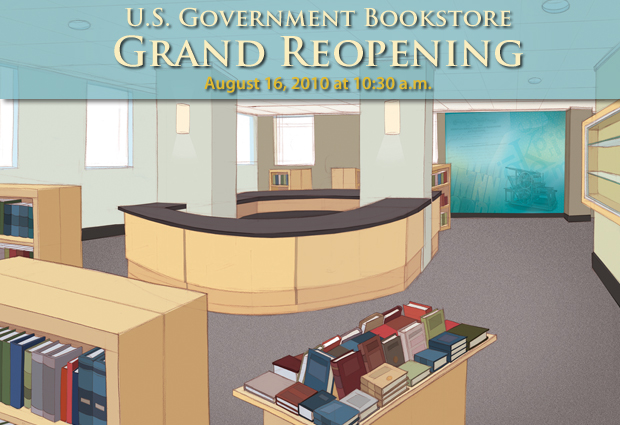
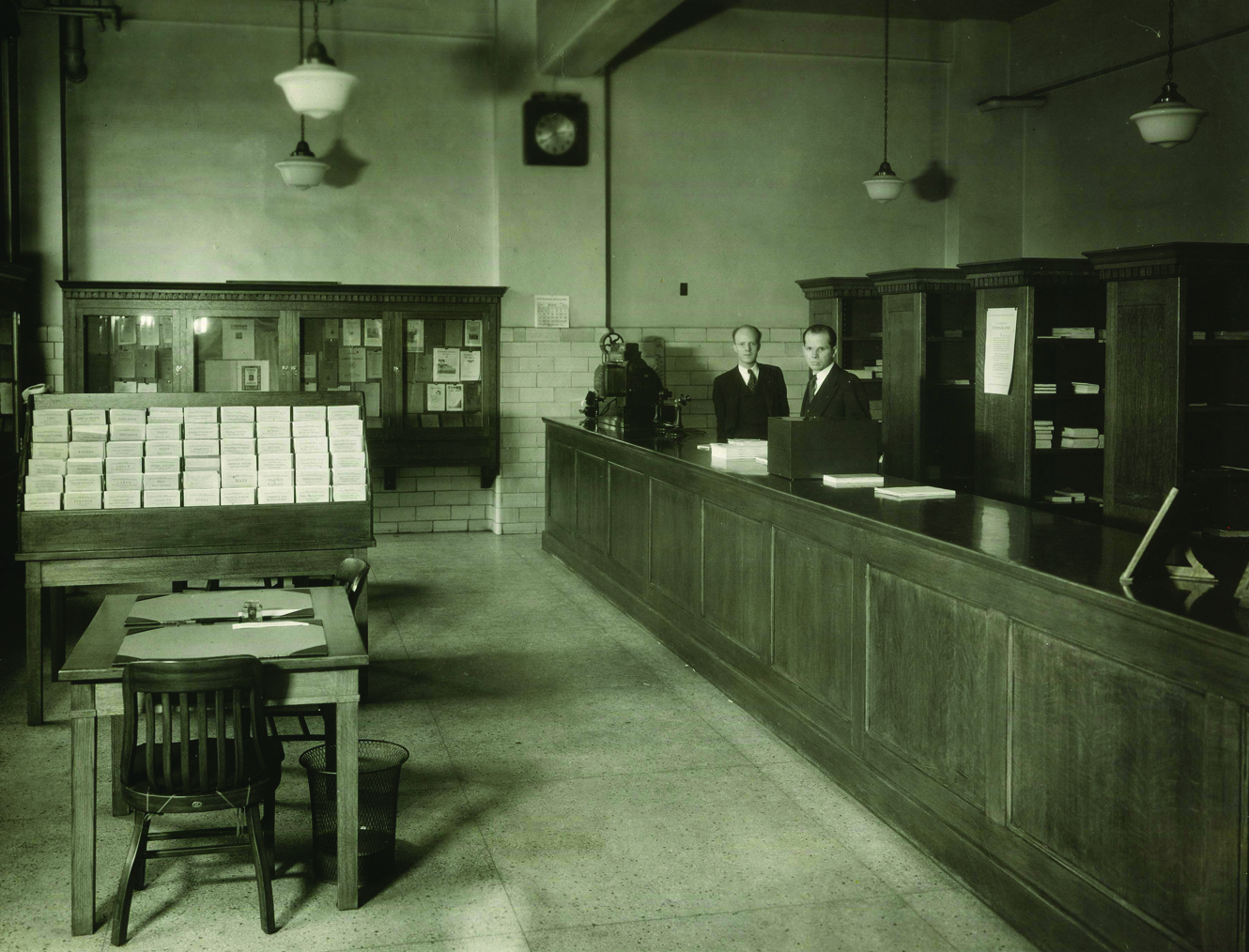
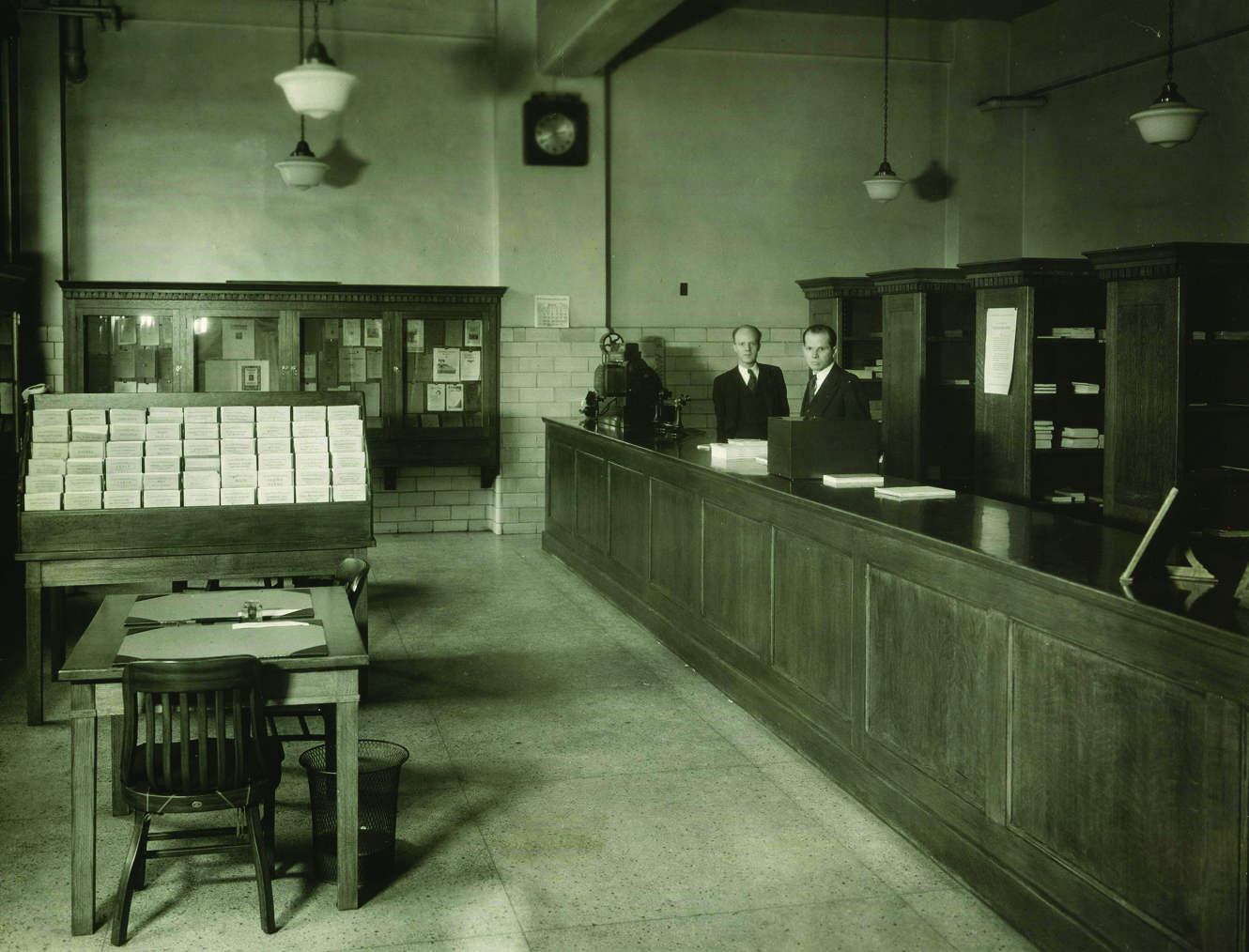
As readers of this blog know, I’m a real book person. Give me a bookstore to roam around in and I’m a goner for the day. That’s why it was especially rewarding this morning, when I got to witness the grand reopening of the Government Printing Office’s own bricks and mortar store, which has been closed for renovation for several months. Although the store has been in existence since 1921, this has got to be the most extensive makeover it’s ever had. The whole atmosphere is more like a small independent bookstore, with an open airy feel, comfortable chairs to read in, and even a children’s corner. Even better, part of the store is now an exhibit area for photos and objects that tell the story of printing at GPO – from handset to digital. All of the work – the design, the cabinetry, the décor – was done by GPO’s own in-house designers and craftsmen.

If you live in the greater Washington, DC area or just in town for a visit, please come on by. You can find all of the sales titles I’ve blogged about and many more of our newest and best books. Even I’m astonished at the vast range of subject matter. Come on book lovers, it’s time to head our way!

For more information, please click here. The address is 710 North Capitol St, NW, Washington, DC 20401.


A Different Kind of Translator: The Work of Nisei Linguists

July 22, 2010

It’s always good to get a fresh perspective on familiar things – in this case, on those Government books we love. I’ve asked the summer interns in our office to select a publication that interests them and write about it. What they picked and wrote about is really interesting, and I think you’ll feel that way, too.

 Our first intern is Camille Turner, a rising junior at the University of Delaware.

The first time that I really began to grasp the severity of World War II was when I did a project on Pearl Harbor. Yet, even after years of learning about  the techniques and tactics utilized by all countries involved, and the toll it took on participants and non-participants alike, I had never heard of anything so charged  with personal conflict as the decisions made by second generation Japanese American (Nisei) soldiers.

Nisei Linguists: Japanese Americans in the Military Intelligence Service during World War II from the Army Center of Military History details the efforts of Nisei who were recruited by the U.S. Army as translators and interpreters. Trained in a secret school, these Nisei soldiers were placed in a unique position, determined to protect the country in which they were raised, while simultaneously embracing the Japanese culture they were taught to value and burdened by the knowledge that many of their family members and friends had been removed from their homes on the West Coast and placed in isolated camps by the country and Army they were serving. (Don’t be concerned if you haven’t heard about this group of nearly 6,000 soldiers: for many years, their work was a military secret, and no official history was published about them until 1994).

As this book explains, in a time of strained American and Japanese-American relations, the Nisei linguists helped to ease tensions and maintain communication between the two groups. Complete with maps and photographs documenting the training process, it follows the work of the linguists chronologically, including the upbringing of several officers, and their service up until the early occupation of Japan in February of 1946.

One of the remarkable aspects of this text is the objectivity of the author in relating the specific events the Nisei had to face, including the bombing of Pearl Harbor by their ancestral country. The author manages to detail respectfully the feelings of multiple groups of citizens in the United States through a multitude of controversial and painful incidents, including the strain on the Nisei officers as their loyalty was questioned continuously by the country they were working to defend against the country they were taught to cherish and respect.

This book is a must read for any World War II enthusiast and a great source of insight into a little-known chapter of military history. You can get a copy here, review it here, or find it in these libraries.


Afghanistan and International Law

July 14, 2010

Since 1901, the Naval War College (NWC) has produced its “Blue Book” series on various international law topics. Over the years, I’ve thumbed through a few of these volumes. I remember one on the law of piracy that would be very relevant today, given the shenanigans off the Somali coast. The latest Blue Book is even more timely. The War in Afghanistan: A Legal Analysis is a compilation of essays from an International Law Expert’s Workshop held at the NWC. It touches on just about every aspect of the war, from the legal issues surrounding the original coalition intervention to the vexed problem of the status of combatants.

The first paper in the “The War in Afghanistan in Context” section was totally engrossing. “Afghanistan and International Security” by Adam Roberts, Senior Research Fellow of the Centre for International Studies, Department of Politics and International Relations at Oxford, and President-elect of the British Academy is a tour de force of clear and logically-structured writing that delineates the historical and political background of Afghanistan, prior efforts by outside power to control it, and the vexing legal issues the current situation presents. Particularly noteworthy was his point that it’s difficult  for the coalition gradually to turn over power to the national government in a place where most of the citizenry historically have had no use for any central government. After I finished reading, I was impressed by the author’s grasp of his subject and absolutely daunted by the challenges Afghanistan presents.

Another excellent paper, “Combatants” by W. Hays Parks, Senior Associate Deputy General Counsel, International Affairs Division, Office of General Counsel, U.S. Department of Defense, concludes that the Bush Administration’s decision to deny prisoner of war status to Taliban and Al Qaeda fighters was correct under long-established international law, but that its supporting statements were incorrect.  I found this essay to be particularly well-documented and lucidly written.

There’s much more to The War in Afghanistan: A Legal Analysis. Some of the discussions depend upon close readings of international precedents that make it heavy going for a lay reader, but all have value for the student of international affairs and the rule of law.

You can find the complete text of The War in Afghanistan: A Legal Analysis  here, browse through it  here, purchase a copy, or look through it at a library.


Summer Travels

July 7, 2010

Government publications are more than just books. Guest blogger Kelly Seifert reminds us that maps and guides can be just as engrossing, especially at this time of year.

If you’re planning on doing some travel around the country this summer, you can start your planning with the National Parks System Map and Guide. It features a map of the United States, including Guam, Puerto Rico, and the Virgin Islands, showing the locations of parks, historic sites, and other properties operated by the National Park Service. On the reverse side, an alphabetical list of each National Park System property describes its activities, services, and facilities. If you’re planning on exploring any of the 391 destinations of the National Parks Service this summer, this is an essential take along. You can also easily access this publication by visiting your local Federal depository library. Locate a library in your area here.

To make your trip complete, check out these other great publications as well: 1) the National Trails System: Map and Guide, which includes descriptions of national historic and scenic trails, and 2) the National Wildlife Refuge System: A Visitor’s Guide, which contains a map showing national wildlife refuges that provide recreational and educational opportunities. The Visitor’s Guide also provides tips for visiting national wildlife refuges and lists refuges in all 50 States, Puerto Rico and the Virgin Islands, along with the best wildlife viewing season and the features of each refuge.

Why leave the country for a little R&R when there are so many national treasures right on your doorstep? Happy Travels!


100 GPO Years Revisited

June 25, 2010

My agency, the U.S. Government Printing Office (GPO), usually is more concerned with getting information from other Federal agencies digitized, printed, posted, and disseminated than in publishing our own books – that’s been our job in the Federal Government for almost 150 years. When we do publish something of our own, such as our Style Manual, about which I blogged awhile back, it’s worthy of note.

That’s my lead-in to 100 GPO Years, 1861-1961, published to mark GPO’s centennial. I’m sure it didn’t make a particular splash in the world of books back then, but it’s a rare and beloved commodity for those of us who work here, or used to. After a brief history of pre-GPO public printing, replete with scandals and corruption (and that’s why Congress decided to establish GPO), the book chronicles GPO’s activities year by year. The growth of GPO paralleled that of the Federal Government, spurred on by the Civil War, two world wars, the Cold War, the New Deal, the Great Society, and all of the other historical developments that gave rise to America’s present status as a superpower. For all of these momentous chapters in our history, GPO was there, printing the Emancipation proclamation, the declarations of war for both world wars, the UN Charter, and innumerable other documents of our democracy. Remarkably, though, we’re still at the same location as we were in 1861, at the corner of North Capitol and H Streets NW in Washington, DC. Instead of one small building, there are four large ones, as well as facilities nationwide.

On June 23, 2010 – the 150th anniversary of the congressional resolution that established GPO – a reprint of 100 GPO Years was a centerpiece of the kickoff of GPO’s sesquicentennial celebration.  It’s a facsimile reprint, but with a new Foreword, an excellent index, and a colophon that describes the typefaces of both printings. On March 4, 2011, 150 years to the day after the inauguration of both GPO and Abraham Lincoln (it was the first day GPO was open for business), GPO will publish a new history. Until then, you can learn a lot about us by reading the straightforward narrative and sampling our unique historic photograph collection in 100 GPO Years. You can read the reprint on our anniversary Web site or purchase a copy here. Soon it will be available in Federal depository libraries nationwide. If you can’t wait, you can find the original printing  in some libraries.

Happy birthday to us!


Fun With the GPO Style Manual

April 15, 2010


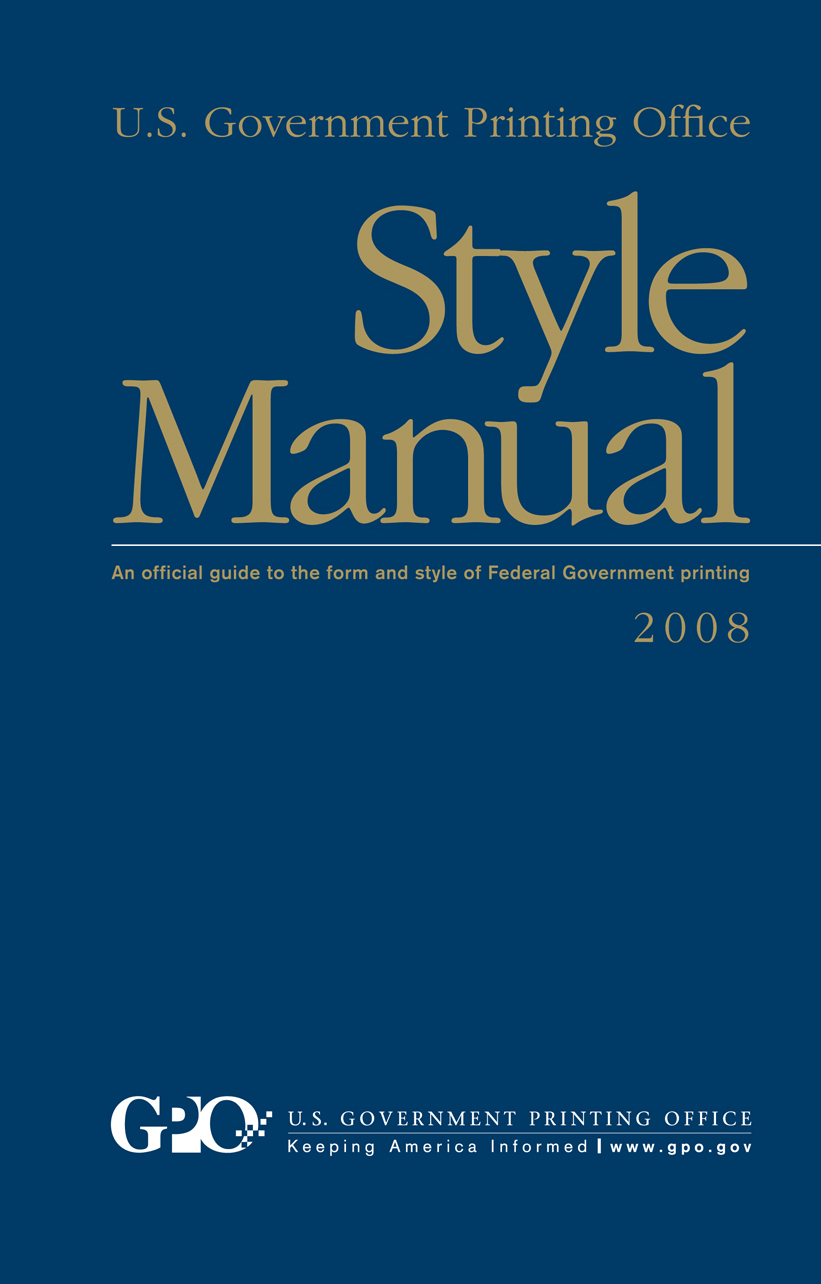
It’s National Library Week, which prompted me to think about my favorite Government reference book – the U.S. Government Printing Office Style Manual, which since 1894 has been the Federal Government’s  guide to form and style in printing and a standard reference for professionals in the field. Although I’ve used the Style Manual for years in a number of different jobs I’ve had at GPO, the real reason it’s my favorite is, I confess, that I’m a member of the GPO Style Board. For many months prior to the publication of the latest edition, our little group met for two hours each week to discuss spelling, capitalization, and the myriad of other details that collectively make up any book of this sort. The best part – it was a lot of fun. As one of the members said to me one day, “This is the high point of my week!” For a word person, spending time on this stuff was really a plum assignment. Some of my colleagues were old acquaintances, while others were new to me. The one thing they all had in common was a  depth of  knowledge and a dedication to producing the best possible product that was truly awesome. I also found out what a demonym is: “Demonym is a name given to a people or inhabitants of a place. ” (See Chapter 17, Useful Tables, Pages 332-334.)

My favorite new features of the 2008 edition: A list of information technology acronyms and initialisms; a chapter on capitalization  with totally updated examples of proper names (a lot of research went into this, believe me!); and a clean, contemporary new design and typeface, thanks to GPO Creative Services.

Despite my obvious bias in favor of the Style Manual, many other Government books and periodicals are worthy of inclusion in the library reference pantheon – you can find a few of them here.