Help is Just a Call, Click or Page Away: Federal Disaster Helplines & Emergency Medical Resources

April 19, 2013

Sadly, most adults in this country can remember some disaster or tragedy that’s happened to them or one of their loved ones in recent history. Most people in my office have their own exit strategy story from 9/11.  We all remember how we tried to cope, and we feel deep sympathy for fellow citizens in similar situations.

After the horrific events at the Boston Marathon and the Texas fertilizer factory explosion this past week, many Americans are again in the unfortunate position of needing assistance in the face of life-changing events. Your Federal government is here to help both the injured citizens and the local medical personnel who rush to their aid, both during and after the disaster occurs.Complementary Federal and local disaster response

Image credit: Vanderbilt University Medical Center Department of Emergency Preparedness  

I. Federal Disaster Resources for Civilians

The Disaster Distress Helpline (DDH) is, in the words of their own staff,

“…the first 24/7, year-round national crisis hotline exclusively dedicated to providing free, immediate and confidential crisis counseling and support to people in distress related to any natural or man-made disaster, such as the explosions in Boston. We offer this counseling 24/7/365 through phone (1-800-985-5990) and through SMS/text messaging (text ‘TalkWithUs’ to 66746) – and DDH is for those affected, family member and loved ones, as well as for responders.”

SAMHSA-Disaster-Distress-Helpline

Operated by the Department of Health and Human Services’ Substance Abuse and Mental Health Services Administration (SAMHSA), the Disaster Distress Helpline’s Web page www.disasterdistress.samhsa.gov also has a section devoted to incidents of mass violence.

If you are suffering from trauma related to the Boston Marathon attack, or similar events, reach out to the Disaster Distress Helpline. Get help, get some shelter. You’re going to wake up tomorrow, and the day after that. Make your day bearable; as Malcolm X said, “The future belongs to those who prepare for it today.”

Additional Federal disaster and emergency resources for civilians include:

GPO is helping in its own way; you can find the catalog record about the Disaster Distress Hotline in GPO’s Catalog of Government Publications or your local federal depository library.

II. Federal Disaster Resources for First Responders and Civilian Medical Personnel

With the tragic terrorist bombings in Boston,  fertilizer factory explosion in Texas, mass shootings in Sandy Hook, and other recent disasters, medical personnel, civilian first responders and mental health personnel have had to learn to deal with injuries both physical and mental that are usually only experienced on the battlefield.

With the experience gained in treating the wounded and traumatized in wars in Iraq and Afghanistan and mass violence and disasters in the US, the Departments of Defense, Health and Human Services, Homeland Security, Justice, and Transportation–

including FEMA, US Fire Administration, Pipeline and Hazardous Materials Safety Administration, Substance Abuse and Mental Health Services Administration, Center for Mental Health Services, US Special Operations Command, and particularly the Army’s Office of the Surgeon General, Walter Reed Army Medical Center, USAMRIID- US Army Medical Research Institute for Infectious Diseases, U.S. Army Medical Department Center and School, and the Borden Institute

— have produced a number of outstanding resources and publications which are of extreme value to emergency medical personnel, including EMTs and surgeons, mental health counselors, fire and rescue personnel, and first responders of all kinds.

[UPDATE 4/30/2013] One great resource for first responders is the Public Health Emergency website maintained by the US Department of Health and Human Services. This is meant to be a one-stop resource for all of the federal medical resources and information for emergency response. The military version, the Department of Defense Force Health Protection and Readiness National Disaster Medical System (NDMS) Page, is here.

[UPDATE 4/26/2013] One of the best resources we have seen was provided by one of our readers, a Regional Emergency Coordinator with the Department of Health and Human Services. It is a one-stop site for all emergency medical resources called the WMD, Emergency Management, and Medical Web Sites List. The author says it is updated every six months to keep it accurate, and it “is intended to provide an extremely “comprehensive list of internet sites of use for emergency planning and in particular Weapons of Mass Destruction (WMD) and medical emergency planning.

boston-marathon-emergency-medical-responseImage: First responders at the Boston Marathon bombings, including fire and rescue and emergency medical personnel. Image credit: EMSWorld

All of these Federal publications below can help civilian emergency response and medical personnel quickly learn from these Federal and military experts on how to respond to disasters and how to treat gunshot and blast wounds (such as from bombs and IEDs), amputations, and other combat-style injuries both in the field as well as the rehabilitation and psychological factors afterwards, including post-traumatic stress.

Some of the more pertinent disaster response and treatment publications that can be found on the U.S. Government Bookstore include:

About the Authors

Part I: Excerpted from a post on the FDLP Community Blog on April 18, 2013, by guest blogger Jennifer Davis from GPO’s Library Services & Content Management Division that supports the Federal Depository Libraries Program (FDLP) who wrote about the Disaster Distress Helpline.

Part II: Government Book Talk Editor Michele Bartram writes about the disaster and emergency response publications that can help civilian personnel respond to disasters with combat-style injuries. Ms. Bartram is Promotions Manager for GPO’s Publication and Information Sales Division in Washington, DC, and is responsible for online and offline marketing of the US Government Online Bookstore (http://bookstore.gpo.gov) and promoting Federal government content to the public.


From Prairies to Peaks with Rockies and Roosevelts

April 3, 2013

Guest blogger GPO Public Relations Specialist Emma Wojtowicz reviews this new publication by the U.S. Forest Service that explores the history of the Forest Service’s Rocky Mountain region, including the involvement of two Roosevelts.

From-Prairies-to-Peaks-US-Forest-ServiceThose traveling west-bound for spring break and summer vacation should check out From Prairies to Peaks: A History of the Rocky Mountain Region of the U.S. Forest Service, 1905-2012. This publication focuses on the Rocky Mountain region, which encompasses Colorado, Kansas, Nebraska, South Dakota and Wyoming and is home to 17 national forests and seven national grasslands.  In From Prairies to Peaks, author Anthony Godfrey takes readers on a tour of the Rocky Mountains to learn about the topography, climate and wildlife as well as the history stretching from when Native Americans originally inhabited the region to the preservation efforts made in recent decades by the Forest Service.

Readers must be true aficionados of the West and Rocky Mountains to digest this nearly 400-page publication. The history is very detailed, but very fascinating.  During the development of the West in the 19th century, it was believed that the United States had an abundance of forest resources, and millions of acres of trees were cleared as a result.

After the Civil War, the threat of a timber famine alerted the government to the problem and brought greater attention to forest management. Passed under President Theodore Roosevelt, the Federal Forest Transfer Act of 1905 moved control of the 63 million acres of national forest reserves from the Department of the Interior to the Department of Agriculture’s Bureau of Forestry, which was renamed the Forest Service.

President-Theodore-Roosevelt-1908-Cartoon-as-Practical-Forester

Image: 1908 editorial cartoon of President Theodore Roosevelt as “A Practical Forester.”  Source: St. Paul Minnesota “Pioneer Press”.

One of the most interesting time periods for the region was the 1920s-1930s. Upkeep and development of the Rocky Mountain region created many jobs for men through New Deal programs during the Great Depression.  In national forests, workers were assigned to tree planting and thinning, insect and rodent control, road building and improvement, telephone line construction, and lookout tower and house construction to increase communication for fire control and timber conservation.

Then during the Dust Bowl, the region played an important role in President Franklin Roosevelt’s Great Plains Shelterbelt Project from 1934-1942, which involved planting a shelterbelt or windbreak of drought-resistant trees and shrubs and from Canada to northern Texas to protect against the winds and prevent erosion.

10-row-shelterbelt-cross-sectionImage: Cross-section of a shelterbelt of various sized evergreens, large and small deciduous trees, and shrubs using the Forest Service-recommended standard of 10 rows that serve as a windbreak and wildlife shelter. Image source: MyFarmlife.com.

The Forest Service assigned the Rocky Mountain region with supervising the planting of more than 217 million trees and shrubs on the windward side of more than 30,000 individual farms. This is just a snapshot of the in-depth history chronicled in this publication.

Planting-first-shelterbelt-tree-OKFrom Prairies to Peaks provides a historical account of one of the lesser known regions in the United States. The West conjures images of cowboys, mountains, hikers and skiers, but there is more to the Rocky Mountain region.

This publication is a great resource for those interested in learning more about the West and the Forest Service. And for those already familiar with the Rocky Mountains region, this book will help you brush up on your history.

Image: Planting the first tree in the Nation’s first shelterbelt on the H.E. Curtis farm near Mangum in Greer county, Oklahoma, on March 18, 1935. Image source: Oklahoma Farm Report.

HOW DO I OBTAIN THIS  PUBLICATION: From Prairies to Peaks: A History of the Rocky Mountain Region of the U.S. Forest Service, 1905-2012?

  • Buy it online 24/7 at GPO’s Online Bookstore.
  • Buy it at GPO’s retail bookstore at 710 North Capitol Street NW, Washington, DC 20401, open Monday-Friday, 9am to 4pm, except Federal holidays, (202) 512-0132.
  • Find it in a library.

BP in Hot Water over Deepwater

February 25, 2013

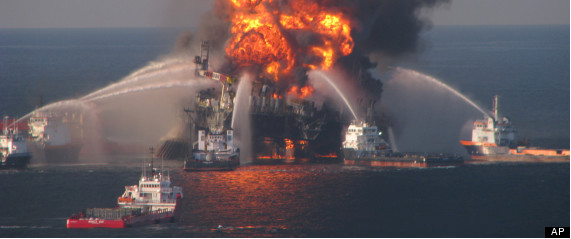
As the BP Oil Spill civil trial begins this week, the Federal Government will attempt to prove whether British Petroleum (BP) and/or any of its contractors such as Transocean (RIG), the owner and operator of the Deepwater Horizon oil rig, and Halliburton (HAL), which was responsible for pouring the cement plugs in the well, were “grossly negligent” and thus financially liable in causing the deadly BP Deepwater Horizon offshore oil rig explosion on April 10, 2010, and the blowout of the Macondo well.

BP-Deep-Water-Explosion-April-20-2010

Image: Explosion of the BP Deepwater Horizon rig at the Macondo prospect well. Photo credit: Associated Press.

The initial explosion killed 11 oil rig workers and triggered a subsequent oil spill which dumped millions of barrels of crude oil into the Gulf of Mexico, with the full extent of the long-term ecological and economic damage to the Gulf states and aquatic and wildlife still unknown.  With tar balls linked to the BP oil spill still washing ashore from Louisiana and Alabama to as far away as Australia, if BP is found “grossly negligent” instead of “simply negligent,” it will be on the hook for $17.6 billion in additional clean-up costs on top of the $4.5 billion fine for the criminal case settled in November 2012.

The National Commission on the BP Deep Water Horizon Oil Spill and Offshore Drilling produced two landmark and controversial reports about the oil spill causes and consequences that are critical in understanding the Government’s case against BP:

1)      Macondo: The Gulf Oil Disaster. Chief Counsel’s Report 2011, and

2)      Deep Water: The Gulf Oil Disaster and the Future of Offshore Drilling, Report to the President, January 2011.

THE MISSION

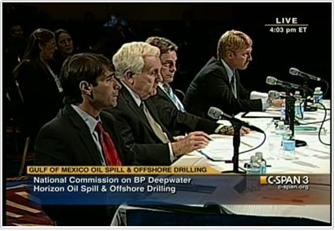
Established by Executive Order 13543 on May 21, 2010 by President Barack Obama, the mission of the National Commission on the BP Deep Water Horizon Oil Spill and Offshore Drilling Commission was to examine the relevant facts and circumstances concerning the root causes of the Deepwater Horizon explosion and develop options to guard against, and mitigate the impact of, any oil spills associated with offshore drilling in the future.

BP-Deep-Water-CommissionIn addition, they were to recommend any needed improvements to Federal laws, regulations, and industry practices concerning the oil and gas industry.

Image: Commissioners of the National Commission on the BP Deep Water Horizon Oil Spill and Offshore Drilling. Image credit: C-SPAN

Key areas of inquiry for the Commission included:

  • The Macondo Well Explosion and Drilling Safety
  • The Role of Offshore Oil Drilling in Domestic Energy Policy
  • Regulatory Oversight of Offshore Drilling
  • Oil Spill Response
  • Spill Impacts and Assessment
  • Restoration Approaches and Options

THE INVESTIGATION

Macondo-Oil-Spill-Report-9780160879630The first order of business for the Commission was to carry out the directive in the Executive Order to “examine the relevant facts and circumstances concerning the root causes of the Deepwater Horizon oil disaster.” They instructed the Commission‘s Chief Counsel Fred Bartlit and his investigative team to provide “the most comprehensive, coherent, and detailed account of the events leading up to the blowout and explosion” of Macondo, the name of BP’s offshore prospect in the Gulf of Mexico in the sector called the Mississippi Canyon Block 252, or MC252 where BP was drilling at the time of the accident.

The result was this report, Macondo: The Gulf Oil Disaster. Chief Counsel’s Report 2011, which provides additional details and documentation supporting the findings in the Commission’s final report.

The respected Library Journal, in selecting the Macondo report as one of its “Notable Government Documents” for 2011, said:

“The National Commission on the BP Deepwater Horizon Oil Spill was created by President Obama and charged with investigating the root causes of the largest accidental marine oil spill in the history of the petroleum industry. The committee concluded that the cause of the blowout was not mechanical. Instead, a number of poor management decisions, combined with an inadequate regulatory structure and an indifferent regulatory agency, overwhelmed the safeguards designed to prevent such disasters. Plenty of illustrations and photographs offer a glimpse into the technology of offshore oil rigs.” – LJ

For trial watchers, this publication is a must-read as much of the initial documentary evidence is included.

THE FINDINGS AND RECOMMENDATIONS

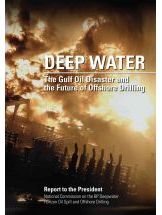
Deep-Water-Report-9780160873713The second and final report is the best-selling Deep Water: The Gulf Oil Disaster and the Future of Offshore Drilling, Report to the President, January 2011. It not only offers the full account of what happened in the Gulf of Mexico on April 20, 2010 and why, but also offers recommendations on proposed actions, changes in company behavior, reform of government oversight, and investments in research and technology that will be required to avert future disasters.

In Part I: The Path to Tragedy, “Chapters 1 through 3 describe the events of April 20th on the Deepwater Horizon, and, more important, the events leading up to it in the preceding decades—especially how the dramatic expansion of deepwater drilling in the Gulf was not met by regulatory oversight capable of ensuring the safety of those drilling operations.

In Part II: Explosion and Aftermath:  The Causes and Consequences of the Disaster, Chapters 4 through 7 lay out the results of the Commission’s investigation in detail, highlighting the crucial policy-related issues: the specific engineering and operating choices made in drilling the Macondo well, the attempts to contain and respond to the oil spill, and the impacts of the spill on the region’s natural resources, economy, and people—in the context of the progressive degradation of the Mississippi Delta environment.

BP-deepwater-2-yr-impact

Image: Chart illustrating some of the ongoing effects of the BP Macondo well oil spill two years after the Deepwater Horizon explosion. Infographic credit: ColorLines.com

In the final section, Part III: Lessons Learned: Industry, Government, Energy Policy, Chapters 8 through 10 present the Commission’s recommendations for reforms in business practices, regulatory oversight, and broader policy concerns.

Throughout the book, the Commission makes the case that outlines a number of primary conclusions, including these unsettling findings:

  • The explosive loss of the Macondo well could have been prevented.
  • The immediate causes of the Macondo well blowout can be traced to a series of identifiable mistakes made by BP, Halliburton, and Transocean that reveal such systematic failures in risk management that they place in doubt the safety culture of the entire industry.
  • Deepwater energy exploration and production, particularly at the frontiers of experience, involve risks for which neither industry nor government has been adequately prepared…
  • To assure human safety and environmental protection, regulatory oversight of leasing, energy exploration, and production require reforms even beyond those significant reforms already initiated…to ensure [the regulators’] political autonomy, technical expertise, and their full consideration of environmental protection concerns.
  • Because regulatory oversight alone will not be sufficient to ensure adequate safety, the oil and gas industry will need to take its own, unilateral steps to dramatically increase safety…
  • The technology, laws and regulations, and practices for containing, responding to, and cleaning up spills lag behind the real risks associated with deepwater drilling…
  • Scientific understanding of environmental conditions in sensitive environments in deep Gulf waters, along the region’s coastal habitats, and in areas proposed for more drilling, such as the Arctic, is inadequate. The same is true of the human and natural impacts of oil spills.

Delivered to the President on January 2011, the final report starts with a poignant dedication “to the 11 men who lost their lives on the Deepwater Horizon rig on April 20, 2010 and to their families, in hope that this report will help minimize the chance of another such disaster ever happening again.”

Will it help prevent another such disaster? Read these publications and decide for yourself.


How can I buy these BP oil spill publications?

  • Buy them at GPO’s retail bookstore at 710 North Capitol Street NW, Washington, DC 20401, open Monday–Friday, 9 a.m. to 4 p.m., except Federal holidays, (202) 512-0132.
  • Find them in a federal depository library.

About the Author:  Michele Bartram is Promotions Manager for GPO’s Publication and Information Sales Division in Washington, DC, and is responsible for online and offline marketing of the US Government Online Bookstore (http://bookstore.gpo.gov) and promoting Federal government content to the public.