The Privacy Act: What the Government Can Collect and Disclose about You

June 28, 2013

Privacy is the watchword in the news these days. With the revelations in recent weeks about far-reaching domestic surveillance programs by the National Security Agency (NSA) and other Federal agencies that were expanded under the Patriot Act, Americans are scrambling to determine what privacy rights they have to information collected by the Federal Government.

Overview-of-the-Privacy-Act-of-1974-2012-Edition-9780160914461Thus, the timing is ideal to review a biennial publication, Overview of the Privacy Act of 1974 (2012 Edition), available in print from the U.S. Government Online Bookstore.

The Overview of the Privacy Act of 1974 provides a valuable function to consumers, the media, Government and members of the legal profession by not only providing the current text of the Privacy Act and all its subsequent amendments, but also by consolidating the current regulations and updates, interpreting the Act’s provisions and giving detailed legal analysis of the latest court decisions that have decided challenges to how the Privacy Act has been enacted by various White House Administrations and Federal Agencies since the Act was passed.

What is covered by the Privacy Act?

The Privacy Act of 1974 established a “Code of Fair Information Practice that governs the collection, maintenance, use, and dissemination of personally identifiable information about individuals that is maintained in systems of records by federal agencies.”

The Privacy Act protects certain federal government records pertaining to individuals. In particular, the Act covers “systems of records” that an agency maintains and retrieves by an individual’s name or other personal identifier, such as your social security number.  (For clarification, a “system of records” refers to a group of records or a file under the control of a particular Federal agency from which information is retrieved by the name of the individual or by some identifier assigned to the individual.)

With the advent of wide-spread use of computers and databases by the Federal Government, the Privacy Act was amended through the Computer Matching and Privacy Protection Act of 1988, which added certain protections for the subjects of Privacy Act records whose records are used in automated matching programs, such as the establishment of Data Integrity Boards at each agency.

Privacy Act Requirements

But what rights do individuals have under the Privacy Act? According to the Overview of the Privacy Act of 1974 (2012 Edition), it gives individuals the right to review records about themselves, to find out if these records have been disclosed, and to request corrections or amendments of these records, unless the records are legally exempt.

From reading the publication, it seems the Act also requires that a Federal Government agency must:

  • give the public notice of their systems of records by publishing them in the Federal Register (also available as a subscription from GPO);
  • follow strict record-keeping requirements;
  • request the written consent of the subject individual for disclosure of their personal information– “unless the disclosure is pursuant to one of twelve statutory exceptions;” and
  • provide individuals with a means  by which they can access and amend (review and correct) records stored about them.

Your-Right-to-Federal-Records-2011-coverYour Right to Federal Records

For information about your rights to “discover, access and amend” Government records about you and frequently asked questions and answers about the Privacy Act and the Freedom of Information Act (FOIA), you might want to check out the free publication, “Your Right to Federal Records available from the GSA’s Federal Citizen Information Center (FCIC).

You may also be interested in learning more about the Freedom of Information Act by reading the Guide to the Freedom of Information Act, also published by the Justice Department and available in print from GPO.

Scope Issues

The Privacy Act does NOT apply to data collected about persons outside the United States, nor does it protect the privacy of your records that are maintained by the private sector, such as your credit report, bank account and medical records or even local or state government records like your driver’s license. Since many Americans today assumed that the battle to keep this non-Federal data private was already lost, it was comforting to discover that there is still a measure of privacy in data kept about you by the Federal Government.

And finally, while The Privacy Act does apply to the records of every “individual,” it nevertheless only applies to records held by an “agency.” Thus, any records ”held by courts, executive components, or non-agency government entities are not subject to the provisions in the Privacy Act and there is no right to these records.”  The Overview covers many questions about scope.

Exemptions and Exceptions

The most fascinating part of reading the publication to me– and timely considering the current news cycle– was to learn that there are situations where the Government is not legally required to follow the Privacy Act . According to the Overview, there are currently Twelve Exceptions to the “No Disclosure Without Consent” Rule of the Act and Ten Exemptions to the Privacy Act altogether where Federal agencies are not required to disclose records. 

Two of the ten exemptions outlined by the Overview are the “General Exemptions,” which apply to records about individuals maintained by

1)      the Central Intelligence Agency (CIA) and

2)      law enforcement agencies— or a component thereof— that primarily perform criminal law enforcement duties, “including police efforts to prevent, control, or reduce crime or to apprehend criminals.”

New proposed exemptions are offered all the time by subsequent Congresses and Administrations, such as the George W. Bush Administration’s agreement signed with the European Union in 2007 to share an airline’s Passenger Name Record as well as the utilize the Automated Targeting System.

Protecting-your-privacy

The questions about what constitute personally identifying data; what legal exemptions and exceptions apply; and how the Privacy Act has been interpreted over time by Federal Agencies, the Office of Management and Budget (OMB) and the Federal courts make up a good part of the Overview.

With post-9/11 security concerns driving Agencies’ desire for more information coupled with rapidly evolving technologies that enable greater collection and analysis of data, the publishers of the Overview of the Privacy Act of 1974 will certainly be kept very busy in upcoming years reporting on and analyzing new privacy regulations and court decisions that will follow.

How Can I Obtain These Privacy Publications?

Anyone concerned with the laws governing what the Federal Government is collecting and disclosing about individuals in the United States—and how much individuals can learn about it—should read this important publication.

  • Overview of the Privacy Act of 1974 (2012 Edition) in Print
    • Shop Online: Buy a print edition on the GPO U.S. Government Online Bookstore NOW ON SALE!!
    • Order by Phone: Call our Customer Contact Center Monday through Friday, 8 am to 5:30 pm Eastern (except US Federal holidays). From US and Canada, call toll-free 1.866.512.1800. DC or International customers call +1.202.512.1800.
    • Visit our Retail Store: Buy it at GPO’s retail bookstore at 710 North Capitol Street NW, Washington, DC 20401, open Monday–Friday, 9 a.m. to 4 p.m., except Federal holidays, (202) 512-0132.
    • Find it in a Library: Search for it in a Federal Depository Library.

About the Author: Government Book Talk Editor Michele Bartram is Promotions Manager for GPO’s Publication and Information Sales Division in Washington, DC, and is responsible for online and offline marketing of the US Government Online Bookstore (http://bookstore.gpo.gov) and promoting Federal government content to the public.


Top Health Issues for LGBT Populations

June 21, 2013

Attendee-DC-Capital-Pride-Festival-2013-in-Washington-DCLast Saturday night, I was riding the metro, and my train car was completely full of revelers from the Capital Pride Parade. Most of parade-goers had festooned themselves in rainbow-colored beads, crayon boxes and feathers. It’s hard to imagine such an out-there event happening when I was a kid. It’s equally hard to imagine the Federal government producing this document twenty years ago. But both the parade and the book are events worthy of some bead-slinging revels.

Image: Reveler at the 2013 Capital Pride Parade in Washington, DC. Credit: Flickr photo by dctim1, used under a Creative Commons license.

An LGBT Primer for Health Professionals

According to Top Health Issues for LGBT Populations Information & Resource Kit, depression and suicide related to coming out (or not coming out) is still grimly common among all LGBT groups. Thank goodness times have changed. In forty-four years, American society has moved from the June 28, 1969, police raids on the gay community at the Stonewall Inn in New York City and subsequent violent demonstrations to today, where the issuance of this video series and the publication of this book by the Federal Government can now be considered commonplace. Things could and should get better—reading the probable causes of those health risks proves that—but acceptance of LGBT persons has definitely increased over the last few decades in the United States.

tophealthissuesLGBTTop Health Issues for LGBT Populations makes health information related to lesbian, gay, bi-and transgender (LGBT) people free and publicly available. Covering the high-level bullet points of the issues is the main purpose of the volume, which provides a good resource to health professionals who need a beginner’s awareness. Although the intended audience for this volume is health professionals, the general public, health teachers, and health students will also benefit from reading this volume to achieve a beginner’s awareness. Since the book uses the vernacular rather than technical health terms, and the writers intended it for newcomers to the topic, it is easily accessible to anyone with an interest.

Understanding Gender Identity

It’s difficult to know where to begin such a primer; this volume opens with the issue of gender identity. It is critical for health professionals to have an understanding of the differences between the groups, which have some related concerns, but also separate ones. As the authors write, “It wasn’t until the 1950s that the concepts and theories about gender, gender roles, and gender identity were introduced and defined in the [psychological] literature.” But ultimately, the authors conclude that health professionals will provide the best care to patients when they work from the position that “gender is not exclusively determined by an assigned sex at birth, but determined by a person’s sense, belief, and ultimate expression of self.”

Glossary of LGBT Terms and Definitions

Following the definition of gender identity is a glossary of terms and definitions related to gender identity, gender expression, sexual identity and sexual expression. If you are unclear as to what MTF, two-spirit, queer, drag king and WSW means, you can find answers here. The section entitled “Gender vs. Sex: a Fundamental Shift from an Exclusive Binary Paradigm” sets the tone for the book, as the authors seek to explore the full rainbow of sexual and gender expression and identity as opposed to the less nuanced hues of the “binary paradigm”. The section titled “Gender Identity Disorder: a Medical Perspective” is now rendered obsolete due to the recent replacement of the more pejorative “Gender Identity Disorder” term with the phrase “gender dysphoria” that is commonly used by the healthcare community today. The authors of this book demonstrated that they were definitely ahead of their time while writing this since they had originally noted the difficulties with the use of the “Gender Identity Disorder” term.

Specific Health Concerns for Different LGBT Groups

The majority of the book is devoted to discussing the varying health issues of the different groups. All of the LGBT groups have some similar concerns: staying in the closet and coming out of the closet create high levels of distress. Sadly, a higher proportion of the LGBT population has experienced physical abuse, either from an intimate partner or a family member. In relation to specific groups, lesbians have a higher risk for breast cancer as compared to straight women due to lower birth incidence among lesbians. Lesbian women are less likely to see a doctor for routine screenings, putting them at higher risk for breast, cervical and other cancers. Bisexual women report more hazardous drinking than either straight or lesbian women. Gay men have an increased risk for testicular, prostate and colon cancers than straight men, and are more likely to have body image problems and use tobacco than straight men. Each section cites the list of risk factors and the probable causes, as well as a list of bibliographic and Web resources.

How Can I Obtain a Copy of this Publication?

Celebrate LGBT Pride month by checking out the Federal Government’s latest support publication for medical, mental health, and other professionals working with LGBT persons as well as LGBT individual, family and community members.

Buy a Print Copy:

  • Shop Online: You can purchase your own copy of Top Health Issues for LGBT Populations Information & Resource Kit through the GPO U.S. Government Online Bookstore.
  • Order by Phone: Call our Customer Contact Center Monday through Friday, 8 am to 5:30 pm Eastern (except US Federal holidays). From US and Canada, call toll-free 1.866.512.1800. DC or International customers call +1.202.512.1800.
  • Visit our Retail Store: Buy it at GPO’s retail bookstore at 710 North Capitol Street NW, Washington, DC 20401, open Monday–Friday, 9 a.m. to 4 p.m., except Federal holidays, (202) 512-0132.

Find it in a Library:

About the author(s): Our guest blogger is Jennifer K. Davis from GPO’s Library Services & Content Management Division that supports the Federal Depository Libraries Program (FDLP). (Article was adapted by Government Book Talk Editor, Michele Bartram, GPO Promotions & Ecommerce Manager, from an original  post on the FDLP Community site blog by Ms. Davis.)


Glad Dad: Best Books and Sites for Fathers

June 11, 2013

Fathers-day-in-multiple-languagesMany of our personal characteristics, such as where we are born, the color of our eyes, our native language—are due to luck. If we get good parents, this is due to luck, too. When we become parents ourselves, though, we need to rely on our own hard work. Being a parent is the happiest and hardest job I’ve ever had, and I know many people say the same. Any help you can get with that job, whether it is from your own parents, friends, your child’s teachers, parents of your child’s friends, is welcome. As the African proverb goes, it takes a village to raise a child.

Image: How do you say Father? Source: Craftionary

The Federal government wants to be part of that village, and provide parents with any assistance it can give. And with Father’s Day this Sunday, the Government Printing Office wants to highlight these terrific Federal publications and websites to help Dads be all they can be. Whether he’s called Papi, Papa, Pop, Baba, Daddy, Da, Abbu or just plain Dad, celebrate the fathers– and father figures– you know by sharing these resources with them.

National Responsible Fatherhood Clearinghouse

Fatherhood.gov Despicable Me National Responsible Fatherhood ClearinghouseThe Government supports fathers in many ways; one of them is through the National Responsible Fatherhood Clearinghouse at Fatherhood.gov. Dads can check out this site to find fatherhood programs and resources, connect with mentors, read the latest blog posting on DadTalk, and take the Fatherhood Pledge.

Eleven Federal partners are involved in the Responsible Fatherhood Working Group: the Departments of Agriculture, Commerce, Education, Health and Human Services, Housing and Urban Development, Justice, Labor, Veterans Affairs, the Corporation for National and Community Service, the U.S. Equal Employment Opportunity Commission, and the Office of National Drug Control Policy. The level of Federal investment shows how seriously the President and the Federal Government takes this initiative. Another way to reap the benefits of Federal support of fathers is to read Federal government publications prepared in support of responsible fatherhood.

Promoting Responsible Fatherhood

Hero poster for FatherhoodFirst.org Promoting Responsible Fatherhood: Every Father Taking Responsibility for His Child’s Intellectual, Emotional, and Financial Well-Being discusses the various programs and initiatives that President Obama has been promoting as part of his Fatherhood and Mentoring Initiative, including the Head Start-sponsored Fatherhood First program (see poster on the left).

President Obama believes in the importance of fatherhood, as he said in 2009:

“I came to understand the importance of fatherhood through its absence—both in my life and in the lives of others. I came to understand that the hole a man leaves when he abandons his responsibility to his children is one that no government can fill” (p. 2).

To keep that void from opening, the Federal Government has started the aforementioned initiative, and the president has asked for Federal budget support for the Child Support Enforcement Program and to sustain funding for the Healthy Marriage and Responsible Fatherhood grants.

President Obama playing with daughters and new dog BoThis book discusses these and similar Federal Government programs started and/or supported by the Obama Administration, and what the programs have done to help fathers and their families.

Image: President Obama playing with his daughters Sasha and Malia along with then-new (and rambunctious) dog, Bo, on the White House lawn. Source: The White House

This volume is mostly a high-level program summary of interest to policy wonks, public policy workers, social workers, local government officials and students of those disciplines. However, the general public can also glean information about what resources they can get from the Federal Government to assist their families.

At the document’s end, there’s a list of things fathers, individuals, NGOs and places of worship can do to support fatherhood in their own communities as well. The document’s authors try to show how the Federal government stretches out a hand, but it ends on a note of helping oneself, much like the next volume.

Download an electronic copy of Promoting Responsible Fatherhood: Every Father Taking Responsibility for His Child’s Intellectual, Emotional, and Financial Well-Being for FREE from GPO. 

Dad’s Play Book: Coaching Kids to Read

Dad’s Play Book: Coaching Kids to ReadDad’s Play Book: Coaching Kids to Read is geared to get dads to help their kids to read, using case studies and helpful tips. The writers use two of the most important behavior modification tools at their disposal: we all want to be like our peers (hence the case studies) and men love sports (hence the extended coaching metaphor). Twenty dads are profiled on how they are helping their kids learn to read, giving their names, photos, occupations and ages, so they’re more relatable to readers.

The middle pages cover five skills that children need to have mastered to be readers by third grade; everyone who has responsibility for a pre-K through 3rd grade child should be taking some time to study this cheat sheet. Each tip has a paragraph subtitled, How Can a Dad Help? that gives specific suggestions for a dad to improve reading—for example, with fluency. This title is short but sweet; there’s a lot more to know about helping a child learn to read, but this friendly, picture-filled piece is definitely worth the time it takes not only to read it, but to study it and employ in your life as well.

You can either


How can I find these publications: Promoting Responsible Fatherhood: Every Father Taking Responsibility for His Child’s Intellectual, Emotional, and Financial Well-Being and Dad’s Play Book: Coaching Kids to Read?

About the author(s): Our guest blogger is Jennifer K. Davis from GPO’s Library Services & Content Management Division that supports the Federal Depository Libraries Program (FDLP). (Article was adapted by Government Book Talk Editor, Michele Bartram, GPO Promotions & Ecommerce Manager, from an original  post on the FDLP Community site blog by Ms. Davis.)


Get Sunwise and Block the Sun, Not the Fun

June 3, 2013

School’s out and the sun’s out, too, so it is time to teach kids about sun safety, particularly as June 2-8 is National Sun Safety Week. With children playing in the backyard, at the park, or in the pool or at the beach, it is important for parents to be aware of sun safety and for kids to be responsible for their own well-being when it comes to the sun.

The Environmental Protection Agency (EPA) has two great resources as part of their SunWise program. The Mission: Sunwise Activity Book 2013 is an educational, hands-on way for kids to learn about sun safety, and the companion website – SunWise – provides parents, teachers, and babysitters with additional resources for teaching children about the harmful effects of the sun.

Fulfill the Mission to Get “Sunwise”

mission_sunwise_activity_book_Page_01The Mission: SunWise Activity Book 2013 targets children in kindergarten through 8th grade and takes a more thorough approach to sun safety. Children learn about the ozone layer, ultraviolet rays, the UV Index, thermometers and preventative actions to protect themselves from the harmful effects of the sun.

There are more than a dozen activities including drawing and coloring, matching, word scrambles and fill in the blanks to engage children in sun safety lessons. The activity book doesn’t just tell kids to wear sun screen and play in the shade, but explains what causes sunburns and why it is important to be “sunwise.” [Says GovBookTalk Editor Michele Bartram: “My favorite page is the “Slip, Slop, Slap, Wrap, Check, Play” page!”]

Parent and Teacher Sun Safety Resources

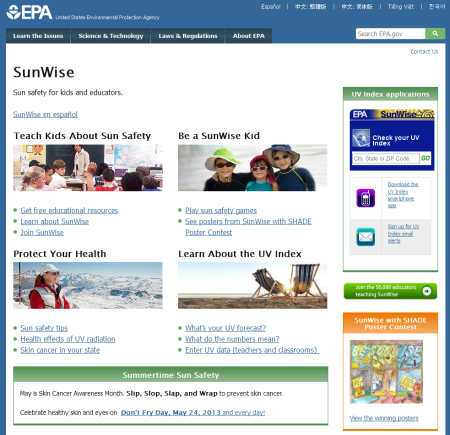
The EPA’s Sunwise sun safety website, http://www2.epa.gov/sunwise, has endless resources for adults and children. Teachers can download suggested lesson plans with PowerPoint presentations and sign-up for the SunWise Program to receive free toolkits that have age appropriate content and activities for their classrooms. Children can play interactive sun safety games, take quizzes and become “Sun Safety Certified.”

Together, adults and children can learn about the UV Index scale and the suggested precautions that go with each category and the health effects of overexposure to UV rays.  It even has Skin Cancer Fact Sheets by state showing the skin cancer rates and Action Steps for Sun Safety.

The website’s content is well-organized and can be translated into Spanish to reach a greater audience.

EPA-Sunwise-WebsiteAnother useful site is from the not-for-profit Sun Safety Alliance, (también en español) which offers its “Block the Sun, Not the Fun” program in addition to sponsoring National Sun Safety Week. 

Graphic-Skin-cancer-video-Sun-Safety-AllianceThe website includes resources for Educators, including this Teacher’s Guide; Healthcare Professionals; Parents and Early Childcare personnel; and a Kids site. It also has activities for children from infants and toddlerspre-school age, and kindergarten to 2nd grade, to grades 3 to 5, middle school,and  all the way through high school.

Image: From a video on the Sun Safety Alliance home page, showing the effects of skin cancer on a former suntan addict. She says, “I wish I knew then what I can see now!”

It is not fun to avoid the sun and sit inside all summer. So be proactive and start the summer out right by taking preventative actions to avoid sunburns. Keep in mind that there is more to sun safety than just putting on sun screen.

HOW DO I OBTAIN the “Mission: SunWise Activity Book 2013”?

  • Buy it online 24/7 on GPO’s U.S. Government Bookstore.
  • Buy it at GPO’s main retail bookstore at 710 North Capitol Street NW, Washington, DC 20401, open Monday-Friday, 9am to 4pm, except Federal holidays, (202) 512-0132.
  • Find it in a a federal depository library.

About the Authors: Our guest blogger is Emma Wojtowicz, Public Relations Specialist in GPO’s Office of Public Affairs. Additional content was provided by Government Book Talk Editor Michele Bartram, Promotions Manager for GPO’s Publication and Information Sales Division.