National Safety Month: A Time to Celebrate Safety

June 14, 2023

June is National Safety Month, a time to focus on preventing injuries and deaths in the workplace and at home. National Safety Month provides an opportunity to raise awareness of safety hazards and learn how to avoid them.

The National Safety Council (NSC), a non-profit organization, works to save lives through safety education and advocacy. This year, the NSC is focusing on the following four key areas:

  • Emergency preparedness: Make sure you have a plan in place in case of an emergency, such as a fire, flood, or earthquake.
  • Slips, trips, and falls: Be aware of your surroundings and take steps to prevent slips, trips, and falls.
  • Heat-related illness: Stay hydrated and cool during hot weather.
  • Hazard recognition: Learn to identify and avoid hazards in your workplace and at home.

The following are tips for staying safe in the workplace:

  • Wear personal protective equipment (PPE) when required.
  • Follow all safety procedures at work.
  • Be aware of your surroundings and be mindful of potential hazards.
  • Don’t be afraid to speak up if you see something unsafe.
  • Get regular safety training.

Sign up for free email alerts regarding safety-related GPO publications.

In addition to the information above, the Federal government also offers the following resources for maintaining a healthy and safe environment in your home.

The Lead-Safe Certified Guide to Renovate Right from the Environmental Protection Agency (EPA) includes essential information about the dangers of lead and the potential lead poisoning through home maintenance and renovation work. This handy booklet covers the basic facts about lead and its impact on health.

Everyone Deserves a Safe and Healthy Home provides home safety tips to help vulnerable family members suffering from chronic illnesses who may be at risk when faced with common occurrences in the home, such as mold, dust, toxins from lead, and old embedded asbestos. It also provides guidance on everyday cleaning chemicals and silent and odorless carbon monoxide and radon, which can pose health risks if not effectively treated and kept under control.

Together, we can create a safer world for everyone by following the above tips in this article.

HOW DO I OBTAIN THESE RESOURCES?

Sign up to receive promotional bulletin emails from the US Government Online Bookstore.

Shop Online Anytime: You can buy a vast majority of eBooks or print publications —with FREE Standard Shipping worldwide— from the U.S. Government Online Bookstore at https://bookstore.gpo.gov.

Order by Phone or Email: Call our Customer Contact Center Monday through Friday, 8 am to 4:30 pm Eastern (except US Federal holidays). From US and Canada, call toll-free 1.866.512.1800. DC or International customers call +1.202.512.1800.  Email orders to ContactCenter@gpo.gov

Visit a Federal depository library: Search for U.S. Government publications in a nearby Federal depository library. You can find the records for most titles in GPO’s Catalog of U.S. Government Publications.

Find more than a million official Federal Government publications from all three branches at www.govinfo.gov.

About the author: Trudy Hawkins is Government Book Talk Editor and Senior Marketing & Promotions Specialist in GPO’s Publication & Information Sales Office, supporting the U.S. Government Online Bookstore (https://bookstore.gpo.gov).


School safety by the numbers

March 9, 2012

Guest blogger GPO Public Relations Specialist Emma Wojtowicz discusses a publication about safety in schools.

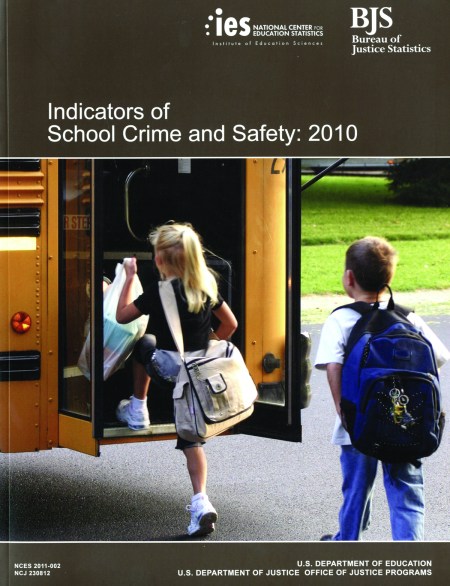
School safety is a concern. The recent school shooting at the public high school in Chardon, Ohio, reminds us that any school is susceptible to violence and tragedy. Indicators of School Crime and Safety: 2010, a publication by the Department of Education and Department of Justice, thoroughly examines the various indicators that threaten the safety of our nation’s schools.

The information and data in this report was collected through surveys conducted from 2007-2009. While this report is regularly published to help policymakers and schools develop ways to keeps schools safe and prevent crime and violence, it makes for an interesting read given recent events.

The report identifies 21 indicators that threaten the safety of schools. The indicators encompass a variety of problems like victimization, bullying, injury, fights, use of drugs and alcohol and weapons possession. Charts and graphs illustrate the data collected about each of the problems with breakdowns by age, ethnicity, gender, public versus private school, and urban versus rural school location.

Is your child afraid at school? For example, this chart shows the number of students from 12-18 who feel threatened at school or away from school. Here, Black students feel the most afraid at school, with Hispanics second, but Hispanic students feel more threatened outside of school than any other group. (CLICK ON IMAGE TO ENLARGE.)

There are also comparisons for some indicators between being at school and outside of school.

Who’s carrying? For example, the above graph from the book shows the percentage of high school students who carried a weapon on and off school property at least once in the last 30 days. The highest weapon-carrying groups were American Indians, Pacific Islanders and White students, with Asian and Black students as the lowest groups. (CLICK ON IMAGE TO ENLARGE.)

The content is organized well with a brief explanation about each indicators followed by the data depicted through charts and graphs making for easy navigation if there is a specific topic you are interested in.

Some interesting findings during the 2007-2008 school year:

  • Victims of bullying are about same for males and females: 30% of male students and 33% of female students reported being bullied
  • 5% of students reported being afraid of attack or harm at school
  • 1% of public schools have daily metal detector checks and 5% of public school have random metal detector checks
  • 6% of students reported carrying a weapon to school and 17% of students reported carrying a weapon anywhere in a 30-day period
  • 21 school-associated homicides occurred
  • 43% of public schools reported they have an electronic notification system for a school-wide emergency in place

It is difficult to analyze these statistics and determine whether or not schools are safe. From scanning the various line graphs, it is easy to notice there has been a decline over the years from the mid-1990s to 2009 regarding most of the indicators. Hopefully, this data is used to improve and strengthen the safety of schools. As our country was reminded on February 27 in Chardon, Ohio, any school is at risk and we must be steadfast in the effort to reduce the risks that leads to tragedy.

What measures are in place to keep your child safe at school? This chart from the book shows what school security measures have been put in place overall since 1999, the year of the Columbine High School in Littleton, Colorado. While all measures increased since 1999, many have dropped from a former high rate in 2003-5, such as use of security guards, metal detectors, locker checks or visible student ID badges. The only measures that have consistently grown over the years are: use of security cameras, instituting a code of student conduct, locked entrance and exit doors during the day, and a requirement that visitors to the school sign in. (CLICK ON IMAGE TO ENLARGE.)

HOW DO I OBTAIN THIS “Indicators of School Crime and Safety: 2010” BOOK?

  • Buy it online 24/7 at GPO’s Online Bookstore.
  • Buy it at GPO’s retail bookstore at 710 North Capitol Street NW, Washington, DC 20401, open Monday-Friday, 9am to 4pm, except Federal holidays, (202) 512-0132.
  • Find it in a library.

Just for Fun: Sprocket Man!

April 9, 2010

Government Book Talk has had a busy couple of weeks getting up and running, so it’s time to kick back, relax,  and talk about one of the many unexplored corners of the world of Federal publications. Sprocket Man, the Consumer Product Safety Commission’s superhero for safe biking, began in 1975 as a comic book character created at Stanford University for the California  Department of Public Safety and the nonprofit Urban Bikeway Design Collaborative. Somewhere along the line, he and his comic books were picked up by the Commission. I know that the GPO sales program carried them at one time, although I don’t know if we sold them singly or in packages. (I checked, and we don’t sell them anymore).

Thanks to the depository library program, you can find Sprocket Man here. Although at first the idea of a superhero dedicated to bicycle safety seems a bit…overdone, I can see how he’s a good way to reach younger bikers. He’s pretty intense, but he gets his message across. Although a few comic buffs seem to scorn him, Sprocket Man is still available for download at a number of safety-oriented Web sites and for collectors at several comic book sites.

 Tune in next Friday for another trip down the one of the many byways of Government books, and don’t forget to wear your helmet!