Everything You Should Know About The Health Care Law

September 24, 2013

Inside-the-affordable-care-act or Obamacare. In one week at the beginning of fiscal year 2014 on October 1, 2013, and at the start of the calendar year on January 1, 2014, the provisions of the new health care law go into effect. Image courtesy: Charlotte Area News.

The health care law, known officially as the Affordable Care Act (ACA) or  more commonly as “Obamacare” has two parts: the Patient Protection and Affordable Care Act (PPACA) (Public Law 111–148), and the Health Care and Education Reconciliation Act (Public Law 111–152 which was enacted to amend the PPACA. It was passed by Congress and signed into law by President Barack Obama on March 30, 2010.

Since that time, in the span of 42 months, the health care law has been upheld by the Supreme Court and some early provisions have already been implemented. Upon conception of the law, 2014 was marked as the year the most significant provisions of the law would go into effect.
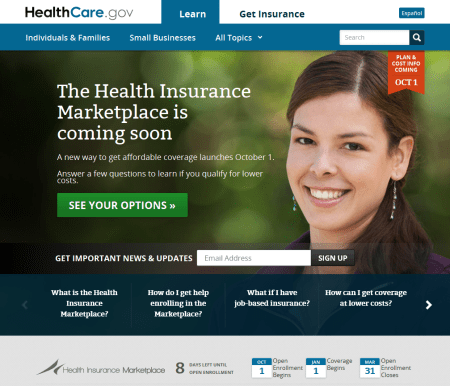
Find information about these marketplaces for Individuals and Families or Small Businesses on the U.S. Centers for Medicare & Medicaid Services Healthcare Marketplace website, https://www.healthcare.gov/.

Image: U.S. Centers for Medicare & Medicaid Services Healthcare Marketplace website, https://www.healthcare.gov/

A week from today on October 1, 2013, open enrollment for the health insurance marketplaces begins and remains open for six months closing on March 31, 2014. Find information about these marketplaces for Individuals and Families or Small Businesses on the U.S. Centers for Medicare & Medicaid Services Healthcare Marketplace website,  https://www.healthcare.gov/. There are links to healthcare marketplace information in other languages as well:

The high profile provisions that go into effect on January 1, 2014, include:

  • Coverage begins if you signed up through the health insurance marketplace
  • Protection for individuals with pre-existing conditions
  • Elimination of annual limits on insurance coverage
  • Tax credits to help pay for costs if you sign up with a health insurance marketplace
  • Expanded access to Medicaid, subject to the state you live in
  • Individual mandate if you choose not to buy health insurance
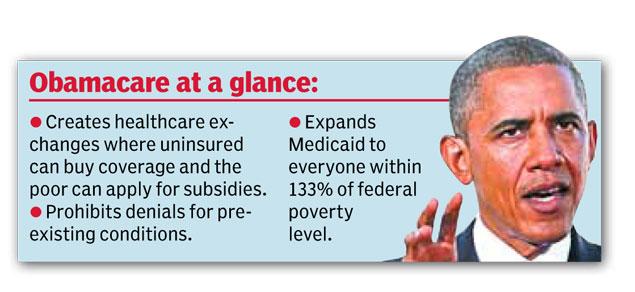
obamacare-at-a-glance-ny-daily-news

Image courtesy: New York Daily News.

This is a basic overview of the law. To fully understand the details requires further reading, and GPO is here to help. GPO makes the authentic, published version of the Patient Protection and Affordable Care Act and the Health Care and Education Reconciliation Act available to the public in print through the agency’s Online Bookstore and digitally through GPO’s Federal Digital System (FDsys). GPO also works with 1,200 libraries nationwide through the Federal Depository Library Program to have resources on the health care law available to public.

How do I obtain a copy of this Affordable Care Act (ACA)?

1) Buy a printed copy

  • Shop Online: You can purchase a printed copy of the Health Care Act containing the Patient Protection and Affordable Care Act and the Health Care and Education Reconciliation Act of 2010 from the U.S. Government Online Bookstore or by shopping our Public Health Policy & Healthcare Laws collection under our Health & Benefits category.
  • Order by Phone: Call our Customer Contact Center Monday through Friday, 8 am to 5:30 pm Eastern (except US Federal holidays). From US and Canada, call toll-free 1.866.512.1800. DC or International customers call +1.202.512.1800.
  • Visit our Retail Store: Buy a printed copy at GPO’s retail bookstore at 710 North Capitol Street NW, Washington, DC 20401, open Monday–Friday, 9 a.m. to 4 p.m., except Federal holidays, Call (202) 512-0132 for information or to arrange in-store pick-up.
  • Find it in a Library: Find this in a federal depository library.

2) View or download a PDF from GPO’s official Federal documents database, FDsys:

About the Author: Our guest blogger is Emma Wojtowicz, Public Relations Specialist in GPO’s Office of Public Affairs. Additional content provided by Government Book Talk Editor: Michele Bartram, Promotions & eCommerce Manager for GPO’s Publication and Information Sales Division.


The Constitution Annotated: The Pursuit of App-iness

September 17, 2013

follow-the-founding-fathers-david-bowman_computerIn preparing for this Constitution Day blog post, not only did I retake the civics quiz from last year’s Constitution Day post (see Quiz: Are you smarter than an 8th grade Civics student?), I also scrolled through my tablet last night, reading the Preamble to the Constitution and looking up related quotes. Then it occurred to me: if Founding Father George Washington had been alive today, would he have been a PC or an Apple guy? I’m betting our pragmatic First President would be a PC guy. I’m pretty sure innovator Thomas Jefferson would have been a stylish iPad man, and Benjamin Franklin, inventor of the bifocals, would probably be sporting Google Glasses now and tinkering with them.

Image: Founding Fathers Thomas Jefferson, Benjamin Franklin, George Washington. Original Illustration by David Bowman from his book “What Would the Founding Fathers Think?”

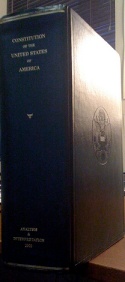
constitution-annotated-printWhat is clear is that our Founding Fathers were strategic thinkers who realized that a fully functioning republic needed a clear but flexible code of law that evolved with the Nation. Thus, they wrote the Constitution of the United States, which has stood the test of time with over two centuries of amendments and interpretations by all branches of the U.S. Federal Government.

CONAN for the Librarian (and Lawyers)

Since 1913, the Senate has directed that a publication be issued summarizing the current state of the Constitution to date, with all the amendments and the official interpretations, with the analysis today provided by the Library of Congress’ Congressional Research Service. This publication is called The Constitution of the United States of America, Analysis and Interpretation, popularly known as the Constitution Annotated or “CONAN” among the real insiders.

Constitution-of-the-US-Pocket-GuideIn addition, many Americans, including Members of Congress, buy a pocket print edition of the Constitution and Declaration of Independence to carry around with them at all times. (Click on image to the left.)

Constitution Goes Mobile and Online

This year marks the 100th anniversary of the Constitution Annotated publication, and to celebrate it and Constitution Day, the Government Printing Office (GPO) not only issued the Centennial Edition in print, but has also worked with the Senate Committee on Rules and Administration and the Library of Congress to develop and launch both a new mobile app as well as a web publication that make analysis and interpretation of constitutional case law by Library experts accessible for free to anyone with a computer or mobile device.

The new resources, which include analysis of Supreme Court cases through June 26, 2013, will be updated multiple times each year as new court decisions are issued.  Legal professionals, teachers, students and anyone researching the constitutional implications of a particular topic can easily locate constitutional amendments, federal and state laws that were held unconstitutional, and tables of recent cases with corresponding topics and constitutional implications.

The new app and improved web publication will make the nearly 3,000-page “Constitution Annotated” more accessible to more people and enable updates of new case analysis three or four times each year.

Public Printer Davita Vance-Cooks said,

“Through this collaborative project, the Library of Congress and GPO are providing the public with timely access to an enhanced, authenticated version of the “Constitution Annotated” through GPO’s Federal Digital System. This is another example of how GPO works with Congress, the Library and other agencies to meet the information needs of the American people in the digital age.”

Keeping our “Complex Machinery” in Working Order

On May 19, 1821, years after the Constitution was adopted, John Adams wrote in a letter to Thomas Jefferson that:

“A free government is a complicated piece of machinery, the nice and exact adjustment of whose springs, wheels, and weights, is not yet well comprehended by the artists of the age, and still less by the people.”

Even though our Founding Fathers could not have envisioned a digital future complete with the Internet and smartphones, the framework they put in place has been able to roll with the times. Americans know that our system is indeed a “complicated piece of machinery,” with our laws serving as the user manual, but tools like the Constitution Annotated– in print or now online or on your mobile device– now exist to help keep our machinery of democracy well oiled.

George-Washingtons-Annotated-Copy-of-a-Draft-of-the-U.S.-ConstitutionImage: Even George Washington annotated his copy of the Constitution! (seen left). Source: National Archives

How can I obtain The Constitution Annotated?

1) Buy the Print Edition of The Constitution of the United States of America, Analysis and Interpretation, Centennial Edition

2) Mobile app version of the Constitution Annotated

  • For Apple iOS Devices: Download the new Constitution Annotated app for iOS devices for free from Apple’s iTunes Store or via this direct link: http://beta.congress.gov/constitution-annotated/.
  • ·        For Android Devices: An Android version of this app is under development.

3) Constitution Annotated web publication on FDsys.gov

The Constitution Annotated web publication will be available on GPO’s Federal Digital System (FDsys) www.fdsys.gov as a digitally-signed, searchable PDF that includes a linked table of contents, a linked table of cases, a linked index and GPO’s Seal of Authenticity on every page.

The new Constitution Annotated and a suite of constitutional resources can be viewed at http://beta.congress.gov/constitution-annotated/. The page features links to the app stores, an interactive table listing recent cases of high interest, a bibliography of Constitution-related primary documents in American history and tips for searching the Constitution Annotated on GPO’s website at www.gpo.gov/constitutionannotated.

About the Author: Government Book Talk Editor Michele Bartram is Promotions Manager for GPO’s Publication and Information Sales Division in Washington, DC, and is responsible for online and offline marketing of the US Government Online Bookstore (http://bookstore.gpo.gov) and promoting Federal government content to the public.


Statistical Abstract and Print Mashups in a Digital Age

October 13, 2011


Since 1878, the Statistical Abstract of the United States has been printed by the Government Printing Office on behalf of the Census Bureau.

The “Stat Abstract” is considered “the authoritative and comprehensive summary of statistics on the social, political, and economic organization of the United States,” and compiles data from multiple sources, including: the Census Bureau, Bureau of Labor Statistics, Bureau of Economic Analysis, and many other Federal agencies and private organizations. Each year, new tables and analyses are added to keep up with the issues and interests of the day.

As Jim Cameron mentioned in his February post about the 2011 edition,

“Family debt, manufacturing, national security, international statistics – there doesn’t seem to be anything that the Statistical Abstract doesn’t cover. At more than 1,000 pages, it’s an America watcher’s dream.”

This important publication has fulfilled a unique niche for over a century for students, educators, researchers and librarians throughout the country as the definitive source of US statistics. As one librarian put it, “The print edition is THE most used reference book in my collection.”

Why is having all this information in a single, compiled, cited, and referenced edition important to its users? Michael Fry, Senior Map Librarian for the National Geographic Society Library and Archives says:

“[W]hile the Census Bureau may be correct that the data is “available elsewhere,” the beauty of the Stat Abstract is that it obviated users’ need to know where “elsewhere” was. And that, as librarians know, can be (at least) half the battle.”

After fifteen years in the Internet industry, I am highly aware of how important it is to your intended audience to be able to quickly and easily find the information they are looking for, and how difficult this search task is made for the users by most web sites.

This has led to an entire field of search engine optimization also called SEO. Unfortunately, all the SEO in the world can’t overcome the amount of time and effort necessary to find all the content and data you need if it is scattered across many web pages and web sites.

In a world where time is money and convenience is king, the time savings in both finding the necessary data and knowing immediately the official source that produced that data are key benefits of a book like the Statistical Abstract. In a sense, this book is the ultimate printed “mashup” that blends data from multiple sources into a cohesive whole that is greater than the sum of its parts.

Who would have thought that a 134 year-old publication tradition would have such relevance in a digital age?  Unfortunately, compiling all this data and obtaining publication rights is increasingly expensive,  as many experts and a lot of effort are needed to pull together a work of this complexity. Thus, this may be the last year in its compiled format, since in its Fiscal Year 2012 budget submission to Congress, the Census Bureau requested “a decrease to terminate the Statistical Abstract program.

So, you may want to get what may be the last print edition of the Statistical Abstract of the United States at the US Government Bookstore in paperback or hardcover or find it in a library. Or you can see the tables online here.

Some interesting facts from the 2012 edition:

  • Increase in US Population: Between April 1, 2000 and April 1, 2010 there was a 9.7 percent increase in the resident population of the United States. The state with the highest percentage increase in resident population during the same time period was Nevada (35.1), while the only state that experienced a decrease was Michigan (-0.6). (Table 14)
  • Retail profits up: For retail trade corporations with assets of 50 billion dollars or more, net profit increased from 54.0 billion in 2008 to 84.1 billion in 2009. Profits per dollar of sales before taxes also increased from 2.6 cents per dollar of sales in 2008 up to 4.1 cents per dollar of sales in 2009. (Table 1052)
  • 80% has Internet access: In 2010, approximately 20 percent of households did not use the Internet…[, and] 80 percent of households had an Internet connection anywhere (at home or mobile etc). (Table 1155)


About the Author:  Michele Bartram is Promotions Manager for GPO’s Publication and Information Sales Division and is responsible for marketing the US Government Online Bookstore (Bookstore.gpo.gov) and promoting Federal government content to the public.