A Teen Survival Guide – for Parents, Too!

January 26, 2011

Guest blogger Ingrid Reyes-Arias remembers a Government publication that has good information for teenagers and parents alike.

Sometimes growing up can be a scary thing, and rearing a child can be scary, too.  As part of my undergraduate career, I devoted a lot of my research time to family and public health issues. With the plethora of information out there, it’s difficult to discern the age-appropriate and accurate health facts.  For my part, I relied heavily on many Department of Health and Human Services (HHS) publications because I knew they were trustworthy and up to date.    

During one of my research efforts, I came across an interesting document from the HHS Office of Women’s Health.  It’s called Teen Survival Guide: Health Tips for On-The-Go Girls.  I used the information in it to give a class on women’s health to several teenage girls.  This guide was extremely helpful when discussing such important topics as reproductive health.   

The first portion of the Survival Guide is “Taking care of your reproductive health,” which includes discussions about the body, sexually transmitted diseases, and advice on seeing your doctor.  The guide also provides recommendations on personal hygiene, exercise tips, tips on healthy eating habits, adverse effects of drug usage, self-esteem and relationship counseling, and advice on future planning – all of which are very important in the life of a teenager. 

This guide is very practical and includes interactive quizzes, real life questions and answers, resources related to the different topics at the end of the sections, and a glossary for many of the medical terms.  The ease of interactivity allows for successful teaching of facts to a class, or even to your own child.  As parents, this can be a tough topic with plenty of tough moments, so having a special guide will allow for a more neutral encounter with your child.

Take advantage of the Teen Survival Guide. You can also find it in a library. It will make those anxiety-provoking future discussions a lot easier!


Russia, America, and the Lands of the Bering Strait

January 21, 2011

Sometimes a Government publication is a window into a program that you never dreamed existed. Before opening my copy of Early Art of the Northern Far East: the Stone Age, I had never heard of the National Park Service’s Shared Beringian Heritage Program. It’s not a new program, either: according to the program’s Web site, it was “created in 1991, [and] resulted from a commitment by Presidents George H.W. Bush and Mikhail Gorbachev to expand United States and Soviet cooperation in the field of environmental protection and the study of global change.”

Now perhaps some of you are thinking, “Hold on there, Government Book Talk, what the heck is Beringia?” Thanks to that same Web site, I can state with confidence that “Beringia is defined as the land and maritime area bounded on the west by the Lena River in Russia; on the east by the Mackenzie River in Canada’s British Columbia; on the north by 72 degrees north latitude in the Chukchi Sea; and on the south by the tip of the Kamchatka Peninsula.” This joint Russo-American geographic and cultural unit possesses unique natural resources and is the home of Native peoples with much in common. The program conducts research on the prehistoric Bering land bridge as well as the natural and human history of its animal and human inhabitants, informs the public about these discoveries, and translates Russian-language publications about the region.

Early Art of the Northern Far East is one of those translated works. I must admit that it’s really for specialists only – very much in the mode of such venerable series as Smithsonian Contributions to Anthropology – but it is intriguing to see the variety of animal and celestial images that were sculpted or incised by Beringia’s earliest peoples. If you have a serious interest in cultural anthropology or prehistoric art, this is a valuable contribution to the study of  both. You can browse through it here, get your own copy here, or find it in a library.


Dams and Hydropower in the West

January 19, 2011

Although the words “Woody Guthrie” and “Federal employee” don’t usually come to mind together, in May 1941, the Government hired the great folk singer to write songs about some of its hydropower projects in the Pacific Northwest. The results included such classics as “Roll on Columbia,” “Pastures of Plenty,” and “Grand Coulee Dam.”

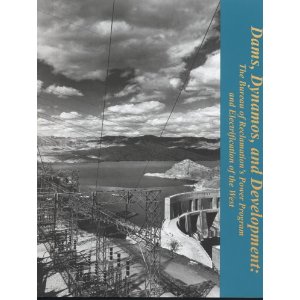
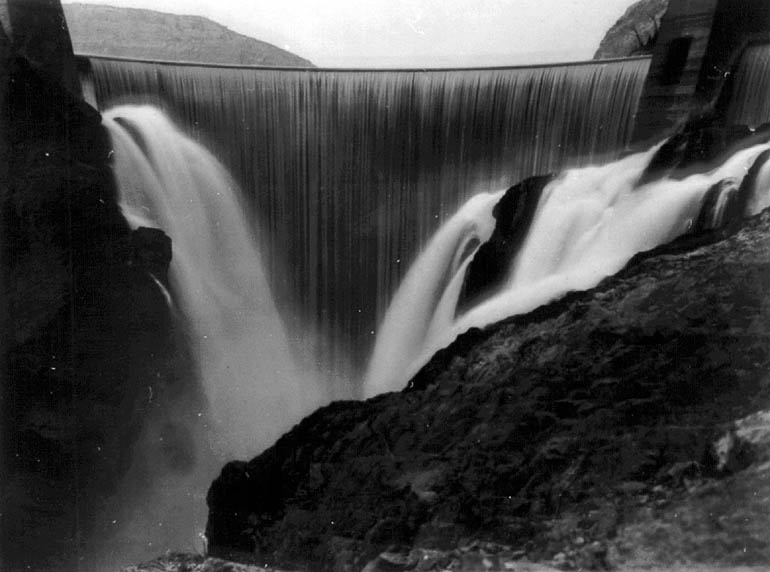
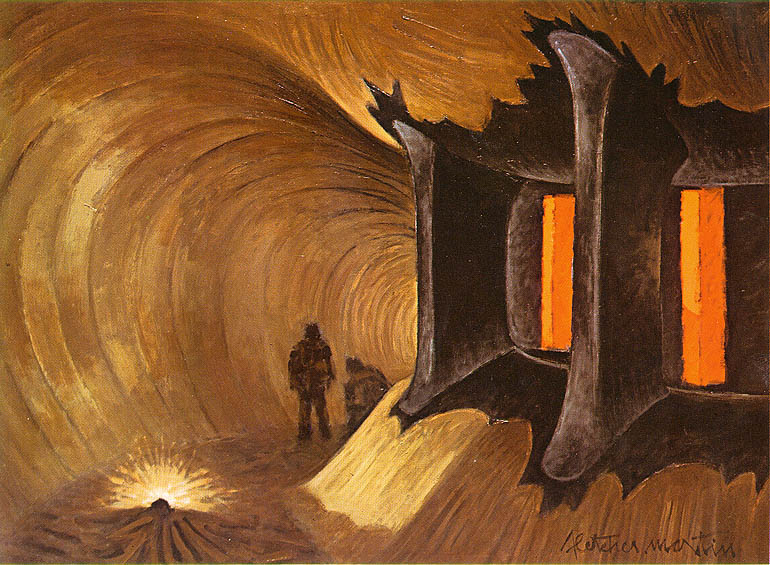
Woody and his songs came to mind as I started thumbing through Dams, Dynamos, and Development: The Bureau of Reclamation’s Power Program and Electrification of the West, a handsome, large-format book published for the centennial of the Bureau in 2002 and now back in print. It includes a broad array of wonderful black and white and color photos, as well as reproductions of art work (even a Norman Rockwell, left), all of which illustrate the history and activities of the Bureau in building dams and power plants to generate electricity. Many of the photos capture Woody’s “big Grand Coulee country in the land I love the best” and the other rivers and canyons of the West.

It’s not just a picture book; there’s also a lot of hard information on the history of the program, the changing views of the effects of dams and hydropower facilities on the environment – even an extensive listing and photo gallery of the 58 power plants that comprise the Bureau’s power network. It conjures up the heroic age of building America’s infrastructure while addressing such issues as alternative power sources and environmental protection.

You can get a copy of this excellent book here or find it in a library. If you want to view some of the art work, check out the Bureau’s American Artist and Water Reclamation Web page; for some of the photos, there’s the Bureau of Reclamation Photography and Engineering Drawings Collections page.


Remembering the Forgotten War

January 14, 2011

Last year marked the 60th anniversary of the outbreak of the Korean War, but whatever commemorations occurred were pretty low key, maintaining its reputation as “the forgotten war.” Given that many people at the time saw the war as possibly leading to World War III, it’s interesting that it’s receded so much from public consciousness.

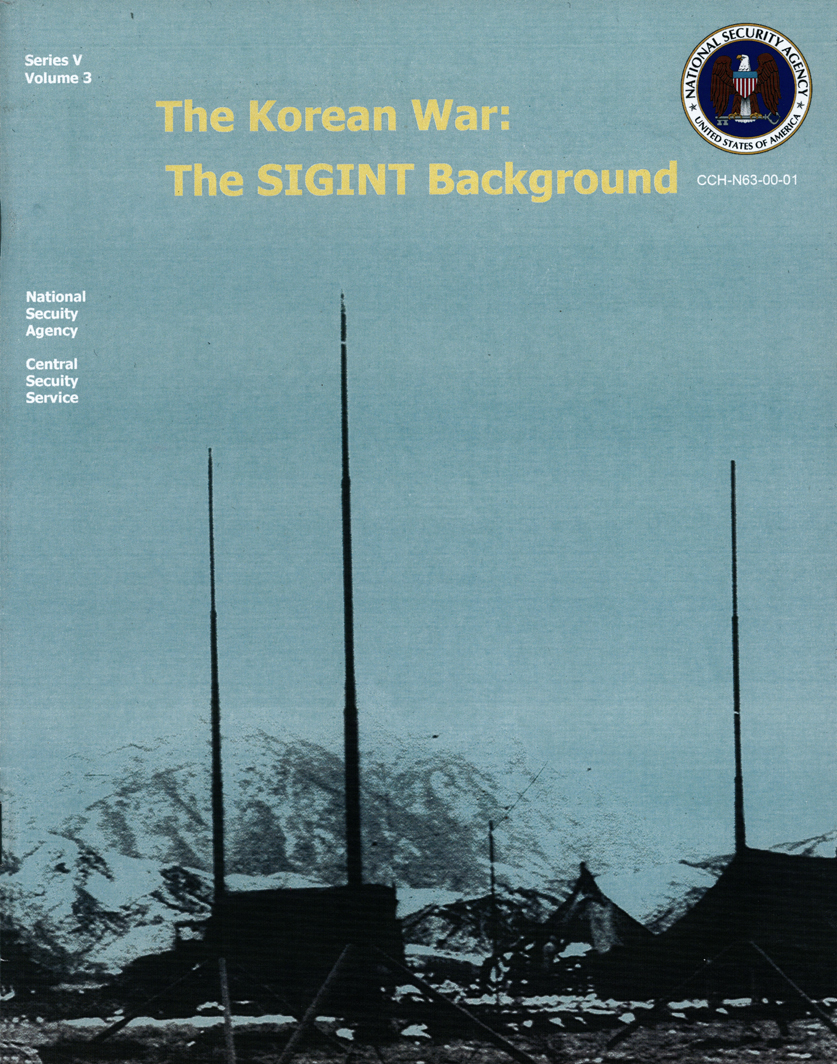
Sometimes it’s the byways of history that tell us the most about how things really were. Two pamphlets produced by the National Security Agency’s Center for Cryptologic History on signals intelligence (SIGINT) in the Korean War do just that. The Korean War: the SIGINT Background shows how woefully understaffed and under-skilled the Armed Forces Security Agency (AFSA) was in the run-up to war. With most of its efforts focused on the Soviet Union and the People’s Republic of China, AFSA had neither the motivation nor the Korean language capabilities to track North Korean communications. The betrayal of American penetration of Soviet cipher systems by an NKVD mole in AFSA resulted in even more distraction.

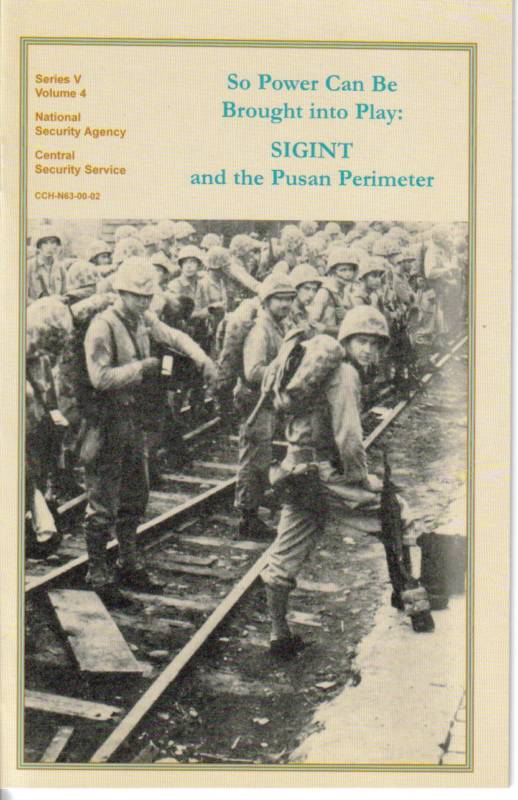
So Power Can be Brought into Play: SIGINT and the Pusan Perimeter takes the story into combat. While recapitulating the failings of AFSA prior to the outbreak of war, it describes how quickly its staff began providing high-quality intelligence to the U.S. forces trapped in the Pusan perimeter after the massive North Korean invasion that pushed them into that pocket southeast of Seoul. Although outnumbered and outgunned, American forces held out until the risky but totally successful amphibious invasion at Inchon. The Korean War: the SIGINT Background then outlines the Chinese phase of the war, the resultant stalemate, and the detailed advance intelligence that led to victories at Hill 395 and Pork Chop Hill prior to the 1953 armistice.

So there is the Korean War in microcosm: initial surprise and near-disaster, furious improvisation, and success followed by stalemate and an indecisive finish. Perhaps that’s why we don’t remember it – hard fighting but no parades. You can read these publications or order copies here or find them in a library.


Plunging into Deep Water

January 12, 2011

Although Government Book Talk tries to cover Government publications of all eras, we do like to jump on hot new titles, especially when they cover subjects of broad public interest. They don’t get any hotter than Deep Water: The Gulf Oil Disaster and the Future of Offshore Drilling. This report from the National Commission on the BP Deepwater Horizon Oil Spill and Offshore Drilling was printed in-house here at GPO and released to the public just yesterday.

Given the proverbially slow pace at which Government supposedly moves, I’d say that this Commission got its work done very expeditiously and thoroughly. it’s fair to say that one word sums up many of its key findings – complacency – on the part of the oil industry and government. According to the report, BP, for example, was quite conscious of the need for safe practices for individuals, but not for processes, despite a recent history of major accidents: Grangemouth in Scotland (2000), North Sea (2003), and the deadly Texas City refinery explosion (2005). The Commission also found fault with BP’s contractors, Halliburton and Transocean, and the Department of the Interior’s Minerals Management Service and other Government entities with responsibility for regulation and oversight. (In thumbing through this document, I also realized that, even though I consider myself relatively well informed about current events, I had quite forgotten the Texas City disaster, which cost more lives than the Deepwater Horizon accident.)

I also liked the Commission’s decision to add sidebars that allowed the victims of the oil spill – businesspeople, fishermen, and residents – to speak frankly and sometimes emotionally about the toll it took on their lives and livelihoods. In our culture of 24/7 news and quasi-news, it’s easy to lose track of yesterday’s victims. I think that’s why Deep Water is dedicated to the 11 men who died last April 20 on the Deepwater Horizon.

Deep Water is an exemplary Commission report – timely, clear, and comprehensive. It’s worthy of any citizen’s attention. You can view it here or get your own copy here.


Orientalism, Intelligence, and Empire

January 7, 2011

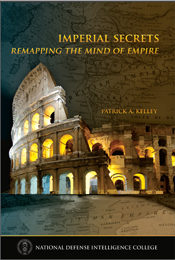
It took me awhile to get a handle on this one. Imperial Secrets: Remapping the Mind of Empire, published by the  National Defense Intelligence College, cites Edward Said, Francis Bacon, Jorge Luis Borges, Michel Foucault, Jeremy Bentham, T.E. Lawrence, and Joseph Conrad just in the Introduction, uses the intelligence experiences of the Roman, Ottoman, and British Empires as its core focus, and includes chapters  headed “Thuggee”, “Barzakh”, “Rhizomes”, and “Boukoloi.” This is a book that challenges its readers.

My take is that Edward Said is the real intellectual godfather of this book. His Orientalism was and remains a brilliant exposition of the West’s perceptions of the “mysterious East”. Although like all seminal works, Said’s work has been challenged, and in some ways refuted, it remains a starting point for anyone in the many fields it touches.

Although Imperial Secrets is too rich and complex a work to summarize here, it proposes that the United States, although not a classic empire, can be viewed as such, from the perspective of knowledge gathering, or intelligence, in the lands over which it exercises “imperial” influence. In the chapter on Thuggee in the British Raj, for example, an age-old Indian problem of robbery carried out via the strangulation of victims, was transmogrified by the British imagination into an organized cult of religious stranglers. Informers and punitive laws  then were employed to eliminate this phantom cult. Imperial Secrets uses this narrative to demonstrate the way empires, when faced with unfamiliar social and cultural environments, use an Orientalist discourse to fit those environments into their own frames of reference.

Another interesting theme is the value of informal networks of information, whether through the Sufi lodges of the Ottoman Empire or the transnational Freemasonic lodges of 19th Century Europe. Related to these networks are attempts by empires to use their own agents (T.E. Lawrence or the remarkable American Josiah Harlan, who had at least a shot at becoming an Afghan prince in the 1830s) and the emotional and psychological stresses that influence, or even distort, these agents’ perceptions however deeply they have steeped themselves in the cultures they infiltrate.

As I said earlier, Imperial Secrets is too intellectually challenging to review in a limited space. I haven’t even touched on its examination of Flavius Josephus as the kind of marginal informant that can to some extent transgress the boundary between and empire and its subjects, or the situationist travels of the 16th century Turkish traveler and official Evliya Celebi and their relevance as an example of  detecting information in the empty spaces between intelligence sources. (I’m starting to sound like the book, which may mean that I’m getting the point!)

Imperial Secrets is not a quick read, but it’s a stimulating one. Bear with it and you’re likely to  reap its rewards. You can read it here, get your own copy, or find it in a library.


Our year in blogging: 2010

January 5, 2011

Healthy blog!

The Blog-Health-o-Meter™ reads Wow!

Government Book Talk  just received some year-end data on how it’s been doing. Here’s a high- level summary of our overall blog health that we’d like to share with you:

The Louvre Museum has 8.5 million visitors per year. This blog was viewed about 110,000 times in 2010. If it were an exhibit at The Louvre Museum, it would take 5 days for that many people to see it.

The busiest day of the year was March 30th with 3,197 views. The most popular post that day was Welcome!.

Where did our readers come from?

The top referring sites in 2010 were links.govdelivery.com, voices.washingtonpost.com, federalnewsradio.com, gpo.gov, and google.com.

Some visitors came searching, mostly for gpo style manual 2010, government book talk, charley harper posters, and gpo style manual.

We now have 1,078 subscribers.

Attractions in 2010

These are the posts and pages that got the most views in 2010.

1

Welcome! March 2010
25 comments

2

A Comic Book History of Printing September 2010
11 comments

3

100 GPO Years Revisited June 2010
20 comments

4

Bookstore Grand Reopening August 2010
9 comments

5

An Award-Winning Blog? October 2010
14 comments

We’d like to thank all of you who read, commented, and mentioned Government Book Talk in 2010. In 2011, we promise to do our best to keep on highlighting the almost infinite variety of Federal Government publications past and present. Let’s keep reading!


The Fine Art of Bookbinding

December 30, 2010

The Washington Post ran an interesting article the other day about hand binding at GPO – specifically, the finishing our Bindery does for the White House on presentation copies of the Public Papers of the President – including hand-tooled goatskin leather, marbled edges, and silk moiré endpapers. Happily, this kind of artistry is still valued by the Government, even in this digital age.

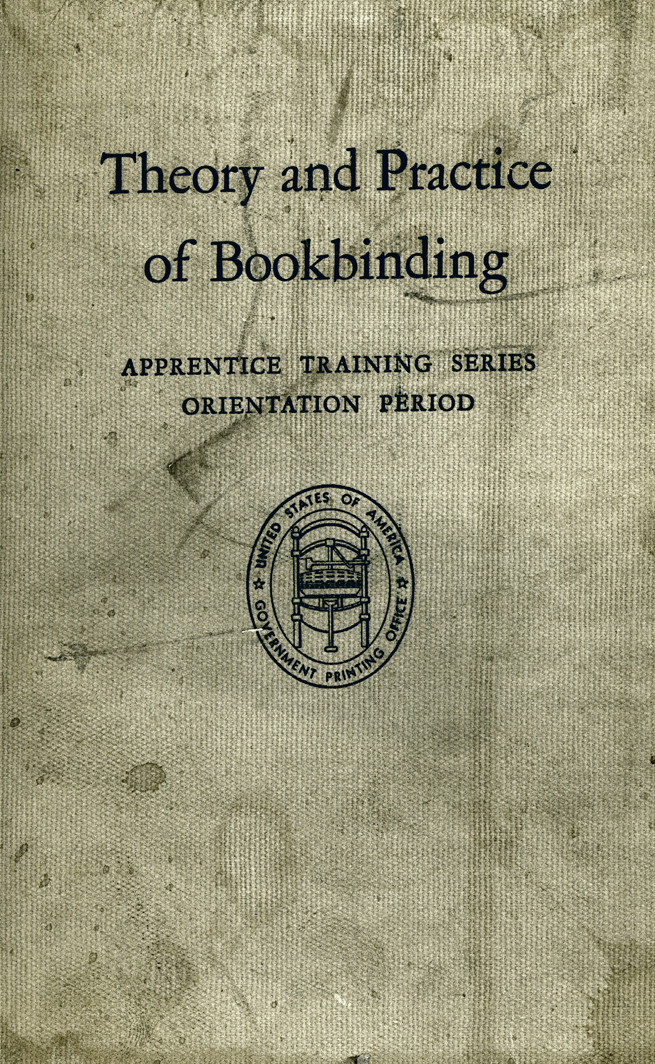
For many years, apprentice printers at GPO have studied bookbinding as one of the graphic arts. Since binding is a material rather than a digital process, reading the 1950 edition of GPO’s Theory and Practice of Bookbinding (left) still provides a pretty good introduction to the work we do today for such publications as the Public Papers and Jefferson’s Manual of parliamentary procedure, developed by Thomas Jefferson and still used by the House of Representatives (here’s a nice video on the handwork involved in binding the Manual).

Take marbling, for instance. According to Theory and Practice of Bookbinding, “marbling and gilding are complicated processes and a bookbinder who can do both well is a rarity. In fact, the majority of modern bookbinders can do neither” – and that was in 1950! As is evident in the post article and the video, we still know how to do it today.

This 60-year old guide to binding also covers even more esoteric book arts. In fore-edge painting, the top edge of a book is scraped and tied, and a watercolor picture is painted on the fanned edges (how cool is that?). Do you need some goffering? That’s a decoration produced by denting the edge after it’s gilded. I don’t know if GPO has ever done fore-edge painting, but the apprentices here had to know ALL of the terms and techniques of their craft.

When you’re in an arts and crafts mood, or if you’re like me and enjoy all kinds of obscure information about books and their making, the Theory and Practice of Bookbinding is well worth a browse. You can find copies of  various editions on used book Web sites at very reasonable prices, or in a library.

Have a Happy New Year, everyone!


Spaniards, Insurrectos, and Boxers

December 29, 2010

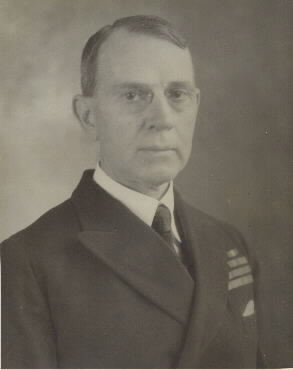
It must be relatively rare for one very junior naval officer to get to participate in three separate armed conflicts within three years, but that’s what Naval Cadet (they weren’t called Midshipmen back in 1898) Joseph K. Taussig did. According to Three Splendid Little Wars: The Diary of Joseph K. Taussig, 1898-1901, published by the Naval War College, after being called away from the U.S. Naval Academy after the outbreak of the Spanish-American War, Taussig witnessed the Battle of Santiago de Cuba, wherein the Spanish fleet unsuccessfully attempted to outrun the American fleet. As part of the two years at sea required of Annapolis graduates prior to their commissioning exam, Taussig then sailed halfway around the world to help defeat Philippine revolutionaries in the Philippine Insurrection (mainly by embarking on an abortive hostage rescue mission).

Since I’m particularly interested in the Boxer Rebellion, I thought that the last section of Taussig’s diary was by far the most engaging. Disembarking near the Taku forts that played such a prominent role in the Opium Wars of the 19th Century, Taussig and his Navy and Marine comrades headed up the Peiho River to the city of Tientsin, where they teamed up with the British, French, German, Russian, Japanese, Italian, and Austrian contingents to form the so-called Boxer Relief Expedition. At first thinking that they would reach the besieged legations in Peking in a day or so, they spent most of their time repairing Boxer-damaged railroad tracks until the Boxers cut the tracks behind them, forcing a grueling retreat back to Tientsin.

Taussig’s impressions of the Boxer rebels and their fighting methods is interesting in itself, and his account shows how what initially seems to have been perceived as a walk-over soon became a grim contest against enemy troops, heat, and the ill-mapped Chinese terrain. It all ended for Taussig when “Although the bullets were flying thick I was never so surprised in my life when I felt a blow in my right hip that knocked me down.” He had been hit by a Boxer bullet. After long periods of being carried on a stretcher, Taussig eventually got medical help and lived long enough to become a Rear Admiral (he could well have risen further if he had not antagonized a certain Assistant Navy Secretary Franklin Roosevelt, who apparently did not forgive and forget when he became President – but that’s another story).

Three Splendid Little Wars is a valuable primary source of information on some little-known conflicts and a “you are there” portrait of the frustrations suffered by the Boxer Relief Expedition in its prolonged struggle to relieve the foreign embassies in Peking. Future historians will have to take Taussig’s diaries into account when they retell that particular story. You can browse through it here, get a printed copy here, or find it in a library.


Looking at the Filibuster

December 23, 2010

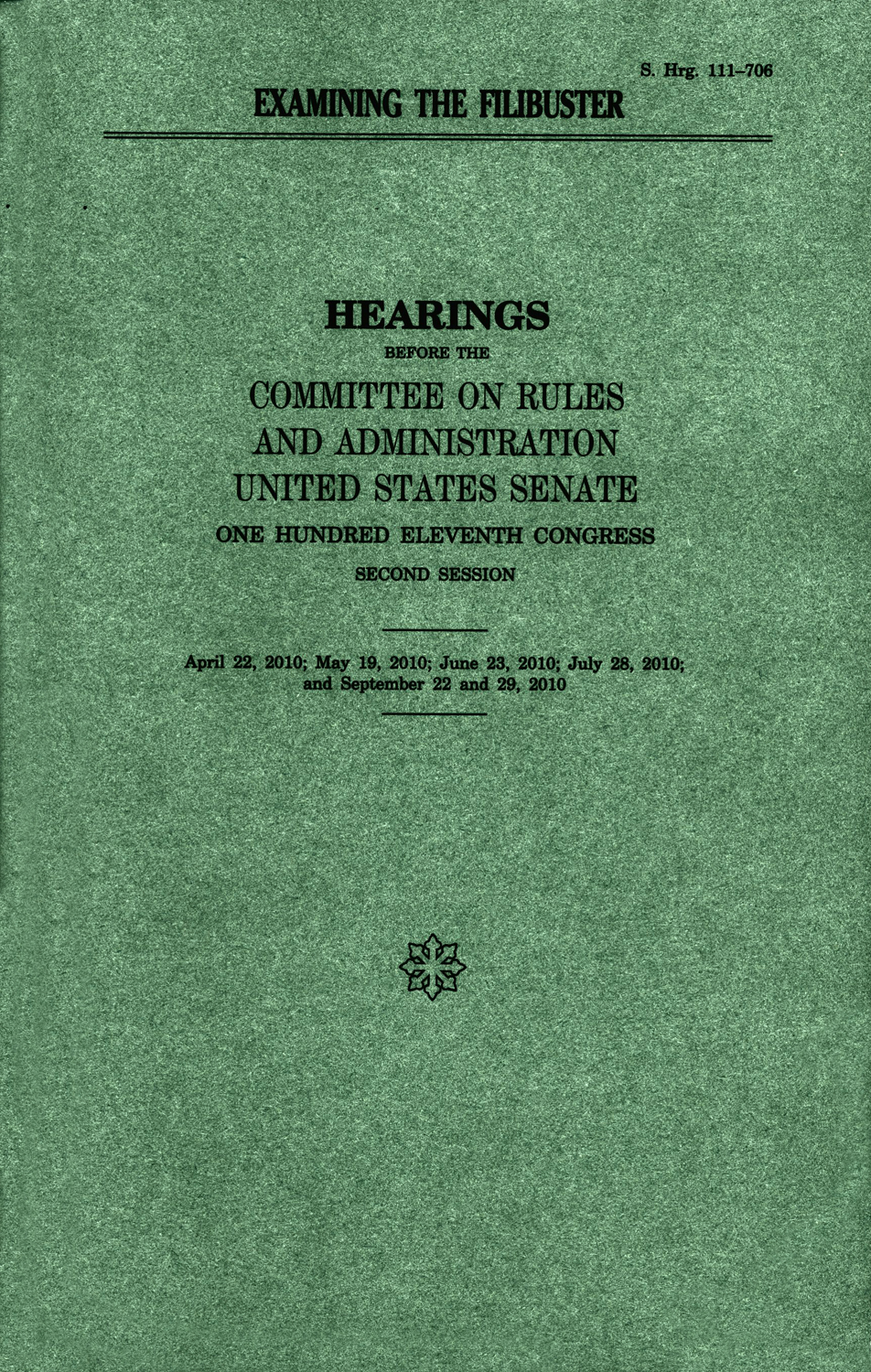
In some ways, Congressional hearings are like Jack Horner’s pie – you never know what kind of plums you’ll pull out of them. Take Examining the Filibuster: Hearings before the Committee on Rules and Administration, United States Senate, for example. As in most congressional hearings, you’ll find lots of polite and sometimes humorous byplay by various Senators, a certain amount of disagreement about the nature and value of the subject at hand, a raft of expert testimony by academics and technical experts, and additional statements by interested parties. That’s what makes it so interesting to flip through one, and why I decided to see what goodies I could extract for the delectation of Government Book Talk readers.

A plum: Apparently the filibuster was not erected by the founding fathers as a way to safeguard the rights of the minority and guarantee careful deliberation of legislation. Originally, both Houses of Congress included a “previous question motion” in their rule books, which still allows a House majority to cut off debate. In 1805, however, neither body used the motion in this way and, at the urging of Vice President Aaron Burr in his capacity as President of the Senate, the Senate eliminated the previous question motion from its rule book – apparently without any real discussion. Even so, it was not until 1837 that the first real filibuster occurred. Another plum: the late Senator Robert C. Byrd, even though he represented the majority in the Senate for much of his career, was a passionate defender of the filibuster, proving that such issues are not decided simply on the basis of party, or majority versus minority.

You’ll find many such gems in the 656 pages of Examining the Filibuster. In addition to a great deal of information on the filibuster, cloture votes, and other such congressional arcana, it’s heartening to note that a fair number of Senators actually participated in these hearings, taking the time to mull over and address whether the filibuster still serves a need in the Senate and engaging in a reasoned dialogue about it.

You can read Examining the Filibuster here, get your own copy here, or find it in a library – and enjoy your pie, plum pudding, or fruitcake and have a great holiday!


Solving the Iran Puzzle

December 21, 2010

When I picked up this morning’s paper (yes, I still read a printed newspaper), the first story I read concerned the opening of a franchised Iranian ice cream parlor in Baghdad’s Green Zone. As I read, it struck me that this small development epitomizes the complexities of Middle Eastern politics – specifically, the role of Iran as a regional power and its continuing friction with America. For example, the Iraqi owners of the Ice Pack franchise stated that they would have preferred owning a McDonald’s, but it was cheaper and less expensive transportation-wise to deal with the Iran-based company – and there was less chance of having their store blown up! Yet the article also pointed out that Iran is not popular among Iraqis, and the owners were not publicizing the origins of their store. Economic power, political pariah – how does Iran fit into the Middle Eastern puzzle?

You can find some interesting answers in The Iranian Puzzle Piece: Understanding Iran in the Global Context, a slim but substantive collection of articles from the Marine Corps University Press. The experts whose opinions appear in this little book generally agree that, despite the outlandish and outrageous pronouncements of some of its leaders, Iran’s rulers are not “mad mullahs” mindlessly fostering apocalyptic violence, but faction-ridden yet eminently hard-headed realists whose foreign policies are more influenced by nationalism and Iran’s role as a regional power than by religious fanaticism. One author points out, for example, that despite the 1988-1994 conflict between Shiite Azerbaijan (the only predominantly Shiite nation besides Iran and Iraq) and Christian Armenia over the disputed Nagorno-Karabagh territory, Iran did not support Azerbaijan – seemingly more concerned about possible secessionist impulses within its own province of Azerbaijan than with any sectarian solidarity. Another article notes that Mesopotamia was for centuries a battleground between the Ottoman and Persian empires, leaving a legacy of mutual national distrust not moderated by a common religion (a readable book on these wars would be both interesting in itself and enlightening as to the roots of Iraqi-Iranian relations over time – I wish I had the linguistic knowledge to write one).

The Iranian Puzzle Piece has a lot of information packed into its 100-plus pages, including an Epilogue covering the disputed Iranian presidential election and subsequent repression of the political opposition. I came away with a greater understanding of the complex and ambiguous Iranian political scene, the motivations of its various factions, and insights into the problems stemming from Tehran’s nuclear adventure and implacable animosity towards Israel. I recommend this one highly. You can read it here, get your own copy here, or find it in a library.

One thing about that newspaper article – it said that Ice Pack carried 34 flavors but didn’t say what they were – quince, pomegranate, apricot, Persian melon? I’d love to know!


America Versus Revolutionary France

December 17, 2010

When people ask me how I choose the books I blog about (actually, no one has asked me that, but it always pays to be prepared), I cite multiple sources of information, including in-house resources at GPO, my past experience with Government publications, and my personal and eclectic reading. For example, I recently read a book about America’s Quasi-War with revolutionary France from 1798 to 1800. Precipitated by French privateering attacks against neutral shipping during its war with England and exacerbated by the French view that the Jay Treaty between Great Britain and America was a violation of its 1778 treaty with the U.S., the fledgling American navy was authorized by Congress to attack any French vessel, including warships that molested American merchant shipping.

So what’s the connection with this blog? Naval Documents related to the Quasi-War between the United States and France, edited by Captain Dudley W. Knox, USN (Ret.) (left). This 7-volume set of official documents, published in the 1930s, is the starting point and standard source for any research on the Quasi-War and was duly acknowledged as such by the author of the book I read. Knox, who for many years was the Navy’s Officer in Charge of the Office of Naval Records and Library, also presided over the editing of other documentary compilations and was a noted writer on naval topics.

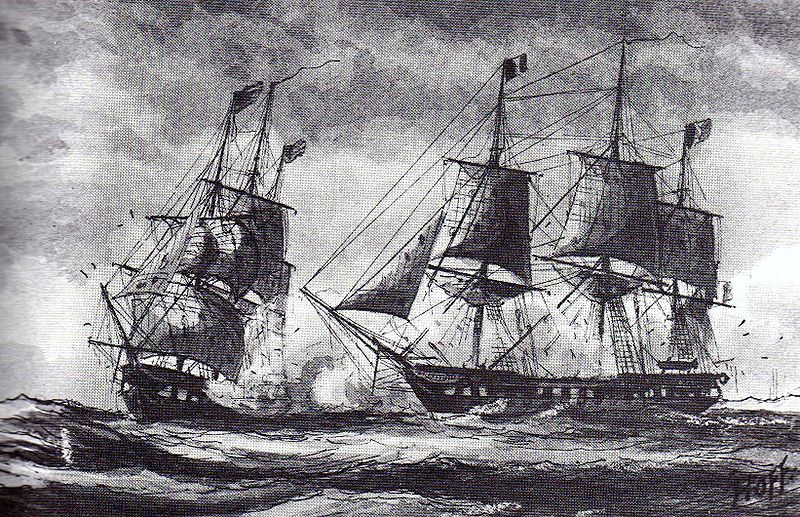
Perusing these ponderous volumes is challenging but rewarding. Included are accounts of the U.S. frigate Constellation’s battles with the French frigates L’Insurgente (top) and La Vengeance, the little-known landing of Marines on the Dutch island of Curacao, and much more. You can also find reports on the captains who led the fight (or sometimes failed) against the formidable forces of France and their often uneasy collaboration with France’s real enemy – the British.

It’s a tribute to the Navy that, at a time when such massive documentary series usually were not subsidized by universities or foundations, Knox and his staff were encouraged to research and preserve these early records of American military and diplomatic history. Today, it’s still a pleasure to plunge into another century and read about the Navy’s battles and the bureaucracy that kept them staffed and supplied at sea. Sets of Naval Documents related to the Quasi-War between the United States and France will set you back hundreds of dollars via the used and antiquarian book market, but they are available to browse here or in print at a library.