Notable Documents 2009: Tracking Hurricanes

May 21, 2010

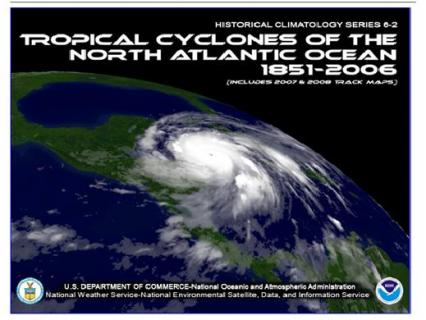
I believe this blog is evidence that Government books can provide both information and entertainment to readers, despite their stereotyped image as massive tomes packed with charts and statistics that only someone wearing a green eyeshade could love. Sometimes, though, charts also have their charms. Consider one of Library Journal’s 2009 Notable Government Documents: Tropical Cyclones of the North Atlantic Ocean, 1851-2006. Known to hurricane aficionados as “The Track Book”, this latest edition of a long-running series is mainly made up of year-by-year charts of the tracks of all North Atlantic tropic storms and hurricanes – 1,370, to be exact. Thanks to some diligent research by the staff of the Hurricane Research Division of NOAA’s Atlantic Oceanographic and Meteorological Laboratory, this edition includes charts from 1851 to 1870 and revised charts from 1871-1910. I’m intrigued by the kind of research that had to be done to come up with tracks for the 19th century storms – no satellite photographs then. Apparently ship records are a major source.

Well, OK, but so what? For one thing, of those 1,370 storms, 521, or 38 percent, have crossed or passed immediately adjacent to the U.S. coastline from Texas to Maine. Having recently blogged about the National Guard in the aftermath of Hurricane Katrina, the colorful spaghetti-like strands that mark the tracks of 2005’s storms make these charts a lot more meaningful. It’s also interesting to see the variations from year to year – 2005 is a real tangle, while for a handful of years the charts are almost blank.

Tropical Cyclones of the North Atlantic Ocean, 1851-2006 isn’t exactly “a good read” but it does have a fascination all its own. For hurricane watchers, for example, it’s a vital reference source. You can look at it here. To find a library that has it, go here. To read more about the lessons Hurricane Katrina taught all of us, go here. Happy hurricane hunting!


Notable Documents 2009: Civics Flash Cards

May 18, 2010

Each year, Library Journal, “the oldest and most respected publication covering the library field,” selects what it considers to be the most notable government documents, including those produced by the Federal Government.  For 2009, 15 Federal Government publications got the nod, and I plan to discuss them here over the next few weeks.

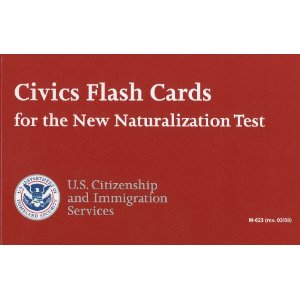
According to Library Journal, “This year’s list of Notable Government Documents includes titles on history, government policy, mental and physical health, biology, global warming, and environmental protection, among other topics.” One of the more unusual items is a new edition of Civics Flash Cards for the Naturalization Test, a publication from U.S. Citizenship and Immigration Services (USCIS). This set of 100 questions and answers is used by USCIS officers to administer orally; an applicant will be asked 10 of these.

The cards cover the nature and structure of the Constitution, the Federal Government and some basic American history. The questions range from “What is the name of the President of the United States now?” (pretty easy) to “How many amendments does the Constitution have?” (uh-oh). Well, that’s why these cards exist: so someone seeking citizenship can, by practicing, be prepared to take and pass the naturalization test. USCIS deserves credit for putting together such an informative and useful publication. I think it would also make a great study guide for use in schools.

You can purchase the Civics Flash Cards for the Naturalization Test here or view them online here. There’s also a do-it-yourself version here.

Note: Many of the questions have more than one correct answer, luckily for me.


Navigating by the Moon, Planets, and Stars

May 14, 2010

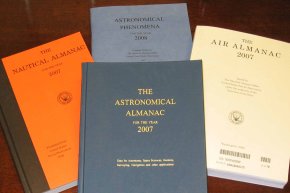
The Nautical Almanac is one of the longest-running publications in the Federal Government, dating back to 1852. It’s also one of the most distinctive-looking books I’ve ever seen.  The covers are orange and made of a stiff board-like material, and the cover graphics certainly look like they date back to 1852. Between those covers lie the complex mathematical tables that, “along with the chronometer, the sextant, a steady hand and a keen eye, are the resources needed to navigate by the stars.” Honestly, the contents mean less than nothing to a non-math person, but what images they conjure up for a history person! Old salts striding across a ship’s deck, sextant in hand, getting ready to round the Horn – well, you get the idea.

The Almanac is a unique example of a Government publication produced by two countries – the United States Naval Observatory (USNO) and Her Majesty’s Nautical Almanac Office (HNMAO). Also unique is that the U.S. part of the Almanac is in the public domain, but the British part is under Crown Copyright.

The Nautical Almanac is one of a number of almanacs published by the U.S. Naval Observatory: the Astronomical Almanac, the Air Almanac, and Astronomical Phenomena. Together, they provide a corpus of navigational knowledge that spans the centuries but is still the ultimate backup to the GPS technology of today.

I wonder if they’ll ever change those orange covers?


“Now, when I was in Baghdad” – A Short Guide to Iraq

May 11, 2010

One of my first posts on this blog concerned a World War II booklet illustrated by Dr. Seuss. It was one of a cache of such booklets that had belonged to one of my uncles during his wartime service as a Navy pilot. Although not collector’s items, these little guides to China, India, Burma, West Africa, and even New Caledonia, fascinated me as a kid. As an adult, both before and after my discovery that the Dr. Seuss booklet was a collector’s item, I didn’t give them much thought.

Several years ago, though, they were brought to mind by a call from the person who was then in charge of GPO’s public relations office. Every so often we get calls about long out of print Government publications, and this was one of them. A reporter was asking about A Short Guide to Iraq and did I have any information about it? “Well, yes. Oddly enough, I own a copy.” I explained the background and said I’d rummage around at home and find it.

Within a few hours, I was in her office doing a telephone interview with a wire service reporter with a British accent. She seemed fascinated by how I had come to own a copy of the booklet she was seeking. As far as I know, the story never went anywhere, but I’m still amazed at how much excitement these old documents can stir up.

As for A Short Guide to Iraq, what seems to engage people is that American troops were sent to Iraq during the Second World War and that so much of the advice it provides seems relevant even today. A university press has reprinted a facsimile under the title “Instructions for American Servicemen in Iraq during World War II” (the cover looks different but it’s basically the same book). It’s a quick read and very well done for its purpose, which was to give a quick overview of Iraq and its people for the average GI or sailor. It’s similar in intent, although less elaborate in execution, to the Afghanistan and Pakistan Smart Books I blogged about a couple of weeks ago. Click here to read this neat little booklet.


“It was very surreal”: Katrina and the National Guard

May 7, 2010

The Gulf Coast is in the news again these days, so it seemed appropriate to write about a new account of the last time disaster struck there. In Katrina’s Wake: The National Guard on the Gulf Coast, 2005 is a concise account of the Guard’s massive relief efforts. Even after five years, the numbers are hard to assimilate: more than $125,000,000,000 in property destroyed, almost 2,000 killed in Alabama, Florida, Mississippi, and Louisiana, and 80 percent of one of America’s great cities flooded. The first-person accounts of Guard personnel and the photos of flooding and rooftop evacuations by helicopter vividly conjure up those grim days.

In Katrina’s Wake was written by the National Guard Bureau’s Historical Services Division, which helps to set some of the events of that time in context. For example, I remember reading about what seemed to be a legalistic discussion as to whether the various state National Guard contingents sent to the Gulf ought to be federalized. The authors point out that keeping the various Guard units under the control of the state governors under the auspices of Title 32 allows the Guard to exercise police powers in an emergency, while the Posse Comitatus Act of 1878 prohibits the military and federalized National Guard troops from doing so. This key distinction was crucial when the New Orleans police force collapsed under the stress of disaster.

The book also highlights small moments: the flooding of the Louisiana Guard’s historic Jackson Barracks; the pathetic story of Snowball the dog and its impact on changing the “no pets” policy of the red Cross and other relief agencies; and the Ohio Guard contingent greeted by a local citizen who started unloading cans of juice and snacks from his truck to give to the Guardsmen. One Guardsman’s response: “We’re here to help you – not the other way around.”

In Katrina’s Wake is a brief but effective account of something that went right during the devastation of the Gulf Coast, when so much else went tragically wrong.


Careers and Paychecks

May 5, 2010

I just got a copy of the latest edition of the Occupational Outlook Handbook (OOH), the Bureau of Labor Statistics compendium of information about every job imaginable. Since the 1940’s, this biennial reference stalwart has provided career guidance information to untold numbers of job seekers, counselors, students, and anyone else interested in the U.S. job market. Although it’s lot like doing an Internet search on oneself, I decided to look up my profession.

In my job, I perform a number of cross-occupational tasks but, given my recent preoccupation with this blog, I decided to try “Authors, Writers, and Editors.” I was impressed by the way in which the entry methodically outlined what’s involved in performing the tasks associated with these professions, how things are done, and the working conditions (“they work any number of hours necessary to meet a deadline”), and also proved to me that I’m the real thing, to wit: “Some writers maintain blogs or issue text messages as a way of keeping in touch with readers or providing information to them quickly, but only those who are paid to write their blogs or send text messages may be considered writers.”

It’s not that I wasn’t aware of what goes into being a writer or editor, but I’ve seldom seen those things expressed so clearly and logically as in the OOH. When I finished reading the entry, I felt a little bit like the character from one of Molière’s plays who was astonished to find out that he had been speaking prose all of his life.

I also have a new understanding of the value of the OOH in providing comprehensive information on occupations in America. I’m not looking for a career or a job right now, but if I were…

GPO has the latest edition of the OOH available here and here.


A Book about the Civil War – and a Mystery

May 3, 2010

I was at a book sale last week and, lover of obscure historical topics that I am, picked up a book on the Civil War in Maine. Yes, there was a naval battle in Maine in 1863: the battle of Portland Harbor, when Confederate raiders seized the revenue cutter Caleb Cushing and, after pursuit by Federal forces, set it afire. Seeing this incident mentioned in the table of contents reminded me that the vast Government Book Talk vaults (AKA my office) held a copy of U.S. Revenue Cutters of the Civil War – a Government book published years ago and a perfect subject for blogging.

Things got mysterious after I unearthed it, though. Upon examination, I couldn’t find any indication that it was a Government publication. In fact, the publisher seemed to be “Alised Enterprises.” Had I been deluding myself all these years? On the other hand, the book also stated that it was “A U.S. Coast Guard Bicentennial Publication” and had a foreword by the Coast Guard’s official historian.

After a quick perusal of the Internet, I relaxed. It had a SuDocs classification number – TD 5.30: C49, to be exact – which means GPO had cataloged it as a Government book. I then learned that, according to WorldCat, which bills itself as “the world’s largest library catalog”, U.S. Revenue Cutters of the Civil War was published in 1988 by Alised Enterprises and again in 1990 by the Coast Guard. I couldn’t find a publication date in my copy, but my guess is that it’s a Coast Guard printing and that the author, Florence Kern, may have done the book under contract. (If anyone can add to the solution of this bibliographic mystery, please let me know.)

Florence Kern wrote a number of short pamphlets about various revenue cutters, mostly of the Revolutionary era. This book does something similar for Civil war cutters but also covers which ships went North or South at the beginning of the war, their work as blockaders for the Union, and much more, including the battle of Portland Harbor. It’s based on extensive archival research and provides a good introduction to a little-known aspect of the war. I wouldn’t mind delving into some research on this topic myself – maybe once I finish reading that book about the Civil War in Maine…

I couldn’t find an online version of U.S. Revenue Cutters of the Civil War, which is long out of print, but used copies do seem to be available at reasonable prices – and through Federal depository libraries, of course.

GPO does have other, more recent books about the Civil War that are well worth reading, so feel free to take a look.


NEW: Afghanistan and Pakistan Smart Books

April 29, 2010

These little publications contain a huge amount of information about two nations that make the news regularly. Developed by the Army’s TRADOC (U.S. Army Training and Doctrine Command) Army Culture Center, they include information on the history, politics, economy, society, and culture of the many peoples that comprise Afghanistan and Pakistan. Although in the past the military has produced guidebooks to various countries in which U.S. troops have been stationed (and I’ll be talking about some World War II-vintage booklets in a future post), these Smart Books provide a more sophisticated and analytical approach to the cultures with which they deal. Either would be invaluable in a classroom setting or as a quick reference source.

The Afghanistan Smart Book and the Pakistan Smart Book are both available from GPO.


“A Pint’s a Pound the World Around”

April 27, 2010

Secret prophesies from the Great Pyramid…a foreign revolutionary conspiracy against America…a shadowy organization led by a millionaire known as “Mr. Z”…

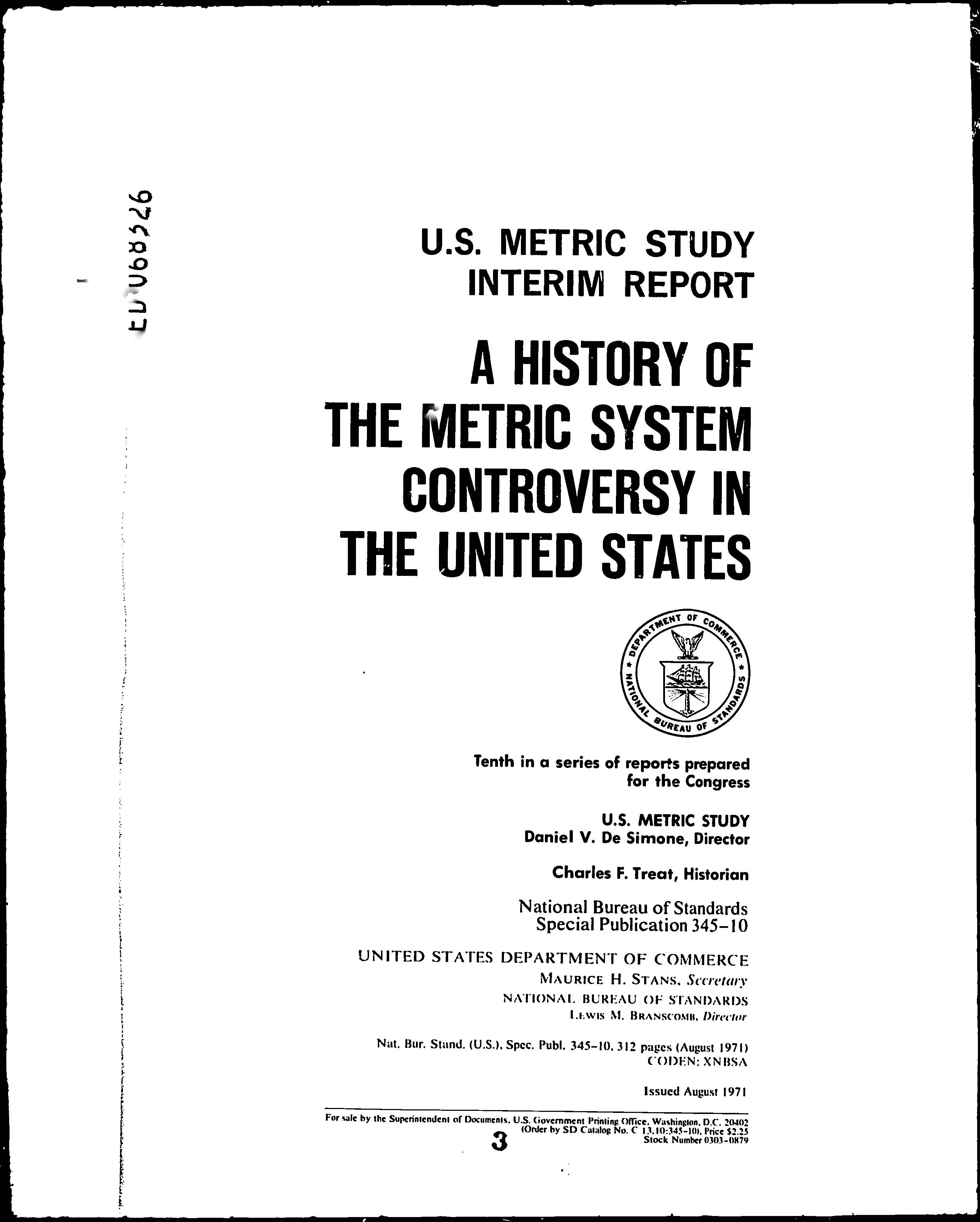
The latest Dan Brown novel? No, A History of the Metric System Controversy in the United States. This 1971 report, part of the U.S. Metric Study series and issued by the National Bureau of Standards (now NIST), is a serious account of a centuries-long battle to make the metric system America’s official standard of measurement. Lurking among the descriptions of John Quincy Adams’ Report on Weights and Measures and the advocacy of opposing positions by eminent scientists and educators, though, are some …unusual… episodes.

In the 1880’s, the International Institute for Preserving and Perfecting (Anglo-Saxon) Weights and Measures advocated both retention of the traditional measuring system and pyramidology – a belief that the Great Pyramid was a huge measuring device constructed by the Hebrews that also hid prophesies about the future. Despite this odd admixture of beliefs, the Institute proved to be an effective lobbying group in resisting the metric system. It also had a theme song: “A Pint’s a Pound the World Around.”

After World War I, Albert Herbert, a wealthy enthusiast, founded the World Trade Club, which despite its name was really a pro-metric lobbying organization. Herbert operated anonymously, so anti-metric forces quickly labeled him as the mysterious “Mr.Z.” The main opposition, the American Institute of Weights and Measures, also lobbied hard, with the aid of various manufacturing groups fearful of the expense of converting to metric. It inspired such articles as “What Real He-Men Think of the Compulsory Metric System.”

Also threaded through A History of the Metric System Controversy in the United States is the fear that the metric system is an alien one, inspired by the revolutionary French (post-World War I advocates of metric in turn claimed that the traditional system was a German invention). The author, Charles F. Treat, makes the interesting point that historically, enthusiasm for adopting the metric system tends to rise and fall with America’s international engagement or non-engagement.

This book, which takes the story though the late 1960’s, was published too soon to describe the failure of yet another attempt to adopt the metric system for America. Not for anyone without a really intense interest in the subject, it’s still extremely browseable and not without humor, especially when dealing with the topics I’ve been discussing. If you’d like to read it in PDF format, go here. If you’re interested in the movie rights, contact Government Book Talk!


Navy Medicine in Vietnam: Passage to Freedom to the Fall of Saigon

April 23, 2010

One of the goals of this blog is to review new Government publications as soon as we can, so people can find out about and, we hope, read them. Navy Medicine in Vietnam just hit my desk. It’s not a long book – around 52 pages. It provides an excellent overview of Navy medical activities in Vietnam from Passage to Freedom – the evacuation of Vietnamese from north to south after the 1954 Geneva Accords – to the collapse of South Vietnam in 1975. Along the way, there are brief descriptions of the work of hospitals,  hospital ships, Navy corpsmen, medevac, and more.

To me, the most fascinating parts of the book are the oral histories: the nurse in Saigon who came under fire during the coup against the Diem government, the grim recollections of another nurse on the staff of the navy Support Activity Hospital in Danang, and the amazingly modest statement of a corpsman who threw himself on a grenade (which amazingly did not detonate)to protect his patients, received a Congressional Medal of Honor and said, “It didn’t appear to me worthy of a general flying in and saying, ‘you’re a hero’.”

For sheer suspense, though, nothing tops “Dr. Dinsmore’s Souvenir”, a first-person account of a Navy surgeon who removed an unexploded 60mm mortar shell from the chest of a South Vietnamese soldier.  The X-ray of the patient has to be seen to be believed. Captain Dinsmore received the Navy Cross for this operation, but I wonder whether Engineman First Class John Lyons, who was the only other person in the operating room and safely detonated the mortar round afterward, got some recognition, too. It’s an amazing story.

You’ll find gripping reading, as well as an informative account of wartime medical activities, in Navy Medicine in Vietnam.


Clara Barton: Clara Barton National Historic Site, Maryland

April 21, 2010

It’s National Parks Week, which made me think about the National Park Service’s long-running Handbook series. Although I enjoy any and all national parks, I tend to seek out those with archaeological or historical connections. Research reveals that the Park Service began publishing its Historical Handbook series in 1949. Although the original handbooks in the series are out of print (you can find a list and cover images here), the series continues today.

A favorite of mine is the Clara Barton Historical Site and its accompanying Handbook. For one thing, the site is in Glen Echo, Maryland, which for residents of the Washington, DC area means Glen Echo Park, another favorite Park Service place. For years it was an amusement park, and remnants of those days remain, as does a carousel and a ballroom for dancing.  It’s worth a visit all by itself.

The Barton house presents quite a contrast. Originally built from timber scavenged from the Johnstown flood for use as a storage depot for Red Cross supplies, in 1897 it became both the headquarters of the American Red Cross and the home of its founder, Clara Barton. (Visiting the site on a hot summer day always makes me wonder what life was like in this rather humid area before air conditioning). The size of this 38-room house, the rooms themselves, and the dark pine paneling all conjure up life in a unique turn-of-the century home/office/volunteer center dedicated to helping victims of disaster at home and abroad.

The Clara Barton Handbook presents the story of the house, the person, and the organization concisely and lucidly. Like all of the Park Service handbooks, it’s also a quality product in design. If you’re planning a visit, or just want to learn more about this remarkable place, I’d recommend it.

You can find a list of Handbooks, including quite a few that cover historical parks, here.


Three Weeks of Government Book Talk

April 21, 2010

It’s the three-week anniversary of Government Book Talk. To mark this auspicious occasion, I thought I’d share some comments we’ve received since Day One, as well as some excellent questions about Federal Government publications and this blog – and what I hope are some useful answers.

Some comments:

 John Ahearn says: The site is excellent. I am pleased to the government being this responsive in its serving the public. Innovation is imperative if we are to keep up with the changes that we are all facing. Glad to see you take this step. Keep up the good work.

eric johnson says: I hope the freedom of information is never broken thank you GPO

Nydia Jacobs says: WOW! AWESOME! Welcome to 2010 and the future – GO GOV! Let God bless this site that we may truly become, “one nation under God”

Joe Harmon says: Neat blog.

Some questions and answers

Mimi asks: Will the blog posts keep coming to my email? I enjoy the blog, but don’t want to have to use a reader…I’d just like to keep reading the info via the email I already have to keep up with. Do I have to set something up to make sure the content will continue to be emailed to me? Thanks for help on this.

Govbooktalk answers: Good question! I have just added a blog subscription block so you can have posts emailed to you. Thanks for the suggestion.

chris decker asks: can i copy any work from g.p.o.?or do i need permission.

Govbooktalk answers: Here’s how GPO addresses this commonly asked question: The intent of Title 17, Section 105, United States Code, is to place in the public domain all works of the United States Government, defined as works “prepared by an officer or employee of the United States Government as part of that person’s official duties.”

This means that public documents can generally be reprinted without legal restriction. However, Government publications often contain certain copyright material which was used with permission of the copyright owner. Publication in a Government document does not authorize any use or appropriation of such copyright material without consent of the owner.

Since the Government Printing office serves as a printing and distribution agency for Government publications and has no jurisdiction over their content or subject matter, we suggest that you consult with the originating department or agency, or its successor, prior to the reprinting of any given publication.

Max Holland asks: Is there any reason why GPO publications are not sold in regular bookstores? A prohibition in law or regs?

Govbooktalk answers: Actually, commercial bookstores can sell Government publications. In the past, there have been some constraints that have limited us, but more recently we’ve been experimenting with more flexible terms and conditions. As a result, in a number of cases, at least one major bookstore chain has ordered books for resale. Let’s hope it’s a trend!

Barby asks: ARE WORDS AT BOTTOM OF THIS PAGE SUPPOSED TO READ “THEME CONTEMPT” INSTEAD OF “THEME CONTENT”?

Govbooktalk answers: Curiously enough, “Contempt” is actually the name of the template we’re using for the blog.