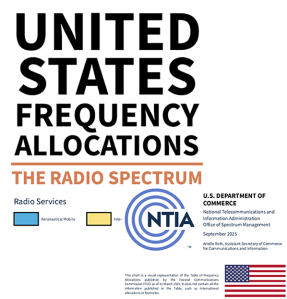
 Today, January 13, 2026, marks Public Radio Broadcasting Day. While digital media evolves, radio remains a uniquely reliable lifeline, reaching listeners where the internet cannot. To celebrate, we are highlighting a favorite for enthusiasts and professionals alike: the NEW 2025 United States Frequency Allocations: The Radio Spectrum Poster.
Available through the Government Publishing Office U.S. Government Bookstore, this best-selling poster is the definitive visual guide to our nation’s airwaves. It transforms the invisible infrastructure of communication into a clear, color-coded map.
The poster utilizes color codes to illustrate the parts of the radio spectrum allocated to various types of radio services, including amateur (ham) radio, commercial radio, television broadcasting, radio navigation, mobile, satellite, and others. Essential facts about the poster include the following:
- The definitive and most current official copy of the 2025 US Radio Spectrum Frequency Allocations, crucial for regulatory adherence and operational planning.
- Substantial size for optimal readability: 39″ x 27″ (inches).
- Expertly printed using fade-resistant, premium archival inks on high-grade 100 lb. premium matte paper. This ensures vibrant colors, crisp detail, and long-term durability.
- Proudly Made in the USA.
- Unframed, offering flexibility for the buyer to customize their display.
For those who want to dive deeper into the rules of the road, the Manual of Regulations and Procedures for Federal Radio Frequency Management is also available to explain the “how” behind the map.
Radio Milestones
- 1906: First radio broadcast by Reginald Fessenden.
- 1910: On January 13, the first public radio broadcast featured a live performance from the Met.
- 1920: KDKA in Pittsburgh begins the first commercial broadcasts.
- Today: Radio remains the most accessible medium, requiring no subscription or high-speed data to keep the public informed.
Whether you’re a hobbyist or a professional, the Radio Spectrum Poster is the perfect way to appreciate the technology that keeps us connected.
The GPO Online Bookstore – Easy Access to Federal Publications
HOW DO I OBTAIN THESE RESOURCES?
Sign up to receive promotional bulletin emails from the US Government Online Bookstore.
Shop Online Anytime: You can buy a vast majority of eBooks or print publications —with FREE Standard Shipping worldwide— from the U.S. Government Online Bookstore at https://bookstore.gpo.gov.
- Click here to purchase the 2025 United States Frequency Allocations: The Radio Spectrum (Poster)
- Click here to purchase the Manual of Regulations and Procedures for Federal Radio Frequency Management
Order by Phone or Email: Call our Customer Contact Center Monday through Friday, 8 am to 4:30 pm Eastern (except US Federal holidays). From US and Canada, call toll-free 1.866.512.1800. DC or International customers call +1.202.512.1800. Email orders to ContactCenter@gpo.gov
Visit a Federal depository library: Search for U.S. Government publications in a nearby Federal depository library. You can find the records for most titles in GPO’s Catalog of U.S. Government Publications.
Find more than a million official Federal Government publications from all three branches at www.govinfo.gov.
About the author: Blogger Trudy Hawkins is the Senior Marketing & Promotions Specialist in GPO’s Publication & Information Sales Office supporting the U.S. Government Online Bookstore (https://bookstore.gpo.gov).

 govbooktalk
 Trudy Hawkins
 Government Book Talk
As a strong fan of radio and having written about radio history, I question your statement “The first commercial radio station was KDKA in Pittsburgh, Pennsylvania, which began broadcasting in 1920.” It was the first LICENSED station on the air regularly. WWJ in Detroit was the first station to go on the air and broadcast regularly, but didn’t have the license at first. See my blog posting: https://kensintrospect.wordpress.com/2020/08/19/happy-birthday-radio-100-years-of-broadcasting-history. Thanks for your site, I enjoy it.
LikeLike
Hi there missionaryjournalist!
Thanks for the feedback!
GPO Bookstore
LikeLike
Ms. Hawkins,
I probably sent the following comment to the wrong office, but now that I’ve seen that you’re the correct person, here it is.
I received the new Electromagnetic Spectrum poster two weeks ago and it’s quite valuable; however, perhaps a magnifying glass should be included! The finest font on the narrowest and smallest bands is unreadable to the naked eye.
Alternatively, there should be a way to increase the font — while small, there is space above and below the characters in the colored field to allow taller and wider fonts.
What I’m suggesting might take a modification of the graphic program your design folks use. But it would really make this poster much more useful.
LikeLike
Hello Greg,
Thank you for reading our blog and for the feedback. I recommend sharing your thoughts
with the agency publisher of the poster, the Department of Commerce (DOC), National Telecommunications and Information Administration (NTIA) office.
GPO Bookstore
LikeLike
Me educaron escuchando la radio y todavia hoy la prefiero mil veces mejor que cualquier otro medio de comunicacion porque sabe llegar a la conciencia social y es un recurso importante
LikeLike
Hola Sandra,
¡Gracias por la respuesta!
GPO Bookstore
LikeLike