As Christmas draws near, Government Book Talk revisits one of our most popular blog posts to coincide with the holiday.
This article is Part 1 of a series on NORAD’s Santa Tracker by Government Book Talk, and tells the history of how a typo in 1955 holiday ad and a NORAD colonel’s heartwarming response to kids led to NORAD tracking Santa Claus (call sign “Big Red One”). Read Part II: “Santa, We Got Your Six!” NORAD’s Santa Tracker Goes High-Tech” that explores the fascinating technology NORAD uses today to keep the Abominable Snowman, the mean Mr. Grinch, and Jack Frost from spoiling Santa’s big flight.
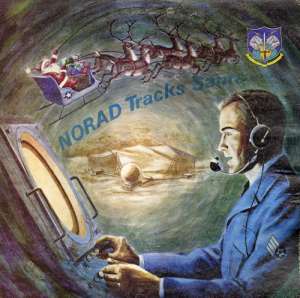
Image: Old NORAD Tracks Santa poster. Source: NORAD
One of America’s key weapons in defense of its homeland is NORAD, the North American Aerospace Defense Command. With its slogan of “Deter, Detect, Defend” its stated mission is as follows:
The North American Aerospace Defense Command conducts aerospace warning, aerospace control and maritime warning in the defense of North America.
What does “aerospace warning” consist of? It includes “the monitoring of man-made objects in space, and the detection, validation, and warning of attack against North America whether by aircraft, missiles, or space vehicles, through mutual support arrangements with other commands.”
One of the most unusual but beloved “objects in space” NORAD has had the responsibility for monitoring is none other than Santa Claus.
How did tracking Santa Claus become part of NORAD’s mission? It all began with a typo.
Tinsel typo
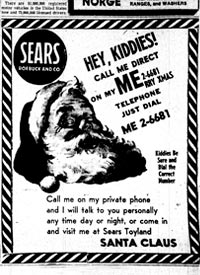 ‘Twas the night before Christmas, December 24, 1955, when a Sears Roebuck & Co. department store placed an advertisement in a Colorado Springs newspaper telling children that they could telephone Santa Claus directly.
It featured a big picture of St. Nick, a phone number and these instructions, “Hey, Kiddies! Call me direct…Call me on my private phone and I will talk to you personally any time day or night.” Ironically, the ad also cautioned, “Kiddies, be sure and dial the correct number!”
Image: 1955 Sears ad with NORAD number. Source: NORAD
Unfortunately, the paper misprinted the phone number, listing instead the top secret hotline that was used only in national emergencies to alert CONAD (the Continental Air Defense Command–NORAD’s predecessor) if the Soviets were attacking!
The “Santa Colonel”
 U.S. Air Force Col. Harry Shoup, CONAD’s director of operations, grabbed the red emergency phone, thinking an attack was imminent.
According to Shoup’s account, he answered, thinking it was his general, “Sir, are you there?”
Image: Col. Harry Shoup, the “Santa Colonel” Source: NORAD
Instead, a little 6 year-old boy’s voice came over the phone asking, “Are you really Santa Claus?” Shoup, thinking it was a prank, barked into the phone asking “Would you repeat that?” and demanding to know who was calling. At this point, the little voice started crying, and asked tentatively, “Is this one of Santa’s elves, then?”
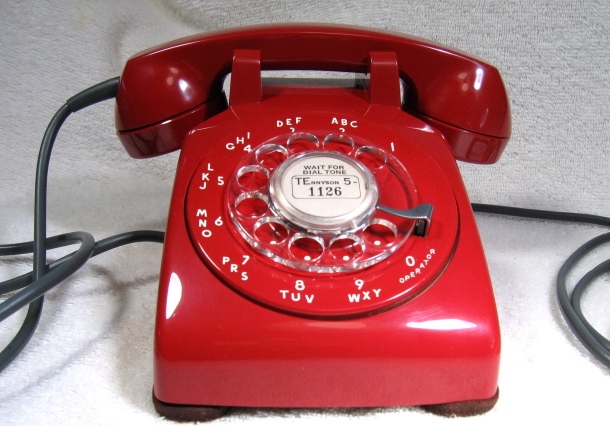 Soon the phone began ringing off the hook with kids wanting to talk to Santa, so once they figured out the error, Shoup decided to play along and instructed his team to act as Santa’s helpers. He had his radar operators check the radar for indications of Santa making his way south from the North Pole.
Image: A 1955 red hotline phone. Source: VintageRotaryPhones.com
Children who called were given updates on the current location of St. Nick and his reindeer-drawn flying sleigh, and a beloved annual Christmas tradition was born.
Shoup became known as the “Santa Colonel,” a moniker he cherished until his death, his daughter says.
Santa Tracker goes high-tech
In 1958 Canada joined the alliance and CONAD became NORAD, which carried on the Santa mission. Originally, Santa tracking updates were delivered via radio broadcasts and of course, calling the Santa Tracking hotline, but with the introduction of the Internet, Santa tracking went online by Christmas 1997.
 Guarding What You Value Most: North American Aerospace Defense Command Celebrating 50 Years (available in Hardcover Print or as an eBook) is the terrific publication documenting NORAD’s illustrious 50+ years of history and provides easy-to-follow timelines of key NORAD events along with copious color photographs, maps and snippets of history of this important organization.
The publication also proudly covers the history of its favorite mission— Santa tracking— stating:
“Today, using the same technology used to perform their day-to-day mission— satellites, high-powered radars and jet fighters— NORAD tracks Santa Claus as he makes his Yuletide journey around the world.”
[This new video also gives some of the history of how the Santa Tracker started in 1955 and some of the technology in place for 2013.]
Specifically, NORAD’s Santa site says that it uses four different high-tech systems to track Santa–radar, satellites, Santa Cams and fighter jets:
Tracking Santa starts with the NORAD radar system called the North Warning System. This powerful radar system consists of 47 installations strung across the northern border of North America. On Christmas Eve, NORAD monitors the radar systems continuously for indications that Santa Claus has left the North Pole.
The moment that radar indicates Santa has lifted off, we use our second detection system. Satellites positioned in geo-synchronous orbit at 22,300 miles from the Earth’s surface are equipped with infrared sensors, which enable them to detect heat. Amazingly, Rudolph’s bright red nose gives off an infrared signature, which allows our satellites to detect Rudolph and Santa.
The third tracking system is the Santa Cam network. Santa Cams are ultra-cool, high-tech, high-speed digital cameras that are pre-positioned at many locations around the world to capture images and video.
The fourth system is made up of fighter jets. First, Canadian NORAD fighter pilots flying the CF-18 intercept and welcome Santa to North America. In the US, American NORAD fighter pilots in either the F-15 or the F-16 provide an escort flying alongside Santa and his famous reindeer.
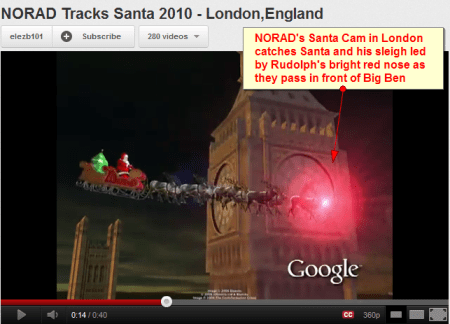 Santa goes mobile… and Global!
[UPDATE DECEMBER 2012]:For Christmas 2012 Google is stepping aside to make room for other companies to help track Santa. Said a NORAD spokesperson: “This year, NTS and Google mutually agreed to go in new directions, and we are excited to welcome a number of new contributors, to include Microsoft, Windows Azure, Bing, and iLink-systems, among others, to help us in our mission of tracking Santa.“

Thanks to dozens of volunteer local translators, NORAD Tracks Santa website is now offered in 8 languages, including English, Spanish, French, German, Italian, Portuguese, Japanese, and Chinese.
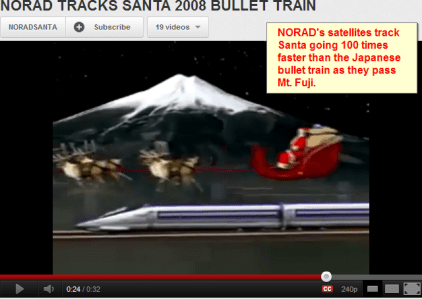
Listening along with the live computer video clips, many parents use this as an opportunity to give a fun world geography lesson as the family follows Santa’s path around the world. Volunteer military personnel give running commentary and interesting tidbits about the cities as Santa passes through. For example, did you know that NORAD’s satellites and radar clocked Santa’s sleigh going 100 times faster than the Japanese bullet train?
How many “elves” does it take to track “Big Red”?
Today, children young and old all over the world can call in or email NORAD on Christmas Eve to find out just where Santa is, or, since Santa went digital, follow along on NORAD’s cutting edge web site.

NORAD has over a thousand volunteers every year from Canadian NORAD and U.S. Army, Navy, Air Force and Marine Corps personnel and their families, who record audio and come in to NORAD on Christmas Eve to staff the phones and answer emails to anxious children wanting to know if here comes Santa Claus right down their particular Santa Claus Lane… Meanwhile engineers ensure the tracking systems are on target and U.S. fighter jets stand ready to escort the “celebrity” that NORAD calls “Big Red” as he passes through U.S. air space.
In 2011, First Lady Michelle Obama helped on the Santa Tracker hotline phones.
How can you track Santa on Christmas Eve?
 So, on the night before Christmas, when not a creature is stirring, you might want to rouse your mouse– uh, your computer version, of course– and surf over to NoradSanta.org or call 1-877-HI-NORAD (1.877.446.6723) from North America to find out when Santa Claus is coming to YOUR town. (By the way, Santa’s helpers at NORAD are great at reminding the kids to go to bed because Santa is near and won’t stop if they’re awake!)
Image: How the Air Force and NORAD Tracks Santa Claus video at NORAD location in Cheyenne Mountain. Source: Around the Air Force news special, December 2005.
Starting at 4am Eastern Time on December 24, you can:
 Track Santa Online: Logon to www.NoradSanta.org.
- Call the Santa Hotline: Starting at 4 am Mountain Standard Time (6 am Eastern Standard Time) on December 24, the public worldwide can speak with a live phone operator to ask about Santa’s whereabouts by dialing the toll-free number from the United States or Canada: 1-877-HI-NORAD (1-877-446-6723).
- Email Santa Tracker: Also at 4 am MST/6am EST, the public can also send an email to noradtrackssanta@outlook.com for up-to-date Santa tracking information delivered via email.
- Maps: Follow Santa on Cesium and Bing Maps, starting 4am EST on December 24th.
- Mobile Apps: Get links to download the #NoradSanta apps for Windows, Android, iPhone & tablet by clicking here.

Play Games while you wait: While you’re waiting for the tracking of the Big Red One to begin, all December you can play some of the many fun games on NORAD’s Santa’s Village web page at the North Pole, and stop by the NORAD Tracks Santa Facebook page to show your appreciation.
How can I get a copy of “Guarding What You Value Most: North American Aerospace Defense Command Celebrating 50 Years, the wonderful hardcover book or eBook of 50 years of NORAD history chock full of color photos and anecdotes, including the Santa Tracker story?
- Shop Online: You can purchase these publications from the U.S. Government Online Bookstore at http://bookstore.gpo.gov by clicking on the links above in this blog post or:
- click here to shop all Air Force History publications
- click here to shop all books about the History of American Industry and Innovation and learn more about fighter jets, weapon systems and technology innovations.
- click here to shop our eBooks collection.
[UPDATED FOR Dec. 2012]: And now, you can also buy the NORAD history publication as an eBook on Google Play or the Apple iTunes iBookstore.
- Order by Phone: Call our Customer Contact Center Monday through Friday, 8 am to 5:30 pm Eastern (except US Federal holidays). From US and Canada, call toll-free 1.866.512.1800. DC or International customers call +1.202.512.1800.
- Shop our Retail Store: Buy a copy of any print editions from this collection at GPO’s retail bookstore at 710 North Capitol Street NW, Washington, DC 20401, open Monday–Friday, 9 a.m. to 4 p.m., except Federal holidays, Call (202) 512-0132 for information or to arrange in-store pick-up.
- Visit a Federal Depository Library: Search for one of these publications in a nearby Federal depository library.
About the Author: Adapted by Trudy Hawkins, Senior Marketing and Promotions Specialist in GPO’s Publication & Information Sales Division in Washington, DC, from an original post by Michele Bartram, former Government Book Talk Editor in support of the U.S. Government Online Bookstore (http://bookstore.gpo.gov).


 Posted by Michele Bartram, U.S. Government Online Bookstore


 govbooktalk
 Trudy Hawkins

