The Fine Art of Bookbinding

December 30, 2010

The Washington Post ran an interesting article the other day about hand binding at GPO – specifically, the finishing our Bindery does for the White House on presentation copies of the Public Papers of the President – including hand-tooled goatskin leather, marbled edges, and silk moiré endpapers. Happily, this kind of artistry is still valued by the Government, even in this digital age.

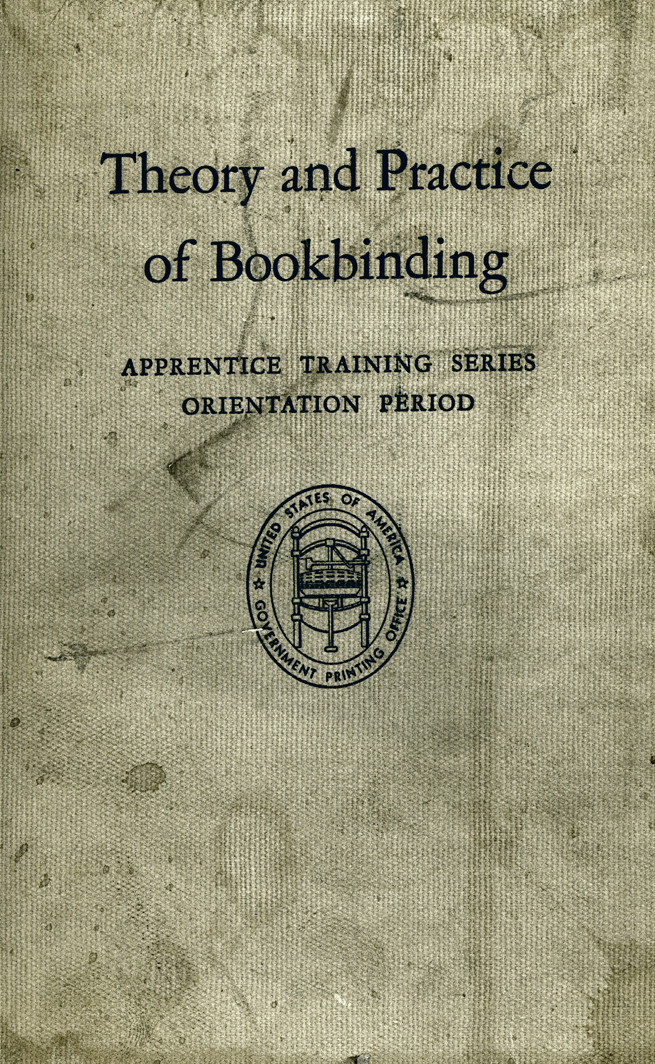
For many years, apprentice printers at GPO have studied bookbinding as one of the graphic arts. Since binding is a material rather than a digital process, reading the 1950 edition of GPO’s Theory and Practice of Bookbinding (left) still provides a pretty good introduction to the work we do today for such publications as the Public Papers and Jefferson’s Manual of parliamentary procedure, developed by Thomas Jefferson and still used by the House of Representatives (here’s a nice video on the handwork involved in binding the Manual).

Take marbling, for instance. According to Theory and Practice of Bookbinding, “marbling and gilding are complicated processes and a bookbinder who can do both well is a rarity. In fact, the majority of modern bookbinders can do neither” – and that was in 1950! As is evident in the post article and the video, we still know how to do it today.

This 60-year old guide to binding also covers even more esoteric book arts. In fore-edge painting, the top edge of a book is scraped and tied, and a watercolor picture is painted on the fanned edges (how cool is that?). Do you need some goffering? That’s a decoration produced by denting the edge after it’s gilded. I don’t know if GPO has ever done fore-edge painting, but the apprentices here had to know ALL of the terms and techniques of their craft.

When you’re in an arts and crafts mood, or if you’re like me and enjoy all kinds of obscure information about books and their making, the Theory and Practice of Bookbinding is well worth a browse. You can find copies of  various editions on used book Web sites at very reasonable prices, or in a library.

Have a Happy New Year, everyone!


Spaniards, Insurrectos, and Boxers

December 29, 2010

It must be relatively rare for one very junior naval officer to get to participate in three separate armed conflicts within three years, but that’s what Naval Cadet (they weren’t called Midshipmen back in 1898) Joseph K. Taussig did. According to Three Splendid Little Wars: The Diary of Joseph K. Taussig, 1898-1901, published by the Naval War College, after being called away from the U.S. Naval Academy after the outbreak of the Spanish-American War, Taussig witnessed the Battle of Santiago de Cuba, wherein the Spanish fleet unsuccessfully attempted to outrun the American fleet. As part of the two years at sea required of Annapolis graduates prior to their commissioning exam, Taussig then sailed halfway around the world to help defeat Philippine revolutionaries in the Philippine Insurrection (mainly by embarking on an abortive hostage rescue mission).

Since I’m particularly interested in the Boxer Rebellion, I thought that the last section of Taussig’s diary was by far the most engaging. Disembarking near the Taku forts that played such a prominent role in the Opium Wars of the 19th Century, Taussig and his Navy and Marine comrades headed up the Peiho River to the city of Tientsin, where they teamed up with the British, French, German, Russian, Japanese, Italian, and Austrian contingents to form the so-called Boxer Relief Expedition. At first thinking that they would reach the besieged legations in Peking in a day or so, they spent most of their time repairing Boxer-damaged railroad tracks until the Boxers cut the tracks behind them, forcing a grueling retreat back to Tientsin.

Taussig’s impressions of the Boxer rebels and their fighting methods is interesting in itself, and his account shows how what initially seems to have been perceived as a walk-over soon became a grim contest against enemy troops, heat, and the ill-mapped Chinese terrain. It all ended for Taussig when “Although the bullets were flying thick I was never so surprised in my life when I felt a blow in my right hip that knocked me down.” He had been hit by a Boxer bullet. After long periods of being carried on a stretcher, Taussig eventually got medical help and lived long enough to become a Rear Admiral (he could well have risen further if he had not antagonized a certain Assistant Navy Secretary Franklin Roosevelt, who apparently did not forgive and forget when he became President – but that’s another story).

Three Splendid Little Wars is a valuable primary source of information on some little-known conflicts and a “you are there” portrait of the frustrations suffered by the Boxer Relief Expedition in its prolonged struggle to relieve the foreign embassies in Peking. Future historians will have to take Taussig’s diaries into account when they retell that particular story. You can browse through it here, get a printed copy here, or find it in a library.


Looking at the Filibuster

December 23, 2010

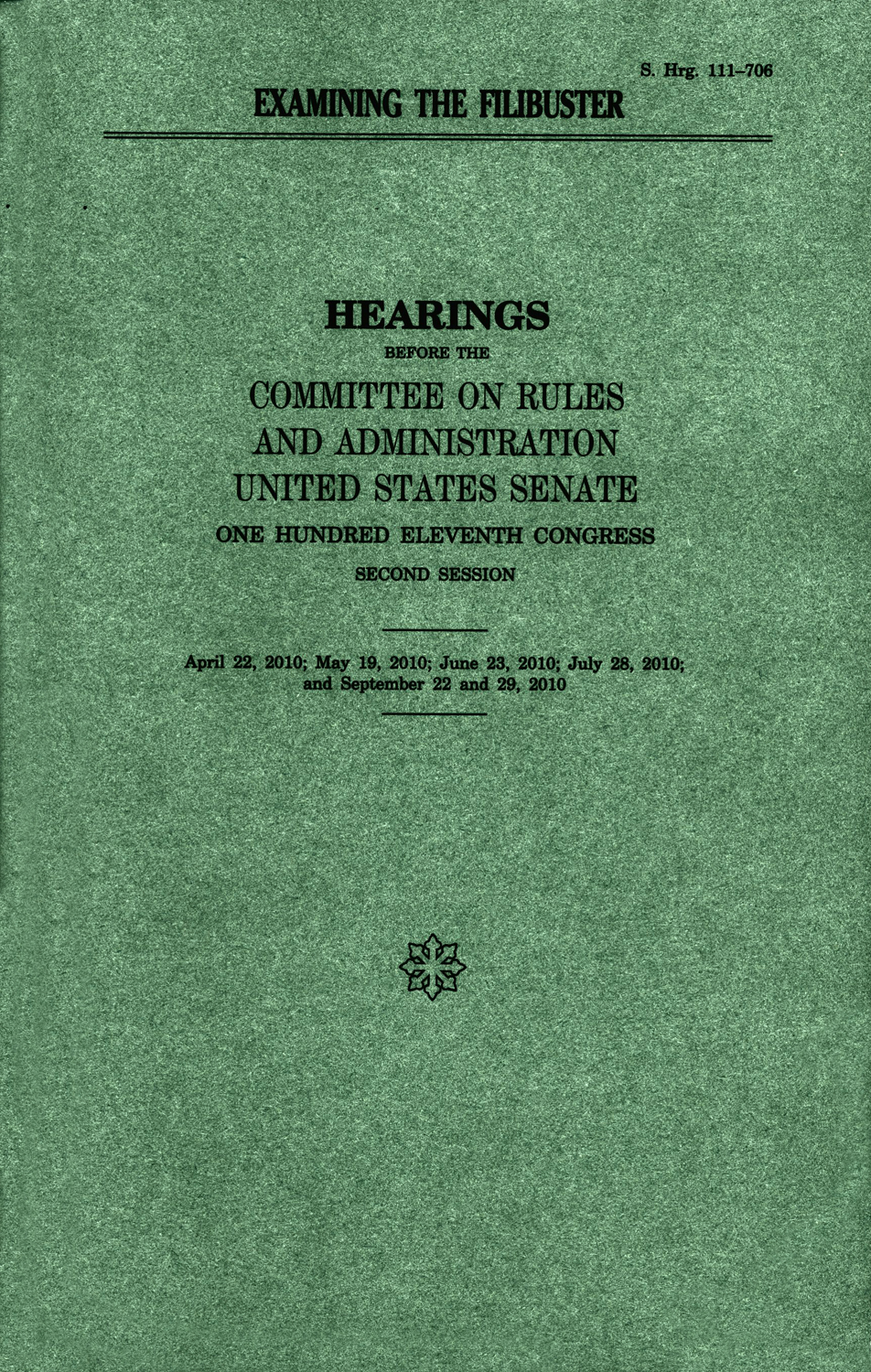
In some ways, Congressional hearings are like Jack Horner’s pie – you never know what kind of plums you’ll pull out of them. Take Examining the Filibuster: Hearings before the Committee on Rules and Administration, United States Senate, for example. As in most congressional hearings, you’ll find lots of polite and sometimes humorous byplay by various Senators, a certain amount of disagreement about the nature and value of the subject at hand, a raft of expert testimony by academics and technical experts, and additional statements by interested parties. That’s what makes it so interesting to flip through one, and why I decided to see what goodies I could extract for the delectation of Government Book Talk readers.

A plum: Apparently the filibuster was not erected by the founding fathers as a way to safeguard the rights of the minority and guarantee careful deliberation of legislation. Originally, both Houses of Congress included a “previous question motion” in their rule books, which still allows a House majority to cut off debate. In 1805, however, neither body used the motion in this way and, at the urging of Vice President Aaron Burr in his capacity as President of the Senate, the Senate eliminated the previous question motion from its rule book – apparently without any real discussion. Even so, it was not until 1837 that the first real filibuster occurred. Another plum: the late Senator Robert C. Byrd, even though he represented the majority in the Senate for much of his career, was a passionate defender of the filibuster, proving that such issues are not decided simply on the basis of party, or majority versus minority.

You’ll find many such gems in the 656 pages of Examining the Filibuster. In addition to a great deal of information on the filibuster, cloture votes, and other such congressional arcana, it’s heartening to note that a fair number of Senators actually participated in these hearings, taking the time to mull over and address whether the filibuster still serves a need in the Senate and engaging in a reasoned dialogue about it.

You can read Examining the Filibuster here, get your own copy here, or find it in a library – and enjoy your pie, plum pudding, or fruitcake and have a great holiday!


Solving the Iran Puzzle

December 21, 2010

When I picked up this morning’s paper (yes, I still read a printed newspaper), the first story I read concerned the opening of a franchised Iranian ice cream parlor in Baghdad’s Green Zone. As I read, it struck me that this small development epitomizes the complexities of Middle Eastern politics – specifically, the role of Iran as a regional power and its continuing friction with America. For example, the Iraqi owners of the Ice Pack franchise stated that they would have preferred owning a McDonald’s, but it was cheaper and less expensive transportation-wise to deal with the Iran-based company – and there was less chance of having their store blown up! Yet the article also pointed out that Iran is not popular among Iraqis, and the owners were not publicizing the origins of their store. Economic power, political pariah – how does Iran fit into the Middle Eastern puzzle?

You can find some interesting answers in The Iranian Puzzle Piece: Understanding Iran in the Global Context, a slim but substantive collection of articles from the Marine Corps University Press. The experts whose opinions appear in this little book generally agree that, despite the outlandish and outrageous pronouncements of some of its leaders, Iran’s rulers are not “mad mullahs” mindlessly fostering apocalyptic violence, but faction-ridden yet eminently hard-headed realists whose foreign policies are more influenced by nationalism and Iran’s role as a regional power than by religious fanaticism. One author points out, for example, that despite the 1988-1994 conflict between Shiite Azerbaijan (the only predominantly Shiite nation besides Iran and Iraq) and Christian Armenia over the disputed Nagorno-Karabagh territory, Iran did not support Azerbaijan – seemingly more concerned about possible secessionist impulses within its own province of Azerbaijan than with any sectarian solidarity. Another article notes that Mesopotamia was for centuries a battleground between the Ottoman and Persian empires, leaving a legacy of mutual national distrust not moderated by a common religion (a readable book on these wars would be both interesting in itself and enlightening as to the roots of Iraqi-Iranian relations over time – I wish I had the linguistic knowledge to write one).

The Iranian Puzzle Piece has a lot of information packed into its 100-plus pages, including an Epilogue covering the disputed Iranian presidential election and subsequent repression of the political opposition. I came away with a greater understanding of the complex and ambiguous Iranian political scene, the motivations of its various factions, and insights into the problems stemming from Tehran’s nuclear adventure and implacable animosity towards Israel. I recommend this one highly. You can read it here, get your own copy here, or find it in a library.

One thing about that newspaper article – it said that Ice Pack carried 34 flavors but didn’t say what they were – quince, pomegranate, apricot, Persian melon? I’d love to know!


America Versus Revolutionary France

December 17, 2010

When people ask me how I choose the books I blog about (actually, no one has asked me that, but it always pays to be prepared), I cite multiple sources of information, including in-house resources at GPO, my past experience with Government publications, and my personal and eclectic reading. For example, I recently read a book about America’s Quasi-War with revolutionary France from 1798 to 1800. Precipitated by French privateering attacks against neutral shipping during its war with England and exacerbated by the French view that the Jay Treaty between Great Britain and America was a violation of its 1778 treaty with the U.S., the fledgling American navy was authorized by Congress to attack any French vessel, including warships that molested American merchant shipping.

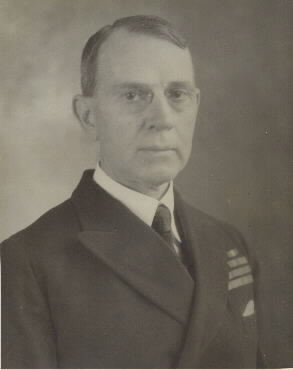
So what’s the connection with this blog? Naval Documents related to the Quasi-War between the United States and France, edited by Captain Dudley W. Knox, USN (Ret.) (left). This 7-volume set of official documents, published in the 1930s, is the starting point and standard source for any research on the Quasi-War and was duly acknowledged as such by the author of the book I read. Knox, who for many years was the Navy’s Officer in Charge of the Office of Naval Records and Library, also presided over the editing of other documentary compilations and was a noted writer on naval topics.

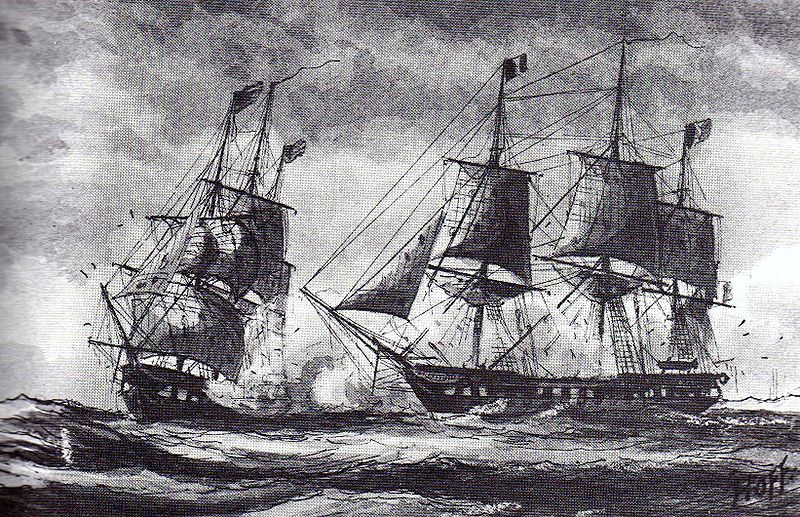
Perusing these ponderous volumes is challenging but rewarding. Included are accounts of the U.S. frigate Constellation’s battles with the French frigates L’Insurgente (top) and La Vengeance, the little-known landing of Marines on the Dutch island of Curacao, and much more. You can also find reports on the captains who led the fight (or sometimes failed) against the formidable forces of France and their often uneasy collaboration with France’s real enemy – the British.

It’s a tribute to the Navy that, at a time when such massive documentary series usually were not subsidized by universities or foundations, Knox and his staff were encouraged to research and preserve these early records of American military and diplomatic history. Today, it’s still a pleasure to plunge into another century and read about the Navy’s battles and the bureaucracy that kept them staffed and supplied at sea. Sets of Naval Documents related to the Quasi-War between the United States and France will set you back hundreds of dollars via the used and antiquarian book market, but they are available to browse here or in print at a library.


Browsing Through the World Factbook

December 14, 2010

The big, comprehensive, and recurring reference work is a classic Government publication type. One of my favorites of this kind is the CIA’s annual World Factbook. Since 1980, this massive volume has been a mainstay for anyone interested in the various countries of the world.

Although the Factbook has all kinds of information about a country’s geography, people, government, economy, population, communications, transportation, and military, plus both inset and foldout maps, the section that always draws my attention is “Transnational Issues.” If, as Thomas Carlyle said, “Happy the people whose annals are blank in history,” then happy is the nation whose World Factbook profile has nothing under that heading. The subheads include “Disputes – International,” “Refugees and internally displaced persons,” “Illicit drugs,” and “Trafficking in persons.” It’s amazing how few countries meet this definition of happiness. Of course, many underdeveloped or newly formed nations, like Chad and Moldova, suffer from these ills, but so do Denmark (disputes with Iceland and the UK over the Faeroe Islands continental shelf; Faeroese interest in full independence), New Zealand (territorial claim in Antarctica; amphetamine use), and Portugal (“Portugal does not recognize Spanish sovereignty over the territory of Olivenza based on a difference of interpretation of the 1815 Congress of Vienna and the 1820 treaty of Badajoz”; gateway for the international drug traffic).

Of course, a peaceful disagreement between Spain and Portugal is a long way from the simmering armed conflict between Eritrea and Ethiopia, but boundary disputes and international crime are, unhappily, common currency in the world – and what better place to find out about them, and a host of other developments, than the World Factbook? The CIA maintains the Factbook here, or you can get your own copy here.


Government Stocking Stuffers for Kids

December 10, 2010

 Guest blogger Kelly Seifert talks about Government publications for children.

Having recently had a child, I was happy to discover that there are many great Government publications for kids. I had no idea there were so many educational and fun resources available – and with the holidays quickly approaching, there are so many economical and entertaining gift options to choose from! What’s more, with cold winter days ahead, these booklets are perfect for keeping little minds occupied when it’s too frigid to venture outside!  

For instance, the National Oceanic & Atmospheric Administration (NOAA) has put out a children’s activity book, Understanding Marine Debris: Games & Activities for Kids of All Ages, Marine Debris 101. Included in this publication are silly stories, coloring activities, word finds, crosswords, memory games, connect the dots, and more. What a great, educational way to teach kids about protecting marine life!

Along the same lines, another great publication is the Chesapeake Bay Activity Book, also put out by NOAA. This book for young children provides information on the Chesapeake Bay watershed and gives them the opportunity to color, connect the dots, try word searches, and even make recipes.

The Federal Emergency Management Agency (FEMA) also puts out a great coloring and activity book called Marty and Jett’s Activity Book: Let’s Have Fun with Fire and Safety.

Also from FEMA, your kids’ favorite Sesame Street characters team up to teach about fire safety, hot and cold, and what to do when you hear a smoke alarm. Sesame Street Fire Safety Station: Color and Learn includes ideas for mapping emergency escape routes from your home and a few safety rhymes that can be sung.

The Environmental Protection Agency (EPA) has teamed up with the American Cancer Society to create the Mission Sunwise Activity Book, which provides puzzles and pages to color about how to be safe in the sun and to use sunscreen.

From the Department of Energy, try Energy Activities With Energy Ant.

And these are just a small sampling of the amazing publications out there!

As always, parents can also visit their local Federal depository library to find these great resources. With more than 1,200 locations around the country, what could be easier?

Locate a depository library near you.


Out in the Ozone

December 8, 2010

As usual, I’ve been rummaging through stacks of new Government publications to find inspiration for this blog. Today, Discoveries from EOS Aura caught my eye. It’s a colorful booklet about the Aura satellite, which is part of the National Aeronautics and Space Administration (NASA) Earth Observing System (EOS) program. I confess that I was a bit hesitant when I turned to the first page and saw a list of such things as the High Resolution Dynamics Limb Sounder (HIRDLS) and the Ozone Monitoring Instrument (OMI). I’m not a technophobe, but all of that sounded out of my league!

I shouldn’t have worried, though. Discoveries from EOS Aura is accessible to the layperson and touches upon a lot of the significant scientific and environmental issues of the past few decades. The Aura satellite uses HIRDLS, OMI, and two other instruments to measure levels of ozone, aerosols, and key gases throughout the atmosphere, and this publication features highlights from the past five years of research.

One highlight: according to Aura, thanks to the international agreement to ban chlorofluorocarbons (CFC) from use in air conditioners and refrigerators, the notorious ozone hole in the stratosphere is closing due to a decline in the chlorine from CFCs. That means the ozone layer can perform its crucial role of protecting us from solar infrared radiation. Another less positive highlight: Aura data-generated maps show how sulfur and nitrogen dioxides, volatile organic compounds (VOC) like formaldehyde, and other human-generated intruders continue to pollute the air we breathe. Aura’s data are so good that they indicate a lessening of industrial pollution on Sundays over North America and Europe, and Saturdays over Israel. Aura also detected a lessening of pollution over China as a result of that country’s atmospheric cleanup prior to the last Olympics (it’s back up again, unfortunately).

I’m always looking for interesting facts in my reading material, and this publication has plenty. Some years ago, there was some discussion of the idea that trees cause air pollution. (I remember seeing a photo of a tree upon which someone had hung a sign that said “Stop me before I kill again”!) The basis of this theory was the emission of isoprene, a VOC that can increase surface (AKA “bad”) ozone, by some species of trees, especially in the Northeastern U.S. Scientists know that trees really do this, although they don’t know exactly why. The key point of the “trees cause air pollution” flap, however, is that without nitrogen oxides from cars, industry, and power plants, surface ozone would be low even when isoprene levels are high. The verdict: not guilty!

Discoveries from EOS Aura is just an introduction to the vast amounts of information that this little-known program is generating. On the Aura Web site, you’ll find lots more, including observations of the havoc wrought in the atmosphere by that Icelandic volcano earlier this year. I wasn’t able to find an online version of this booklet (I know some blog readers may regard this as a challenge!), but you can get a printed copy here.


A Portrait of America in Maps

December 2, 2010

When I was a kid, I was fascinated by geography.  I liked to pore over the maps of the various continents, with their bright colors and exotic place names. Later, as a history major, I was even more taken with historical maps – those that showed countries that arose, changed their boundaries, or sometimes vanished altogether. I guess it’s a sort of progression from the simple to the complex, but now I’m often drawn to maps that reveal the social and economic makeup of a state, a region, or a nation. I’m more verbal than visual, but an image does make these intangible influences on our world more concrete for me.

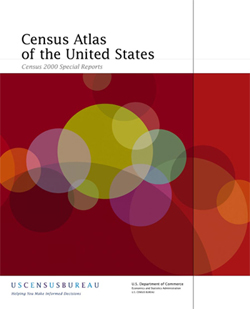
That brings me to the Census Bureau’s Census Atlas of the United States. Through my work at GPO, I had an inside view of the various stages of development that converted raw data from the 2000 census of population into the really incredible profusion of maps that fill this huge (about 12.25 x 15.25 inches), colorful, (I know from personal experience the diligence and talent that went into producing these huge full-color maps) and (dare I say it?) unique publication.

It’s unique because this atlas, more than any publication I can think of, visually portrays the key trends in American life at the turn of the century – age and sex, ethnicity, work life, education, income and poverty, housing – that comprise everyday reality for all of us in this country. For example, I’m Scottish on my father’s side and Polish on my mother’s side. I can look at the Ancestry section, see maps depicting the distribution of those Americans who self-identify as either, and learn that there are a lot of both in the Northeast. It also tells me where in the country I’m more likely to find kielbasa or mince and tatties if I get a craving (experts say that when self-conscious ethnicity fades, food is the last thing to go!)

Seriously, though, the Atlas covers virtually every longer-term social and economic trend you can call to mind, all illustrated by maps that make it easier to grasp those trends. You can look at this outstanding book here, get a personal copy here, or find it in a library. Meanwhile, I’ll be planning my ethnic food trip…