Losing our Shared National Experience?

October 31, 2011

Our blog post last week talked about GPO’s 150-year history of keeping America informed. But what does this mean in today’s media-saturated world?

Has the proliferation of media eroded our shared national experience?

[Figure 1. U.S. History Collage. Image courtesy of Mrs. Rice’s American History II class, Lexington High School, Lexington, Ohio.

Two weeks ago in a social media seminar for Federal Government, David Kirkpatrick (technology writer for the Daily Beast and Fortune magazine and author of a new insider book on Facebook) gave some startling statistics: 50% of Facebook’s 800 million users worldwide visit Facebook daily and up to 500 million have accessed Facebook on a single day, with the average Facebook user having over 130 “friends.”

But even more surprising, he said that 50% of Americans today now get their news and analysis about important events— sometimes edited or changed as it is passed along— from friends and family, often via social networks, text or email rather than from traditional media sources.

Prior to the 21st century, when Americans had only a few national media choices and limited local media, we would all receive the same original message at the same time, thus creating a shared American experience.

Today, in the U.S. alone Americans can choose to receive information from any of an estimated 1,476 daily newspapers; 1,500 television stations; 10,322 radio stations; 71 million cable television subscribers with hundreds of TV channels each; and more than 12 billion web pages and social media.

Kirkpatrick and others say the combination of the “Facebook effect”, media proliferation, and message selectivity have contributed to the erosion of our common, shared national experience.

GPO’s role in preserving our common American experience

As we mentioned in our blog last week, GPO’s mission for over 150 years has been “Keeping America Informed” about the three branches of the Federal Government.  This mission drives us to ensure the original information produced by Federal Agencies on behalf of the American people can be found by all Americans now and in the future.

What’s involved in capturing and disseminating our common Governmental information? It starts with gathering the content from Federal Agencies and publishing it in a professional format, whether print or digital. It then continues with authenticating the information to ensure Americans are getting the “genuine” unaltered information; creating permanent records with our catalog teams for our own FDSys digital database and Catalog of Government Publications; distributing these records to libraries in our Federal Depository Library Program and to worldwide library databases like WorldCat; and sending physical copies and/or ebooks to libraries, bookstores and book etailers.

View this video for an inside look at how GPO assembles and prints the Congressional Record—the official record of the proceedings, debates, and activities of Congress.

To keep America informed digitally, we allow users to subscribe to email newsletters by topic and are also now on social media, including Facebook, Twitter, YouTube, Foursquare and Yelp.

GPO Publications about shared American experiences

Here are some of my favorite Federal publications GPO has published that document significant shared American experiences over the past century. Do you remember when and how you learned of these events?

What are some of the significant national experiences that you will never forget and how did you learn about them and share them with others?

We would love to hear from you!


About the Author:  Michele Bartram is Promotions Manager for GPO’s Publication and Information Sales Division and is responsible for marketing the US Government Online Bookstore (Bookstore.gpo.gov) and promoting Federal government content to the public.


This Day in History: Lincoln visits the GPO

October 24, 2011

Guest blogger Emma Wojtowicz talks about an important day in GPO history.

On October 24, 1863 – 148 years ago today – President Abraham Lincoln visited the Government Printing Office, the only sitting president to visit the agency. To celebrate the anniversary of his visit, Government Book Talk is taking another look at GPO’s own publication, Keeping America Informed: The U.S. Government Printing Office, 150 Years of Service to our Nation (the book was previously featured on this blog on June 15).

GPO opened for business on the same day that Abraham Lincoln was inaugurated as President of the United States – March 4, 1861. The following year in September 1862, GPO printed the preliminary version of the Emancipation Proclamation issued by Lincoln as a general order. Then in 1863, Lincoln visited GPO by invitation from Public Printer John Defrees.

President Abraham Lincoln reads a draft of the Emancipation Proclamation to his Cabinet

Figure 1. First reading of the draft of the Emancipation Proclamation by Abraham Lincoln to his Cabinet on July 22, 1862.

[Painted by F.B. Carpenter ; engraved by A.H. Ritchie. Image courtesy of: The Library of Congress]

These unknown facts about Lincoln are part of GPO’s history and foundation. For 150 years, GPO has worked quietly and diligently behind-the-scenes for Congress, the White House, Federal agencies, and the public. Keeping America Informed tells the story of the United States from the different and unknown perspective of GPO employees and their consistent contribution to the workings of the Government. The book is full of “did you know?” facts and tidbits of information, often accompanied by an illustration or picture. For example, did you know that GPO has produced the United States passport since the 1920s?

Well, even if you did, you can learn a brief history of the passport – an idea originally conceptualized and produced by Benjamin Franklin, which identified the bearer as a trusted individual who was able to enter the U.S. The State Department took over control of the passport in 1856 and the single engraved page was produced by the Bureau of Engraving and Printing. When in the 1920s the League of Nations created an international standard for a booklet-style passport, the State Department sought GPO’s services to print it, and has remained a loyal customer ever since.

Earliest booklet-style US passports printed by the Government Printing Office (GPO)

Figure 2. First generation of booklet-style US passports. Printed by GPO. Source: “Keeping America Informed”

These types of facts and added background are what make Keeping America Informed a worthwhile read. Similar information can be found on the United Nations Charter, the Warren Commission, President George H. W. Bush’s 1991 inauguration, and the list goes on. In between, you can see historical photographs from GPO’s vast collection.

The book was written, edited, designed, and printed by GPO employees, which is entirely fitting because the message of the book is centered on GPO employees and how they have played a major role in the history of the United States. Abraham Lincoln visited GPO when the agency was still in its infancy, yet working around the clock in support of the war effort.

As the book details, GPO is a much different place today than when Lincoln visited; however, the mission of GPO remains the same. Keeping America Informed: The U.S. Government Printing Office, 150 Years of Service to our Nation is available through GPO’s online bookstore, retail bookstore, on our FDSys federal document database or in a library.

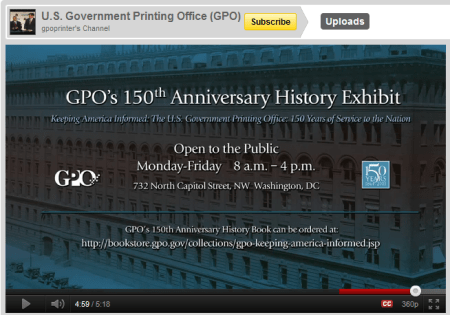
You can see the original printer’s proof of the Emancipation Proclamation in person at GPO’s 150th anniversary history exhibit now through December 2011!

To view an original copy of the preliminary version of the Emancipation Proclamation that was issued by President Lincoln and printed by GPO, visit our 150th anniversary history exhibit located at 732 North Capitol Street NW in Washington, DC. The Emancipation Proclamation is on loan from the Library of Congress only through December…

Click here to watch a video of our 150th anniversary exhibit on GPO’s YouTube channel.

The GPO 150th anniversary exhibit is open 8 a.m. to 4 p.m. Monday through Friday, except on Federal holidays.

Read more about Abraham Lincoln and his rise to the Presidency in the National Park Service’s recent work commemorating the 150th anniversary of Lincoln’s inauguration: Abraham Lincoln’s Journey to Greatness.


Statistical Abstract and Print Mashups in a Digital Age

October 13, 2011


Since 1878, the Statistical Abstract of the United States has been printed by the Government Printing Office on behalf of the Census Bureau.

The “Stat Abstract” is considered “the authoritative and comprehensive summary of statistics on the social, political, and economic organization of the United States,” and compiles data from multiple sources, including: the Census Bureau, Bureau of Labor Statistics, Bureau of Economic Analysis, and many other Federal agencies and private organizations. Each year, new tables and analyses are added to keep up with the issues and interests of the day.

As Jim Cameron mentioned in his February post about the 2011 edition,

“Family debt, manufacturing, national security, international statistics – there doesn’t seem to be anything that the Statistical Abstract doesn’t cover. At more than 1,000 pages, it’s an America watcher’s dream.”

This important publication has fulfilled a unique niche for over a century for students, educators, researchers and librarians throughout the country as the definitive source of US statistics. As one librarian put it, “The print edition is THE most used reference book in my collection.”

Why is having all this information in a single, compiled, cited, and referenced edition important to its users? Michael Fry, Senior Map Librarian for the National Geographic Society Library and Archives says:

“[W]hile the Census Bureau may be correct that the data is “available elsewhere,” the beauty of the Stat Abstract is that it obviated users’ need to know where “elsewhere” was. And that, as librarians know, can be (at least) half the battle.”

After fifteen years in the Internet industry, I am highly aware of how important it is to your intended audience to be able to quickly and easily find the information they are looking for, and how difficult this search task is made for the users by most web sites.

This has led to an entire field of search engine optimization also called SEO. Unfortunately, all the SEO in the world can’t overcome the amount of time and effort necessary to find all the content and data you need if it is scattered across many web pages and web sites.

In a world where time is money and convenience is king, the time savings in both finding the necessary data and knowing immediately the official source that produced that data are key benefits of a book like the Statistical Abstract. In a sense, this book is the ultimate printed “mashup” that blends data from multiple sources into a cohesive whole that is greater than the sum of its parts.

Who would have thought that a 134 year-old publication tradition would have such relevance in a digital age?  Unfortunately, compiling all this data and obtaining publication rights is increasingly expensive,  as many experts and a lot of effort are needed to pull together a work of this complexity. Thus, this may be the last year in its compiled format, since in its Fiscal Year 2012 budget submission to Congress, the Census Bureau requested “a decrease to terminate the Statistical Abstract program.

So, you may want to get what may be the last print edition of the Statistical Abstract of the United States at the US Government Bookstore in paperback or hardcover or find it in a library. Or you can see the tables online here.

Some interesting facts from the 2012 edition:

  • Increase in US Population: Between April 1, 2000 and April 1, 2010 there was a 9.7 percent increase in the resident population of the United States. The state with the highest percentage increase in resident population during the same time period was Nevada (35.1), while the only state that experienced a decrease was Michigan (-0.6). (Table 14)
  • Retail profits up: For retail trade corporations with assets of 50 billion dollars or more, net profit increased from 54.0 billion in 2008 to 84.1 billion in 2009. Profits per dollar of sales before taxes also increased from 2.6 cents per dollar of sales in 2008 up to 4.1 cents per dollar of sales in 2009. (Table 1052)
  • 80% has Internet access: In 2010, approximately 20 percent of households did not use the Internet…[, and] 80 percent of households had an Internet connection anywhere (at home or mobile etc). (Table 1155)


About the Author:  Michele Bartram is Promotions Manager for GPO’s Publication and Information Sales Division and is responsible for marketing the US Government Online Bookstore (Bookstore.gpo.gov) and promoting Federal government content to the public.


Steve Jobs and our Innovation Nation

October 11, 2011

Last week we lost one of America’s great geniuses of innovation, Apple’s founder and CEO, Steve Jobs.

I can remember each time I first used one of Apple’s products. While working for IBM as a systems engineer right out of college and working with both mainframe systems and some not-always-so-friendly early PC operating systems (remember DOS?), I got to use a friend’s Macintosh and was blown away by how easy it was to use. Fast forward through the introduction of the iPod; iTunes online music and apps store; the iPhone—the first touchscreen smartphone; and now the iPad, first touchscreen tablet; and we now have a world that couldn’t conceive of life without Steve Jobs’ innovations.

One of Jobs’ secret to success was treating Apple as an idea and business incubator to continually research and fund what could possibly be the “next great thing” in the future, but was still only a germ of an idea from some engineer or scientist.

The Federal Government as an Incubator of Innovation

Like Apple, one of the key roles of the US Federal Government is to serve as an incubator of innovation.

Here at GPO, for example, we are embracing innovation by producing eBooks, digital downloads, information portals and databases in response to the changing needs of our increasingly digital society, which have been driven in part by Apple inventions introduced by Steve Jobs.

Most of the work products from the Federal Government can be and are used freely by private industry or other areas of Government to spur their own innovations. From statistics to research, processes to products, the Government has provided the seeds to innovation for American industry throughout the years.

Looking through our recent catalog on the US Government Bookstore website, I came across these publications which provide examples of innovation both within the Federal Government and in partnership with the private sector:

 
  • Spinoff Innovative Partnerships Program 2009, provides an in-depth look at how NASA’s initiatives in aeronautics and space exploration have resulted in beneficial commercial technologies in the fields of health and medicine, transportation, public safety, consumer goods, environmental protection, computer technology and industrial productivity.  Some innovation spinoffs over the years include:
    • lightweight breathing system adapted for firefighters;
    • Teflon-coated fiberglass fabric for astronaut spacesuits is now used as a permanent roofing material for buildings and stadiums;
    • remote-controlled robotic arms are now being used for robotic surgical operations; and
    • artificial heart pump based on the design of NASA’s space shuttle main engine fuel pumps.
    • You can get a print copy of this book now at the US Government Bookstore or find it in a library.


About the Author:  I am Michele Bartram, Promotions Manager for GPO’s Publication and Information Sales Division.  My duties include marketing for the US Government Online Bookstore (Bookstore.gpo.gov) and promoting Federal government content to the public. Due to the retirement of Jim Cameron, my duties now also include taking the helm as Blogger for Government Book Talk. I have been in the Internet marketing and ecommerce field for over 15 years.

We at GPO wish Jim all the best in his retirement, and will continue to do our best to spotlight the amazing variety of Government publications and their impact on ourselves and our world – and have fun while doing it.