The Constitution & How a Bill Becomes a Law

April 30, 2024

The U.S. Government Publishing Office Bookstore offers the following best-selling classics about the American government.

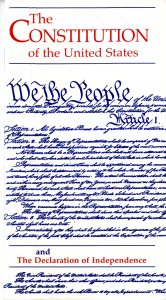
The Constitution of the United States and the Declaration of Independence (Pocket Edition). This official publication contains two core American democracy documents– the Constitution of the United States of America and the Declaration of Independence. It outlines the framework of the entire lawmaking process.

How a Bill Becomes a Law (Poster). This poster outlines the many steps in our Federal law-making process from the introduction of a bill—an excellent resource for a brick-and-mortar classroom or home school.

Here’s a breakdown of how a bill becomes a law and how the Constitution plays a role:

The Journey of a Bill:

  1. Introduction: A member of Congress (Senate or House of Representatives) introduces a bill, proposing a new law or changes to an existing one.
  2. Committee Action: The bill is assigned to a relevant committee for research, discussion, and possible revisions. The committee may hold hearings to gather public input.
  3. Floor Vote: If the committee approves the bill, it goes before the entire chamber (House or Senate) for debate and a vote.
  4. Second Chamber: If the bill passes one chamber, it goes through the same process in the other chamber. There may be revisions to reconcile differences between the two versions.
  5. Reaching the President: Once both chambers approve an identical version of the bill, it’s sent to the President.
  6. Presidential Action: The President has three choices:
    • Sign the bill: The bill becomes law.
    • Veto the bill: The bill is sent back to Congress with reasons for disapproval. Congress can try to override the veto with a two-thirds vote in both chambers.
    • Pocket Veto (inaction): If the President doesn’t sign the bill within 10 days while Congress is in session, it dies. (This doesn’t apply if Congress adjourns before the 10 days.)
  7. Law of the Land: If the President signs or Congress overrides a veto, the bill becomes law and is enforced.

The Constitution’s Role:

The Constitution establishes the legislative branch (Congress) with the power to “make all Laws which shall be necessary and proper” (Article I, Section 8). It also creates a system of checks and balances:

  • Bicameralism: Having two chambers (House and Senate) ensures more deliberation before a bill becomes law.
  • Presentation Clause: The President can influence legislation by signing or vetoing bills.
  • Veto Override: Congress can check the President’s power by overriding a veto with a supermajority.

This process ensures that laws go through multiple stages of review and approval before becoming effective, reflecting the principles laid out in the Constitution.

The GPO Online Bookstore – Easy Access to Federal Publications

HOW DO I OBTAIN THESE RESOURCES?

Sign up to receive promotional bulletin emails from the US Government Online Bookstore.

Shop Online Anytime: You can buy a vast majority of eBooks or print publications —with FREE Standard Shipping worldwide— from the U.S. Government Online Bookstore at https://bookstore.gpo.gov.

Order by Phone or Email: Call our Customer Contact Center Monday through Friday, 8 am to 4:30 pm Eastern (except US Federal holidays). From US and Canada, call toll-free 1.866.512.1800. DC or International customers call +1.202.512.1800.  Email orders to ContactCenter@gpo.gov

Visit a Federal depository library: Search for U.S. Government publications in a nearby Federal depository library. You can find the records for most titles in GPO’s Catalog of U.S. Government Publications.

Find more than a million official Federal Government publications from all three branches at www.govinfo.gov.

About the author: Blogger Trudy Hawkins is the Senior Marketing & Promotions Specialist in GPO’s Publication & Information Sales Office supporting the U.S. Government Online Bookstore (https://bookstore.gpo.gov).


Bill of Rights Day

December 14, 2020

The Bill of Rights was established on December 15, 1791. It was one of our country’s earliest acts to protect the rights endowed by our founding documents that are afforded all Americans. It is the first ten amendments to the Constitution and guarantees our freedoms. These Ten Constitutional Amendments safeguard the principles of equality, liberty, and justice.

The U.S. Government Publishing Office Bookstore provides a number of federal titles describing the contents of the Constitution as well as other historical documents.

Americans can keep the Constitution of the United States and the Declaration of Independence handy in this pocket-size booklet containing the complete text of the two core documents of American democracy; the Constitution of the United States, and, Declaration of Independence. You can use this comprehensive booklet to stay readily connected with the principles that have made America a bastion of democracy throughout its history.

The Citizen Almanac features information on our history, diverse people, and events that brought us where we are today as a beacon of hope and freedom to the world. This booklet serves as an important reminder of the cherished rights and responsibilities immigrants have upon becoming a U.S. citizen. There’s always more to learn about this great country, its founding ideals, achievements, and history. These important resources provide a great place to begin the journey.

The GPO Online Bookstore – Easy Access to Federal Publications

HOW DO I OBTAIN THESE RESOURCES?

Sign up to receive promotional bulletin emails from the US Government Online Bookstore.

Shop Online Anytime: You can buy a vast majority of eBooks or print publications —with FREE Standard Shipping worldwide— from the U.S. Government Online Bookstore at https://bookstore.gpo.gov.

Visit our Retail Store: To buy or order a copy of any print editions from this collection at GPO’s retail bookstore at 710 North Capitol Street NW, Washington, DC 20401, open Monday–Friday, 8 a.m. to 4 p.m., except Federal holidays, Call (202) 512-0132 for information or to arrange in-store pick-up(s).

Order by Phone or Email: Call our Customer Contact Center Monday through Friday, 8 am to 4:30 pm Eastern (except US Federal holidays). From US and Canada, call toll-free 1.866.512.1800. DC or International customers call +1.202.512.1800.  Email orders to ContactCenter@gpo.gov

Visit a Federal depository library: Search for U.S. Government publications in a nearby Federal depository library. You can find the records for most titles in GPO’s Catalog of U.S. Government Publications.

Find more than a million official Federal Government publications from all three branches at www.govinfo.gov.

About the author: Blogger contributor Ed Kessler is a Promotions Specialist in GPO’s Publication and Information Sales program office.


Bill of Rights at 225: A Guarantee for the People

December 14, 2016

9780160514234295It has been said that the Declaration of Independence was the promise; the Constitution was the fulfillment. Then you might say that the Bill of Rights was the affirmation. On December 15, 2016 those enduring first ten amendments to the Constitution turn 225 years old.

GPO makes available a pocket copy of The Constitution of the United States and the Declaration of Independence that includes the celebrated Bill of Rights.

Since they were ratified in 1791, that compact collection of amendments have become some of the most talked about text in history. Before their guarantees were plainly enumerated in the Constitution, there was a rumbling fear of the tyrannical actions of government. The concern grew loud enough to stall the Constitution’s ratification.

It all centered on the contentious tug between Federalists and Anti-Federalists. The Federalists believed an official declaration of individual rights was unnecessary. The Anti-Federalists had little confidence in strong centralized government to safeguard liberties of the governed. They simply would not ratify the Constitution without a “bill of rights.”

In response, James Madison presented a list of amendments that would follow Article VII of the Constitution. His list placed prohibitions on government power and enshrined as inalienable rights the self-evident truths invoked in preceding documents.

bill-of-rightsThe amendments required approval from the House, Senate, and all state legislatures. Virginia was the last to ratify. Finally, on December 15, 1791, the Bill of Rights became part of the Constitution. Without the Bill of Rights, the Constitution might never have been ratified.

Although the phrase itself does not appear explicitly in the Constitution, the Bill of Rights is a foundational document that has lived long and large. Because of it, fundamental freedoms such as religion, speech, and due process of law are formally protected within the supreme law of the land.

Together, the Bill of Rights and Constitution are the slow-burning coals of a quiet revolution, a steady progression to improve the quality of American life. They secure individual liberties and the spirit of popular sovereignty extolled in the phrase “we the people.” Bill of Rights Day is as good a time as any for “we the people” to re-read them.

HOW DO I OBTAIN THIS RESOURCE?

Shop Online Anytime: You can buy eBooks or print publications —with FREE Standard Shipping worldwide— from the U.S. Government Online Bookstore at http://bookstore.gpo.gov.

Shop our Retail Store: Buy a copy of any print editions from this collection at GPO’s retail bookstore at 710 North Capitol Street NW, Washington, DC 20401, open Monday–Friday, 9 a.m. to 4 p.m., except Federal holidays, Call (202) 512-0132 for information or to arrange in-store pick-up.

Order by Phone: Call our Customer Contact Center Monday through Friday, 8 am to 5:30 pm Eastern (except US Federal holidays). From US and Canada, call toll-free 1.866.512.1800. DC or International customers call +1.202.512.1800.

Visit a Federal depository library: Search for U.S. Government publications in a nearby Federal depository library. You can find the records for most titles in GPO’s Catalog of U.S. Government Publications.

About the author: Blogger contributor Chelsea Milko is a Public Relations Specialist in GPO’s Public Relations Office.


The Constitution of the United States and the Declaration of Independence

August 2, 2016

9780160514234295It’s an election year, there’s no better time for your family to read and discuss the Constitution of the United States and the Declaration of Independence.

These two documents represent the core principles of American democracy.

The U.S. Government Bookstore offers the pocket version of the Constitution of the United States and the Declaration of Independence for your convenience to carry wherever you go.

Pick-up your copy of the Constitution of the United States and the Declaration of Independence (Pocket Edition) now!

HOW DO I OBTAIN THIS RESOURCE?

Shop Online Anytime: You can buy eBooks or print publications —with FREE Standard Shipping worldwide— from the U.S. Government Online Bookstore at http://bookstore.gpo.gov.

 Shop our Retail Store: Buy a copy of any print editions from this collection at GPO’s retail bookstore at 710 North Capitol Street NW, Washington, DC 20401, open Monday–Friday, 9 a.m. to 4 p.m., except Federal holidays, Call (202) 512-0132 for information or to arrange in-store pick-up.

Order by Phone: Call our Customer Contact Center Monday through Friday, 8 am to 5:30 pm Eastern (except US Federal holidays). From US and Canada, call toll-free 1.866.512.1800. DC or International customers call +1.202.512.1800.

Visit a Federal depository library: Search for U.S. Government publications in a nearby Federal depository library. You can find the records for most titles in GPO’s Catalog of U.S. Government Publications.

About the author: Blogger contributor Trudy Hawkins is a Marketing and Promotions Specialist in GPO’s Publication and Information Sales program office.