Based on personal experience, guest blogger Ingrid Reyes-Arias has some good advice for college-bound students.
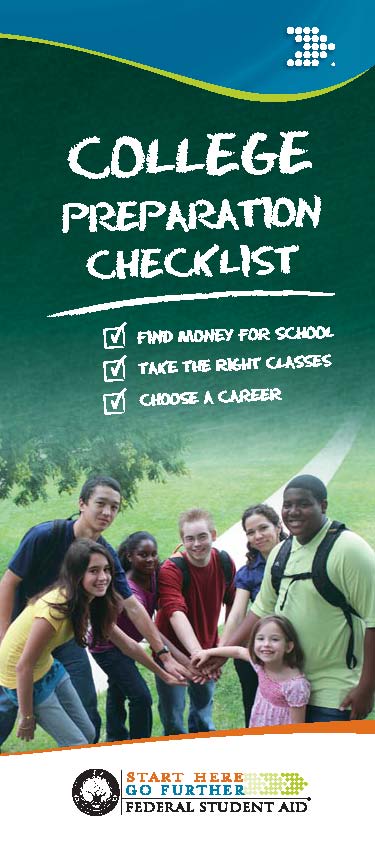 It’s unbelievable the amount of influence money has on an individual’s pursuit of success. Before college I had many stressful days of thinking how I would pay for my education, and there were very tough moments when the problem was not the admissions step but the finance step. I remember when I began applying to colleges, I had a wonderful counselor that gave me all the resources I needed and, most important, helped me organize my finances. For those that do not have the privilege of a counselor available every moment of every day. this great checklist can help.
The College Preparation Checklist (revised 2009) is a free publication provided by ED Pubs (U.S. Department of Education Publications) that prepares students for the journey of pursuing higher education. This checklist has been created to reach students of all ages who are contemplating further education, as well as parents of children in elementary and secondary school. This “to do” list begins by addressing elementary age students regarding how to prepare academically for higher education and how to support this opportunity financially. The checklist has been divided into portions for students and parents, each tailored to meet their respective needs. In addition, it suggests different resources for more information. The checklist is broken down into “to do lists” for elementary and junior high, as well as the different high school grades.
As you may know, the Federal government contributes to higher education through Federal Student Aid (FAFSA). This program within the U.S. Department of Education assists eligible students in getting funds to pay off the cost of attending school. Every year a student should fill out the FAFSA application to seek financial aid, such as work-study, student loans, scholarships, or grants. The aid goes towards expenses such as tuition, room and board, books, and supplies. The application can be found at www.fafsa.ed.gov.
Most important decisions require time to think about, which may lead to you starting the process later than others. Even if you get a late start, the checklist includes a “must do” list. The first thing listed is completing the FAFSA application, followed by contacting the school you plan to attend to find out about other payment plans or scholarships. It is always good to keep in mind that this is a process, so at times you must rely on subject matter experts, like teachers and guidance counselors, for help.
If you are at the beginning stages of planning, this publication includes a FAFSA4caster, which estimates your expected family contribution. It will then estimate the award amount and give you an idea of the loans or grants for which you may qualify. This estimator can be found at www.fafsa4caster.edu.gov. Additionally, the checklist encourages you to research and apply for scholarships. It provides many resources on scholarships, including a Department of Education database: www.FederalStudentAid.ed.gov./scholarship.
Keep in mind that knowing which steps to take will make the process go smoothly and eliminate unnecessary stress. The college application is already stressful enough, so don’t add more! The College Preparation Checklist offers a lot more help, so take a good long look. You can find it at the Ed Pubs website http://www.edpubs.gov/ and order a copy or two at no cost.


 Posted by govbooktalk
 govbooktalk
 Trudy Hawkins
 Government Book Talk