Your Guide to Education Publications

August 27, 2025

Whether you’re a teacher, a student, a parent, or a school administrator, the world of education is constantly evolving. Staying on top of best practices, new research, and critical resources is key to success. From enhancing the classroom environment to planning for college, our diverse collection of education publications has you covered.

For Educators and a Healthy Learning Environment

Effective teaching and a healthy school environment go hand in hand. The English Teaching Forum is a fantastic resource for English language teachers outside the United States, offering practical articles, ideas, and materials to help improve their craft.

For those focused on the school building, the Sensible Guide for Healthier School Renovations provides crucial environmental health considerations for any school-renovation project. Pair this with the Sensible Steps to Healthier School Environments, which outlines cost-effective measures to protect the health of students and staff. These two guides provide practical, actionable advice for creating a safe and healthy place to learn and teach.

For Students and Parents: Planning for College

Navigating the path to higher education can feel overwhelming, but it doesn’t have to be. We have several essential publications to help make the journey clearer.

My Future, My Way: First Steps Toward College is a great starting point for students, helping them think about their goals and what they want from their education.

The College Preparation Checklist is an easy-to-use resource outlining all the key steps students must take, from test prep to application deadlines.

Finally, a key piece of the puzzle is understanding how to pay for everything. Funding Your Education: The Guide to Federal Student Aid is an invaluable resource that demystifies finding and applying for federal financial assistance.

These publications, available as accessible eBooks, provide the knowledge and tools students need to prepare for their future confidently.

From professional development for teachers to financial aid guidance for students, these publications offer a wealth of information for every step of the educational journey. Find the resources you need to learn, grow, and succeed.

The GPO Online Bookstore – Easy Access to Federal Publications

HOW DO I OBTAIN THESE RESOURCES?

Sign up to receive promotional bulletin emails from the US Government Online Bookstore.

Shop Online Anytime: You can buy a vast majority of eBooks or print publications —with FREE Standard Shipping worldwide— from the U.S. Government Online Bookstore at https://bookstore.gpo.gov.

Order by Phone or Email: Call our Customer Contact Center Monday through Friday, 8 am to 4:30 pm Eastern (except US Federal holidays). From US and Canada, call toll-free 1.866.512.1800. DC or International customers call +1.202.512.1800.  Email orders to ContactCenter@gpo.gov

Visit a Federal depository library: Search for U.S. Government publications in a nearby Federal depository library. You can find the records for most titles in GPO’s Catalog of U.S. Government Publications.

Find more than a million official Federal Government publications from all three branches at www.govinfo.gov.

About the author: Blogger Trudy Hawkins is the Senior Marketing & Promotions Specialist in GPO’s Publication & Information Sales Office, supporting the U.S. Government Online Bookstore (https://bookstore.gpo.gov).


Steppin’ It Up With College Planning

February 18, 2016

Planning for college is a towering task. Paying for college can be a monumental challenge. My head hurts! I can hardly imagine any of it makes sense to middle and high school students. Until My Future, My Way: First Steps Toward College came along.

The Department of Education’s Federal Student Aid folks have assembled a top-shelf e-Pub booklet to frame the big, scary questions without oversimplifying them. The layout is arranged in a series of prompts, mythbusters, and graphics for the college and vocational school-bound. It tackles the “when should I begin thinking of college?” and “what can a college education do for me?” and “how will I pay for college?” sort of FAQs. And it features a nifty comparison of vocational, technical, and professional career choices as well.

065-300-00008-7The workbook is certainly not designed to replace traditional guidance counseling. The goal here is to get middle schoolers to start asking questions now that will make professional career planning less intimidating. As is often the case when undertaking something new, school kids might not even know what questions to ask. Give them a tailor-made activity book, such as My Future, My Way, and post-high school success will be that much more attainable.

Equipped with a few new life skills, 6th through 9th graders will hopefully be compelled to build a mentorship network. The workbook calls it a “college support team”—the people who can help youngsters get to college. It’s a sensible suggestion that doesn’t get enough airtime amid the all too important talk of money planning, test scores, and scholarships. Charts and checklists are great. Caring, informed people are better. As the booklet rightly points out, “Getting ready for college may seem like a lot to handle, but you don’t have to do it alone!”

Now my head doesn’t hurt as much! All joking aside, it’s nice to see real answers placed in the hands of students. A bit of good guidance is the sure footing needed for those first steps toward college.

HOW DO I OBTAIN THIS RESOURCE?

Shop Online Anytime: You can buy eBooks or print publications —with FREE Standard Shipping worldwide— from the U.S. Government Online Bookstore at http://bookstore.gpo.gov.

Shop our Retail Store: Buy a copy of any print editions from this collection at GPO’s retail bookstore at 710 North Capitol Street NW, Washington, DC 20401, open Monday–Friday, 9 a.m. to 4 p.m., except Federal holidays, Call (202) 512-0132 for information or to arrange in-store pick-up.

Order by Phone: Call our Customer Contact Center Monday through Friday, 8 am to 5:30 pm Eastern (except US Federal holidays). From US and Canada, call toll-free 1.866.512.1800. DC or International customers call +1.202.512.1800.

Visit a Federal depository library: Search for U.S. Government publications in a nearby Federal depository library. You can find the records for most titles in GPO’s Catalog of U.S. Government Publications.

About the author: Our guest blogger is Chelsea Milko, Public Relations Specialist in GPO’s Public Relations Office.


Education Statistical Resources from the Federal Government

August 19, 2014

With the start of a new school year just around the corner, Government Book Talk takes a look at two recently released publications from the Department of Education that examine the latest trends and developments in American education.

The Condition of Education 2013 and the Digest of Education Statistics 2012,which are currently available from the GPO Bookstore, provide important statistical data on the progress of education in the United States.

065-000-01438-6_2The Condition of Education 2013 focuses on 42 indicators in the subject areas of population characteristics, participation in education, elementary and secondary education, and postsecondary education. Each indicator covers important developments and key indicators such as economic outcomes, preprimary education, school characteristics and climate, and finance and resources.

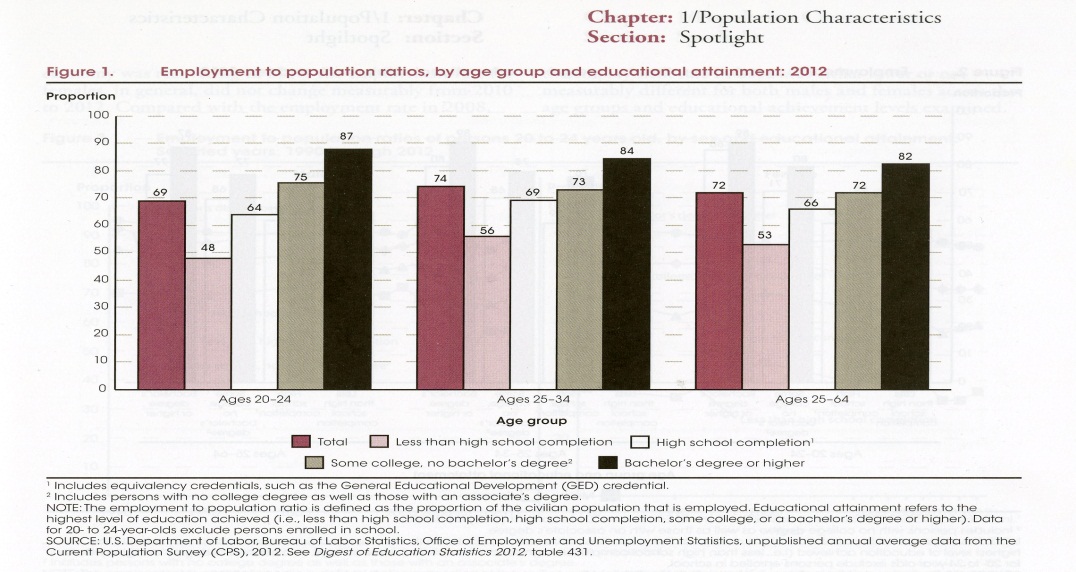
The report also features easy-to-read charts and graphs to illustrate the current trends within each indicator. For example, the chart below from the book illustrates trends in employment rates by age group and education attainment for 2012. According to the chart, in 2012, the employment rate for young adults was 87 percent for those with at least a bachelor’s degree, compared with 75 percent for those whose educational attainment was some college, 64 percent for high school graduates, and 48 percent for those who did not complete high school. Further analysis of the chart points out that older students that did not complete school—those aged 25-34 and 25-64 did slightly better in comparison to their younger counterparts, however, were still employed at a significantly lower rate than those with additional education. (CLICK ON IMAGE TO ENLARGE)

conditions employment chart 2012In addition to trends in employment rates by educational attainment, this year’s report focuses on kindergarten entry status, the status of rural education, and financing postsecondary education in the United States.

065-000-01439-4The Digest of Education Statistics 2012 provides a compilation of statistical information covering the broad field of American education from pre-kindergarten through graduate school. Like the Condition of Education, the data in this annual report was drawn from government and private sources, but especially from surveys and other activities led by NCES (National Center for Education Statistics) part of the Institute for Education Sciences (IES). The digest contains information on the number of schools, students, and teachers, as well as statistics on educational attainment, finances, libraries, technology, and international comparisons. Details on population trends, education attitudes, labor force characteristics, and federal aid supplies helpful background for evaluating the education data.

In addition to updating many of the statistics that have appeared in previous years, this edition contains new material, including:

  • Percentage distribution of 6- to 18-year olds, by parent’s highest level of educational attainment, household type (either two-parent or single-parent), and child’s race/ethnicity (table 12)
  • Enrollment and percentage distribution of enrollment in public elementary and secondary schools, by race/ethnicity and region (table 44)
  • Number and percentage of public school students participating in programs for English language learners, by state (table 47)
  • Children 3 to 21 years old served under Individuals with Disabilities Education Act, Part B, by age group and race/ethnicity (table 49)
  • Percentage of 3-, 4-, and 5-year-old children enrolled in preprimary programs, by attendance status, level of program, and selected child and family characteristics (table 57)
  • Number and enrollment of public elementary and secondary schools that have closed, by school level and type (table 109)
  • Number and percentage distribution of public school students eligible for free or reduced-price lunch, by school level, locale, and student race/ethnicity (table 112)

This statistical reference could be helpful to parents choosing schools for their children as well as for teachers, librarians, and public administrators as it tracks enrollment, population trends and key areas of studies with student progress.

How can I get these publications on education statistics?

Shop Online Anytime: You can buy these and other publications (with FREE Standard Shipping worldwide) from the U.S. Government Online Bookstore website at http://bookstore.gpo.gov:

Shop our Retail Store: Buy a copy of any print editions from this collection at GPO’s retail bookstore at 710 North Capitol Street NW, Washington, DC 20401, open Monday–Friday, 9 a.m. to 4 p.m., except Federal holidays, Call (202) 512-0132 for information or to arrange in-store pick-up.

Order by Phone: Call our Customer Contact Center Monday through Friday, 8 am to 5:30 pm Eastern (except US Federal holidays). From US and Canada, call toll-free 1.866.512.1800. DC or International customers call +1.202.512.1800.

Visit a Federal Depository Library: Search for these in a nearby Federal depository library. You can find the records for most titles in the Catalog of U.S. Government Publications or CGP.

About the author: Trudy Hawkins is a writer and marketing specialist in GPO’s Publication & Information Sales Division supporting the U.S. Government Online Bookstore (http://bookstore.gpo.gov).