CIA’s World Factbook: Global intelligence for every thinker, traveler, soldier, spy

January 27, 2012

A great publication not only provides timely and valuable information, but it also allows us a glimpse into the times and events that necessitated its production.

Such is the case with the CIA’s World Factbook—which marks its 50th anniversary in 2012 for the classified version and over 40 years for the public version described here— and shows us a glimpse into how Pearl Harbor and the Cold War changed the way America began to gather information about all corners of the globe.

The Factbook has its origins in the aftermath of the Japanese attack on Pearl Harbor, and the realization by Congress and the White House that lack of coordinated intelligence across all Governmental departments had left the United States woefully unprepared for the attack, and determined to correct this as a national security necessity and priority.  According to the CIA historians:

During World War II, intelligence consumers realized that the production of basic intelligence by different components of the US Government resulted in a great duplication of effort and conflicting information.

Detailed and coordinated information was needed not only on such major powers as Germany and Japan, but also on places of little previous interest. In the Pacific Theater, for example, the Navy and Marines had to launch amphibious operations against many islands about which information was unconfirmed or nonexistent.

Image above: During WWII, OSS intelligence reviewed existing maps with the military. Source: Top Secret Writers

JANIS Drops In

To correct this deficiency, in 1943, General George B. Strong (G-2), Admiral H. C. Train (Office of Naval Intelligence – known as ONI), and General William J. Donovan (Director of the Office of Strategic Services – known as OSS, the precursor of the CIA) oversaw the formation of a Joint Intelligence Study Publishing Board to assemble, edit, coordinate, and publish the Joint Army Navy Intelligence Studies (JANIS).

JANIS was the first cross-departmental basic intelligence program to fulfill the needs of the US Government for an authoritative and coordinated appraisal of strategic basic intelligence.

All groups involved in the war agreed that finished basic intelligence was required that covered territories around the world where the war was being fought. They needed detailed, up-to-date maps and geography; basic understanding of the cultural, economical, political and historical issues of the people and the region.

Compiling and publishing this information for the Allied intelligence needs, JANIS became an indispensable reference for war planning and execution.

The Cold War Gives Birth to the CIA… and the National Intelligence Survey

But the Cold War that immediately followed World War II showed that there was just as much need for continued intelligence gathering as ever. In the 1946 publication “The Future of American Secret Intelligence,” national security author George S. Petee wrote: “The conduct of peace involves all countries, all human activities – not just the enemy and his war production.”

In acknowledgement of this, the Congress established the Central Intelligence Agency in 1947 which immediately took over responsibility for JANIS. The next year, the National Security Council authorized the National Intelligence Survey program as a peacetime replacement for the wartime JANIS program. By 1955, the Hoover Commission evaluating the CIA advised Congress that: “The National Intelligence Survey [NIS] is an invaluable publication which provides the essential elements of basic intelligence on all areas of the world. There will always be a continuing requirement for keeping the Survey up-to-date.

The Sum of All Facts: The World Factbook

Subsequently, the World Factbook was created as an “annual summary and update to the encyclopedic NIS studies.

Originally published only as a classified publication starting a half century ago in August 1962 (just prior to the Cuban Missile Crisis of October 1962), the World Factbook was first published in its declassified version for public consumption in June 1971, 40 years ago.

Image: CIA map produced for President Kennedy’s team estimating the range of Soviet missiles being set up in Cuba during the Cuban Missile Crisis in October 1962. Source: Canadian History Portal

Today’s World Factbook is the declassified version of the finished basic intelligence compiled by the U.S. Central Intelligence Agency (CIA) and coordinated across all the U.S. intelligence community. It uses only recognized, authoritative sources, not only CIA-gathered intelligence, but also a wide variety of U.S. Government agencies from the National Security Agency, Department of Defense, Department of State, Department of Agriculture, Defense Intelligence Agency, and hundreds of other published sources around the world.

Printed Version Provides an Annual Snapshot

Once a year, the Government Printing Office takes a snapshot of this information from the CIA as of January 1 and produces a printed version of the World Factbook. It provides unparalleled and succinct information about hundreds of countries in a format that provides an easy-to-use comparison.The Factbook has been available from GPO since 1975.

The 2011 version just published provides a two- to three-page summary of the history, people, government, economy, geography, communications, transportation, military, and transnational issues for 267 world entities, including U.S.-recognized countries, dependencies, and other areas in the world.

Each country has its own basic map and shows its flag, but of particular interest are the maps of the major world regions, as well three pull-out maps included in the publication: Physical Map of the World, Political Map of the World, and Standard Time Zones of the World Map, all of which can be used as wall maps.

Who Can Benefit from the World Factbook?

A perennial best seller in the GPO bookstore, The World Factbook is used by not only US Government officials, but is a must-have reference for researchers, news organizations, businesses, geographers, international travelers, teachers, professors, librarians, and students.

In short, after 40 years, the World Factbook is still the best source of  up-to-date, summarized intelligence about the world for any “thinker, traveler, soldier, or spy” of any age!

Image: Pupils at Crosby’s Valewood Primary School near Liverpool, England, dress up as ‘Spies’ as part of a creative project. Photographer: Andrew Teebay. Source: Liverpool Echo

To gather your own up-to-date intelligence about the world we live in, you can obtain the World Factbook 2011 at one of these locations:

How can you get this publication?

  • Buy the current version of the World Factbook and selected previous editions online 24/7 at GPO’s Online Bookstore.
  • Buy it at GPO’s retail bookstore at 710 North Capitol Street NW, Washington, DC 20401, open Monday-Friday, 9am to 4pm, except Federal holidays, (202) 512-0132.
  • Find it in a library.

Some Interesting “DID YOU KNOW?” Facts related to the CIA’s World Factbook:

  • Question: What separates “intelligence” from “information”?
    • Answer: According to the CIA: The Intelligence Cycle is the process by which information is acquired, converted into intelligence, and made available to policymakers. Information is raw data from any source, data that may be fragmentary, contradictory, unreliable, ambiguous, deceptive, or wrong. Intelligence is information that has been collected, integrated, evaluated, analyzed, and interpreted. Finished intelligence is the final product of the Intelligence Cycle ready to be delivered to the policymaker.

The three types of finished intelligence are: basic, current, and estimative. Basic intelligence provides the fundamental and factual reference material on a country or issue.

  • Question: “Why is the British Labour Party misspelled?”
    • Answer: When American and British spellings of common English words differ, The World Factbook always uses the American spelling, even when these common words form part of a proper name in British English.
  • Question: “What is a ‘doubly landlocked’ country and which are the only two in the world?”
    • Answer: A doubly landlocked country is one that is separated from an ocean or an ocean-accessible sea by two intervening countries. Uzbekistan and Liechtenstein are the only countries that fit this definition.
  • Question: “Why does the Factbook use metric units, even though Americans still use traditional units of measure like feet, pounds, and Fahrenheit?”
    • Answer: US Federal agencies are required by the Metric Conversion Act of 1975 (Public Law 94-168) and by Executive Order 12770 of July 1991 to use the International System of Units, commonly referred to as the metric system or SI. In addition, the metric system is used by over 95 percent of the world’s population.
  • Question: “Why is the European Union listed at the end of the Factbook entries? It’s not a country!”
    • Answer:  The European Union (EU) is not a country, but it has taken on many nation-like attributes and these may be expanded in the future. A more complete explanation on the inclusion of the EU into the Factbook can be found in the Preliminary statement.

About the Author:  Michele Bartram is Promotions Manager for GPO’s Publication and Information Sales Division and is responsible for online and offline marketing of the US Government Online Bookstore (Bookstore.gpo.gov) and promoting Federal government content to the public. She’s a big fan of the National Spy Museum and of spy movies, which she is going to enjoy for her birthday tomorrow.


Veterans Day and 100 Years of Flying Leathernecks

November 10, 2011

November 11, Americans celebrate Veterans Day, honoring the brave men and women who have served our Armed Forces in peacetime and in war.

This holiday dates back to the end of World War I when President Woodrow Wilson declared that this day be commemorated as Armistice Day after the warring sides declared an armistice:

On the 11th hour of the 11th day of the 11th month of 1918, an armistice, or temporary cessation of hostilities, was declared between the Allied nations and Germany in the First World War, then known as “the Great War.” (History.com)

Figure 1. Armistice Day poster. Source USFlagStore Blog

November 11th was celebrated as Armistice Day starting in 1919 and became a legal federal holiday in the United States in 1938. After World War II and the Korean War, Armistice Day became Veterans Day in the United States. November 11 is still celebrated as Armistice Day in France and Belgium, but is called Remembrance Day today in the British Commonwealth of Nations, and is known as the Day of Peace in the Flanders Fields.

While Veterans Day is typically a tribute to America’s living veterans, it is always appropriate to include a moment of silence in respect for those who gave their lives for their country.

Honor veterans past and present by pausing for a minute of silence at 11:11 on 11/11/11, “the eleventh hour on the eleventh day on the eleventh month.” and in this case, the 11th year of the century as well!

The “War to End All Wars” instead gave birth to aerial warfare

Idealistically, many thought that “The Great War” would be “The War That Will End War” , a term first coined by famed British author H.G. Wells in 1914 and later used as “a war to end war” in a speech by President Wilson.

Instead of being the end of wars, World War I was a first in many ways, including the first war to feature the large scale use of manned aircraft for both reconnaissance and aerial combat.

It also marked the introduction of Marine Corps Aviation.

Happy 100th, Marine Corps Aviation!

2012 will mark the hundredth anniversary of the founding of Marine Corps Aviation. To commemorate this noteworthy milestone, the US Marine Corps has produced a remarkable new publication entitled 1912-2012 100 Years of Marine Corps Aviation: An Illustrated History.

Figure 2. 1912-2012 100 Years of Marine Corps Aviation: An Illustrated History

A stirring snapshot of some of the key people, aircraft, and events that comprise this first century of Marine aviation, this book showcases the achievements of Marine aviation through seldom seen photographs and accounts of pivotal battles and events.

Intended as a “museum in a book,” 1912-2012 100 Years of Marine Corps Aviation: An Illustrated History includes an overview for each time period in Marine aviation, chapter introductions, feature articles, and a running timeline. A real plus is the bonus oral history CD that the Marine Corps has included in the back of the book, providing the text and photos along with first-hand accounts from select Marine aviators, which really bring the stories alive.

Particularly interesting are the exploits of legendary Marine aviators including Roy Geiger, Joseph Foss, Gregory “Pappy” Boyington, Keith McCutcheon, Frank Petersen Jr., and others, including aviator-turned-astronaut John Glenn Jr., who besides being the first American to orbit the earth, wrote the foreword for this book.

First Flying Leatherneck

Featured in the book is the man who started it all: A.A. Cunningham. On May 22, 1912, two years before the outset of World War I, Alfred A. Cunningham, then a First Lieutenant in the United States Marine Corps, first reported for “duty in connection with aviation”—i.e., flight instruction—to the new Naval Aviation Camp that had just been established at Annapolis, Maryland, home of the US Naval Academy.

Today considered “the father of Marine aviation,” Lt. Col. Alfred Austell Cunningham, better known to Marines as A.A. Cunningham, became the “de facto director of Marine Corps aviation.

Fun fact: A quick study, Cunningham received less than three hours of instruction before flying his first solo flight as a Marine aviator!

Figure 3. Lt. Alfred A. Cunningham floats in a Curtiss hydro-aeroplane in 1914.  Source: Marine Corps Air Station Cherry Point

Aces in the Air: The oldest Marine air attack squadron

Also mentioned in the publication is Marine Corps Air Station Cherry Point in Havelock, North Carolina, next to where I used to live in New Bern. MCAS Cherry Point is home to a number of Marine air squadrons, including VMAQ-1, VMAQ-2, VMA-223 and VMA-231, and hosts a phenomenal air show every year. Oo-rah to my old neighbors!

Formally established in 1919, Marine Attack Squadron 231 takes great pride in being the oldest squadron in the Marine Corps. After being re-designated the First Squadron, VMA-231 adopted the “Ace of Spades” moniker, since the Ace is the first card in the suit. The “A” in the upper left stands for “Air” and the “S” in the lower right stands for “Squadron”.

Figure 4. VMA-231 Ace of Spades logo. Source: Marine Corps

Where can you find this and other publications on aviation?

You can find 1912-2012 100 Years of Marine Corps Aviation: An Illustrated History on our online bookstore, in a library, or at our retail bookstore at 710 North Capitol Street NW, Washington, DC 20401.

For regular updates about today’s naval and marine aviation, you may wish to subscribe to these excellent magazines from the Navy and Marine Corps: quarterly magazine Naval Aviation News: Flagship Publication of Naval Aviation or the bi-monthly Approach: The Navy & Marine Corps Aviation Safety Magazine.

Aviation fans and practitioners in general should check out our Aviation Publications Collection on our online bookstore with books on aviation past and present and information for pilots, balloonists, and more.

Oh, and I would be remiss if I didn’t point out that you can sign up to receive Aviation email updates about new Federal Government aviation publications as they come out.

About the Author:  Michele Bartram is Promotions Manager for GPO’s Publication and Information Sales Division and is responsible for marketing the US Government Online Bookstore (Bookstore.gpo.gov) and promoting Federal government content to the public. She is a fan of military aviation, from growing up near Andrews Air Force Base in Maryland and watching Air Force One and the Blue Angels overhead, to living in New Bern, NC, near Marine Corps Air Station Cherry Point and watching the Harriers do practice fly over runs.

New Caledonia and the New Yorker?

August 4, 2011

From time to time I’ve talked about the little World War II-vintage booklets produced to familiarize Army and Navy personnel with various places around the world that the fight against the Axis might compel them to go. Some of those places are still hot spots, like Iraq. Others were obscure then and remain so today, unless you’re a specialist or someone with an inordinate curiosity about things in general (me).

For out of the way places, you can’t beat New Caledonia. This large island in the Southwest Pacific, a French territory only now looking towards a future referendum on independence, is populated by Melanesian Kanaks and French settlers and has an economy centered on nickel mining. During the war, however, it was the island’s strategic position that made it the subject of a Pocket Guide to New Caledonia. Not long after the fall of France in 1940, the French colonials on the island revolted against their pro-Vichy governor and declared for the Free French, so the island and the harbor at Noumea, the colony’s capital, became a huge naval repair, troop transit, and logistical nexus for America’s armed forces. TheU.S. presence had a huge and generally positive economic, political, and cultural impact on the Kanak population, but stimulated an almost paranoid reaction among Free French officials, who saw the American “occupation” as a threat to their colonial dominance. Clearly, our soldiers and sailors needed some guidance on how to handle these complicated crosscurrents!

Pocket Guide to New Caledonia does a very good job of outlining New Caledonia’s history and cultures, with an emphasis on tolerance and understanding of the customs and faiths of others, whether French or Kanak. It also manages a light touch when discussing some topics, to wit:

“People living in the tropics or subtropics are likely to be exposed to       hookworm and other intestinal parasites, and to be bothered by dysentery. To check this latter ailment, the natives eat a certain grass which is called ‘dysentery grass’ and is supposed to have a herbaceous effect. Our troops have made not a few noble experiments with this particular variety of hay, and up to date nobody has been hurt, though the record is confused as to whether anybody has been helped. So if you see a creature eating grass inNew Caledonia, don’t shoot! It may be the corporal.”

Like other wartime publications, this booklet also benefited from the work of a well-known artist. While Dr. Seuss handled malaria prevention, the great New Yorker cartoonist George Price drew theNew Caledonia short straw (see left) and provides a comic glimpse at GI life in the tropics.

I enjoyed browsing through Pocket Guide to New Caledonia. The Government did a good job of prepping folks for trips to places that most of them never imagined going, and now we can make the same visit thought these little time capsules. You can read it here or in a library.


The Few, the Proud, the Anthology

July 6, 2011

 Book buyers and book hunters (who tend to be one and the same) are funny about bibliographies. Non-fiction books need to have them, they’re great to skim through to locate more books on favorite topics – but they’re not exactly scintillating reading. When I saw that the title of this 2011 Library Journal notable Government document was U.S. Marines in Iraq, 2004-2008: An Anthology and Annotated Bibliography, I had mixed feelings. What percentage was going to be anthology as opposed to bibliography?

It really wasn’t a problem. Most of the book is anthology – and not just selections from the Marine Corps Gazette, although there are some excellent ones from that estimable publication. It also includes articles from such distinctly non-military sources as Vanity Fair and Foreign Affairs, and they’re not always totally favorable. Coverage of controversies such as the killings of civilians at Haditha and blunt discussions of whether the American course of action in Iraq was selfless or madness make this collection a lot more than just a “how-to” guide to irregular warfare or IEDs (improvised explosive devices). The U.S. Marines might not love everything journalists and experts write about them, but they’re willing to address criticism, not just ignore it – and I liked this open-mindedness. As a bonus, each article begins with a striking color photograph of Marines in their varied roles inIraq, from combat to pacification.

The bibliography, as the title says, is annotated, so it’s a handy guide to the mainly periodical literature covering these crucial four years of U.S.intervention in Iraq and undoubtedly will be useful to scholars and soldiers alike. U.S.Marines in Iraq, 2004-2008 is a fine book for readers and bibliography-philes alike. You can find it here or in a library.


Navy and Marine POWs in Vietnam

May 2, 2011

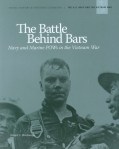
For some time now, the Naval History & Heritage Command has been producing concise studies of the Navy’s role during the Vietnam War. In previous posts, I’ve blogged about Navy Medicine in Vietnam and The Approaching Storm, the latter covering the decade-long run up to the introduction of combat troops in 1965. Today’s subject is The Battle Behind Bars: Navy and Marine POWs in the Vietnam War. The author, the late Stuart Rochester, was particularly well qualified to write on this subject, since he was the co-author of what must be considered the definitive account of POWs in Vietnam – Honor Bound: American Prisoners of War in Southeast Asia, 1961-1973 – published by the Army’sCenter ofMilitary History.

A personal note:This is the first time I’ve written about a book whose author I knew personally. Stuart and I worked together for years, on and off – he as deputy and then chief historian at the Pentagon’s Historical Office and me as a GPO marketing contact for his office’s books. We talked mainly by phone, although we did meet in person a couple of times. He was great to work with, a fine scholar, and I regret he wasn’t able to enjoy his position of chief historian longer before his untimely death from cancer in 2009.

The Battle Behind Bars, as the subtitle indicates, focuses on Navy and Marine POWs. Most of the Navy personnel captured during the war were pilots, so they formed a close-knit group of like-minded individuals. One exception was Seaman Apprentice Douglas B. Hegdahl, who was swept overboard from the missile cruiser Canberra and picked up by North Vietnamese fishermen. In a terrific sidebar, the book describes the incredulity of Hegdahl’s captors when he told them how he had come to be swimming in the Gulf ofTonkin – they understandably found his story so incredible that they assumed he was a spy! Once they accepted that he was a raw recruit, an enlisted man, and had trouble seeing due to the loss of his glasses in the water, he became a kind of camp mascot, perceived as not that bright. In realty, he was smart, alert, and able to serve as a secret mailman for other prisoners under the noses of the guards. He also had a retentive memory that let him memorize a huge amount of information about other POWs, which he revealed to the Navy after his early release by the Vietnamese.  

Another sidebar discusses the use of a “tap code” by Navy POWs to communicate via their cell walls. Initially a simple code, it was changed often to prevent detection, to the point where Defense Intelligence Agency personnel had difficulty in decoding some of the samples the prisoners brought back after their release.

It wasn’t all movie derring-do, however. The book details the poor conditions, attempted ideological indoctrination, and sometimes brutal treatment of prisoners in North Vietnam and the even worse situation of POWS in the South, where they shared the miserable living conditions of their Viet Cong captors. The author is fair-minded enough to point out instances, such as in the area of medical treatment, where the Vietnamese often did provide decent care, albeit under primitive conditions. Overall, though, captivity in Vietnam was a prolonged ordeal which, even as conditions eased after 1970, meant years of misery for American POWs.

This is a fine study of a controversial subject and a fitting capstone to the career of a talented scholar. You can get a copy of The Battle Behind Bars here or find it in a library here.


“Uncivilized Warfare”: Defeating the Kaiser’s U-Boats

April 8, 2011

I’ve been on a bit of a World War I binge lately. In addition to my own at-home reading (most recently a book on naval battles of the First World War and a biography of Colonel Edward M. House, Woodrow Wilson’s closest foreign policy advisor during and immediately after the war), in recent weeks I’ve blogged about World War I aerial reconnaissance, Army nurses, and Stars and Stripes, the doughboys’ newspaper. Maybe it’s because of the recent death of Frank Buckles, the last American veteran of the Great War, or because in another three years we’ll be hearing about the centennial of the war’s outbreak. Given that “the war to end all wars” kicked off what many historians view as one war that lasted from 1914 to 1945 with a 20-year intermission, that its repercussions still echo today, and that it was fought on or near every continent, I find the subject to be one of endless, multifaceted interest.

Because Americans tend to focus on such incidents as the sinking of the Lusitania, it’s easy to forget how deadly a weapon the German U-Boat was on an ongoing basis and how close it came to success. According to Defeating the U-boat: Inventing Antisubmarine Warfare, a new book from the U.S. Naval War College, after a meeting between U. S. Rear Admiral William Sims and the Royal navy’s Admiral of the Fleet Sir John Jellicoe in which the struggle against the U-boats was discussed, Sims cabled Washington to say “briefly stated, I consider that at the present moment we are losing the war.” A major part of the problem was England’s utter unpreparedness to fight an anti-submarine war. This was partly due to the belief that no “civilized” nation would engage in unrestricted submarine warfare, i.e. firing torpedoes at non-military vessels without warning and making no effort to aid or pick up survivors. After trying anti-submarine patrols,  “barrages” or barriers in the Strait of Dover, mines, and the employment of Q-ships (freighters and other civilian craft with concealed/camouflaged guns that could snag U-boats playing by the old “fair warning” rules), it was the development of the convoy system that proved most decisive. Yet such was the ambivalence of many officers (and even Winston Churchill) about the “defensive-mindedness” of convoys that even in World War II it took far too long for Allied navies, including the American navy, to use the convoy against Nazi U-boats.

In its concluding chapter, the author, Jan S. Breemer, reflects on the general tendency of large bureaucracies in general avoid decisions that involve risk.  It also makes the specific point that the Royal Navy in World War I viewed the protection of shipping and the sinking of U-boats as separate issues instead of the two parts of a strategic whole. In other words, combine sluggish bureaucracy and blinkered strategy and you come up with an almost lethal combination. As the great naval historian Arthur Marder put it, “sinking submarines is a bonus, not a necessity.” It took a long while for this lesson to sink in (excuse the pun!)

Defeating the U-boat is a neat little book that’s readable and furnishes a lot of useful information very concisely. It would be a great asset to any World War I buff’s collection. You can read it here, get that copy for your collection here, or seek it out at a library.


Spaniards, Insurrectos, and Boxers

December 29, 2010

It must be relatively rare for one very junior naval officer to get to participate in three separate armed conflicts within three years, but that’s what Naval Cadet (they weren’t called Midshipmen back in 1898) Joseph K. Taussig did. According to Three Splendid Little Wars: The Diary of Joseph K. Taussig, 1898-1901, published by the Naval War College, after being called away from the U.S. Naval Academy after the outbreak of the Spanish-American War, Taussig witnessed the Battle of Santiago de Cuba, wherein the Spanish fleet unsuccessfully attempted to outrun the American fleet. As part of the two years at sea required of Annapolis graduates prior to their commissioning exam, Taussig then sailed halfway around the world to help defeat Philippine revolutionaries in the Philippine Insurrection (mainly by embarking on an abortive hostage rescue mission).

Since I’m particularly interested in the Boxer Rebellion, I thought that the last section of Taussig’s diary was by far the most engaging. Disembarking near the Taku forts that played such a prominent role in the Opium Wars of the 19th Century, Taussig and his Navy and Marine comrades headed up the Peiho River to the city of Tientsin, where they teamed up with the British, French, German, Russian, Japanese, Italian, and Austrian contingents to form the so-called Boxer Relief Expedition. At first thinking that they would reach the besieged legations in Peking in a day or so, they spent most of their time repairing Boxer-damaged railroad tracks until the Boxers cut the tracks behind them, forcing a grueling retreat back to Tientsin.

Taussig’s impressions of the Boxer rebels and their fighting methods is interesting in itself, and his account shows how what initially seems to have been perceived as a walk-over soon became a grim contest against enemy troops, heat, and the ill-mapped Chinese terrain. It all ended for Taussig when “Although the bullets were flying thick I was never so surprised in my life when I felt a blow in my right hip that knocked me down.” He had been hit by a Boxer bullet. After long periods of being carried on a stretcher, Taussig eventually got medical help and lived long enough to become a Rear Admiral (he could well have risen further if he had not antagonized a certain Assistant Navy Secretary Franklin Roosevelt, who apparently did not forgive and forget when he became President – but that’s another story).

Three Splendid Little Wars is a valuable primary source of information on some little-known conflicts and a “you are there” portrait of the frustrations suffered by the Boxer Relief Expedition in its prolonged struggle to relieve the foreign embassies in Peking. Future historians will have to take Taussig’s diaries into account when they retell that particular story. You can browse through it here, get a printed copy here, or find it in a library.


America Versus Revolutionary France

December 17, 2010

When people ask me how I choose the books I blog about (actually, no one has asked me that, but it always pays to be prepared), I cite multiple sources of information, including in-house resources at GPO, my past experience with Government publications, and my personal and eclectic reading. For example, I recently read a book about America’s Quasi-War with revolutionary France from 1798 to 1800. Precipitated by French privateering attacks against neutral shipping during its war with England and exacerbated by the French view that the Jay Treaty between Great Britain and America was a violation of its 1778 treaty with the U.S., the fledgling American navy was authorized by Congress to attack any French vessel, including warships that molested American merchant shipping.

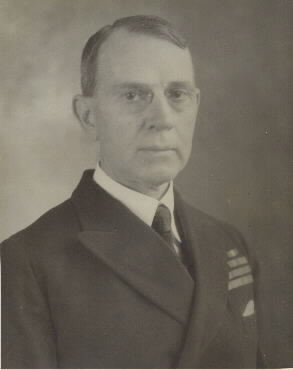
So what’s the connection with this blog? Naval Documents related to the Quasi-War between the United States and France, edited by Captain Dudley W. Knox, USN (Ret.) (left). This 7-volume set of official documents, published in the 1930s, is the starting point and standard source for any research on the Quasi-War and was duly acknowledged as such by the author of the book I read. Knox, who for many years was the Navy’s Officer in Charge of the Office of Naval Records and Library, also presided over the editing of other documentary compilations and was a noted writer on naval topics.

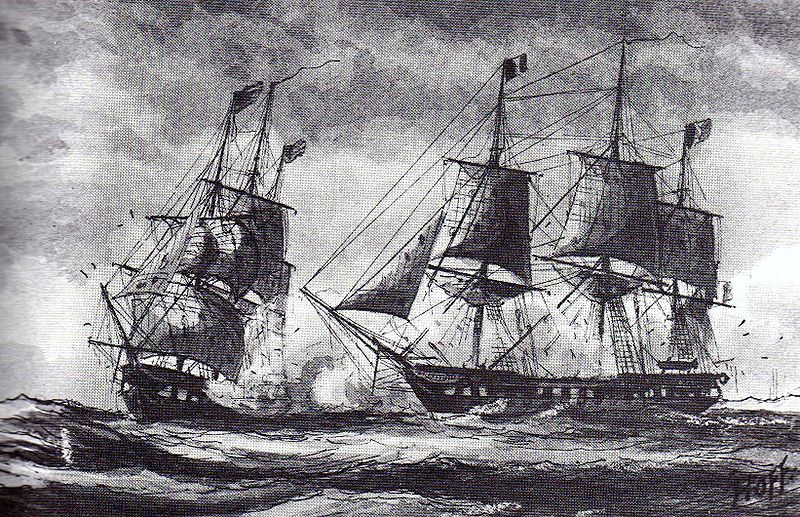
Perusing these ponderous volumes is challenging but rewarding. Included are accounts of the U.S. frigate Constellation’s battles with the French frigates L’Insurgente (top) and La Vengeance, the little-known landing of Marines on the Dutch island of Curacao, and much more. You can also find reports on the captains who led the fight (or sometimes failed) against the formidable forces of France and their often uneasy collaboration with France’s real enemy – the British.

It’s a tribute to the Navy that, at a time when such massive documentary series usually were not subsidized by universities or foundations, Knox and his staff were encouraged to research and preserve these early records of American military and diplomatic history. Today, it’s still a pleasure to plunge into another century and read about the Navy’s battles and the bureaucracy that kept them staffed and supplied at sea. Sets of Naval Documents related to the Quasi-War between the United States and France will set you back hundreds of dollars via the used and antiquarian book market, but they are available to browse here or in print at a library.


Around the World with the Great White Fleet

October 15, 2010

I’ve always been more of a text person than an images person when it comes to reading history, but The World Cruise of the Great White Fleet has persuaded me to change my mind. This handsome volume, subtitled “Honoring 100 Years of Global Partnerships and Security” commemorates the centennial of the voyage of Teddy Roosevelt’s U.S. Great White Fleet around the world. I was a bit chagrined to learn, despite my having read a book about U.S. sea power a couple of years ago, that the ostensible cause of the cruise was a war scare with Japan that died down almost immediately – that had totally escaped my memory. In fact, Roosevelt’s desire to announce America’s emergence as a world naval power was the real motivation. Interestingly, when Senator Eugene Hale of Maine threatened to withhold money from the cruise, “the undeterred Roosevelt replied in his typically brusque and forthright manner that he already had sufficient funding to get the fleet to the Pacific, and if the Congress wanted the fleet to return to the Atlantic it would have to authorize the additional funding.” TR didn’t mince words, now did he?

Although the text concisely covers the ships, the mean, and the cruise of those dazzlingly white battleships and accompanying torpedo boat destroyers, the real pleasure is leafing through the illustrations. If you’re a ship fan, there are paintings and photos galore (left). I liked the photos of the crew at work, crossing the Equator, riding camels in Egypt, and just smiling into the camera all those years ago. In the narrative section, there are lots more photos and great reproductions of souvenir postcards, magazine covers, and banners from Hawaii, New Zealand, Australia (left), Japan (where instead of war, the fleet was greeted by overflowing hospitality) and China. It’s an outstanding collection, beautifully presented.

Produced by the U.S. Navy’s Naval  History & Heritage Command (and please check out its redesigned Web site, which features many images of the cruise), The World Cruise of the Great White Fleet has much to offer Navy buffs and anyone interested in history as word and image. You can get your own copy here or find it in a library here.


Afghanistan and International Law

July 14, 2010

Since 1901, the Naval War College (NWC) has produced its “Blue Book” series on various international law topics. Over the years, I’ve thumbed through a few of these volumes. I remember one on the law of piracy that would be very relevant today, given the shenanigans off the Somali coast. The latest Blue Book is even more timely. The War in Afghanistan: A Legal Analysis is a compilation of essays from an International Law Expert’s Workshop held at the NWC. It touches on just about every aspect of the war, from the legal issues surrounding the original coalition intervention to the vexed problem of the status of combatants.

The first paper in the “The War in Afghanistan in Context” section was totally engrossing. “Afghanistan and International Security” by Adam Roberts, Senior Research Fellow of the Centre for International Studies, Department of Politics and International Relations at Oxford, and President-elect of the British Academy is a tour de force of clear and logically-structured writing that delineates the historical and political background of Afghanistan, prior efforts by outside power to control it, and the vexing legal issues the current situation presents. Particularly noteworthy was his point that it’s difficult  for the coalition gradually to turn over power to the national government in a place where most of the citizenry historically have had no use for any central government. After I finished reading, I was impressed by the author’s grasp of his subject and absolutely daunted by the challenges Afghanistan presents.

Another excellent paper, “Combatants” by W. Hays Parks, Senior Associate Deputy General Counsel, International Affairs Division, Office of General Counsel, U.S. Department of Defense, concludes that the Bush Administration’s decision to deny prisoner of war status to Taliban and Al Qaeda fighters was correct under long-established international law, but that its supporting statements were incorrect.  I found this essay to be particularly well-documented and lucidly written.

There’s much more to The War in Afghanistan: A Legal Analysis. Some of the discussions depend upon close readings of international precedents that make it heavy going for a lay reader, but all have value for the student of international affairs and the rule of law.

You can find the complete text of The War in Afghanistan: A Legal Analysis  here, browse through it  here, purchase a copy, or look through it at a library.


Notable Documents: The Navy and Indochina, 1945-1965

June 18, 2010

Continuing with my review of Library Journal’s 2009 Notable Government Documents, today’s selection is The Approaching Storm: Conflict in Asia, 1945-1965. This first volume in a new Naval History and Heritage Command  series is designed to present “well-illustrated, engagingly written, and authoritative booklets that detail the Navy’s major involvement” in the Vietnam War.

The Approaching Storm is an auspicious beginning to this series. Its concise text places the Navy’s Southeast Asian operational activities in the post-World War II decade into the context of American and international politics. It’s instructive to follow internal political developments in South Vietnam, particularly during the Ngo Dinh Diem regime, and its effects on U.S.-Vietnamese naval collaboration. Despite the Navy’s best professional efforts in both riverine and blue water operations, “the greatest drawback to the development of the navy and other South Vietnamese armed forces was the involvement of their officers in plots, coups, and other political intrigues.” The book also presents a clear account of the Tonkin Gulf incident – a classic example of how the fog of war can obscure the facts for even the participants most closely involved in the action.

Profusely illustrated by photographs and useful maps, The Approaching Storm also includes accounts of individuals involved in the events of the time. I was particularly interested in “Escape from Laos”, which tells the story of Navy Lieutenant Charles F. Klusmann, whose reconnaissance aircraft was shot down over central Laos in 1964. After almost three months of captivity, Lieutenant Klusmann and a number of others escaped from their Pathet Lao prison camp. After three days, Klusmann and one other escapee made it to friendly lines – one of the few American flyers to escape from captivity in Laos during the entire course of the war.

Like Navy Medicine in Vietnam, a previous volume in this series that I’ve blogged about, The Approaching Storm is an excellent brief account of one aspect of the Vietnam War – still perhaps the most controversial armed conflict in American history –  whose story is neither well-known nor well-understood. You can get a copy here, browse through it here, or find it in a library here.


Navigating by the Moon, Planets, and Stars

May 14, 2010

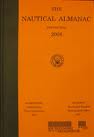
The Nautical Almanac is one of the longest-running publications in the Federal Government, dating back to 1852. It’s also one of the most distinctive-looking books I’ve ever seen.  The covers are orange and made of a stiff board-like material, and the cover graphics certainly look like they date back to 1852. Between those covers lie the complex mathematical tables that, “along with the chronometer, the sextant, a steady hand and a keen eye, are the resources needed to navigate by the stars.” Honestly, the contents mean less than nothing to a non-math person, but what images they conjure up for a history person! Old salts striding across a ship’s deck, sextant in hand, getting ready to round the Horn – well, you get the idea.

The Almanac is a unique example of a Government publication produced by two countries – the United States Naval Observatory (USNO) and Her Majesty’s Nautical Almanac Office (HNMAO). Also unique is that the U.S. part of the Almanac is in the public domain, but the British part is under Crown Copyright.

The Nautical Almanac is one of a number of almanacs published by the U.S. Naval Observatory: the Astronomical Almanac, the Air Almanac, and Astronomical Phenomena. Together, they provide a corpus of navigational knowledge that spans the centuries but is still the ultimate backup to the GPS technology of today.

I wonder if they’ll ever change those orange covers?