A Botanic Garden for the Nation: “National benefits to be derived from exploration”

September 20, 2011

Guest blogger Nancy Faget sheds some light on a little-known Federal agency.

It’s always interesting to see what kinds of things I can learn from a Government publication. For example, I just found out that President George Washington asked the city commission to incorporate a botanical garden into the plan for Washington, DC.  He suggested the square next to the President’s House as a possible site. But it was President James Monroe who passed the bill to set aside five acres on the National Mall for a national botanic garden.  Thus, a living museum of plants was created as an oasis on Capitol Hill.

This National Garden is a living laboratory which includes the Rose Garden, the Butterfly Garden, the Lawn Terrace, the First Ladies’ Water Garden, the Regional Garden, and an outdoor amphitheater.

The founders of the country had an understanding of plants and gardens as a national benefit.  In the beautifully produced A Botanic Garden for the Nation, published by the U.S. Botanic Garden, I learned many interesting facts that I didn’t expect to find. For example, Thomas Jefferson emphasized that the Lewis and Clark expedition should look for plants and vegetables.  The U.S. Exploring Expedition of 1842 also was charged partly with gathering plants and seeds from around the world.  As the expedition traveled 87,000 nautical miles charting oceans and coastlines, the botanists and naturalist aboard the ships collected plant and seed specimens.Although the color photographs in the book are spectacular, it’s also a fascinating read.  Here are some other bits I discovered:

  • The Botanic Garden houses more rare plants all the time as gifts are received from foreign governments and (incredibly) as a result of law enforcement actions!   When rare or endangered species are confiscated, they often are sent to the Botanic Garden for its collection.  For example, The Vietnamese orchid in the Garden’s collection was seized by U.S. Fish and Wildlife Service (FWS).  It’s now working with FWS and a commercial grower to produce marketable quantities of this orchid for sale and distribution to other public gardens.
  • The Garden also was established as an important plant rescue center for orchids and succulents.  Through a program, present species may be prevented from going extinct.  It has a production facility that works to propagate plants for exchange with other institutions.
  • In the Garden’s Medical Collection, visitors find the saw palmetto, from which fruits are studied to treat prostate cancer.  Turmeric is included in the collection because of the anti-inflammatory benefit.   In cultures where turmeric is used regularly, rates of Alzheimer’s disease are significantly lower.

Best of all, the photos of Bartholdi Park and the National Garden look so inviting, they make me want to grab A Botanic Garden for the Nation, sit in the sun, and just ponder the seasons!

You can buy your own copy for garden reading on the U.S. Government Online Bookstore, or find it in a library.


The Remarkable Stories of Women in Congress

August 11, 2011

When I was a kid, I would read from an old set of encyclopedias – just randomly, but with a predilection for famous and not-so-famous people. As a result, I still remember at least something about the lives of the Roman-era scholar-king Juba II of Mauretania, the Seneca chief and orator Red Jacket, the World War I field marshal August von Mackensen, and scads of other people.  It’s useless knowledge, I suppose, but it entertains me and is tolerated (mostly) by friends and family members.

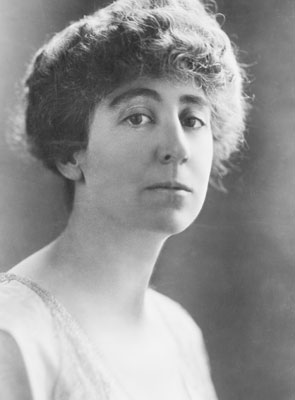
Given my fondness for small-scale biographies, a hefty reference work like Women in Congress, 1917-2006 could put me out of action for days. These meticulously researched biographies, including sources for further reading and a photograph of each Senate or House member discussed, are a treasure trove for fans of American politics and history and trivia buffs alike. Jeannette Rankin, the first woman elected to Congress and a life-long pacifist, voted against going to war withGermany in 1917, didn’t get elected again until 1940, and promptly voted her conscience again by opposing the declaration of war againstJapan after Pearl Harbor. Like the others in this book, Rankin was more than just a source for a Jeopardy question – in the 1960s, she was still marching for the causes she held dear.

Although many of those discussed in Women in Congress, especially prior to the 1960s, arrived via the “widow’s mandate” – succeeding their deceased husbands in office – many of them stayed to make significant careers on their own. Take Edith Nourse Rogers, for example. After being elected to her husband’s seat in the House of Representatives, this self-proclaimed “Republican by inheritance and by conviction” served 18 terms, noted for her advocacy on behalf of veterans, steadfast opposition to fascism in Nazi Germany andItaly, and dedicated anticommunism during the Cold War.

After World War II, Helen Gahagan Douglas, a former movie actress, was labeled “The Pink Lady” by an opponent targeting her liberal political views. She, in turn, enriched the language of American politics by dubbing her final opponent, Richard M. Nixon, “Tricky Dick.”

Millicent Fenwick, a fiscally conservative but independent Republican of the 1970s and 1980s, was the inspiration for the Lacey Davenport character in Garry Trudeau’s long-running Doonesbury comic strip)

Okay, I’d better stop or this post will never end. Every one of the entries in Women in Congress is worthy of mention, and I know a lot of you have your own favorites, but I just can’t do it all. Happily, you can browse as much as you want right here, get your own copy, or find it in a library.

Oh, and did you know that King Juba II of Mauretania married Cleopatra’s daughter?


Good Things in Plain Packages

July 8, 2011

Although I generally try to fight the stereotype of Government publications as weighty tomes with austere, distinctly non-decorative covers, I must admit that many worthy documents do come clad in such sober raiment.

Take, for example, Invest in Women, Invest in America: A Comprehensive Review of Women in the U.S. Economy. This publication of the congressional Joint Economic Committee, like many such documents, presents its material straightforwardly and unadorned except for an assortment of graphs and charts, all in black and white.  But the format is immaterial when matched against the importance of its subject. Indeed, the very sobriety with which the economic progress of American women, or lack thereof, is presented actually increases the credibility of its findings, at least for me.

One important message is that women have made significant economic strides over the last several decades. Yet certain persistent issues documented in this report – the pay gap, under-representation of women in top corporate jobs, and the problems of working mothers – still block the achievement of women’s economic equality.

Of course, the economic downturn of the last few years only serves to emphasize these issues. I was particularly interested in a survey that covered how employers were dealing with this. A surprisingly large percentage of employers said that they were actively helping their employees to cope with the recession and also maintaining flexible employment policies. I was also struck by number showing that without Social Security, far more older women than men would live in poverty.

Although various submissions within Invest in Women, Invest in America suggest possible solutions to the problems of women in our economy, I was most impressed by the depth and quality of the research, without which no really sound solutions are possible. Sober, serious, and detailed, this publication is a valuable resource for studying a complex and long-running social issue. You can read it here or here or get a copy here. It’s also available in libraries.


Looking at the Filibuster

December 23, 2010

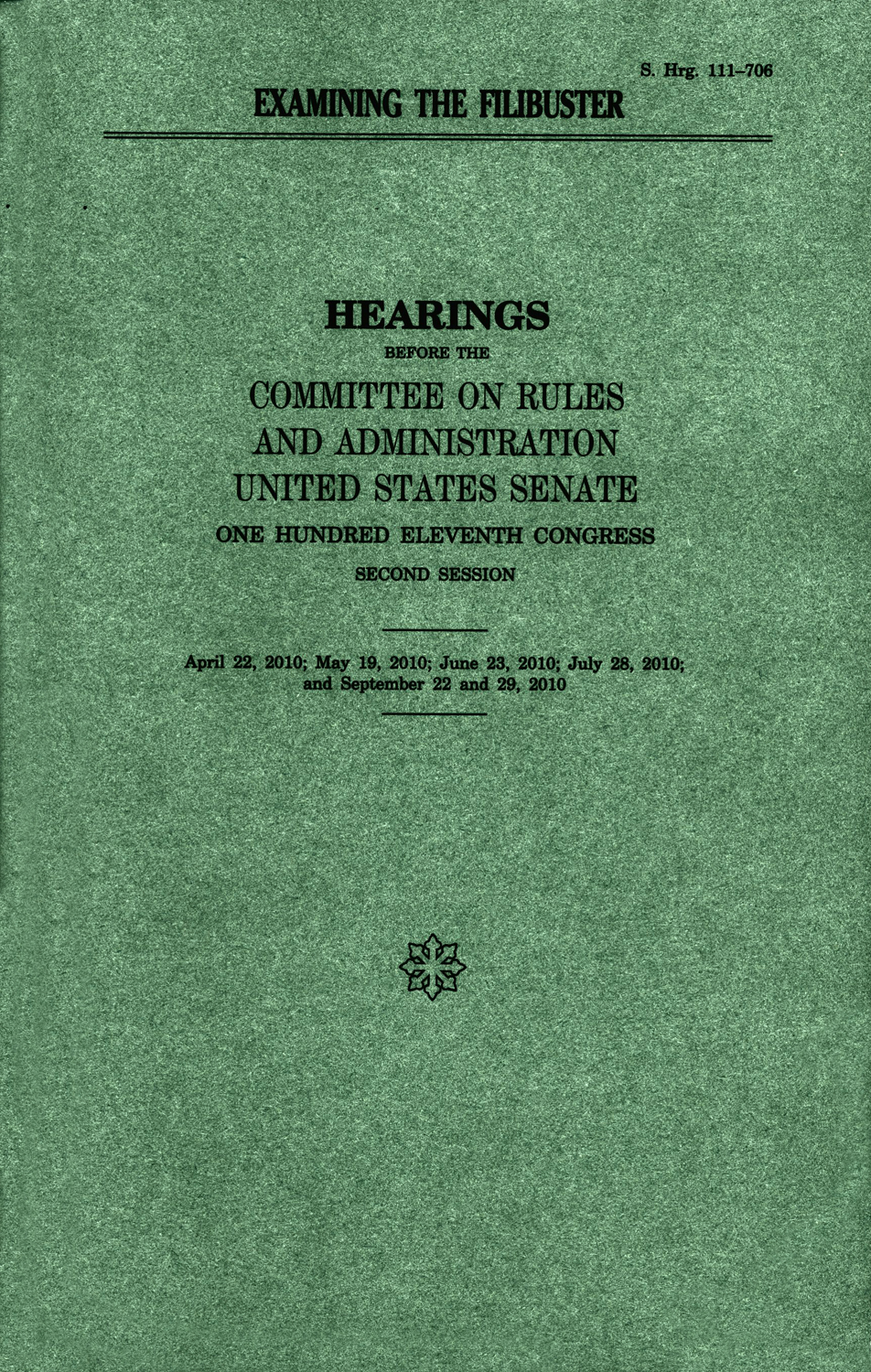
In some ways, Congressional hearings are like Jack Horner’s pie – you never know what kind of plums you’ll pull out of them. Take Examining the Filibuster: Hearings before the Committee on Rules and Administration, United States Senate, for example. As in most congressional hearings, you’ll find lots of polite and sometimes humorous byplay by various Senators, a certain amount of disagreement about the nature and value of the subject at hand, a raft of expert testimony by academics and technical experts, and additional statements by interested parties. That’s what makes it so interesting to flip through one, and why I decided to see what goodies I could extract for the delectation of Government Book Talk readers.

A plum: Apparently the filibuster was not erected by the founding fathers as a way to safeguard the rights of the minority and guarantee careful deliberation of legislation. Originally, both Houses of Congress included a “previous question motion” in their rule books, which still allows a House majority to cut off debate. In 1805, however, neither body used the motion in this way and, at the urging of Vice President Aaron Burr in his capacity as President of the Senate, the Senate eliminated the previous question motion from its rule book – apparently without any real discussion. Even so, it was not until 1837 that the first real filibuster occurred. Another plum: the late Senator Robert C. Byrd, even though he represented the majority in the Senate for much of his career, was a passionate defender of the filibuster, proving that such issues are not decided simply on the basis of party, or majority versus minority.

You’ll find many such gems in the 656 pages of Examining the Filibuster. In addition to a great deal of information on the filibuster, cloture votes, and other such congressional arcana, it’s heartening to note that a fair number of Senators actually participated in these hearings, taking the time to mull over and address whether the filibuster still serves a need in the Senate and engaging in a reasoned dialogue about it.

You can read Examining the Filibuster here, get your own copy here, or find it in a library – and enjoy your pie, plum pudding, or fruitcake and have a great holiday!


Senator Byrd and the Roman Republic

June 30, 2010

The passing of Senator Robert C. Byrd from the American political scene also marks the departure of a great American character. This fiddle-playing high school graduate who earned a law degree at night (in 1963) and a college degree via correspondence courses (in 1994) regularly quoted the Bible, the classics, and large swaths of memorized poetry on the floor of the Senate was also a historian of the institution he loved most: The United States Senate.

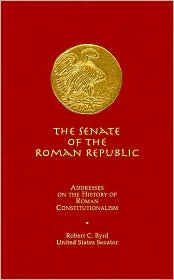
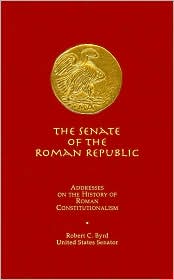
Curiously, his reverence for the Senate and fierce defense of its constitutional role resulted in a most remarkable Government book on ancient Rome: The Senate of the Roman Republic: Addresses on the History of Roman Constitutionalism. The roots of this book lay in Senator Byrd’s determined opposition to the idea of the line-item veto, which would grant the President the power to veto particular items in appropriations bills. Byrd viewed this proposal as usurping the Senate’s role and a threat to constitutional checks and balances. As a result, to quote Senate Historian Richard C. Baker’s Foreword, the Senator “initiated a series of fourteen addresses in opposition to the proposed line-item veto concept. During the following five and a-half months, he delivered each of the speeches – packed with names, dates, and complex narratives – entirely from memory and without recourse even to notes on consultation with staff aides.” (Italics in the original).

(Note: I knew Dick Baker when he was Senate Historian and asked him about the Senator’s role in writing both this book and his 4-volume The Senate: 1789-1989. He assured me that the Senator was indeed the author of these books, not just a speech reader.)

The Senate of the Roman Republic is replete with scholarly references to Polybius, Tacitus, and Montesquieu, as well as impassioned arguments against the line-item veto – surely a unique method of resisting encroachment on the rights of the Senate, and one we’ll not likely see again. Likewise, the departure of Robert Byrd, a man of the 20th century whose personality retained a bit of the flavor of the 19th, will leave Congress with a bit less color and zest.

You can browse in The Senate of the Roman Republic here, get a copy here, or find it in a library here.

To view a page listing all of Senator Byrd’s historical works, go here.


The Constitution: Pocket and Otherwise

May 28, 2010

Last week a Capitol Hill paper did a piece on the popularity of the United States Constitution as a publication and one of the news services picked it up. Although those of us who work at the Government Printing Office think of the “Pocket Constitution” authorized by Congress as the classic printed version, many other organizations also print and distribute copies, as the article points out. At least one other Federal Government agency does its own edition of the Pocket Constitution: U.S. Citizenship and Immigration Services (USCIS), as part of its effort to encourage immigrants to become citizens. Like the congressional edition, this little booklet throws in the Declaration of Independence as well.

All of this made me curious about how many editions of the Constitution currently appear in Federal documents of various sorts. It turns out there are quite a few.

Note: This is a totally unscientific and partial survey based on what I found in our online bookstore.

For those who can’t get enough of the Constitution and its interpretation, there’s the Constitution of the United States of America: Analysis and Interpretation, published every 10 years or so and weighing in at an imposing 9 pounds, six ounces, not counting the supplements issued to keep it up to date.  If you can’t wait to start reading, you can find it here.

For those of us who like to contemplate history’s “might have beens,” you can’t do better than The Constitution of the United States of America as Amended; Unratified Amendments; Analytical Index, which, in addition to the text of the Constitution, details about the ratification of each amendment to the Constitution, and an exhaustive index, discusses six other amendments that were submitted to the states for ratification but not adopted. You can read them here and find out which unratified amendment was the only one actually signed by the President.

Naturally, the Constitution is also included in the procedural manuals of the Senate and the House of Representatives. And don’t forget Interpreting Old Ironsides: An Illustrated Guide to the USS Constitution – oh, wait, that’s a different kind of vessel of democracy.

I think I’ve made my point, and I haven’t even touched on everything in our online bookstore, let alone what you could find through the vast resources of the Federal Depository Library Program. Maybe someone can put a list together before the Fourth of July…