Go-to Guide on Hazardous Materials for First Responders

November 2, 2012

After my electrical power was restored late last night in northern Virginia following Hurricane or Superstorm #Sandy, I was caught up with images of the devastation that has affected millions from the Caribbean up the East Coast and even to the Midwest of the United States. Even the first floor of my house where I used to live in New Jersey on the Hudson River across from Manhattan was flooded. (Our best wishes go out to everyone affected by the storm!)

As in so many emergencies, the heroes of Superstorm #Sandy are definitely the first responders from firemen, police, National Guard, and emergency medical personnel  who rushed to deal with emergency situations even while the storm was at its height. These first responders have to rush into extremely hazardous conditions, often with live power lines, broken gas lines, or work around sewage, spilled chemicals, or other pollutants, such as is happening in Hoboken, all while trying to save lives.

IMAGE: Hazmat personnel (at back in yellow) test contaminated water around half-submerged cars float in a flooded parking lot in the aftermath of Hurricane Sandy in New York City. (Credit: Justin Lane/EPA)

Published by the experts at Department of Transportation’s (DOT) Pipeline and Hazardous Materials Safety Administration (PHMSA) in conjunction with Transport Canada, the Emergency Response Guidebook 2012 is the newly updated guide for use by transporters, firefighters, police, and other emergency services personnel who may be the first to arrive at the scene of a transportation incident involving a hazardous material or “Hazmat” as it is usually referred to in the United States.

The Emergency Response Guidebook 2012, or ERG as it is known popularly to those who use it, provides first responders with a go-to manual to help deal with hazmat accidents during the critical first 30 minutes. PHMSA’s goal is to place one of these ERGs into every emergency service vehicle nationwide.

While the subtitle is: “A Guidebook for First Responders During the Initial Phase of a Dangerous Goods/Hazardous Materials Transportation Incident,”  it can be used during any emergency incident where hazardous materials are present.

The Guidebook is organized to provide first responders individual pages or guides on how to deal with each kind of hazardous material. It recommends a three-step process:

  •  STEP ONE: Identify the HAZARDOUS MATERIAL by finding either the Name of the Material or the Identification Number (4-DIGIT ID after UN/NA) of the material from a placard or orange panel on the container or from the shipping paper or package.
  • STEP TWO: Identify the 3-digit GUIDE NUMBER in this guidebook that corresponds to the material name or number.
  • STEP THREE: Follow the GUIDE INSTRUCTIONS carefully on the corresponding orange-bordered numbered guide page.

IMAGE: Fully-suited hazardous materials first responders at a chemical spill drill.  The 4-digit Hazardous Material Identification Number 2880 is clearly shown on a placard on the tanker. Credit Guy McCarthy

How to use the ERG 2012

Here is the cross-reference to the Guide number to follow for the above hazardous material # 2880, which we find is Calcium hypochlorite, corresponding to Guide number 140 in the ERG.

IMAGE: Cross-reference for hazardous material ID number to the ERG Guide number.

Looking up Guide number 140, we find that water is to be used to deal with this particular material, not dry chemicals or foams such as from fire extinguishers. Each Guide page also discusses how to handle small or large fires of this material, fires involving whole tanks for trailer loads, spills or leaks of this material, and first aid for anyone injured by this substance.

The ERG 2012 also provides guidance for responding when the hazardous material is unknown, with a Table of Placards and Emergency Response Guide to Use On-Scene.

Whom do the first responders call?

Since first responders can’t have the answers to every time of hazardous material incident, the guide provides a list of toll-free, 24-hour emergency response hotlines to call for the United States and U.S. Virgin Islands, and numbers to call for incidents involving military shipments with explosives, ammunition or other dangerous goods, as well as CBRN (Chemical-Biological-Radiological-Nuclear) incidents and terrorist or criminal incidents involving IEDs (improvised explosive devices), pipe bombs, car bombs, suicide vests and more . It also includes numbers for all provinces in  Canada, including bilingual French-English phone numbers, and hotline numbers for Mexico, Argentina, Brazil and Colombia.

And finally, a terrific glossary of terms helps decipher some of the jargon.

Firemen, bomb squads, CBRN teams, police, emergency medical personnel, military police and other first responders  have a hard enough job to do without risking their lives dealing with broken pipelines, overturned tankers, bombs, spills, and other hazardous materials. Fortunately the Department of Transportation provides this excellent tool to help keep them—and us—safer. That’s something we can all respond to.

HOW DO I OBTAIN Emergency Response Guidebook 2012”?

  • Buy a print copy online 24/7 at GPO’s Online Bookstore. NOTE: Save 60% off the original price of $28. Now only $10.
  • Buy it at GPO’s retail bookstore at 710 North Capitol Street NW, Washington, DC 20401, open Monday-Friday, 9am to 4pm, except Federal holidays, (202) 512-0132.

Find this and other books for Emergency Management and First Responders under the Security, Defense & Law Enforcement category on our new online bookstore.

About the Author:  Michele Bartram is Promotions Manager for GPO’s Publication and Information Sales Division in Washington, DC, and is responsible for online and offline marketing of the US Government Online Bookstore (http://bookstore.gpo.gov) and promoting Federal government content to the public.


Owlie Skywarn helps us all prepare for bad weather

October 26, 2012

With the threat of an unusual “Frankenstorm” pre-Halloween hurricane possibly combined with a blizzard about to hit the East Coast in the next few days, I found myself with a dozen others at the store last night buying batteries, flashlights and bottled water. Next to me was a mother with two small children, one of whom asked loudly, “Mommy, why is everybody buying batteries and water?” I chuckled to myself as I looked at the frazzled adults and wondered how she’d explain what the fuss was about. With the rise in severe weather events in the United States and the related rise in media coverage about these creating anxiety in both young and old, parents and teachers have a lot of “‘splaining” to do to children.

NOAA Owlie Skywarn's Weather BookFortunately, NOAA, the National Oceanic and Atmospheric Administration, in conjunction with FEMA (the Federal Emergency Management Association) and the American Red Cross, have prepared a terrific new booklet, Owlie Skywarn’s Weather Book, to explain different types of severe weather and how to prepare for each.

Although formatted to appeal to children, with “Owlie Skywarn” the cartoon weather owl introducing topics on most pages, this booklet is valuable for all ages.

The book covers the gamut of severe weather, from hurricanes and tornadoes to lightning, floods and winter storms.

For each type of weather, Owlie explains what it is, what kind of alerts or warnings may be issued and by whom, how to prepare in advance (if possible), and how to react while it is happening. For example, a great page illustrates a car safety kit every driver should have if he or she lives in places that get deep snow. Still other pages tell you where to go and how to protect yourself when a tornado warning is issued by NOAA’s National Weather Service, or over the Emergency Alert System, whether at home, school, office, store, outdoors or in a car.

Sprinkled throughout are anecdotes from real people and towns that make the advice come alive. One is the story of a retired National Park Ranger who has been struck by lightning seven times and lived to tell the tale (albeit now with lightning rods all over his home). Yikes! Fascinating (and intimidating) weather facts are included like the fact that the most snow in one month in the United States actually fell in Tamarack, California, in 1911: a whopping 32.5 feet or 390 inches (or 10 meters for our non-US readers)!

At the end of the book are quizzes and activities that can be used by a family at home or teachers in school with children to help ensure the lessons get through that severe weather is not to be played with.

My recommendation to parents, teachers, well, really everyone is get a copy of Owlie Skywarn’s Weather Book, read it, prepare, and keep it with your other extreme weather supplies. These are lessons worth repeating often. I’ve got my copy with my spare batteries and my NOAA weather emergency radio.

P.S. And to that mother in the flashlight and batteries aisle preparing for Hurricane Sandy: You will be happy to know that the answer to your daughter’s question about why everyone is buying batteries and water can be found on page 6.

HOW DO I OBTAIN Owlie Skywarn’s Weather Book”?

  • Buy it online 24/7 at GPO’s Online Bookstore.
  • Buy it at GPO’s retail bookstore at 710 North Capitol Street NW, Washington, DC 20401, open Monday-Friday, 9am to 4pm, except Federal holidays, (202) 512-0132.

Find this and other books about Weather and Climate on our new online bookstore.

About the Author:  Michele Bartram is Promotions Manager for GPO’s Publication and Information Sales Division in Washington, DC, and is responsible for online and offline marketing of the US Government Online Bookstore (http://bookstore.gpo.gov) and promoting Federal government content to the public.


Hawks vs. Doves: The Joint Chiefs and the Cuban Missile Crisis

October 18, 2012

50 years ago this week, the world stood on the brink of nuclear war as the Cuban Missile Crisis unfolded. The United States finally decided to first blockade rather than immediately attack Cuba to prevent the Soviet Union from finishing installation of missiles that could reach the continental United States. This article introduces the little-known story of the battles between the “hawks” and the “doves” in the Kennedy Administration as related in a new publication, The Joint Chiefs of Staff and National Policy, Vol. 8, 1961-1964.

When President John F. Kennedy finally announced the naval blockade of Cuba and the reasons for it on national television, Americans huddled together, practiced nuclear drills, and prayed for some peaceful solution to prevent all-out nuclear war. Only decades later did the full story of brinkmanship, bravado and brilliance come out about what really happened behind the scenes during those two weeks.

Image Credit: The Arizona State Library, Archives and Public Records

A little known side of the story comes from the top military commanders who were serving the Kennedy administration during the crisis, found in the surprisingly fascinating book titled The Joint Chiefs of Staff and National Policy, Vol. 8, 1961-1964, from the Office of Joint History of the Joint Chiefs of Staff.

The Joint Chiefs of Staff during the Kennedy Administration

This accounting of the Joint Chiefs of Staff during this tumultuous period in the history of American foreign affairs goes beyond the normal third party historian’s post mortem, since the author was actually able to meet with several members of the joint chiefs in the 1970’s to add more of their personal insights, including Admiral Arleigh Burke, Admiral George Anderson, General Lyman Lemnitzer, Chairman during 1960-1962, and the Chairman who succeeded him, General Maxwell D. Taylor.

Image: President John F. Kennedy meets with the Joint Chiefs of Staff. Photograph includes: (L-R) United States Marine Corps General David Shoup; United States Army General Earle Wheeler; United States Air Force General Curtis LeMay, President Kennedy; Chairman of the Joint Chiefs of Staff General Maxwell Taylor; United States Navy Admiral George Anderson. West Wing Lawn.  White House. Washington, D.C. Credit: Robert Knudsen. White House Photographs. John F. Kennedy Presidential Library and Museum, Boston

What results is an interesting amalgam of history and a peek into the tensions between military joint chiefs and the civilians to whom they reported. Describing the relationship of the Kennedy administration and the military establishment, author Walter S. Poole says: “During 1961-1962, relations between the JCS and their civilian superiors were often awkward and even confrontational” particularly between Secretary of Defense Robert S. McNamara and Lemnitzer.

The old-school Joint Chiefs were concerned about the new approach to foreign policy being espoused by the Kennedy administration, and tensions grew. According to the author:

“What most concerned the JCS was an apparent erosion of US credibility that emboldened communist leaders to pursue more adventurous policies. President John F. Kennedy and Secretary of Defense Robert S. McNamara pursued what they conceived as more flexible approaches to strategy and crisis management.”

Quick Background on the Cuban Missile Crisis

In 1962, the Soviet Union was losing the arms race with the United States. In late April 1962, Soviet Premier Nikita Khrushchev conceived the idea of placing intermediate-range missiles in Cuba to double the Soviet strategic arsenal and provide a real deterrent to a potential U.S. attack against the Soviet Union from the Jupiter missiles the U.S. had just placed in Turkey.  Ever since the failed Bay of Pigs invasion the previous year, Fidel Castro felt a second attack by the U.S. on Cuba was inevitable, so he agreed to host the missiles as protection.

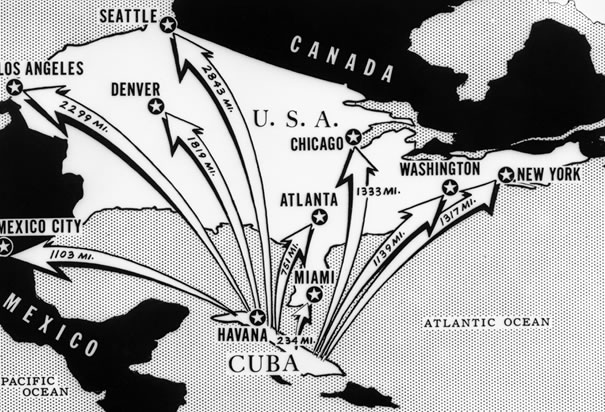
Image: Initial U.S. intelligence estimates of possible U.S. targets within range of the nuclear-capable Soviet SS-4 medium-range ballisticmissiles (MRBMs) and SS-5 intermediate-range ballistic missiles (IRBMs) found by the U-2 spy plane surveillance photographs if they were launched from Cuba.  Credit: Bettmann/CORBIS

On October 15, 1962, the National Photographic Intelligence Center confirmed that secret reconnaissance photographs from an American U-2 spy plane flight the day before were finally able to definitively prove the suspicion that Soviet medium-range and intermediate-range ballistic missiles capable of hitting Atlanta, the Midwest, Washington, DC, and even Los Angeles and Seattle were indeed in place and in the process of being installed and ready in Cuba within days. In response, President Kennedy and Secretary McNamara assembled the Executive Committee of the National Security Council call “ExComm” as a task force that, together with the Joint Chiefs of Staff and experts from the State Department and other intelligence agencies, would debate the United States’ options to deter the Soviets from nuclear escalation.

To Blockade, Strike or Invade?

Earlier in September 1962, after cloud-obscured U-2 photos had hinted at Soviet build-up in Cuba, the Joint Strategic Survey Council had submitted a recommendation for blockading rather than invading Cuba, on grounds that a blockade would be less dramatic, require smaller resources, cause fewer casualties, and be more plausibly related to upholding the Monroe Doctrine. In his 1823 annual message to Congress, President James Monroe had established this doctrine followed by the U.S. ever since that warned European countries not to interfere in the Western Hemisphere, stating “that the American continents… are henceforth not to be considered as subjects for future colonization by any European powers.

However, as the crisis unfolded, the primary debate among the military commanders of the Joint Chiefs was over whether to carry out an all-inclusive attack against Soviet and Cuban forces on the island or a surgical strike confined to just attacking the missiles themselves, the nuclear storage sites, and Soviet MiG planes.

Both President Kennedy and McNamara thought that an all-inclusive attack would inevitably lead to invasion of Cuba, and then possible counter-attacks elsewhere by the Soviets or escalation to all-out war.

But General Taylor reported that the Joint Chiefs and the combatant commanders felt “so strongly about the dangers inherent in [only] the limited strike that they would prefer taking no military action. They feel it’s opening up the United States to attacks which they can’t prevent, if we don’t take advantage of surprise.” Taylor added that his personal inclination was “all against invasion, but nonetheless trying to eliminate as effectively as possible every weapon [present in Cuba] that can strike the United States”.

According to the reports by the author, the Joint Chiefs were opposed to only attacking the medium-range ballistic missiles themselves, saying it would incur “an unacceptable risk” and that not attacking the enemy’s planes would expose the continental United States and Puerto Rico to air attack and could cause unnecessary casualties among the garrison at Guantanamo and the forces assembling for invasion.  Instead, the JCS initially recommended “also hitting tactical missiles, aircraft, ships, tanks, and other appropriate targets, as well as imposing a ‘complete’ blockade.


Image: A meeting of the Executive Committee of the National Security Council in the Cabinet Room during the Cuban Missile Crisis, October 29, 1962, 10:10-10:58am. Clockwise from left: Attorney General Robert F. Kennedy (standing); Assistant Sec. Defense Paul Nitze; Dep. USIA Dir. Donald Wilson; Special Counsel Theodore Sorensen; Exec. Sec. NSC Bromley Smith; Special Assistant McGeorge Bundy; Sec. Treasury Douglas Dillon; Vice President Lyndon B. Johnson; Ambassador  Llewellyn Thompson; William C. Foster; CIA Dir. John McCone (hidden); Under Secretary of State George Ball (hidden); President John F. Kennedy; Sec. State Dean Rusk; Sec. Defense Robert McNamara; Dep. Sec. Defense Roswell Gilpatric; Chairman JCS Gen. Maxwell Taylor. Credit: Photo by Cecil Stoughton, JFK Library ST-A26-18-62

The Blues vs. the Reds

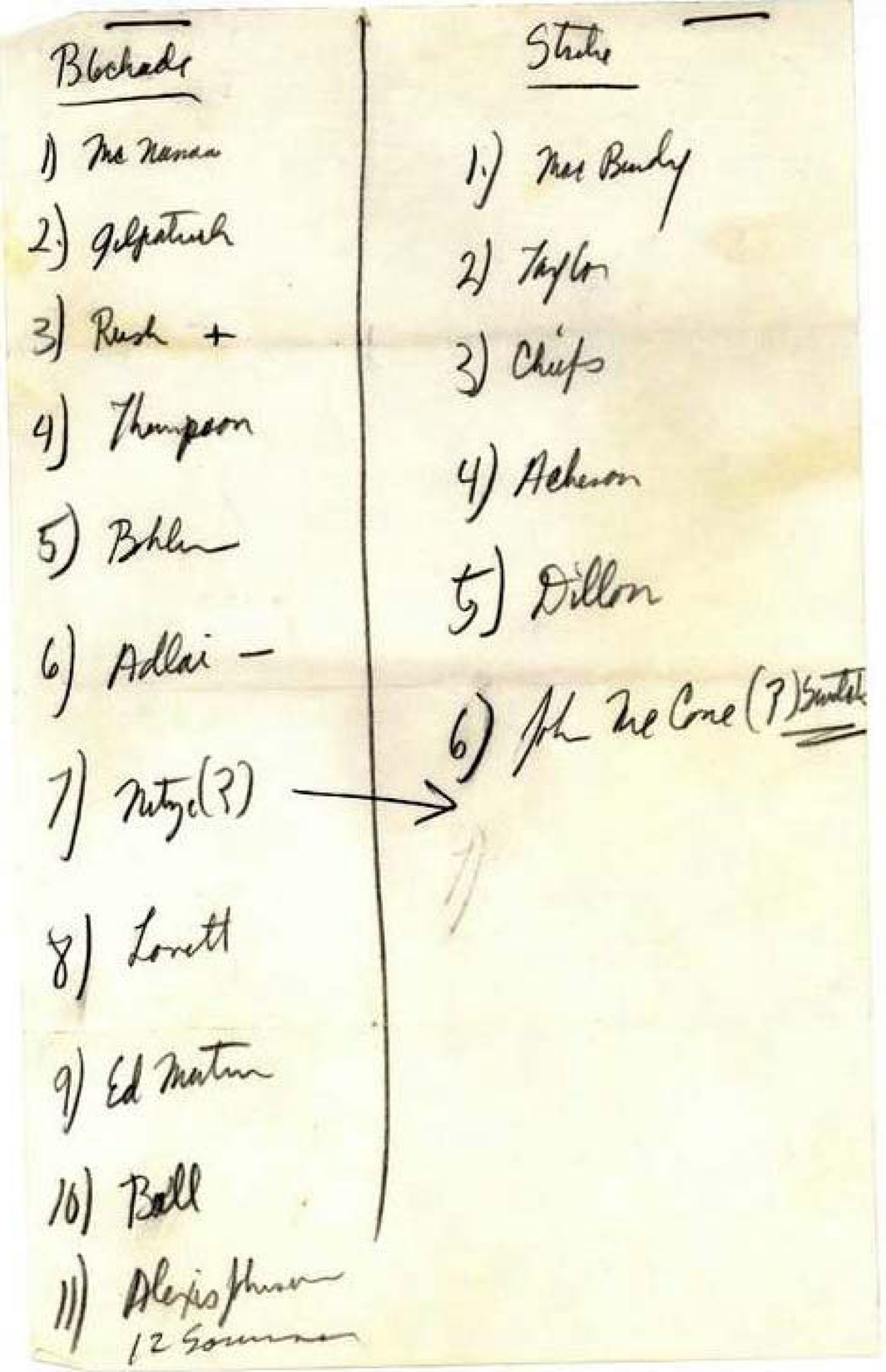
Even more fascinating was the story of the war gaming techniques used. To quickly develop two alternative scenarios for the President to consider, the ExComm task force split into two groups that constantly exchanged position papers and critiqued each other’s work. The “Blues,” who were to prepare the scenario for a surprise air strike, included General Maxwell Taylor, Robert Kennedy, Treasury Secretary Douglas Dillon, Director McCone, Dean Acheson, and McGeorge Bundy. The “Reds,” drafting the blockade option, included Chief of U.S. Naval Operations Adm. George Anderson, Marine Corps Commandant David Shoup, Secretary Rusk, Deputy Secretary Gilpatric, and Theodore Sorensen.

Image: On October 11 last week, certain documents from Attorney General Robert F. Kennedy’s personal papers about the Cuban Missile Crisis were declassified. In it was the above personal list of who RFK thought among the ExComm were the “Hawks” who favored an air strike (shown in the right column labeled “Strike”) vs. the “Doves” who favored a blockade of Cuba (in the left column). Note that the “Chiefs” meaning the Joint Chiefs of Staff along with General Taylor are shown on the “Hawks” Strike side of his list on the right.  Source: The National Security Archive

In less than two days, two complete scenarios were prepared and presented to President Kennedy on October 20, with competing input coming from the Pentagon and the State Department.

From this insider accounting of events, we learn that the Chairman thought that the probable sequence of events to be green-lighted would be: a political approach; a warning; air attack on the missile sites; blockade; and, if necessary, invasion, with the earliest air strike date set for October 21 (optimally the 23rd), and an invasion to begin on October 28.

However, to find out exactly what happened and how the drama played out behind the scenes, pick up a copy of this fascinating book.

HOW DO I OBTAIN The Joint Chiefs of Staff and National Policy, Vol. 8, 1961-1964”?

  • Buy it online 24/7 at GPO’s US Government Online Bookstore.
  • Buy it at GPO’s retail bookstore at 710 North Capitol Street NW, Washington, DC 20401, open Monday-Friday, 9am to 4pm, except Federal holidays, (202) 512-0132.

Find this and other Government publications about Cuba in our Cuba collection.

About the Author:  Michele Bartram is Promotions Manager for GPO’s Publication and Information Sales Division and is responsible for online and offline marketing of the US Government Online Bookstore (http://bookstore.gpo.gov) and promoting Federal government content to the public.


Exporting Made Simple

October 2, 2012

Guest blogger, GPO Public Relations Specialist Emma Wojtowicz, reviews the newly revised edition of the best-selling publication on exporting for U.S. businesses.

The U.S. Government Printing Office (GPO) entered the eBook market through an agreement with Google in December of 2010. Since that time, GPO has expanded its eBook distribution partnerships to include Apple, Google, Barnes & Noble, OverDrive, Ingram, Zinio digital magazines, and other online vendors to make Federal titles available in digital magazine or eBook format.

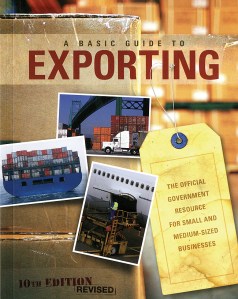
One popular title that is available in eBook format through many of our vendors as well as in print format is the 10th Edition Revised “A Basic Guide to Exporting”, a publication by the Department of Commerce. This publication supports President Obama’s National Export Initiative (NEI), which brings together the efforts of the public and private sector to increase U.S. exports. According to the U.S. Secretary of Commerce Gary Locke, 95 percent of the world’s consumers exist outside of the United States, and only 1 percent of the U.S.’s 30 million companies export their goods to these other markets.

A Basic Guide to Exporting is a how-to guide for small and medium-sized business to export their products. The publication is broken down into 17 chapters with each chapter focusing on one step of the exporting process from determining if exporting is right for your business to placing your products in foreign markets. The book defines export-related terminology so each topic is clear. Many questions are asked forcing the reader to assess each topic and thoroughly evaluate if exporting will work for them.

The book is also motivational; each chapter ends with a case study or profile of a successful company reflecting on their export experience identifying challenges, solutions, and lessons learned.

The book does not provide all of the answers, but serves as a central resource for how to export. There are many Government agencies, trade centers and associations, financial institutions, and seminars that exist and are available to give advice and guide companies. The publication lists each of these resources, explains their services and how they can be helpful, and provides website links and phone numbers for contacting each resource.

Forms are often a complicated part of any process – including exporting – and this publication is very helpful with forms. When referencing forms that may need to be filled out, the book includes a picture of the form and explains how to fill it out item by item. This book is the Government’s version of “Exporting Made Simple.”

A Basic Guide to Exporting is usable in eBook format because the information is broken down and well-organized making it easy to navigate on any mobile device or eReader. The eBook format is helpful because there are websites listed for outside resources and the reader can click on the websites and directly access the resource’s web page.

Regardless of what format is used to read this publication, A Basic Guide to Exporting is excellent guide for small and medium sized companies interested in learning how to export their products.

Other popular export-related Federal publications including a subscription to the latest regulations concerning import/ export can be found on our Essential Publications about Exporting collection.

HOW DO I OBTAIN “A Basic Guide to Exporting”?

  • Buy it at GPO’s retail bookstore at 710 North Capitol Street NW, Washington, DC 20401, open Monday-Friday, 9am to 4pm, except Federal holidays, (202) 512-0132.
  • Find it in a library.

Quiz: Are you smarter than an 8th grade Civics student?

September 20, 2012

Flash cards. They may bring back memories of studying for a big exam like the SAT or GRE, or they may remind you of elementary school when they were used as a great way to learn your numbers and letters.

But did you know that the US Government Printing Office produces flash cards for the U.S. Citizenship and Immigration Services’ Office of Citizenship under the Department of Homeland Security?

This week marked an important milestone for all U.S. citizens as the 225th anniversary of the signing of the Constitution of the United States of America.

September 17 is now commemorated annually as Constitution & Citizenship Day, a time to reflect on the rights, honors and privileges of being a U.S. citizen, so I thought it was a perfect time to introduce our readers to the Civics Flash Cards.

The Civics Flash Cards are one of the most popular products sold in the US Government Bookstore as a tried and true way for immigrants and to learn about U.S. history and government while preparing for the United States naturalization test.  These easy-to-use flash cards (available in English and now also in Spanish) contain each of the 100 civics questions and answers contained on the United States naturalization test, and are updated when there is a change of leadership in the White House or Congress.

The Civics Flash Cards also feature interesting historical photos and relevant captions, thus providing additional civic learning opportunities, making them ideal not only for use as an instructional tool for U.S. citizenship preparation, but also in standard American social studies classes or home schooling. For example, one card contains a picture of Jeannette Rankin, the first woman to be elected to the U.S. House of Representatives, while another shows Hiram Revels of Mississippi, the first African American U.S. Senator, elected in 1870.

A description of the Spanish version of the Civics Flash Cards:

Recién actualizadas para 2012, las Tarjetas Flash de Educación Cívica en Español ayudarán a a los inmigrantes a aprender sobre la historia de los EE.UU. y del gobierno mientras se preparan para el exámen de naturalización. Estas tarjetas de memoria fáciciles de utilizar contienen cada una de las 100 preguntas y respuestas cívicas (sobre la historia y el gobierno) del exámen de naturalización estadounidense, y conllevan fotos históricas y leyendas pertinentes a que proporcionen el aprendizaje cívico adicional.

Failing grade in civics for American kids… and maybe their parents?

In 2010, The Department of Education administered the National Assessment of Educational Progress or NAEP test, known as the nation’s report card, to 27,000 4th-, 8th- and 12th-grade students throughout the United States.

The New York Times reported that the civics examination results were dismal, as “fewer than half of American eighth graders knew the purpose of the Bill of Rights… and only one in 10 demonstrated acceptable knowledge of the checks and balances among the legislative, executive and judicial branches.

Of the high school students who took the NAEP, 75% “were unable to demonstrate skills like identifying the effect of United States foreign policy on other nations or naming a power granted to Congress by the Constitution.”

Reading through the flash cards, it makes me wonder how many native U.S. citizens— parents and children— could correctly pass the test given to immigrants aspiring to become citizens?

See how you compare to these 8th and 12th graders on these questions constructed from information on the Civics Flash Cards

(Hint: I provide the correct answers at the end of this post 😉 since they are trickier than one would think!)


Another question


And finally, some geography:

HOW CAN YOU OBTAIN a copy of the Civics Flash Cards for the Naturalization Test, either the English Version or the Spanish Version?

You may also be interested in our other Constitution and Citizenship products, such as the pocket edition of the Constitution and Declaration of Independence. Click here to shop our entire Citizenship Collection.

Correct Answers to the Flash Card Poll Questions:

1)      Which of these does NOT represent one of the powers of the Federal Government under our Constitution? To provide protection & safety such as police and fire services is a function of state and local governments.

2)      Which of these are responsibilities that are only for United States Citizens?  Only citizens may vote in a Federal election, serve on a jury, or run for Federal office such as U.S. Senate or House of Representatives and for most state and local offices. Unfortunately, everyone has to pay Federal taxes, citizen or not!

3)      Which of these states does NOT border Canada? Of all of these, only Wisconsin does not share a border with Canada. All the international border states with our northern neighbor are (east to west): Maine, New Hampshire, Vermont, New York, Pennsylvania (border on Lake Erie), Ohio (also border on Lake Erie), Michigan, Minnesota, North Dakota, Montana, Idaho, Washington and Alaska.

About the Author:  Michele Bartram is Promotions Manager for GPO’s Publication and Information Sales Division and is responsible for online and offline marketing of the US Government Online Bookstore (http://bookstore.gpo.gov) and promoting Federal government content to the public.


Social Security Facts and Figures

September 10, 2012

Guest blogger, GPO Public Relations Specialist Emma Wojtowicz, reviews a new publication giving the “Fast Facts & Figures” about the U.S. Social Security System.

The Federal Government offers many publications to educate and inform the public. If there is a topic that interests you or that you want to learn more about, Government publications are a great resource. Not all publications are long, dense and written as legal briefs.

Fast Facts & Figures About Social Security, 2011 is a 36-page booklet that accomplishes what the title suggests – providing readers with fast facts and figures about Social Security.

Social Security is always a hot topic with election-year fact checkers, and this annual publication does a good job breaking down the information so the reader can understand and better grasp this important topic.

The introduction describes the publication as a “chartbook” which it is with at least one chart, graph, or table on each page. This is a smart way to present the information because it allows the reader to gain a lot of knowledge from just scanning each page.

Like most Government-related publications there are many acronyms that readers are not familiar with, luckily, this publication includes a list of abbreviations and acronyms on the second page which is helpful for understanding the content, such as OASI which stands for Old-Age and Survivors Insurance.

The data focuses on Social Security programs for retired workers and their dependents, disabled workers and their dependents, and survivors of a deceased worker, which benefits or assists over 59.2 million Americans.

Here are some of noteworthy Social Security facts and figures for 2011:

  • Of all adults receiving monthly Social Security benefits, 44% are men and 56% are women.
  • The recipients of Social Security benefits are  64% retired workers, 15% disabled workers, 12% survivors of decreased workers, and 9% dependents of a retired or disabled worker.
  • The average Social Security benefit for a worker who retires at full retirement age is $1,176 per month, and the maximum Social Security benefit a worker who retired at full retirement age can receive is $2,366 per month.
  • The average Social Security benefit for the children of a deceased worker is $750 per month.
  • Social Security is financed from three sources: 82% from payroll taxes, 15% from interest earned on Government bonds held by trust funds, and 3% from income taxes on Social Security benefits.
  • For 73% of single elderly (nonmarried aged) beneficiaries (and 54% of elderly couples receiving benefits) in 2011, Social Security provided at least 50% of their total income. Social Security benefits make up over 90% of the total income for 43% of single elderly recipients (and 22% of elderly couples), making Social Security benefits a critical source of monthly income for them to live on (See image below).

The one downside to this publication is that is does not thoroughly explain how Social Security benefits are calculated for recipients; there is a benefit formula, but it is not easy to understand. Despite that negative, the publication provides thorough data in an easy to read format that helps familiarize readers with Social Security.

HOW MAY I OBTAIN “Fast Facts & Figures About Social Security, 2011”?

  • Buy it online 24/7 at GPO’s US Government Online Bookstore.
  • Buy it at GPO’s retail bookstore at 710 North Capitol Street NW, Washington, DC 20401, open Monday-Friday, 9am to 4pm, except Federal holidays, (202) 512-0132.
  • Find it in a library.

US Geological Survey and the Science of Hurricanes

August 30, 2012

Having family and friends who live on the coastlines of North Carolina, South Carolina, Florida, and the Gulf Coast, I find myself glued to the weather stations following the latest hurricane reports whenever late August rolls around.

Today, folks along the Gulf Coast and particularly Plaquemines Parish outside of New Orleans are dealing with the wind and flood damage of slow-moving Hurricane Isaac that made landfall on the seventh anniversary of the devastating Hurricane Katrina on August 28, 2005.

Image: Advance projection of the track of Hurricane Isaac as of August 27, 2012, vs. Katrina in 2005. Source: University of Miami/ Rosenstiel School of Marine & Atmospheric Science 

Thus, it seems like a good time to talk about the great work of the U.S. Geological Survey (USGS) and their role in hurricane response and prediction of their impact.

The USGS Mission

The USGS is a bureau of the US Department of the Interior and its mission is to “provide the Nation with reliable, impartial information to describe and understand the Earth. This information is used to minimize loss of life and property from natural disasters; manage water, biological, energy, and mineral resources; enhance and protect the quality of life; and contribute to wise economic and physical development.”

The Natural Hazards part of the USGS mission sounds like the latest natural disaster movie script from Hollywood where the brilliant scientist comes in with the latest findings of pending disaster and how to avert it (Quite often, that “brilliant scientist” comes from USGS.)

The USGS Natural Hazards mission areas include:

The Coastal and Marine Geology Program conducts research on changes in the coastal and marine environment, whether naturally occurring or human induced. Contributing to the Natural Hazards mission, the program supports research on marine geohazards including earthquakes, tsunami, and underwater landslides, and on coastal change hazards from sea-level rise, erosion, and extreme storms including hurricanes.

Typical USGS Hurricane Support

While the National Oceanic and Atmospheric Administration (NOAA) and its National Weather Service is responsible for tracking and predicting the course of hurricanes (See the National Hurricane Center), the USGS’s research “focuses on understanding the magnitude and variability of the impacts of hurricanes and extreme storms on the sandy beaches of the United States. The overall objective is to improve the capability to predict coastal change that results from severe storms” and to “support management of coastal infrastructure, resources, and safety.

USGS science helps identify areas that may need to be evacuated due to their extreme vulnerability to hurricanes or where preventive measures are needed to mitigate some of their damaging effects.  When hurricanes strike, you can find critical information to help protect lives and property at the U.S. Geological Survey (USGS) hurricane website.

After all, according to the U.S. Geological Survey, “More than half of the U.S. population lives within 50 miles of a coast—and coastal populations are increasing. Many U.S. coastal areas, especially the Atlantic and Gulf coasts, will be in the direct path of hurricanes.”

USGS Response to the Hurricanes of 2005

Science and the Storms: The USGS Response to the Hurricanes of 2005 reports on the many and varied activities performed by the USGS in response to the four major hurricanes—Dennis, Katrina, Rita and Wilma— that hit the United States during that year.  Topics vary from flooding and water quality to landscape and ecosystem impacts, from geotechnical reconnaissance to analyzing the collapse of bridges and estimating the volume of debris caused by the hurricanes.

From the report we learn that some of the tasks performed by USGS were routine for them. After all, as employees of the Nation’s largest water, earth, and biological science and civilian mapping agency, USGS scientists have been studying hurricanes and hurricane-related impacts for decades:

[USGS scientists] have measured and studied flooding and water quality. They have used the latest technology—from satellite imagery and geographic information systems to lidar (light detection and ranging)—to view and analyze damage to the barrier islands and coastal wetlands that protect people and property. They have examined the effects of hurricanes on land, water, vegetation, and wildlife.

But the impact of the extraordinary 2005 hurricane season on the United States required a new level of study. It was a season of unfortunate hurricane “firsts” from the first year with: 13 hurricanes, 4 hurricanes of them hitting the U.S.,  and with 3 of them Category 5. This led the USGS scientists to perform “dozens and dozens of other studies that hurricane season,” including the following:

  • Examining the cycles of hurricanes and their relation to sea water surface temperature.
  • Looking at oil slicks and chemicals in the flood waters and the sediments in and around New Orleans
  • Studying the flood protection systems in New Orleans and surrounding areas.
  • Recording the effects of the hurricanes on manatees off the coast of Florida and on birds whose fall migration was disrupted by these ferocious storms.
  • Analyzing the destruction of bridges and measuring debris.
  • Studying the landscape of the Gulf Coast and measuring the enormous changes due to hurricane winds and flooding.

Chapter 1:The Need for Science in Restoring Resilience to the Northern Gulf of Mexico is an essay establishing the need for science in building a resilient coast.

Chapter 2: The Storms of 2005, includes some hurricane facts that provide hurricane terminology, history, and maps of the four hurricanes’ paths. Chapters that follow give the scientific response of USGS to the storms with the analysis and findings, including:

Chapter 3: Rescue and Response,  documents the U.S. Geological Survey’s (USGS) humanitarian rescue operations as well as its scientific responses to assess damages from the hurricanes, from the Mississippi River flood-protection system and bridges and to assess the coastal debris, oil slicks, and flooding in New Orleans.  Rescue operations by USGS personnel included boat rescue, delivery of food and water to isolated communities, and the geoaddressing of 911 calls, which merited the USGS a Service to America Medal award.

This was one of the more interesting stories in the book, showing how important fast-acting science can be in an emergency. As New Orleans’ streets flooded, emergency response officials suddenly realized that water rescue in a major metropolitan area was not a contingency they had planned for and that many emergency responders could not locate specific streets if they were all underwater, unrecognizable, or unfindable. Thus, the U.S. Geological Survey (USGS) was asked to apply geoaddressing to convert New Orleans street addresses on emergency calls into latitudinal and longitudinal coordinates that could be located by compass and GPS-wielding emergency responders in the field- on boats, in the air, or on land.

The result was a database that USGS built in which each emergency call was represented by a point in a geographic information system (GIS). This data ended up being provided to a variety of emergency personnel and scientists from: the Louisiana Department of Wildlife and Fisheries (LDWF), the Louisiana State Police (LSP), the Louisiana Office of Homeland Security and Emergency Preparedness, Federal Emergency Management Agency (FEMA), Centers for Disease Control and Prevention (CDC), and Louisiana Geological Survey.

Chapter 4: How Technology Helps describes some of the critical technology that enables U.S. Geological Survey scientists to assess conditions before and after storms, including: near real-time geospatial monitoring systems, geospatial support for emergency responders, Web-accessible data, and satellite imagery.

Chapter 5: Landscape Changes documents the more severe changes to the Gulf Coast landscape resulting from these four hurricanes from Alabama to Texas, including plunging hundreds of miles of Louisiana coastline underwater; estuarine damage to barrier islands; erosion of beaches ; and the damages and loss of floodplain forest.

Chapter 6: Ecological Impacts covers the hurricanes’ effects on both vegetation and the animals that depend on Gulf Coast habitats on land and in water. Discussed in this section are migratory birds, coastal marsh vegetation, chenier forests, coastal floodplain forests, mangrove forests, estuaries, and the endangered manatee.

Image: USGS scientist illustrates the depth of sand deposition (74 inches) from Hurricane Rita in 2005 on Hackberry Beach chenier in Louisiana. Source: USGS Science and the Storms.

Chapter 7: Aquatic Environments reports on the many studies performed by USGS scientists devoted to analyzing waters affected by the flooding from the storms of 2005 and the chemical composition of contaminated sediments.

Chapter 8: Science and the Storms: the Science Continues is a compilation of relevant ongoing and future hurricane research for restoring a resilient coast.

Epilogue: The epilogue marks the second year anniversary of Hurricane Katrina.

Facts and Figures

Usefully, both English and metric measurements are used in the articles in anticipation of both general and scientific audiences in the United States and elsewhere, and the entire report is peer-reviewed to ensure the integrity and independence of the findings.

Furthermore, the publications is chock full of color photographs, illustrations and graphs, bringing the facts alive and conveying the stark devastation of a hurricane-ravaged coastline, such as before and after photographs of the Chandeleur Islands in Louisiana.

Conclusion

Thus, the purpose of Science and the Storms: The USGS Response to the Hurricanes of 2005 was to inform the American people of the USGS science that is available and ongoing in regard to hurricanes.

Hopefully, the lessons learned by USGS following the Hurricanes of 2005 will help inform our response to hurricanes in 2012.

HOW CAN YOU OBTAIN a print copy of Science and the Storms: The USGS Response to the Hurricanes of 2005?

  • Buy it at GPO’s retail bookstore at 710 North Capitol Street NW, Washington, DC 20401, open Monday-Friday, 9am to 4pm, except Federal holidays, (202) 512-0132.
  • Find it in a library.

About the Author:  Michele Bartram is Promotions Manager for GPO’s Publication and Information Sales Division and is responsible for online and offline marketing of the US Government Online Bookstore (http://bookstore.gpo.gov) and promoting Federal government content to the public.


Country Reports on Human Rights Practices

August 15, 2012

After watching Secretary of State Hillary Clinton’s interview about the State Department’s release of their Country Reports on Human Rights Practices for 2010, I had to blog about this important annual publication.

Image: U.S. Secretary of State Hillary Clinton presents latest Annual Human Rights Report (Read her remarks here.). Source:  State Department

In its 35th year for 2010, Country Reports on Human Rights Practices are Congressionally mandated reports produced by the U.S. Department of State that provide encyclopedic detail on human rights conditions in each of the 194 countries that are members of the United Nations.

The 2010 version available from GPO is a two-volume set that provides an overview of the human rights situation around the world as a means to raise awareness of human rights conditions, in particular as these conditions affect the well-being of women, children, racial and religious minorities, trafficking victims, members of indigenous groups and ethnic communities, persons with disabilities, sexual minorities, refugees, and members of other vulnerable groups.  Grouped by region, the country reports detail the situation in each member nation, and the set also provides an introduction and preface describing overall trends as well as detailed appendices.

What are Human Rights?

With the end of World War II, and the creation of the United Nations, the international community vowed to never allow atrocities like those experienced during the war to happen again. World leaders decided to complement the UN Charter with a road map to guarantee the rights of every individual everywhere, with the resulting document becoming The Universal Declaration of Human Rights.

 Image: In 1950, on the second anniversary of the adoption of the Universal Declaration of Human Rights, students at the UN International Nursery School in New York viewed a poster of the historic document. Source: United Nations

The Universal Declaration of Human Rights was proposed 64 years ago next month and adopted by the UN General Assembly on December 10, 1948. This defines the following universal human rights across all members of the United Nations:

Image: Universal human rights. Source: Jayara9re

The Best and the Worst List

The Country Reports also serve as a progress report in relation to previous years by outlining which countries are improving and which are backsliding as far as human rights are concerned. The 2010 reports praise Colombia, Guinea, and Indonesia for their marked improvements shown that year, and notes Ukraine for backsliding. Check the book for details on each country’s status.

Image: Human rights protestor in Syria holds sign in English aimed to worldwide audiences and media. Source: My San Antonio blog.

Three Trends Affecting Human Rights

The 2010 report discusses three important trends from the year including:

1)      Persecution of Vulnerable Groups: the continuing rise of violence, persecution, and official and societal discrimination of members of vulnerable groups, often racial, religious, or ethnic minorities or disempowered majorities;

2)      Repression of Civil Society and Growth of Advocacy Groups: the repression of civil society in different countries and the explosive growth of non-governmental advocacy organizations focused on a wide range of democracy and human rights issues and causes; and

3)      Rise of Web and Mobile Technology: “the dramatic growth of the Internet, mobile phones, and other connective technologies that allow instantaneous communications to billions of people across the globe.”

Further information on all three of these trends is more fully documented in the Introduction to this year’s report, as well as in specific country reports.

Persecution of “Vulnerable Groups”

The Country Reports on Human Rights Practices for 2010 outlined the negative trend of the continuing escalation of violence, persecution, and official and societal discrimination of members of vulnerable groups, often racial, religious, or ethnic minorities or disempowered majorities.

In many countries this pattern of discrimination extended to women; children; persons with disabilities; indigenous; lesbian, gay, bisexual, and transgender (LGBT) persons; and members of other vulnerable groups who lacked the political power to defend their own interests.

The report also notes that “often members of these groups were denied economic opportunity or the ability to abide by their social or cultural traditions or practices or were restricted in their ability to speak freely, to assemble peacefully, or to form associations or organizations.”

For example, the report notes that there is increasing exploitation of laborers and threats against workers for attempting to unionize in many countries, as well as increasing violence against members of the LGBT community.

Image: LGBT Human rights protestors in Honduras hold sign saying “Nuestros derechos también son humanos.” (“Our rights are also human.”). Source:  Ultima Hora (Honduras)

Civil societies rebel against repression: The rise of the “Arab Spring”

By the end of 2010 which is when this report finishes, the issues relating to repression of civil society were giving rise to the so-called “Arab Spring.” Maria Otero, Under Secretary for Democracy and Global Affairs at the U.S. State Department, noted that this report captured these conditions in Egypt and Iran that were leading to protests, and “some of the areas we are seeing changing in the Middle East as demonstrating the inability in those of societies of civil societies to express themselves as one of the problems that emerged.”

Tools of rebellion: The Internet, social media and mobile technology

One of the more interesting trends that added fuel to these rebellions was a key theme in the 2010 report, namely “the explosive way in which the Internet, mobile phones, and other types of types of technologies have emerged in order for different groups to be able to use them to promote democracy and to promote human rights.”

Image: Protestor holds sign that points out the importance of social media today to civil protests and movements. Source:  Linney Group

Smartphone-based social media such as Twitter, Facebook, YouTube and blogs played a critical role in extending the reach of opposition messages, which was validated by the University of Washington’s Project on Information Technology and Political Islam which assembled and analyzed data from more than 3 million tweets, gigabytes of YouTube content and thousands of blog posts about Tunisia and Egypt prior to the crisis in each country.

Image: Protester in Egypt holds up home-made sign at a protest rally that mentions both Facebook and the Egyptian uprising organizers’ Twitter hashtag #jan25. Inspired by the successful Tunisian Arab Spring revolution hashtag, #sidibouzid, the Egyptian hashtag #jan25 stands for January 25, 2011, the date the organizers launched the Egyptian civil uprising in Tahir Square. Photo by Essam Sharaf.

Who should read this?

Maria Otero says the State Department team sees this report as a “way of providing credible thoughtful, analytical information to all of those people around the world, whether it is non-governmental organizations, universities, other governments who are specifically looking at this issue.”

But in addition to serving scholars, reporters and analysts looking at the past, Otero says the State Department uses these reports as a source of information for present and future U.S. policy making, and sees them as a way activists and policy developers in this and other countries can help their own governments identify and decrease whatever abuses may exist, while at the same time increasing their own capacity to protect and to address the issues of human rights in their own countries.

It shows that there’s nothing wrong with reading about rights!

HOW CAN YOU OBTAIN a copy of the two-volume set of Country Reports on Human Rights Practices for 2010?

  • Buy it at GPO’s retail bookstore at 710 North Capitol Street NW, Washington, DC 20401, open Monday-Friday, 9am to 4pm, except Federal holidays, (202) 512-0132.
  • Find it in a library.

To find more U.S. government reports and publications about human rights reports,browse our online bookstore and search on “human rights”.

About the Author:  Michele Bartram is Promotions Manager for GPO’s Publication and Information Sales Division and is responsible for online and offline marketing of the US Government Online Bookstore (http://bookstore.gpo.gov) and promoting Federal government content to the public.


Keeping Her “Army Strong”: Musculoskeletal Injuries in Military Women

July 30, 2012

Guest blogger, GPO Public Relations Specialist Emma Wojtowicz, reviews a new publication addressing the prevention, diagnosis, treatment, and rehabilitation of musculoskeletal injuries in women serving in the Army and National Guard.

The transition in the 1970’s from a drafted military to a volunteer-based military opened up more opportunities for women to join the military and serve in different capacities. As of September 2010, women account for 14% of active duty service members and 18% of Reserve and National Guard service members. With the opportunity to serve comes the risk of being injured.

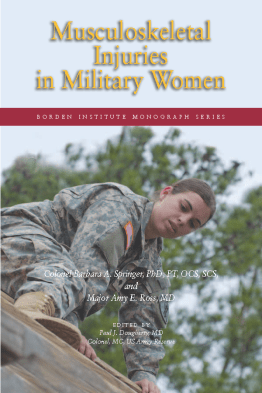
Musculoskeletal Injuries in Military Women by the United States Army Borden Institute focuses on risk factors, prevention, diagnosis, treatment, and rehabilitation of musculoskeletal injuries in women. This is the most recently released publication of the Borden Institute Monograph Series.

This publication is slim and targeted to a specific audience of the medical community, military, and those afflicted by the described injuries, including athletes and soldiers alike. It is of particular value to those who work with this sort of injury, from diagnosis to treatment to rehabilitation, including physical therapists, orthopedists and sports medicine professionals, both civilian and military.

According to the publication, women serving in the Army have a higher incidence of injury compared to men due to the female anatomy and physiology. More women become injured during the Army’s basic combat training and associated activities compared to men and their female counterparts in the Air Force and Navy.

Image: Female soldiers negotiate obstacles during the U.S. Army Special Operations Command’s cultural support program which prepares all-female Soldier teams to serve as enablers supporting Army special operations combat forces in and around secured objective areas. The Army is working to improve women’s health throughout the Army, thus contributing to force readiness. (Photo by Staff Sgt. Russell Klika, USAJFKSWCS. Source: Soldiers Magazine)

Overuse injuries, primarily in the bone and tendons, account for 75 percent of women’s injuries from activities like running, marching, and repetitive jumping. The book’s authors identify running shoes as the most important equipment during training to prevent injury and give advice on how to select the right running shoe (See image below).

Musculoskeletal Injuries in Military Women thoroughly and succinctly details each potential musculoskeletal injury. The musculoskeletal system provides form, support, stability, and movement to the body. The injury descriptions are broken down by risk factors, prevention, diagnosis, treatment, and rehabilitation. Most injury descriptions are accompanied by detailed instructions and pictures showing what the injury looks like, ways to test for the injury, and appropriate therapeutic exercises.

The content of the publication is not limited only to only military women, but can be beneficial to female athletes and physically active women who suffer from the described injuries and require physical therapy or rehabilitation.

Military injuries, whether suffered by men or women, have an effect on the readiness of the military and force levels. Musculoskeletal Injuries in Military Women reminds readers that injury is possible at any time, not only in combat.

HOW DO I OBTAIN Musculoskeletal Injuries in Military Women?

  • Buy it online 24/7 at GPO’s Online Bookstore.
  • Buy it at GPO’s retail bookstore at 710 North Capitol Street NW, Washington, DC 20401, open Monday-Friday, 9am to 4pm, except Federal holidays, (202) 512-0132.
  • Find it in a library.

Other Titles about Rehabilitation and Physical Therapy

You may also be interested in the Journal of Rehabilitation Research and Development.  This journal is known in the industry as the JRRD and is an international, peer-reviewed rehabilitation research journal sponsored by the U.S. Department of Veterans Affairs. The JRRD accepts original manuscripts from domestic and international researchers on a broad range of topics, including assistive technology, cognitive disorders, rehabilitation, prosthetics, SCI, traumatic brain injury, and telemedicine, and more.

The JRRD is available via subscription from the U.S. Government Printing Office in two formats:

1) Print Journal: Buy a year’s subscription to the JRRD from our GPO Online Bookstore

2) Digital Journal:  The electronic subscription (ISSN: 0748-7711) for tablets, desktop computers and smartphones can be purchased through our e-magazine partner, Zinio.com:


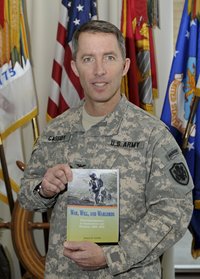
War, Will and Warlords: An Interview, Part II

July 23, 2012


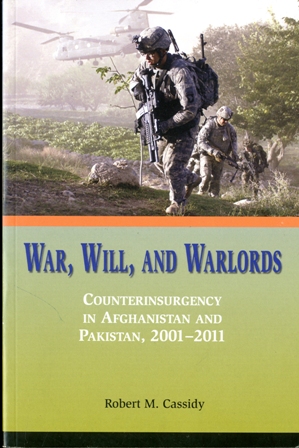
In this second part of a two-part interview by Government Book Talk blog editor Michele Bartram,  Col. Robert M. Cassidy, author of the new, critically acclaimed book, War, Will, and Warlords: Counterinsurgency in Afghanistan and Pakistan, 2001-2011, describes the lessons learned after ten years of war in Afghanistan. Click here to read Part I of the interview.

GovBookTalk: In Chapter 5 of War, Will, and Warlords, you refer to Pakistan’s prospects of doing what needs to be done as “hard, not hopeful, but not impossible.”  What role does Pakistan play today in 2012 in this counterinsurgency, and how do you rate these prospects today on the scale of hopeful vs. impossible?

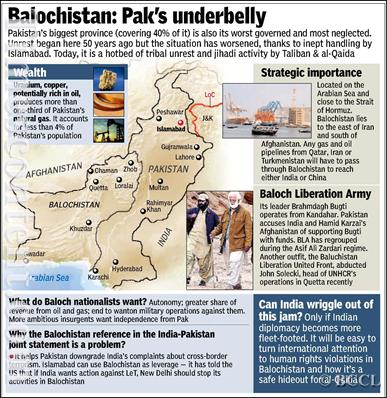
Cassidy: There is currently not much at all to be sanguine about in relation to Pakistan, as it has done the most odious things in terms of regenerating and sustaining the Afghan Taliban and other groups.  And, the Coalition and the international community have allowed Pakistan to get away with this—murders, literally.  Pakistan poses as a friend, but performs as a foe. The Afghan Taliban would have withered away over the last several years of the surge if Pakistan had stopped supporting the regeneration, resting, recruitment, and retraining of militants, improvised explosive device makers, technology, and components in its tribal sanctuaries and in Baluchistan.

Image: Balochistan’s strategic importance. Source: Intellibriefs

Pakistan has employed terrorism and unconventional warfare to ostensibly achieve strategic depth by supporting its proxies in Afghanistan for almost four decades.

However, the United States has not yet crafted a Pakistan strategy that employs its substantial leverage to modify Pakistan’s strategic calculus.  A genuine Pakistan strategy, coupled with unambiguous momentum and perseverance in Afghanistan, could compel Pakistan to alter its strategic rationale and reduce support to the Afghan Taliban and the Haqqani network. 

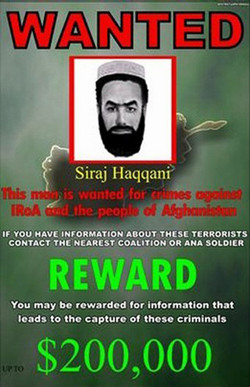
Image: [GovBookTalk] The Haqqani Network,an insurgent group allied with the Taliban and operating on both sides of the Afghanistan-Pakistan border, is one of the most dangerous groups fighting U.S.-led Coalition forces and the Afghan government. Originating in Afghanistan during the mid-1970s, it was nurtured by the U.S. Central Intelligence Agency (CIA) and Pakistan’s Inter-Services Intelligence (ISI) during the 1980s Soviet war in Afghanistan. Maulvi Jalaluddin Haqqani and his son Sirajuddin Haqqani lead the group. A reward of $200,000-USD was offered by Coalition forces for information leading to the arrest of Siraj Haqqani. Source: Wikipedia.

The United States needs a strategy for Pakistan, one which is logically and temporally linked and integrated with the imperatives in Afghanistan.  A viable strategy must first recognize that the U.S. does have considerable leverage over Pakistan.  America must demand discernible results for the steady diet of carrots it has been feeding Pakistan for the perfidious abetting of enemies who kill and maim the Afghan and Coalition civilians and military forces trying to stabilize the country in some lasting way.

GovBookTalk: After wars in Iraq and Afghanistan, what lessons has the US military learned about fighting a counterinsurgency campaign— in strategy, training, equipment, communications with locals, relations with coalition nations and neighboring regions?

Cassidy: Let me clarify at the outset that counterinsurgency is not a strategy in and of itself, but more of the art and method of an operational campaign to defeat or neutralize an insurgency.  The first and most paramount thing we should learn is not to unlearn or expunge what we know of previous counterinsurgencies’ best practices.  In 2001-2003 when we undertook those wars, there was very little thinking, knowledge, doctrine, or awareness of the requirements for prosecuting counterinsurgency to a successful conclusion.   The American military was compelled to adapt in the crucible of combat and it ultimately changed over time, and we now see the most seasoned counterinsurgent forces in our history.

Image: [GovBookTalk]: This is an actual PowerPoint slide shown by Gen. Stanley McChrystal, commander of U.S. and NATO forces in Afghanistan in the summer of 2009 to portray the complexity of U.S. strategy. Source: Charles V. Peña. Click on image above to enlarge.

Cassidy: Notwithstanding, it is negligence of criminal magnitude to prepare soldiers with the doctrine, the equipment, and the leadership savvy for countering insurgents only after the fighting has begun.  Also, in many ways and instances, it was the early methods of American military forces in Iraq and Afghanistan that helped catalyze support for the insurgencies by alienating large parts of those populations.  Here are some pithy things we should retain:

  • Knowledge empowers and the one who thinks, wins:  analyze and understand the environment.
  • Good counterinsurgency campaigns fully integrate both general purpose and special forces.
  • Start with simple and clear, not convoluted and cumbersome, command and control.
  • Match action and information to address grievances to win the war of ideas.
  • If the insurgency benefits from unimpeded sanctuary, ruthlessly shut this down.
  • Start with the end— what should the indigenous security capacity be when we leave?
  • Show moral rectitude:  kill precisely the insurgent leaders and protect most of the people.

GovBookTalk: If you had to do it all over again, would you change anything in this book?

Cassidy: Two things: one, I would have added a chapter that explained how we need to rethink and reframe our relationship with Pakistan after the bin Laden raid; and two, I would have made one more look to minimize any redundancy between the first chapter and the last chapter because the last chapter was something I developed apart from the main manuscript when I was last in Afghanistan during 2011.

GovBookTalk: Did you personally learn anything from writing this book and what was it?   

Cassidy: I deepened and broadened my knowledge about the enduring and deplorable perfidy of the Pakistani ISI in Afghanistan over almost four decades of war in the region.

Image: Pakistan spy chief (right), Lt. Gen. Shuja Pasha, is head of  the Pakistan Directorate for Inter-Services Intelligence or ISI, whose headquarters are shown to the left. Source: Jagran Post. [GovBookTalk] Note that the ISI continually denies links to the Taliban and terrorism, in spite of accusations by Coalition allies of ISI ties to the 7/7/2005 terrorist attacks in London, the attempted assassination of President Karzai, the bombing of the Indian embassy, supporting terrorist groups and other acts. Source: The Council on Foreign Relations 

GovBookTalk: Are there additional resources where readers can go for more information, assistance with this topic?

Cassidy: Some useful resources include the websites of the Afghan Analysts Network (AAN), the New America Foundation Counterterrorism Strategy Initiative Policy Paper series, the Congressional Research Service (CRS) [link to Stanford University’s archives of CRS reports], the Institute for the Study of War (ISW), The Council on Foreign Relations  and the U.S. Government 1230 and 1231 reports on the progress in Afghanistan.  Also, they could start with the bibliography of this book.

GovBookTalk: What are the next upcoming projects for you?  

I am drafting an outline for a new book with the draft title of, On Raw War:  The wages of the American way of strategy and war.  This will start with a theoretical chapter that distills the best thinkers on strategy and war and then it will proceed to explore American wars after Vietnam, from the Persian Gulf War up until Afghanistan to assess how practices compared to the theory.

GovBookTalk: Do you have anything specific that you want to say to your readers in parting, a memorable quote?

Cassidy: The Roger Ascham quote in Chapter 1:  “it is a costly wisdom that is bought by experience;” juxtaposed with the famous Bismarck quote that “fools say they learn from experience; I prefer to learn from the experience of others.”

GovBookTalk: Thank you for your insights, Col. Cassidy!
HOW CAN YOU OBTAIN a copy of War, Will, and Warlords: Counterinsurgency in Afghanistan and Pakistan, 2001-2011?

  • Buy it online 24/7 at GPO’s Online Bookstore.
  • Buy it at GPO’s retail bookstore at 710 North Capitol Street NW, Washington, DC 20401, open Monday-Friday, 9am to 4pm, except Federal holidays, (202) 512-0132.
  • Find it in a library.

To learn more about America’s involvement in Afghanistan, browse our new Afghanistan Collection of Federal publications.

About the author: Colonel Robert M. Cassidy, USA, is a military professor at the U.S. Naval War College, a senior fellow with the Center for Advanced Defense Studies, and a member of the RUSI Advisory Board. His experience and scholarship focus on strategy and irregular warfare. He has served on deployments to Iraq, Afghanistan, the Persian Gulf, Egypt, and Grenada. He most recently served as a special assistant to the senior operational commander in Afghanistan in 2011. Colonel Cassidy has published a number of articles and two previous books on stability operations and irregular war:  1) Peacekeeping in the Abyss: British and American Peacekeeping Doctrine and Practice after the Cold War and 2) Counterinsurgency and the Global War on Terror: Military Culture and Irregular War. He has a Ph.D. from the Fletcher School of Law and Diplomacy at Tufts University.


War, Will and Warlords: An Interview, Part I

July 17, 2012

Government Book Talk editor Michele Bartram writes a two-part interview with author Col. Robert Cassidy about his new, critically acclaimed book, War, Will, and Warlords: Counterinsurgency in Afghanistan and Pakistan, 2001-2011, which covers the causes and consequences of counterinsurgency in that troubled region and recommendations for future American approaches there and in similar operations. Part I goes into the cause of the war there and explanations of the key concepts. Click here to read Part II of the interview.


Since World War II, the character of the wars America has fought has changed radically. Traditional methods of warfare, technology, training and strategies designed to counter national armed forces, are not suited for today’s counterinsurgency operations often where civilians mingle freely with enemy combatants in complex urban terrain or remote encampments, and which can be carried out by local warlord-led troops, small guerrilla groups or even individual insurgents. First in Iraq and now honed by the war in Afghanistan, American military (operations), tactics and technology have required reengineering to adapt to this new reality of war.

Soldier-scholar Col. Robert Cassidy, Ph.D., is a military professor at the U.S. Naval War College and a senior fellow with the Center for Advanced Defense Studies who served on operations in Grenada, Egypt, the Persian Gulf, Iraq, and most recently as the special assistant to the commander of ISAF Joint Command in Afghanistan from June 2010 to June 2011.

As an expert in strategy and irregular warfare, Cassidy has authored the recently published War, Will, and Warlords: Counterinsurgency in Afghanistan and Pakistan, 2001-2011 which is featured this month in our U.S. Government Bookstore’s special War in Afghanistan collection.

Foreign Policy magazine lauds War, Will, and Warlords as a “must read for all scholars, policymakers, diplomats, and military practitioners seeking to understand the Afghanistan-Pakistan nexus” which provides invaluable analysis “concerning uneven U.S. involvement in the region, the contradictions of Pakistan, and the counterinsurgency (COIN) approaches implemented on both sides of the porous region” between Pakistan and Afghanistan.

Some refer to the War in Afghanistan as America’s longest war, but to Afghans, conflict has been going on there continuously for almost four decades. Today, July 17, 2012, actually marks the 39-year anniversary of when continual tumult and conflict began in Afghanistan. In July 1973 Afghanistan’s last King or Padishah, Mohammed Zahir Shah, was ousted in a coup d’état by his first cousin and former Prime Minister Mohammed Daoud Khan, who established a republican government. Years of conflict followed, including war with the Soviet Union, rise and fall of the Taliban, Al-Qaeda and today’s insurgency.

Image: (Left) Zahir Shah, King of Afghanistan, with his first cousin and Prime Minister Daoud Khan (right) who later deposed Zahir in 1973, beginning Afghanistan’s slide towards forty years of war. Source: CivFanatics Forum.

AN INTERVIEW WITH THE AUTHOR

In this two-part special feature, Government Book Talk was pleased to be able to interview Col. Cassidy about the book, his personal observations about the conflict and the countries, and his recommendations for the future.

Government Book Talk: What inspired you to write this book?  

Colonel Robert Cassidy: I had written a study about the Soviet War in Afghanistan at the French École de Guerre in 2000-2001 and I continued to study our war in Afghanistan after September 2001.   The proximate reason was that I was at the Naval War College in 2009-2010 between tours in Afghanistan and I thought it would be helpful to capture and compare what happened for the first eight years to those years after the surge.  Also, I knew that researching and writing this book would make me more knowledgeable and useful as an adviser in Afghanistan during my tour in 2010-2011.

GovBookTalk: I understand that this was not the original title for the book. How did you arrive at the final choice?

Cassidy: Two initial titles were vetoed. First, I suggested “Malice in Wonderstan,” and my editor then suggested “Ten Years Gone,” which I liked because of its triple reference to the Afghan War’s length, the Led Zeppelin classic song, and the subject of that song, an ancient Greek war.  In the end, I picked “War, Will and Warlords” because these three things are so salient in terms of Afghanistan and what we have done or not done there since we supported the anti-Soviet insurgency in the 1980s.

In the excerpted piece of the preface below, I explain the meaning behind the title because “War, will, and warlords…are central to any understanding of what has transpired in Pakistan and Afghanistan.”

WAR: First, the Afghan people have faced tumult, conflict, and war since July 1973… A corollary to this is the fact that the Pakistani state has helped foment insurgent proxy war and terrorism in Afghanistan since 1973. In fact, fomenting insurgencies in Afghanistan by proxy is in the metaphorical DNA of the Pakistani security apparatus.

WILL: Second, protracted irregular wars are a contest of will, as insurgents use the art of the ambush, armed propaganda in the form of spectacular violence, and cross-border sanctuaries to protract the war to erode the will of the counterinsurgents so they give up the fight. The insurgents can win if they can prolong the war while not exhausting their own will.

WARLORDS: Third, warlords, or feudal barons, run criminal patronage fiefs or insurgent-terrorist networks that operate across the borders and exist outside and inside the states as well as serve as state proxies in some cases. Patronage has long been a reality in South Asia. However, the growth and scope of warlord-led insurgent and criminal networks that began before the Soviet-Afghan War… have helped catalyze support for the insurgencies.

Image: Afghan warlords and power brokers. Source: WorldNews,

GovBookTalk: What is the overall message in the book that you want readers to grasp?  

Cassidy: To understand the catalysts for and the ineluctable links between security and insurgency in both Pakistan and Afghanistan; to know the grave consequences if we ultimately fail, and to fathom the odious role of Pakistan’s perfidy in its persistent support of terrorism and insurgency in Afghanistan.

GovBookTalk: You have been on multiple tours in Afghanistan. What surprised you most about either the people or the country itself? 

Cassidy: I would not use the word surprised, but what intrigued me and enthralled me were the country’s beautiful diversity and the Afghan people’s formidable resiliency.

GovBookTalk: What was the single most important “don’t miss” chapter and page in your book and why?

Cassidy: The most important chapter is Chapter 3 because it explains why and how the Taliban regenerated from sanctuary in Pakistan and what catalyzed the Pakistani Taliban’s insurgency within and against that state.

The most important single page is page 6 because it elucidates why and how the tribal areas in Pakistan along the Durand Line are the most dangerous places on earth in terms of the terrorist and militant machinations to support attacks on the U.S., other western states, and non-western states.

Image: [GovBookTalk] The Durand Line: Established in an 1893 treaty between Amir Abdul Rahman Khan of Afghanistan and Sir Mortimer Durand, the foreign secretary of the British Indian government, the Durand line set up the border between Afghanistan and then British India/now present-day Pakistan. Not recognized today by Afghanistan and a source of contention with Pakistan, this poorly marked buffer zone cuts through the Pashtun tribal areas, dividing ethnic Pashtuns (Afghans) on both sides of the border. It is considered to be one of the most dangerous places in the world. Source: IntelliBriefs and Wikipedia.

READ PART II: In PART II of this interview, Cassidy describes Pakistan’s role, hard lessons learned, useful resources and more…

HOW CAN YOU OBTAIN a copy of War, Will, and Warlords: Counterinsurgency in Afghanistan and Pakistan, 2001-2011?

  • Buy it online 24/7 at GPO’s Online Bookstore.
  • Buy it at GPO’s retail bookstore at 710 North Capitol Street NW, Washington, DC 20401, open Monday-Friday, 9am to 4pm, except Federal holidays, (202) 512-0132.
  • Find it in a library.

To learn more about America’s involvement in Afghanistan, browse our new Afghanistan Collection of Federal publications:


Reagan, Intelligence and the End of the Cold War

July 9, 2012

Guest blogger, GPO Public Relations Specialist Emma Wojtowicz, reviews a publication with an inside look at intelligence and the end of the Cold War:

In this election year, President Ronald Reagan has been  mentioned by Democrats and Republicans alike regarding his stance on tax policy. However, another association is the Cold War and President Reagan’s famous declaration about the Berlin Wall, “Mr. Gorbachev, tear down this wall!

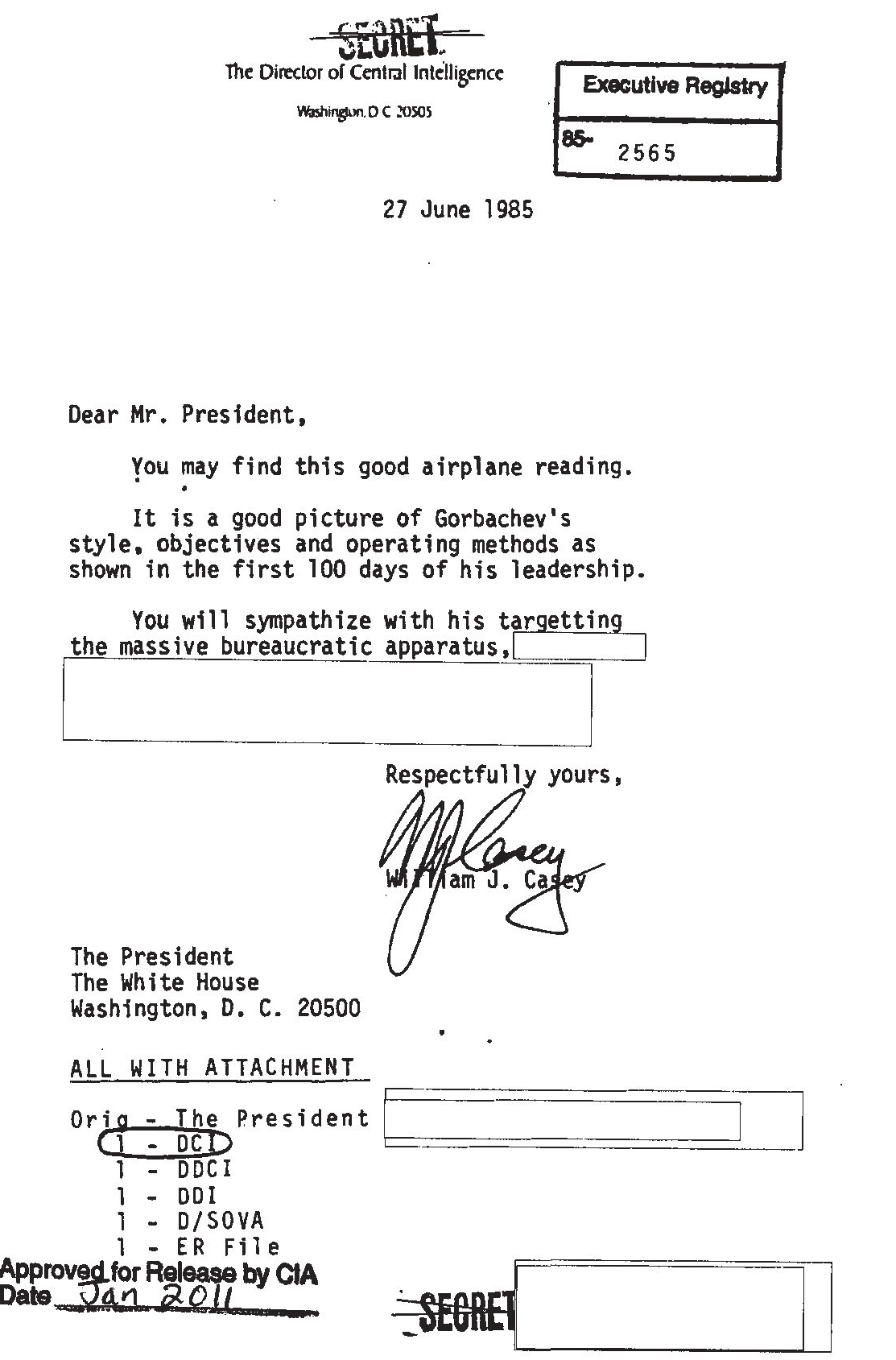
Ronald Reagan, Intelligence and the End of the Cold War is a multimedia book and DVD recently published in November 2011 by the Ronald Reagan Presidential Library and the Historical Collections at the Central Intelligence Agency. It shares declassified documents from latter years of the Cold War with a focus on relations between General Secretary of the Soviet Union Mikhail Gorbachev and the Reagan administration.

Declassified documents are the primary focus of the book, but there is also an introduction and brief overview on intelligence, including President Reagan’s experience with the intelligence community prior to his presidency and his approach to intelligence as president; the role the intelligence community played in monitoring and anticipating the collapse of the Soviet Union; and expectations the public should have of the intelligence community.

Ronald Reagan, Intelligence and the End of the Cold War poses the question, “Should the U.S. intelligence community have done a better job foreseeing the collapse of the Soviet Union?” It does not answer the question for you, rather puts the subject of intelligence in context and provides declassified documents so readers can decide for themselves.

The book itself only contains a handful of declassified documents, but it comes with a DVD where readers have access to more than 200 declassified documents as well as photos from President Reagan’s administration, videos of press conferences and summits between the U.S. and Soviet Union, and an interactive timeline of the Cold War during the Reagan administration. The content of the book is also available on the DVD.

Image: Ronald Reagan Cold War timeline. Source: Ronald Reagan, Intelligence and the End of the Cold War (CLICK TO ENLARGE)

Highlights of the collection include video briefings for the Reagan Administration produced by the CIA’s Directorate of Intelligence on such topics as the Soviet space program, the Andropov succession, the Chernobyl disaster, and the Soviet media portrait of America. These briefings represent the first time the Agency used videos on a regular basis to deliver intelligence to policymakers. The entire collection marks the first substantial release of such historical material.

The amount of available declassified documents is a bit overwhelming. The content falls across a wide range of topics with a substantial focus on nuclear weapons and disarmament, but what is more interesting are the analyses of the Soviet Union’s politics and leaders, economy, society,  labor force, relationship with satellite countries, energy policy, and foreign policy.

One example is a memo on civil unrest in the Soviet Union that analyzes the number of instances of strikes, demonstrations, and riots, where they occurred, and the cause – each individual instance is thoroughly recorded. Another is on the volatile leadership situation in the USSR.

Image: Declassified CIA memorandum on the volatile leadership situation in the USSR; September 27, 1988. Source:  Ronald Reagan, Intelligence and the End of the Cold War

A particularly popular topic among the documents is Mikhail Gorbachev, both the man and the leader. Many documents focus on Gorbachev’s personality, goals and strategy of implanting his goals, the way he is perceived by citizens and other communist leaders, and his impact on the Soviet Union. It is clear from the documents that Gorbachev was viewed by the Reagan administration as a capable leader, who understood the problems the Soviet Union was facing, and had the potential to turn the Soviet Union around.

Image: Cover letter to President Ronald Reagan by William Casey of the recently declassified CIA assessment of Mikhail Gorbachev after this first 100 days in office. Source: Ronald Reagan, Intelligence and the End of the Cold War

An insightful comment is made in the introduction, “Deep down, officials seem to want intelligence to make decisions for them, when, in reality, it rarely can.

This sentiment is reflected in the declassified documents– they provide a wealth of information that is deeply analytical, but they do not spell out the best plans or policies for dealing with the Soviet Union or determine when it will cease to exist.

HOW DO I OBTAIN THIS “Ronald Reagan, Intelligence and the End of the Cold War”?

  • Buy it online 24/7 at GPO’s Online Bookstore.
  • Buy it at GPO’s retail bookstore at 710 North Capitol Street NW, Washington, DC 20401, open Monday-Friday, 9am to 4pm, except Federal holidays, (202) 512-0132.
  • Find it in a library.