Earth Day

April 19, 2012

ImageAs we celebrate the 42nd Earth Day, the arrival of warm weather and the planting of summer gardens, our Guest Blogger — GPO Public Relations Specialist Emma Wojtowicz — takes a look at a few Federal publications focusing on the environment and how they play a role in our communities.

Congressional Budget Office: Potential Impacts of Climate Change in the United States

Published in May 2009, this report by the Congressional Budget Office (CBO) defines climate change and examines the causes and potential impact climate change has on North America. The report is brief (only 17 pages), concise and written in plain language, so you do not have to be a scientist to understand the focus of the paper. CBO effectively explains the scope of climate change and the effect is has on different parts of our environment. A few interesting takeaways:

  • Energy from the sun is absorbed by the Earth’s climate system and then radiated back into space. Greenhouse gases increase the amount of energy being held, thus warming the Earth’s surface.
  • Aerosol gases from volcanic eruptions have the opposite effect – they cool the Earth.
  • Climate change causes precipitation to be unevenly distributed: regions and seasons that already have greater precipitation will tend to get more and drier regions will tend to get less.
  • Rising surface temperature of the ocean increase the strength, size and intensity of hurricanes and typhoons.
  • Higher concentrations of carbon dioxide, a kind of greenhouse gas, will boost forest growth and timber production.

The Container Tree Nursery Manual, Volume Seven: Seedling Processing, Storage and Outplanting

A rite of spring and summer involves planning and preparing for outdoor landscaping and gardens, which means a trip to the nursery. Do you ever question where those trees come from? In the Container Tree Nursery Manual you will learn about the cultivation of trees from seed to what you purchase at the store. This publication is a bit dense with scientific processes and terminology, but once you get used to the tone of the book it makes for a fascinating read. Informative pictures, charts, graphs and diagrams help readers understand the content and “see” the entire life of a nursery tree from the planting, growing, storing, and shipping stages. For gardening enthusiasts, you can learn practical information that can be adapted to your own gardening endeavors. While you may not be planting trees in containers, the book emphasizes important growing techniques and considerations that you can apply to your own potted plants like the depth of the container for roots, water amount and frequency, as well as outside temperature.

Restorative Commons: Creating Health and Well-being through Urban Landscapes

This publication embodies the community spirit of Earth Day. Previously blogged about in August 2010, Restorative Commons is a lovely book about the importance and positive effect gardens and green landscapes have on urban communities. Urban gardening projects bring together neighbors and people of all ages giving them a common goal and a visible result to take pride in. The book explores the history of urban landscaping and ways community parks have shaped society; next it goes through various case studies of urban gardening initiatives in American cities and the impact they have on their communities; and then concludes with interviews with the people who lead the initiatives that beautify and strengthen their communities through urban gardens. Restorative Commons reflects the purpose and essence of Earth Day, which is to work with your neighbors to make a positive contribution to the community you live in and in turn an impression on greater global community.    

How do I obtain these Federal publications?

Congressional Budget Office: Potential Impacts of Climate Change in the United States

  • Buy it online 24/7 at GPO’s Online Bookstore
  • Buy it at GPO’s retail bookstore at 710 North Capitol Street NW, Washington, DC  20401, open Monday-Friday, 9am to 4pm, except Federal holidays, (202) 512-0132.
  • Find it in a library

The Container Tree Nursery Manual, Volume Seven: Seedling Processing, Storage and Outplanting

  • Buy it online 24/7 at GPO’s Online Bookstore
  • Buy it at GPO’s retail bookstore at710 North Capitol Street NW,Washington,DC20401, open Monday-Friday, 9am to 4pm, except Federal holidays, (202) 512-0132.
  • Find it in a library

Restorative Commons: Creating Health and Well-being through Urban Landscapes

  • Buy it online 24/7 at GPO’s Online Bookstore
  • Buy it at GPO’s retail bookstore at710 North Capitol Street NW,Washington,DC20401, open Monday-Friday, 9am to 4pm, except Federal holidays, (202) 512-0132.
  • Find it in a library

1940 Census Goes Digital

April 11, 2012

Last week, on April 2, 2012, the 1940 United States census was released to the public in digital format by the National Archives in conjunction with the U.S Census Bureau at http://1940census.archives.gov

Image: 1940 Census Poster urging Americans to “Help the Ten-Year Roll Call”. Source:U.S.Census Bureau

Reports National Public Radio:

Veiled in secrecy for 72 years because of privacy protections, the 1940 U.S. census is the first historical federal decennial survey to be made available on the Internet initially rather than on microfilm.

In a great example of a private/public partnership, Archives.com’s parent company partnered with the National Archives to provide the public with free digital access to the 1940 Federal Population Census.

Miriam Kleiman, spokeswoman for the U.S. National Archives, told The Associated Press that the Archives’ 1940 census site registered more than 22 million hits in just four hours from almost 2 million users on its very first day of release. It is extremely popular already with librarians, researchers and genealogists researching their family tree.

Data from the Great Depression

Archivist Connie Potter, in an entertaining video about the Archives’ digitization project, explains that the reason this census is so amazing is because it describes “the country during the Great Depression.  It reflects all of the economic dislocation, how many people were immigrants, how many people had what level of education.

Last week’s release of digitized information covers detailed records on 132 million people living in the United States at the end of the Depression and a year before Pearl Harbor.

The census data was transferred to microfilm during World War II, and in 2009, National Archives personnel began digitizing those records, culminating in the release of the database last week.

Over 3.9 million images were digitized, providing a bonanza for researchers.

Some interesting facts about the 1940 Census

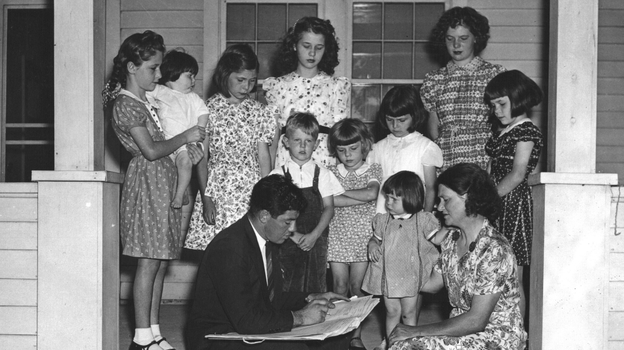
Image: An enumerator interviews a woman with her 10 children around her for the 1940 census. Source: National Archives at College Park

The Census Bureau began the 1940 census with extensive long-term planning, recruiting and training.  Back in 1940, about 120,000 census-takers, called enumerators, spread out across the U.S. and territories, going door-to-door to interview families.

Enumerators both then and now can face challenging situations when gathering the data to tabulate the census, from trudging through fields or mushing a dog sled across the snow.

Image: Rural visit by a U.S. Census taker in connection with the 16th decennial census of 1940  Source: Library of Congress image number LC-USZ62-91199

Image: The Alaska Territory saw the census enumerator arrive in his dog sled, 1940 – 1941 Source: National Archives Research Catalog

Questions from the 1940 Census

It’s interesting to note the questions that were asked on the 1940 census form.  One of the fifty questions the enumerators asked Americans in 1940 reflected the more formal societal structures of the time: “What was the Relationship of this person to the head of the household, as wife, daughter, father, mother-in-law, grandson, lodger, lodger’s wife, servant, hired hand, etc.?”  

Another question was very relevant for a Depression-era nation where children as young as 14 still worked, and millions of out-of-work Americans were given “public emergency” jobs around the country under Franklin Roosevelt’s New Deal programs. One was the Works Project Administration (originally the Works Progress Administration) or WPA, which was the “largest and most ambitious New Deal agency and employed millions of unskilled workers to carry out public works projects,including the construction of public buildings, roads and dams, as well as operating large arts, drama, media, and literacy projects.

Image: WPA Federal Arts poster. Source: Smithsonian Archives of American Art

Another New Deal program mentioned in the census was the Civilian Conservation Corps or CCC . It was designed to provide employment mostly for young men in relief families who had difficulty finding jobs during the Great Depression (there were separate programs for veterans and Native Americans), while at the same time implementing a general natural resource conservation program in every state and territory for the “conservation and development of natural resources in rural lands” owned by federal, state and local governments. Many trees were planted and national and state parks built and preserved by the CCC.

Image: Illinois CCC recruiting poster. Source: Archives.gov

Another youth-focused program referenced was the National Youth Administration or NYA that focused on providing work and education for young Americans between the ages of 16 and 25.

Thus, it makes sense that this 1940 census question asked Persons 14 Years Old and Over” to classify their employment status during the time of the census-taking (March 24-30, 1940) as follows:

  • Was this person AT WORK for pay or profit in private or non-emergency Government work during week of March 24-30? (Yes or No).
  • If not, was he at work on, or assigned to, public EMERGENCY WORK (WPA, NYA, CCC, etc.) during week of March 24-30? (Yes or No).

How to Use the 1940 Census

Even for those not steeped in genealogy research will find it thrilling, like I do, to see the excitement build over the release of these images.  It might be fun to look up my ancestors because I know my grandfather worked for the W.P.A.   I’m also interested in looking at the various trends and metrics available on housing to see if there is any correlation to the current economic situations.

Visit the National Archives pages to see the various resource location aids, enumerator training videos, and question templates that have been gathered for your use.  Based on the times, there were specific instructions for enumerators to get a count of temporary housing such as huts, tents, and cabins as of a point in time.   Here’s one bit of instruction to help clarify how to count the large transient population: “Persons in hotels, tourist or trailer camps, missions, and cheap one night lodging houses (flophouses) will all be enumerated as of the evening of April 8th”.

Help Tag the Images

The Census Bureau is appealing to the public for help indexing and meta tagging the images.  This is a genealogy crowdsourcing project to ensure the 3.8 million images are indexed and freely searchable online. You, too, can register to be a 1940 Census Blog Ambassador and get a nifty badge for your page!

You can follow the 1940 Census via Twitter at: #1940Census #Genealogy #history. 

How can you get other Census Bureau publications today?

The release of the historic images will be made at 1940census.archives.gov.

For those interested in more current information, take a look at the resources in GPO’s U.S. Government Bookstore.  The subscription series help keep you updated on the Census and Population statistics as they are released.

  • Buy them at GPO’s retail bookstore at 710 North Capitol Street NW,Washington, DC 20401. Open Monday-Friday, 9am to 4pm, except Federal holidays. Call 1.(202) 512-0132 for more information.
  • Find them in a Federal Depository Library.

Guest blogger: Nancy Faget, one of our federal librarians in GPO’s Library Services & Content Management Division who writes often about NASA “rocket scientists” and digital innovations in the library field.


Invest in Women, Invest in America

April 3, 2012

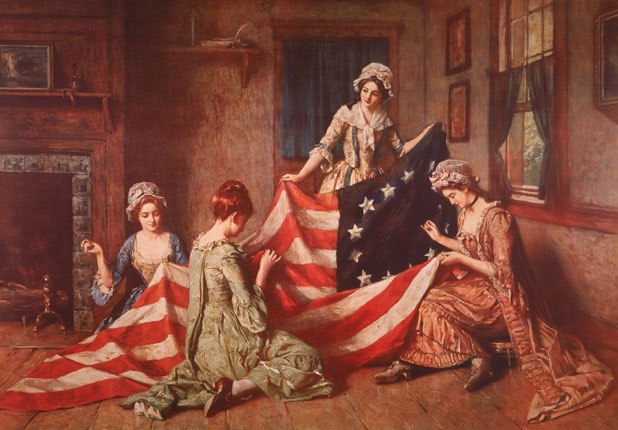
In honor of National Women’s History Month 2012 and its theme of “Women’s Education – Women’s Empowerment,” I wanted to write about a thought-provoking publication that just came across my desk about women and their evolving role in the U.S. workforce.  Since the founding of America, women like Betsy Ross have played a critical role in contributing to the economic fabric of the U.S. economy and  American households.

Image: Sewing circle presided by working mother Betsy Ross, who started out as first a home sewer before being educated as an upholstery apprentice. She  then ran an upholstery business with her husband, before managing her own business when her husband died by sewing tents, blankets and flags for the American Revolution.

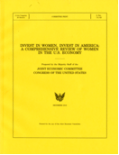
Invest in Women, Invest in America: A Comprehensive Review of Women in the U.S. Economy was prepared by the Joint Economic Committee of Congress.

It forms part of GPO’s Online Bookstore National Women’s History Month collection of Government publications celebrating women’s contributions to America.

Outgoing Chair of the Committee, Congresswoman Carolyn B. Maloney, said in a December 2010 letter that the goal was to prepare a “comprehensive review of women in the U.S. economy so that policymakers could have a better understanding of women’s essential contributions to our economy and their potential to play a stronger role in our economic recovery.”

PART I: Invest in Women, Invest in America

Part I of this publication starts with an overview of the decades of progress of women in the workforce. For the first time, we learn that women now comprise half of the U.S. workforce.

Next, relating to this month’s theme of education providing empowerment for women, the report shows that women earn more college degrees than men at every level, from 57.4% of the bachelor’s degrees to over 60% of the Master’s degrees in the United States.

And it demonstrates just how important women’s earnings have become to overall household income, particularly in families with children. For example, by 2008 over 6 in 10 families with children under 6 have the mother working outside the home, and women are the sole job-holders in over a third of American families with children.

The “Invest in Women” publication discusses the three key factors that are still holding women back, including:

  1. underrepresentation in business leadership roles,
  2. a “persistent gender wage gap” in both public and private sectors, and
  3. an “out-of-date framework for social support.”

Factor 1: Underrepresentation of Women in the Executive Suite

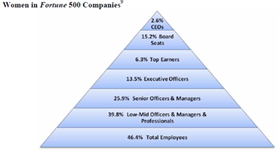
Under this factor, the report puts forth both current figures and possible causes about why “women remain dramatically underrepresented in corporate boardrooms and executive suites” in the United States. Some figures shared in the report show that while women comprise 46.4% of all Fortune 500 employees, they make up just 15.7% of board seats, 14.4% of executive officers, 7.6% of top earning executive officers, and only 2.4% of CEOs.

This contrasts to studies included in the report that demonstrated that “companies with more women board members, on average, significantly outperform those with fewer women by 53% on Return on Equity, 42% on Return on Sales, and a whopping 66% of Return on Invested Capital.

Factor 2: Persistent Gender Wage Gap

In the private sector, “Invest in Women” reports, “women working full-time earn only 77 cents for every dollar earned by men”— a gap the report says has not improved since 2001. This wage gap is true also for the Federal Government where “women managers earn 81 cents for every dollar earned by their male manager peers”.

Source:  Women’s Media

Factor 3: An Out-Of-Date Framework for Social Support

Here the report offers the premise that “our nation’s public policies are still rooted in the antiquated assumption that families rely on a single male breadwinner” when today’s “reality is that most families depend on two breadwinners.” Discussion of the issues relating to lack of paid leave, particularly sick leave and the burden it places on mothers who often “still bear the primary responsibility for their children’s health” are followed by sections on inflexible work arrangements and insufficient “quality, affordable early care and education.

This ends with an interesting analysis of the nation’s current retirement system and its effect on women. The report points out the lifetime earnings penalty—caused by the many interruptions over the span of a woman’s career to provide unpaid at-home care for children, elderly parents or ill family members— results in vastly decreased Social Security income for women, thus increasing women’s poverty rates later in life at a rate of 11.7% vs. 7.4% for elderly men.

Possible Policy Solutions to Improve Women’s Economic Position

Some possible policy solutions are put forward in this report as well, including:

  • “Stronger protections against wage discrimination;”
  • “Health reform;”
  • “Work-family policies” (including the right to request a flexible schedule and mandatory paid sick leave);
  • Financial regulatory reform and the “establishment of Offices of Minority and Women Inclusion at each federal financial services agency;”
  • “Value the Care Economy”, which, according to the authors, refers to boosting investment in quality early education  and child care programs, such as Early Head Start and Head Start; and
  •  Differentiating the impact of tax and entitlement reforms on women versus on men.

Part II: Compendium of JEC Reports and Hearings from the 111th Congress

The second part of the publication compiles various reports and hearings held by the Joint Economic Committee that referred to women’s issues covering four areas: Women in the Economy Today, Equal Pay, Access to Benefits and Retirement Security.

It is chock full of charts, tables, graphs and quotable quotes.


HOW DO I OBTAIN “Invest in Women, Invest in America: A Comprehensive Review of Women in the U.S. Economy”?

  • Buy it at GPO’s retail bookstore at 710 North Capitol Street NW, Washington, DC 20401, open Monday-Friday, 9am to 4pm, except Federal holidays, (202) 512-0132.
  • Find it in a library.

About the Author:  Michele Bartram is Promotions Manager for GPO’s Publication and Information Sales Division and is responsible for online and offline marketing of the US Government Online Bookstore (Bookstore.gpo.gov) and promoting Federal government content to the public.