Last week during National Black History Month, ground was broken on the National Mall in Washington, DC, for what will become the National Museum of African American History and Culture. In his remarks at the ceremony, President Obama mentioned that he wanted his daughters to see the famous African Americans like Harriet Tubman not as larger-than-life characters, but as inspiration of “how ordinary Americans can do extraordinary things.”

Image: This original photo of Harriet Tubman in the handbook lists the many roles she played in addition to being a “conductor” on the Underground Railroad, including nurse, spy and scout for the Union army during the Civil War. Her quote: “I looked at my hands to see if I was the same person now I was free. There was such a glory over everything… I felt like I was in heaven.” Source: The Underground Railroad: Official National Park Handbook.
One of the most dramatic areas of African American history is the story of the fight against slavery and the profile in courage represented by the ordinary people who did extraordinary things while participating in the Underground Railroad.
The National Park Service (NPS) has produced a number of exemplary publications about it, with three of them available today from the U.S. Government Bookstore, including the
- Underground Railroad: Official Map and Guide,
- the Discovering the Underground Railroad: Junior Ranger Activity Book, and
- the Underground Railroad: Official National Park Handbook, a perpetual bestseller.
That these items are not your typical guidebooks about a single historic site is due to the fact that the Underground Railroad itself is not a typical American national park.
Congress and the National Park Service act to preserve the legacy of the Underground Railroad
Back in 1990, Congress instructed the National Park Service to perform a special resource study of the Underground Railroad, its routes and operations in order to preserve and interpret this aspect of United States history.
Following the study, the National Park Service was mandated by Public Law 105-203 in 1998 (you can read the law on GPO’s FDSys site) to commemorate and preserve this history through a new National Underground Railroad Network to Freedom Program to “educate the public about the importance of the Underground Railroad in the eradication of slavery, its relevance in fostering the spirit of racial harmony and national reconciliation, and the evolution of our national civil rights movement.”
What was the Underground Railroad?
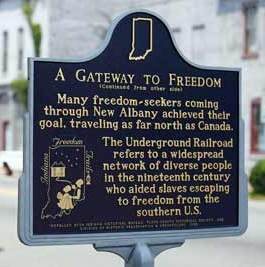 What was called the Underground Railroad was neither “underground” nor a “railroad,” but was instead a loose network of aid and assistance by antislavery sympathizers and freed blacks across the country that may have helped as many as one hundred thousand enslaved persons escape their bondage from before the American Revolution through the Civil War.
Image: NY State historical marker in Albany for the UGRR along the American Trails UGRR bicycle route.
Describing one of the most significant internal resistance movements ever, the National Park Service said in a 1996 press release that:
The Underground Railroad was perhaps the most dramatic protest against human bondage in United States history. It was a clandestine operation that began during colonial times, grew as part of the organized abolitionist movement, and reached a peak between 1830 and 1865. The story is filled with excitement and triumph as well as tragedy –-individual heroism and sacrifice as well as cooperation to help enslaved people reach freedom.
Where did the term “Underground Railroad” come from?
 Historians cannot confirm the origins of the name, but one of the stories reported by the Park Service has the term coming out of Washington, DC, in 1839, when a recaptured fugitive slave allegedly claimed under torture that his escape plan instructions were to send him north, where “the railroad ran underground all the way to Boston.” However it came about, the term was widely in use by 1840, and is often shortened to “UGRR” by “those in the know.”
Image: An 1837 newspaper ad about a runaway slave from the book “The Underground Railroad from Slavery to Freedom” By Wilbur Henry Siebert, 1898.
Underground Railroad Routes
Another byproduct of the UGRR special resource study was that the National Park Service carried out an analysis of slavery and abolitionism and identified the primary escape routes used on the UGRR.
The map below is included in the Underground Railroad: Official Map and Guide, produced by the National Park Service Cartographic staff at Harpers Ferry Center, shows the general direction of escape routes. Contrary to popular belief, Canada was not the only destination for freedom-seeking slaves–since some fled to Mexico, Florida and the Caribbean– but it was the primary destination as the efforts to catch fugitives increased.
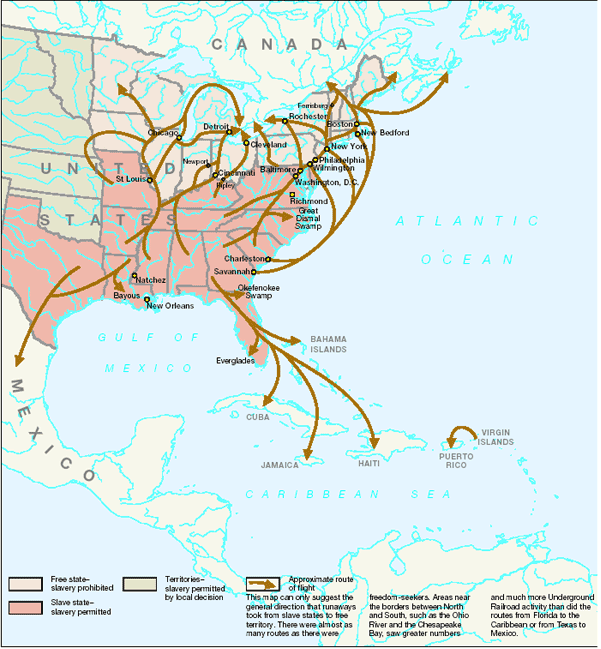
Image: Selected Routes of the Underground Railroad from the Underground Railroad: Official Map and Guide.
Additional outputs of the resource study and the subsequent research are the following three excellent Underground Railroad publications from the National Park Service.
Underground Railroad: Official National Park Handbook
 The first book in our trio of publications is the Underground Railroad: Official National Park Handbook. It is comprised of a series of fascinating articles by top Underground Railroad historians that weave together a thorough view of the amazing stories behind the legend, illustrated with many drawings, court records, letters, paintings, photos, and other pictorial representations that help make this history come alive for the reader.
The handbook is broken into 3 major sections and 5 chapters:
- Part I: An Epic in United States History:
- 1- Myth and Reality by Larry Gara. This introductory chapter reviews and evaluates the truths vs. the legends that grew about the Underground Railroad.
- Part II: From Bondage to Freedom:
- 2- Slavery in America by Brenda E. Stevenson. In this chapter, the author details the rise of the institution of slavery in America and the harsh realities of life for the people who suffered under it. An interesting segment discusses the inequities of life for enslaved women vs. men.
- 3- The Underground Railroad by C. Peter Ripley. This fascinating chapter tells the courageous and often harrowing stories of freedom seekers and those who aided them, including Harriet Tubman who made nearly 20 trips to lead 300 slaves to freedom and Henry “Box” Brown who shipped himself in a 2X3’ wooden crate from Richmond to Philadelphia to escape. Sprinkled throughout are cameos of famous former fugitives and abolitionists including Sojourner Truth, Frederick Douglas, and abolitionists William Lloyd Garrison and Gerritt Smith, among many others.
- Part III: Tracking the Past:
- 4- Tracking the Past by the National Park Service. This chapter outlines some of the work done by the National Park Service and others to discover, verify and catalog the important people, places and artifacts related to the Underground Railroad.
- 5- Further Reading by Marie Tyler McGraw. In this final chapter, the author provides a recommended reading list for interested researchers of the authoritative works related to different aspects of the Underground Railroad story.
Underground Railroad: Official Map and Guide

This map and guide includes drawings, blurbs, maps and chronologies about different aspects of the slave trade and the Underground Railroad.
Included in this fold-out map and guide are the escape routes map shown earlier, vignettes of key figures from key “conductors” on the Railroad to abolitionists, and even a short glossary of terms related to the UGRR.
Discovering the Underground Railroad: Junior Ranger Activity Book
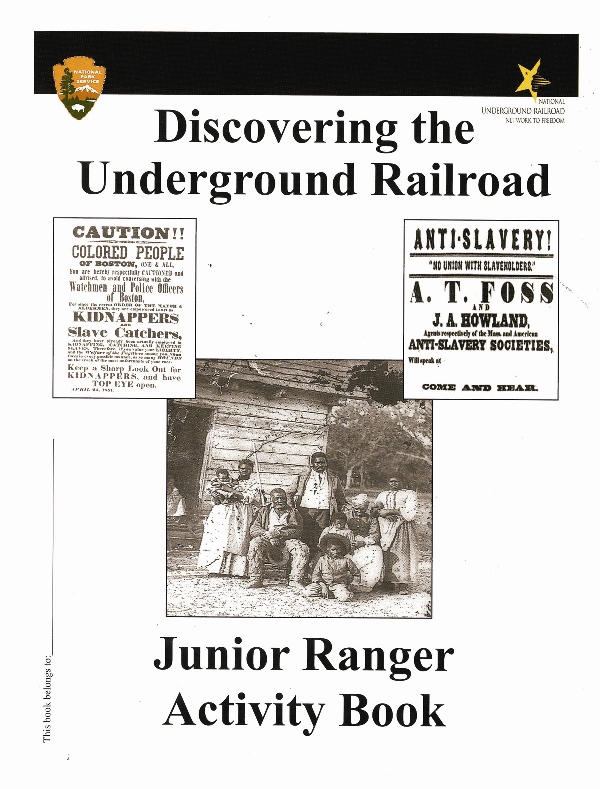 The final item in our trio of publications is the Discovering the Underground Railroad: Junior Ranger Activity Book.
Many National Parks offer visitors the opportunity to join the National Park Service Family as Junior Rangers. Interested students complete a series of activities during their park visit, share their answers with a park ranger, and receive an official Junior Ranger badge or patch and Junior Ranger certificate.
Since there is no one national park site for the Underground Railroad, the National Park Service came up with a different process with this activity book. Aspiring Underground Railroad Junior Rangers have to complete different numbers of activities in the book pertaining to their particular age level, then send the completed booklet in to the National Park Service’s Omaha office. There, “a ranger will go over your answers and then return your booklet along with an official Junior Ranger Badge for your efforts.”
This fun booklet includes activities appropriate from ages 5 to 10 and older, from word finders and mazes to essays and historical fact matching.
How can you get these Underground Railroad publications?
- Buy them online 24/7 at GPO’s Online Bookstore:
- Browse our entire Black History Month collection of Federal publications at the GPO Online Bookstore.
- Buy them at GPO’s retail bookstore at 710 North Capitol Street NW, Washington, DC 20401, open Monday-Friday, 9am to 4pm, except Federal holidays, (202) 512-0132.
- Find them in a library.
- Find some of the information online at the National Park Service’s National Underground Railroad Network to Freedom website.
About the Author: Michele Bartram is Promotions Manager for GPO’s Publication and Information Sales Division and is responsible for online and offline marketing of the US Government Online Bookstore (Bookstore.gpo.gov) and promoting Federal government content to the public.


 Posted by Michele Bartram, U.S. Government Online Bookstore



 govbooktalk
 Trudy Hawkins
 Government Book Talk