NEW: Afghanistan and Pakistan Smart Books

April 29, 2010

These little publications contain a huge amount of information about two nations that make the news regularly. Developed by the Army’s TRADOC (U.S. Army Training and Doctrine Command) Army Culture Center, they include information on the history, politics, economy, society, and culture of the many peoples that comprise Afghanistan and Pakistan. Although in the past the military has produced guidebooks to various countries in which U.S. troops have been stationed (and I’ll be talking about some World War II-vintage booklets in a future post), these Smart Books provide a more sophisticated and analytical approach to the cultures with which they deal. Either would be invaluable in a classroom setting or as a quick reference source.

The Afghanistan Smart Book and the Pakistan Smart Book are both available from GPO.


“A Pint’s a Pound the World Around”

April 27, 2010

Secret prophesies from the Great Pyramid…a foreign revolutionary conspiracy against America…a shadowy organization led by a millionaire known as “Mr. Z”…

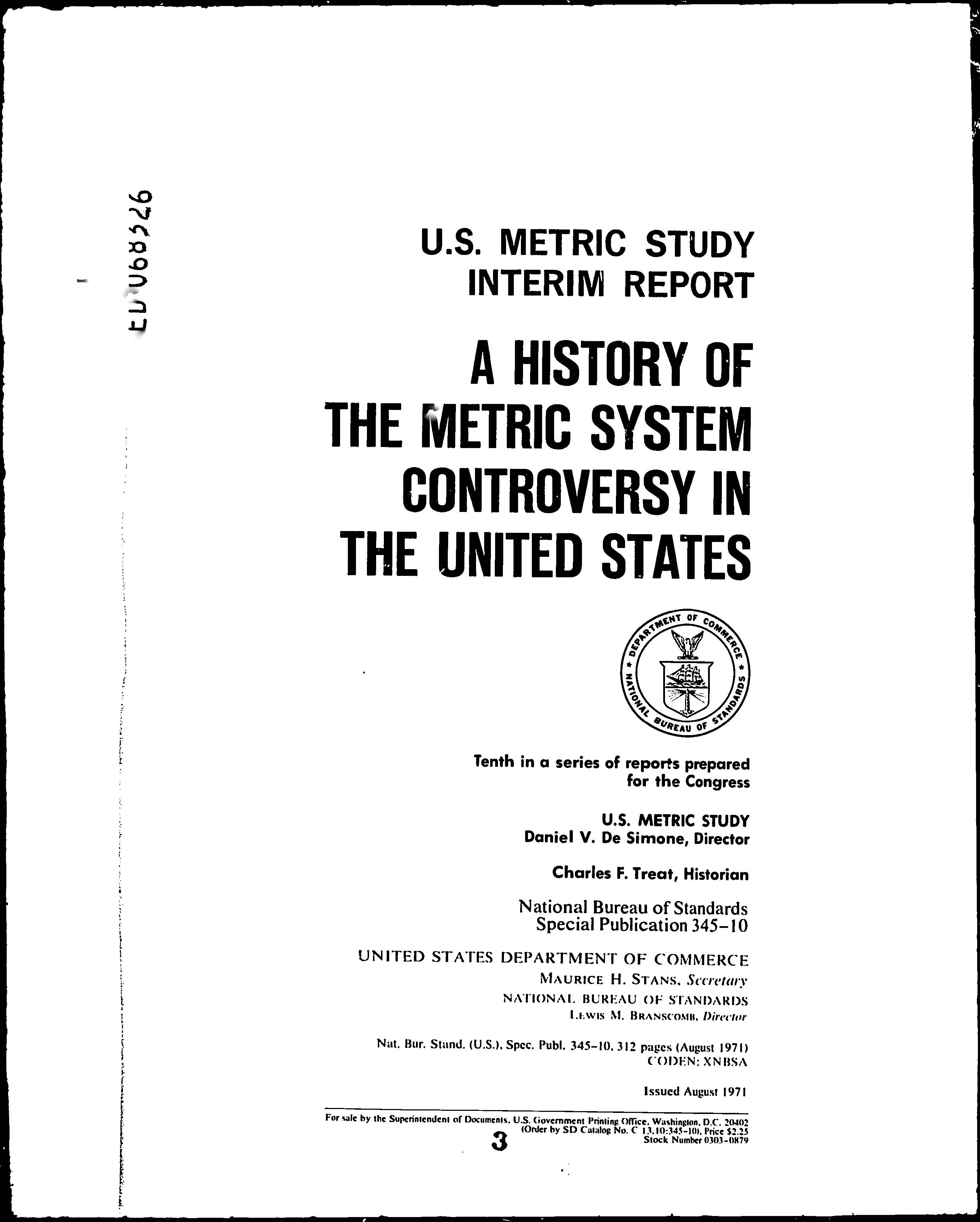
The latest Dan Brown novel? No, A History of the Metric System Controversy in the United States. This 1971 report, part of the U.S. Metric Study series and issued by the National Bureau of Standards (now NIST), is a serious account of a centuries-long battle to make the metric system America’s official standard of measurement. Lurking among the descriptions of John Quincy Adams’ Report on Weights and Measures and the advocacy of opposing positions by eminent scientists and educators, though, are some …unusual… episodes.

In the 1880’s, the International Institute for Preserving and Perfecting (Anglo-Saxon) Weights and Measures advocated both retention of the traditional measuring system and pyramidology – a belief that the Great Pyramid was a huge measuring device constructed by the Hebrews that also hid prophesies about the future. Despite this odd admixture of beliefs, the Institute proved to be an effective lobbying group in resisting the metric system. It also had a theme song: “A Pint’s a Pound the World Around.”

After World War I, Albert Herbert, a wealthy enthusiast, founded the World Trade Club, which despite its name was really a pro-metric lobbying organization. Herbert operated anonymously, so anti-metric forces quickly labeled him as the mysterious “Mr.Z.” The main opposition, the American Institute of Weights and Measures, also lobbied hard, with the aid of various manufacturing groups fearful of the expense of converting to metric. It inspired such articles as “What Real He-Men Think of the Compulsory Metric System.”

Also threaded through A History of the Metric System Controversy in the United States is the fear that the metric system is an alien one, inspired by the revolutionary French (post-World War I advocates of metric in turn claimed that the traditional system was a German invention). The author, Charles F. Treat, makes the interesting point that historically, enthusiasm for adopting the metric system tends to rise and fall with America’s international engagement or non-engagement.

This book, which takes the story though the late 1960’s, was published too soon to describe the failure of yet another attempt to adopt the metric system for America. Not for anyone without a really intense interest in the subject, it’s still extremely browseable and not without humor, especially when dealing with the topics I’ve been discussing. If you’d like to read it in PDF format, go here. If you’re interested in the movie rights, contact Government Book Talk!


Navy Medicine in Vietnam: Passage to Freedom to the Fall of Saigon

April 23, 2010

One of the goals of this blog is to review new Government publications as soon as we can, so people can find out about and, we hope, read them. Navy Medicine in Vietnam just hit my desk. It’s not a long book – around 52 pages. It provides an excellent overview of Navy medical activities in Vietnam from Passage to Freedom – the evacuation of Vietnamese from north to south after the 1954 Geneva Accords – to the collapse of South Vietnam in 1975. Along the way, there are brief descriptions of the work of hospitals,  hospital ships, Navy corpsmen, medevac, and more.

To me, the most fascinating parts of the book are the oral histories: the nurse in Saigon who came under fire during the coup against the Diem government, the grim recollections of another nurse on the staff of the navy Support Activity Hospital in Danang, and the amazingly modest statement of a corpsman who threw himself on a grenade (which amazingly did not detonate)to protect his patients, received a Congressional Medal of Honor and said, “It didn’t appear to me worthy of a general flying in and saying, ‘you’re a hero’.”

For sheer suspense, though, nothing tops “Dr. Dinsmore’s Souvenir”, a first-person account of a Navy surgeon who removed an unexploded 60mm mortar shell from the chest of a South Vietnamese soldier.  The X-ray of the patient has to be seen to be believed. Captain Dinsmore received the Navy Cross for this operation, but I wonder whether Engineman First Class John Lyons, who was the only other person in the operating room and safely detonated the mortar round afterward, got some recognition, too. It’s an amazing story.

You’ll find gripping reading, as well as an informative account of wartime medical activities, in Navy Medicine in Vietnam.


Clara Barton: Clara Barton National Historic Site, Maryland

April 21, 2010

It’s National Parks Week, which made me think about the National Park Service’s long-running Handbook series. Although I enjoy any and all national parks, I tend to seek out those with archaeological or historical connections. Research reveals that the Park Service began publishing its Historical Handbook series in 1949. Although the original handbooks in the series are out of print (you can find a list and cover images here), the series continues today.

A favorite of mine is the Clara Barton Historical Site and its accompanying Handbook. For one thing, the site is in Glen Echo, Maryland, which for residents of the Washington, DC area means Glen Echo Park, another favorite Park Service place. For years it was an amusement park, and remnants of those days remain, as does a carousel and a ballroom for dancing.  It’s worth a visit all by itself.

The Barton house presents quite a contrast. Originally built from timber scavenged from the Johnstown flood for use as a storage depot for Red Cross supplies, in 1897 it became both the headquarters of the American Red Cross and the home of its founder, Clara Barton. (Visiting the site on a hot summer day always makes me wonder what life was like in this rather humid area before air conditioning). The size of this 38-room house, the rooms themselves, and the dark pine paneling all conjure up life in a unique turn-of-the century home/office/volunteer center dedicated to helping victims of disaster at home and abroad.

The Clara Barton Handbook presents the story of the house, the person, and the organization concisely and lucidly. Like all of the Park Service handbooks, it’s also a quality product in design. If you’re planning a visit, or just want to learn more about this remarkable place, I’d recommend it.

You can find a list of Handbooks, including quite a few that cover historical parks, here.


Three Weeks of Government Book Talk

April 21, 2010

It’s the three-week anniversary of Government Book Talk. To mark this auspicious occasion, I thought I’d share some comments we’ve received since Day One, as well as some excellent questions about Federal Government publications and this blog – and what I hope are some useful answers.

Some comments:

 John Ahearn says: The site is excellent. I am pleased to the government being this responsive in its serving the public. Innovation is imperative if we are to keep up with the changes that we are all facing. Glad to see you take this step. Keep up the good work.

eric johnson says: I hope the freedom of information is never broken thank you GPO

Nydia Jacobs says: WOW! AWESOME! Welcome to 2010 and the future – GO GOV! Let God bless this site that we may truly become, “one nation under God”

Joe Harmon says: Neat blog.

Some questions and answers

Mimi asks: Will the blog posts keep coming to my email? I enjoy the blog, but don’t want to have to use a reader…I’d just like to keep reading the info via the email I already have to keep up with. Do I have to set something up to make sure the content will continue to be emailed to me? Thanks for help on this.

Govbooktalk answers: Good question! I have just added a blog subscription block so you can have posts emailed to you. Thanks for the suggestion.

chris decker asks: can i copy any work from g.p.o.?or do i need permission.

Govbooktalk answers: Here’s how GPO addresses this commonly asked question: The intent of Title 17, Section 105, United States Code, is to place in the public domain all works of the United States Government, defined as works “prepared by an officer or employee of the United States Government as part of that person’s official duties.”

This means that public documents can generally be reprinted without legal restriction. However, Government publications often contain certain copyright material which was used with permission of the copyright owner. Publication in a Government document does not authorize any use or appropriation of such copyright material without consent of the owner.

Since the Government Printing office serves as a printing and distribution agency for Government publications and has no jurisdiction over their content or subject matter, we suggest that you consult with the originating department or agency, or its successor, prior to the reprinting of any given publication.

Max Holland asks: Is there any reason why GPO publications are not sold in regular bookstores? A prohibition in law or regs?

Govbooktalk answers: Actually, commercial bookstores can sell Government publications. In the past, there have been some constraints that have limited us, but more recently we’ve been experimenting with more flexible terms and conditions. As a result, in a number of cases, at least one major bookstore chain has ordered books for resale. Let’s hope it’s a trend!

Barby asks: ARE WORDS AT BOTTOM OF THIS PAGE SUPPOSED TO READ “THEME CONTEMPT” INSTEAD OF “THEME CONTENT”?

Govbooktalk answers: Curiously enough, “Contempt” is actually the name of the template we’re using for the blog.


Just for Fun: Aunt Sammy’s Radio Recipes

April 19, 2010

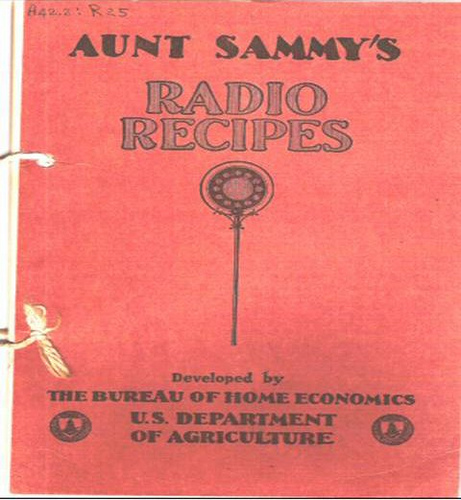
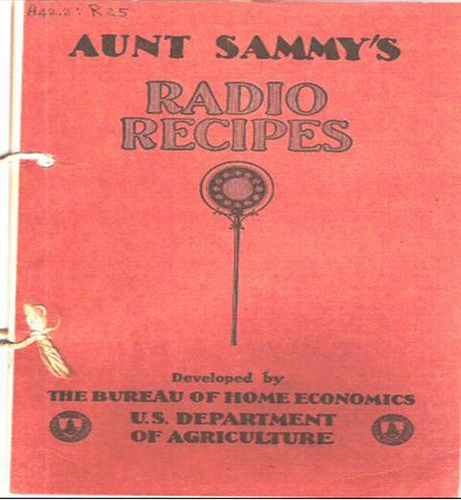
When I first got the idea to blog about Aunt Sammy’s Radio Recipes, I figured that I’d be shedding light on a totally forgotten Government publication. I remembered Aunt Sammy as the title character of an odd-sounding booklet that GPO was selling in my early days here. When I searched the Internet, though, she was everywhere. Cooking sites, old time radio sites, newspaper sites – who knew?

On October 4, 1926, the U.S. Department of Agriculture (USDA) Bureau of Home Economics and the Radio Service launched its Housekeeper’s Chat show, featuring Aunt Sammy – Uncle Sam’s wife, of course. In addition to meals and recipes, she talked about all kinds of other household matters, but it was the recipes that got listeners’ attention. In 1927 USDA put the most popular recipes into a pamphlet: Aunt Sammy’s Radio Recipes. According to the introduction to the 1976 USDA reprint (the one I remembered hearing about),  “The demand was so great that it had to be reprinted after only a month. ‘Aunt Sammy’s Radio Recipes’ was revised and enlarged three times between 1927 and 1931. In 1932 it became the first cookbook published in braille.”

Aunt Sammy vanished in 1934 and the show did likewise in 1946, yet her memory lingers on. I discovered that the 1931 edition has been reprinted by a private publisher and is still available. I like the 1976 edition, which you can find here, because it has contemporary recipes from USDA as well as some 1920’s favorites. It’s all what I think of as “hearty fare” or “comfort food” – definitely BA (before arugula). What with diners and such making a comeback, our Aunt Sammy may be more contemporary than we think. Maybe I’ll have meatloaf tonight…


Fun With the GPO Style Manual

April 15, 2010


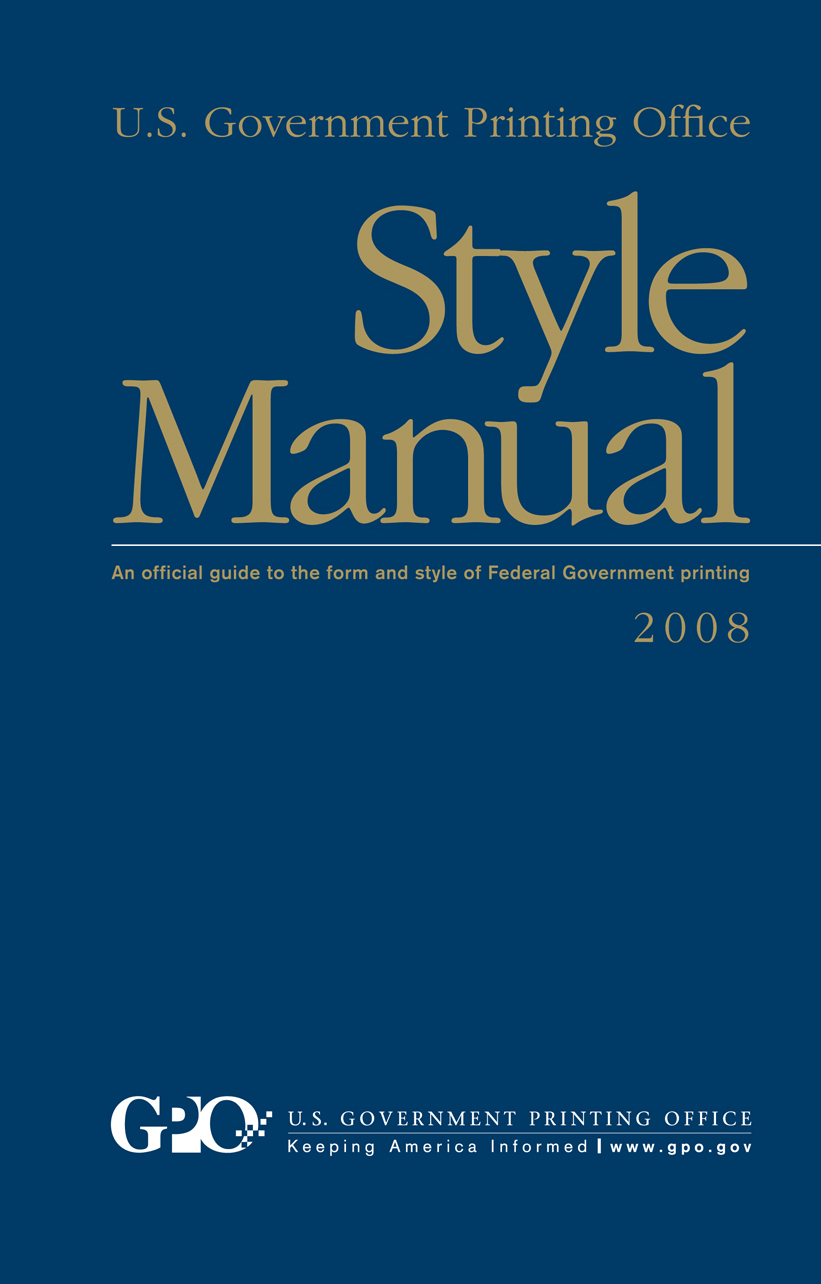
It’s National Library Week, which prompted me to think about my favorite Government reference book – the U.S. Government Printing Office Style Manual, which since 1894 has been the Federal Government’s  guide to form and style in printing and a standard reference for professionals in the field. Although I’ve used the Style Manual for years in a number of different jobs I’ve had at GPO, the real reason it’s my favorite is, I confess, that I’m a member of the GPO Style Board. For many months prior to the publication of the latest edition, our little group met for two hours each week to discuss spelling, capitalization, and the myriad of other details that collectively make up any book of this sort. The best part – it was a lot of fun. As one of the members said to me one day, “This is the high point of my week!” For a word person, spending time on this stuff was really a plum assignment. Some of my colleagues were old acquaintances, while others were new to me. The one thing they all had in common was a  depth of  knowledge and a dedication to producing the best possible product that was truly awesome. I also found out what a demonym is: “Demonym is a name given to a people or inhabitants of a place. ” (See Chapter 17, Useful Tables, Pages 332-334.)

My favorite new features of the 2008 edition: A list of information technology acronyms and initialisms; a chapter on capitalization  with totally updated examples of proper names (a lot of research went into this, believe me!); and a clean, contemporary new design and typeface, thanks to GPO Creative Services.

Despite my obvious bias in favor of the Style Manual, many other Government books and periodicals are worthy of inclusion in the library reference pantheon – you can find a few of them here.


URL Update

April 15, 2010

Effective today, the new URL for Government Book Talk is http://govbooktalk.gpo.gov. The old URL, https://govbooktalk.wordpress.com, will redirect to the new one. Thanks!


Nothing but Praise: A History of the 1321st Engineer General Service Regiment

April 12, 2010

When I drew up a list of possible blog topics, this new book from the Army Corps of Engineers was an obvious choice for someone like me, who likes to investigate less well- known historical subjects. There were three reasons for me to be interested. Although key to the success of any army, Engineer units tend to labor in the shade of more “glamorous” branches. Also, even though African-Americans made up the bulk of enlisted personnel in World War II-era engineer outfits, their accomplishments are even less well-known that those of the Corps overall. Finally, Nothing but Praise was written by the 1321st’s commanding officer, Aldo H. Bagnulo. It consists of his unpublished history of the unit, a diary he kept during the war, and an extensive array of photographs of  unit personnel and activities. (The book was carefully edited and annotated by Corps historian Michael J. Brodhead).

The 1321st was an Engineer General Service regiment, which means that its personnel were well-trained in the various building and engineering trades before deployment overseas. The regiment’s job was to build and maintain bridges, roads, and various structures needed to keep wartime supplies stored and supply lines moving. In the course of its service in France and Germany, from December 1944 until several months after Germany’s surrender, the 1321st worked diligently and well in all kinds of weather and quasi-combat conditions in highly creditable fashion, as documented by the receipt of the Bronze Star by six officers and nine enlisted men. Viewed from this perspective, Bagnulo sheds welcome light on the crucial but often neglected role of the Army Corps of Engineers in supporting the logistics of war.

Bagnulo’s treatment of the racial aspects of his command is intriguing. His unpublished manuscript never refers to race at all. Reading it out of the context of this published edition makes it sound like every other small military unit – the rigors of training, the weeding out of the less fit, the occasional wild party, terrible weather, back-breaking work, intense fear, and finally a feeling of accomplishment duly rewarded by official recognition of a job well done.

In his diary, Bagnulo does mention race a few times. It’s clear that, although a man of his time, he made a conscious effort to eschew prejudice. One issue he cites as productive of tension after V-E Day sprang from his African-American officers’ concern about fairness in promotion; Bagnulo strongly endorsed merit promotion in two meetings with them, which he seemed to think was helpful. He was clearly comfortable with addressing such issues head-on, which must have been unusual in those days.

In mid-1945, the 1321st shipped out to the Pacific theater, didn’t get there before the surrender of Japan, and spent several months building roads and bridges in Korea before demobilization. Afterward, Bagnulo had a long career in the Army and at NASA before retiring.

The verdict: A valuable read for anyone interested in the sinews of war and the story of  race relations in America. Nothing but Praise is available from GPO.

For more about the creation of Nothing but Praise, check out this Army Corps of Engineers video. Note: GPO’s Creative Services organization did a great job in designing this book.


Just for Fun: Sprocket Man!

April 9, 2010

Government Book Talk has had a busy couple of weeks getting up and running, so it’s time to kick back, relax,  and talk about one of the many unexplored corners of the world of Federal publications. Sprocket Man, the Consumer Product Safety Commission’s superhero for safe biking, began in 1975 as a comic book character created at Stanford University for the California  Department of Public Safety and the nonprofit Urban Bikeway Design Collaborative. Somewhere along the line, he and his comic books were picked up by the Commission. I know that the GPO sales program carried them at one time, although I don’t know if we sold them singly or in packages. (I checked, and we don’t sell them anymore).

Thanks to the depository library program, you can find Sprocket Man here. Although at first the idea of a superhero dedicated to bicycle safety seems a bit…overdone, I can see how he’s a good way to reach younger bikers. He’s pretty intense, but he gets his message across. Although a few comic buffs seem to scorn him, Sprocket Man is still available for download at a number of safety-oriented Web sites and for collectors at several comic book sites.

 Tune in next Friday for another trip down the one of the many byways of Government books, and don’t forget to wear your helmet!


Charley Harper Posters

April 7, 2010

It’s easy to become blasé about the things you deal with on the job. For years, I’ve been seeing a variety of National Park Service posters whose design was along similar lines. They depicted stylized birds and animals, evoking, at least for me, a sort of Native American sensibility. I admit, though, that this is more thought than I actually put into them. If asked, I would have surmised vaguely that the stylistic resemblance was due to some kind of “look” the Park Service was trying to achieve, rather than because they were the work of a particular artist.

Recently, we reprinted a number of these posters and our content acquisition staff kept referring to them as “Charley Harper” posters. Then we got an inquiry from the depository library side of the house about “Charley Harper” posters. My first response: Who’s he? Well, Charley Harper (1922-2007) was a noted American artist, particularly esteemed for his wildlife posters, prints, and illustrations in a style he described as “minimal realism.” He’s also an eminently collectible artist, so once again Government publications suddenly appear in a new guise,  far removed from the tired old stereotype.

These posters are sold by stores in the various national parks and also are available from GPO. It’s easy to pick them out! To see all of the posters and handbooks produced by our Park Service colleagues in Harpers Ferry, West Virginia, go here, where you’ll also find a link to the various parks associations that sell Park Service products.


Health Care Legislation Update

April 6, 2010

The other day I replied to a comment about the availability of the new health care law. Since then, we’ve received other questions, so I thought it might be helpful to provide the latest information we have available. First, GPO’s Federal Digital System (FDsys) has various documents here and printed copies are available for purchase here. The Congressional Record, V. 156, No. 43, Book 2, March 21, 2010 includes the text of the Patient Protection and Affordable Care Act.  Public Law 111-148, Patient Protection and Affordable Care Act, is being printed and is currently expected to be available around May 25. Public Law 111-152, Health Care and Education Reconciliation Act, which contains changes to the initial Act and provisions related to education, has just been submitted for printing. I hope this helps!